
The Book of Five Rings
Paperback
• 80 Pages
• INR 245.00
• English
• 9789354991202
No ratings yet
| Publisher | General Press |
|---|---|
| ISBN13 | 9789354991202 |
| ASIN/SKU | 9354991203 |
| Book Format | Paperback |
| Language | English |
| Pages | 80 |
| List Price | INR 245.00 |
| Subject Code | PHI005000, HIS021000, SPO027000, Node 16571 |
| Publishing Date | 01/10/2021 |
| Dimensions | 8.5 x 5.25 x 0.5 inches |
| Weight | 104 g |
| Book Code | BD00054770 |
Buy this Book
Amazon Stores
Ebook Stores
Other Stores
Discover The Book of Five Rings by Miyamoto Musashi. This book is published by General Press in Paperback format, ISBN 9789354991202, ASIN 9354991203, under Sports and Outdoors, Ethics and Morality, Japanese History.
Book Description
Written by legendary Japanese swordsman Miyamoto Musashi in 1645, 'The Book of Five Rings' is far more than a simple manual on sword fighting. At its heart, it is a profoundly human guide to mastering oneself and navigating the conflicts of life with grace and purpose.
Musashi divides his wisdom into five distinct rings: Earth, Water, Fire, Wind, and Void. The Book of Earth lays the groundwork, teaching us the importance of understanding our tools and building a solid, grounded foundation. In Water, we learn the vital value of fluidity and adaptability, reminding us that a rigid mind is easily broken. Fire addresses the heat of conflict, offering timeless strategies to remain calm and decisive when pressure mounts. The Book of Wind explores the necessity of understanding others; by actively studying different perspectives and outside traditions, we avoid becoming trapped in our own narrow viewpoints. Finally, the Book of Void touches on the sublime, describing a peaceful state of pure awareness where intuition flows without conscious effort or fear.
What makes Musashi’s work so deeply relatable centuries later is its immense practicality. He famously insisted that the true way of strategy applies to every single profession, from the carpenter to the general. By embracing gentle discipline, continuous practice, and an open mind, The Book of Five Rings invites us to approach our daily struggles not as brutal battles, but as profound opportunities for lifelong personal mastery and lasting inner peace.
Musashi divides his wisdom into five distinct rings: Earth, Water, Fire, Wind, and Void. The Book of Earth lays the groundwork, teaching us the importance of understanding our tools and building a solid, grounded foundation. In Water, we learn the vital value of fluidity and adaptability, reminding us that a rigid mind is easily broken. Fire addresses the heat of conflict, offering timeless strategies to remain calm and decisive when pressure mounts. The Book of Wind explores the necessity of understanding others; by actively studying different perspectives and outside traditions, we avoid becoming trapped in our own narrow viewpoints. Finally, the Book of Void touches on the sublime, describing a peaceful state of pure awareness where intuition flows without conscious effort or fear.
What makes Musashi’s work so deeply relatable centuries later is its immense practicality. He famously insisted that the true way of strategy applies to every single profession, from the carpenter to the general. By embracing gentle discipline, continuous practice, and an open mind, The Book of Five Rings invites us to approach our daily struggles not as brutal battles, but as profound opportunities for lifelong personal mastery and lasting inner peace.
Author Biography
Miyamoto Musashi (born Shinmen Takezō) remains one of Japan’s most legendary and revered historical figures. Widely celebrated as an unmatched swordsman and wandering rōnin, Musashi carved his name into history through a series of legendary, high-stakes duels. Astonishingly, his undefeated record began when he was just thirteen years old, setting the stage for a lifetime of relentless martial pursuit and self-perfection. Also known by his Buddhist name, Niten Dōraku, Musashi was far more than a mere warrior; he was a profound strategic thinker and a true innovator.
He famously founded the Hyōhō Niten Ichi-ryū (or Niten-ryū) school of swordsmanship, a highly distinctive martial art style renowned for its simultaneous use of both the long and short swords. However, Musashi’s most enduring legacy lies not on the battlefield, but in the wisdom he penned.
In his final years, he retreated to a remote cave to write 'The Book of Five Rings'. This masterwork of strategy, tactics, and philosophy transcended the samurai era. Today, it stands as a cornerstone text, avidly studied by martial artists, business leaders, and strategists worldwide who seek to apply Musashi’s timeless principles of mental mastery to their own lives.
He famously founded the Hyōhō Niten Ichi-ryū (or Niten-ryū) school of swordsmanship, a highly distinctive martial art style renowned for its simultaneous use of both the long and short swords. However, Musashi’s most enduring legacy lies not on the battlefield, but in the wisdom he penned.
In his final years, he retreated to a remote cave to write 'The Book of Five Rings'. This masterwork of strategy, tactics, and philosophy transcended the samurai era. Today, it stands as a cornerstone text, avidly studied by martial artists, business leaders, and strategists worldwide who seek to apply Musashi’s timeless principles of mental mastery to their own lives.
Editorial Reviews
• Time Magazine (1981 Business Review):
During the Japanese economic boom of the 1980s, Time reviewed the book's sudden massive popularity on Wall Street. The publication noted that American executives were reading it as a masterclass in ruthless corporate strategy, stating that Musashi's advice to "strike when the enemy is in a state of unreadiness" had become the new gospel for hostile takeovers and market competition.
• Joe Hyams (Author of Zen in the Martial Arts):
Hyams celebrated the book as the ultimate expression of Zen philosophy in action. He reviewed Musashi’s work as proof that true mastery requires the elimination of ego and hesitation, praising the book for showing how the physical technique of the sword is secondary to the mental state of the warrior.
• William Scott Wilson (Translator and Historian):
Wilson, another premier translator of the text, highlighted the raw, unpolished nature of Musashi's writing. He reviewed it as a uniquely grounded text, noting that unlike other samurai philosophers who wrote from comfortable bureaucratic positions, Musashi wrote from the perspective of a man who survived over sixty life-or-death duels, giving his words a stark, pragmatic authenticity.
• The New York Times (Cultural Retrospective):
Reflecting on the book's cultural impact, the Times reviewed its transition from a niche historical document to a staple of the "cutthroat 1980s corporate culture." However, the review critically noted that many Western businessmen completely stripped the text of its Zen spirituality, turning a profound study of mindfulness into a mere handbook for financial ruthlessness.
• Victor Harris (British Translator and Kendo Master):
In his 1974 translation, Harris emphasized the psychological depth of the text. He noted that Musashi's division of the book into Earth, Water, Fire, Wind, and Void perfectly maps the journey of a student from learning basic physical forms to achieving a state of complete spiritual emptiness (the Void), where action happens organically without conscious thought.
• Kenji Tokitsu (Martial Arts Historian and Author):
In Miyamoto Musashi: His Life and Writings, Tokitsu offered a highly critical, scholarly review of the text. He argued against the overly romanticized modern readings, pointing out that Musashi was a product of a deeply violent, transitional era in Japan, and that his writings must be understood as a survival mechanism in a world transitioning from constant war to enforced peace under the Tokugawa shogunate.
• George Lois (Famed American Art Director and Ad Man):
Lois famously kept the book on his desk and recommended it as a bible for the advertising industry. He reviewed the concept of "perceiving those things which cannot be seen" as the ultimate secret to creative marketing, applying Musashi's combat timing to the fast-paced world of Madison Avenue.
• The Harvard Business Review (On Japanese Strategy):
In analytical pieces comparing Eastern and Western management styles, HBR contributors have frequently cited the book. They review Musashi’s emphasis on continuous adaptation (moving like "Water") as a stark contrast to rigid Western strategic planning, noting that Musashi teaches agility and responsiveness over fixed doctrine.
• Eiji Yoshikawa (Author of the epic novel Musashi):
While writing the definitive fictionalized account of Musashi's life (which sold over 120 million copies), Yoshikawa reviewed The Book of Five Rings as the ultimate culmination of a wild beast becoming a serene sage. He saw the book as the literary proof of Musashi's spiritual redemption.
• Thomas Cleary (Acclaimed Translator and Scholar):
In his widely read translation, Cleary noted that Musashi's approach to the sword is ultimately an approach to life: "The Book of Five Rings is not just a book about martial arts, but a guide to the strategy of dealing with conflict and competition in every area of human life."
During the Japanese economic boom of the 1980s, Time reviewed the book's sudden massive popularity on Wall Street. The publication noted that American executives were reading it as a masterclass in ruthless corporate strategy, stating that Musashi's advice to "strike when the enemy is in a state of unreadiness" had become the new gospel for hostile takeovers and market competition.
• Joe Hyams (Author of Zen in the Martial Arts):
Hyams celebrated the book as the ultimate expression of Zen philosophy in action. He reviewed Musashi’s work as proof that true mastery requires the elimination of ego and hesitation, praising the book for showing how the physical technique of the sword is secondary to the mental state of the warrior.
• William Scott Wilson (Translator and Historian):
Wilson, another premier translator of the text, highlighted the raw, unpolished nature of Musashi's writing. He reviewed it as a uniquely grounded text, noting that unlike other samurai philosophers who wrote from comfortable bureaucratic positions, Musashi wrote from the perspective of a man who survived over sixty life-or-death duels, giving his words a stark, pragmatic authenticity.
• The New York Times (Cultural Retrospective):
Reflecting on the book's cultural impact, the Times reviewed its transition from a niche historical document to a staple of the "cutthroat 1980s corporate culture." However, the review critically noted that many Western businessmen completely stripped the text of its Zen spirituality, turning a profound study of mindfulness into a mere handbook for financial ruthlessness.
• Victor Harris (British Translator and Kendo Master):
In his 1974 translation, Harris emphasized the psychological depth of the text. He noted that Musashi's division of the book into Earth, Water, Fire, Wind, and Void perfectly maps the journey of a student from learning basic physical forms to achieving a state of complete spiritual emptiness (the Void), where action happens organically without conscious thought.
• Kenji Tokitsu (Martial Arts Historian and Author):
In Miyamoto Musashi: His Life and Writings, Tokitsu offered a highly critical, scholarly review of the text. He argued against the overly romanticized modern readings, pointing out that Musashi was a product of a deeply violent, transitional era in Japan, and that his writings must be understood as a survival mechanism in a world transitioning from constant war to enforced peace under the Tokugawa shogunate.
• George Lois (Famed American Art Director and Ad Man):
Lois famously kept the book on his desk and recommended it as a bible for the advertising industry. He reviewed the concept of "perceiving those things which cannot be seen" as the ultimate secret to creative marketing, applying Musashi's combat timing to the fast-paced world of Madison Avenue.
• The Harvard Business Review (On Japanese Strategy):
In analytical pieces comparing Eastern and Western management styles, HBR contributors have frequently cited the book. They review Musashi’s emphasis on continuous adaptation (moving like "Water") as a stark contrast to rigid Western strategic planning, noting that Musashi teaches agility and responsiveness over fixed doctrine.
• Eiji Yoshikawa (Author of the epic novel Musashi):
While writing the definitive fictionalized account of Musashi's life (which sold over 120 million copies), Yoshikawa reviewed The Book of Five Rings as the ultimate culmination of a wild beast becoming a serene sage. He saw the book as the literary proof of Musashi's spiritual redemption.
• Thomas Cleary (Acclaimed Translator and Scholar):
In his widely read translation, Cleary noted that Musashi's approach to the sword is ultimately an approach to life: "The Book of Five Rings is not just a book about martial arts, but a guide to the strategy of dealing with conflict and competition in every area of human life."
Book Summary
Written in the solitary confines of a cave in 1645 just weeks before his death, Miyamoto Musashi’s "The Book of Five Rings" is a seminal masterpiece of martial arts philosophy and strategic thinking. Musashi was an undefeated Japanese ronin, a wandering samurai who fought and won over sixty lethal duels during his lifetime. Rather than merely offering a technical manual on swordsmanship, he distilled a lifetime of brutal, practical experience into a profound philosophical treatise. He founded the Ni-Ten Ichi Ryu, or the "Two Heavens as One" school, which advocated the pragmatic use of both the long and short swords simultaneously. However, the true brilliance of the book lies in its universality; Musashi’s principles of combat are fundamentally principles of conflict resolution, making the text as revered by modern business leaders and strategists as it is by martial artists. The text is divided into five distinct "scrolls"—Earth, Water, Fire, Wind, and Void—each representing a different element of physical and psychological mastery.
The first section, the Book of Earth, lays the philosophical and practical groundwork for Musashi’s approach to strategy. He uses the metaphor of a master carpenter constructing a house to illustrate how a warrior must build his foundation. A master carpenter must deeply understand his tools, the nature of his materials, the capabilities of his workers, and the overall design of the structure before a single nail is driven. Similarly, a strategist must understand the lay of the land, the flow of timing, and the fundamental rules of engagement. Musashi emphasizes that true strategy relies on an unshakeable foundation built through relentless, repetitive practice. There are no shortcuts in his philosophy; one must intimately know the smallest details of their craft to comprehend the largest, overarching concepts, cultivating a broad perspective that sees the forest and the trees simultaneously.
Within this grounding element of Earth, Musashi places a heavy emphasis on the concept of timing, which he argues is the most critical component of any endeavor. Timing exists in all things—in the rising and falling of fortunes, in the rhythm of a dance, and crucially, in the striking and blocking of a sword. Recognizing the opponent's timing and intentionally disrupting it is the key to gaining the upper hand. Furthermore, the Book of Earth insists on total, unwavering commitment to the chosen path. Musashi warns against dabbling or superficial learning; the Way of the warrior requires a person to polish their skills constantly and resolve to overcome any obstacle. This resolute mindset is the bedrock upon which all other techniques and elements of his philosophy are constructed, ensuring that when chaos ensues, the foundation holds firm.
Moving from the rigid foundation, the Book of Water explores the necessity of extreme adaptability, focusing on the warrior's physical stance, gaze, and, most importantly, state of mind. Musashi argues that a combatant's spirit must be like water: formless, fluid, and capable of taking the shape of whatever container it enters. Whether a tiny stream or a raging ocean, water retains its essential nature while completely adapting to its environment. In battle, a warrior’s mind must remain perfectly calm and undisturbed—like the still surface of a pond—even in the midst of extreme violence and chaos. This emotional detachment prevents fear, anger, or anticipation from clouding judgment, allowing the warrior to react spontaneously and appropriately to the reality of the situation rather than their preconceived expectations of it.
Beyond the philosophical mindset, the Book of Water details the specific mechanics of Musashi’s fighting style, though always tied back to the concept of fluidity. He discusses the proper way to hold a sword, emphasizing a grip that is relaxed but ready, avoiding the rigid tension that slows down movement. He explains footwork and body posture, insisting that the way one stands in everyday life should be the same as the way one stands in battle. This erasure of the line between normal life and combat ensures that the warrior is never caught off guard. By mastering these fluid physical techniques until they become entirely second nature, the practitioner can strike without conscious thought, flowing around an opponent's defenses just as water effortlessly flows around a rock in a stream.
The Book of Fire transitions into the active heat of battle, examining the direct friction of conflict and the chaotic environment where two opposing forces meet. Unlike the fluid and calm nature of water, fire is fierce, sudden, and entirely focused on consuming its fuel. This scroll teaches the art of taking the initiative and dominating the encounter through overwhelming presence and strategic positioning. Musashi breaks down the various ways to seize the advantage, whether by initiating the attack, preempting the enemy’s strike, or turning the opponent's own aggressive momentum against them. A crucial component of this fiery approach is environmental awareness; the warrior must constantly maneuver to force the sun, the terrain, or physical obstacles into the enemy's eyes or path, thereby blinding them or restricting their movement.
Equally important in the Book of Fire is the psychological warfare necessary to break an opponent's spirit before a physical blow is even landed. Musashi describes techniques for "crushing" an enemy, making themselves appear larger and more intimidating, and recognizing the exact moment when the opponent's resolve begins to collapse. He speaks of "crossing at a ford," a metaphor for recognizing the critical moment to commit entirely to a decisive action, knowing when the enemy is vulnerable. Feints, sudden changes in tempo, and the calculated use of loud noises are all tools to unsettle the adversary. The goal of Fire is absolute destruction of the enemy’s will and capability to fight, achieving victory by controlling the pace, location, and emotional temperature of the engagement.
The fourth section, the Book of Wind, takes a unique analytical turn by shifting focus away from Musashi's own school to examine the traditions and techniques of rival martial arts styles. "Wind" in this context refers to the traditions, styles, or "airs" of other schools. Musashi argues that one cannot truly understand their own strengths and weaknesses without deeply analyzing the competition. He critiques other schools for relying heavily on overly complex, flashy techniques, unnecessarily long or short swords, or rigid, codified rules that look impressive in a dojo but fail in the unpredictable grit of actual combat. By dissecting these flawed approaches, Musashi reinforces his own philosophy of extreme pragmatism, reminding the reader that the sole, unfiltered purpose of martial arts is to cut down the enemy and survive, not to perform elegant, theatrical movements.
The final and most esoteric section is the Book of the Void, which represents the ultimate pinnacle of a warrior's spiritual and technical development. The Void is the concept of emptiness, representing that which cannot be seen, quantified, or understood through mere intellect. For a martial artist, reaching the Void means achieving a state of "no-mind" (mushin), where years of relentless practice and hard-won experience completely internalize all strategy and technique. In this state, there is no conscious thought about how to hold the sword, how to step, or what the enemy will do next. The warrior simply exists in the present moment, reacting to attacks naturally, spontaneously, and perfectly. It is a paradoxical state where absolute emptiness gives birth to limitless potential, and where the self dissolves completely into the action of the duel.
In the end, "The Book of Five Rings" is much more than a historical artifact or a guide to lethal swordsmanship; it is a profound philosophical roadmap for self-mastery. Musashi’s journey through Earth, Water, Fire, Wind, and Void is a metaphor for human development, moving from rigid, conscious learning to a state of enlightened, effortless action. The core message demands a relentless dedication to one’s craft, the stripping away of all that is superficial, and a commitment to objective, pragmatic truth over comfortable illusions. By mastering the self, controlling the mind, and understanding the universal rhythms of conflict, Musashi argues that one can overcome any opponent or obstacle. It is this enduring wisdom, forged in the fires of life-or-death combat, that ensures Musashi’s teachings continue to resonate powerfully across centuries and disciplines.
The first section, the Book of Earth, lays the philosophical and practical groundwork for Musashi’s approach to strategy. He uses the metaphor of a master carpenter constructing a house to illustrate how a warrior must build his foundation. A master carpenter must deeply understand his tools, the nature of his materials, the capabilities of his workers, and the overall design of the structure before a single nail is driven. Similarly, a strategist must understand the lay of the land, the flow of timing, and the fundamental rules of engagement. Musashi emphasizes that true strategy relies on an unshakeable foundation built through relentless, repetitive practice. There are no shortcuts in his philosophy; one must intimately know the smallest details of their craft to comprehend the largest, overarching concepts, cultivating a broad perspective that sees the forest and the trees simultaneously.
Within this grounding element of Earth, Musashi places a heavy emphasis on the concept of timing, which he argues is the most critical component of any endeavor. Timing exists in all things—in the rising and falling of fortunes, in the rhythm of a dance, and crucially, in the striking and blocking of a sword. Recognizing the opponent's timing and intentionally disrupting it is the key to gaining the upper hand. Furthermore, the Book of Earth insists on total, unwavering commitment to the chosen path. Musashi warns against dabbling or superficial learning; the Way of the warrior requires a person to polish their skills constantly and resolve to overcome any obstacle. This resolute mindset is the bedrock upon which all other techniques and elements of his philosophy are constructed, ensuring that when chaos ensues, the foundation holds firm.
Moving from the rigid foundation, the Book of Water explores the necessity of extreme adaptability, focusing on the warrior's physical stance, gaze, and, most importantly, state of mind. Musashi argues that a combatant's spirit must be like water: formless, fluid, and capable of taking the shape of whatever container it enters. Whether a tiny stream or a raging ocean, water retains its essential nature while completely adapting to its environment. In battle, a warrior’s mind must remain perfectly calm and undisturbed—like the still surface of a pond—even in the midst of extreme violence and chaos. This emotional detachment prevents fear, anger, or anticipation from clouding judgment, allowing the warrior to react spontaneously and appropriately to the reality of the situation rather than their preconceived expectations of it.
Beyond the philosophical mindset, the Book of Water details the specific mechanics of Musashi’s fighting style, though always tied back to the concept of fluidity. He discusses the proper way to hold a sword, emphasizing a grip that is relaxed but ready, avoiding the rigid tension that slows down movement. He explains footwork and body posture, insisting that the way one stands in everyday life should be the same as the way one stands in battle. This erasure of the line between normal life and combat ensures that the warrior is never caught off guard. By mastering these fluid physical techniques until they become entirely second nature, the practitioner can strike without conscious thought, flowing around an opponent's defenses just as water effortlessly flows around a rock in a stream.
The Book of Fire transitions into the active heat of battle, examining the direct friction of conflict and the chaotic environment where two opposing forces meet. Unlike the fluid and calm nature of water, fire is fierce, sudden, and entirely focused on consuming its fuel. This scroll teaches the art of taking the initiative and dominating the encounter through overwhelming presence and strategic positioning. Musashi breaks down the various ways to seize the advantage, whether by initiating the attack, preempting the enemy’s strike, or turning the opponent's own aggressive momentum against them. A crucial component of this fiery approach is environmental awareness; the warrior must constantly maneuver to force the sun, the terrain, or physical obstacles into the enemy's eyes or path, thereby blinding them or restricting their movement.
Equally important in the Book of Fire is the psychological warfare necessary to break an opponent's spirit before a physical blow is even landed. Musashi describes techniques for "crushing" an enemy, making themselves appear larger and more intimidating, and recognizing the exact moment when the opponent's resolve begins to collapse. He speaks of "crossing at a ford," a metaphor for recognizing the critical moment to commit entirely to a decisive action, knowing when the enemy is vulnerable. Feints, sudden changes in tempo, and the calculated use of loud noises are all tools to unsettle the adversary. The goal of Fire is absolute destruction of the enemy’s will and capability to fight, achieving victory by controlling the pace, location, and emotional temperature of the engagement.
The fourth section, the Book of Wind, takes a unique analytical turn by shifting focus away from Musashi's own school to examine the traditions and techniques of rival martial arts styles. "Wind" in this context refers to the traditions, styles, or "airs" of other schools. Musashi argues that one cannot truly understand their own strengths and weaknesses without deeply analyzing the competition. He critiques other schools for relying heavily on overly complex, flashy techniques, unnecessarily long or short swords, or rigid, codified rules that look impressive in a dojo but fail in the unpredictable grit of actual combat. By dissecting these flawed approaches, Musashi reinforces his own philosophy of extreme pragmatism, reminding the reader that the sole, unfiltered purpose of martial arts is to cut down the enemy and survive, not to perform elegant, theatrical movements.
The final and most esoteric section is the Book of the Void, which represents the ultimate pinnacle of a warrior's spiritual and technical development. The Void is the concept of emptiness, representing that which cannot be seen, quantified, or understood through mere intellect. For a martial artist, reaching the Void means achieving a state of "no-mind" (mushin), where years of relentless practice and hard-won experience completely internalize all strategy and technique. In this state, there is no conscious thought about how to hold the sword, how to step, or what the enemy will do next. The warrior simply exists in the present moment, reacting to attacks naturally, spontaneously, and perfectly. It is a paradoxical state where absolute emptiness gives birth to limitless potential, and where the self dissolves completely into the action of the duel.
In the end, "The Book of Five Rings" is much more than a historical artifact or a guide to lethal swordsmanship; it is a profound philosophical roadmap for self-mastery. Musashi’s journey through Earth, Water, Fire, Wind, and Void is a metaphor for human development, moving from rigid, conscious learning to a state of enlightened, effortless action. The core message demands a relentless dedication to one’s craft, the stripping away of all that is superficial, and a commitment to objective, pragmatic truth over comfortable illusions. By mastering the self, controlling the mind, and understanding the universal rhythms of conflict, Musashi argues that one can overcome any opponent or obstacle. It is this enduring wisdom, forged in the fires of life-or-death combat, that ensures Musashi’s teachings continue to resonate powerfully across centuries and disciplines.
Sample Chapters
Chapter 1 : The Ground Book
Strategy is the craft of the warrior. Commanders must enact the craft, and troopers should know this Way. There is no warrior in the world today who really understands the Way of Strategy.
There are various Ways. There is the Way of salvation by the law of Buddha, the Way of Confucius governing the Way of learning, the Way of healing as a doctor, as a poet teaching the Way of Waka, tea, archery, and many arts and skills. Each man practices as he feels inclined. It is said the warrior’s is the twofold Way of pen and sword, and he should have a taste for both Ways.
Even if a man has no natural ability he can be a warrior by sticking assiduously to both divisions of the Way. Generally speaking, the Way of the warrior is resolute acceptance of death. Although not only warriors but priests, women, peasants and lowlier folk have been known to die readily in the cause of duty or out of shame, this is a different thing. The warrior is different in that studying the Way of Strategy is based on overcoming men. By victory gained in crossing swords with individuals, or enjoining battle with large numbers, we can attain power and fame for ourselves or our lord. This is the virtue of strategy.
The Way of Strategy
In China and Japan practitioners of the Way have been known as “masters of strategy.” Warriors must learn this Way.
Recently there have been people getting on in the world as strategists, but they are usually just sword-fencers. The attendants of the Kashima Kantori shrines of the province Hitachi received instruction from the gods, and made schools based on this teaching, travelling from country to country instructing men. This is the recent meaning of strategy.
In olden times strategy was listed among the Ten Abilities and Seven Arts as a beneficial practice. It was certainly an art but as a beneficial practice it was not limited to sword-fencing. The true value of sword-fencing cannot be seen within the confines of sword-fencing technique.
If we look at the world we see arts for sale. Men use equipment to sell their own selves. As if with the nut and the flower, the nut has become less than the flower. In this kind of Way of Strategy, both those teaching and those learning the way are concerned with colouring and showing off their technique, trying to hasten the bloom of the flower. They speak of “This Dojo” and “That Dojo.” They are looking for profit. Someone once said “Immature strategy is the cause of grief.” That was a true saying.
There are four Ways in which men pass through life: as gentlemen, farmers, artisans and merchants.
The Way of the farmer. Using agricultural instruments, he sees springs through to autumns with an eye on the changes of season.
Second is the Way of the merchant. The wine maker obtains his ingredients and puts them to use to make his living. The Way of the merchant is always to live by taking profit. This is the Way of the merchant.
Thirdly the gentleman warrior, carrying the weaponry of his Way. The Way of the warrior is to master the virtue of his weapons. If a gentleman dislikes strategy he will not appreciate the benefit of weaponry, so must he not have a little taste for this? Fourthly the Way of the artisan. The Way of the carpenter is to become proficient in the use of his tools, first to lay his plans with a true measure and then perform his work according to plan. Thus he passes through life. These are the four Ways of the gentleman, the farmer, the artisan and the merchant.
Comparing the Way of the Carpenter to Strategy
The comparison with carpentry is through the connection with houses. Houses of the nobility, houses of warriors, the four houses, ruin of houses, thriving of houses, the style of the house, the tradition of the house, and the name of the house. The carpenter uses a master plan of the building, and the Way of Strategy is similar in that there is a plan of campaign. If you want to learn the craft of war, ponder over this book. The teacher is as a needle, the disciple is as thread. You must practice constantly.
Like the foreman carpenter, the commander must know natural rules, and the rules of the country, and the rules of houses. This is the Way of the foreman.
The foreman carpenter must know the architectural theory of towers and temples, and the plans of palaces, and must employ men to raise up houses. The Way of the foreman carpenter is the same as the Way of the commander of a warrior house. In the construction of houses, choice of woods is made.
Straight un-knotted timber of good appearance is used for the revealed pillars, straight timber with small defects is used for the inner pillars. Timbers of the finest appearance, even if a little weak, is used for the thresholds, lintels, doors, and sliding doors, and so on. Good strong timber, though it be gnarled and knotted, can always be used discreetly in construction. Timber which is weak or knotted throughout should be used as scaffolding, and later for firewood.
The foreman carpenter allots his men work according to their ability. Floor layers, makers of sliding doors, thresholds and lintels, ceilings and so on. Those of poor ability lay the floor joists, and those of lesser ability carve wedges and do such miscellaneous work. If the foreman knows and deploys his men well the finished work will be good. The foreman should take into account the abilities and limitations of his men, circulating among them and asking nothing unreasonable. He should know their morale and spirit, and encourage them when necessary. This is the same as the principle of strategy.
The Way of Strategy
Like a trooper, the carpenter sharpens his own tools. He carries his equipment in his tool box, and works under the direction of his foreman. He makes columns and girders with an axe, shapes floorboards and shelves with a plane, cuts fine openwork and carvings accurately, giving as excellent a finish as his skill will allow. This is the craft of the carpenters. When the carpenter becomes skilled and understands measures he can become a foreman.
The carpenter’s attainment is, having tools which will cut well, to make small shrines, writing shelves, tables, paper lanterns, chopping boards and pot lids. These are the specialties of the carpenter. Things are similar for the trooper. You ought to think deeply about this.
The attainment of the carpenter is that his work is not warped, that the joints are not misaligned, and that the work is truly planed so that it meets well and is not merely finished in sections. This is essential. If you want to learn this Way, deeply consider the things written in this book one at a time. You must do sufficient research.
Outline of the Five Books of this Book of Strategy
The Way is shown as five books concerning different aspects. These are Ground, Water, Fire, Wind (tradition), and Void (the illusionary nature of worldly things)
The body of the Way of Strategy from the viewpoint of my Ichi school is explained in the Ground book. It is difficult to realize the true Way just through sword-fencing. Know the smallest things and the biggest things, the shallowest things and the deepest things. As if it were a straight road mapped out on the ground, the first book is called the Ground book.
Second is the Water book. With water as the basis, the spirit becomes like water. Water adopts the shape of its receptacle, it is sometimes a trickle and sometimes a wild sea. Water has a clear blue colour. By the clarity, things of Ichi school are shown in this book. If you master the principles of sword-fencing, when you freely beat one man, you beat any man in the world. The spirit of defeating a man is the same for ten million men. The strategist makes small things into big things, like building a great Buddha from a one foot model. I cannot write in detail how this is done. The principle of strategy is having one thing, to know ten thousand things. Things of Ichi school are written in this the Water book.
Third is the Fire book. This book is about fighting. The spirit of fire is fierce, whether the fire be small or big; and so it is with battles. The Way of battles is the same for man to man fights and for ten thousand a side battles. You must appreciate that spirit can become big or small. What is big is easy to perceive: what is small is difficult to perceive. In short, it is difficult for large numbers of men to change position, so their movements can be easily predicted. An individual can easily change his mind, so his movements are difficult to predict. You must appreciate this. The essence of this book is that you must train day and night in order to make quick decisions. In strategy it is necessary to treat training as part of normal life with your spirit unchanging. Thus combat in battle is described in the Fire book.
Fourthly the Wind book. This book is not concerned with my Ichi school but with other schools of strategy. By Wind I mean old traditions, present-day traditions, and family traditions of strategy. Thus I clearly explain the strategies of the world. This is tradition. It is difficult to know yourself if you do not know others. To all Ways there are side-tracks. If you study a Way daily, and your spirit diverges, you may think you are obeying a good Way but objectively it is not the true Way. If you are following the true way and diverge a little, this will later become a large divergence. You must realize this. Other strategies have come to be thought of as mere sword-fencing, and it is not unreasonable that this should be so. The benefit of my strategy, although it includes sword-fencing, lies in a separate principle. I have explained what is commonly meant by strategy in other schools in the Tradition (Wind) book.
Fifthly, the book of the Void. By void I mean that which has no beginning and no end. Attaining this principle means not attaining the principle. The Way of strategy is the Way of nature. When you appreciate the power of nature, knowing rhythm of any situation, you will be able to hit the enemy naturally and strike naturally. All this is the Way of the Void. I intend to show how to follow the true Way according to nature in the book of the Void.
The Name Ichi Ryu Ni To (One school – two swords)
Warriors, both commanders and troopers, carry two swords at their belt. In olden times these were called the long sword and the sword; nowadays they are known as the sword and the companion sword. Let it suffice to say that in our land, whatever the reason, a warrior carries two swords at his belt. It is the Way of the warrior.
“Nito Ichi Ryu” shows the advantages of using both swords.
The spear and the halberd are weapons which are carried out of doors. Students of the Ichi school Way of Strategy should train from the start with the sword and the long sword in either hand. This is a truth: when you sacrifice your life, you must make fullest use of your weaponry. It is false not to do so, and to die with a weapon yet undrawn.
If you hold a sword with both hands, it is difficult to wield it freely to left and right, so my method is to carry the sword in one hand. This does not apply to large weapons such as the spear or halberd, but swords and companion swords can be carried in one hand. It is encumbering to hold a sword in both hands when you are on horseback, when running on un-even roads, on swampy ground, muddy rice fields, stony ground, or in a crowd of people. To hold the long sword in both hands is not the true Way, for if you carry a bow or spear or other arms in your left hand you have only one hand free for the long sword. However, when it is difficult to cut an enemy down with one hand, you must use both hands. It is not difficult to wield a sword in one hand; the Way to learn this is to train with two long swords, one in each hand. It will seem difficult at first, but everything is difficult at first. Bows are difficult to draw, halberds are difficult to wield; as you become accustomed to the bow so your pull will become stronger. When you become used to wielding the long sword, you will gain the power of the Way and wield the sword well.
As I will explain in the second book, the Water Book, there is no fast way of wielding the long sword. The long sword should be wielded broadly and the companion sword closely. This is the first thing to realize.
According to this Ichi school, you can win with a long weapon, and yet you can also win with a short weapon. In short, the Way of the Ichi school is the spirit of winning, whatever the weapon and whatever its size.
It is better to use two swords rather than one when you are fighting a crowd, and especially if you want to take a prisoner.
These things cannot be explained in detail. From one thing, know ten thousand things. When you attain the Way of Strategy there will not be one thing you cannot see. You must study hard.
Strategy is the craft of the warrior. Commanders must enact the craft, and troopers should know this Way. There is no warrior in the world today who really understands the Way of Strategy.
There are various Ways. There is the Way of salvation by the law of Buddha, the Way of Confucius governing the Way of learning, the Way of healing as a doctor, as a poet teaching the Way of Waka, tea, archery, and many arts and skills. Each man practices as he feels inclined. It is said the warrior’s is the twofold Way of pen and sword, and he should have a taste for both Ways.
Even if a man has no natural ability he can be a warrior by sticking assiduously to both divisions of the Way. Generally speaking, the Way of the warrior is resolute acceptance of death. Although not only warriors but priests, women, peasants and lowlier folk have been known to die readily in the cause of duty or out of shame, this is a different thing. The warrior is different in that studying the Way of Strategy is based on overcoming men. By victory gained in crossing swords with individuals, or enjoining battle with large numbers, we can attain power and fame for ourselves or our lord. This is the virtue of strategy.
The Way of Strategy
In China and Japan practitioners of the Way have been known as “masters of strategy.” Warriors must learn this Way.
Recently there have been people getting on in the world as strategists, but they are usually just sword-fencers. The attendants of the Kashima Kantori shrines of the province Hitachi received instruction from the gods, and made schools based on this teaching, travelling from country to country instructing men. This is the recent meaning of strategy.
In olden times strategy was listed among the Ten Abilities and Seven Arts as a beneficial practice. It was certainly an art but as a beneficial practice it was not limited to sword-fencing. The true value of sword-fencing cannot be seen within the confines of sword-fencing technique.
If we look at the world we see arts for sale. Men use equipment to sell their own selves. As if with the nut and the flower, the nut has become less than the flower. In this kind of Way of Strategy, both those teaching and those learning the way are concerned with colouring and showing off their technique, trying to hasten the bloom of the flower. They speak of “This Dojo” and “That Dojo.” They are looking for profit. Someone once said “Immature strategy is the cause of grief.” That was a true saying.
There are four Ways in which men pass through life: as gentlemen, farmers, artisans and merchants.
The Way of the farmer. Using agricultural instruments, he sees springs through to autumns with an eye on the changes of season.
Second is the Way of the merchant. The wine maker obtains his ingredients and puts them to use to make his living. The Way of the merchant is always to live by taking profit. This is the Way of the merchant.
Thirdly the gentleman warrior, carrying the weaponry of his Way. The Way of the warrior is to master the virtue of his weapons. If a gentleman dislikes strategy he will not appreciate the benefit of weaponry, so must he not have a little taste for this? Fourthly the Way of the artisan. The Way of the carpenter is to become proficient in the use of his tools, first to lay his plans with a true measure and then perform his work according to plan. Thus he passes through life. These are the four Ways of the gentleman, the farmer, the artisan and the merchant.
Comparing the Way of the Carpenter to Strategy
The comparison with carpentry is through the connection with houses. Houses of the nobility, houses of warriors, the four houses, ruin of houses, thriving of houses, the style of the house, the tradition of the house, and the name of the house. The carpenter uses a master plan of the building, and the Way of Strategy is similar in that there is a plan of campaign. If you want to learn the craft of war, ponder over this book. The teacher is as a needle, the disciple is as thread. You must practice constantly.
Like the foreman carpenter, the commander must know natural rules, and the rules of the country, and the rules of houses. This is the Way of the foreman.
The foreman carpenter must know the architectural theory of towers and temples, and the plans of palaces, and must employ men to raise up houses. The Way of the foreman carpenter is the same as the Way of the commander of a warrior house. In the construction of houses, choice of woods is made.
Straight un-knotted timber of good appearance is used for the revealed pillars, straight timber with small defects is used for the inner pillars. Timbers of the finest appearance, even if a little weak, is used for the thresholds, lintels, doors, and sliding doors, and so on. Good strong timber, though it be gnarled and knotted, can always be used discreetly in construction. Timber which is weak or knotted throughout should be used as scaffolding, and later for firewood.
The foreman carpenter allots his men work according to their ability. Floor layers, makers of sliding doors, thresholds and lintels, ceilings and so on. Those of poor ability lay the floor joists, and those of lesser ability carve wedges and do such miscellaneous work. If the foreman knows and deploys his men well the finished work will be good. The foreman should take into account the abilities and limitations of his men, circulating among them and asking nothing unreasonable. He should know their morale and spirit, and encourage them when necessary. This is the same as the principle of strategy.
The Way of Strategy
Like a trooper, the carpenter sharpens his own tools. He carries his equipment in his tool box, and works under the direction of his foreman. He makes columns and girders with an axe, shapes floorboards and shelves with a plane, cuts fine openwork and carvings accurately, giving as excellent a finish as his skill will allow. This is the craft of the carpenters. When the carpenter becomes skilled and understands measures he can become a foreman.
The carpenter’s attainment is, having tools which will cut well, to make small shrines, writing shelves, tables, paper lanterns, chopping boards and pot lids. These are the specialties of the carpenter. Things are similar for the trooper. You ought to think deeply about this.
The attainment of the carpenter is that his work is not warped, that the joints are not misaligned, and that the work is truly planed so that it meets well and is not merely finished in sections. This is essential. If you want to learn this Way, deeply consider the things written in this book one at a time. You must do sufficient research.
Outline of the Five Books of this Book of Strategy
The Way is shown as five books concerning different aspects. These are Ground, Water, Fire, Wind (tradition), and Void (the illusionary nature of worldly things)
The body of the Way of Strategy from the viewpoint of my Ichi school is explained in the Ground book. It is difficult to realize the true Way just through sword-fencing. Know the smallest things and the biggest things, the shallowest things and the deepest things. As if it were a straight road mapped out on the ground, the first book is called the Ground book.
Second is the Water book. With water as the basis, the spirit becomes like water. Water adopts the shape of its receptacle, it is sometimes a trickle and sometimes a wild sea. Water has a clear blue colour. By the clarity, things of Ichi school are shown in this book. If you master the principles of sword-fencing, when you freely beat one man, you beat any man in the world. The spirit of defeating a man is the same for ten million men. The strategist makes small things into big things, like building a great Buddha from a one foot model. I cannot write in detail how this is done. The principle of strategy is having one thing, to know ten thousand things. Things of Ichi school are written in this the Water book.
Third is the Fire book. This book is about fighting. The spirit of fire is fierce, whether the fire be small or big; and so it is with battles. The Way of battles is the same for man to man fights and for ten thousand a side battles. You must appreciate that spirit can become big or small. What is big is easy to perceive: what is small is difficult to perceive. In short, it is difficult for large numbers of men to change position, so their movements can be easily predicted. An individual can easily change his mind, so his movements are difficult to predict. You must appreciate this. The essence of this book is that you must train day and night in order to make quick decisions. In strategy it is necessary to treat training as part of normal life with your spirit unchanging. Thus combat in battle is described in the Fire book.
Fourthly the Wind book. This book is not concerned with my Ichi school but with other schools of strategy. By Wind I mean old traditions, present-day traditions, and family traditions of strategy. Thus I clearly explain the strategies of the world. This is tradition. It is difficult to know yourself if you do not know others. To all Ways there are side-tracks. If you study a Way daily, and your spirit diverges, you may think you are obeying a good Way but objectively it is not the true Way. If you are following the true way and diverge a little, this will later become a large divergence. You must realize this. Other strategies have come to be thought of as mere sword-fencing, and it is not unreasonable that this should be so. The benefit of my strategy, although it includes sword-fencing, lies in a separate principle. I have explained what is commonly meant by strategy in other schools in the Tradition (Wind) book.
Fifthly, the book of the Void. By void I mean that which has no beginning and no end. Attaining this principle means not attaining the principle. The Way of strategy is the Way of nature. When you appreciate the power of nature, knowing rhythm of any situation, you will be able to hit the enemy naturally and strike naturally. All this is the Way of the Void. I intend to show how to follow the true Way according to nature in the book of the Void.
The Name Ichi Ryu Ni To (One school – two swords)
Warriors, both commanders and troopers, carry two swords at their belt. In olden times these were called the long sword and the sword; nowadays they are known as the sword and the companion sword. Let it suffice to say that in our land, whatever the reason, a warrior carries two swords at his belt. It is the Way of the warrior.
“Nito Ichi Ryu” shows the advantages of using both swords.
The spear and the halberd are weapons which are carried out of doors. Students of the Ichi school Way of Strategy should train from the start with the sword and the long sword in either hand. This is a truth: when you sacrifice your life, you must make fullest use of your weaponry. It is false not to do so, and to die with a weapon yet undrawn.
If you hold a sword with both hands, it is difficult to wield it freely to left and right, so my method is to carry the sword in one hand. This does not apply to large weapons such as the spear or halberd, but swords and companion swords can be carried in one hand. It is encumbering to hold a sword in both hands when you are on horseback, when running on un-even roads, on swampy ground, muddy rice fields, stony ground, or in a crowd of people. To hold the long sword in both hands is not the true Way, for if you carry a bow or spear or other arms in your left hand you have only one hand free for the long sword. However, when it is difficult to cut an enemy down with one hand, you must use both hands. It is not difficult to wield a sword in one hand; the Way to learn this is to train with two long swords, one in each hand. It will seem difficult at first, but everything is difficult at first. Bows are difficult to draw, halberds are difficult to wield; as you become accustomed to the bow so your pull will become stronger. When you become used to wielding the long sword, you will gain the power of the Way and wield the sword well.
As I will explain in the second book, the Water Book, there is no fast way of wielding the long sword. The long sword should be wielded broadly and the companion sword closely. This is the first thing to realize.
According to this Ichi school, you can win with a long weapon, and yet you can also win with a short weapon. In short, the Way of the Ichi school is the spirit of winning, whatever the weapon and whatever its size.
It is better to use two swords rather than one when you are fighting a crowd, and especially if you want to take a prisoner.
These things cannot be explained in detail. From one thing, know ten thousand things. When you attain the Way of Strategy there will not be one thing you cannot see. You must study hard.
Reader Reviews
No reviews yet.
The Book of Five Rings
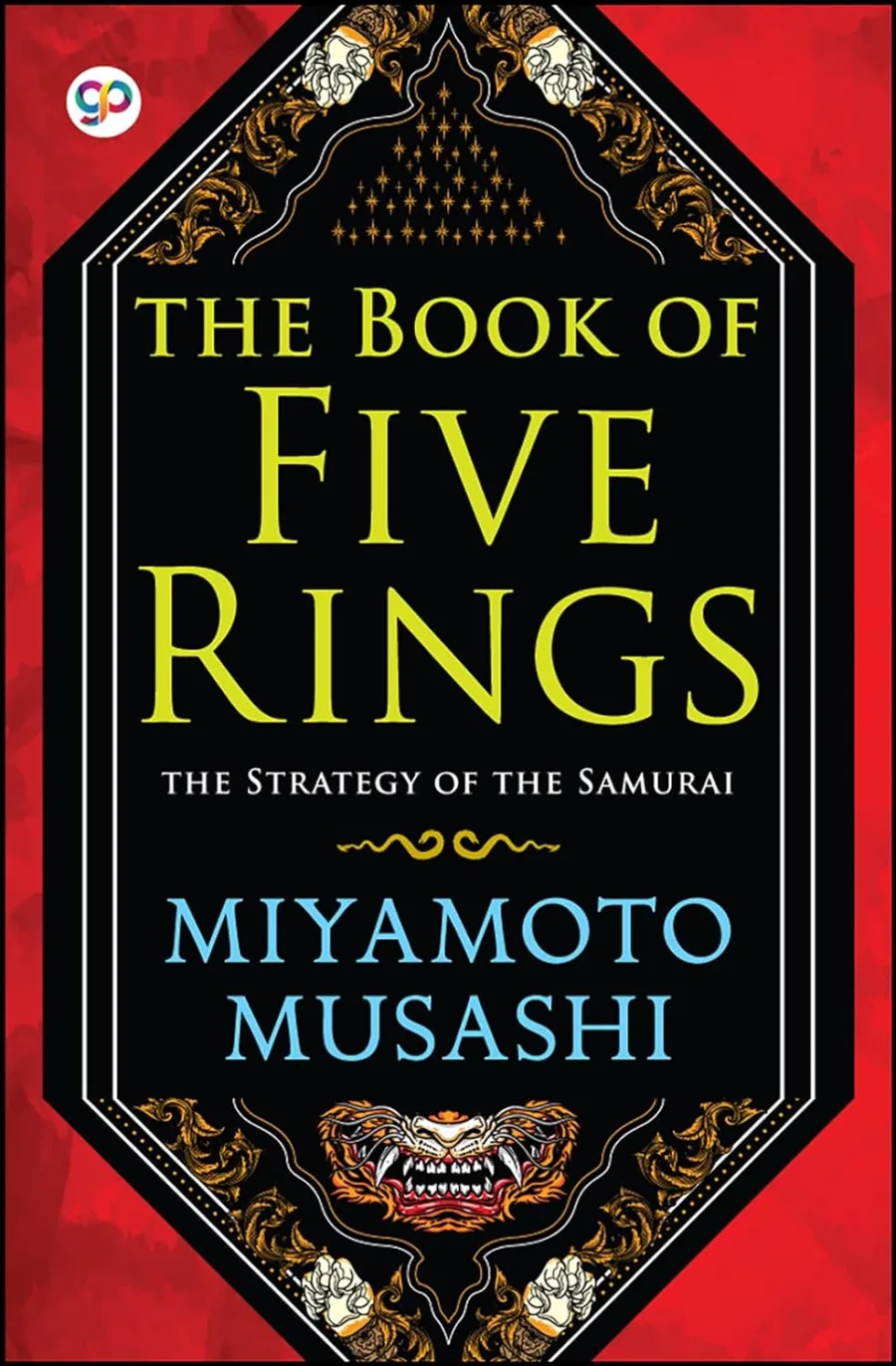
Download Cover Image
Do you want to download the full cover image for The Book of Five Rings?