
Illustrated Biography of William Shakespeare
Paperback
• 138 Pages
• INR 275.00
• English
• 9788180320941
No ratings yet
| Publisher | General Press |
|---|---|
| ISBN13 | 9788180320941 |
| ASIN/SKU | 8180320944 |
| Book Format | Paperback |
| Language | English |
| Pages | 138 |
| List Price | INR 275.00 |
| Subject Code | LIT000000, LIT025050, BIO000000, JNF013060 |
| Publishing Date | 01/01/2017 |
| Dimensions | 8.25 x 5.25 x 1.0 inches |
| Book Code | BD00067539 |
Buy this Book
Amazon Stores
Ebook Stores
Other Stores
Discover Illustrated Biography of William Shakespeare by Manju Gupta. This book is published by General Press in Paperback format, ISBN 9788180320941, ASIN 8180320944, under Biographies and Memoirs, Children's Nonfiction, Nonfiction.
Book Description
Hundreds of years have passed since William Shakespeare's time. He has left behind nearly a million words of text, but his life is still a mystery. This book is an engaging introduction to a subject that students will certainly encounter many times throughout their education—and their lives.
Lucid language and dramatic illustrations re-create the Bard's world of kings and queens, fairies and potions, and bloody beheadings. It imparts an amazing amount of vivid, interesting material about place, period and background of Shakespeare.
This sweeping account is a biography, a history, and a retelling of some of Shakespeare’s most famous plays—all in one approachable volume.
Salient Features:
• Shakespeare's Early Life
• Life as Playwright and Actor
• Theatre Companies
• Style of Presentation
• Last Years of Life
• England of Shakespeare's Days
• Drama in Shakespeare's Days
• Shakespeare's Greatness as a Poet
• Shakespeare's Influence
• Works of Shakespeare in detail
• Principal Facts of Shakespeare's Life
Lucid language and dramatic illustrations re-create the Bard's world of kings and queens, fairies and potions, and bloody beheadings. It imparts an amazing amount of vivid, interesting material about place, period and background of Shakespeare.
This sweeping account is a biography, a history, and a retelling of some of Shakespeare’s most famous plays—all in one approachable volume.
Salient Features:
• Shakespeare's Early Life
• Life as Playwright and Actor
• Theatre Companies
• Style of Presentation
• Last Years of Life
• England of Shakespeare's Days
• Drama in Shakespeare's Days
• Shakespeare's Greatness as a Poet
• Shakespeare's Influence
• Works of Shakespeare in detail
• Principal Facts of Shakespeare's Life
Author Biography
Author Biography will be added soon…
Editorial Reviews
Editorial Reviews will be added soon…
Book Summary
Illustrated Biography of William Shakespeare by Manju Gupta is an accessible introduction to the life, times, literary career, and lasting influence of William Shakespeare. First published in 2014 and later issued by General Press in illustrated hardcover editions, the book is designed to make Shakespeare approachable for readers who may know his name and famous plays but know little about the man behind them. The book combines biography, literary history, historical background, and retellings of some of Shakespeare’s best-known works. Its relatively short length—around 140 pages in the General Press edition—makes it particularly suitable for students and general readers looking for a clear Shakespeare biography rather than a highly academic study.
One of the most interesting things about Shakespeare is the contrast between the enormous amount of writing he left behind and the limited information we possess about his personal life. He produced a remarkable body of poetry and drama, yet many details of his childhood, education, private relationships, and working life remain uncertain. Gupta’s book begins from this fascinating tension. Shakespeare is one of the most famous writers in history, but the man himself remains partly hidden behind his works. The book therefore tries to reconstruct his world through the historical facts that survive and through the plays and poems that reveal something about his imagination.
Shakespeare’s Early Life and Stratford-upon-Avon
William Shakespeare was born in Stratford-upon-Avon in the sixteenth century, during a period of enormous change in English society. His traditional birth date is April 23, 1564, although the documentary record establishes his baptism on April 26. He was the son of John Shakespeare and Mary Arden. His father was involved in business and local civic affairs, giving Shakespeare a childhood that was connected to the life of a prosperous market town.
Gupta’s account places Shakespeare within the social and cultural environment of his time rather than presenting him as an isolated genius. Understanding Stratford matters because Shakespeare did not grow up in London or in a literary household of the kind modern readers might imagine. He came from provincial England and eventually moved into the center of the country’s theatrical and cultural life.
His education is also important. Shakespeare is generally believed to have attended the King's New School in Stratford, where students would have encountered grammar, rhetoric, Latin, classical literature, and religious texts. Even though there is no surviving university record for Shakespeare, his later writing demonstrates an extraordinary familiarity with language, storytelling traditions, classical mythology, rhetoric, and human behavior.
The book’s approach helps readers understand that Shakespeare’s education did not have to resemble a modern university education to be intellectually valuable. The cultural world around him supplied an enormous amount of material that he would later transform into drama.
Marriage, Family, and the Lost Years
One of the mysteries surrounding Shakespeare is the period between his youth in Stratford and his emergence as a successful London playwright. His marriage to Anne Hathaway in 1582 is one of the better-documented parts of his early adult life. Shakespeare was only eighteen when he married, while Anne was older and already pregnant with their first child.
The couple had three children: Susanna and the twins Hamnet and Judith. Hamnet died at the age of eleven, a personal tragedy that occurred while Shakespeare was already established as a dramatist.
Between Shakespeare’s marriage and his emergence in London lies what scholars often call the “lost years.” There is no complete record of what he did during this period. Various theories have been proposed, but certainty is impossible.
Gupta does not need to invent an elaborate story to fill the gaps. Instead, the uncertainty itself becomes part of Shakespeare’s biography. His life reminds us that historical figures do not always leave behind complete records. Much of what we know must be reconstructed from scattered evidence.
Shakespeare Arrives in London
Eventually Shakespeare became part of London’s theatrical world. This was the decisive turning point in his career.
London in the late sixteenth century was a rapidly developing cultural center. The theatre was becoming an increasingly important form of popular entertainment, and professional acting companies attracted audiences from different social classes. Shakespeare entered this environment not simply as a playwright but as a participant in the theatrical profession.
One of the book’s useful features is its attention to Shakespeare’s work as both actor and playwright. Modern readers often imagine him primarily as an author sitting alone and writing manuscripts. In reality, the theatre was collaborative. Playwrights, actors, musicians, stage workers, managers, patrons, and audiences all contributed to the theatrical experience.
Shakespeare understood the stage because he worked within it.
This helped shape the way he wrote. His plays were not intended merely to be read. They were designed to be performed, heard, watched, and experienced in front of an audience.
Shakespeare and the Theatre Companies
Theatre companies were central to Shakespeare’s professional life. He became associated with the Lord Chamberlain’s Men, a company that later became the King’s Men under James I.
This association was enormously important. Shakespeare was not simply producing plays independently; he was writing for a company with actors, financial interests, audiences, and royal connections.
The growth of the company also helped establish Shakespeare’s financial success. The construction of the Globe Theatre in 1599 was a major milestone. Shakespeare was not merely an employee of the theatrical world. He had a financial stake in the enterprise.
The Globe has since become almost inseparable from Shakespeare’s reputation. It represents the physical environment in which many of his plays came alive. The theatre was open to the public and attracted audiences who came for stories involving kings, lovers, fools, villains, ghosts, battles, conspiracies, magic, and comedy.
The dramatic illustrations in Gupta’s book help recreate this world for readers. The book deliberately uses visual material to make Shakespeare’s period more vivid, including its atmosphere of kings and queens, supernatural figures, potions, violence, and theatrical spectacle.
Shakespeare as Playwright and Poet
Shakespeare’s literary career developed across several genres. His early work included comedies and history plays, while his later writing became increasingly associated with major tragedies and romances.
Among his important comedies are A Midsummer Night’s Dream, Much Ado About Nothing, Twelfth Night, and The Comedy of Errors. These works demonstrate his extraordinary ability to create confusion, mistaken identity, wordplay, romance, and comic situations while still exploring serious questions about love and human behavior.
His history plays examine England’s kings and political conflicts. Works concerning figures such as Henry VI, Richard III, Henry IV, and Henry V transform historical material into dramatic stories about ambition, power, leadership, war, legitimacy, and national identity.
Then there are the tragedies: Romeo and Juliet, Hamlet, Othello, King Lear, Macbeth, and others.
These plays are among the clearest reasons Shakespeare has remained so influential. They do not present human beings as simple heroes and villains. Instead, they explore people whose desires, weaknesses, fears, ambitions, mistakes, and relationships gradually produce catastrophe.
The Famous Plays in Context
A major strength of Illustrated Biography of William Shakespeare is that it does not treat Shakespeare’s plays as isolated literary objects. It connects them with the man and the period in which they were produced.
Romeo and Juliet, for example, is more than a tragic love story. It explores youthful passion, family conflict, social expectations, impulsiveness, and the consequences of hatred.
Macbeth examines ambition and the psychological consequences of violence. Macbeth’s desire for power begins as an aspiration and becomes a destructive force that consumes his relationships and sense of security.
Hamlet is built around uncertainty, revenge, grief, morality, performance, and the difficulty of knowing what is true. Its famous central character constantly questions both himself and the world around him.
King Lear explores family, power, aging, blindness, betrayal, and suffering. The tragedy becomes especially powerful because Lear’s political authority cannot protect him from the emotional consequences of his own mistakes.
Through these works, Shakespeare repeatedly returns to the same fundamental human questions: What makes people act as they do? How does ambition change a person? What happens when love collides with social pressure? Can power provide happiness? How much of human life is controlled by choice, and how much by circumstance?
Shakespeare’s England
To understand Shakespeare properly, Gupta emphasizes the England in which he lived. This was the Elizabethan and early Jacobean period, a time of political, religious, social, and cultural transformation.
Theatre was becoming a major form of entertainment. London was expanding. Printing allowed texts to circulate more widely. England was developing a stronger sense of national identity, while religious and political tensions continued to shape society.
Theatre itself could be controversial. Plays attracted huge audiences, but authorities sometimes worried about public disorder, disease, morality, and political content.
Shakespeare’s genius developed within this complicated environment.
His plays contain kings and queens, but also servants and laborers. They include aristocratic courts as well as taverns, battlefields, forests, streets, and domestic spaces. His characters range across social classes, allowing him to portray an unusually broad picture of human society.
Shakespeare’s Style and Greatness as a Poet
Another major theme of the book is Shakespeare’s extraordinary command of language.
He could write elegant poetry, comic dialogue, philosophical reflection, rapid conversation, insults, wordplay, romantic speeches, and powerful dramatic monologues. His language could be beautiful and complex, but it could also be direct and energetic.
His poetry is especially visible in his sonnets and narrative poems such as Venus and Adonis and The Rape of Lucrece. These works demonstrate his ability to explore desire, beauty, aging, mortality, jealousy, love, and time through tightly constructed verse.
Shakespeare’s greatness, however, cannot be reduced to the number of words he supposedly invented. His deeper achievement lies in his ability to make language reveal character.
A Shakespearean character often tells us who they are through the way they speak.
A confident character speaks differently from a frightened one. A manipulator chooses language differently from an innocent person. A character in love sees the world differently from someone consumed by jealousy.
This connection between language and psychology is one reason Shakespeare’s writing continues to feel remarkably alive.
The Shakespeare Authorship Question
Shakespeare’s mysterious biography has also encouraged debates about whether he truly wrote the works attributed to him. Various alternative candidates have been proposed over the centuries.
The question is interesting partly because Shakespeare’s personal life is so poorly documented compared with the enormous scale of his literary achievement. Gupta’s book acknowledges the broader question of Shakespeare’s status and influence, while the work as a whole remains centered on the traditional historical Shakespeare.
For general readers, the larger lesson is that the mystery surrounding Shakespeare has become part of his cultural mythology. The fewer details we possess about his private life, the more space there is for speculation.
Yet the surviving evidence of his professional life and the literary tradition associated with his name remain extraordinarily strong.
Shakespeare’s Final Years
Shakespeare eventually returned to Stratford and spent more time there during the later part of his life, although he remained connected to London and the theatre.
His later works include plays that are sometimes categorized as romances, such as The Tempest, The Winter’s Tale, and Cymbeline. These works often combine tragedy and comedy with themes of reconciliation, forgiveness, loss, and renewal.
Shakespeare died in 1616 at the age of fifty-two and was buried at Holy Trinity Church in Stratford-upon-Avon.
His death did not end his influence. In many ways, it marked the beginning of the long process through which his works would be collected, studied, performed, translated, adapted, and repeatedly rediscovered.
Shakespeare’s Lasting Influence
The final part of Gupta’s biography focuses on Shakespeare’s influence and enduring greatness. The book presents him not simply as a successful Elizabethan dramatist but as a writer whose work crossed historical and cultural boundaries.
His plays continue to be performed because their subjects remain recognizable. Jealousy, ambition, love, betrayal, grief, family conflict, political power, revenge, friendship, aging, and death do not belong to one particular century.
This universality is perhaps Shakespeare’s greatest achievement.
A reader living hundreds of years after Shakespeare can still recognize something of themselves in Hamlet’s uncertainty, Macbeth’s ambition, Lear’s blindness, Othello’s jealousy, Romeo and Juliet’s passion, or Viola’s confusion and resilience.
The book also highlights Shakespeare’s enormous influence on the English language and on later literature and theatre. His works have been translated widely and adapted into countless forms. The First Folio, published in 1623 by his fellow actors John Heminges and Henry Condell, was especially important because it preserved many plays that might otherwise have disappeared.
Final Thoughts on Illustrated Biography of William Shakespeare
Illustrated Biography of William Shakespeare by Manju Gupta is best understood as a gateway into Shakespeare’s life and literary world. Rather than offering an extremely detailed scholarly biography, it brings together the major facts of Shakespeare’s life, the history of Elizabethan theatre, the cultural background of his age, his development as a playwright and actor, summaries and context for important works, and an explanation of his continuing influence. Its stated features specifically include Shakespeare’s early life, career as playwright and actor, theatre companies, presentation style, final years, Elizabethan England, drama of the period, his achievement as a poet, his influence, his works, and the principal facts of his life.
The greatest value of the book is its accessibility. Shakespeare can initially seem intimidating because of his language and enormous reputation. Gupta makes the historical figure easier to approach by placing him inside the world that shaped him.
Ultimately, the story presented here is not simply that of a man who wrote famous plays. It is the story of an ambitious young man from Stratford who entered a rapidly developing theatrical culture, learned how to write for audiences, became an actor and shareholder as well as a playwright, and transformed the possibilities of English drama and poetry.
Shakespeare’s personal life may remain partly mysterious, but his imagination is remarkably visible. His characters continue to speak because he understood something fundamental about people: we may live in different centuries, speak different languages, and inhabit different societies, but our deepest hopes, fears, ambitions, loves, mistakes, and desires remain surprisingly familiar.
That is ultimately why Shakespeare remains Shakespeare. His world has disappeared, but the human beings he created still feel alive.
One of the most interesting things about Shakespeare is the contrast between the enormous amount of writing he left behind and the limited information we possess about his personal life. He produced a remarkable body of poetry and drama, yet many details of his childhood, education, private relationships, and working life remain uncertain. Gupta’s book begins from this fascinating tension. Shakespeare is one of the most famous writers in history, but the man himself remains partly hidden behind his works. The book therefore tries to reconstruct his world through the historical facts that survive and through the plays and poems that reveal something about his imagination.
Shakespeare’s Early Life and Stratford-upon-Avon
William Shakespeare was born in Stratford-upon-Avon in the sixteenth century, during a period of enormous change in English society. His traditional birth date is April 23, 1564, although the documentary record establishes his baptism on April 26. He was the son of John Shakespeare and Mary Arden. His father was involved in business and local civic affairs, giving Shakespeare a childhood that was connected to the life of a prosperous market town.
Gupta’s account places Shakespeare within the social and cultural environment of his time rather than presenting him as an isolated genius. Understanding Stratford matters because Shakespeare did not grow up in London or in a literary household of the kind modern readers might imagine. He came from provincial England and eventually moved into the center of the country’s theatrical and cultural life.
His education is also important. Shakespeare is generally believed to have attended the King's New School in Stratford, where students would have encountered grammar, rhetoric, Latin, classical literature, and religious texts. Even though there is no surviving university record for Shakespeare, his later writing demonstrates an extraordinary familiarity with language, storytelling traditions, classical mythology, rhetoric, and human behavior.
The book’s approach helps readers understand that Shakespeare’s education did not have to resemble a modern university education to be intellectually valuable. The cultural world around him supplied an enormous amount of material that he would later transform into drama.
Marriage, Family, and the Lost Years
One of the mysteries surrounding Shakespeare is the period between his youth in Stratford and his emergence as a successful London playwright. His marriage to Anne Hathaway in 1582 is one of the better-documented parts of his early adult life. Shakespeare was only eighteen when he married, while Anne was older and already pregnant with their first child.
The couple had three children: Susanna and the twins Hamnet and Judith. Hamnet died at the age of eleven, a personal tragedy that occurred while Shakespeare was already established as a dramatist.
Between Shakespeare’s marriage and his emergence in London lies what scholars often call the “lost years.” There is no complete record of what he did during this period. Various theories have been proposed, but certainty is impossible.
Gupta does not need to invent an elaborate story to fill the gaps. Instead, the uncertainty itself becomes part of Shakespeare’s biography. His life reminds us that historical figures do not always leave behind complete records. Much of what we know must be reconstructed from scattered evidence.
Shakespeare Arrives in London
Eventually Shakespeare became part of London’s theatrical world. This was the decisive turning point in his career.
London in the late sixteenth century was a rapidly developing cultural center. The theatre was becoming an increasingly important form of popular entertainment, and professional acting companies attracted audiences from different social classes. Shakespeare entered this environment not simply as a playwright but as a participant in the theatrical profession.
One of the book’s useful features is its attention to Shakespeare’s work as both actor and playwright. Modern readers often imagine him primarily as an author sitting alone and writing manuscripts. In reality, the theatre was collaborative. Playwrights, actors, musicians, stage workers, managers, patrons, and audiences all contributed to the theatrical experience.
Shakespeare understood the stage because he worked within it.
This helped shape the way he wrote. His plays were not intended merely to be read. They were designed to be performed, heard, watched, and experienced in front of an audience.
Shakespeare and the Theatre Companies
Theatre companies were central to Shakespeare’s professional life. He became associated with the Lord Chamberlain’s Men, a company that later became the King’s Men under James I.
This association was enormously important. Shakespeare was not simply producing plays independently; he was writing for a company with actors, financial interests, audiences, and royal connections.
The growth of the company also helped establish Shakespeare’s financial success. The construction of the Globe Theatre in 1599 was a major milestone. Shakespeare was not merely an employee of the theatrical world. He had a financial stake in the enterprise.
The Globe has since become almost inseparable from Shakespeare’s reputation. It represents the physical environment in which many of his plays came alive. The theatre was open to the public and attracted audiences who came for stories involving kings, lovers, fools, villains, ghosts, battles, conspiracies, magic, and comedy.
The dramatic illustrations in Gupta’s book help recreate this world for readers. The book deliberately uses visual material to make Shakespeare’s period more vivid, including its atmosphere of kings and queens, supernatural figures, potions, violence, and theatrical spectacle.
Shakespeare as Playwright and Poet
Shakespeare’s literary career developed across several genres. His early work included comedies and history plays, while his later writing became increasingly associated with major tragedies and romances.
Among his important comedies are A Midsummer Night’s Dream, Much Ado About Nothing, Twelfth Night, and The Comedy of Errors. These works demonstrate his extraordinary ability to create confusion, mistaken identity, wordplay, romance, and comic situations while still exploring serious questions about love and human behavior.
His history plays examine England’s kings and political conflicts. Works concerning figures such as Henry VI, Richard III, Henry IV, and Henry V transform historical material into dramatic stories about ambition, power, leadership, war, legitimacy, and national identity.
Then there are the tragedies: Romeo and Juliet, Hamlet, Othello, King Lear, Macbeth, and others.
These plays are among the clearest reasons Shakespeare has remained so influential. They do not present human beings as simple heroes and villains. Instead, they explore people whose desires, weaknesses, fears, ambitions, mistakes, and relationships gradually produce catastrophe.
The Famous Plays in Context
A major strength of Illustrated Biography of William Shakespeare is that it does not treat Shakespeare’s plays as isolated literary objects. It connects them with the man and the period in which they were produced.
Romeo and Juliet, for example, is more than a tragic love story. It explores youthful passion, family conflict, social expectations, impulsiveness, and the consequences of hatred.
Macbeth examines ambition and the psychological consequences of violence. Macbeth’s desire for power begins as an aspiration and becomes a destructive force that consumes his relationships and sense of security.
Hamlet is built around uncertainty, revenge, grief, morality, performance, and the difficulty of knowing what is true. Its famous central character constantly questions both himself and the world around him.
King Lear explores family, power, aging, blindness, betrayal, and suffering. The tragedy becomes especially powerful because Lear’s political authority cannot protect him from the emotional consequences of his own mistakes.
Through these works, Shakespeare repeatedly returns to the same fundamental human questions: What makes people act as they do? How does ambition change a person? What happens when love collides with social pressure? Can power provide happiness? How much of human life is controlled by choice, and how much by circumstance?
Shakespeare’s England
To understand Shakespeare properly, Gupta emphasizes the England in which he lived. This was the Elizabethan and early Jacobean period, a time of political, religious, social, and cultural transformation.
Theatre was becoming a major form of entertainment. London was expanding. Printing allowed texts to circulate more widely. England was developing a stronger sense of national identity, while religious and political tensions continued to shape society.
Theatre itself could be controversial. Plays attracted huge audiences, but authorities sometimes worried about public disorder, disease, morality, and political content.
Shakespeare’s genius developed within this complicated environment.
His plays contain kings and queens, but also servants and laborers. They include aristocratic courts as well as taverns, battlefields, forests, streets, and domestic spaces. His characters range across social classes, allowing him to portray an unusually broad picture of human society.
Shakespeare’s Style and Greatness as a Poet
Another major theme of the book is Shakespeare’s extraordinary command of language.
He could write elegant poetry, comic dialogue, philosophical reflection, rapid conversation, insults, wordplay, romantic speeches, and powerful dramatic monologues. His language could be beautiful and complex, but it could also be direct and energetic.
His poetry is especially visible in his sonnets and narrative poems such as Venus and Adonis and The Rape of Lucrece. These works demonstrate his ability to explore desire, beauty, aging, mortality, jealousy, love, and time through tightly constructed verse.
Shakespeare’s greatness, however, cannot be reduced to the number of words he supposedly invented. His deeper achievement lies in his ability to make language reveal character.
A Shakespearean character often tells us who they are through the way they speak.
A confident character speaks differently from a frightened one. A manipulator chooses language differently from an innocent person. A character in love sees the world differently from someone consumed by jealousy.
This connection between language and psychology is one reason Shakespeare’s writing continues to feel remarkably alive.
The Shakespeare Authorship Question
Shakespeare’s mysterious biography has also encouraged debates about whether he truly wrote the works attributed to him. Various alternative candidates have been proposed over the centuries.
The question is interesting partly because Shakespeare’s personal life is so poorly documented compared with the enormous scale of his literary achievement. Gupta’s book acknowledges the broader question of Shakespeare’s status and influence, while the work as a whole remains centered on the traditional historical Shakespeare.
For general readers, the larger lesson is that the mystery surrounding Shakespeare has become part of his cultural mythology. The fewer details we possess about his private life, the more space there is for speculation.
Yet the surviving evidence of his professional life and the literary tradition associated with his name remain extraordinarily strong.
Shakespeare’s Final Years
Shakespeare eventually returned to Stratford and spent more time there during the later part of his life, although he remained connected to London and the theatre.
His later works include plays that are sometimes categorized as romances, such as The Tempest, The Winter’s Tale, and Cymbeline. These works often combine tragedy and comedy with themes of reconciliation, forgiveness, loss, and renewal.
Shakespeare died in 1616 at the age of fifty-two and was buried at Holy Trinity Church in Stratford-upon-Avon.
His death did not end his influence. In many ways, it marked the beginning of the long process through which his works would be collected, studied, performed, translated, adapted, and repeatedly rediscovered.
Shakespeare’s Lasting Influence
The final part of Gupta’s biography focuses on Shakespeare’s influence and enduring greatness. The book presents him not simply as a successful Elizabethan dramatist but as a writer whose work crossed historical and cultural boundaries.
His plays continue to be performed because their subjects remain recognizable. Jealousy, ambition, love, betrayal, grief, family conflict, political power, revenge, friendship, aging, and death do not belong to one particular century.
This universality is perhaps Shakespeare’s greatest achievement.
A reader living hundreds of years after Shakespeare can still recognize something of themselves in Hamlet’s uncertainty, Macbeth’s ambition, Lear’s blindness, Othello’s jealousy, Romeo and Juliet’s passion, or Viola’s confusion and resilience.
The book also highlights Shakespeare’s enormous influence on the English language and on later literature and theatre. His works have been translated widely and adapted into countless forms. The First Folio, published in 1623 by his fellow actors John Heminges and Henry Condell, was especially important because it preserved many plays that might otherwise have disappeared.
Final Thoughts on Illustrated Biography of William Shakespeare
Illustrated Biography of William Shakespeare by Manju Gupta is best understood as a gateway into Shakespeare’s life and literary world. Rather than offering an extremely detailed scholarly biography, it brings together the major facts of Shakespeare’s life, the history of Elizabethan theatre, the cultural background of his age, his development as a playwright and actor, summaries and context for important works, and an explanation of his continuing influence. Its stated features specifically include Shakespeare’s early life, career as playwright and actor, theatre companies, presentation style, final years, Elizabethan England, drama of the period, his achievement as a poet, his influence, his works, and the principal facts of his life.
The greatest value of the book is its accessibility. Shakespeare can initially seem intimidating because of his language and enormous reputation. Gupta makes the historical figure easier to approach by placing him inside the world that shaped him.
Ultimately, the story presented here is not simply that of a man who wrote famous plays. It is the story of an ambitious young man from Stratford who entered a rapidly developing theatrical culture, learned how to write for audiences, became an actor and shareholder as well as a playwright, and transformed the possibilities of English drama and poetry.
Shakespeare’s personal life may remain partly mysterious, but his imagination is remarkably visible. His characters continue to speak because he understood something fundamental about people: we may live in different centuries, speak different languages, and inhabit different societies, but our deepest hopes, fears, ambitions, loves, mistakes, and desires remain surprisingly familiar.
That is ultimately why Shakespeare remains Shakespeare. His world has disappeared, but the human beings he created still feel alive.
Sample Chapters
Sample Chapters will be added soon…
Reader Reviews
No reviews yet.
Illustrated Biography of William Shakespeare
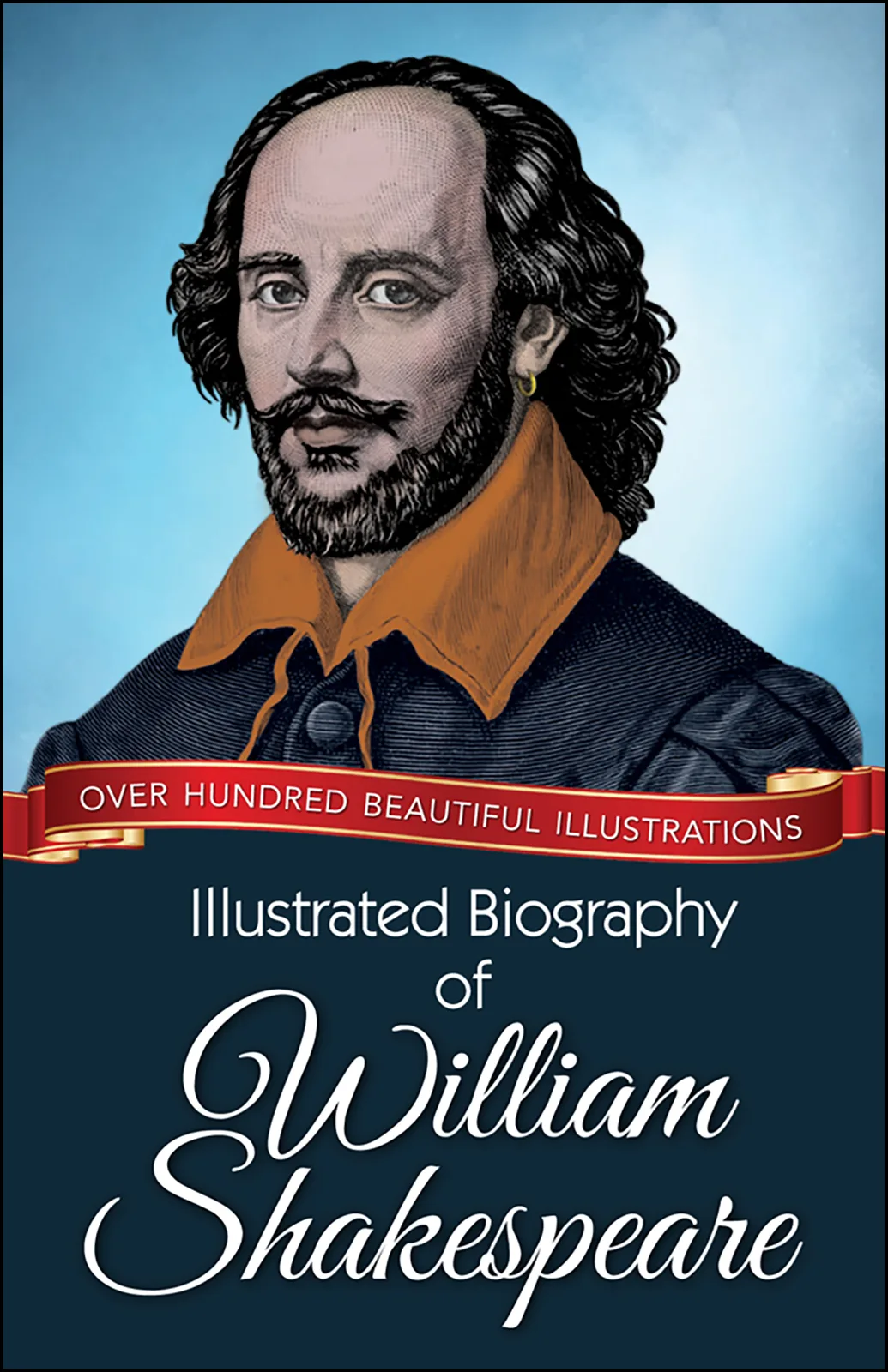
Download Cover Image
Do you want to download the full cover image for Illustrated Biography of William Shakespeare?