
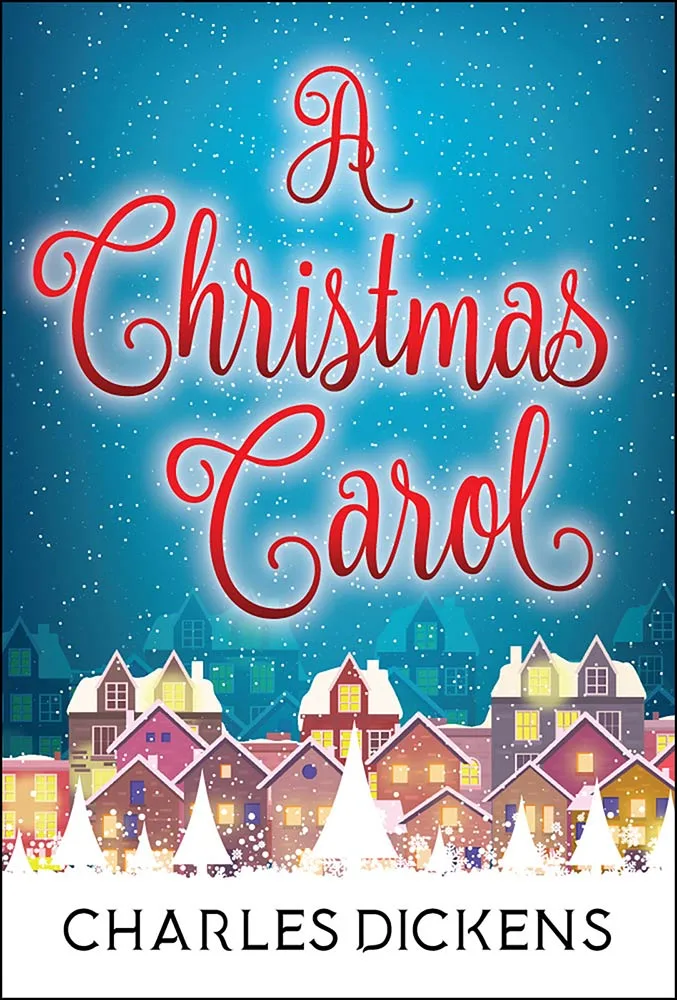
A Christmas Carol
Paperback
• 128 Pages
• INR 245.00
• English
• 9788193545874
No ratings yet
| Publisher | General Press |
|---|---|
| ISBN13 | 9788193545874 |
| ASIN/SKU | 8193545877 |
| Book Format | Paperback |
| Language | English |
| Pages | 128 |
| List Price | INR 245.00 |
| Subject Code | JUV007000, JUV000000, FIC084000 |
| Publishing Date | 01/12/2017 |
| Dimensions | 8.25 x 5.25 x 1.0 inches |
| Book Code | BD00067547 |
Buy this Book
Amazon Stores
Ebook Stores
Other Stores
Discover A Christmas Carol by Charles Dickens. This book is published by General Press in Paperback format, ISBN 9788193545874, ASIN 8193545877, under Children's Books, Children's Classics, Christian Fiction.
Book Description
'A Christmas Carol' by Charles Dickens is a timeless work of Victorian fiction that has warmed hearts and pricked consciences since it was first published in December 1843. In just a few short pages, Dickens manages to do something extraordinary — he takes one of literature's most unpleasant characters and makes you care deeply about what becomes of him.
The story centers on Ebenezer Scrooge, a cold, miserly businessman who has spent a lifetime hoarding money and pushing people away. He dismisses Christmas as a humbug, begrudges his clerk Bob Cratchit a day off for the holiday, and slams the door on his own cheerful nephew. Scrooge has built walls so high around himself that he can no longer feel the warmth of human connection — and he seems perfectly content with that arrangement. Until one bitter Christmas Eve changes everything.
That night, Scrooge is visited by the ghost of his former business partner, Jacob Marley, who appears in chains forged from a lifetime of greed and indifference. Marley warns Scrooge that three spirits will come before dawn, each offering him a journey he cannot refuse. What follows is one of the most emotionally rich sequences in all of English literature — a haunting, tender, and at times gut-wrenching tour through Scrooge's past joys and regrets, the humble present-day warmth he has chosen to ignore, and a shadowy, silent glimpse of what the future holds if nothing changes.
Dickens wrote this book at extraordinary speed, driven by genuine anger at the poverty and child labor he witnessed in industrial England. That urgency pulses through every page. This is not a soft, sentimental holiday tale — it is a story about what it costs a person to close their heart, and what it takes to open it again. If you have ever wondered whether it is too late to change, this book has something quietly powerful to say to you.
The story centers on Ebenezer Scrooge, a cold, miserly businessman who has spent a lifetime hoarding money and pushing people away. He dismisses Christmas as a humbug, begrudges his clerk Bob Cratchit a day off for the holiday, and slams the door on his own cheerful nephew. Scrooge has built walls so high around himself that he can no longer feel the warmth of human connection — and he seems perfectly content with that arrangement. Until one bitter Christmas Eve changes everything.
That night, Scrooge is visited by the ghost of his former business partner, Jacob Marley, who appears in chains forged from a lifetime of greed and indifference. Marley warns Scrooge that three spirits will come before dawn, each offering him a journey he cannot refuse. What follows is one of the most emotionally rich sequences in all of English literature — a haunting, tender, and at times gut-wrenching tour through Scrooge's past joys and regrets, the humble present-day warmth he has chosen to ignore, and a shadowy, silent glimpse of what the future holds if nothing changes.
Dickens wrote this book at extraordinary speed, driven by genuine anger at the poverty and child labor he witnessed in industrial England. That urgency pulses through every page. This is not a soft, sentimental holiday tale — it is a story about what it costs a person to close their heart, and what it takes to open it again. If you have ever wondered whether it is too late to change, this book has something quietly powerful to say to you.
Author Biography
Charles Dickens (7 February 1812 – 9 June 1870) was an English writer and social critic. He created some of the world's best-known fictional characters and is regarded as the greatest novelist of the Victorian era. His works enjoyed unprecedented popularity during his lifetime, and by the twentieth century critics and scholars had recognised him as a literary genius. His novels and short stories enjoy lasting popularity.
The second of eight children, he grew up in a family frequently beset by financial insecurity. At age eleven, Dickens was taken out of school and sent to work in London backing warehouse, where his job was to paste labels on bottles for six shillings a week. His father John Dickens, was a warmhearted but improvident man. When he was condemned the Marshela Prison for unpaid debts, he unwisely agreed that Charles should stay in lodgings and continue working while the rest of the family joined him in jail. This three-month separation caused Charles much pain; his experiences as a child alone in a huge city—cold, isolated with barely enough to eat—haunted him for the rest of his life.
When the family fortunes improved, Charles went back to school, after which he became an office boy, a freelance reporter and finally an author. With Pickwick Papers (1836-7) he achieved immediate fame; in a few years he was easily the most popular and respected writer of his time. It has been estimated that one out of every ten persons in Victorian England was a Dickens reader. Oliver Twist (1837), Nicholas Nickleby (1838-9) and The Old Curiosity Shop (1840-41) were huge successes. Martin Chuzzlewit (1843-4) was less so, but Dickens followed it with his unforgettable, A Christmas Carol (1843), Bleak House (1852-3), Hard Times (1854) and Little Dorrit (1855-7) reveal his deepening concern for the injustices of British Society. A Tale of Two Cities (1859), Great Expectations (1860-1) and Our Mutual Friend (1864-5) complete his major works.
Dickens's marriage to Catherine Hoggarth produced ten children but ended in separation in 1858. In that year he began a series of exhausting public readings; his health gradually declined. After putting in a full day's work at his home at Gads Hill, Kent on June 8, 1870, Dickens suffered a stroke, and he died the following day.
He was a sympathiser with the poor, the suffering, and the oppressed; and by his death, one of England's greatest writers is lost to the world.
The second of eight children, he grew up in a family frequently beset by financial insecurity. At age eleven, Dickens was taken out of school and sent to work in London backing warehouse, where his job was to paste labels on bottles for six shillings a week. His father John Dickens, was a warmhearted but improvident man. When he was condemned the Marshela Prison for unpaid debts, he unwisely agreed that Charles should stay in lodgings and continue working while the rest of the family joined him in jail. This three-month separation caused Charles much pain; his experiences as a child alone in a huge city—cold, isolated with barely enough to eat—haunted him for the rest of his life.
When the family fortunes improved, Charles went back to school, after which he became an office boy, a freelance reporter and finally an author. With Pickwick Papers (1836-7) he achieved immediate fame; in a few years he was easily the most popular and respected writer of his time. It has been estimated that one out of every ten persons in Victorian England was a Dickens reader. Oliver Twist (1837), Nicholas Nickleby (1838-9) and The Old Curiosity Shop (1840-41) were huge successes. Martin Chuzzlewit (1843-4) was less so, but Dickens followed it with his unforgettable, A Christmas Carol (1843), Bleak House (1852-3), Hard Times (1854) and Little Dorrit (1855-7) reveal his deepening concern for the injustices of British Society. A Tale of Two Cities (1859), Great Expectations (1860-1) and Our Mutual Friend (1864-5) complete his major works.
Dickens's marriage to Catherine Hoggarth produced ten children but ended in separation in 1858. In that year he began a series of exhausting public readings; his health gradually declined. After putting in a full day's work at his home at Gads Hill, Kent on June 8, 1870, Dickens suffered a stroke, and he died the following day.
He was a sympathiser with the poor, the suffering, and the oppressed; and by his death, one of England's greatest writers is lost to the world.
Editorial Reviews
Editorial Reviews will be added soon…
Book Summary
A Christmas Carol by Charles Dickens is a timeless story about greed, loneliness, compassion, and the possibility of personal change. Set in Victorian London at Christmas, the novella follows Ebenezer Scrooge, a wealthy but miserly businessman who has become so obsessed with money that he has shut himself away from affection, friendship, and human kindness. Through a supernatural journey into his past, present, and possible future, Scrooge is forced to confront the consequences of the life he has chosen. By the end, he discovers that true wealth lies not in possessing money but in sharing life with others.
The story begins on Christmas Eve. Ebenezer Scrooge is working in his counting-house, where he is visited by his nephew Fred. Fred is cheerful and warm-hearted and has come to invite his uncle to Christmas dinner. Scrooge refuses the invitation with irritation. He dislikes Christmas because he sees it as a waste of time and money. To him, Christmas means unnecessary generosity and foolish celebration. He rejects Fred's affection and tells him to leave.
Scrooge's clerk, Bob Cratchit, is working in the cold office. Cratchit is poorly paid and treated harshly by his employer, yet he remains patient and devoted to his family. Scrooge reluctantly gives him Christmas Day off, complaining that it is an unfair expense.
Later, two gentlemen visit Scrooge and ask him to contribute money to help poor and hungry people. Scrooge refuses. He argues that the poor should rely on prisons and workhouses rather than charity. When they remind him that many people would rather die than enter such institutions, Scrooge coldly suggests that perhaps they should do so. His response reveals how completely his concern for money has replaced his concern for other people.
That evening, Scrooge returns alone to his dark and gloomy home. There, something extraordinary happens. He sees the ghostly face of his former business partner, Jacob Marley, appearing on his door knocker. Later, Marley's ghost enters the house, carrying a heavy chain made from cash boxes, keys, locks, and other objects associated with money and business.
Marley explains that he forged this chain during his lifetime through his selfishness and indifference to others. Now he is condemned to wander through the world watching human suffering without being able to help. He warns Scrooge that the same fate awaits him if he does not change. Marley tells him that three spirits will visit him during the night.
The first spirit is the Ghost of Christmas Past. It takes Scrooge back to scenes from his childhood and youth. Scrooge sees himself as a lonely schoolboy, abandoned at school during Christmas while other children return home to their families. Although Scrooge had once suffered loneliness himself, he gradually allowed bitterness to harden his heart.
The spirit then shows him happier memories. Scrooge remembers his beloved sister Fan, who came to bring him home. He also remembers working for Fezziwig, a generous employer who treated his workers and their families with warmth and respect. Fezziwig's Christmas celebration costs relatively little, yet it creates enormous happiness. Scrooge begins to understand that kindness does not depend on wealth.
The spirit then shows Scrooge another painful memory: his relationship with Belle, the woman he once loved. Belle realizes that Scrooge has become increasingly obsessed with money. She tells him that another love has replaced her—the love of wealth. Eventually, she leaves him.
Scrooge watches Belle later enjoying a happy family life with her husband and children. He is deeply affected by the sight. For the first time, he recognizes how much he has sacrificed. His wealth has given him financial security, but it has cost him love, companionship, and the possibility of a family.
The next spirit is the Ghost of Christmas Present, a joyful giant surrounded by warmth and abundance. The spirit takes Scrooge through London and shows him people celebrating Christmas despite their limited means. Scrooge sees that happiness is not determined by wealth.
The spirit then takes him to Bob Cratchit's home. The Cratchit family is poor, but they love one another deeply. Scrooge notices Bob's youngest son, Tiny Tim, a gentle and physically fragile child. Despite his health problems, Tiny Tim is cheerful and loving. Bob and his family are grateful for what little they have.
Scrooge becomes especially concerned about Tiny Tim and asks whether the child will survive. The spirit tells him that, unless the future changes, Tiny Tim will die. The spirit then uses Scrooge's own cruel words about the poor against him, forcing Scrooge to confront the ugliness of his earlier attitude.
Scrooge also visits his nephew Fred's Christmas gathering. Fred and his friends laugh about Scrooge's strange behavior, but Fred does not hate his uncle. Instead, he continues to speak of him with affection and hopes that someday Scrooge will become happier. Scrooge begins to understand that he has been rejecting people who genuinely care about him.
The spirit then reveals a disturbing pair of children hiding beneath its robe. They are named Ignorance and Want. The spirit warns Scrooge that these are among humanity's greatest dangers. Ignorance represents the failure to understand the suffering and needs of others, while Want represents poverty and deprivation. Dickens uses these children to emphasize that society cannot remain healthy when it ignores people who are suffering.
Finally, the Ghost of Christmas Yet to Come appears. Unlike the previous spirits, this figure is silent and frightening. It shows Scrooge scenes from a possible future.
Scrooge first sees businessmen casually discussing the death of an unnamed man. They are more interested in the practical details than in mourning him. Then he sees people stealing belongings from the dead man's home. The scenes are cold and disturbing. No one appears to love or respect the dead man.
Scrooge then sees the Cratchit family grieving. Tiny Tim has died. Bob is devastated, and the family struggles to cope with the loss. Scrooge realizes that his own selfishness has contributed to the conditions that made the child's life so difficult.
Eventually, the spirit takes Scrooge to a neglected graveyard. There he sees a gravestone bearing his own name. The lonely death he has witnessed belongs to him. Scrooge finally understands that the future is not necessarily fixed. He begs the spirit for another chance and promises to change his life.
When Scrooge awakens on Christmas morning, he discovers that he is alive and has been given the opportunity he desperately wanted. He is filled with joy. Instead of returning to his old habits, he immediately begins putting his new understanding into action.
He buys a large Christmas turkey and secretly sends it to the Cratchit family. He gives generously to the charity collectors he had rejected the day before. He visits Fred and accepts his invitation to Christmas dinner. Most importantly, he changes the way he treats Bob Cratchit.
Scrooge becomes a different kind of man. He remains financially successful, but money is no longer the center of his existence. He becomes generous, friendly, compassionate, and involved in the lives of others. He helps Tiny Tim and becomes like a second father to him.
The story closes by emphasizing that Scrooge's transformation is genuine and lasting. He learns to celebrate Christmas throughout the year, not merely as a holiday but as a way of living—with generosity, kindness, forgiveness, and concern for other people.
At its heart, A Christmas Carol is not simply a supernatural Christmas story. It is a story about the human ability to change. Dickens shows that selfishness often grows from fear, loneliness, disappointment, and the wounds of the past, but he also insists that these things do not have to determine a person's future.
Scrooge's journey demonstrates that wealth without compassion can produce an empty life, while generosity creates connections that money alone cannot buy. His transformation also suggests that social responsibility begins with recognizing the humanity of others. The poor are not statistics or inconveniences; they are people with families, hopes, fears, and dignity.
The novella remains powerful because its message is both simple and deeply human: it is never too late to become kinder, to repair damaged relationships, and to use what we have to make another person's life better. Scrooge's greatest discovery is that giving does not diminish a person's life—it enlarges it. In learning to care for others, he finally learns how to live.
The story begins on Christmas Eve. Ebenezer Scrooge is working in his counting-house, where he is visited by his nephew Fred. Fred is cheerful and warm-hearted and has come to invite his uncle to Christmas dinner. Scrooge refuses the invitation with irritation. He dislikes Christmas because he sees it as a waste of time and money. To him, Christmas means unnecessary generosity and foolish celebration. He rejects Fred's affection and tells him to leave.
Scrooge's clerk, Bob Cratchit, is working in the cold office. Cratchit is poorly paid and treated harshly by his employer, yet he remains patient and devoted to his family. Scrooge reluctantly gives him Christmas Day off, complaining that it is an unfair expense.
Later, two gentlemen visit Scrooge and ask him to contribute money to help poor and hungry people. Scrooge refuses. He argues that the poor should rely on prisons and workhouses rather than charity. When they remind him that many people would rather die than enter such institutions, Scrooge coldly suggests that perhaps they should do so. His response reveals how completely his concern for money has replaced his concern for other people.
That evening, Scrooge returns alone to his dark and gloomy home. There, something extraordinary happens. He sees the ghostly face of his former business partner, Jacob Marley, appearing on his door knocker. Later, Marley's ghost enters the house, carrying a heavy chain made from cash boxes, keys, locks, and other objects associated with money and business.
Marley explains that he forged this chain during his lifetime through his selfishness and indifference to others. Now he is condemned to wander through the world watching human suffering without being able to help. He warns Scrooge that the same fate awaits him if he does not change. Marley tells him that three spirits will visit him during the night.
The first spirit is the Ghost of Christmas Past. It takes Scrooge back to scenes from his childhood and youth. Scrooge sees himself as a lonely schoolboy, abandoned at school during Christmas while other children return home to their families. Although Scrooge had once suffered loneliness himself, he gradually allowed bitterness to harden his heart.
The spirit then shows him happier memories. Scrooge remembers his beloved sister Fan, who came to bring him home. He also remembers working for Fezziwig, a generous employer who treated his workers and their families with warmth and respect. Fezziwig's Christmas celebration costs relatively little, yet it creates enormous happiness. Scrooge begins to understand that kindness does not depend on wealth.
The spirit then shows Scrooge another painful memory: his relationship with Belle, the woman he once loved. Belle realizes that Scrooge has become increasingly obsessed with money. She tells him that another love has replaced her—the love of wealth. Eventually, she leaves him.
Scrooge watches Belle later enjoying a happy family life with her husband and children. He is deeply affected by the sight. For the first time, he recognizes how much he has sacrificed. His wealth has given him financial security, but it has cost him love, companionship, and the possibility of a family.
The next spirit is the Ghost of Christmas Present, a joyful giant surrounded by warmth and abundance. The spirit takes Scrooge through London and shows him people celebrating Christmas despite their limited means. Scrooge sees that happiness is not determined by wealth.
The spirit then takes him to Bob Cratchit's home. The Cratchit family is poor, but they love one another deeply. Scrooge notices Bob's youngest son, Tiny Tim, a gentle and physically fragile child. Despite his health problems, Tiny Tim is cheerful and loving. Bob and his family are grateful for what little they have.
Scrooge becomes especially concerned about Tiny Tim and asks whether the child will survive. The spirit tells him that, unless the future changes, Tiny Tim will die. The spirit then uses Scrooge's own cruel words about the poor against him, forcing Scrooge to confront the ugliness of his earlier attitude.
Scrooge also visits his nephew Fred's Christmas gathering. Fred and his friends laugh about Scrooge's strange behavior, but Fred does not hate his uncle. Instead, he continues to speak of him with affection and hopes that someday Scrooge will become happier. Scrooge begins to understand that he has been rejecting people who genuinely care about him.
The spirit then reveals a disturbing pair of children hiding beneath its robe. They are named Ignorance and Want. The spirit warns Scrooge that these are among humanity's greatest dangers. Ignorance represents the failure to understand the suffering and needs of others, while Want represents poverty and deprivation. Dickens uses these children to emphasize that society cannot remain healthy when it ignores people who are suffering.
Finally, the Ghost of Christmas Yet to Come appears. Unlike the previous spirits, this figure is silent and frightening. It shows Scrooge scenes from a possible future.
Scrooge first sees businessmen casually discussing the death of an unnamed man. They are more interested in the practical details than in mourning him. Then he sees people stealing belongings from the dead man's home. The scenes are cold and disturbing. No one appears to love or respect the dead man.
Scrooge then sees the Cratchit family grieving. Tiny Tim has died. Bob is devastated, and the family struggles to cope with the loss. Scrooge realizes that his own selfishness has contributed to the conditions that made the child's life so difficult.
Eventually, the spirit takes Scrooge to a neglected graveyard. There he sees a gravestone bearing his own name. The lonely death he has witnessed belongs to him. Scrooge finally understands that the future is not necessarily fixed. He begs the spirit for another chance and promises to change his life.
When Scrooge awakens on Christmas morning, he discovers that he is alive and has been given the opportunity he desperately wanted. He is filled with joy. Instead of returning to his old habits, he immediately begins putting his new understanding into action.
He buys a large Christmas turkey and secretly sends it to the Cratchit family. He gives generously to the charity collectors he had rejected the day before. He visits Fred and accepts his invitation to Christmas dinner. Most importantly, he changes the way he treats Bob Cratchit.
Scrooge becomes a different kind of man. He remains financially successful, but money is no longer the center of his existence. He becomes generous, friendly, compassionate, and involved in the lives of others. He helps Tiny Tim and becomes like a second father to him.
The story closes by emphasizing that Scrooge's transformation is genuine and lasting. He learns to celebrate Christmas throughout the year, not merely as a holiday but as a way of living—with generosity, kindness, forgiveness, and concern for other people.
At its heart, A Christmas Carol is not simply a supernatural Christmas story. It is a story about the human ability to change. Dickens shows that selfishness often grows from fear, loneliness, disappointment, and the wounds of the past, but he also insists that these things do not have to determine a person's future.
Scrooge's journey demonstrates that wealth without compassion can produce an empty life, while generosity creates connections that money alone cannot buy. His transformation also suggests that social responsibility begins with recognizing the humanity of others. The poor are not statistics or inconveniences; they are people with families, hopes, fears, and dignity.
The novella remains powerful because its message is both simple and deeply human: it is never too late to become kinder, to repair damaged relationships, and to use what we have to make another person's life better. Scrooge's greatest discovery is that giving does not diminish a person's life—it enlarges it. In learning to care for others, he finally learns how to live.
Sample Chapters
Stave One : Marley’s Ghost
Marley was dead: to begin with. There is no doubt whatever about that. The register of his burial was signed by the clergyman, the clerk, the undertaker, and the chief mourner. Scrooge signed it: and Scrooge’s name was good upon ’Change, for anything he chose to put his hand to. Old Marley was as dead as a door-nail.
Mind! I don’t mean to say that I know, of my own knowledge, what there is particularly dead about a door-nail I might have been inclined, myself, to regard a coffin-nail as the deadest piece of ironmongery in the trade. But the wisdom of our ancestors is in the simile; and my unhallowed hands shall not disturb it, or the Country’s done for. You will therefore permit me to repeat, emphatically, that Marley was as dead as a door-nail.
Scrooge knew he was dead? Of course he did. How could it be otherwise? Scrooge and he were partners for I don’t know how many years. Scrooge was his sole executor, his sole administrator, his sole assign, his sole residuary legatee, his sole friend, and sole mourner. And even Scrooge was not so dreadfully cut up by the sad event, but that he was an excellent man of business on the very day of the funeral, and solemnised it with an undoubted bargain.
The mention of Marley’s funeral brings me back to the point I started from. There is no doubt that Marley was dead. This must be distinctly understood, or nothing wonderful can come of the story I am going to relate. If we were not perfectly convinced that Hamlet’s Father died before the play began, there would be nothing more remarkable in his taking a stroll at night, in an easterly wind, upon his own ramparts, than there would be in any other middle-aged gentleman rashly turning out after dark in a breezy spot—say Saint Paul’s Churchyard for instance—literally to astonish his son’s weak mind.
Scrooge never painted out Old Marley’s name. There it stood, years afterwards, above the warehouse door: Scrooge and Marley. The firm was known as Scrooge and Marley. Sometimes people new to the business called Scrooge Scrooge, and sometimes Marley, but he answered to both names. It was all the same to him.
Oh! But he was a tight-fisted hand at the grindstone, Scrooge! A squeezing, wrenching, grasping, scraping, clutching, covetous, old sinner! Hard and sharp as flint, from which no steel had ever struck out generous fire; secret, and self-contained, and solitary as an oyster. The cold within him froze his old features, nipped his pointed nose, shrivelled his cheek, stiffened his gait; made his eyes red, his thin lips blue; and spoke out shrewdly in his grating voice. A frosty rime was on his head, and on his eyebrows, and his wiry chin. He carried his own low temperature always about with him; he iced his office in the dog-days; and didn’t thaw it one degree at Christmas.
External heat and cold had little influence on Scrooge. No warmth could warm, no wintry weather chill him. No wind that blew was bitterer than he, no falling snow was more intent upon its purpose, no pelting rain less open to entreaty. Foul weather didn’t know where to have him. The heaviest rain, and snow, and hail, and sleet, could boast of the advantage over him in only one respect. They often “came down” handsomely, and Scrooge never did.
Nobody ever stopped him in the street to say, with gladsome looks, “My dear Scrooge, how are you? When will you come to see me?” No beggars implored him to bestow a trifle, no children asked him what it was o’clock, no man or woman ever once in all his life inquired the way to such and such a place, of Scrooge. Even the blind men’s dogs appeared to know him; and when they saw him coming on, would tug their owners into doorways and up courts; and then would wag their tails as though they said, “No eye at all is better than an evil eye, dark master!”
But what did Scrooge care! It was the very thing he liked. To edge his way along the crowded paths of life, warning all human sympathy to keep its distance, was what the knowing ones call “nuts” to Scrooge.
Once upon a time—of all the good days in the year, on Christmas Eve—old Scrooge sat busy in his counting-house. It was cold, bleak, biting weather: foggy withal: and he could hear the people in the court outside, go wheezing up and down, beating their hands upon their breasts, and stamping their feet upon the pavement stones to warm them. The city clocks had only just gone three, but it was quit dark already—it had not been light all day—and candles were flaring in the windows of the neighbouring offices, like ruddy smears upon the palpable brown air. The fog came pouring in at every chink and keyhole, and was so dense without, that although the court was of the narrowest, the houses opposite were mere phantoms. To see the dingy cloud come drooping down, obscuring everything, one might have thought that Nature lived hard by, and was brewing on a large scale.
The door of Scrooge’s counting-house was open that he might keep his eye upon his clerk, who in a dismal little cell beyond, a sort of tank, was copying letters, Scrooge had a very small fire, but the clerk’s fire was so very much smaller that it looked like one coal. But he couldn’t replenish it, for Scrooge kept the coal-box in his own room; and so surely as the clerk came in with the shovel, the master predicted that it would be necessary for them to part. Wherefore the clerk put on his white comforter, and tried to warm himself at the candle; in which effort, not being a man of a strong imagination, he failed.
“A merry Christmas, uncle! God save you!” cried a cheerful voice. It was the voice of Scrooge’s nephew, who came upon him so quickly that this was the first intimation he had of his approach.
“Bah!” said Scrooge, “Humbug!”
He had so heated himself with rapid walking in the fog and frost, this nephew of Scrooge’s, that he was all in a glow; his face was ruddy and handsome; his eyes sparkled, and his breath smoked again.
“Christmas a humbug, uncle!” said Scrooge’s nephew. “You don’t mean that, I am sure?”
“I do,” said Scrooge. “Merry Christmas! What right have you to be merry? What reason have you to be merry? You’re poor enough.”
“Come, then,” returned the nephew gaily. “What right have you to be dismal? What reason have you to be morose? You’re rich enough.”
Scrooge having no better answer ready on the spur of the moment, said, “Bah!” again; and followed it up with “Humbug.”
“Don’t be cross, uncle!” said the nephew.
“What else can I be,” returned the uncle, “when I live in such a world of fools as this? Merry Christmas! Out upon merry Christmas! What’s Christmas time to you but a time for paying bills without money; a time for finding yourself a year older, but not an hour richer; a time for balancing your books and having every item in ’em through a round dozen of months presented dead against you? If I could work my will,” said Scrooge indignantly, “every idiot who goes about with ‘Merry Christmas’ on his lips, should be boiled with his own pudding, and buried with a stake of holly through his heart. He should!”
“Uncle!” pleaded the nephew.
“Nephew!” returned the uncle sternly, “keep Christmas in your own way, and let me keep it in mine.”
“Keep it!” repeated Scrooge’s nephew. “But you don’t keep it.”
“Let me leave it alone, then,” said Scrooge. “Much good may it do you! Much good it has ever done you!”
“There are many things from which I might have derived good, by which I have not profited, I dare say,” returned the nephew. “Christmas among the rest. But I am sure I have always thought of Christmas time, when it has come round—apart from the veneration due to its sacred name and origin, if anything belonging to it can be apart from that—as a good time; a kind, forgiving, charitable, pleasant time; the only time I know of, in the long calendar of the year, when men and women seem by one consent to open their shut-up hearts freely, and to think of people below them as if they really were fellow-passengers to the grave, and not another race of creatures bound on other journeys. And therefore, uncle, though it has never put a scrap of gold or silver in my pocket. I believe that it has done me good, and will do me good; and I say, God bless it!”
The clerk in the Tank involuntarily applauded. Becoming immediately sensible of the impropriety, he poked the fire, and extinguished the last frail spark for ever.
“Let me hear another sound from you,” said Scrooge, “and you’ll keep your Christmas by losing your situation! You’re quite a powerful speaker, sir,” he added, turning to his nephew. “I wonder you don’t go into Parliament.”
“Don’t be angry, uncle. Come! Dine with us to-morrow.”
Scrooge said that he would see him—yes, indeed he did. He went the whole length of the expression, and said that he would see him in that extremity first.
“But why?” cried Scrooge’s nephew. “Why?”
“Why did you get married?” said Scrooge.
“Because I fell in love.”
“Because you fell in love!” growled Scrooge, as if that were the only one thing in the world more ridiculous than a merry Christmas. “Good afternoon!”
“Nay, uncle, but you never came to see me before that happened. Why give it as a reason for not coming now?”
“Good afternoon,” said Scrooge.
“I want nothing from you; I ask nothing of you; why cannot we be friends?”
“Good afternoon,” said Scrooge.
“I am sorry, with all my heart, to find you so resolute. We have never had any quarrel, to which I have been a party. But I have made the trial in homage to Christmas, and I’ll keep my Christmas humour to the last. So A Merry Christmas, uncle!”
“Good afternoon!” said Scrooge.
“And A Happy New Year!”
“Good afternoon!” said Scrooge.
His nephew left the room without an angry word, notwithstanding. He stopped at the outer door to bestow the greetings of the season on the clerk, who, cold as he was, was warmer than Scrooge; for he returned them cordially.
“There’s another fellow,” muttered Scrooge; who overheard him: “my clerk, with fifteen shillings a week, and a wife and family, talking about a merry Christmas. I’ll retire to Bedlam.”
This lunatic, in letting Scrooge’s nephew out, had let two other people in. They were portly gentlemen, pleasant to behold, and now stood, with their hats off, in Scrooge’s office. They had books and papers in their hands, and bowed to him.
“Scrooge and Marley’s, I believe,” said one of the gentlemen, referring to his list. “Have I the pleasure of addressing Mr. Scrooge, or Mr. Marley.”
“Mr. Marley has been dead these seven years,” Scrooge replied. “He died seven years ago, this very night.”
We have no doubt his liberality is well represented by his surviving partner,” said the gentleman, presenting his credentials.
It certainly was; for they had been two kindred spirits. At the ominous word “liberality,” Scrooge frowned, and shook his head, and handed the credentials back.
“At this festive season of the year, Mr. Scrooge,” said the gentleman, taking up a pen, “it is more than usually desirable that we should make some slight provision for the Poor and destitute, who suffer greatly at the present time. Many thousands are in want of common necessaries; hundreds of thousands are in want of common comforts, sir.”
“Are there no prisons?” asked Scrooge.
“Plenty of prisons,” said the gentleman, laying down the pen again.
“And the Union workhouses?” demanded Scrooge. “Are they still in operation?”
“They are. Still,” returned the gentleman, “I wish I could say they were not.”
“The Treadmill and the Poor Law are in full vigour, then?” said Scrooge.
“Both very busy, sir.”
“Oh! I was afraid, from what you said at first, that something had occurred to stop them in their useful course,” said Scrooge. “I’m very glad to hear it.”
“Under the impression that they scarcely furnish Christian cheer of mind or body to the multitude,” returned the gentleman, “a few of us are endeavouring to raise a fund to buy the Poor some meat and drink, and means of warmth. We choose this time, because it is a time, of all others, when Want is keenly felt, and Abundance rejoices. What shall I put you down for?”
“Nothing!” Scrooge replied.
“You wish to be anonymous?”
“I wish to be left alone,” said Scrooge. “Since you ask me what I wish, gentlemen, that is my answer, I don’t make merry myself at Christmas and I can’t afford to make idle people merry. I help to support the establishments I have mentioned—they cost enough; and those who are badly off must go there.”
“Many can’t go there; and many would rather die.”
“If they would rather die,” said Scrooge, “they had better do it, and decrease the surplus population. Besides—excuse me—I don’t know that.”
“But you might know it,” observed the gentleman.
“It’s not my business,” Scrooge returned. “It’s enough for a man to understand his own business, and not to interfere with other people’s. Mine occupies me constantly. Good afternoon, gentlemen!”
Seeing clearly that it would be useless to pursue their point, the gentlemen withdrew. Scrooge resumed his labours with an improved opinion of himself, and in a more facetious temper than was usual with him.
Meanwhile the fog and darkness thickened so, that people ran about with flaring links, proffering their services to go before horses in carriages, and conduct them on their way. The ancient tower of a church, whose gruff old bell was always peeping slily down at Scrooge out of a Gothic window in the wall, became invisible, and struck the hours and quarters in the clouds, with tremulous vibrations afterwards as if its teeth were chattering in its frozen head up there. The cold became intense. In the main street, at the corner of the court, some labourers were repairing the gas-pipes, and had lighted a great fire in a brazier, round which a party of ragged men and boys were gathered: warming their hands and winking their eyes before the blaze in rapture. The water-plug being left in solitude, its overflowings sullenly congealed, and turned to misanthropic ice. The brightness of the shops where holly springs and berries crackled in the lamp heat of the windows, made pale faces ruddy as they passed. Poulterers’ and grocers’ trades became a splendid joke: a glorious pageant, with which it was next to impossible to believe that such dull principles as bargain and sale had anything to do. The Lord Mayor, in the stronghold of the mighty Mansion House, gave orders to his fifty cooks and butlers to keep Christmas as a Lord Mayor’s household should; and even the little tailor, whom he had fined five shillings on the previous Monday for being drunk and bloodthirsty in the streets, stirred up to-morrow’s pudding in his garret, while his lean wife and the baby sallied out to buy the beef.
Foggier yet, and colder. Piercing, searching, biting cold. If the good Saint Dunstan had put nipped the Evil Spirit’s nose with a touch of such weather as that, instead of using his familiar weapons, then indeed he would have roared to lusty purpose. The owner of one scant young nose, gnawed and mumbled by the hungry cold as bones are gnawed by dogs, stooped down at Scrooge’s keyhole to regale him with a Christmas carol: but at the first sound of—
“God bless you, merry gentleman!
May nothing you dismay!”
Scrooge seized the ruler with such energy of action, that the singer fled in terror, leaving the keyhole to the fog and even more congenial frost.
At length the hour of shutting up the counting-house arrived.
With an ill-will Scrooge dismounted from his stool, and tacitly admitted the fact to the expectant clerk in the Tank, who instantly snuffed his candle out, and put on his hat.
“You’ll want all day to-morrow, I suppose?” said Scrooge.”
“If Quite convenient, sir.”
“It’s not convenient,” said Scrooge, “and it’s not fair. If I was to stop half-a-crown for it, you’d think yourself ill-used, I’ll be bound?”
The clerk smiled faintly.
“And yet,” said Scrooge, “you don’t think me ill-used, when I pay a day’s wages for no work.”
The clerk observed that it was only once a year.
“A poor excuse for picking a man’s pocket every twenty-fifth of December!” said Scrooge, buttoning his great-coat to the chin. “But I suppose you must have the whole day. Be here all the earlier next morning.”
The clerk promised that he would; and Scrooge walked out with a growl. The office was closed in a twinkling, and the clerk, with the long ends of his white comforter dangling below his waist (for he boasted no great-coat), went down a slide on Cornhill, at the end of a lane of boys, twenty times, in honour of its being Christmas Eve, and then ran home to Camden Town as hard as he could pelt, to play at blindman’s-buff.
Scrooge took his melancholy dinner in his usual melancholy tavern; and having read all the newspapers, and beguiled the rest of the evening with his banker’s-book, went home to bed. He lived in chambers which had once belonged to his deceased partner. They were a gloomy suite of rooms, in a lowering pile of building up a yard, where it had so little business to be, that one could scarcely help fancying it must have run there when it was a young house, playing at hide-and-seek with other houses, and forgotten the way out again. It was old enough now, and dreary enough, for nobody lived in it but Scrooge, the other rooms being all let out as offices. The yard was so dark that even Scrooge, who knew its every stone, was fain to grope with his hands. The fog and frost so hung about the black old gateway of the house, that it seemed as if the Genius of the Weather sat in mournful meditation on the threshold.
Now, it is a fact, that there was nothing at all particular about the knocker on the door, except that it was very large. It is also a fact, that Scrooge had seen it, night and morning, during his whole residence in that place; also that Scrooge has as little of what is called fancy about him as any man in the city of London, even including—which is a bold word—the corporation, aldermen, and livery. Let it also be borne in mind that Scrooge had not bestowed on thought on Marley, since his last mention of his seven years’ dead partner that afternoon. And then let any man explain to me, if he can, how it happened that Scrooge, having his key in the lock of the door, saw in the knocker, without its undergoing any intermediate process of change—not a knocker, but Marley’s face.
Marley’s face. It was not in impenetrable shadow as the other objects in the yard were, but had a dismal light about it, like a bad lobster in a dark cellar. In was not angry or ferocious, but looked at Scrooge as Marley used to look: with ghostly spectacles turned up on its ghostly forehead. The hair was curiously stirred, as if by breath or hot air; and, though the eyes were wide open, they were perfectly motionless. That, and its livid colour, made it horrible; but its horror seemed to be in spite of the face and beyond its control, rather than a part of its own expression.
As Scrooge looked fixedly at this phenomenon, it was a knocker again.
To say that he was not startled, or that his blood was not conscious of a terrible sensation to which it had been a stranger from infancy, would be untrue. But he put his hand upon the key he had relinquished, turned it sturdily, walked in, and lighted his candle.
Marley was dead: to begin with. There is no doubt whatever about that. The register of his burial was signed by the clergyman, the clerk, the undertaker, and the chief mourner. Scrooge signed it: and Scrooge’s name was good upon ’Change, for anything he chose to put his hand to. Old Marley was as dead as a door-nail.
Mind! I don’t mean to say that I know, of my own knowledge, what there is particularly dead about a door-nail I might have been inclined, myself, to regard a coffin-nail as the deadest piece of ironmongery in the trade. But the wisdom of our ancestors is in the simile; and my unhallowed hands shall not disturb it, or the Country’s done for. You will therefore permit me to repeat, emphatically, that Marley was as dead as a door-nail.
Scrooge knew he was dead? Of course he did. How could it be otherwise? Scrooge and he were partners for I don’t know how many years. Scrooge was his sole executor, his sole administrator, his sole assign, his sole residuary legatee, his sole friend, and sole mourner. And even Scrooge was not so dreadfully cut up by the sad event, but that he was an excellent man of business on the very day of the funeral, and solemnised it with an undoubted bargain.
The mention of Marley’s funeral brings me back to the point I started from. There is no doubt that Marley was dead. This must be distinctly understood, or nothing wonderful can come of the story I am going to relate. If we were not perfectly convinced that Hamlet’s Father died before the play began, there would be nothing more remarkable in his taking a stroll at night, in an easterly wind, upon his own ramparts, than there would be in any other middle-aged gentleman rashly turning out after dark in a breezy spot—say Saint Paul’s Churchyard for instance—literally to astonish his son’s weak mind.
Scrooge never painted out Old Marley’s name. There it stood, years afterwards, above the warehouse door: Scrooge and Marley. The firm was known as Scrooge and Marley. Sometimes people new to the business called Scrooge Scrooge, and sometimes Marley, but he answered to both names. It was all the same to him.
Oh! But he was a tight-fisted hand at the grindstone, Scrooge! A squeezing, wrenching, grasping, scraping, clutching, covetous, old sinner! Hard and sharp as flint, from which no steel had ever struck out generous fire; secret, and self-contained, and solitary as an oyster. The cold within him froze his old features, nipped his pointed nose, shrivelled his cheek, stiffened his gait; made his eyes red, his thin lips blue; and spoke out shrewdly in his grating voice. A frosty rime was on his head, and on his eyebrows, and his wiry chin. He carried his own low temperature always about with him; he iced his office in the dog-days; and didn’t thaw it one degree at Christmas.
External heat and cold had little influence on Scrooge. No warmth could warm, no wintry weather chill him. No wind that blew was bitterer than he, no falling snow was more intent upon its purpose, no pelting rain less open to entreaty. Foul weather didn’t know where to have him. The heaviest rain, and snow, and hail, and sleet, could boast of the advantage over him in only one respect. They often “came down” handsomely, and Scrooge never did.
Nobody ever stopped him in the street to say, with gladsome looks, “My dear Scrooge, how are you? When will you come to see me?” No beggars implored him to bestow a trifle, no children asked him what it was o’clock, no man or woman ever once in all his life inquired the way to such and such a place, of Scrooge. Even the blind men’s dogs appeared to know him; and when they saw him coming on, would tug their owners into doorways and up courts; and then would wag their tails as though they said, “No eye at all is better than an evil eye, dark master!”
But what did Scrooge care! It was the very thing he liked. To edge his way along the crowded paths of life, warning all human sympathy to keep its distance, was what the knowing ones call “nuts” to Scrooge.
Once upon a time—of all the good days in the year, on Christmas Eve—old Scrooge sat busy in his counting-house. It was cold, bleak, biting weather: foggy withal: and he could hear the people in the court outside, go wheezing up and down, beating their hands upon their breasts, and stamping their feet upon the pavement stones to warm them. The city clocks had only just gone three, but it was quit dark already—it had not been light all day—and candles were flaring in the windows of the neighbouring offices, like ruddy smears upon the palpable brown air. The fog came pouring in at every chink and keyhole, and was so dense without, that although the court was of the narrowest, the houses opposite were mere phantoms. To see the dingy cloud come drooping down, obscuring everything, one might have thought that Nature lived hard by, and was brewing on a large scale.
The door of Scrooge’s counting-house was open that he might keep his eye upon his clerk, who in a dismal little cell beyond, a sort of tank, was copying letters, Scrooge had a very small fire, but the clerk’s fire was so very much smaller that it looked like one coal. But he couldn’t replenish it, for Scrooge kept the coal-box in his own room; and so surely as the clerk came in with the shovel, the master predicted that it would be necessary for them to part. Wherefore the clerk put on his white comforter, and tried to warm himself at the candle; in which effort, not being a man of a strong imagination, he failed.
“A merry Christmas, uncle! God save you!” cried a cheerful voice. It was the voice of Scrooge’s nephew, who came upon him so quickly that this was the first intimation he had of his approach.
“Bah!” said Scrooge, “Humbug!”
He had so heated himself with rapid walking in the fog and frost, this nephew of Scrooge’s, that he was all in a glow; his face was ruddy and handsome; his eyes sparkled, and his breath smoked again.
“Christmas a humbug, uncle!” said Scrooge’s nephew. “You don’t mean that, I am sure?”
“I do,” said Scrooge. “Merry Christmas! What right have you to be merry? What reason have you to be merry? You’re poor enough.”
“Come, then,” returned the nephew gaily. “What right have you to be dismal? What reason have you to be morose? You’re rich enough.”
Scrooge having no better answer ready on the spur of the moment, said, “Bah!” again; and followed it up with “Humbug.”
“Don’t be cross, uncle!” said the nephew.
“What else can I be,” returned the uncle, “when I live in such a world of fools as this? Merry Christmas! Out upon merry Christmas! What’s Christmas time to you but a time for paying bills without money; a time for finding yourself a year older, but not an hour richer; a time for balancing your books and having every item in ’em through a round dozen of months presented dead against you? If I could work my will,” said Scrooge indignantly, “every idiot who goes about with ‘Merry Christmas’ on his lips, should be boiled with his own pudding, and buried with a stake of holly through his heart. He should!”
“Uncle!” pleaded the nephew.
“Nephew!” returned the uncle sternly, “keep Christmas in your own way, and let me keep it in mine.”
“Keep it!” repeated Scrooge’s nephew. “But you don’t keep it.”
“Let me leave it alone, then,” said Scrooge. “Much good may it do you! Much good it has ever done you!”
“There are many things from which I might have derived good, by which I have not profited, I dare say,” returned the nephew. “Christmas among the rest. But I am sure I have always thought of Christmas time, when it has come round—apart from the veneration due to its sacred name and origin, if anything belonging to it can be apart from that—as a good time; a kind, forgiving, charitable, pleasant time; the only time I know of, in the long calendar of the year, when men and women seem by one consent to open their shut-up hearts freely, and to think of people below them as if they really were fellow-passengers to the grave, and not another race of creatures bound on other journeys. And therefore, uncle, though it has never put a scrap of gold or silver in my pocket. I believe that it has done me good, and will do me good; and I say, God bless it!”
The clerk in the Tank involuntarily applauded. Becoming immediately sensible of the impropriety, he poked the fire, and extinguished the last frail spark for ever.
“Let me hear another sound from you,” said Scrooge, “and you’ll keep your Christmas by losing your situation! You’re quite a powerful speaker, sir,” he added, turning to his nephew. “I wonder you don’t go into Parliament.”
“Don’t be angry, uncle. Come! Dine with us to-morrow.”
Scrooge said that he would see him—yes, indeed he did. He went the whole length of the expression, and said that he would see him in that extremity first.
“But why?” cried Scrooge’s nephew. “Why?”
“Why did you get married?” said Scrooge.
“Because I fell in love.”
“Because you fell in love!” growled Scrooge, as if that were the only one thing in the world more ridiculous than a merry Christmas. “Good afternoon!”
“Nay, uncle, but you never came to see me before that happened. Why give it as a reason for not coming now?”
“Good afternoon,” said Scrooge.
“I want nothing from you; I ask nothing of you; why cannot we be friends?”
“Good afternoon,” said Scrooge.
“I am sorry, with all my heart, to find you so resolute. We have never had any quarrel, to which I have been a party. But I have made the trial in homage to Christmas, and I’ll keep my Christmas humour to the last. So A Merry Christmas, uncle!”
“Good afternoon!” said Scrooge.
“And A Happy New Year!”
“Good afternoon!” said Scrooge.
His nephew left the room without an angry word, notwithstanding. He stopped at the outer door to bestow the greetings of the season on the clerk, who, cold as he was, was warmer than Scrooge; for he returned them cordially.
“There’s another fellow,” muttered Scrooge; who overheard him: “my clerk, with fifteen shillings a week, and a wife and family, talking about a merry Christmas. I’ll retire to Bedlam.”
This lunatic, in letting Scrooge’s nephew out, had let two other people in. They were portly gentlemen, pleasant to behold, and now stood, with their hats off, in Scrooge’s office. They had books and papers in their hands, and bowed to him.
“Scrooge and Marley’s, I believe,” said one of the gentlemen, referring to his list. “Have I the pleasure of addressing Mr. Scrooge, or Mr. Marley.”
“Mr. Marley has been dead these seven years,” Scrooge replied. “He died seven years ago, this very night.”
We have no doubt his liberality is well represented by his surviving partner,” said the gentleman, presenting his credentials.
It certainly was; for they had been two kindred spirits. At the ominous word “liberality,” Scrooge frowned, and shook his head, and handed the credentials back.
“At this festive season of the year, Mr. Scrooge,” said the gentleman, taking up a pen, “it is more than usually desirable that we should make some slight provision for the Poor and destitute, who suffer greatly at the present time. Many thousands are in want of common necessaries; hundreds of thousands are in want of common comforts, sir.”
“Are there no prisons?” asked Scrooge.
“Plenty of prisons,” said the gentleman, laying down the pen again.
“And the Union workhouses?” demanded Scrooge. “Are they still in operation?”
“They are. Still,” returned the gentleman, “I wish I could say they were not.”
“The Treadmill and the Poor Law are in full vigour, then?” said Scrooge.
“Both very busy, sir.”
“Oh! I was afraid, from what you said at first, that something had occurred to stop them in their useful course,” said Scrooge. “I’m very glad to hear it.”
“Under the impression that they scarcely furnish Christian cheer of mind or body to the multitude,” returned the gentleman, “a few of us are endeavouring to raise a fund to buy the Poor some meat and drink, and means of warmth. We choose this time, because it is a time, of all others, when Want is keenly felt, and Abundance rejoices. What shall I put you down for?”
“Nothing!” Scrooge replied.
“You wish to be anonymous?”
“I wish to be left alone,” said Scrooge. “Since you ask me what I wish, gentlemen, that is my answer, I don’t make merry myself at Christmas and I can’t afford to make idle people merry. I help to support the establishments I have mentioned—they cost enough; and those who are badly off must go there.”
“Many can’t go there; and many would rather die.”
“If they would rather die,” said Scrooge, “they had better do it, and decrease the surplus population. Besides—excuse me—I don’t know that.”
“But you might know it,” observed the gentleman.
“It’s not my business,” Scrooge returned. “It’s enough for a man to understand his own business, and not to interfere with other people’s. Mine occupies me constantly. Good afternoon, gentlemen!”
Seeing clearly that it would be useless to pursue their point, the gentlemen withdrew. Scrooge resumed his labours with an improved opinion of himself, and in a more facetious temper than was usual with him.
Meanwhile the fog and darkness thickened so, that people ran about with flaring links, proffering their services to go before horses in carriages, and conduct them on their way. The ancient tower of a church, whose gruff old bell was always peeping slily down at Scrooge out of a Gothic window in the wall, became invisible, and struck the hours and quarters in the clouds, with tremulous vibrations afterwards as if its teeth were chattering in its frozen head up there. The cold became intense. In the main street, at the corner of the court, some labourers were repairing the gas-pipes, and had lighted a great fire in a brazier, round which a party of ragged men and boys were gathered: warming their hands and winking their eyes before the blaze in rapture. The water-plug being left in solitude, its overflowings sullenly congealed, and turned to misanthropic ice. The brightness of the shops where holly springs and berries crackled in the lamp heat of the windows, made pale faces ruddy as they passed. Poulterers’ and grocers’ trades became a splendid joke: a glorious pageant, with which it was next to impossible to believe that such dull principles as bargain and sale had anything to do. The Lord Mayor, in the stronghold of the mighty Mansion House, gave orders to his fifty cooks and butlers to keep Christmas as a Lord Mayor’s household should; and even the little tailor, whom he had fined five shillings on the previous Monday for being drunk and bloodthirsty in the streets, stirred up to-morrow’s pudding in his garret, while his lean wife and the baby sallied out to buy the beef.
Foggier yet, and colder. Piercing, searching, biting cold. If the good Saint Dunstan had put nipped the Evil Spirit’s nose with a touch of such weather as that, instead of using his familiar weapons, then indeed he would have roared to lusty purpose. The owner of one scant young nose, gnawed and mumbled by the hungry cold as bones are gnawed by dogs, stooped down at Scrooge’s keyhole to regale him with a Christmas carol: but at the first sound of—
“God bless you, merry gentleman!
May nothing you dismay!”
Scrooge seized the ruler with such energy of action, that the singer fled in terror, leaving the keyhole to the fog and even more congenial frost.
At length the hour of shutting up the counting-house arrived.
With an ill-will Scrooge dismounted from his stool, and tacitly admitted the fact to the expectant clerk in the Tank, who instantly snuffed his candle out, and put on his hat.
“You’ll want all day to-morrow, I suppose?” said Scrooge.”
“If Quite convenient, sir.”
“It’s not convenient,” said Scrooge, “and it’s not fair. If I was to stop half-a-crown for it, you’d think yourself ill-used, I’ll be bound?”
The clerk smiled faintly.
“And yet,” said Scrooge, “you don’t think me ill-used, when I pay a day’s wages for no work.”
The clerk observed that it was only once a year.
“A poor excuse for picking a man’s pocket every twenty-fifth of December!” said Scrooge, buttoning his great-coat to the chin. “But I suppose you must have the whole day. Be here all the earlier next morning.”
The clerk promised that he would; and Scrooge walked out with a growl. The office was closed in a twinkling, and the clerk, with the long ends of his white comforter dangling below his waist (for he boasted no great-coat), went down a slide on Cornhill, at the end of a lane of boys, twenty times, in honour of its being Christmas Eve, and then ran home to Camden Town as hard as he could pelt, to play at blindman’s-buff.
Scrooge took his melancholy dinner in his usual melancholy tavern; and having read all the newspapers, and beguiled the rest of the evening with his banker’s-book, went home to bed. He lived in chambers which had once belonged to his deceased partner. They were a gloomy suite of rooms, in a lowering pile of building up a yard, where it had so little business to be, that one could scarcely help fancying it must have run there when it was a young house, playing at hide-and-seek with other houses, and forgotten the way out again. It was old enough now, and dreary enough, for nobody lived in it but Scrooge, the other rooms being all let out as offices. The yard was so dark that even Scrooge, who knew its every stone, was fain to grope with his hands. The fog and frost so hung about the black old gateway of the house, that it seemed as if the Genius of the Weather sat in mournful meditation on the threshold.
Now, it is a fact, that there was nothing at all particular about the knocker on the door, except that it was very large. It is also a fact, that Scrooge had seen it, night and morning, during his whole residence in that place; also that Scrooge has as little of what is called fancy about him as any man in the city of London, even including—which is a bold word—the corporation, aldermen, and livery. Let it also be borne in mind that Scrooge had not bestowed on thought on Marley, since his last mention of his seven years’ dead partner that afternoon. And then let any man explain to me, if he can, how it happened that Scrooge, having his key in the lock of the door, saw in the knocker, without its undergoing any intermediate process of change—not a knocker, but Marley’s face.
Marley’s face. It was not in impenetrable shadow as the other objects in the yard were, but had a dismal light about it, like a bad lobster in a dark cellar. In was not angry or ferocious, but looked at Scrooge as Marley used to look: with ghostly spectacles turned up on its ghostly forehead. The hair was curiously stirred, as if by breath or hot air; and, though the eyes were wide open, they were perfectly motionless. That, and its livid colour, made it horrible; but its horror seemed to be in spite of the face and beyond its control, rather than a part of its own expression.
As Scrooge looked fixedly at this phenomenon, it was a knocker again.
To say that he was not startled, or that his blood was not conscious of a terrible sensation to which it had been a stranger from infancy, would be untrue. But he put his hand upon the key he had relinquished, turned it sturdily, walked in, and lighted his candle.
Reader Reviews
No reviews yet.
A Christmas Carol
Download Cover Image
Do you want to download the full cover image for A Christmas Carol?