
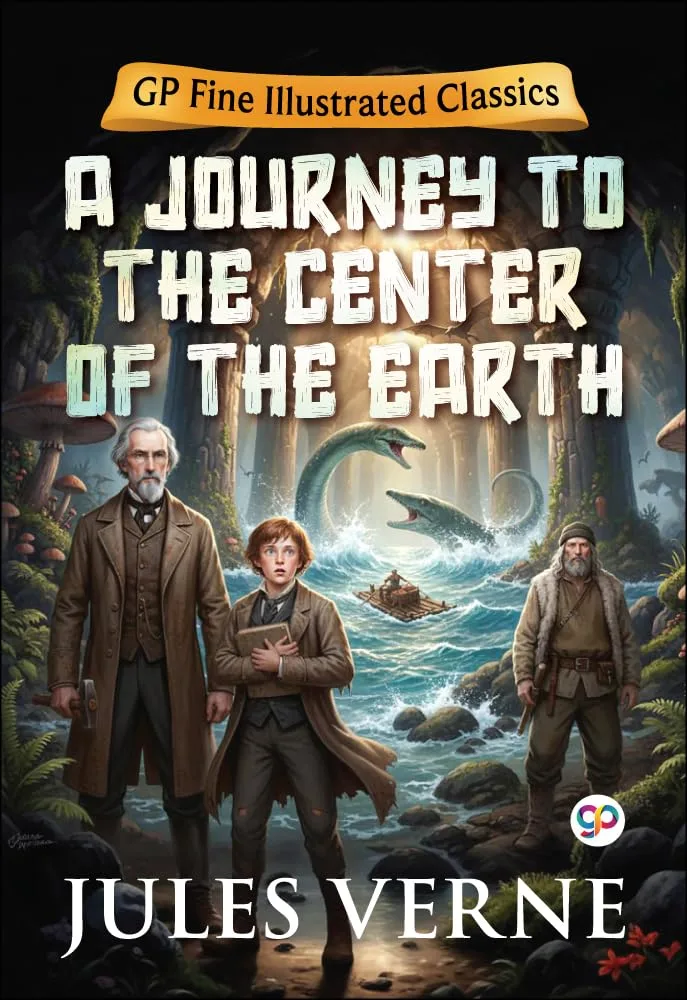
A Journey to the Center of the Earth (GP Fine Illustrated Classics | 50+ Highly Detailed Illustratio...
Hardcover
• 160 Pages
• INR 299.00
• English
• 9788199258150
No ratings yet
| Publisher | General Press |
|---|---|
| ISBN13 | 9788199258150 |
| ASIN/SKU | 8199258152 |
| Book Format | Hardcover |
| Language | English |
| Pages | 160 |
| List Price | INR 299.00 |
| Subject Code | JUV007000, JUV001010, FIC098040 |
| Dimensions | 8.25 x 5.25 x 1.0 inches |
| Book Code | BD00067564 |
Buy this Book
Amazon Stores
Ebook Stores
Other Stores
Discover A Journey to the Center of the Earth (GP Fine Illustrated Classics | 50+ Highly Detailed Illustrations | Hardcover) by Jules Verne. This book is published by General Press in Hardcover format, ISBN 9788199258150, ASIN 8199258152, under Children's Books, Children's Fiction, Children's Classics.
Book Description
Jules Verne’s A Journey to the Center of the Earth is a thrilling testament to human curiosity, blending scientific wonder with the timeless thrill of exploration. The story follows eccentric, fiercely driven German geologist Professor Otto Lidenbrock. Discovering a cryptic, centuries-old manuscript by an Icelandic alchemist, he deciphers a breathtaking secret: a direct path to the Earth's core.
Dragging along his cautious, highly reluctant nephew, Axel, the professor rushes to Iceland. There, they hire Hans, a profoundly stoic and dependable local guide whose quiet strength anchors the trio. Together, they descend into the crater of a dormant volcano, leaving the sunlit world behind.
What follows is a grueling yet magical descent into the unknown. They battle crushing thirst, paralyzing claustrophobia, and the terrifying prospect of being lost in absolute darkness. However, their struggles are rewarded when they stumble upon a staggering subterranean world. Hidden miles beneath the surface lies a vast, luminous ocean enclosed by a cavern of impossible proportions. Here, time has stood still. The travelers witness towering forests of giant mushrooms, weather fierce subterranean storms, and watch prehistoric sea monsters battle in the ancient waters.
Ultimately, an erupting volcano propels them safely back to the surface in Italy. Beyond its science fiction elements, the novel remains a deeply human story about overcoming our deepest fears, the enduring bond of companionship, and the insatiable desire to uncover the unknown.
Dragging along his cautious, highly reluctant nephew, Axel, the professor rushes to Iceland. There, they hire Hans, a profoundly stoic and dependable local guide whose quiet strength anchors the trio. Together, they descend into the crater of a dormant volcano, leaving the sunlit world behind.
What follows is a grueling yet magical descent into the unknown. They battle crushing thirst, paralyzing claustrophobia, and the terrifying prospect of being lost in absolute darkness. However, their struggles are rewarded when they stumble upon a staggering subterranean world. Hidden miles beneath the surface lies a vast, luminous ocean enclosed by a cavern of impossible proportions. Here, time has stood still. The travelers witness towering forests of giant mushrooms, weather fierce subterranean storms, and watch prehistoric sea monsters battle in the ancient waters.
Ultimately, an erupting volcano propels them safely back to the surface in Italy. Beyond its science fiction elements, the novel remains a deeply human story about overcoming our deepest fears, the enduring bond of companionship, and the insatiable desire to uncover the unknown.
Author Biography
Jules Verne (1828–1905) is celebrated as one of the founding fathers of modern science fiction and adventure literature. Born on February 8, 1828, in Nantes, France, Verne was the eldest of five children in a middle-class family. His father, a lawyer, expected him to follow the same career, but young Jules was fascinated by travel, technology, and stories of exploration. Though he began law studies in Paris, he was drawn into literary circles, befriending authors such as Alexandre Dumas, which encouraged his early plays and short stories.
In his middle life, Verne developed the unique narrative style that would define his legacy. His breakthrough came in 1863 with Five Weeks in a Balloon, published by Pierre-Jules Hetzel. This partnership launched his famous series Voyages Extraordinaires, which included many of his most celebrated novels. Among them are Journey to the Center of the Earth (1864), From the Earth to the Moon (1865), Twenty Thousand Leagues Under the Seas (1870), and Around the World in Eighty Days (1873). These works combined adventure with scientific speculation, blending accurate research with imaginative foresight. Verne predicted technologies such as submarines, space travel, and advanced exploration long before they were realized, earning him the title “the father of science fiction,” alongside H.G. Wells.
Verne’s achievements were not limited to his imagination. His novels were translated into multiple languages, making him one of the most widely read authors of his time. He became a cultural icon, admired for his ability to inspire curiosity about science, geography, and human progress. In his later years, despite suffering from health issues and partial blindness, he continued to write prolifically, producing over 60 novels.
Jules Verne died on March 24, 1905, in Amiens, France, leaving behind a literary treasure that continues to inspire readers, writers, and scientists worldwide.
In his middle life, Verne developed the unique narrative style that would define his legacy. His breakthrough came in 1863 with Five Weeks in a Balloon, published by Pierre-Jules Hetzel. This partnership launched his famous series Voyages Extraordinaires, which included many of his most celebrated novels. Among them are Journey to the Center of the Earth (1864), From the Earth to the Moon (1865), Twenty Thousand Leagues Under the Seas (1870), and Around the World in Eighty Days (1873). These works combined adventure with scientific speculation, blending accurate research with imaginative foresight. Verne predicted technologies such as submarines, space travel, and advanced exploration long before they were realized, earning him the title “the father of science fiction,” alongside H.G. Wells.
Verne’s achievements were not limited to his imagination. His novels were translated into multiple languages, making him one of the most widely read authors of his time. He became a cultural icon, admired for his ability to inspire curiosity about science, geography, and human progress. In his later years, despite suffering from health issues and partial blindness, he continued to write prolifically, producing over 60 novels.
Jules Verne died on March 24, 1905, in Amiens, France, leaving behind a literary treasure that continues to inspire readers, writers, and scientists worldwide.
Editorial Reviews
Editorial Reviews will be added soon…
Book Summary
A Journey to the Center of the Earth by Jules Verne is a thrilling science-fiction adventure that takes readers deep beneath the surface of our planet into a world of ancient creatures, enormous underground landscapes, mysterious seas, and dangerous natural forces. The GP Fine Illustrated Classics edition, with more than 50 detailed illustrations, brings this classic journey vividly to life, making the strange underground world easier to imagine. At the heart of the story is Professor Otto Lidenbrock, a brilliant but impatient scientist, and his young nephew Axel, who is much more cautious and doubtful. Their extraordinary expedition begins with a mysterious message and eventually leads them into one of the most imaginative journeys in classic literature.
The story opens in Hamburg, Germany, where Axel lives with his uncle, Professor Lidenbrock, a respected professor of mineralogy. Although Axel cares deeply for his uncle, he finds him intimidating because of his intense personality and obsession with scientific discovery. One day, Lidenbrock discovers an old Icelandic manuscript containing a coded message written by Arne Saknussemm, a sixteenth-century Icelandic alchemist and explorer. After working out the meaning of the message, the professor becomes convinced that Saknussemm discovered a route leading to the center of the Earth.
The idea seems impossible to Axel. He believes that the extreme heat and pressure deep inside the Earth would make such a journey fatal. He tries to explain the dangers to his uncle, but Lidenbrock is fascinated rather than discouraged. For him, the possibility of following in Saknussemm’s footsteps is an opportunity that cannot be ignored. Soon, he decides that he and Axel must travel to Iceland and find the entrance described in the mysterious document.
Axel is not enthusiastic about the expedition, especially because he is secretly in love with a young woman named Grauben. He worries that the journey will separate him from her forever. Grauben, however, encourages him to accompany his uncle. She understands that the adventure may be dangerous, but she also recognizes that Axel must face his fears and discover his own courage.
The travelers eventually reach Iceland, where they find the entrance to the underground world at the crater of the extinct volcano Snæfellsjökull. There they are joined by Hans, a calm and dependable Icelandic guide. Hans is almost the opposite of Professor Lidenbrock. While the professor is energetic, impatient, and constantly searching for scientific discoveries, Hans is quiet, practical, and remarkably steady in dangerous situations. His presence becomes essential to the survival of the expedition.
The descent into the Earth is difficult from the beginning. The travelers move through dark volcanic passages, carrying limited supplies and depending on the professor’s knowledge and the clues left by Saknussemm. They soon become separated from one another when Axel takes a wrong path and finds himself alone in the darkness. This section of the story is particularly frightening because Axel has no idea where he is or whether he will ever see his companions again. His fear, loneliness, and desperation make the underground world feel almost endless.
Eventually, Axel is reunited with Lidenbrock and Hans, but the journey becomes even more extraordinary. Instead of simply finding a series of tunnels leading downward, they discover a vast underground landscape unlike anything on the surface. They encounter enormous caverns and a subterranean sea. The sight is both beautiful and terrifying, suggesting that the Earth contains entire worlds hidden from human knowledge.
The underground sea becomes one of the most memorable parts of the expedition. Lidenbrock, Axel, and Hans build a raft and sail across it, surrounded by enormous geological formations. They observe strange atmospheric conditions and encounter prehistoric creatures living in the water. Among the most frightening discoveries are giant marine animals that appear to belong to an ancient age of the Earth. The travelers witness a dramatic struggle between huge creatures, reminding them that they are entering a world where human beings are small and vulnerable.
As they continue, they discover evidence suggesting that prehistoric life once existed in this underground environment. They see giant mushrooms, ancient vegetation, and the remains of creatures that appear to belong to Earth's distant past. The discoveries are scientifically astonishing for Professor Lidenbrock. For Axel, however, they are reminders that their journey has taken them far beyond anything they could have imagined.
The travelers also encounter traces of human presence. They find evidence that Arne Saknussemm really did travel through these regions centuries earlier. This discovery gives Lidenbrock renewed confidence that they are following the correct route. The expedition is no longer simply an experiment; they are retracing the path of another explorer who faced the same extraordinary dangers.
Their progress is repeatedly threatened by natural disasters. At one point, an earthquake or violent geological disturbance separates the travelers from their planned route. Later, they encounter obstacles that make it seem impossible to continue. The Earth itself becomes the main antagonist of the story. There is no villain manipulating events; instead, the characters must survive darkness, hunger, thirst, underground storms, collapsing passages, and volcanic forces.
One of the most dramatic episodes occurs when the explorers reach a passage that has been deliberately blocked. They use explosives to clear the obstruction, hoping to open a route forward. Instead, the explosion triggers a terrifying chain of events. Water rushes into the passage, carrying the travelers along with tremendous force. They have little control over their movement and are swept through an underground system at terrifying speed.
Eventually, the force of the underground water carries them upward through a volcanic passage. They emerge unexpectedly on the surface, not in Iceland as they had expected, but near Stromboli in the Mediterranean. Their journey has therefore taken them through an immense underground world and returned them to the surface through an active volcano.
The expedition becomes a scientific triumph for Professor Lidenbrock, even though the travelers never actually reach the exact center of the Earth. They have nevertheless discovered a hidden world filled with geological and prehistoric wonders. Their experiences provide evidence that the planet is far more mysterious and complex than people of their time understood.
Axel also changes profoundly during the journey. At the beginning, he is fearful, hesitant, and dependent on his uncle. By the end, he has developed courage, endurance, and confidence. The adventure forces him to confront dangers that cannot be avoided simply by being cautious. His relationship with Lidenbrock also gains a deeper dimension, as the two men learn to depend on one another.
Ultimately, A Journey to the Center of the Earth is more than an adventure story. It is a celebration of curiosity and the human desire to explore the unknown. Jules Verne combines scientific ideas with fantasy, creating a world in which geology, paleontology, adventure, and imagination come together. Professor Lidenbrock represents the relentless pursuit of knowledge, while Axel represents the ordinary person who is frightened by the unknown but discovers courage by confronting it. Hans provides the practical wisdom that keeps them alive.
The lasting appeal of the novel comes from this combination of wonder and danger. Verne invites readers to imagine that beneath the familiar world lies another world waiting to be discovered. The journey may never reach the literal center of the planet, but it reaches something equally important: the limits of human imagination. Through Axel’s transformation and Lidenbrock’s determination, the story suggests that exploration is valuable not only because of what we discover, but also because of what the journey teaches us about ourselves.
The story opens in Hamburg, Germany, where Axel lives with his uncle, Professor Lidenbrock, a respected professor of mineralogy. Although Axel cares deeply for his uncle, he finds him intimidating because of his intense personality and obsession with scientific discovery. One day, Lidenbrock discovers an old Icelandic manuscript containing a coded message written by Arne Saknussemm, a sixteenth-century Icelandic alchemist and explorer. After working out the meaning of the message, the professor becomes convinced that Saknussemm discovered a route leading to the center of the Earth.
The idea seems impossible to Axel. He believes that the extreme heat and pressure deep inside the Earth would make such a journey fatal. He tries to explain the dangers to his uncle, but Lidenbrock is fascinated rather than discouraged. For him, the possibility of following in Saknussemm’s footsteps is an opportunity that cannot be ignored. Soon, he decides that he and Axel must travel to Iceland and find the entrance described in the mysterious document.
Axel is not enthusiastic about the expedition, especially because he is secretly in love with a young woman named Grauben. He worries that the journey will separate him from her forever. Grauben, however, encourages him to accompany his uncle. She understands that the adventure may be dangerous, but she also recognizes that Axel must face his fears and discover his own courage.
The travelers eventually reach Iceland, where they find the entrance to the underground world at the crater of the extinct volcano Snæfellsjökull. There they are joined by Hans, a calm and dependable Icelandic guide. Hans is almost the opposite of Professor Lidenbrock. While the professor is energetic, impatient, and constantly searching for scientific discoveries, Hans is quiet, practical, and remarkably steady in dangerous situations. His presence becomes essential to the survival of the expedition.
The descent into the Earth is difficult from the beginning. The travelers move through dark volcanic passages, carrying limited supplies and depending on the professor’s knowledge and the clues left by Saknussemm. They soon become separated from one another when Axel takes a wrong path and finds himself alone in the darkness. This section of the story is particularly frightening because Axel has no idea where he is or whether he will ever see his companions again. His fear, loneliness, and desperation make the underground world feel almost endless.
Eventually, Axel is reunited with Lidenbrock and Hans, but the journey becomes even more extraordinary. Instead of simply finding a series of tunnels leading downward, they discover a vast underground landscape unlike anything on the surface. They encounter enormous caverns and a subterranean sea. The sight is both beautiful and terrifying, suggesting that the Earth contains entire worlds hidden from human knowledge.
The underground sea becomes one of the most memorable parts of the expedition. Lidenbrock, Axel, and Hans build a raft and sail across it, surrounded by enormous geological formations. They observe strange atmospheric conditions and encounter prehistoric creatures living in the water. Among the most frightening discoveries are giant marine animals that appear to belong to an ancient age of the Earth. The travelers witness a dramatic struggle between huge creatures, reminding them that they are entering a world where human beings are small and vulnerable.
As they continue, they discover evidence suggesting that prehistoric life once existed in this underground environment. They see giant mushrooms, ancient vegetation, and the remains of creatures that appear to belong to Earth's distant past. The discoveries are scientifically astonishing for Professor Lidenbrock. For Axel, however, they are reminders that their journey has taken them far beyond anything they could have imagined.
The travelers also encounter traces of human presence. They find evidence that Arne Saknussemm really did travel through these regions centuries earlier. This discovery gives Lidenbrock renewed confidence that they are following the correct route. The expedition is no longer simply an experiment; they are retracing the path of another explorer who faced the same extraordinary dangers.
Their progress is repeatedly threatened by natural disasters. At one point, an earthquake or violent geological disturbance separates the travelers from their planned route. Later, they encounter obstacles that make it seem impossible to continue. The Earth itself becomes the main antagonist of the story. There is no villain manipulating events; instead, the characters must survive darkness, hunger, thirst, underground storms, collapsing passages, and volcanic forces.
One of the most dramatic episodes occurs when the explorers reach a passage that has been deliberately blocked. They use explosives to clear the obstruction, hoping to open a route forward. Instead, the explosion triggers a terrifying chain of events. Water rushes into the passage, carrying the travelers along with tremendous force. They have little control over their movement and are swept through an underground system at terrifying speed.
Eventually, the force of the underground water carries them upward through a volcanic passage. They emerge unexpectedly on the surface, not in Iceland as they had expected, but near Stromboli in the Mediterranean. Their journey has therefore taken them through an immense underground world and returned them to the surface through an active volcano.
The expedition becomes a scientific triumph for Professor Lidenbrock, even though the travelers never actually reach the exact center of the Earth. They have nevertheless discovered a hidden world filled with geological and prehistoric wonders. Their experiences provide evidence that the planet is far more mysterious and complex than people of their time understood.
Axel also changes profoundly during the journey. At the beginning, he is fearful, hesitant, and dependent on his uncle. By the end, he has developed courage, endurance, and confidence. The adventure forces him to confront dangers that cannot be avoided simply by being cautious. His relationship with Lidenbrock also gains a deeper dimension, as the two men learn to depend on one another.
Ultimately, A Journey to the Center of the Earth is more than an adventure story. It is a celebration of curiosity and the human desire to explore the unknown. Jules Verne combines scientific ideas with fantasy, creating a world in which geology, paleontology, adventure, and imagination come together. Professor Lidenbrock represents the relentless pursuit of knowledge, while Axel represents the ordinary person who is frightened by the unknown but discovers courage by confronting it. Hans provides the practical wisdom that keeps them alive.
The lasting appeal of the novel comes from this combination of wonder and danger. Verne invites readers to imagine that beneath the familiar world lies another world waiting to be discovered. The journey may never reach the literal center of the planet, but it reaches something equally important: the limits of human imagination. Through Axel’s transformation and Lidenbrock’s determination, the story suggests that exploration is valuable not only because of what we discover, but also because of what the journey teaches us about ourselves.
Sample Chapters
Sample Chapters will be added soon…
Reader Reviews
No reviews yet.
A Journey to the Center of the Earth (GP Fine Illustrated Classics | 50+ Highly Detailed Illustrations | Hardcover)
Download Cover Image
Do you want to download the full cover image for A Journey to the Center of the Earth (GP Fine Illustrated Classics | 50+ Highly Detailed Illustrations | Hardcover)?