
The Red Badge of Courage
Hardcover
• 160 Pages
• INR 345.00
• English
• 9789354990212
No ratings yet
| Publisher | General Press |
|---|---|
| ISBN13 | 9789354990212 |
| ASIN/SKU | 9354990215 |
| Book Format | Hardcover |
| Language | English |
| Pages | 160 |
| List Price | INR 345.00 |
| Subject Code | FIC042080, FIC014000, FIC019000 |
| Publishing Date | 15/09/2021 |
| Dimensions | 8.25 x 5.25 x 1.0 inches |
| Book Code | BD00067576 |
Buy this Book
Amazon Stores
Ebook Stores
Other Stores
Discover The Red Badge of Courage by Stephen Crane. This book is published by General Press in Hardcover format, ISBN 9789354990212, ASIN 9354990215, under Mystery, Thriller and Suspense.
Book Description
Written by Stephen Crane at the age of twenty-one, The Red Badge of Courage is one of the greatest war novels of all time-so groundbreaking that critics consider it to be the first work of modern American fiction. It is a realistic and terrifying account of the Civil War and the fear that a young soldier must face on the battlefield as well as within himself. It is a classic modern depiction of the psychological turmoil of war from the perspective of an ordinary soldier.
The story revolves around Henry Fleming, a member of the 304th regiment of the Union Army, serving during the American Civil War. At the start of the novel Henry is eager to show his patriotism in battle but when faced with the savagery of death, he flees the frontline. Ashamed of his behavior, Henry spends the rest of the life trying to redeem his earlier cowardice.
Instantly popular from its original publication, brought Crane instant notoriety in the United States and abroad. Although Stephen Crane did not participate in any Civil War battles, the novel is known for its realistic portrayal of the battlefield.
The story revolves around Henry Fleming, a member of the 304th regiment of the Union Army, serving during the American Civil War. At the start of the novel Henry is eager to show his patriotism in battle but when faced with the savagery of death, he flees the frontline. Ashamed of his behavior, Henry spends the rest of the life trying to redeem his earlier cowardice.
Instantly popular from its original publication, brought Crane instant notoriety in the United States and abroad. Although Stephen Crane did not participate in any Civil War battles, the novel is known for its realistic portrayal of the battlefield.
Author Biography
Stephen Crane (November 1, 1871 – June 5, 1900) was an American poet, novelist, and short story writer. Prolific throughout his short life, he wrote notable works in the Realist tradition as well as early examples of American Naturalism and Impressionism. He is recognized by modern critics as one of the most innovative writers of his generation.
The ninth surviving child of Protestant Methodist parents, Crane began writing at the age of four and had published several articles by the age of 16. Having little interest in university studies, he left college in 1891 to work as a reporter and writer. Crane's first novel was the 1893 Bowery tale Maggie: A Girl of the Streets, generally considered by critics to be the first work of American literary Naturalism. He won international acclaim in 1895 for his Civil War novel The Red Badge of Courage, which he wrote without having any battle experience.
In 1896, Crane endured a highly publicized scandal after appearing as a witness in the trial of a suspected prostitute, an acquaintance named Dora Clark. Late that year he accepted an offer to travel to Cuba as a war correspondent. As he waited in Jacksonville, Florida, for passage, he met Cora Taylor, with whom he began a lasting relationship. En route to Cuba, Crane's vessel the SS Commodore, sank off the coast of Florida, leaving him and others adrift for 30 hours in a dinghy. Crane described the ordeal in "The Open Boat". During the final years of his life, he covered conflicts in Greece (accompanied by Cora, recognized as the first woman war correspondent) and later lived in England with her. He was befriended by writers such as Joseph Conrad and H. G. Wells. Plagued by financial difficulties and ill health, Crane died of tuberculosis in a Black Forest sanatorium in Germany at the age of 28.
At the time of his death, Crane was considered an important figure in American literature. After he was nearly forgotten for two decades, critics revived interest in his life and work. Crane's writing is characterized by vivid intensity, distinctive dialects, and irony. Common themes involve fear, spiritual crises and social isolation. Although recognized primarily for The Red Badge of Courage, which has become an American classic, Crane is also known for his poetry, journalism, and short stories such as "The Open Boat", "The Blue Hotel", "The Bride Comes to Yellow Sky", and The Monster. His writing made a deep impression on 20th-century writers, most prominent among them Ernest Hemingway, and is thought to have inspired the Modernists and the Imagists.
Bio from Wikipedia, the free encyclopedia. Photo by unknown author [Public domain], via Wikimedia Commons.
The ninth surviving child of Protestant Methodist parents, Crane began writing at the age of four and had published several articles by the age of 16. Having little interest in university studies, he left college in 1891 to work as a reporter and writer. Crane's first novel was the 1893 Bowery tale Maggie: A Girl of the Streets, generally considered by critics to be the first work of American literary Naturalism. He won international acclaim in 1895 for his Civil War novel The Red Badge of Courage, which he wrote without having any battle experience.
In 1896, Crane endured a highly publicized scandal after appearing as a witness in the trial of a suspected prostitute, an acquaintance named Dora Clark. Late that year he accepted an offer to travel to Cuba as a war correspondent. As he waited in Jacksonville, Florida, for passage, he met Cora Taylor, with whom he began a lasting relationship. En route to Cuba, Crane's vessel the SS Commodore, sank off the coast of Florida, leaving him and others adrift for 30 hours in a dinghy. Crane described the ordeal in "The Open Boat". During the final years of his life, he covered conflicts in Greece (accompanied by Cora, recognized as the first woman war correspondent) and later lived in England with her. He was befriended by writers such as Joseph Conrad and H. G. Wells. Plagued by financial difficulties and ill health, Crane died of tuberculosis in a Black Forest sanatorium in Germany at the age of 28.
At the time of his death, Crane was considered an important figure in American literature. After he was nearly forgotten for two decades, critics revived interest in his life and work. Crane's writing is characterized by vivid intensity, distinctive dialects, and irony. Common themes involve fear, spiritual crises and social isolation. Although recognized primarily for The Red Badge of Courage, which has become an American classic, Crane is also known for his poetry, journalism, and short stories such as "The Open Boat", "The Blue Hotel", "The Bride Comes to Yellow Sky", and The Monster. His writing made a deep impression on 20th-century writers, most prominent among them Ernest Hemingway, and is thought to have inspired the Modernists and the Imagists.
Bio from Wikipedia, the free encyclopedia. Photo by unknown author [Public domain], via Wikimedia Commons.
Editorial Reviews
Editorial Reviews will be added soon…
Book Summary
When Stephen Crane published The Red Badge of Courage in 1895, he did something entirely revolutionary. He did not write a sprawling historical epic filled with brilliant generals, sweeping cavalry charges, or neat moral lessons about the American Civil War. Instead, Crane, who had never actually seen a day of combat when he penned the novel, gave readers a deeply psychological, startlingly intimate portrait of war through the eyes of a single, terrified teenage boy. It is a story not about the grand politics of the North and the South, but about the messy human landscape of fear, shame, and the desperate search for identity.
The Illusion of Glory
Our protagonist is Henry Fleming, known throughout the novel simply as "the youth." Like many young men before him, Henry enlists in the Union Army with a head full of romanticized, classical ideas about war. He dreams of epic heroism and returning home draped in glory. His mother, however, offers no such romantic send-off. She packs his socks, tells him to avoid bad company, and reminds him not to shirk his duties. Her grounded, tearful farewell is the first crack in his grand illusion.
Once in camp, Henry’s dreams of immediate glory are quickly suffocated by the crushing, mundane reality of military life. For months, his New York regiment does nothing but sit in the mud, drill, and wait. The camp becomes a breeding ground for rumors, led by characters like the boisterous Jim Conklin and the argumentative Wilson. In this agonizing stillness, Henry is left alone with his thoughts, and a terrible, gnawing doubt begins to consume him. He wonders what he will do when the bullets actually start flying. Will he stand and fight, or will he turn and run like a coward? He realizes, to his absolute horror, that he simply does not know himself.
The First Test and the Flight
Eventually, the endless waiting breaks. The regiment is marched out, and the chaotic, disorienting reality of combat finally descends. Crane paints battle not as a grand chessboard, but as a blinding, deafening monster of smoke, noise, and confusion. When the first Confederate charge comes, Henry manages to hold his ground. Operating almost purely on instinct, he fires his rifle blindly into the smoke, feeling a sudden, intoxicating sense of brotherhood with the men beside him. He survives the skirmish and feels an immense wave of self-satisfaction. He has passed the test.
But the relief is a cruel illusion. Almost immediately, a second, more ferocious enemy charge surges toward their lines. This time, the exhaustion, the terrifying noise, and the sheer overwhelming force of the attack shatter Henry's fragile nerve. He sees a few men near him break and flee, and panic takes hold of him like a physical disease. Henry drops his rifle and runs. He flees blindly through the woods, terrified of being shot in the back. In his panicked mind, he rationalizes his cowardice, convincing himself that the regiment was doomed anyway and that running was the only logical thing to do for self-preservation.
The Forest and the Red Badge
Deep in the quiet woods, Henry seeks comfort in nature, but the forest offers no true sanctuary. In one of the novel’s most haunting scenes, he pushes his way into a serene, chapel-like clearing of trees, only to come face-to-face with a decaying, ant-covered corpse staring up at the sky. It is a grotesque reminder that death is inescapable.
Hearing the roar of the battle continue, a strange mixture of guilt and curiosity draws Henry back toward the fighting. He falls in with a column of wounded, bleeding men limping away from the front. Among them is a deeply injured "tattered soldier" who innocently asks Henry where he is wounded. The question pierces Henry like a knife. He has no physical wound; his only injury is to his pride. His shame is absolute.
In this grim procession, Henry also reunites with Jim Conklin from his camp. Jim is mortally wounded, wandering in a ghostly, trancelike state. Henry watches in helpless agony as Jim collapses and dies in a field. This traumatic loss breaks Henry. Surrounding him are men who have proved their courage in blood. Henry desperately wishes for his own wound—a "red badge of courage"—to outwardly legitimize his inner turmoil and cover his cowardly secret. Ironically, he receives this badge not from the enemy, but from a panicked Union soldier fleeing a skirmish, who bashes Henry over the head with a rifle butt.
Return and Redemption
Bloody and dazed, Henry stumbles back to his regiment. The men welcome him, believing his head wound is a genuine battle injury. Wilson, who has now been humbled by the fighting, tenderly cares for Henry. This undeserved kindness compounds Henry’s internal guilt, yet he leans into the lie, using his fake badge as a shield against their judgment.
The next day, Henry’s psychological state shifts radically. Driven by a volatile cocktail of lingering shame, suppressed anger, and a bizarre, almost detached hatred for the enemy, Henry fights like a wild, possessed animal. When the color-bearer falls during a desperate charge, Henry and Wilson scramble to seize the regiment’s flag. Henry carries the colors forward, rallying the men and surviving a harrowing skirmish.
In the quiet aftermath of the battle, Henry reflects on his turbulent journey over the past few days. He has touched the great, terrible death and found that he is no longer a naive boy, but a man who has finally made a quiet peace with his own very human flaws. He realizes that his previous, romantic ideas of heroism were nothing but childish illusions. Crane leaves his readers with a profoundly humane, enduring understanding: courage is not the total absence of fear, nor is it a gleaming medal won without a moment of doubt. True courage is a messy, flawed, and deeply internal struggle, born only after we strip away our pride and confront our own darkest, most shameful failures.
The Illusion of Glory
Our protagonist is Henry Fleming, known throughout the novel simply as "the youth." Like many young men before him, Henry enlists in the Union Army with a head full of romanticized, classical ideas about war. He dreams of epic heroism and returning home draped in glory. His mother, however, offers no such romantic send-off. She packs his socks, tells him to avoid bad company, and reminds him not to shirk his duties. Her grounded, tearful farewell is the first crack in his grand illusion.
Once in camp, Henry’s dreams of immediate glory are quickly suffocated by the crushing, mundane reality of military life. For months, his New York regiment does nothing but sit in the mud, drill, and wait. The camp becomes a breeding ground for rumors, led by characters like the boisterous Jim Conklin and the argumentative Wilson. In this agonizing stillness, Henry is left alone with his thoughts, and a terrible, gnawing doubt begins to consume him. He wonders what he will do when the bullets actually start flying. Will he stand and fight, or will he turn and run like a coward? He realizes, to his absolute horror, that he simply does not know himself.
The First Test and the Flight
Eventually, the endless waiting breaks. The regiment is marched out, and the chaotic, disorienting reality of combat finally descends. Crane paints battle not as a grand chessboard, but as a blinding, deafening monster of smoke, noise, and confusion. When the first Confederate charge comes, Henry manages to hold his ground. Operating almost purely on instinct, he fires his rifle blindly into the smoke, feeling a sudden, intoxicating sense of brotherhood with the men beside him. He survives the skirmish and feels an immense wave of self-satisfaction. He has passed the test.
But the relief is a cruel illusion. Almost immediately, a second, more ferocious enemy charge surges toward their lines. This time, the exhaustion, the terrifying noise, and the sheer overwhelming force of the attack shatter Henry's fragile nerve. He sees a few men near him break and flee, and panic takes hold of him like a physical disease. Henry drops his rifle and runs. He flees blindly through the woods, terrified of being shot in the back. In his panicked mind, he rationalizes his cowardice, convincing himself that the regiment was doomed anyway and that running was the only logical thing to do for self-preservation.
The Forest and the Red Badge
Deep in the quiet woods, Henry seeks comfort in nature, but the forest offers no true sanctuary. In one of the novel’s most haunting scenes, he pushes his way into a serene, chapel-like clearing of trees, only to come face-to-face with a decaying, ant-covered corpse staring up at the sky. It is a grotesque reminder that death is inescapable.
Hearing the roar of the battle continue, a strange mixture of guilt and curiosity draws Henry back toward the fighting. He falls in with a column of wounded, bleeding men limping away from the front. Among them is a deeply injured "tattered soldier" who innocently asks Henry where he is wounded. The question pierces Henry like a knife. He has no physical wound; his only injury is to his pride. His shame is absolute.
In this grim procession, Henry also reunites with Jim Conklin from his camp. Jim is mortally wounded, wandering in a ghostly, trancelike state. Henry watches in helpless agony as Jim collapses and dies in a field. This traumatic loss breaks Henry. Surrounding him are men who have proved their courage in blood. Henry desperately wishes for his own wound—a "red badge of courage"—to outwardly legitimize his inner turmoil and cover his cowardly secret. Ironically, he receives this badge not from the enemy, but from a panicked Union soldier fleeing a skirmish, who bashes Henry over the head with a rifle butt.
Return and Redemption
Bloody and dazed, Henry stumbles back to his regiment. The men welcome him, believing his head wound is a genuine battle injury. Wilson, who has now been humbled by the fighting, tenderly cares for Henry. This undeserved kindness compounds Henry’s internal guilt, yet he leans into the lie, using his fake badge as a shield against their judgment.
The next day, Henry’s psychological state shifts radically. Driven by a volatile cocktail of lingering shame, suppressed anger, and a bizarre, almost detached hatred for the enemy, Henry fights like a wild, possessed animal. When the color-bearer falls during a desperate charge, Henry and Wilson scramble to seize the regiment’s flag. Henry carries the colors forward, rallying the men and surviving a harrowing skirmish.
In the quiet aftermath of the battle, Henry reflects on his turbulent journey over the past few days. He has touched the great, terrible death and found that he is no longer a naive boy, but a man who has finally made a quiet peace with his own very human flaws. He realizes that his previous, romantic ideas of heroism were nothing but childish illusions. Crane leaves his readers with a profoundly humane, enduring understanding: courage is not the total absence of fear, nor is it a gleaming medal won without a moment of doubt. True courage is a messy, flawed, and deeply internal struggle, born only after we strip away our pride and confront our own darkest, most shameful failures.
Sample Chapters
Sample Chapters will be added soon…
Reader Reviews
No reviews yet.
The Red Badge of Courage
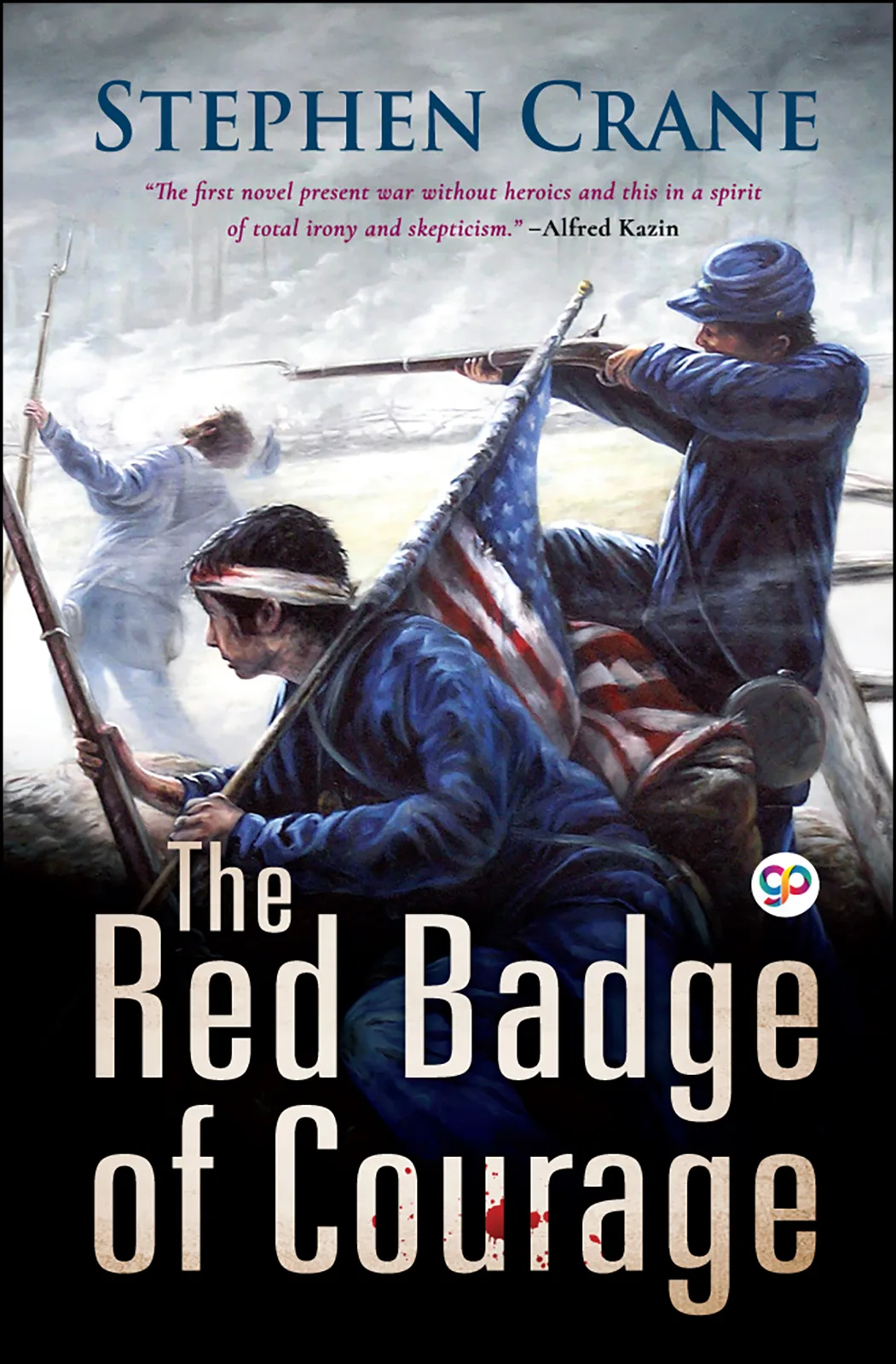
Download Cover Image
Do you want to download the full cover image for The Red Badge of Courage?