
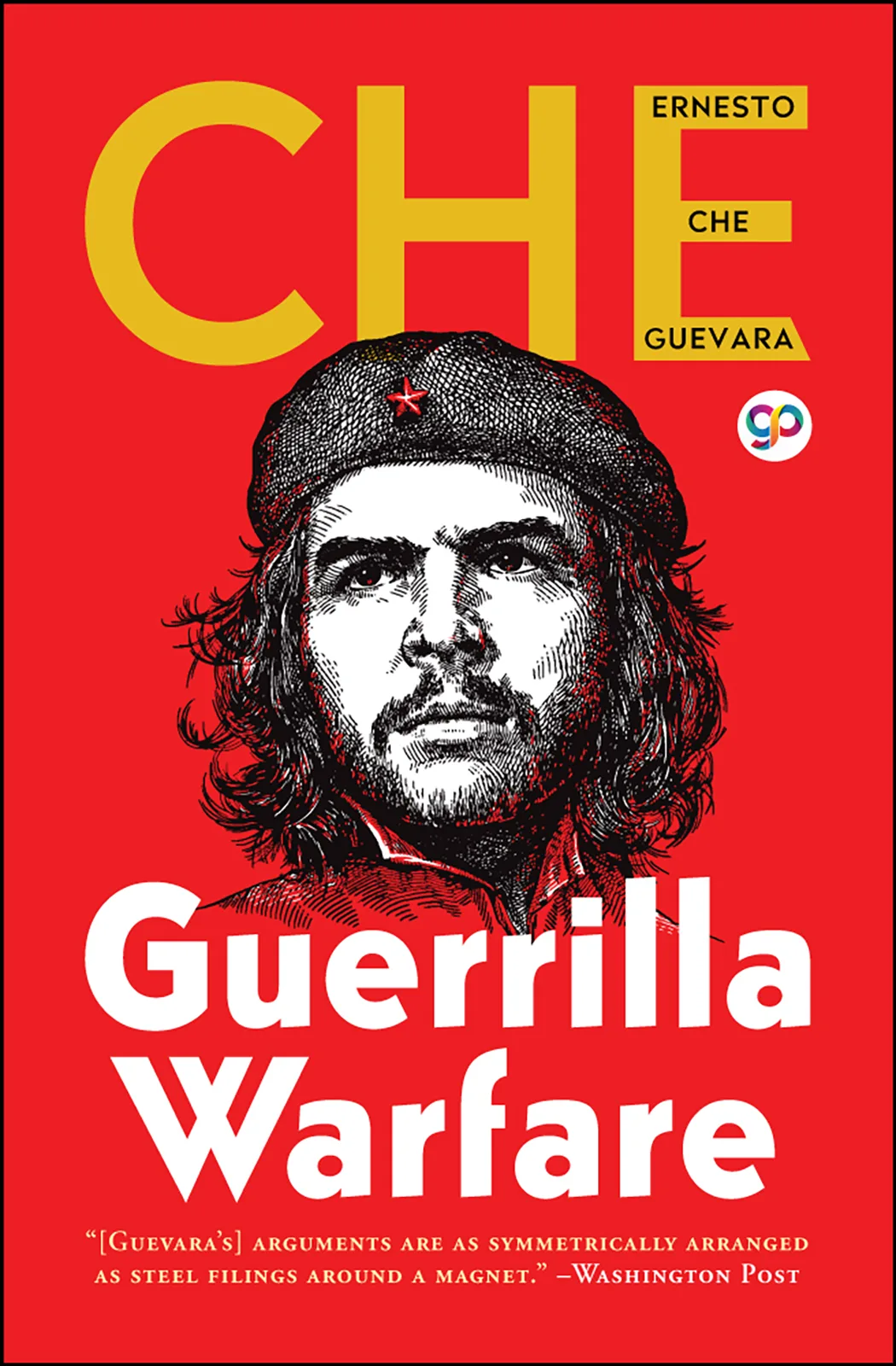
Guerrilla Warfare
Paperback
• 144 Pages
• INR 245.00
• English
• 9789354990366
No ratings yet
| Publisher | General Press |
|---|---|
| ISBN13 | 9789354990366 |
| ASIN/SKU | 9354990363 |
| Book Format | Paperback |
| Language | English |
| Pages | 144 |
| List Price | INR 245.00 |
| Subject Code | HIS027060, POL005000, BIO006000 |
| Publishing Date | 15/09/2021 |
| Dimensions | 8.25 x 5.25 x 1.0 inches |
| Book Code | BD00067581 |
Buy this Book
Amazon Stores
Ebook Stores
Other Stores
Discover Guerrilla Warfare by Ernesto Che Guevara. This book is published by General Press in Paperback format, ISBN 9789354990366, ASIN 9354990363, under History, Military Strategy History, Communism and Socialism.
Book Description
'Guerrilla Warfare' by Ernesto "Che" Guevara is a landmark work of political and military writing that explains the principles, methods, and philosophy of guerrilla conflict. Drawing heavily on his experiences during the Cuban Revolution, Guevara presents his belief that a small, disciplined, and committed group of fighters can challenge a larger and better-equipped army when supported by the local population. The book combines practical observations with broader reflections on revolution, leadership, and social change.
Throughout the book, Guevara discusses how guerrilla movements are organized, trained, and sustained. He explains the importance of mobility, secrecy, intelligence gathering, and adapting to difficult terrain. At the same time, he emphasizes that successful guerrilla campaigns depend not only on military tactics but also on earning the trust and cooperation of ordinary people. According to Guevara, discipline, sacrifice, and a clear political purpose are essential qualities for those involved in revolutionary struggles.
Beyond its discussion of military strategy, the book reflects Guevara's vision of revolution as a response to social inequality and political oppression. His ideas are presented as both a practical guide and a statement of his revolutionary beliefs, making the work influential far beyond the events that inspired it.
Today, 'Guerrilla Warfare' is read primarily as a historical and political text. It offers valuable insight into Guevara's thinking, the dynamics of the Cuban Revolution, and the development of twentieth-century revolutionary movements. Whether readers agree with its arguments or not, the book remains an important document for understanding a significant chapter in modern history and political thought.
Throughout the book, Guevara discusses how guerrilla movements are organized, trained, and sustained. He explains the importance of mobility, secrecy, intelligence gathering, and adapting to difficult terrain. At the same time, he emphasizes that successful guerrilla campaigns depend not only on military tactics but also on earning the trust and cooperation of ordinary people. According to Guevara, discipline, sacrifice, and a clear political purpose are essential qualities for those involved in revolutionary struggles.
Beyond its discussion of military strategy, the book reflects Guevara's vision of revolution as a response to social inequality and political oppression. His ideas are presented as both a practical guide and a statement of his revolutionary beliefs, making the work influential far beyond the events that inspired it.
Today, 'Guerrilla Warfare' is read primarily as a historical and political text. It offers valuable insight into Guevara's thinking, the dynamics of the Cuban Revolution, and the development of twentieth-century revolutionary movements. Whether readers agree with its arguments or not, the book remains an important document for understanding a significant chapter in modern history and political thought.
Author Biography
Ernesto "Che" Guevara, commonly known as El Che or simply Che, was a Marxist revolutionary, physician, author, intellectual, guerrilla leader, diplomat, and military theorist. A major figure of the Cuban Revolution, since his death Guevara's stylized visage has become an ubiquitous countercultural symbol and global icon within popular culture.
His belief in the necessity of world revolution to advance the interests of the poor prompted his involvement in Guatemala's social reforms under President Jacobo Arbenz, whose eventual CIA-assisted overthrow solidified Guevara's radical ideology. Later, while living in Mexico City, he met Raúl and Fidel Castro, joined their movement, and travelled to Cuba with the intention of overthrowing the U.S.-backed Batista regime. Guevara soon rose to prominence among the insurgents, was promoted to second-in-command, and played a pivotal role in the successful two year guerrilla campaign that topled the Cuban government.
After serving in a number of key roles in the new government, Guevara left Cuba in 1965 to foment revolution abroad, first unsuccessfully in Congo-Kinshasa and later in Bolivia, where he was captured by CIA-assisted Bolivian forces and executed.
Guevara remains both a revered and reviled historical figure, polarized in the collective imagination in a multitude of biographies, memoirs, essays, documentaries, songs, and films. Time magazine named him one of the 100 most influential people of the 20th century, while an Alberto Korda photograph of him entitled "Guerrillero Heroico," was declared "the most famous photograph in the world" by the Maryland Institute of Art.
His belief in the necessity of world revolution to advance the interests of the poor prompted his involvement in Guatemala's social reforms under President Jacobo Arbenz, whose eventual CIA-assisted overthrow solidified Guevara's radical ideology. Later, while living in Mexico City, he met Raúl and Fidel Castro, joined their movement, and travelled to Cuba with the intention of overthrowing the U.S.-backed Batista regime. Guevara soon rose to prominence among the insurgents, was promoted to second-in-command, and played a pivotal role in the successful two year guerrilla campaign that topled the Cuban government.
After serving in a number of key roles in the new government, Guevara left Cuba in 1965 to foment revolution abroad, first unsuccessfully in Congo-Kinshasa and later in Bolivia, where he was captured by CIA-assisted Bolivian forces and executed.
Guevara remains both a revered and reviled historical figure, polarized in the collective imagination in a multitude of biographies, memoirs, essays, documentaries, songs, and films. Time magazine named him one of the 100 most influential people of the 20th century, while an Alberto Korda photograph of him entitled "Guerrillero Heroico," was declared "the most famous photograph in the world" by the Maryland Institute of Art.
Editorial Reviews
Editorial Reviews will be added soon…
Book Summary
"Guerrilla Warfare" by Ernesto Che Guevara is a political and military manual that outlines the principles, strategies, and practical experiences of guerrilla warfare as understood by the Argentine revolutionary following the Cuban Revolution. Drawing heavily on his firsthand involvement in the Cuban revolutionary struggle, Guevara explains how small, mobile groups of fighters can challenge larger and better-equipped military forces under certain political and social conditions. The book is not a conventional narrative but a structured exposition of guerrilla tactics, organisation, discipline, logistics, and the relationship between armed movements and civilian populations. Alongside military guidance, it presents Guevara's broader views on revolution, leadership, and the social circumstances he believed could give rise to armed resistance.
The opening sections introduce Guevara's central argument that guerrilla warfare is more than a military technique; it is closely connected to political objectives and the support of the population. He contends that a small group of committed fighters cannot succeed through military strength alone but must gain the trust and cooperation of local communities. According to Guevara, the effectiveness of a guerrilla movement depends upon its ability to represent the interests of ordinary people, maintain discipline, and operate with a clear sense of purpose. He repeatedly stresses that military action and political organisation should reinforce one another rather than function separately.
Guevara then describes the qualities he considers essential for a guerrilla fighter. Physical endurance, courage, adaptability, patience, and self-discipline are presented as indispensable characteristics for surviving in difficult environments. He emphasises that guerrilla units often operate with limited resources and must therefore rely on careful planning, flexibility, and intimate knowledge of the terrain. Fighters are expected to endure hardship, avoid unnecessary risks, and place the success of the wider movement above personal comfort or ambition. Throughout the discussion, Guevara argues that discipline and unity are vital for maintaining both effectiveness and morale.
A significant portion of the book focuses on the practical organisation of guerrilla forces. Guevara explains how small units can function independently while remaining coordinated within a larger movement. He discusses the importance of selecting secure operating areas, establishing reliable communication, obtaining food and medical supplies, and maintaining mobility to avoid direct confrontation with stronger conventional armies. Rather than engaging in prolonged battles, guerrilla units are encouraged to rely on surprise, careful timing, and rapid movement. He presents these ideas as lessons drawn from his own experiences rather than as universally applicable formulas.
The relationship between guerrilla fighters and civilians receives considerable attention throughout the work. Guevara argues that local communities play an essential role in providing information, shelter, supplies, and moral support. For this reason, he maintains that revolutionary forces should seek to earn public confidence through respectful conduct, fairness, and disciplined behaviour. He suggests that mistreating civilians ultimately weakens a movement by destroying the trust upon which its survival depends. In his view, military success cannot be separated from the broader social and political environment in which a conflict takes place.
The book also addresses the many practical difficulties faced by irregular forces. Guevara examines challenges such as illness, shortages of equipment, difficult terrain, fatigue, and maintaining cohesion under constant pressure. He explains that leaders must make decisions quickly while balancing military necessity with the welfare of their fighters. Training is presented as an ongoing process in which experience, observation, and adaptation gradually improve the effectiveness of a unit. The emphasis remains on flexibility rather than rigid adherence to predetermined plans, since changing circumstances often require rapid adjustments.
Leadership is another recurring theme in Guevara's writing. He argues that commanders should lead by personal example rather than relying solely on authority. Effective leaders, in his view, demonstrate courage, fairness, and a willingness to share the same hardships as those under their command. He also stresses the importance of education within a movement, encouraging fighters to understand the political goals behind their actions instead of viewing military operations in isolation. This combination of practical leadership and ideological commitment is presented as essential to maintaining unity during prolonged struggles.
Although the book is rooted in the experience of the Cuban Revolution, Guevara frequently reflects on broader questions about revolution and social change. He examines the conditions under which he believed guerrilla warfare could emerge, while acknowledging that different countries possess distinct political, economic, and geographical circumstances. Rather than presenting every aspect of the Cuban experience as directly transferable, he discusses factors that, in his opinion, influenced the outcome of that conflict. These observations connect military strategy with wider debates about governance, inequality, and political transformation that were prominent during the mid-twentieth century.
"Guerrilla Warfare" remains an influential and historically significant work because it documents one revolutionary leader's perspective on irregular conflict and political struggle. Beyond its discussions of tactics and organisation, the book provides insight into Guevara's broader philosophy regarding leadership, discipline, and the relationship between armed movements and the societies in which they operate. It has been studied by historians, political scientists, military analysts, and scholars seeking to understand the development of revolutionary movements during the twentieth century. Whether approached as a historical document, a political text, or a study of unconventional military strategy, the work offers an important window into the ideas that shaped a pivotal period in modern history and continues to inform discussions about insurgency, revolution, and political conflict.
The opening sections introduce Guevara's central argument that guerrilla warfare is more than a military technique; it is closely connected to political objectives and the support of the population. He contends that a small group of committed fighters cannot succeed through military strength alone but must gain the trust and cooperation of local communities. According to Guevara, the effectiveness of a guerrilla movement depends upon its ability to represent the interests of ordinary people, maintain discipline, and operate with a clear sense of purpose. He repeatedly stresses that military action and political organisation should reinforce one another rather than function separately.
Guevara then describes the qualities he considers essential for a guerrilla fighter. Physical endurance, courage, adaptability, patience, and self-discipline are presented as indispensable characteristics for surviving in difficult environments. He emphasises that guerrilla units often operate with limited resources and must therefore rely on careful planning, flexibility, and intimate knowledge of the terrain. Fighters are expected to endure hardship, avoid unnecessary risks, and place the success of the wider movement above personal comfort or ambition. Throughout the discussion, Guevara argues that discipline and unity are vital for maintaining both effectiveness and morale.
A significant portion of the book focuses on the practical organisation of guerrilla forces. Guevara explains how small units can function independently while remaining coordinated within a larger movement. He discusses the importance of selecting secure operating areas, establishing reliable communication, obtaining food and medical supplies, and maintaining mobility to avoid direct confrontation with stronger conventional armies. Rather than engaging in prolonged battles, guerrilla units are encouraged to rely on surprise, careful timing, and rapid movement. He presents these ideas as lessons drawn from his own experiences rather than as universally applicable formulas.
The relationship between guerrilla fighters and civilians receives considerable attention throughout the work. Guevara argues that local communities play an essential role in providing information, shelter, supplies, and moral support. For this reason, he maintains that revolutionary forces should seek to earn public confidence through respectful conduct, fairness, and disciplined behaviour. He suggests that mistreating civilians ultimately weakens a movement by destroying the trust upon which its survival depends. In his view, military success cannot be separated from the broader social and political environment in which a conflict takes place.
The book also addresses the many practical difficulties faced by irregular forces. Guevara examines challenges such as illness, shortages of equipment, difficult terrain, fatigue, and maintaining cohesion under constant pressure. He explains that leaders must make decisions quickly while balancing military necessity with the welfare of their fighters. Training is presented as an ongoing process in which experience, observation, and adaptation gradually improve the effectiveness of a unit. The emphasis remains on flexibility rather than rigid adherence to predetermined plans, since changing circumstances often require rapid adjustments.
Leadership is another recurring theme in Guevara's writing. He argues that commanders should lead by personal example rather than relying solely on authority. Effective leaders, in his view, demonstrate courage, fairness, and a willingness to share the same hardships as those under their command. He also stresses the importance of education within a movement, encouraging fighters to understand the political goals behind their actions instead of viewing military operations in isolation. This combination of practical leadership and ideological commitment is presented as essential to maintaining unity during prolonged struggles.
Although the book is rooted in the experience of the Cuban Revolution, Guevara frequently reflects on broader questions about revolution and social change. He examines the conditions under which he believed guerrilla warfare could emerge, while acknowledging that different countries possess distinct political, economic, and geographical circumstances. Rather than presenting every aspect of the Cuban experience as directly transferable, he discusses factors that, in his opinion, influenced the outcome of that conflict. These observations connect military strategy with wider debates about governance, inequality, and political transformation that were prominent during the mid-twentieth century.
"Guerrilla Warfare" remains an influential and historically significant work because it documents one revolutionary leader's perspective on irregular conflict and political struggle. Beyond its discussions of tactics and organisation, the book provides insight into Guevara's broader philosophy regarding leadership, discipline, and the relationship between armed movements and the societies in which they operate. It has been studied by historians, political scientists, military analysts, and scholars seeking to understand the development of revolutionary movements during the twentieth century. Whether approached as a historical document, a political text, or a study of unconventional military strategy, the work offers an important window into the ideas that shaped a pivotal period in modern history and continues to inform discussions about insurgency, revolution, and political conflict.
Sample Chapters
Chapter 1 : General Principles of Guerrilla Warfare
1. Essence of Guerrilla Warfare
The armed victory of the Cuban people over the Batista dictatorship was not only the triumph of heroism as reported by the newspapers of the world; it also forced a change in the old dogmas concerning the conduct of the popular masses of Latin America. It showed plainly the capacity of the people to free themselves by means of guerrilla warfare from a government that oppresses them.
We consider that the Cuban Revolution contributed three fundamental lessons to the conduct of revolutionary movements in America. They are:
Popular forces can win a war against the army.
It is not necessary to wait until all conditions for making revolution exist; the insurrection can create them.
In underdeveloped America the countryside is the basic area for armed fighting.
Of these three propositions the first two contradict the defeatist attitude of revolutionaries or pseudo-revolutionaries who remain inactive and take refuge in the pretext that against a professional army nothing can be done, who sit down to wait until in some mechanical way all necessary objective and subjective conditions are given without working to accelerate them. As these problems were formerly a subject of discussion in Cuba, until facts settled the question, they are probably still much discussed in America. Naturally, it is not to be thought that all conditions for revolution are going to be created through the impulse given to them by guerrilla activity. It must always be kept in mind that there is a necessary minimum without which the establishment and consolidation of the first center is not practicable. People must see clearly the futility of maintaining the fight for social goals within the framework of civil debate. When the forces of oppression come to maintain themselves in power against established law; peace is considered already broken.
In these conditions popular discontent expresses itself in more active forms. An attitude of resistance finally crystallizes in an outbreak of fighting, provoked initially by the conduct of the authorities. Where a government has come into power through some form of popular vote, fraudulent or not, and maintains at least an appearance of constitutional legality, the guerrilla outbreak cannot be promoted, since the possibilities of peaceful struggle have not yet been exhausted.
The third proposition is a fundamental of strategy. It ought to be noted by those who maintain dogmatically that the struggle of the masses is centered in city movements, entirely forgetting the immense participation of the country people in the life of all the underdeveloped parts of America. Of course the struggles of the city masses of organized workers should not be underrated; but their real possibilities of engaging in armed struggle must be carefully analyzed where the guarantees which customarily adorn our constitutions are suspended or ignored. In these conditions the illegal workers’ movements face enormous dangers. They must function secretly without arms. The situation in the open country is not so difficult. There, in places beyond the reach of the repressive forces, the armed guerrillas can support the inhabitants. We will later make a careful analysis of these three conclusions that stand out in the Cuban revolutionary experience. We emphasize them now at the beginning of this work as our fundamental contribution.
Guerrilla warfare, the basis of the struggle of a people to redeem itself, has diverse characteristics, different facets, even though the essential will for liberation remains the same. It is obvious and writers on the theme have said it many times-that war responds to a certain series of scientific laws; whoever ignores them will go down to defeat. Guerrilla warfare as a phase of war must be ruled by all of these; but besides, because of its special aspects, a series of corollary laws must also be recognized in order to carry it forward. Though geographical and social conditions in each country determine the mode and particular forms that guerrilla warfare will take, there are general laws that hold for all fighting of this type.
Our task at the moment is to find the basic principles of this kind of fighting and the rules to be followed by peoples seeking liberation; to develop theory from facts; to generalize and give structure to our experience for the profit of others.
Let us first consider the question: who are the combatants in guerrilla warfare? On one side we have a group composed of the oppressor and his agents, the professional army, well armed and disciplined, in many cases receiving foreign help as well as the help of the bureaucracy in the employ of the oppressor. On the other side are the people of the nation or region involved. It is important to emphasize that guerrilla warfare is a war of the masses, a war of the people. The guerrilla band is an armed nucleus, the fighting vanguard of the people. It draws its great force from the mass of the people themselves. The guerrilla band is not to be considered inferior to the army against which it fights simply because it is inferior in firepower. Guerrilla warfare is used by the side which is supported by a majority but which possesses a much smaller number of arms for use in defense against oppression.
The guerrilla fighter needs full help from the people of the area. This is an indispensable condition. This is clearly seen by considering the case of bandit gangs that operate in a region. They have all the characteristics of a guerrilla army, homogeneity, respect for the leader, valor, knowledge of the ground, and, often, even good understanding of the tactics to be employed. The only thing missing is support of the people; and, inevitably, these gangs are captured and exterminated by the public force.
Analyzing the mode of operation of the guerrilla band, seeing its form of struggle and understanding its base in the masses, we can answer the question: why does the guerrilla fighter fight? We must come to the inevitable conclusion that the guerrilla fighter is a social reformer, that he takes up arms responding to the angry protest of the people against their oppressors, and that he fights in order to change the social system that keeps all his unarmed brothers in ignominy and misery. He launches himself against the conditions of the reigning institutions at a particular moment and dedicates himself with all the vigor that circumstances permit to breaking the mold of these institutions.
When we analyze more fully the tactic of guerrilla warfare, we will see that the guerrilla fighter needs to have a good knowledge of the surrounding countryside, the paths of entry and escape, the possibilities of speedy maneuver, good hiding places; naturally also, he must count on the support of the people. All this indicates that the guerrilla fighter will carry out his action in wild places of small population. Since in these places the struggle of the people for reforms is aimed primarily and almost exclusively at changing the social form of land ownership, the guerrilla fighter is above all an agrarian revolutionary. He interprets the desires of the great peasant mass to be owners of land, owners of their means of production, of their animals, of all that which they have long yearned to call their own, of that which constitutes their life and will also serve as their cemetery.
It should be noted that in current interpretations there are two different types of guerrilla warfare, one of which a struggle complementing great regular armies such as was the case of the Ukrainian fighters in the Soviet Union-does not enter into this analysis. We are interested in the other type, the case of an armed group engaged in struggle against the constituted power, whether colonial or not, which establishes itself as the only base and which builds itself up in rural areas. In all such cases, whatever the ideological aims that may inspire the fight, the economic aim is determined by the aspiration toward ownership of land.
The China of Mao begins as an outbreak of worker groups in the South, which is defeated and almost annihilated. It succeeds in establishing itself and begins its advance only when, after the long march from Yenan, it takes up its base in rural territories and makes agrarian reform its fundamental goal. The struggle of Ho Chi Minh is based in the rice-growing peasants, who are oppressed by the French colonial yoke; with this force it is going forward to the defeat of the colonialists. In both cases there is a framework of patriotic war against the Japanese invader, but the economic basis of a fight for the land has not disappeared. In the case of Algeria, the grand idea of Arab nationalism has its economic counterpart in the fact that a million French settlers utilize nearly all of the arable land of Algeria. In some countries, such as Puerto Rico, where the special conditions of the island have not permitted a guerrilla outbreak, the nationalist spirit, deeply wounded by the discrimination that is daily practiced, has as its basis the aspiration of the peasants (even though many of them are already a proletariat) to recover the land that the Yankee invader seized from them. This same central idea, though in different forms, inspired the small farmers, peasants, and slaves of the eastern estates of Cuba to close ranks and defend together the right to possess land during the thirty-year war of liberation.
Taking account of the possibilities of development of guerrilla warfare, which is transformed with the increase in the operating potential of the guerrilla band into a war of positions, this type of warfare, despite its special character, is to be considered as an embryo, a prelude, of the other. The possibilities of growth of the guerrilla band and of changes in the mode of fight until conventional warfare is reached, are as great as the possibilities of defeating the enemy in each of the different battles, combats, or skirmishes that take place. Therefore, the fundamental principle is that no battle, combat, or skirmish is to be fought unless it will be won. There is a malevolent definition that says: The guerrilla fighter is the Jesuit of warfare. By this is indicated a quality of secretiveness, of treachery, of surprise that is obviously an essential element of guerrilla warfare. It is a special kind of Jesuitism, naturally prompted by circumstances, which necessitates acting at certain moments in ways different from the romantic and sporting conceptions with which we are taught to believe war is fought.
War is always a struggle in which each contender tries to annihilate the other. Besides using force, they will have recourse to all possible tricks and stratagems in order to achieve the goal.
Military strategy and tactics are a representation by analysis of the objectives of the groups and of the means of achieving these objectives. These means contemplate taking advantage of all the weak points of the enemy. The fighting action of each individual platoon in a large army in a war of positions will present the same characteristics as those of the guerrilla band. It uses secretiveness, treachery, and surprise; and when these are not present, it is because vigilance on the other side prevents surprise. But since the guerrilla band is a division unto itself, and since there are large zones of territory not controlled by the enemy, it is always possible to carry out guerrilla attacks in such a way as to assure surprise; and it is the duty of the guerrilla fighter to do so. _Hit and run_ some call this scornfully, and this is accurate. Hit and run, wait, lie in ambush, again hit and run, and thus repeatedly, without giving any rest to the enemy. There is in all this, it would appear, a negative quality, an attitude of retreat, of avoiding frontal fights. However, this is consequent upon the general strategy of guerrilla warfare, which is the same in its ultimate end as is any warfare: to win, to annihilate the enemy.
Thus it is clear that guerrilla warfare is a phase that does not afford in itself opportunities to arrive at complete victory. It is one of the initial phases of warfare and will develop continuously until the guerrilla army in its steady growth acquires the characteristics of a regular army. At that moment it will be ready to deal final blows to the enemy and to achieve victory. Triumph will always be the product of a regular army, even though its origins are in a guerrilla army.
Just as the general of a division in a modern war does not have to die in front of his soldiers, the guerrilla fighter, who is general of himself, need not die in every battle. He is ready to give his life, but the positive quality of this guerrilla warfare is precisely that each one of the guerrilla fighters is ready to die, not to defend an ideal, but rather to convert it into reality. This is the basis, the essence of guerrilla fighting. Miraculously, a small band of men, the armed vanguard of the great popular force that supports them, goes beyond the immediate tactical objective, goes on decisively to achieve an ideal, to establish a new society, to break the old molds of the outdated, and to achieve, finally, the social justice for which they fight.
Considered thus, all these disparaged qualities acquire a true nobility, the nobility of the end at which they aim; and it becomes clear that we are not speaking of distorted means of reaching an end. This fighting attitude, this attitude of not being dismayed at any time, this inflexibility when confronting the great problems in the final objective is also the nobility of the guerrilla fighter.
2. Guerrilla Strategy
In guerrilla terminology, strategy is understood as the analysis of the objectives to be achieved in the light of the total military situation and the overall ways of reaching these objectives.
To have a correct strategic appreciation from the point of view of the guerrilla band, it is necessary to analyze fundamentally what will be the enemy’s mode of action. If the final objective is always the complete destruction of the opposite force, the enemy is confronted in the case of a civil war of this kind with the standard task: he will have to achieve the total destruction of each one of the components of the guerrilla band. The guerrilla fighter, on the other hand, must analyze the resources which the enemy has for trying to achieve that outcome: the means in men, in mobility, in popular support, in armaments, in capacity of leadership on which he can count. We must make our own strategy adequate on the basis of these studies, keeping in mind always the final objective of defeating the enemy army.
There are fundamental aspects to be studied: the armament, for example, and the manner of using this armament. The value of a tank, of an airplane in a fight of this type must be weighed. The arms of the enemy, his ammunition, his habits must be considered; because the principal source of provision for the guerrilla force is precisely in enemy armaments. If there is a possibility of choice, we should prefer the same type as that used by the enemy, since the greatest problem of the guerrilla band is the lack of ammunition, which the opponent must provide.
After the objectives have been fixed and analyzed, it is necessary to study the order of the steps leading to the achievement of the final objective. This should be planned in advance, even though it will be modified and adjusted as the fighting develops and unforeseen circumstances arise.
At the outset, the essential task of the guerrilla fighter is to keep himself from being destroyed. Little by little it will be easier for the members of the guerrilla band or bands to adapt themselves to their form of life and to make flight and escape from the forces that are on the offensive an easy task, because it is performed daily. When this condition is reached, the guerrilla, having taken up inaccessible positions out of reach of the enemy, or having assembled forces that deter the enemy from attacking, ought to proceed to the gradual weakening of the enemy. This will be carried out at first at those points nearest to the points of active warfare against the guerrilla band and later will be taken deeper into enemy territory, attacking his communications, later attacking or harassing his bases of operations and his central bases, tormenting him on all sides to the full extent of the capabilities of the guerrilla forces.
The blows should be continuous. The enemy soldier in a zone of operations ought not to be allowed to sleep; his outposts ought to be attacked and liquidated systematically. At every moment the impression ought to be created that he is surrounded by a complete circle. In wooded and broken areas this effort should be maintained both day and night; in open zones that are easily penetrated by enemy patrols, at night only. In order to do all this the absolute cooperation of the people and a perfect knowledge of the ground is necessary. These two necessities affect every minute of the life of the guerrilla fighter. Therefore, along with centers for study of present and future zones of operations, intensive popular work must be undertaken to explain the motives of the revolution, its ends, and to spread the incontrovertible truth that victory of the enemy against the people is finally impossible. Whoever does not feel this undoubted truth cannot be a guerrilla fighter.
This popular work should at first be aimed at securing secrecy; that is, each peasant, each member of the society in which action is taking place, will be asked not to mention what he sees and hears; later, help will be sought from inhabitants whose loyalty to the revolution offers greater guarantees; still later, use will be made of these persons in missions of contact, for transporting goods or arms, as guides in the zones familiar to them; still later, it is possible to arrive at organized mass action in the centers of work, of which the final result will be the general strike.
The strike is a most important factor in civil war, but in order to reach it a series of complementary conditions are necessary which do not always exist and which very rarely come to exist spontaneously. It is necessary to create these essential conditions, basically by explaining the purposes of the revolution and by demonstrating the forces of the people and their possibilities.
It is also possible to have recourse to certain very homogeneous groups, which must have shown their efficacy previously in less dangerous tasks, in order to make use of another of the terrible arms of the guerrilla band, sabotage. It is possible to paralyze entire armies, to suspend the industrial life of a zone, leaving the inhabitants of a city without factories, without light, without water, without communications of any kind, without being able to risk travel by highway except at certain hours. If all this is achieved, the morale of the enemy falls, the morale of his combatant units weakens, and the fruit ripens for plucking at a precise moment.
All this presupposes an increase in the territory included within the guerrilla action, but an excessive increase of this territory is to be avoided. It is essential always to preserve a strong base of operations and to continue strengthening it during the course of the war. Within this territory, measures of indoctrination of the inhabitants of the zone should be utilized; measures of quarantine should be taken against the irreconcilable enemies of the revolution; all the purely defensive measures, such as trenches, mines, and communications, should be perfected.
1. Essence of Guerrilla Warfare
The armed victory of the Cuban people over the Batista dictatorship was not only the triumph of heroism as reported by the newspapers of the world; it also forced a change in the old dogmas concerning the conduct of the popular masses of Latin America. It showed plainly the capacity of the people to free themselves by means of guerrilla warfare from a government that oppresses them.
We consider that the Cuban Revolution contributed three fundamental lessons to the conduct of revolutionary movements in America. They are:
Popular forces can win a war against the army.
It is not necessary to wait until all conditions for making revolution exist; the insurrection can create them.
In underdeveloped America the countryside is the basic area for armed fighting.
Of these three propositions the first two contradict the defeatist attitude of revolutionaries or pseudo-revolutionaries who remain inactive and take refuge in the pretext that against a professional army nothing can be done, who sit down to wait until in some mechanical way all necessary objective and subjective conditions are given without working to accelerate them. As these problems were formerly a subject of discussion in Cuba, until facts settled the question, they are probably still much discussed in America. Naturally, it is not to be thought that all conditions for revolution are going to be created through the impulse given to them by guerrilla activity. It must always be kept in mind that there is a necessary minimum without which the establishment and consolidation of the first center is not practicable. People must see clearly the futility of maintaining the fight for social goals within the framework of civil debate. When the forces of oppression come to maintain themselves in power against established law; peace is considered already broken.
In these conditions popular discontent expresses itself in more active forms. An attitude of resistance finally crystallizes in an outbreak of fighting, provoked initially by the conduct of the authorities. Where a government has come into power through some form of popular vote, fraudulent or not, and maintains at least an appearance of constitutional legality, the guerrilla outbreak cannot be promoted, since the possibilities of peaceful struggle have not yet been exhausted.
The third proposition is a fundamental of strategy. It ought to be noted by those who maintain dogmatically that the struggle of the masses is centered in city movements, entirely forgetting the immense participation of the country people in the life of all the underdeveloped parts of America. Of course the struggles of the city masses of organized workers should not be underrated; but their real possibilities of engaging in armed struggle must be carefully analyzed where the guarantees which customarily adorn our constitutions are suspended or ignored. In these conditions the illegal workers’ movements face enormous dangers. They must function secretly without arms. The situation in the open country is not so difficult. There, in places beyond the reach of the repressive forces, the armed guerrillas can support the inhabitants. We will later make a careful analysis of these three conclusions that stand out in the Cuban revolutionary experience. We emphasize them now at the beginning of this work as our fundamental contribution.
Guerrilla warfare, the basis of the struggle of a people to redeem itself, has diverse characteristics, different facets, even though the essential will for liberation remains the same. It is obvious and writers on the theme have said it many times-that war responds to a certain series of scientific laws; whoever ignores them will go down to defeat. Guerrilla warfare as a phase of war must be ruled by all of these; but besides, because of its special aspects, a series of corollary laws must also be recognized in order to carry it forward. Though geographical and social conditions in each country determine the mode and particular forms that guerrilla warfare will take, there are general laws that hold for all fighting of this type.
Our task at the moment is to find the basic principles of this kind of fighting and the rules to be followed by peoples seeking liberation; to develop theory from facts; to generalize and give structure to our experience for the profit of others.
Let us first consider the question: who are the combatants in guerrilla warfare? On one side we have a group composed of the oppressor and his agents, the professional army, well armed and disciplined, in many cases receiving foreign help as well as the help of the bureaucracy in the employ of the oppressor. On the other side are the people of the nation or region involved. It is important to emphasize that guerrilla warfare is a war of the masses, a war of the people. The guerrilla band is an armed nucleus, the fighting vanguard of the people. It draws its great force from the mass of the people themselves. The guerrilla band is not to be considered inferior to the army against which it fights simply because it is inferior in firepower. Guerrilla warfare is used by the side which is supported by a majority but which possesses a much smaller number of arms for use in defense against oppression.
The guerrilla fighter needs full help from the people of the area. This is an indispensable condition. This is clearly seen by considering the case of bandit gangs that operate in a region. They have all the characteristics of a guerrilla army, homogeneity, respect for the leader, valor, knowledge of the ground, and, often, even good understanding of the tactics to be employed. The only thing missing is support of the people; and, inevitably, these gangs are captured and exterminated by the public force.
Analyzing the mode of operation of the guerrilla band, seeing its form of struggle and understanding its base in the masses, we can answer the question: why does the guerrilla fighter fight? We must come to the inevitable conclusion that the guerrilla fighter is a social reformer, that he takes up arms responding to the angry protest of the people against their oppressors, and that he fights in order to change the social system that keeps all his unarmed brothers in ignominy and misery. He launches himself against the conditions of the reigning institutions at a particular moment and dedicates himself with all the vigor that circumstances permit to breaking the mold of these institutions.
When we analyze more fully the tactic of guerrilla warfare, we will see that the guerrilla fighter needs to have a good knowledge of the surrounding countryside, the paths of entry and escape, the possibilities of speedy maneuver, good hiding places; naturally also, he must count on the support of the people. All this indicates that the guerrilla fighter will carry out his action in wild places of small population. Since in these places the struggle of the people for reforms is aimed primarily and almost exclusively at changing the social form of land ownership, the guerrilla fighter is above all an agrarian revolutionary. He interprets the desires of the great peasant mass to be owners of land, owners of their means of production, of their animals, of all that which they have long yearned to call their own, of that which constitutes their life and will also serve as their cemetery.
It should be noted that in current interpretations there are two different types of guerrilla warfare, one of which a struggle complementing great regular armies such as was the case of the Ukrainian fighters in the Soviet Union-does not enter into this analysis. We are interested in the other type, the case of an armed group engaged in struggle against the constituted power, whether colonial or not, which establishes itself as the only base and which builds itself up in rural areas. In all such cases, whatever the ideological aims that may inspire the fight, the economic aim is determined by the aspiration toward ownership of land.
The China of Mao begins as an outbreak of worker groups in the South, which is defeated and almost annihilated. It succeeds in establishing itself and begins its advance only when, after the long march from Yenan, it takes up its base in rural territories and makes agrarian reform its fundamental goal. The struggle of Ho Chi Minh is based in the rice-growing peasants, who are oppressed by the French colonial yoke; with this force it is going forward to the defeat of the colonialists. In both cases there is a framework of patriotic war against the Japanese invader, but the economic basis of a fight for the land has not disappeared. In the case of Algeria, the grand idea of Arab nationalism has its economic counterpart in the fact that a million French settlers utilize nearly all of the arable land of Algeria. In some countries, such as Puerto Rico, where the special conditions of the island have not permitted a guerrilla outbreak, the nationalist spirit, deeply wounded by the discrimination that is daily practiced, has as its basis the aspiration of the peasants (even though many of them are already a proletariat) to recover the land that the Yankee invader seized from them. This same central idea, though in different forms, inspired the small farmers, peasants, and slaves of the eastern estates of Cuba to close ranks and defend together the right to possess land during the thirty-year war of liberation.
Taking account of the possibilities of development of guerrilla warfare, which is transformed with the increase in the operating potential of the guerrilla band into a war of positions, this type of warfare, despite its special character, is to be considered as an embryo, a prelude, of the other. The possibilities of growth of the guerrilla band and of changes in the mode of fight until conventional warfare is reached, are as great as the possibilities of defeating the enemy in each of the different battles, combats, or skirmishes that take place. Therefore, the fundamental principle is that no battle, combat, or skirmish is to be fought unless it will be won. There is a malevolent definition that says: The guerrilla fighter is the Jesuit of warfare. By this is indicated a quality of secretiveness, of treachery, of surprise that is obviously an essential element of guerrilla warfare. It is a special kind of Jesuitism, naturally prompted by circumstances, which necessitates acting at certain moments in ways different from the romantic and sporting conceptions with which we are taught to believe war is fought.
War is always a struggle in which each contender tries to annihilate the other. Besides using force, they will have recourse to all possible tricks and stratagems in order to achieve the goal.
Military strategy and tactics are a representation by analysis of the objectives of the groups and of the means of achieving these objectives. These means contemplate taking advantage of all the weak points of the enemy. The fighting action of each individual platoon in a large army in a war of positions will present the same characteristics as those of the guerrilla band. It uses secretiveness, treachery, and surprise; and when these are not present, it is because vigilance on the other side prevents surprise. But since the guerrilla band is a division unto itself, and since there are large zones of territory not controlled by the enemy, it is always possible to carry out guerrilla attacks in such a way as to assure surprise; and it is the duty of the guerrilla fighter to do so. _Hit and run_ some call this scornfully, and this is accurate. Hit and run, wait, lie in ambush, again hit and run, and thus repeatedly, without giving any rest to the enemy. There is in all this, it would appear, a negative quality, an attitude of retreat, of avoiding frontal fights. However, this is consequent upon the general strategy of guerrilla warfare, which is the same in its ultimate end as is any warfare: to win, to annihilate the enemy.
Thus it is clear that guerrilla warfare is a phase that does not afford in itself opportunities to arrive at complete victory. It is one of the initial phases of warfare and will develop continuously until the guerrilla army in its steady growth acquires the characteristics of a regular army. At that moment it will be ready to deal final blows to the enemy and to achieve victory. Triumph will always be the product of a regular army, even though its origins are in a guerrilla army.
Just as the general of a division in a modern war does not have to die in front of his soldiers, the guerrilla fighter, who is general of himself, need not die in every battle. He is ready to give his life, but the positive quality of this guerrilla warfare is precisely that each one of the guerrilla fighters is ready to die, not to defend an ideal, but rather to convert it into reality. This is the basis, the essence of guerrilla fighting. Miraculously, a small band of men, the armed vanguard of the great popular force that supports them, goes beyond the immediate tactical objective, goes on decisively to achieve an ideal, to establish a new society, to break the old molds of the outdated, and to achieve, finally, the social justice for which they fight.
Considered thus, all these disparaged qualities acquire a true nobility, the nobility of the end at which they aim; and it becomes clear that we are not speaking of distorted means of reaching an end. This fighting attitude, this attitude of not being dismayed at any time, this inflexibility when confronting the great problems in the final objective is also the nobility of the guerrilla fighter.
2. Guerrilla Strategy
In guerrilla terminology, strategy is understood as the analysis of the objectives to be achieved in the light of the total military situation and the overall ways of reaching these objectives.
To have a correct strategic appreciation from the point of view of the guerrilla band, it is necessary to analyze fundamentally what will be the enemy’s mode of action. If the final objective is always the complete destruction of the opposite force, the enemy is confronted in the case of a civil war of this kind with the standard task: he will have to achieve the total destruction of each one of the components of the guerrilla band. The guerrilla fighter, on the other hand, must analyze the resources which the enemy has for trying to achieve that outcome: the means in men, in mobility, in popular support, in armaments, in capacity of leadership on which he can count. We must make our own strategy adequate on the basis of these studies, keeping in mind always the final objective of defeating the enemy army.
There are fundamental aspects to be studied: the armament, for example, and the manner of using this armament. The value of a tank, of an airplane in a fight of this type must be weighed. The arms of the enemy, his ammunition, his habits must be considered; because the principal source of provision for the guerrilla force is precisely in enemy armaments. If there is a possibility of choice, we should prefer the same type as that used by the enemy, since the greatest problem of the guerrilla band is the lack of ammunition, which the opponent must provide.
After the objectives have been fixed and analyzed, it is necessary to study the order of the steps leading to the achievement of the final objective. This should be planned in advance, even though it will be modified and adjusted as the fighting develops and unforeseen circumstances arise.
At the outset, the essential task of the guerrilla fighter is to keep himself from being destroyed. Little by little it will be easier for the members of the guerrilla band or bands to adapt themselves to their form of life and to make flight and escape from the forces that are on the offensive an easy task, because it is performed daily. When this condition is reached, the guerrilla, having taken up inaccessible positions out of reach of the enemy, or having assembled forces that deter the enemy from attacking, ought to proceed to the gradual weakening of the enemy. This will be carried out at first at those points nearest to the points of active warfare against the guerrilla band and later will be taken deeper into enemy territory, attacking his communications, later attacking or harassing his bases of operations and his central bases, tormenting him on all sides to the full extent of the capabilities of the guerrilla forces.
The blows should be continuous. The enemy soldier in a zone of operations ought not to be allowed to sleep; his outposts ought to be attacked and liquidated systematically. At every moment the impression ought to be created that he is surrounded by a complete circle. In wooded and broken areas this effort should be maintained both day and night; in open zones that are easily penetrated by enemy patrols, at night only. In order to do all this the absolute cooperation of the people and a perfect knowledge of the ground is necessary. These two necessities affect every minute of the life of the guerrilla fighter. Therefore, along with centers for study of present and future zones of operations, intensive popular work must be undertaken to explain the motives of the revolution, its ends, and to spread the incontrovertible truth that victory of the enemy against the people is finally impossible. Whoever does not feel this undoubted truth cannot be a guerrilla fighter.
This popular work should at first be aimed at securing secrecy; that is, each peasant, each member of the society in which action is taking place, will be asked not to mention what he sees and hears; later, help will be sought from inhabitants whose loyalty to the revolution offers greater guarantees; still later, use will be made of these persons in missions of contact, for transporting goods or arms, as guides in the zones familiar to them; still later, it is possible to arrive at organized mass action in the centers of work, of which the final result will be the general strike.
The strike is a most important factor in civil war, but in order to reach it a series of complementary conditions are necessary which do not always exist and which very rarely come to exist spontaneously. It is necessary to create these essential conditions, basically by explaining the purposes of the revolution and by demonstrating the forces of the people and their possibilities.
It is also possible to have recourse to certain very homogeneous groups, which must have shown their efficacy previously in less dangerous tasks, in order to make use of another of the terrible arms of the guerrilla band, sabotage. It is possible to paralyze entire armies, to suspend the industrial life of a zone, leaving the inhabitants of a city without factories, without light, without water, without communications of any kind, without being able to risk travel by highway except at certain hours. If all this is achieved, the morale of the enemy falls, the morale of his combatant units weakens, and the fruit ripens for plucking at a precise moment.
All this presupposes an increase in the territory included within the guerrilla action, but an excessive increase of this territory is to be avoided. It is essential always to preserve a strong base of operations and to continue strengthening it during the course of the war. Within this territory, measures of indoctrination of the inhabitants of the zone should be utilized; measures of quarantine should be taken against the irreconcilable enemies of the revolution; all the purely defensive measures, such as trenches, mines, and communications, should be perfected.
Reader Reviews
No reviews yet.
Guerrilla Warfare
Download Cover Image
Do you want to download the full cover image for Guerrilla Warfare?