
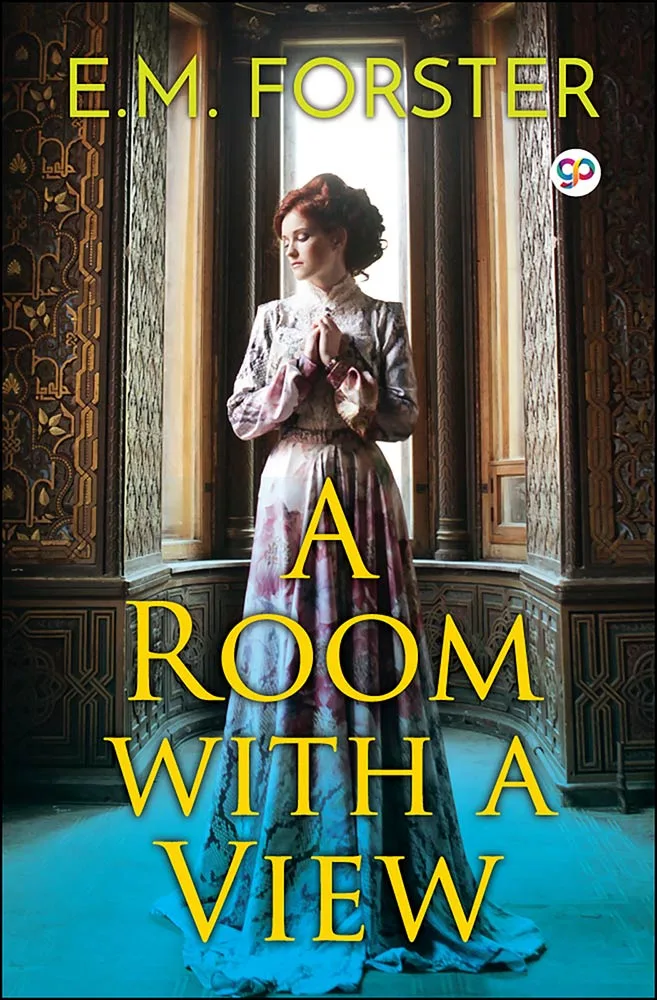
A Room With A View
Hardcover
• 264 Pages
• INR 445.00
• English
• 9789354990991
No ratings yet
| Publisher | General Press |
|---|---|
| ISBN13 | 9789354990991 |
| ASIN/SKU | 9354990991 |
| Book Format | Hardcover |
| Language | English |
| Pages | 264 |
| List Price | INR 445.00 |
| Subject Code | FIC004000, FIC027170, FIC027050, LCO002000 |
| Publishing Date | 01/08/2022 |
| Dimensions | 8.25 x 5.25 x 1.0 inches |
| Book Code | BD00067598 |
Buy this Book
Amazon Stores
Ebook Stores
Other Stores
Discover A Room With A View by E.M. Forster. This book is published by General Press in Hardcover format, ISBN 9789354990991, ASIN 9354990991, under Literature and Fiction, Classics, Women Fiction.
Book Description
First published in 1908, ‘A Room with A View’ is a coming of age story of a young woman, by E.M. Forster, an English fiction writer, essayist, and librettist. Many of his novels examined class differences and hypocrisy.
Set against the stunning setting of Florence, Italy, during the Edwardian period, young Lucy Honeychurch travels the district with her domineering, old-fashioned cousin, Charlotte Bartlett. When Lucy meets the strange Emerson family, she forms an awkward friendship with their son, George. Through her relationship with the Emersons, and with other tourists, Lucy encounters the criticisms of society and must choose between a life of harmony and one of love.
The lasting pleasure of this tale of romance is embedded in Forster’s vibrant characters, including absurd spinsters, superior clergypersons, and candid patriots. It is one of E.M. Forster’s earliest and most outstanding works.
Set against the stunning setting of Florence, Italy, during the Edwardian period, young Lucy Honeychurch travels the district with her domineering, old-fashioned cousin, Charlotte Bartlett. When Lucy meets the strange Emerson family, she forms an awkward friendship with their son, George. Through her relationship with the Emersons, and with other tourists, Lucy encounters the criticisms of society and must choose between a life of harmony and one of love.
The lasting pleasure of this tale of romance is embedded in Forster’s vibrant characters, including absurd spinsters, superior clergypersons, and candid patriots. It is one of E.M. Forster’s earliest and most outstanding works.
Author Biography
Edward Morgan Forster, generally published as E.M. Forster, was an novelist, essayist, and short story writer. He is known best for his ironic and well-plotted novels examining class difference and hypocrisy in early 20th-century British society. His humanistic impulse toward understanding and sympathy may be aptly summed up in the epigraph to his 1910 novel Howards End: "Only connect".
He had five novels published in his lifetime, achieving his greatest success with A Passage to India (1924) which takes as its subject the relationship between East and West, seen through the lens of India in the later days of the British Raj.
Forster's views as a secular humanist are at the heart of his work, which often depicts the pursuit of personal connections in spite of the restrictions of contemporary society. He is noted for his use of symbolism as a technique in his novels, and he has been criticised for his attachment to mysticism. His other works include Where Angels Fear to Tread (1905), The Longest Journey (1907), A Room with a View (1908) and Maurice (1971), his posthumously published novel which tells of the coming of age of an explicitly gay male character.
He had five novels published in his lifetime, achieving his greatest success with A Passage to India (1924) which takes as its subject the relationship between East and West, seen through the lens of India in the later days of the British Raj.
Forster's views as a secular humanist are at the heart of his work, which often depicts the pursuit of personal connections in spite of the restrictions of contemporary society. He is noted for his use of symbolism as a technique in his novels, and he has been criticised for his attachment to mysticism. His other works include Where Angels Fear to Tread (1905), The Longest Journey (1907), A Room with a View (1908) and Maurice (1971), his posthumously published novel which tells of the coming of age of an explicitly gay male character.
Editorial Reviews
Editorial Reviews will be added soon…
Book Summary
E. M. Forster’s A Room with a View is a warm, witty, and deeply humane novel about love, freedom, social expectations, and the courage to live honestly. First published in 1908, the novel contrasts the restrictive conventions of Edwardian English society with the openness and vitality Lucy Honeychurch experiences during a trip to Italy. Through Lucy’s emotional journey, Forster asks whether people should follow the lives society has designed for them or have the courage to pursue what they genuinely feel.
The story begins in Florence, where Lucy Honeychurch, a young Englishwoman, is traveling with her older cousin and chaperone, Charlotte Bartlett. Lucy is intelligent, sensitive, and curious, but she has been raised according to the strict rules of respectable middle-class society. She is expected to behave properly, avoid scandal, and eventually marry an appropriate English gentleman.
Lucy and Charlotte are staying at the Pension Bertolini, where they are disappointed to discover that their rooms do not have the promised views of Florence. At dinner, they meet Mr. Emerson and his son, George Emerson. The Emersons are unconventional and direct, and they do not follow the social rules that govern Lucy's world. When George learns that Lucy and Charlotte have no rooms with views, he offers to exchange rooms with them.
Charlotte initially finds the offer improper and refuses. George, however, is not concerned with such formalities. His father, Mr. Emerson, encourages the exchange, arguing that there is no reason for people to suffer merely because social convention says they should. Eventually, the women accept.
The room with a view becomes an important symbol throughout the novel. It represents openness, beauty, freedom, and the possibility of a life beyond restrictive social expectations. Lucy can literally see the world from her window, but she is also beginning to imagine a different kind of existence.
While exploring Florence, Lucy witnesses a violent incident in the Piazza della Signoria. A man is stabbed, and she becomes overwhelmed by the sight of blood and death. George Emerson happens to be nearby and helps her. The experience creates an unexpected emotional connection between them.
George is very different from the men Lucy has been taught to admire. He is passionate, spontaneous, honest, and unwilling to hide his feelings behind polite social behavior. Lucy is attracted to him, although she does not fully understand or admit it.
During another excursion into the countryside, Lucy and George are separated from the others. In a beautiful natural setting, surrounded by fields and hills, George impulsively kisses Lucy. The moment shocks her because it violates everything she has been taught about respectable behavior. Charlotte discovers what has happened and immediately removes Lucy from the situation.
Lucy returns to England, determined to forget George and the uncomfortable emotions he awakened in her. She becomes engaged to Cecil Vyse, a sophisticated young Englishman from a socially respectable family. Cecil is intelligent, educated, and well connected, and Lucy initially believes that marrying him is the sensible choice.
Yet Cecil is deeply different from George. He treats Lucy less as an independent person than as an idealized woman whom he wants to possess and admire. He is attracted to the idea of Lucy but does not always understand her as a real human being with desires and contradictions.
Lucy lives with her mother and brother in Surrey, where the atmosphere is more conventional than the one she experienced in Italy. Her life appears comfortable and respectable, but she gradually realizes that something important is missing.
Cecil's attitude becomes increasingly controlling. He criticizes Lucy's friendships and dislikes people whom he considers socially inferior. He also becomes possessive about Lucy's relationship with George Emerson when the Emersons unexpectedly move into the neighborhood.
George's arrival brings Lucy's unresolved feelings back to the surface. She tries to convince herself that she loves Cecil and that George represents danger and emotional chaos. But George's presence makes it increasingly difficult for her to maintain that illusion.
One of the novel's important contrasts is between Cecil's intellectual sophistication and George's emotional honesty. Cecil reads books, discusses art, and understands social conventions, but his intelligence often makes him self-conscious and controlling. George, by contrast, does not possess Cecil's social polish. Yet he responds to life more directly. He is capable of genuine affection, spontaneity, and emotional courage.
Lucy also becomes friends with George's father, Mr. Emerson. He recognizes the conflict within her and understands that she is trying to live according to other people's expectations. He encourages her to be honest with herself rather than allowing fear and social convention to determine her future.
The conflict reaches a turning point when Cecil reads aloud from a romantic novel containing a passionate kissing scene. He does so without realizing—or perhaps without caring—that George is nearby. George reacts emotionally, and the situation reveals the tension between the two men.
Lucy eventually realizes that Cecil's version of respectability is incompatible with the life she wants. She breaks off her engagement.
However, Lucy still struggles to accept her feelings for George. She is frightened by the idea of choosing passion over social approval. Her family and friends have taught her that a respectable woman should be cautious, restrained, and obedient. Following her heart seems almost like a moral failure.
Mr. Emerson speaks with Lucy and urges her to stop living according to fear. He helps her understand that love should not be treated as something shameful. His advice finally allows Lucy to acknowledge what she has been trying to suppress.
Lucy and George eventually marry.
The novel ends with the couple in Florence, staying in the same pension where Lucy had once stayed with Charlotte. This return to Italy is significant. Lucy now possesses the emotional freedom she lacked at the beginning of the story. The “view” that once represented a distant possibility has become part of her actual life.
The title, A Room with a View, therefore has a symbolic meaning. The view represents a broader way of seeing life. At the beginning, Lucy is physically surrounded by beauty but emotionally restricted. By the end, she has learned to look beyond social rules and recognize her own desires.
The novel's central theme is the conflict between convention and authenticity. Forster does not argue that all social rules are meaningless. Rather, he questions rules that force people to deny their genuine feelings. Lucy's challenge is not simply choosing between two men. It is choosing between two ways of living: one based on appearances, approval, and social expectations, and another based on honesty, emotional courage, and personal freedom.
The novel also explores love as a form of self-discovery. Lucy does not simply fall in love with George; through him, she discovers parts of herself that she had been taught to suppress. George gives her permission to acknowledge her emotions rather than constantly judging them.
Forster also gently criticizes the rigid class and gender expectations of Edwardian England. Women like Lucy are expected to behave according to carefully defined standards of respectability, while men are given greater freedom. The novel suggests that such restrictions can prevent people from forming genuine relationships.
Yet A Room with a View is not bitter. Its tone remains playful, humorous, romantic, and optimistic. Forster believes that people can change when they become brave enough to see themselves honestly.
Ultimately, the novel is a celebration of choosing life over convention. Lucy's journey from a sheltered young woman to someone capable of making her own emotional decisions is the heart of the story. Her “view” is not merely the beautiful landscape of Florence. It is a new way of seeing the world—a world in which love, desire, honesty, and personal freedom are allowed to exist.
Forster's lasting message is simple and deeply human: a fulfilling life cannot be built entirely around what society expects from us. Sometimes we must have the courage to look beyond the walls that surround us, trust our own feelings, and choose the life that allows us to become fully ourselves.
The story begins in Florence, where Lucy Honeychurch, a young Englishwoman, is traveling with her older cousin and chaperone, Charlotte Bartlett. Lucy is intelligent, sensitive, and curious, but she has been raised according to the strict rules of respectable middle-class society. She is expected to behave properly, avoid scandal, and eventually marry an appropriate English gentleman.
Lucy and Charlotte are staying at the Pension Bertolini, where they are disappointed to discover that their rooms do not have the promised views of Florence. At dinner, they meet Mr. Emerson and his son, George Emerson. The Emersons are unconventional and direct, and they do not follow the social rules that govern Lucy's world. When George learns that Lucy and Charlotte have no rooms with views, he offers to exchange rooms with them.
Charlotte initially finds the offer improper and refuses. George, however, is not concerned with such formalities. His father, Mr. Emerson, encourages the exchange, arguing that there is no reason for people to suffer merely because social convention says they should. Eventually, the women accept.
The room with a view becomes an important symbol throughout the novel. It represents openness, beauty, freedom, and the possibility of a life beyond restrictive social expectations. Lucy can literally see the world from her window, but she is also beginning to imagine a different kind of existence.
While exploring Florence, Lucy witnesses a violent incident in the Piazza della Signoria. A man is stabbed, and she becomes overwhelmed by the sight of blood and death. George Emerson happens to be nearby and helps her. The experience creates an unexpected emotional connection between them.
George is very different from the men Lucy has been taught to admire. He is passionate, spontaneous, honest, and unwilling to hide his feelings behind polite social behavior. Lucy is attracted to him, although she does not fully understand or admit it.
During another excursion into the countryside, Lucy and George are separated from the others. In a beautiful natural setting, surrounded by fields and hills, George impulsively kisses Lucy. The moment shocks her because it violates everything she has been taught about respectable behavior. Charlotte discovers what has happened and immediately removes Lucy from the situation.
Lucy returns to England, determined to forget George and the uncomfortable emotions he awakened in her. She becomes engaged to Cecil Vyse, a sophisticated young Englishman from a socially respectable family. Cecil is intelligent, educated, and well connected, and Lucy initially believes that marrying him is the sensible choice.
Yet Cecil is deeply different from George. He treats Lucy less as an independent person than as an idealized woman whom he wants to possess and admire. He is attracted to the idea of Lucy but does not always understand her as a real human being with desires and contradictions.
Lucy lives with her mother and brother in Surrey, where the atmosphere is more conventional than the one she experienced in Italy. Her life appears comfortable and respectable, but she gradually realizes that something important is missing.
Cecil's attitude becomes increasingly controlling. He criticizes Lucy's friendships and dislikes people whom he considers socially inferior. He also becomes possessive about Lucy's relationship with George Emerson when the Emersons unexpectedly move into the neighborhood.
George's arrival brings Lucy's unresolved feelings back to the surface. She tries to convince herself that she loves Cecil and that George represents danger and emotional chaos. But George's presence makes it increasingly difficult for her to maintain that illusion.
One of the novel's important contrasts is between Cecil's intellectual sophistication and George's emotional honesty. Cecil reads books, discusses art, and understands social conventions, but his intelligence often makes him self-conscious and controlling. George, by contrast, does not possess Cecil's social polish. Yet he responds to life more directly. He is capable of genuine affection, spontaneity, and emotional courage.
Lucy also becomes friends with George's father, Mr. Emerson. He recognizes the conflict within her and understands that she is trying to live according to other people's expectations. He encourages her to be honest with herself rather than allowing fear and social convention to determine her future.
The conflict reaches a turning point when Cecil reads aloud from a romantic novel containing a passionate kissing scene. He does so without realizing—or perhaps without caring—that George is nearby. George reacts emotionally, and the situation reveals the tension between the two men.
Lucy eventually realizes that Cecil's version of respectability is incompatible with the life she wants. She breaks off her engagement.
However, Lucy still struggles to accept her feelings for George. She is frightened by the idea of choosing passion over social approval. Her family and friends have taught her that a respectable woman should be cautious, restrained, and obedient. Following her heart seems almost like a moral failure.
Mr. Emerson speaks with Lucy and urges her to stop living according to fear. He helps her understand that love should not be treated as something shameful. His advice finally allows Lucy to acknowledge what she has been trying to suppress.
Lucy and George eventually marry.
The novel ends with the couple in Florence, staying in the same pension where Lucy had once stayed with Charlotte. This return to Italy is significant. Lucy now possesses the emotional freedom she lacked at the beginning of the story. The “view” that once represented a distant possibility has become part of her actual life.
The title, A Room with a View, therefore has a symbolic meaning. The view represents a broader way of seeing life. At the beginning, Lucy is physically surrounded by beauty but emotionally restricted. By the end, she has learned to look beyond social rules and recognize her own desires.
The novel's central theme is the conflict between convention and authenticity. Forster does not argue that all social rules are meaningless. Rather, he questions rules that force people to deny their genuine feelings. Lucy's challenge is not simply choosing between two men. It is choosing between two ways of living: one based on appearances, approval, and social expectations, and another based on honesty, emotional courage, and personal freedom.
The novel also explores love as a form of self-discovery. Lucy does not simply fall in love with George; through him, she discovers parts of herself that she had been taught to suppress. George gives her permission to acknowledge her emotions rather than constantly judging them.
Forster also gently criticizes the rigid class and gender expectations of Edwardian England. Women like Lucy are expected to behave according to carefully defined standards of respectability, while men are given greater freedom. The novel suggests that such restrictions can prevent people from forming genuine relationships.
Yet A Room with a View is not bitter. Its tone remains playful, humorous, romantic, and optimistic. Forster believes that people can change when they become brave enough to see themselves honestly.
Ultimately, the novel is a celebration of choosing life over convention. Lucy's journey from a sheltered young woman to someone capable of making her own emotional decisions is the heart of the story. Her “view” is not merely the beautiful landscape of Florence. It is a new way of seeing the world—a world in which love, desire, honesty, and personal freedom are allowed to exist.
Forster's lasting message is simple and deeply human: a fulfilling life cannot be built entirely around what society expects from us. Sometimes we must have the courage to look beyond the walls that surround us, trust our own feelings, and choose the life that allows us to become fully ourselves.
Sample Chapters
Sample Chapters will be added soon…
Reader Reviews
No reviews yet.
A Room With A View
Download Cover Image
Do you want to download the full cover image for A Room With A View?