
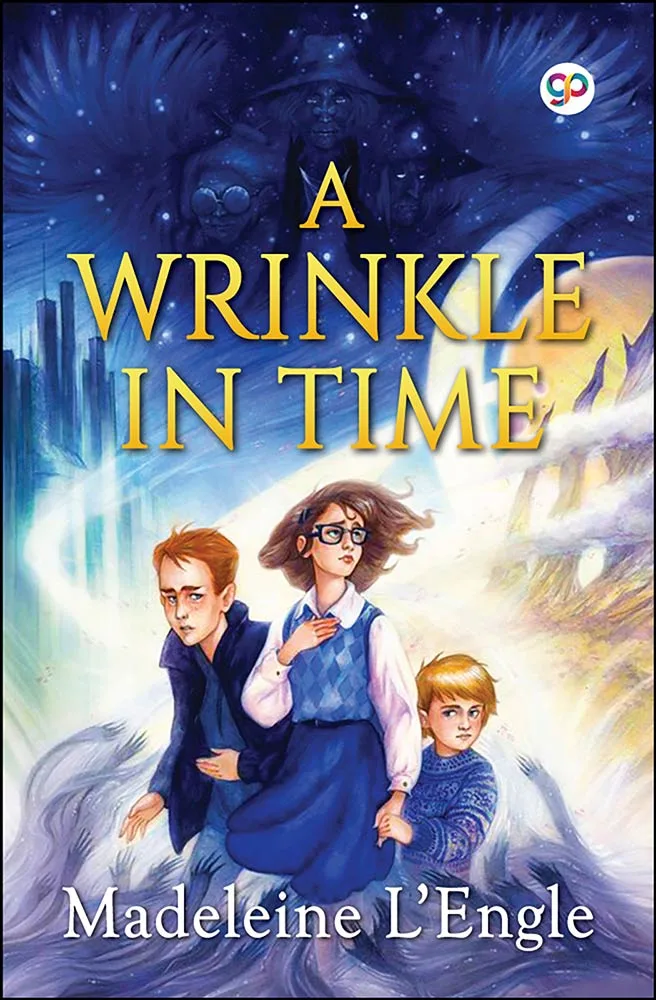
A Wrinkle in Time
Paperback
• 192 Pages
• INR 295.00
• English
• 9789354991066
No ratings yet
| Publisher | General Press |
|---|---|
| ISBN13 | 9789354991066 |
| ASIN/SKU | 9354991068 |
| Book Format | Paperback |
| Language | English |
| Pages | 192 |
| List Price | INR 295.00 |
| Subject Code | JUV053000, JUV064000, JUV037000 |
| Publishing Date | 15/09/2021 |
| Dimensions | 8.25 x 5.25 x 1.0 inches |
| Book Code | BD00067601 |
Buy this Book
Amazon Stores
Ebook Stores
Other Stores
Discover A Wrinkle in Time by Madeleine L'Engle. This book is published by General Press in Paperback format, ISBN 9789354991066, ASIN 9354991068, under Children's Books, Fantasy, Children's Classics.
Book Description
Winner of the 1963 Newbery Medal
'A Wrinkle in Time' by Madeleine L'Engle is a beloved classic of science fantasy fiction that has captivated readers young and old since its publication in 1962 — a book that was famously rejected by dozens of publishers before going on to win the Newbery Medal and earn its place as one of the most cherished novels in American literature. It is the kind of story that works on multiple levels at once, thrilling you with its adventure while quietly asking some of the biggest questions a person can wrestle with.
At the center of the story is Meg Murry, a thirteen-year-old girl who feels like a misfit in almost every way — awkward, impatient, fiercely emotional, and painfully aware that she does not fit the mold the world seems to expect of her. Her father, a brilliant physicist working on a mysterious government project, has been missing for over a year, and Meg aches with a grief and anger she does not know how to carry. Then one stormy night, three extraordinary women appear — Mrs. Whatsit, Mrs. Who, and Mrs. Which — and Meg's world cracks open in the most astonishing way imaginable.
Together with her remarkably gifted younger brother Charles Wallace and her kind, steady classmate Calvin, Meg is swept into an interstellar journey through a phenomenon called a tesseract — a wrinkle in time and space that allows travel across the universe in an instant. What they find on the other side is a darkness far older and more menacing than anything Meg could have imagined, and somewhere within it, her father.
L'Engle weaves together physics, philosophy, and fierce emotional truth in a way that feels completely effortless. She never talks down to her readers — young or adult — and she takes seriously the idea that love, courage, and individuality are not soft things but among the most powerful forces in existence. If you have ever felt like you did not quite belong, or wondered whether one ordinary person can make a difference against something enormous and dark, this book will feel like it was written just for you.
'A Wrinkle in Time' by Madeleine L'Engle is a beloved classic of science fantasy fiction that has captivated readers young and old since its publication in 1962 — a book that was famously rejected by dozens of publishers before going on to win the Newbery Medal and earn its place as one of the most cherished novels in American literature. It is the kind of story that works on multiple levels at once, thrilling you with its adventure while quietly asking some of the biggest questions a person can wrestle with.
At the center of the story is Meg Murry, a thirteen-year-old girl who feels like a misfit in almost every way — awkward, impatient, fiercely emotional, and painfully aware that she does not fit the mold the world seems to expect of her. Her father, a brilliant physicist working on a mysterious government project, has been missing for over a year, and Meg aches with a grief and anger she does not know how to carry. Then one stormy night, three extraordinary women appear — Mrs. Whatsit, Mrs. Who, and Mrs. Which — and Meg's world cracks open in the most astonishing way imaginable.
Together with her remarkably gifted younger brother Charles Wallace and her kind, steady classmate Calvin, Meg is swept into an interstellar journey through a phenomenon called a tesseract — a wrinkle in time and space that allows travel across the universe in an instant. What they find on the other side is a darkness far older and more menacing than anything Meg could have imagined, and somewhere within it, her father.
L'Engle weaves together physics, philosophy, and fierce emotional truth in a way that feels completely effortless. She never talks down to her readers — young or adult — and she takes seriously the idea that love, courage, and individuality are not soft things but among the most powerful forces in existence. If you have ever felt like you did not quite belong, or wondered whether one ordinary person can make a difference against something enormous and dark, this book will feel like it was written just for you.
Author Biography
Madeleine L'Engle was an American writer best known for her young adult fiction, particularly the Newbery Medal-winning A Wrinkle in Time and its sequels A Wind in the Door, A Swiftly Tilting Planet, and Many Waters. Her works reflect her strong interest in modern science: tesseracts, for example, are featured prominently in A Wrinkle in Time, mitochondrial DNA in A Wind in the Door, organ regeneration in The Arm of the Starfish, and so forth.
"Madeleine was born on November 29th, 1918, and spent her formative years in New York City. Instead of her school work, she found that she would much rather be writing stories, poems and journals for herself, which was reflected in her grades (not the best). However, she was not discouraged.
At age 12, she moved to the French Alps with her parents and went to an English boarding school where, thankfully, her passion for writing continued to grow. She flourished during her high school years back in the United States at Ashley Hall in Charleston, South Carolina, vacationing with her mother in a rambling old beach cottage on a beautiful stretch of Florida beach.
She went to Smith College and studied English with some wonderful teachers as she read the classics and continued her own creative writing. She graduated with honors and moved into a Greenwich Village apartment in New York. She worked in the theater, where Equity union pay and a flexible schedule afforded her the time to write! She published her first two novels during these years—A Small Rain and Ilsa—before meeting Hugh Franklin, her future husband, when she was an understudy in Anton Chekov's The Cherry Orchard. They married during The Joyous Season.
"Madeleine was born on November 29th, 1918, and spent her formative years in New York City. Instead of her school work, she found that she would much rather be writing stories, poems and journals for herself, which was reflected in her grades (not the best). However, she was not discouraged.
At age 12, she moved to the French Alps with her parents and went to an English boarding school where, thankfully, her passion for writing continued to grow. She flourished during her high school years back in the United States at Ashley Hall in Charleston, South Carolina, vacationing with her mother in a rambling old beach cottage on a beautiful stretch of Florida beach.
She went to Smith College and studied English with some wonderful teachers as she read the classics and continued her own creative writing. She graduated with honors and moved into a Greenwich Village apartment in New York. She worked in the theater, where Equity union pay and a flexible schedule afforded her the time to write! She published her first two novels during these years—A Small Rain and Ilsa—before meeting Hugh Franklin, her future husband, when she was an understudy in Anton Chekov's The Cherry Orchard. They married during The Joyous Season.
Editorial Reviews
Editorial Reviews will be added soon…
Book Summary
"A Wrinkle in Time" by Madeleine L'Engle is a timeless blend of science fiction, fantasy, and coming-of-age storytelling that explores the power of love, courage, and individuality. The novel follows Meg Murry, an intelligent but insecure teenage girl who struggles to fit in at school and often feels overshadowed by others. Her younger brother, Charles Wallace, is extraordinarily gifted, possessing remarkable intelligence and intuition that make him seem unusual to those around him. Their father, a brilliant scientist, disappeared mysteriously several years earlier while working on a secret government project involving space and time. His absence has left the Murry family burdened with grief and uncertainty, while rumors from neighbors only deepen Meg's sense of isolation. Although life appears ordinary on the surface, strange events soon reveal that the universe holds far greater mysteries than Meg could ever have imagined.
The adventure begins on a stormy night when an eccentric old woman named Mrs. Whatsit unexpectedly visits the Murry home. She casually mentions something called a "tesseract," a concept that intrigues Meg's scientist mother and hints at her missing father's research. Soon afterward, Meg, Charles Wallace, and their new friend Calvin O'Keefe encounter Mrs. Whatsit again, this time accompanied by two equally mysterious beings, Mrs. Who and Mrs. Which. The three celestial women reveal that they are not ordinary humans but ancient, benevolent creatures dedicated to fighting the darkness spreading throughout the universe. They explain that a tesseract is a way of folding space and time, allowing travelers to cross unimaginable distances instantly. Most importantly, they reveal that Mr. Murry is still alive but trapped on a distant planet dominated by an evil force, and only the children can rescue him.
Using the power of the tesseract, the travelers journey through breathtaking worlds unlike anything they have ever known. Their first stop is the beautiful planet Uriel, where they witness magnificent landscapes and creatures that exist in harmony with one another. Here, the children begin to understand that the universe is engaged in an endless battle between light and darkness. Mrs. Which explains that many great figures from Earth's history—including artists, scientists, philosophers, and spiritual leaders—have fought against this universal evil in their own ways by bringing knowledge, beauty, hope, and truth to humanity. These revelations broaden Meg's understanding of her own world and help her realize that every person's unique gifts can contribute to defeating darkness.
As the journey continues, the children are shown a terrifying black cloud known simply as the Dark Thing, which has engulfed countless planets. They learn that Earth itself is partially trapped beneath this oppressive force, explaining why hatred, fear, and cruelty continue to exist. Eventually they arrive on the planet Camazotz, a world where absolute order and complete conformity have replaced freedom and individuality. Every child bounces a ball in perfect rhythm, every house looks identical, and every citizen behaves exactly the same. At first glance the society appears peaceful, but beneath its flawless appearance lies an atmosphere of fear and oppression. No one is allowed to think independently or express personal emotions, and anyone who differs from the norm is swiftly corrected.
While searching for Mr. Murry, the children discover that Camazotz is controlled by a powerful disembodied intelligence known as IT. This immense brain exercises complete mental control over every inhabitant, stripping them of their individuality and forcing them into perfect obedience. Charles Wallace, confident in his exceptional intelligence, attempts to confront IT alone. However, his pride becomes his greatest weakness, and IT successfully enters his mind, taking control of him. Possessed by this malevolent force, Charles Wallace becomes cold, calculating, and hostile toward Meg and Calvin. Instead of helping them, he leads them deeper into danger, forcing Meg to face the heartbreaking reality that her beloved brother is no longer acting of his own free will.
Eventually the children find Mr. Murry imprisoned on Camazotz. Although physically weakened, he is relieved to see his children and quickly understands the danger surrounding them. Using the tesseract, he manages to escape with Meg and Calvin, but in the confusion Charles Wallace remains behind under IT's control. The group narrowly reaches another planet where gentle, sightless creatures care for Meg as she recovers from the exhausting journey. There they meet a wise being known as Aunt Beast, whose kindness, compassion, and unconditional acceptance comfort Meg during one of the darkest moments of her life. Through Aunt Beast's nurturing presence, Meg gradually begins to see herself differently. Instead of focusing on her flaws and insecurities, she starts recognizing her own inner strength and the importance of believing in herself.
The three mysterious guides soon reveal that only Meg can return to Camazotz and rescue Charles Wallace. Neither Calvin nor Mr. Murry possesses the one quality necessary to defeat IT. Although frightened, Meg accepts the responsibility and returns alone. When she confronts IT, logic, intelligence, and physical strength prove completely useless against its overwhelming mental power. Even Charles Wallace, speaking under IT's influence, mocks her weaknesses and attempts to break her spirit. For a moment Meg feels helpless, believing she has nothing valuable to offer. Then she remembers everything she has learned throughout her journey, especially Aunt Beast's gentle wisdom about love and acceptance. She realizes that while IT can manipulate fear, pride, and intellect, it cannot understand genuine love.
Drawing upon the deep, unconditional love she feels for her brother, Meg reaches through the darkness surrounding Charles Wallace. Instead of arguing or fighting, she simply loves him with all her heart, reminding him of the bond they have always shared. This pure expression of love becomes the one force IT cannot control or overcome. The darkness loses its hold over Charles Wallace, freeing him from its influence. At that moment Meg discovers that her greatest weakness had actually concealed her greatest strength. Throughout her life she had viewed herself as awkward, emotional, and imperfect, yet these very qualities allowed her to love more deeply than anyone else. By embracing her true self instead of wishing to be someone different, she succeeds where superior intelligence alone had failed.
With Charles Wallace finally free, the family escapes Camazotz and returns safely to Earth through the tesseract. Mr. Murry is reunited with his wife after years of separation, bringing joy and healing to the entire family. Meg emerges from the adventure transformed. She no longer measures her worth by comparing herself to others or by focusing on her insecurities. Instead, she understands that courage is not the absence of fear but the willingness to act despite it, and that love is the most powerful force in existence. Madeleine L'Engle concludes the novel with a deeply hopeful message: every individual possesses unique gifts that contribute to the triumph of light over darkness. Through its unforgettable characters, imaginative worlds, and profound exploration of family, identity, and compassion, A Wrinkle in Time remains a beloved classic that reminds readers that love, individuality, and hope will always be stronger than fear and conformity.
The adventure begins on a stormy night when an eccentric old woman named Mrs. Whatsit unexpectedly visits the Murry home. She casually mentions something called a "tesseract," a concept that intrigues Meg's scientist mother and hints at her missing father's research. Soon afterward, Meg, Charles Wallace, and their new friend Calvin O'Keefe encounter Mrs. Whatsit again, this time accompanied by two equally mysterious beings, Mrs. Who and Mrs. Which. The three celestial women reveal that they are not ordinary humans but ancient, benevolent creatures dedicated to fighting the darkness spreading throughout the universe. They explain that a tesseract is a way of folding space and time, allowing travelers to cross unimaginable distances instantly. Most importantly, they reveal that Mr. Murry is still alive but trapped on a distant planet dominated by an evil force, and only the children can rescue him.
Using the power of the tesseract, the travelers journey through breathtaking worlds unlike anything they have ever known. Their first stop is the beautiful planet Uriel, where they witness magnificent landscapes and creatures that exist in harmony with one another. Here, the children begin to understand that the universe is engaged in an endless battle between light and darkness. Mrs. Which explains that many great figures from Earth's history—including artists, scientists, philosophers, and spiritual leaders—have fought against this universal evil in their own ways by bringing knowledge, beauty, hope, and truth to humanity. These revelations broaden Meg's understanding of her own world and help her realize that every person's unique gifts can contribute to defeating darkness.
As the journey continues, the children are shown a terrifying black cloud known simply as the Dark Thing, which has engulfed countless planets. They learn that Earth itself is partially trapped beneath this oppressive force, explaining why hatred, fear, and cruelty continue to exist. Eventually they arrive on the planet Camazotz, a world where absolute order and complete conformity have replaced freedom and individuality. Every child bounces a ball in perfect rhythm, every house looks identical, and every citizen behaves exactly the same. At first glance the society appears peaceful, but beneath its flawless appearance lies an atmosphere of fear and oppression. No one is allowed to think independently or express personal emotions, and anyone who differs from the norm is swiftly corrected.
While searching for Mr. Murry, the children discover that Camazotz is controlled by a powerful disembodied intelligence known as IT. This immense brain exercises complete mental control over every inhabitant, stripping them of their individuality and forcing them into perfect obedience. Charles Wallace, confident in his exceptional intelligence, attempts to confront IT alone. However, his pride becomes his greatest weakness, and IT successfully enters his mind, taking control of him. Possessed by this malevolent force, Charles Wallace becomes cold, calculating, and hostile toward Meg and Calvin. Instead of helping them, he leads them deeper into danger, forcing Meg to face the heartbreaking reality that her beloved brother is no longer acting of his own free will.
Eventually the children find Mr. Murry imprisoned on Camazotz. Although physically weakened, he is relieved to see his children and quickly understands the danger surrounding them. Using the tesseract, he manages to escape with Meg and Calvin, but in the confusion Charles Wallace remains behind under IT's control. The group narrowly reaches another planet where gentle, sightless creatures care for Meg as she recovers from the exhausting journey. There they meet a wise being known as Aunt Beast, whose kindness, compassion, and unconditional acceptance comfort Meg during one of the darkest moments of her life. Through Aunt Beast's nurturing presence, Meg gradually begins to see herself differently. Instead of focusing on her flaws and insecurities, she starts recognizing her own inner strength and the importance of believing in herself.
The three mysterious guides soon reveal that only Meg can return to Camazotz and rescue Charles Wallace. Neither Calvin nor Mr. Murry possesses the one quality necessary to defeat IT. Although frightened, Meg accepts the responsibility and returns alone. When she confronts IT, logic, intelligence, and physical strength prove completely useless against its overwhelming mental power. Even Charles Wallace, speaking under IT's influence, mocks her weaknesses and attempts to break her spirit. For a moment Meg feels helpless, believing she has nothing valuable to offer. Then she remembers everything she has learned throughout her journey, especially Aunt Beast's gentle wisdom about love and acceptance. She realizes that while IT can manipulate fear, pride, and intellect, it cannot understand genuine love.
Drawing upon the deep, unconditional love she feels for her brother, Meg reaches through the darkness surrounding Charles Wallace. Instead of arguing or fighting, she simply loves him with all her heart, reminding him of the bond they have always shared. This pure expression of love becomes the one force IT cannot control or overcome. The darkness loses its hold over Charles Wallace, freeing him from its influence. At that moment Meg discovers that her greatest weakness had actually concealed her greatest strength. Throughout her life she had viewed herself as awkward, emotional, and imperfect, yet these very qualities allowed her to love more deeply than anyone else. By embracing her true self instead of wishing to be someone different, she succeeds where superior intelligence alone had failed.
With Charles Wallace finally free, the family escapes Camazotz and returns safely to Earth through the tesseract. Mr. Murry is reunited with his wife after years of separation, bringing joy and healing to the entire family. Meg emerges from the adventure transformed. She no longer measures her worth by comparing herself to others or by focusing on her insecurities. Instead, she understands that courage is not the absence of fear but the willingness to act despite it, and that love is the most powerful force in existence. Madeleine L'Engle concludes the novel with a deeply hopeful message: every individual possesses unique gifts that contribute to the triumph of light over darkness. Through its unforgettable characters, imaginative worlds, and profound exploration of family, identity, and compassion, A Wrinkle in Time remains a beloved classic that reminds readers that love, individuality, and hope will always be stronger than fear and conformity.
Sample Chapters
1 : Mrs Whatsit
It was a dark and stormy night.
In her attic bedroom Margaret Murry, wrapped in an old patchwork quilt, sat on the foot of her bed and watched the trees tossing in the frenzied lashing of the wind. Behind the trees clouds scudded frantically across the sky. Every few moments the moon ripped through them, creating wraithlike shadows that raced along the ground.
The house shook.
Wrapped in her quilt, Meg shook.
She wasn’t usually afraid of weather.—It’s not just the weather, she thought.—It’s the weather on top of everything else. On top of me. On top of Meg Murry doing everything wrong.
School. School was all wrong. She’d been dropped down to the lowest section in her grade. That morning one of her teachers had said crossly, “Really, Meg, I don’t understand how a child with parents as brilliant as yours are supposed to be can be such a poor student. If you don’t manage to do a little better you’ll have to stay back next year.”
During lunch she’d rough-housed a little to try to make herself feel better, and one of the girls said scornfully, “After all, Meg, we aren’t grammar-school kids anymore. Why do you always act like such a baby?”
And on the way home from school, walking up the road with her arms full of books, one of the boys had said something about her “dumb baby brother.” At this she’d thrown the books on the side of the road and tackled him with every ounce of strength she had, and arrived home with her blouse torn and a big bruise under one eye.
Sandy and Dennys, her ten-year-old twin brothers, who got home from school an hour earlier than she did, were disgusted. “Let us do the fighting when it’s necessary,” they told her.
—A delinquent, that’s what I am, she thought grimly.—That’s what they’ll be saying next. Not Mother. But Them. Everybody Else. I wish Father—
But it was still not possible to think about her father without the danger of tears. Only her mother could talk about him in a natural way, saying, “When your father gets back—”
Gets back from where? And when? Surely her mother must know what people were saying, must be aware of the smugly vicious gossip. Surely it must hurt her as it did Meg. But if it did she gave no outward sign. Nothing ruffled the serenity of her expression.
—Why can’t I hide it, too? Meg thought. Why do I always have to show everything?
The window rattled madly in the wind, and she pulled the quilt close about her. Curled up on one of her pillows a gray fluff of kitten yawned, showing its pink tongue, tucked its head under again, and went back to sleep.
Everybody was asleep. Everybody except Meg. Even Charles Wallace, the “dumb baby brother,” who had an uncanny way of knowing when she was awake and unhappy, and who would come, so many nights, tiptoeing up the attic stairs to her—even Charles Wallace was asleep.
How could they sleep? All day on the radio there had been hurricane warnings. How could they leave her up in the attic in the rickety brass bed, knowing that the roof might be blown right off the house, and she tossed out into the wild night sky to land who knows where? Her shivering grew uncontrollable.
—You asked to have the attic bedroom, she told herself savagely.—Mother let you have it because you’re the oldest. It’s a privilege, not a punishment.
“Not during a hurricane, it isn’t a privilege,” she said aloud. She tossed the quilt down on the foot of the bed, and stood up. The kitten stretched luxuriously, and looked up at her with huge, innocent eyes.
“Go back to sleep,” Meg said. “Just be glad you’re a kitten and not a monster like me.” She looked at herself in the wardrobe mirror and made a horrible face, baring a mouthful of teeth covered with braces. Automatically she pushed her glasses into position, ran her fingers through her mouse-brown hair, so that it stood wildly on end, and let out a sigh almost as noisy as the wind.
The wide wooden floorboards were cold against her feet. Wind blew in the crevices about the window frame, in spite of the protection the storm sash was supposed to offer. She could hear wind howling in the chimneys. From all the way downstairs she could hear Fortinbras, the big black dog, starting to bark. He must be frightened, too. What was he barking at? Fortinbras never barked without reason.
Suddenly she remembered that when she had gone to the post office to pick up the mail she’d heard about a tramp who was supposed to have stolen twelve sheets from Mrs. Buncombe, the constable’s wife. They hadn’t caught him, and maybe he was heading for the Murrys’ house right now, isolated on a back road as it was; and this time maybe he’d be after more than sheets. Meg hadn’t paid much attention to the talk about the tramp at the time, because the postmistress, with a sugary smile, had asked if she’d heard from her father lately.
She left her little room and made her way through the shadows of the main attic, bumping against the ping-pong table.—Now I’ll have a bruise on my hip on top of everything else, she thought.
Next she walked into her old dolls’ house, Charles Wallace’s rocking horse, the twins’ electric trains. “Why must everything happen to me?” She demanded of a large teddy bear.
At the foot of the attic stairs she stood still and listened. Not a sound from Charles Wallace’s room on the right. On the left, in her parents’ room, not a rustle from her mother sleeping alone in the great double bed. She tiptoed down the hall and into the twins’ room, pushing again at her glasses as though they could help her to see better in the dark. Dennys was snoring. Sandy murmured something about baseball and subsided. The twins didn’t have any problems. They weren’t great students, but they weren’t bad ones, either. They were perfectly content with a succession of B’s and an occasional A or C. They were strong and fast runners and good at games, and when cracks were made about anybody in the Murry family, they weren’t made about Sandy and Dennys.
She left the twins’ room and went on downstairs, avoiding the creaking seventh step. Fortinbras had stopped barking. It wasn’t the tramp this time, then. Fort would go on barking if anybody was around.
—But suppose the tramp does come? Suppose he has a knife? Nobody lives near enough to hear if we screamed and screamed and screamed. Nobody’s care, anyhow.
—I’ll make myself some cocoa, she decided.—That’ll cheer me up, and if the roof blows off at least I won’t go off with it.
In the kitchen a light was already on, and Charles Wallace was sitting at the table drinking milk and eating bread and jam. He looked very small and vulnerable sitting there alone in the big old-fashioned kitchen, a blond little boy in faded blue Dr. Dentons, his feet swinging a good six inches above the floor.
“Hi,” he said cheerfully. “I’ve been waiting for you.”
From under the table where he was lying at Charles Wallace’s feet, hoping for a crumb or two, Fortinbras raised his slender dark head in greeting to Meg, and his tail thumped against the floor. Fortinbras had arrived on their doorstep, a half-grown puppy, scrawny and abandoned, one winter night. He was, Meg’s father had decided, part Llewellyn setter and part greyhound, and he had a slender, dark beauty that was all his own.
“Why didn’t you come up to the attic?” Meg asked her brother, speaking as though he were at least her own age. “I’ve been scared stiff.”
“Too windy up in that attic of yours,” the little boy said. “I knew you’d be down. I put some milk on the stove for you. It ought to be hot by now.”
How did Charles Wallace always know about her? How could he always tell? He never knew—or seemed to care—what Dennys or Sandy were thinking. It was his mother’s mind, and Meg’s, that he probed with frightening accuracy.
Was it because people were a little afraid of him that they whispered about the Murrys’ youngest child, who was rumored to be not quite bright? “I’ve heard that clever people often have subnormal children,” Meg had once overheard. “The two boys seem to be nice, regular children, but that unattractive girl and the baby boy certainly aren’t all there.”
It was true that Charles Wallace seldom spoke when anybody was around, so that many people thought he’d never learned to talk. And it was true that he hadn’t talked at all until he was almost four. Meg would turn white with fury when people looked at him and clucked, shaking their heads sadly.
“Don’t worry about Charles Wallace, Meg,” her father had once told her. Meg remembered it very clearly because it was shortly before he went away. “There’s nothing the matter with his mind. He just does things in his own way and in his own time.”
“I don’t want him to grow up to be dumb like me,” Meg had said.
“Oh, my darling, you’re not dumb,” her father answered. “You’re like Charles Wallace. Your development has to go at its own pace. It just doesn’t happen to be the usual pace.”
“How do you know?” Meg had demanded. “How do you know I’m not dumb? Isn’t it just because you love me?”
“I love you, but that’s not what tells me. Mother and I’ve given you a number of tests, you know.” Yes, that was true. Meg had realized that some of the “games” her parents played with her were tests of some kind, and that there had been more for her and Charles Wallace than for the twins. “IQ tests, you mean?”
“Yes, some of them.”
“Is my IQ okay?”
“More than okay.”
“What is it?”
“That I’m not going to tell you. But it assures me that both you and Charles Wallace will be able to do pretty much whatever you like when you grow up to yourselves. You just wait till Charles Wallace starts to talk. You’ll see.”
How right he had been about that, though he himself had left before Charles Wallace began to speak, suddenly, with none of the usual baby preliminaries, using entire sentences. How proud he would have been!
“You’d better check the milk,” Charles Wallace said to Me now, his diction clearer and clearer than that of most five-year-olds. “You know you don’t like it when it gets a skin on top.”
“You put in more than twice enough milk.” Meg peered into the saucepan.
Charles Wallace nodded serenely. “I thought Mother might like some.”
“I might like what?” a voice said, and there was their mother standing in the doorway.
“Cocoa,” Charles Wallace said. “Would you like a liverwurst-and-cream-cheese sandwich? I’ll be happy to make you one.”
“That would be lovely,” Mrs. Murry said, “but I can make it myself if you’re busy.”
“No trouble at all.” Charles Wallace slid down from his chair and trotted over to the refrigerator, his pajamaed feet padding softly as a kitten’s. “How about you, Meg?” he asked. “Sandwich?”
“Yes, please,” she said. “But not liverwurst. Do we have any tomatoes?”
Charles Wallace peered into the crisper. “One. All right if I use it on Meg, Mother?”
“To what better use could it be put?” Mrs. Murry smiled. “But not so loud, please, Charles. That is, unless you want the twins downstairs, too.”
“Let’s be exclusive,” Charles Wallace said. “That’s my new word for the day. Impressive, isn’t it?”
“Prodigious,” Mrs. Murry said. “Meg, come let me look at that bruise.”
Meg knelt at her mother’s feet. The warmth and light of the kitchen had relaxed her so that her attic fears were gone. The cocoa steamed fragrantly in the saucepan; geraniums bloomed on the window sills and there was a bouquet of tiny yellow chrysanthemums in the center of the table. The curtains, red, with a blue and green geometrical pattern, were drawn, and seemed to reflect their cheerfulness throughout the room. The furnace purred like a great, sleepy animal; the lights glowed with steady radiance; outside, alone in the dark, the wind still battered against the house, but the angry power that had frightened Meg while she was alone in the attic was subdued by the familiar comfort of the kitchen. Underneath Mrs. Murry’s chair Fortinbras let out a contented sigh.
Mrs. Murry gently touched Meg’s bruised cheek. Meg looked up at her mother, half in loving admiration, half in sullen resentment. It was not an advantage to have a mother who was a scientist and a beauty as well. Mrs. Murry’s flaming red hair, creamy skin, and violet eyes with long dark lashes, seemed even more spectacular in comparison with Meg’s outrageous plainness. Meg’s hair had been passable as long as she wore it tidily in braids. When she went into high school it was cut, and now she and her mother struggled with putting it up, but one side would come out curly and the other straight, so that she looked even plainer than before.
“You don’t know the meaning of moderation, do you, my darling?” Mrs. Murry asked. “A happy medium is something I wonder if you’ll ever learn. That’s a nasty bruise the Henderson boy gave you. By the way, shortly after you’d gone to bed his mother called up to complain about how badly you’d hurt him. I told her that since he’s a year older and at least twenty-five pounds heavier than you are, I thought I was the one who ought to be doing the complaining. But she seemed to think it was all your fault.”
“I suppose that depends on how you look at it,” Meg said. “Usually no matter what happens people think it’s my fault, even if I have nothing to do with it at all. But I’m sorry I tried to fight him. It’s just been an awful week. And I’m full of bad feeling.”
Mrs. Murry stroked Meg’s shaggy head. “Do you know why?”
“I hate being an oddball,” Meg said. “It’s hard on Sandy and Dennys, too. I don’t know if they’re really like everybody else, or if they’re just able to pretend they are. I try to pretend, but it isn’t any help.”
“You’re much too straightforward to be able to pretend to be what you aren’t,” Mrs. Murry said. “I’m sorry, Meglet. Maybe if Father were here he could help you, but I don’t think I can do anything till you’ve managed to plow through some more time. Then things will be easier for you. But that isn’t much help right now, is it?”
“Maybe if I weren’t so repulsive-looking—maybe if I were pretty like you—”
“Mother’s not a bit pretty; she’s beautiful,” Charles Wallace announced, slicing liverwurst. “Therefore I bet she was awful at your age.”
“How right you are,” Mrs. Murry said. “Just give yourself time, Meg.”
“Lettuce on your sandwich, Mother?” Charles Wallace asked.
“No, thanks.”
He cut the sandwich into sections, put it on a plate, and set it in front of his mother. “Yours’ll be along in just a minute, Meg. I think I’ll talk to Mrs Whatsit about you.”
“Who’s Mrs Whatsit?” Meg asked.
“I think I want to be exclusive about her for a while,” Charles Wallace said. “Onion salt?”
“Yes, please.”
“What’s Mrs Whatsit stand for?” Mrs. Murry asked.
“That’s her name,” Charles Wallace answered. “You know the old shingled house back in the woods that the kids won’t go near because they say it’s haunted? That’s where they live.”
“They?”
“Mrs Whatsit and her two friends. I was out with Fortinbras a couple of days ago—you and the twins were at school, Meg. We like to walk in the woods, and suddenly he took off after a squirrel and I took off after him and we ended up by the haunted house, so I met them by accident, as you might say.”
“But nobody lives there,” Meg said.
“Mrs Whatsit and her friends do. They’re very enjoyable.”
“Why didn’t you tell me about it before?” Mrs. Murry asked. “And you know you’re not supposed to go off our property without permission, Charles.”
“I know,” Charles said. “That’s one reason I didn’t tell you. I just rushed off after Fortinbras without thinking. And then I decided, well, I’d better save them for an emergency, anyhow.”
A fresh gust of wind took the house and shook it, and suddenly the rain began to lash against the windows.
“I don’t think I like this wind,” Meg said nervously.
“We’ll lose some shingles off the roof, that’s certain,” Mrs. Murry said. “But this house has stood for almost two hundred years and I think it will last a little longer, Meg. There’s been many a high wind up on this hill.”
“But this is a hurricane!” Meg wailed. “The radio kept saying it was a hurricane!”
“It’s October,” Mrs. Murry told her. “There’ve been storms in October before.”
As Charles Wallace gave Meg her sandwich Fortinbras came out from under the table. He gave a long, low growl, and they could see the dark fur slowly rising on his back. Meg felt her own skin prickle.
“What’s wrong?” she asked anxiously.
Fortinbras stared at the door that opened into Mrs. Murry’s laboratory which was in the old stone dairy right off the kitchen. Beyond the lab a pantry led outdoors, though Mrs. Murry had done her best to train the family to come into the house through the garage door or the front door and not through her lab. But it was the lab door and not the garage door toward which Fortinbras was growling.
“You didn’t leave any nasty-smelling chemicals cooking over a Bunsen burner, did you, Mother?” Charles Wallace asked.
Mrs. Murray stood up. “No. But I think I’d better go see what’s upsetting Fort, anyhow.”
“It’s the tramp, I’m sure it’s the tramp,” Meg said nervously.
“What tramp?” Charles Wallace asked.
“They were saying at the post office this afternoon that a tramp stole all Mrs. Buncombe’s sheets.”
“We’d better sit on the pillow cases, then,” Mrs. Murry said lightly. “I don’t think even a tramp would be out on a night like this, Meg.”
“But that’s probably why he is out,” Meg wailed, “trying to find a place not to be out.”
“In which case I’ll offer him the barn till morning.” Mrs. Murry went briskly to the door.
“I’ll go with you.” Meg’s voice was shrill.
“No, Meg, you stay with Charles and eat your sandwich.”
“Eat!” Meg exclaimed as Mrs. Murry went out through the lab. “How does she expect me to eat?”
“Mother can take care of herself,” Charles said. “Physically, that is.” But he sat in his father’s chair at the table and his legs kicked at the rungs; and Charles Wallace, unlike most small children, had the ability to sit still.
After a few moments that seemed like forever to Meg, Mrs. Murry came back in, holding the door open for—was it the tramp? It seemed small for Meg’s idea of a tramp. The age or sex was impossible to tell, for it was completely bundled up in clothes. Several scarves of assorted colors were tied about the head, and a man’s felt hat perched atop. A shocking pink stole was knotted about a rough overcoat, and black rubber boots covered the feet.
“Mrs Whatsit,” Charles said suspiciously, “what are you doing here? And at this time of night, too?”
“Now don’t you be worried, my honey.” A voice emerged from among turned-up coat collar, stole, scarves, and hat, a voice like an unoiled gate, but somehow not unpleasant.
“Mrs—uh—Whatsit—says she lost her way,” Mrs. Murry said. “Would you care for some hot chocolate, Mrs Whatsit?”
“Charmed, I’m sure,” Mrs Whatsit answered, taking off the hat and the stole. “It isn’t so much that I lost my way as that I got blown off course. And when I realized that I was at little Charles Wallace’s house I thought I’d just come in and rest a bit before proceeding on my way.”
“How did you know this was Charles Wallace’s house?” Meg asked.
“By the smell.” Mrs Whatsit untied a blue and green paisley scarf, a red and yellow flowered print, a gold Liberty print, a red and black bandanna. Under all this a sparse quantity of grayish hair was tied in a small but tidy knot on top of her head. Her eyes were bright, her nose a round, soft blob, her mouth puckered like an autumn apple. “My, but it’s lovely and warm in here,” she said.
“Do sit down.” Mrs. Murry indicated a chair. “Would you like a sandwich, Mrs Whatsit? I’ve had liverwurst and cream cheese; Charles has had bread and jam; and Meg, lettuce and tomato.”
It was a dark and stormy night.
In her attic bedroom Margaret Murry, wrapped in an old patchwork quilt, sat on the foot of her bed and watched the trees tossing in the frenzied lashing of the wind. Behind the trees clouds scudded frantically across the sky. Every few moments the moon ripped through them, creating wraithlike shadows that raced along the ground.
The house shook.
Wrapped in her quilt, Meg shook.
She wasn’t usually afraid of weather.—It’s not just the weather, she thought.—It’s the weather on top of everything else. On top of me. On top of Meg Murry doing everything wrong.
School. School was all wrong. She’d been dropped down to the lowest section in her grade. That morning one of her teachers had said crossly, “Really, Meg, I don’t understand how a child with parents as brilliant as yours are supposed to be can be such a poor student. If you don’t manage to do a little better you’ll have to stay back next year.”
During lunch she’d rough-housed a little to try to make herself feel better, and one of the girls said scornfully, “After all, Meg, we aren’t grammar-school kids anymore. Why do you always act like such a baby?”
And on the way home from school, walking up the road with her arms full of books, one of the boys had said something about her “dumb baby brother.” At this she’d thrown the books on the side of the road and tackled him with every ounce of strength she had, and arrived home with her blouse torn and a big bruise under one eye.
Sandy and Dennys, her ten-year-old twin brothers, who got home from school an hour earlier than she did, were disgusted. “Let us do the fighting when it’s necessary,” they told her.
—A delinquent, that’s what I am, she thought grimly.—That’s what they’ll be saying next. Not Mother. But Them. Everybody Else. I wish Father—
But it was still not possible to think about her father without the danger of tears. Only her mother could talk about him in a natural way, saying, “When your father gets back—”
Gets back from where? And when? Surely her mother must know what people were saying, must be aware of the smugly vicious gossip. Surely it must hurt her as it did Meg. But if it did she gave no outward sign. Nothing ruffled the serenity of her expression.
—Why can’t I hide it, too? Meg thought. Why do I always have to show everything?
The window rattled madly in the wind, and she pulled the quilt close about her. Curled up on one of her pillows a gray fluff of kitten yawned, showing its pink tongue, tucked its head under again, and went back to sleep.
Everybody was asleep. Everybody except Meg. Even Charles Wallace, the “dumb baby brother,” who had an uncanny way of knowing when she was awake and unhappy, and who would come, so many nights, tiptoeing up the attic stairs to her—even Charles Wallace was asleep.
How could they sleep? All day on the radio there had been hurricane warnings. How could they leave her up in the attic in the rickety brass bed, knowing that the roof might be blown right off the house, and she tossed out into the wild night sky to land who knows where? Her shivering grew uncontrollable.
—You asked to have the attic bedroom, she told herself savagely.—Mother let you have it because you’re the oldest. It’s a privilege, not a punishment.
“Not during a hurricane, it isn’t a privilege,” she said aloud. She tossed the quilt down on the foot of the bed, and stood up. The kitten stretched luxuriously, and looked up at her with huge, innocent eyes.
“Go back to sleep,” Meg said. “Just be glad you’re a kitten and not a monster like me.” She looked at herself in the wardrobe mirror and made a horrible face, baring a mouthful of teeth covered with braces. Automatically she pushed her glasses into position, ran her fingers through her mouse-brown hair, so that it stood wildly on end, and let out a sigh almost as noisy as the wind.
The wide wooden floorboards were cold against her feet. Wind blew in the crevices about the window frame, in spite of the protection the storm sash was supposed to offer. She could hear wind howling in the chimneys. From all the way downstairs she could hear Fortinbras, the big black dog, starting to bark. He must be frightened, too. What was he barking at? Fortinbras never barked without reason.
Suddenly she remembered that when she had gone to the post office to pick up the mail she’d heard about a tramp who was supposed to have stolen twelve sheets from Mrs. Buncombe, the constable’s wife. They hadn’t caught him, and maybe he was heading for the Murrys’ house right now, isolated on a back road as it was; and this time maybe he’d be after more than sheets. Meg hadn’t paid much attention to the talk about the tramp at the time, because the postmistress, with a sugary smile, had asked if she’d heard from her father lately.
She left her little room and made her way through the shadows of the main attic, bumping against the ping-pong table.—Now I’ll have a bruise on my hip on top of everything else, she thought.
Next she walked into her old dolls’ house, Charles Wallace’s rocking horse, the twins’ electric trains. “Why must everything happen to me?” She demanded of a large teddy bear.
At the foot of the attic stairs she stood still and listened. Not a sound from Charles Wallace’s room on the right. On the left, in her parents’ room, not a rustle from her mother sleeping alone in the great double bed. She tiptoed down the hall and into the twins’ room, pushing again at her glasses as though they could help her to see better in the dark. Dennys was snoring. Sandy murmured something about baseball and subsided. The twins didn’t have any problems. They weren’t great students, but they weren’t bad ones, either. They were perfectly content with a succession of B’s and an occasional A or C. They were strong and fast runners and good at games, and when cracks were made about anybody in the Murry family, they weren’t made about Sandy and Dennys.
She left the twins’ room and went on downstairs, avoiding the creaking seventh step. Fortinbras had stopped barking. It wasn’t the tramp this time, then. Fort would go on barking if anybody was around.
—But suppose the tramp does come? Suppose he has a knife? Nobody lives near enough to hear if we screamed and screamed and screamed. Nobody’s care, anyhow.
—I’ll make myself some cocoa, she decided.—That’ll cheer me up, and if the roof blows off at least I won’t go off with it.
In the kitchen a light was already on, and Charles Wallace was sitting at the table drinking milk and eating bread and jam. He looked very small and vulnerable sitting there alone in the big old-fashioned kitchen, a blond little boy in faded blue Dr. Dentons, his feet swinging a good six inches above the floor.
“Hi,” he said cheerfully. “I’ve been waiting for you.”
From under the table where he was lying at Charles Wallace’s feet, hoping for a crumb or two, Fortinbras raised his slender dark head in greeting to Meg, and his tail thumped against the floor. Fortinbras had arrived on their doorstep, a half-grown puppy, scrawny and abandoned, one winter night. He was, Meg’s father had decided, part Llewellyn setter and part greyhound, and he had a slender, dark beauty that was all his own.
“Why didn’t you come up to the attic?” Meg asked her brother, speaking as though he were at least her own age. “I’ve been scared stiff.”
“Too windy up in that attic of yours,” the little boy said. “I knew you’d be down. I put some milk on the stove for you. It ought to be hot by now.”
How did Charles Wallace always know about her? How could he always tell? He never knew—or seemed to care—what Dennys or Sandy were thinking. It was his mother’s mind, and Meg’s, that he probed with frightening accuracy.
Was it because people were a little afraid of him that they whispered about the Murrys’ youngest child, who was rumored to be not quite bright? “I’ve heard that clever people often have subnormal children,” Meg had once overheard. “The two boys seem to be nice, regular children, but that unattractive girl and the baby boy certainly aren’t all there.”
It was true that Charles Wallace seldom spoke when anybody was around, so that many people thought he’d never learned to talk. And it was true that he hadn’t talked at all until he was almost four. Meg would turn white with fury when people looked at him and clucked, shaking their heads sadly.
“Don’t worry about Charles Wallace, Meg,” her father had once told her. Meg remembered it very clearly because it was shortly before he went away. “There’s nothing the matter with his mind. He just does things in his own way and in his own time.”
“I don’t want him to grow up to be dumb like me,” Meg had said.
“Oh, my darling, you’re not dumb,” her father answered. “You’re like Charles Wallace. Your development has to go at its own pace. It just doesn’t happen to be the usual pace.”
“How do you know?” Meg had demanded. “How do you know I’m not dumb? Isn’t it just because you love me?”
“I love you, but that’s not what tells me. Mother and I’ve given you a number of tests, you know.” Yes, that was true. Meg had realized that some of the “games” her parents played with her were tests of some kind, and that there had been more for her and Charles Wallace than for the twins. “IQ tests, you mean?”
“Yes, some of them.”
“Is my IQ okay?”
“More than okay.”
“What is it?”
“That I’m not going to tell you. But it assures me that both you and Charles Wallace will be able to do pretty much whatever you like when you grow up to yourselves. You just wait till Charles Wallace starts to talk. You’ll see.”
How right he had been about that, though he himself had left before Charles Wallace began to speak, suddenly, with none of the usual baby preliminaries, using entire sentences. How proud he would have been!
“You’d better check the milk,” Charles Wallace said to Me now, his diction clearer and clearer than that of most five-year-olds. “You know you don’t like it when it gets a skin on top.”
“You put in more than twice enough milk.” Meg peered into the saucepan.
Charles Wallace nodded serenely. “I thought Mother might like some.”
“I might like what?” a voice said, and there was their mother standing in the doorway.
“Cocoa,” Charles Wallace said. “Would you like a liverwurst-and-cream-cheese sandwich? I’ll be happy to make you one.”
“That would be lovely,” Mrs. Murry said, “but I can make it myself if you’re busy.”
“No trouble at all.” Charles Wallace slid down from his chair and trotted over to the refrigerator, his pajamaed feet padding softly as a kitten’s. “How about you, Meg?” he asked. “Sandwich?”
“Yes, please,” she said. “But not liverwurst. Do we have any tomatoes?”
Charles Wallace peered into the crisper. “One. All right if I use it on Meg, Mother?”
“To what better use could it be put?” Mrs. Murry smiled. “But not so loud, please, Charles. That is, unless you want the twins downstairs, too.”
“Let’s be exclusive,” Charles Wallace said. “That’s my new word for the day. Impressive, isn’t it?”
“Prodigious,” Mrs. Murry said. “Meg, come let me look at that bruise.”
Meg knelt at her mother’s feet. The warmth and light of the kitchen had relaxed her so that her attic fears were gone. The cocoa steamed fragrantly in the saucepan; geraniums bloomed on the window sills and there was a bouquet of tiny yellow chrysanthemums in the center of the table. The curtains, red, with a blue and green geometrical pattern, were drawn, and seemed to reflect their cheerfulness throughout the room. The furnace purred like a great, sleepy animal; the lights glowed with steady radiance; outside, alone in the dark, the wind still battered against the house, but the angry power that had frightened Meg while she was alone in the attic was subdued by the familiar comfort of the kitchen. Underneath Mrs. Murry’s chair Fortinbras let out a contented sigh.
Mrs. Murry gently touched Meg’s bruised cheek. Meg looked up at her mother, half in loving admiration, half in sullen resentment. It was not an advantage to have a mother who was a scientist and a beauty as well. Mrs. Murry’s flaming red hair, creamy skin, and violet eyes with long dark lashes, seemed even more spectacular in comparison with Meg’s outrageous plainness. Meg’s hair had been passable as long as she wore it tidily in braids. When she went into high school it was cut, and now she and her mother struggled with putting it up, but one side would come out curly and the other straight, so that she looked even plainer than before.
“You don’t know the meaning of moderation, do you, my darling?” Mrs. Murry asked. “A happy medium is something I wonder if you’ll ever learn. That’s a nasty bruise the Henderson boy gave you. By the way, shortly after you’d gone to bed his mother called up to complain about how badly you’d hurt him. I told her that since he’s a year older and at least twenty-five pounds heavier than you are, I thought I was the one who ought to be doing the complaining. But she seemed to think it was all your fault.”
“I suppose that depends on how you look at it,” Meg said. “Usually no matter what happens people think it’s my fault, even if I have nothing to do with it at all. But I’m sorry I tried to fight him. It’s just been an awful week. And I’m full of bad feeling.”
Mrs. Murry stroked Meg’s shaggy head. “Do you know why?”
“I hate being an oddball,” Meg said. “It’s hard on Sandy and Dennys, too. I don’t know if they’re really like everybody else, or if they’re just able to pretend they are. I try to pretend, but it isn’t any help.”
“You’re much too straightforward to be able to pretend to be what you aren’t,” Mrs. Murry said. “I’m sorry, Meglet. Maybe if Father were here he could help you, but I don’t think I can do anything till you’ve managed to plow through some more time. Then things will be easier for you. But that isn’t much help right now, is it?”
“Maybe if I weren’t so repulsive-looking—maybe if I were pretty like you—”
“Mother’s not a bit pretty; she’s beautiful,” Charles Wallace announced, slicing liverwurst. “Therefore I bet she was awful at your age.”
“How right you are,” Mrs. Murry said. “Just give yourself time, Meg.”
“Lettuce on your sandwich, Mother?” Charles Wallace asked.
“No, thanks.”
He cut the sandwich into sections, put it on a plate, and set it in front of his mother. “Yours’ll be along in just a minute, Meg. I think I’ll talk to Mrs Whatsit about you.”
“Who’s Mrs Whatsit?” Meg asked.
“I think I want to be exclusive about her for a while,” Charles Wallace said. “Onion salt?”
“Yes, please.”
“What’s Mrs Whatsit stand for?” Mrs. Murry asked.
“That’s her name,” Charles Wallace answered. “You know the old shingled house back in the woods that the kids won’t go near because they say it’s haunted? That’s where they live.”
“They?”
“Mrs Whatsit and her two friends. I was out with Fortinbras a couple of days ago—you and the twins were at school, Meg. We like to walk in the woods, and suddenly he took off after a squirrel and I took off after him and we ended up by the haunted house, so I met them by accident, as you might say.”
“But nobody lives there,” Meg said.
“Mrs Whatsit and her friends do. They’re very enjoyable.”
“Why didn’t you tell me about it before?” Mrs. Murry asked. “And you know you’re not supposed to go off our property without permission, Charles.”
“I know,” Charles said. “That’s one reason I didn’t tell you. I just rushed off after Fortinbras without thinking. And then I decided, well, I’d better save them for an emergency, anyhow.”
A fresh gust of wind took the house and shook it, and suddenly the rain began to lash against the windows.
“I don’t think I like this wind,” Meg said nervously.
“We’ll lose some shingles off the roof, that’s certain,” Mrs. Murry said. “But this house has stood for almost two hundred years and I think it will last a little longer, Meg. There’s been many a high wind up on this hill.”
“But this is a hurricane!” Meg wailed. “The radio kept saying it was a hurricane!”
“It’s October,” Mrs. Murry told her. “There’ve been storms in October before.”
As Charles Wallace gave Meg her sandwich Fortinbras came out from under the table. He gave a long, low growl, and they could see the dark fur slowly rising on his back. Meg felt her own skin prickle.
“What’s wrong?” she asked anxiously.
Fortinbras stared at the door that opened into Mrs. Murry’s laboratory which was in the old stone dairy right off the kitchen. Beyond the lab a pantry led outdoors, though Mrs. Murry had done her best to train the family to come into the house through the garage door or the front door and not through her lab. But it was the lab door and not the garage door toward which Fortinbras was growling.
“You didn’t leave any nasty-smelling chemicals cooking over a Bunsen burner, did you, Mother?” Charles Wallace asked.
Mrs. Murray stood up. “No. But I think I’d better go see what’s upsetting Fort, anyhow.”
“It’s the tramp, I’m sure it’s the tramp,” Meg said nervously.
“What tramp?” Charles Wallace asked.
“They were saying at the post office this afternoon that a tramp stole all Mrs. Buncombe’s sheets.”
“We’d better sit on the pillow cases, then,” Mrs. Murry said lightly. “I don’t think even a tramp would be out on a night like this, Meg.”
“But that’s probably why he is out,” Meg wailed, “trying to find a place not to be out.”
“In which case I’ll offer him the barn till morning.” Mrs. Murry went briskly to the door.
“I’ll go with you.” Meg’s voice was shrill.
“No, Meg, you stay with Charles and eat your sandwich.”
“Eat!” Meg exclaimed as Mrs. Murry went out through the lab. “How does she expect me to eat?”
“Mother can take care of herself,” Charles said. “Physically, that is.” But he sat in his father’s chair at the table and his legs kicked at the rungs; and Charles Wallace, unlike most small children, had the ability to sit still.
After a few moments that seemed like forever to Meg, Mrs. Murry came back in, holding the door open for—was it the tramp? It seemed small for Meg’s idea of a tramp. The age or sex was impossible to tell, for it was completely bundled up in clothes. Several scarves of assorted colors were tied about the head, and a man’s felt hat perched atop. A shocking pink stole was knotted about a rough overcoat, and black rubber boots covered the feet.
“Mrs Whatsit,” Charles said suspiciously, “what are you doing here? And at this time of night, too?”
“Now don’t you be worried, my honey.” A voice emerged from among turned-up coat collar, stole, scarves, and hat, a voice like an unoiled gate, but somehow not unpleasant.
“Mrs—uh—Whatsit—says she lost her way,” Mrs. Murry said. “Would you care for some hot chocolate, Mrs Whatsit?”
“Charmed, I’m sure,” Mrs Whatsit answered, taking off the hat and the stole. “It isn’t so much that I lost my way as that I got blown off course. And when I realized that I was at little Charles Wallace’s house I thought I’d just come in and rest a bit before proceeding on my way.”
“How did you know this was Charles Wallace’s house?” Meg asked.
“By the smell.” Mrs Whatsit untied a blue and green paisley scarf, a red and yellow flowered print, a gold Liberty print, a red and black bandanna. Under all this a sparse quantity of grayish hair was tied in a small but tidy knot on top of her head. Her eyes were bright, her nose a round, soft blob, her mouth puckered like an autumn apple. “My, but it’s lovely and warm in here,” she said.
“Do sit down.” Mrs. Murry indicated a chair. “Would you like a sandwich, Mrs Whatsit? I’ve had liverwurst and cream cheese; Charles has had bread and jam; and Meg, lettuce and tomato.”
Reader Reviews
No reviews yet.
A Wrinkle in Time
Download Cover Image
Do you want to download the full cover image for A Wrinkle in Time?