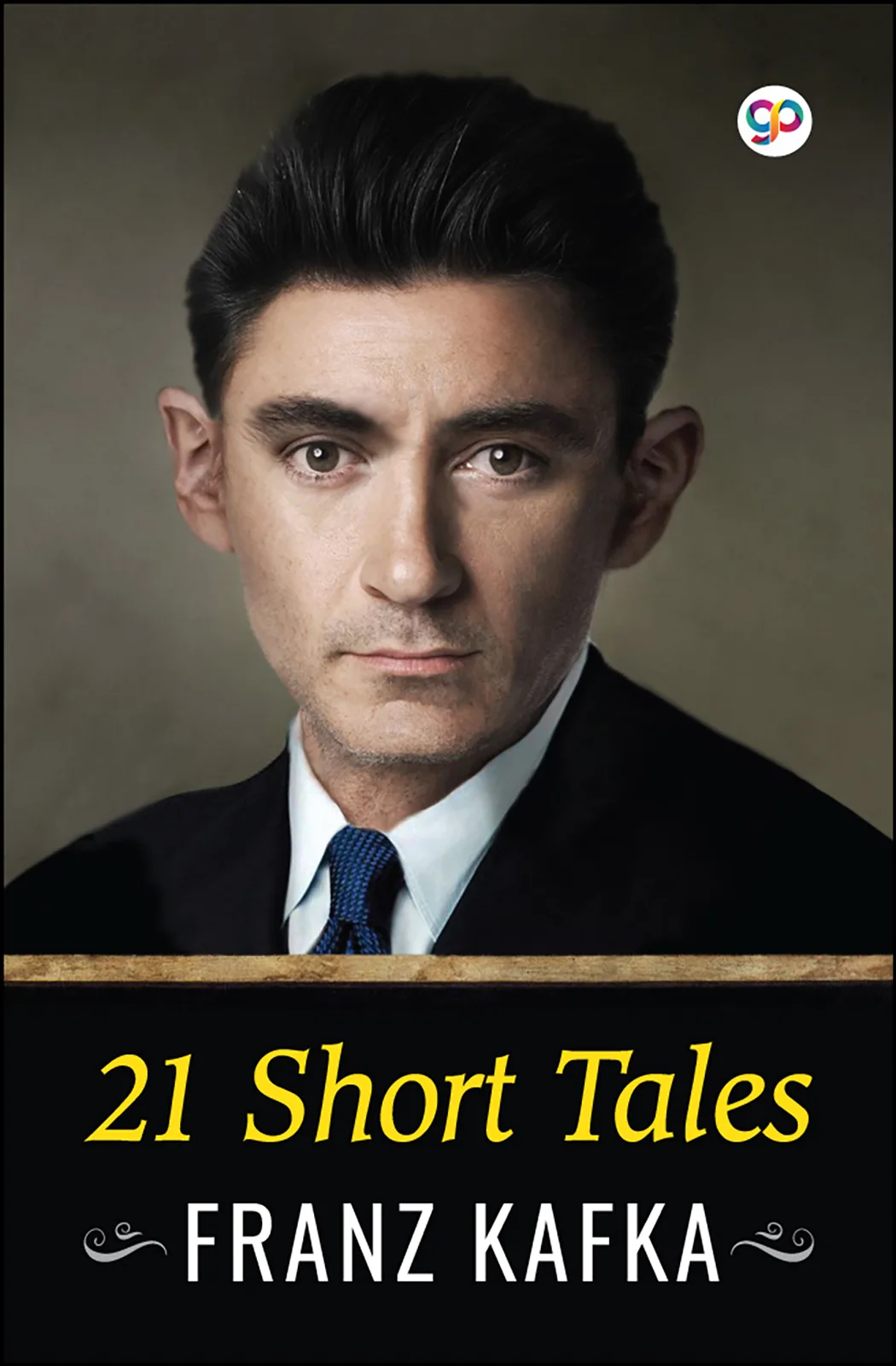
21 Short Tales
Paperback
• 176 Pages
• INR 325.00
• English
• 9789354991103
No ratings yet
| Publisher | General Press |
|---|---|
| ISBN13 | 9789354991103 |
| ASIN/SKU | 9354991106 |
| Book Format | Paperback |
| Language | English |
| Pages | 176 |
| List Price | INR 325.00 |
| Subject Code | FIC025000, FIC039000, FIC029000 |
| Publishing Date | 27/09/2021 |
| Dimensions | 8.25 x 5.25 x 1.0 inches |
| Book Code | BD00067603 |
Buy this Book
Amazon Stores
Ebook Stores
Other Stores
Discover 21 Short Tales by Franz Kafka. This book is published by General Press in Paperback format, ISBN 9789354991103, ASIN 9354991106, under Literature and Fiction, Classics, Short Stories.
Book Description
This collection has Kafka's best twenty-one short stories. It has a total length of around 54,000 words. This is the most comprehensive and recent translation of Franz Kafka's stories, including short and long tales. Scrupulously naturalistic on the surface, uncanny in their depths, these stories represent the achieved art of a modern master who had the gift of making our problematic spiritual life palpable and real.
Kafka was born into a middle-class, German-speaking Jewish family in Prague, then part of the Austro-Hungarian Empire. In his lifetime, most of the population of Prague spoke Czech, and the division between Czech- and German-speaking people was a tangible reality, as both groups were strengthening their national identity. The Jewish community often found itself in between the two sentiments, naturally raising questions about a place to which one belongs. Kafka himself was fluent in both languages, considering German his mother tongue. Kafka trained as a lawyer and, after completing his legal education, obtained employment with an insurance company. He began to write short stories in his spare time. For the rest of his life, he complained about the little time he had to devote to what he came to regard as his calling.
Kafka was born into a middle-class, German-speaking Jewish family in Prague, then part of the Austro-Hungarian Empire. In his lifetime, most of the population of Prague spoke Czech, and the division between Czech- and German-speaking people was a tangible reality, as both groups were strengthening their national identity. The Jewish community often found itself in between the two sentiments, naturally raising questions about a place to which one belongs. Kafka himself was fluent in both languages, considering German his mother tongue. Kafka trained as a lawyer and, after completing his legal education, obtained employment with an insurance company. He began to write short stories in his spare time. For the rest of his life, he complained about the little time he had to devote to what he came to regard as his calling.
Author Biography
Franz Kafka (1883–1924) was a German-speaking Bohemian novelist and short-story writer widely regarded as one of the major figures of 20th-century literature. Born in Prague into a middle-class Jewish family, Kafka grew up in the shadow of a domineering father. This fraught paternal relationship, combined with his own pervasive sense of isolation, became a central psychological driver in his writing, deeply shaping his unique perspective on authority and alienation.
After earning a law degree, Kafka spent most of his adult life working at a workers' accident insurance institute. He viewed this demanding bureaucratic job primarily as a means to pay the bills, reserving his nights for his true passion: writing. It was during these quiet hours that he crafted his distinct literary style, blending realistic settings with surreal, nightmarish scenarios where individuals are crushed by incomprehensible socio-bureaucratic powers.
During his lifetime, Kafka published only a small fraction of his work. His most famous piece published while he was alive is the 1915 novella The Metamorphosis, which chronicles the absurd and tragic story of a traveling salesman who wakes to find himself unexpectedly transformed into a giant insect. The haunting, illogical complexity of this and his other stories eventually gave rise to the term "Kafkaesque," a word now universally used to describe hopelessly bewildering and oppressive situations.
Plagued by crippling self-doubt and chronic health issues, Kafka contracted tuberculosis and died in a sanatorium near Vienna at just 40 years old. Before his death, he left explicit instructions for his closest friend and literary executor, Max Brod, to gather and burn all of his unpublished diaries and manuscripts unread.
Defying these final wishes, Brod recognized the profound genius of his friend's work and instead oversaw the posthumous publication of Kafka’s major unfinished novels, including The Trial and The Castle. Because of Brod's momentous decision, Kafka's visionary explorations of existential anxiety survived, securing his enduring legacy as a literary titan whose works continue to resonate worldwide.
After earning a law degree, Kafka spent most of his adult life working at a workers' accident insurance institute. He viewed this demanding bureaucratic job primarily as a means to pay the bills, reserving his nights for his true passion: writing. It was during these quiet hours that he crafted his distinct literary style, blending realistic settings with surreal, nightmarish scenarios where individuals are crushed by incomprehensible socio-bureaucratic powers.
During his lifetime, Kafka published only a small fraction of his work. His most famous piece published while he was alive is the 1915 novella The Metamorphosis, which chronicles the absurd and tragic story of a traveling salesman who wakes to find himself unexpectedly transformed into a giant insect. The haunting, illogical complexity of this and his other stories eventually gave rise to the term "Kafkaesque," a word now universally used to describe hopelessly bewildering and oppressive situations.
Plagued by crippling self-doubt and chronic health issues, Kafka contracted tuberculosis and died in a sanatorium near Vienna at just 40 years old. Before his death, he left explicit instructions for his closest friend and literary executor, Max Brod, to gather and burn all of his unpublished diaries and manuscripts unread.
Defying these final wishes, Brod recognized the profound genius of his friend's work and instead oversaw the posthumous publication of Kafka’s major unfinished novels, including The Trial and The Castle. Because of Brod's momentous decision, Kafka's visionary explorations of existential anxiety survived, securing his enduring legacy as a literary titan whose works continue to resonate worldwide.
Editorial Reviews
Editorial Reviews will be added soon…
Book Summary
21 Short Tales by Franz Kafka is a striking collection of brief stories, parables, and prose sketches that reveal the author’s remarkable ability to turn ordinary situations into unsettling reflections on human life. The 2011 English edition brings together twenty-one pieces ranging from longer narratives such as “A Country Doctor” and “Jackals and Arabs” to extremely short parables such as “The Next Village” and “A Little Fable.” Rather than offering conventional stories with clear beginnings, conflicts, and satisfying conclusions, Kafka presents fragments of experience in which people struggle against forces they cannot fully understand. The result is a collection filled with loneliness, uncertainty, helplessness, fear, authority, and the strange absurdity of existence.
The collection begins with “A Country Doctor,” one of Kafka’s most memorable tales. A doctor is urgently called to visit a sick patient, but the journey quickly becomes surreal and uncontrollable. His professional identity, which should give him authority and purpose, proves almost useless. The patient’s mysterious wound, the expectations of the villagers, and the doctor’s inability to return home create a dreamlike sense of entrapment. “In the Gods” and “An Old Folio” continue this atmosphere of disorder. In the latter, nomadic outsiders occupy a city while the authorities appear unable or unwilling to restore order. The people recognize the danger but seem powerless to act. Kafka transforms a seemingly social or political problem into a deeper meditation on helplessness and the failure of institutions to protect ordinary individuals.
“Before the Law” is perhaps the collection’s clearest expression of Kafka’s fascination with inaccessible authority. A man spends his entire life waiting outside a doorway that is supposedly intended specifically for him. A doorkeeper prevents him from entering, and the man never discovers whether he could have passed through the door by acting differently. The story is simple, almost childlike, yet its implications are enormous. It can be read as a meditation on justice, religion, bureaucracy, personal freedom, or the human tendency to wait for permission before taking action. Kafka offers no single answer, which is part of the story’s enduring power.
“Jackals and Arabs” presents another strange encounter. A traveler from Europe is approached by jackals who ask him to help free them from their ancient enemies, the Arabs. Their request appears to place the narrator in the role of a potential savior, but the situation soon becomes more complicated. Neither side seems capable of escaping the cycle of hostility. “A Visit to the Mine” is quieter, focusing on a group of engineers and the atmosphere surrounding their work. Even here, Kafka’s interest in hierarchy and observation remains visible: people are reduced to roles within a larger system, and human individuality seems strangely fragile.
“The Next Village” compresses an enormous idea into a few sentences. A person reflects that life is so short that even traveling to the neighboring village might consume the whole of it. The tale captures Kafka’s recurring awareness of time and mortality. “An Imperial Message” develops a similar sense of unreachable distance. An emperor sends a message to one particular subject, but the messenger can never get through the immense crowds and obstacles separating the palace from the recipient. The message exists, but communication remains impossible. Kafka repeatedly shows that having something to say does not mean that it can ever truly reach another person.
“A Paterfamilias Perplexed” and “Eleven Sons” turn attention toward family and identity. In “Eleven Sons,” a father describes his children one by one, judging their personalities, abilities, and shortcomings. His observations reveal not only his children but also his own complicated expectations. The family becomes a miniature world in which love, disappointment, comparison, and authority coexist uneasily. “A Fratricide,” meanwhile, presents violence with Kafka’s characteristic restraint, making the event feel both sudden and strangely inevitable.
Several stories explore the uncertain boundary between reality and imagination. In “A Dream,” Kafka presents a world in which ordinary perception slips into something symbolic and mysterious. “Bucket Rider” follows a desperately poor man who rides an empty coal bucket to seek fuel, only to be carried away without receiving what he needs. The story combines poverty with fantasy, making material deprivation feel like a condition from which escape is almost impossible. “Of Metaphors” then turns Kafka’s attention toward language itself. Metaphors are presented as useful but also potentially misleading, suggesting that attempts to explain reality may sometimes make it more confusing.
“The Silence of the Sirens” reimagines the famous encounter between Odysseus and the sirens. Kafka introduces the possibility that their silence, rather than their song, is their most powerful weapon. The story demonstrates his habit of taking a familiar myth and quietly changing one essential element. By doing so, he makes readers question what they thought they understood. “Gracchus the Hunter” similarly unsettles the boundary between life and death. Gracchus is dead, yet his journey does not end. His ship continues to travel without ever reaching its intended destination, creating a haunting image of existence suspended between states.
“The Knock on the Courtyard Door” and “Advocates” return to Kafka’s familiar world of unexplained authority and anxiety. A seemingly insignificant action can lead to consequences that are impossible to understand. In “Advocates,” people search for legal help, but the supposed protectors of justice seem distant, ineffective, or absurd. Kafka suggests that institutions created to provide security may instead deepen a person’s uncertainty.
“The Vulture” is one of the collection’s most disturbing miniature tales. A man is attacked by a vulture, and although another person appears to offer help, the ending provides no genuine relief. Violence and suffering seem to have their own momentum. “At Night” offers an even more abstract picture of loneliness, imagining people sleeping while the world around them becomes cold, dark, and strangely unprotected. The story conveys the feeling that human beings may share the same world without ever truly overcoming their isolation.
The collection ends with “A Little Fable,” perhaps one of Kafka’s simplest and most devastating pieces. A mouse discovers that the world seems to grow smaller as it moves forward. Just when it believes it has found a direction, a cat appears and closes the conversation with brutal finality. The tale captures Kafka’s larger vision in miniature: human beings search for meaning and direction, but the world does not necessarily provide the answers they hope to find.
Taken together, 21 Short Tales is less a collection of conventional narratives than a portrait of the human condition. Kafka’s characters are frequently trapped between desire and impossibility, authority and obedience, communication and silence, hope and resignation. His stories rarely explain themselves, and that uncertainty is deliberate. Their strange events often feel like dreams, yet the emotions behind them are intensely recognizable. Fear of failure, loneliness, social pressure, guilt, confusion, and the desire to be understood are all presented with remarkable simplicity.
The greatest strength of the collection is Kafka’s ability to make enormous philosophical questions emerge from very small situations. A locked door can represent an entire lifetime; a journey can become a meditation on death; a message can become a symbol of failed communication; an animal can reveal the helplessness of human existence. Readers may not find definitive answers in these tales, but they are likely to recognize something deeply human in their uncertainty. 21 Short Tales ultimately asks us to sit with questions that cannot easily be solved—and that is precisely where Kafka’s unsettling brilliance lies.
The collection begins with “A Country Doctor,” one of Kafka’s most memorable tales. A doctor is urgently called to visit a sick patient, but the journey quickly becomes surreal and uncontrollable. His professional identity, which should give him authority and purpose, proves almost useless. The patient’s mysterious wound, the expectations of the villagers, and the doctor’s inability to return home create a dreamlike sense of entrapment. “In the Gods” and “An Old Folio” continue this atmosphere of disorder. In the latter, nomadic outsiders occupy a city while the authorities appear unable or unwilling to restore order. The people recognize the danger but seem powerless to act. Kafka transforms a seemingly social or political problem into a deeper meditation on helplessness and the failure of institutions to protect ordinary individuals.
“Before the Law” is perhaps the collection’s clearest expression of Kafka’s fascination with inaccessible authority. A man spends his entire life waiting outside a doorway that is supposedly intended specifically for him. A doorkeeper prevents him from entering, and the man never discovers whether he could have passed through the door by acting differently. The story is simple, almost childlike, yet its implications are enormous. It can be read as a meditation on justice, religion, bureaucracy, personal freedom, or the human tendency to wait for permission before taking action. Kafka offers no single answer, which is part of the story’s enduring power.
“Jackals and Arabs” presents another strange encounter. A traveler from Europe is approached by jackals who ask him to help free them from their ancient enemies, the Arabs. Their request appears to place the narrator in the role of a potential savior, but the situation soon becomes more complicated. Neither side seems capable of escaping the cycle of hostility. “A Visit to the Mine” is quieter, focusing on a group of engineers and the atmosphere surrounding their work. Even here, Kafka’s interest in hierarchy and observation remains visible: people are reduced to roles within a larger system, and human individuality seems strangely fragile.
“The Next Village” compresses an enormous idea into a few sentences. A person reflects that life is so short that even traveling to the neighboring village might consume the whole of it. The tale captures Kafka’s recurring awareness of time and mortality. “An Imperial Message” develops a similar sense of unreachable distance. An emperor sends a message to one particular subject, but the messenger can never get through the immense crowds and obstacles separating the palace from the recipient. The message exists, but communication remains impossible. Kafka repeatedly shows that having something to say does not mean that it can ever truly reach another person.
“A Paterfamilias Perplexed” and “Eleven Sons” turn attention toward family and identity. In “Eleven Sons,” a father describes his children one by one, judging their personalities, abilities, and shortcomings. His observations reveal not only his children but also his own complicated expectations. The family becomes a miniature world in which love, disappointment, comparison, and authority coexist uneasily. “A Fratricide,” meanwhile, presents violence with Kafka’s characteristic restraint, making the event feel both sudden and strangely inevitable.
Several stories explore the uncertain boundary between reality and imagination. In “A Dream,” Kafka presents a world in which ordinary perception slips into something symbolic and mysterious. “Bucket Rider” follows a desperately poor man who rides an empty coal bucket to seek fuel, only to be carried away without receiving what he needs. The story combines poverty with fantasy, making material deprivation feel like a condition from which escape is almost impossible. “Of Metaphors” then turns Kafka’s attention toward language itself. Metaphors are presented as useful but also potentially misleading, suggesting that attempts to explain reality may sometimes make it more confusing.
“The Silence of the Sirens” reimagines the famous encounter between Odysseus and the sirens. Kafka introduces the possibility that their silence, rather than their song, is their most powerful weapon. The story demonstrates his habit of taking a familiar myth and quietly changing one essential element. By doing so, he makes readers question what they thought they understood. “Gracchus the Hunter” similarly unsettles the boundary between life and death. Gracchus is dead, yet his journey does not end. His ship continues to travel without ever reaching its intended destination, creating a haunting image of existence suspended between states.
“The Knock on the Courtyard Door” and “Advocates” return to Kafka’s familiar world of unexplained authority and anxiety. A seemingly insignificant action can lead to consequences that are impossible to understand. In “Advocates,” people search for legal help, but the supposed protectors of justice seem distant, ineffective, or absurd. Kafka suggests that institutions created to provide security may instead deepen a person’s uncertainty.
“The Vulture” is one of the collection’s most disturbing miniature tales. A man is attacked by a vulture, and although another person appears to offer help, the ending provides no genuine relief. Violence and suffering seem to have their own momentum. “At Night” offers an even more abstract picture of loneliness, imagining people sleeping while the world around them becomes cold, dark, and strangely unprotected. The story conveys the feeling that human beings may share the same world without ever truly overcoming their isolation.
The collection ends with “A Little Fable,” perhaps one of Kafka’s simplest and most devastating pieces. A mouse discovers that the world seems to grow smaller as it moves forward. Just when it believes it has found a direction, a cat appears and closes the conversation with brutal finality. The tale captures Kafka’s larger vision in miniature: human beings search for meaning and direction, but the world does not necessarily provide the answers they hope to find.
Taken together, 21 Short Tales is less a collection of conventional narratives than a portrait of the human condition. Kafka’s characters are frequently trapped between desire and impossibility, authority and obedience, communication and silence, hope and resignation. His stories rarely explain themselves, and that uncertainty is deliberate. Their strange events often feel like dreams, yet the emotions behind them are intensely recognizable. Fear of failure, loneliness, social pressure, guilt, confusion, and the desire to be understood are all presented with remarkable simplicity.
The greatest strength of the collection is Kafka’s ability to make enormous philosophical questions emerge from very small situations. A locked door can represent an entire lifetime; a journey can become a meditation on death; a message can become a symbol of failed communication; an animal can reveal the helplessness of human existence. Readers may not find definitive answers in these tales, but they are likely to recognize something deeply human in their uncertainty. 21 Short Tales ultimately asks us to sit with questions that cannot easily be solved—and that is precisely where Kafka’s unsettling brilliance lies.
Sample Chapters
Story 1 : Before the Law
Before the law sits a gatekeeper. To this gatekeeper comes a man from the country who asks to gain entry into the law. But the gatekeeper says that he cannot grant him entry at the moment. The man thinks about it and then asks if he will be allowed to come in later on. “It is possible,” says the gatekeeper, “but not now.” At the moment the gate to the law stands open, as always, and the gatekeeper walks to the side, so the man bends over in order to see through the gate into the inside. When the gatekeeper notices that, he laughs and says: “If it tempts you so much, try it in spite of my prohibition. But take note: I am powerful. And I am only the most lowly gatekeeper. But from room to room stand gatekeepers, each more powerful than the other. I can’t endure even one glimpse of the third.” The man from the country has not expected such difficulties: the law should always be accessible for everyone, he thinks, but as he now looks more closely at the gatekeeper in his fur coat, at his large pointed nose and his long, thin, black Tartar’s beard, he decides that it would be better to wait until he gets permission to go inside. The gatekeeper gives him a stool and allows him to sit down at the side in front of the gate. There he sits for days and years. He makes many attempts to be let in, and he wears the gatekeeper out with his requests. The gatekeeper often interrogates him briefly, questioning him about his homeland and many other things, but they are indifferent questions, the kind great men put, and at the end he always tells him once more that he cannot let him inside yet. The man, who has equipped himself with many things for his journey, spends everything, no matter how valuable, to win over the gatekeeper. The latter takes it all but, as he does so, says, “I am taking this only so that you do not think you have failed to do anything.”
During the many years the man observes the gatekeeper almost continuously. He forgets the other gatekeepers, and this one seems to him the only obstacle for entry into the law. He curses the unlucky circumstance, in the first years thoughtlessly and out loud, later, as he grows old, he still mumbles to himself. He becomes childish and, since in the long years studying the gatekeeper he has come to know the fleas in his fur collar, he even asks the fleas to help him persuade the gatekeeper. Finally his eyesight grows weak, and he does not know whether things are really darker around him or whether his eyes are merely deceiving him. But he recognizes now in the darkness an illumination which breaks inextinguishably out of the gateway to the law. Now he no longer has much time to live. Before his death he gathers in his head all his experiences of the entire time up into one question which he has not yet put to the gatekeeper. He waves to him, since he can no longer lift up his stiffening body.
The gatekeeper has to bend way down to him, for the great difference has changed things to the disadvantage of the man. “What do you still want to know, then?” asks the gatekeeper. “You are insatiable.” “Everyone strives after the law,” says the man, “so how is that in these many years no one except me has requested entry?” The gatekeeper sees that the man is already dying and, in order to reach his diminishing sense of hearing, he shouts at him, “Here no one else can gain entry, since this entrance was assigned only to you. I’m going now to close it.
Story 2 : An Imperial Message
The Emperor—so they say—has sent a message, directly from his death bed, to you alone, his pathetic subject, a tiny shadow which has taken refuge at the furthest distance from the imperial sun. He ordered the herald to kneel down beside his bed and whispered the message in his ear. He thought it was so important that he had the herald speak it back to him. He confirmed the accuracy of verbal message by nodding his head. And in front of the entire crowd of those witnessing his death—all the obstructing walls have been broken down, and all the great ones of his empire are standing in a circle on the broad and high soaring flights of stairs—in front of all of them he dispatched his herald. The messenger started off at once, a powerful, tireless man. Sticking one arm out and then another, he makes his way through the crowd. If he runs into resistance, he points to his breast where there is a sign of the sun. So he moves forwards easily, unlike anyone else. But the crowd is so huge; its dwelling places are infinite. If there were an open field, how he would fly along, and soon you would hear the marvellous pounding of his fist on your door. But instead of that, how futile are all his efforts. He is still forcing his way through the private rooms of the innermost palace. Never will he win his way through.
And if he did manage that, nothing would have been achieved. He would have to fight his way down the steps, and, if he managed to do that, nothing would have been achieved. He would have to stride through the courtyards, and after the courtyards through the second palace encircling the first, and, then again, through stairs and courtyards, and then, once again, a palace, and so on for thousands of years. And if he finally burst through the outermost door—but that can never, never happen—the royal capital city, the centre of the world, is still there in front of him, piled high and full of sediment. No one pushes his way through here, certainly not someone with a message from a dead man. But you sit at your window and dream of that message when evening comes.
Story 3 : A Country Doctor
I was in great difficulty. An urgent journey was facing me. A seriously ill man was waiting for me in a village ten miles distant. A severe snowstorm filled the space between him and me. I had a carriage—a light one, with large wheels, entirely suitable for our country roads. Wrapped up in furs with the bag of instruments in my hand, I was already standing in the courtyard ready for the journey; but the horse was missing—the horse. My own horse had died the previous night, as a result of over exertion in this icy winter. My servant girl was at that very moment running around the village to see if she could borrow a horse, but it was hopeless—I knew that—and I stood there useless, increasingly covered with snow, becoming all the time more immobile. The girl appeared at the gate, alone. She was swinging the lantern. Of course, who is now going to lend her his horse for such a journey? I walked once again across the courtyard. I couldn’t see what to do. Distracted and tormented, I kicked my foot against the cracked door of the pig sty which had not been used for years. The door opened and banged to and fro on its hinges. A warmth and smell as if from horses came out. A dim stall lantern on a rope swayed inside. A man huddled down in the stall below showed his open blue eyed face. “Shall I hitch up?” he asked, crawling out on all fours. I didn’t know what to say and bent down to see what was still in the stall. The servant girl stood beside me. “One doesn’t know the sorts of things one has stored in one’s own house,” she said, and we both laughed. “Hey, Brother, hey Sister,” the groom cried out, and two horses, powerful animals with strong flanks, shoved their way one behind the other, legs close to the bodies, lowering their well formed heads like camels, and getting through the door space, which they completely filled, only through the powerful movements of their rumps. But right away they stood up straight, long legged, with thick steaming bodies. “Help him,” I said, and the girl obediently hurried to hand the wagon harness to the groom. But as soon as she was beside him, the groom puts his arms around her and pushes his face against hers. She screams out and runs over to me. On the girl’s cheek were red marks from two rows of teeth. “You brute,” I cry out in fury, “do you want the whip?” But I immediately remember that he is a stranger, that I don’t know where he comes from, and that he’s helping me out of his own free will, when everyone else is refusing to. As if he knows what I was thinking, he takes no offence at my threat, but turns around to me once more, still busy with the horses. Then he says, “Climb in,” and, in fact, everything is ready. I notice that I have never before travelled with such a beautiful team of horses, and I climb in happily. “But I’ll take the reins. You don’t know the way,” I say. “Of course,” he says; “I’m not going with you.
I’m staying with Rosa.” “No,” screams Rosa and runs into the house, with an accurate premonition of the inevitability of her fate. I hear the door chain rattling as she sets it in place. I hear the lock click. I see how in addition she runs down the corridor and through the rooms putting out all the lights in order to make herself impossible to find. “You’re coming with me,” I say to the groom, “or I’ll give up the journey, no matter how urgent it is. It’s not my intention to give you the girl as the price of the trip.” “Giddy up,” he says and claps his hands. The carriage is torn away, like a piece of wood in a current. I still hear how the door of my house is breaking down and splitting apart under the groom’s onslaught, and then my eyes and ears are filled with a roaring sound which overwhelms all my senses at once. But only for a moment. Then I am already there, as if the farm yard of my invalid opens up immediately in front of my courtyard gate. The horses stand quietly. The snowfall has stopped, moonlight all around. The sick man’s parents rush out of the house, his sister behind them. They almost lift me out of the carriage. I get nothing from their confused talking. In the sick room one can hardly breathe the air. The neglected cooking stove is smoking. I want to push open the window, but first I’ll look at the sick man. Thin, without fever, not cold, not warm, with empty eyes, without a shirt, the young man under the stuffed quilt heaves himself up, hangs around my throat, and whispers in my ear, “Doctor, let me die.” I look around. No one has heard. The parents stand silently, leaning forward, and wait for my opinion. The sister has brought a stool for my handbag. I open the bag and look among my instruments. The young man constantly gropes at me from the bed to remind me of his request. I take some tweezers, test them in the candle light, and put them back. “Yes,” I think blasphemously, “in such cases the gods do help. They send the missing horse, even add a second one because it’s urgent, and even throw in a groom as a bonus.” Now for the first time I think once more of Rosa. What am I doing? How am I saving her? How do I pull her out from under this groom, ten miles away from her, with uncontrollable horses in the front of my carriage? These horses, who have somehow loosened their straps, are pushing open the window from outside, I don’t know how. Each one is sticking its head through a window and, unmoved by the crying of the family, is observing the invalid. “I’ll go back right away,” I think, as if the horses were ordering me to journey back, but I allow the sister, who thinks I am in a daze because of the heat, to take off my fur coat. A glass of rum is prepared for me. The old man claps me on the shoulder; the sacrifice of his treasure justifies this familiarity. I shake my head. In the narrow circle of the old man’s thinking I was not well; that’s the only reason I refuse to drink.
The mother stands by the bed and entices me over. I follow and, as a horse neighs loudly at the ceiling, lay my head on the young man’s chest, which trembles under my wet beard. That confirms what I know: the young man is healthy. His circulation is a little off, saturated with coffee by his caring mother, but he’s healthy and best pushed out of bed with a shove. I’m no improver of the world and let him live there. I am employed by the district and do my duty to the full, right to the point where it’s almost too much. Badly paid, but I’m generous and ready to help the poor. I still have to look after Rosa, and then the young man may have his way, and I want to die too. What am I doing here in this endless winter! My horse is dead, and there is no one in the village who’ll lend me his. I have to drag my team out of the pig sty. If they hadn’t happened to be horses, I’d have had to travel with pigs. That’s the way it is. And I nod to the family. They know nothing about it, and if they did know, they wouldn’t believe it. Incidentally, it’s easy to write prescriptions, but difficult to come to an understanding with people. Now, at this point my visit might have come to an end—they have once more called for my help unnecessarily. I’m used to that. With the help of my night bell the entire region torments me, but that this time I had to sacrifice Rosa as well, this beautiful girl, who lives in my house all year long and whom I scarcely notice—this sacrifice is too great, and I must somehow in my own head subtly rationalize it away for the moment, in order not to let loose at this family who cannot, even with their best will, give me Rosa back again. But as I am closing up by hand bag and calling for my fur coat, the family is standing together, the father sniffing the glass of rum in his hand, the mother, probably disappointed in me—what more do these people expect?—tearfully biting her lips, and the sister flapping a very bloody hand towel, I am somehow ready, in the circumstances, to concede that the young man is perhaps nonetheless sick. I go to him. He smiles up at me, as if I was bringing him the most nourishing kind of soup—ah, now both horses are whinnying, the noise is probably supposed to come from higher regions in order to illuminate my examination—and now I find out that, yes indeed, the young man is ill. On his right side, in the region of the hip, a wound the size of the palm of one’s hand has opened up. Rose coloured, in many different shadings, dark in the depths, brighter on the edges, delicately grained, with uneven patches of blood, open to the light like a mine. That’s what it looks like from a distance. Close up a complication is apparent. Who can look at that without whistling softly? Worms, as thick and long as my little finger, themselves rose coloured and also spattered with blood, are wriggling their white bodies with many limbs from their stronghold in the inner of the wound towards the light. Poor young man, there’s no helping you.
I have found out your great wound. You are dying from this flower on your side. The family is happy; they see me doing something. The sister says that to the mother, the mother tells the father, the father tells a few guests who are coming in on tip toe through the moonlight of the open door, balancing themselves with outstretched arms. “Will you save me?” whispers the young man, sobbing, quite blinded by the life inside his wound. That’s how people are in my region. Always demanding the impossible from the doctor. They have lost the old faith. The priest sits at home and tears his religious robes to pieces, one after the other. But the doctor is supposed to achieve everything with his delicate surgeon’s hand. Well, it’s what they like to think. I have not offered myself. If they use me for sacred purposes, I let that happen to me as well. What more do I want, an old country doctor, robbed of my servant girl! And they come, the families and the village elders, and take my clothes off. A choir of school children with the teacher at the head stands in front of the house and sings an extremely simple melody with the words
Take his clothes off, then he’ll heal,
and if he doesn’t cure, then kill him.
It’s only a doctor; it’s only a doctor.
Then I am stripped of my clothes and, with my fingers in my beard and my head tilted to one side, I look at the people quietly. I am completely calm and clear about everything and stay that way, too, although it is not helping me at all, for they are now taking me by the head and feet and dragging me into bed. They lay me against the wall on the side of wound. Then they all go out of the room. The door is shut. The singing stops. Clouds move in front of the moon. The bedclothes lie warmly around me. In the open space of the windows the horses’ heads sway like shadows. “Do you know,” I hear someone saying in my ear, “my confidence in you is very small. You were shaken out from somewhere. You don’t come on your own feet. Instead of helping, you give me less room on my deathbed. The best thing would be if I scratch your eyes out.” “Right,” I say, “it’s a disgrace. But now I’m a doctor. What am I supposed to do? Believe me, things are not easy for me either.” “Should I be satisfied with this excuse? Alas, I’ll probably have to be. I always have to make do. I came into the world with a beautiful wound; that was all I was furnished with.” “Young friend,” I say, “your mistake is that you have no perspective. I’ve already been in all the sick rooms, far and wide, and I tell you your wound is not so bad. Made in a tight corner with two blows from an axe. Many people offer their side and hardly hear the axe in the forest, to say nothing of the fact that it’s coming closer to them.” “Is that really so, or are you deceiving me in my fever?” “It is truly so. Take the word of honour of a medical doctor.” He took my word and grew still.
But now it was time to think about my escape. The horses were still standing loyally in place. Clothes, fur coat, and bag were quickly snatched up. I didn’t want to delay by getting dressed; if the horses rushed as they had on the journey out, I should, in fact, be springing out of that bed into my own, as it were. One horse obediently pulled back from the window. I threw the bundle into the carriage. The fur coat flew too far and was caught on a hook by only one arm. Good enough. I swung myself up onto the horse. The reins dragging loosely, one horse barely harnessed to the other, the carriage-swaying behind, last of all the fur coat in the snow. “Giddy up,” I said, but there was no giddying up about it. We dragged through the snowy desert like old men; for a long time the fresh but inaccurate singing of the children resounded behind us:
Enjoy yourselves, you patients.
The doctor’s laid in bed with you.
I’ll never come home at this rate. My flourishing practice is lost. A successor is robbing me, but to no avail, for he cannot replace me. In my house the disgusting groom is wreaking havoc. Rosa is his victim. I will not think it through. Naked, abandoned to the frost of this unhappy age, with an earthly carriage and unearthly horses, I drive around by myself, an old man. My fur coat hangs behind the wagon, but I cannot reach it, and no one from the nimble rabble of patients lifts a finger. Betrayed! Betrayed! Once one responds to a false alarm on the night bell, there’s no making it good again—not ever.
Before the law sits a gatekeeper. To this gatekeeper comes a man from the country who asks to gain entry into the law. But the gatekeeper says that he cannot grant him entry at the moment. The man thinks about it and then asks if he will be allowed to come in later on. “It is possible,” says the gatekeeper, “but not now.” At the moment the gate to the law stands open, as always, and the gatekeeper walks to the side, so the man bends over in order to see through the gate into the inside. When the gatekeeper notices that, he laughs and says: “If it tempts you so much, try it in spite of my prohibition. But take note: I am powerful. And I am only the most lowly gatekeeper. But from room to room stand gatekeepers, each more powerful than the other. I can’t endure even one glimpse of the third.” The man from the country has not expected such difficulties: the law should always be accessible for everyone, he thinks, but as he now looks more closely at the gatekeeper in his fur coat, at his large pointed nose and his long, thin, black Tartar’s beard, he decides that it would be better to wait until he gets permission to go inside. The gatekeeper gives him a stool and allows him to sit down at the side in front of the gate. There he sits for days and years. He makes many attempts to be let in, and he wears the gatekeeper out with his requests. The gatekeeper often interrogates him briefly, questioning him about his homeland and many other things, but they are indifferent questions, the kind great men put, and at the end he always tells him once more that he cannot let him inside yet. The man, who has equipped himself with many things for his journey, spends everything, no matter how valuable, to win over the gatekeeper. The latter takes it all but, as he does so, says, “I am taking this only so that you do not think you have failed to do anything.”
During the many years the man observes the gatekeeper almost continuously. He forgets the other gatekeepers, and this one seems to him the only obstacle for entry into the law. He curses the unlucky circumstance, in the first years thoughtlessly and out loud, later, as he grows old, he still mumbles to himself. He becomes childish and, since in the long years studying the gatekeeper he has come to know the fleas in his fur collar, he even asks the fleas to help him persuade the gatekeeper. Finally his eyesight grows weak, and he does not know whether things are really darker around him or whether his eyes are merely deceiving him. But he recognizes now in the darkness an illumination which breaks inextinguishably out of the gateway to the law. Now he no longer has much time to live. Before his death he gathers in his head all his experiences of the entire time up into one question which he has not yet put to the gatekeeper. He waves to him, since he can no longer lift up his stiffening body.
The gatekeeper has to bend way down to him, for the great difference has changed things to the disadvantage of the man. “What do you still want to know, then?” asks the gatekeeper. “You are insatiable.” “Everyone strives after the law,” says the man, “so how is that in these many years no one except me has requested entry?” The gatekeeper sees that the man is already dying and, in order to reach his diminishing sense of hearing, he shouts at him, “Here no one else can gain entry, since this entrance was assigned only to you. I’m going now to close it.
Story 2 : An Imperial Message
The Emperor—so they say—has sent a message, directly from his death bed, to you alone, his pathetic subject, a tiny shadow which has taken refuge at the furthest distance from the imperial sun. He ordered the herald to kneel down beside his bed and whispered the message in his ear. He thought it was so important that he had the herald speak it back to him. He confirmed the accuracy of verbal message by nodding his head. And in front of the entire crowd of those witnessing his death—all the obstructing walls have been broken down, and all the great ones of his empire are standing in a circle on the broad and high soaring flights of stairs—in front of all of them he dispatched his herald. The messenger started off at once, a powerful, tireless man. Sticking one arm out and then another, he makes his way through the crowd. If he runs into resistance, he points to his breast where there is a sign of the sun. So he moves forwards easily, unlike anyone else. But the crowd is so huge; its dwelling places are infinite. If there were an open field, how he would fly along, and soon you would hear the marvellous pounding of his fist on your door. But instead of that, how futile are all his efforts. He is still forcing his way through the private rooms of the innermost palace. Never will he win his way through.
And if he did manage that, nothing would have been achieved. He would have to fight his way down the steps, and, if he managed to do that, nothing would have been achieved. He would have to stride through the courtyards, and after the courtyards through the second palace encircling the first, and, then again, through stairs and courtyards, and then, once again, a palace, and so on for thousands of years. And if he finally burst through the outermost door—but that can never, never happen—the royal capital city, the centre of the world, is still there in front of him, piled high and full of sediment. No one pushes his way through here, certainly not someone with a message from a dead man. But you sit at your window and dream of that message when evening comes.
Story 3 : A Country Doctor
I was in great difficulty. An urgent journey was facing me. A seriously ill man was waiting for me in a village ten miles distant. A severe snowstorm filled the space between him and me. I had a carriage—a light one, with large wheels, entirely suitable for our country roads. Wrapped up in furs with the bag of instruments in my hand, I was already standing in the courtyard ready for the journey; but the horse was missing—the horse. My own horse had died the previous night, as a result of over exertion in this icy winter. My servant girl was at that very moment running around the village to see if she could borrow a horse, but it was hopeless—I knew that—and I stood there useless, increasingly covered with snow, becoming all the time more immobile. The girl appeared at the gate, alone. She was swinging the lantern. Of course, who is now going to lend her his horse for such a journey? I walked once again across the courtyard. I couldn’t see what to do. Distracted and tormented, I kicked my foot against the cracked door of the pig sty which had not been used for years. The door opened and banged to and fro on its hinges. A warmth and smell as if from horses came out. A dim stall lantern on a rope swayed inside. A man huddled down in the stall below showed his open blue eyed face. “Shall I hitch up?” he asked, crawling out on all fours. I didn’t know what to say and bent down to see what was still in the stall. The servant girl stood beside me. “One doesn’t know the sorts of things one has stored in one’s own house,” she said, and we both laughed. “Hey, Brother, hey Sister,” the groom cried out, and two horses, powerful animals with strong flanks, shoved their way one behind the other, legs close to the bodies, lowering their well formed heads like camels, and getting through the door space, which they completely filled, only through the powerful movements of their rumps. But right away they stood up straight, long legged, with thick steaming bodies. “Help him,” I said, and the girl obediently hurried to hand the wagon harness to the groom. But as soon as she was beside him, the groom puts his arms around her and pushes his face against hers. She screams out and runs over to me. On the girl’s cheek were red marks from two rows of teeth. “You brute,” I cry out in fury, “do you want the whip?” But I immediately remember that he is a stranger, that I don’t know where he comes from, and that he’s helping me out of his own free will, when everyone else is refusing to. As if he knows what I was thinking, he takes no offence at my threat, but turns around to me once more, still busy with the horses. Then he says, “Climb in,” and, in fact, everything is ready. I notice that I have never before travelled with such a beautiful team of horses, and I climb in happily. “But I’ll take the reins. You don’t know the way,” I say. “Of course,” he says; “I’m not going with you.
I’m staying with Rosa.” “No,” screams Rosa and runs into the house, with an accurate premonition of the inevitability of her fate. I hear the door chain rattling as she sets it in place. I hear the lock click. I see how in addition she runs down the corridor and through the rooms putting out all the lights in order to make herself impossible to find. “You’re coming with me,” I say to the groom, “or I’ll give up the journey, no matter how urgent it is. It’s not my intention to give you the girl as the price of the trip.” “Giddy up,” he says and claps his hands. The carriage is torn away, like a piece of wood in a current. I still hear how the door of my house is breaking down and splitting apart under the groom’s onslaught, and then my eyes and ears are filled with a roaring sound which overwhelms all my senses at once. But only for a moment. Then I am already there, as if the farm yard of my invalid opens up immediately in front of my courtyard gate. The horses stand quietly. The snowfall has stopped, moonlight all around. The sick man’s parents rush out of the house, his sister behind them. They almost lift me out of the carriage. I get nothing from their confused talking. In the sick room one can hardly breathe the air. The neglected cooking stove is smoking. I want to push open the window, but first I’ll look at the sick man. Thin, without fever, not cold, not warm, with empty eyes, without a shirt, the young man under the stuffed quilt heaves himself up, hangs around my throat, and whispers in my ear, “Doctor, let me die.” I look around. No one has heard. The parents stand silently, leaning forward, and wait for my opinion. The sister has brought a stool for my handbag. I open the bag and look among my instruments. The young man constantly gropes at me from the bed to remind me of his request. I take some tweezers, test them in the candle light, and put them back. “Yes,” I think blasphemously, “in such cases the gods do help. They send the missing horse, even add a second one because it’s urgent, and even throw in a groom as a bonus.” Now for the first time I think once more of Rosa. What am I doing? How am I saving her? How do I pull her out from under this groom, ten miles away from her, with uncontrollable horses in the front of my carriage? These horses, who have somehow loosened their straps, are pushing open the window from outside, I don’t know how. Each one is sticking its head through a window and, unmoved by the crying of the family, is observing the invalid. “I’ll go back right away,” I think, as if the horses were ordering me to journey back, but I allow the sister, who thinks I am in a daze because of the heat, to take off my fur coat. A glass of rum is prepared for me. The old man claps me on the shoulder; the sacrifice of his treasure justifies this familiarity. I shake my head. In the narrow circle of the old man’s thinking I was not well; that’s the only reason I refuse to drink.
The mother stands by the bed and entices me over. I follow and, as a horse neighs loudly at the ceiling, lay my head on the young man’s chest, which trembles under my wet beard. That confirms what I know: the young man is healthy. His circulation is a little off, saturated with coffee by his caring mother, but he’s healthy and best pushed out of bed with a shove. I’m no improver of the world and let him live there. I am employed by the district and do my duty to the full, right to the point where it’s almost too much. Badly paid, but I’m generous and ready to help the poor. I still have to look after Rosa, and then the young man may have his way, and I want to die too. What am I doing here in this endless winter! My horse is dead, and there is no one in the village who’ll lend me his. I have to drag my team out of the pig sty. If they hadn’t happened to be horses, I’d have had to travel with pigs. That’s the way it is. And I nod to the family. They know nothing about it, and if they did know, they wouldn’t believe it. Incidentally, it’s easy to write prescriptions, but difficult to come to an understanding with people. Now, at this point my visit might have come to an end—they have once more called for my help unnecessarily. I’m used to that. With the help of my night bell the entire region torments me, but that this time I had to sacrifice Rosa as well, this beautiful girl, who lives in my house all year long and whom I scarcely notice—this sacrifice is too great, and I must somehow in my own head subtly rationalize it away for the moment, in order not to let loose at this family who cannot, even with their best will, give me Rosa back again. But as I am closing up by hand bag and calling for my fur coat, the family is standing together, the father sniffing the glass of rum in his hand, the mother, probably disappointed in me—what more do these people expect?—tearfully biting her lips, and the sister flapping a very bloody hand towel, I am somehow ready, in the circumstances, to concede that the young man is perhaps nonetheless sick. I go to him. He smiles up at me, as if I was bringing him the most nourishing kind of soup—ah, now both horses are whinnying, the noise is probably supposed to come from higher regions in order to illuminate my examination—and now I find out that, yes indeed, the young man is ill. On his right side, in the region of the hip, a wound the size of the palm of one’s hand has opened up. Rose coloured, in many different shadings, dark in the depths, brighter on the edges, delicately grained, with uneven patches of blood, open to the light like a mine. That’s what it looks like from a distance. Close up a complication is apparent. Who can look at that without whistling softly? Worms, as thick and long as my little finger, themselves rose coloured and also spattered with blood, are wriggling their white bodies with many limbs from their stronghold in the inner of the wound towards the light. Poor young man, there’s no helping you.
I have found out your great wound. You are dying from this flower on your side. The family is happy; they see me doing something. The sister says that to the mother, the mother tells the father, the father tells a few guests who are coming in on tip toe through the moonlight of the open door, balancing themselves with outstretched arms. “Will you save me?” whispers the young man, sobbing, quite blinded by the life inside his wound. That’s how people are in my region. Always demanding the impossible from the doctor. They have lost the old faith. The priest sits at home and tears his religious robes to pieces, one after the other. But the doctor is supposed to achieve everything with his delicate surgeon’s hand. Well, it’s what they like to think. I have not offered myself. If they use me for sacred purposes, I let that happen to me as well. What more do I want, an old country doctor, robbed of my servant girl! And they come, the families and the village elders, and take my clothes off. A choir of school children with the teacher at the head stands in front of the house and sings an extremely simple melody with the words
Take his clothes off, then he’ll heal,
and if he doesn’t cure, then kill him.
It’s only a doctor; it’s only a doctor.
Then I am stripped of my clothes and, with my fingers in my beard and my head tilted to one side, I look at the people quietly. I am completely calm and clear about everything and stay that way, too, although it is not helping me at all, for they are now taking me by the head and feet and dragging me into bed. They lay me against the wall on the side of wound. Then they all go out of the room. The door is shut. The singing stops. Clouds move in front of the moon. The bedclothes lie warmly around me. In the open space of the windows the horses’ heads sway like shadows. “Do you know,” I hear someone saying in my ear, “my confidence in you is very small. You were shaken out from somewhere. You don’t come on your own feet. Instead of helping, you give me less room on my deathbed. The best thing would be if I scratch your eyes out.” “Right,” I say, “it’s a disgrace. But now I’m a doctor. What am I supposed to do? Believe me, things are not easy for me either.” “Should I be satisfied with this excuse? Alas, I’ll probably have to be. I always have to make do. I came into the world with a beautiful wound; that was all I was furnished with.” “Young friend,” I say, “your mistake is that you have no perspective. I’ve already been in all the sick rooms, far and wide, and I tell you your wound is not so bad. Made in a tight corner with two blows from an axe. Many people offer their side and hardly hear the axe in the forest, to say nothing of the fact that it’s coming closer to them.” “Is that really so, or are you deceiving me in my fever?” “It is truly so. Take the word of honour of a medical doctor.” He took my word and grew still.
But now it was time to think about my escape. The horses were still standing loyally in place. Clothes, fur coat, and bag were quickly snatched up. I didn’t want to delay by getting dressed; if the horses rushed as they had on the journey out, I should, in fact, be springing out of that bed into my own, as it were. One horse obediently pulled back from the window. I threw the bundle into the carriage. The fur coat flew too far and was caught on a hook by only one arm. Good enough. I swung myself up onto the horse. The reins dragging loosely, one horse barely harnessed to the other, the carriage-swaying behind, last of all the fur coat in the snow. “Giddy up,” I said, but there was no giddying up about it. We dragged through the snowy desert like old men; for a long time the fresh but inaccurate singing of the children resounded behind us:
Enjoy yourselves, you patients.
The doctor’s laid in bed with you.
I’ll never come home at this rate. My flourishing practice is lost. A successor is robbing me, but to no avail, for he cannot replace me. In my house the disgusting groom is wreaking havoc. Rosa is his victim. I will not think it through. Naked, abandoned to the frost of this unhappy age, with an earthly carriage and unearthly horses, I drive around by myself, an old man. My fur coat hangs behind the wagon, but I cannot reach it, and no one from the nimble rabble of patients lifts a finger. Betrayed! Betrayed! Once one responds to a false alarm on the night bell, there’s no making it good again—not ever.
Reader Reviews
No reviews yet.
21 Short Tales