
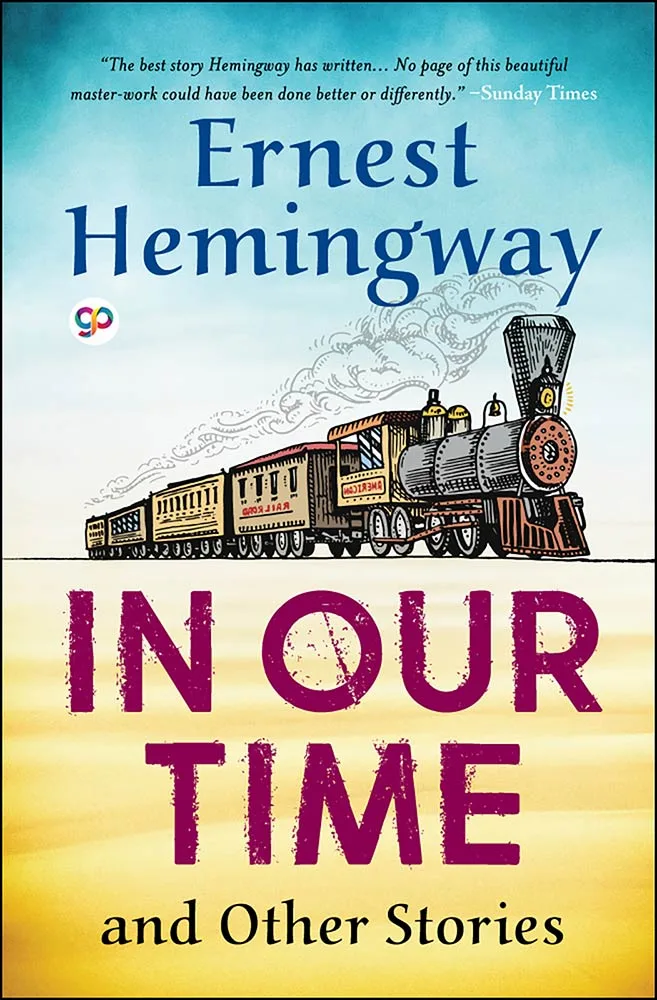
In Our Time and Other Stories
Hardcover
• 88 Pages
• INR 275.00
• English
• 9789354991608
No ratings yet
| Publisher | General Press |
|---|---|
| ISBN13 | 9789354991608 |
| ASIN/SKU | 9354991602 |
| Book Format | Hardcover |
| Language | English |
| Pages | 88 |
| List Price | INR 275.00 |
| Subject Code | FIC047000, FIC049040, LIT004150 |
| Publishing Date | 01/08/2022 |
| Dimensions | 8.25 x 5.25 x 1.0 inches |
| Book Code | BD00067618 |
Buy this Book
Amazon Stores
Ebook Stores
Other Stores
Discover In Our Time and Other Stories by Ernest Hemingway. This book is published by General Press in Hardcover format, ISBN 9789354991608, ASIN 9354991602, under Literature and Fiction, Short Stories, Literary Fiction.
Book Description
First published in 1925, ‘In Our Time’ was widely praised for its simple and precise use of language to convey a wide range of complex emotions. Ernest Hemingway’s American debut was marked by this strikingly original collection of short stories and accompanying vignettes and earned him a place among the most promising American writers of that period. This contains several early Hemingway classics, including the famous Nick Adams stories ‘Indian Camp’ and ‘The Three Day Blow’, and introduces readers to the hallmarks of the Hemingway style: an eye for the realistic. His writing suggests, through the simplest of statements, a sense of moral value and clarity of vision.
A selection of 14 short stories and 15 vignettes is now recognized as one of the most original short story collections in 20th-century literature; it also provides a key to Hemingway's later work.
A selection of 14 short stories and 15 vignettes is now recognized as one of the most original short story collections in 20th-century literature; it also provides a key to Hemingway's later work.
Author Biography
Ernest Miller Hemingway (1899–1961) was a legendary American novelist, short-story writer, and journalist whose economical, understated prose style profoundly influenced 20th-century fiction. Born in Oak Park, Illinois, Hemingway began his career as a reporter before volunteering as an ambulance driver in Italy during World War I. He was severely wounded and returned home, a traumatic but formative experience that heavily informed his early fiction, particularly his acclaimed 1929 novel A Farewell to Arms.
In the 1920s, Hemingway moved to Paris, where he became a central figure in the "Lost Generation" of expatriate artists and writers, associating with luminaries like F. Scott Fitzgerald and Gertrude Stein. During this period, he published his breakthrough debut novel, The Sun Also Rises (1926), which perfectly captured the post-war disillusionment of his peers. Hemingway's writing was famously characterized by his "iceberg theory"—a minimalist approach where the underlying meaning and emotion are implied rather than explicitly stated. His thirst for adventure frequently mirrored the rugged lives of his characters; he passionately pursued bullfighting, deep-sea fishing, and big-game hunting. He later covered the Spanish Civil War as a journalist, an experience that inspired his 1940 masterpiece For Whom the Bell Tolls.
Hemingway’s later years were marked by a tumultuous personal life, failing physical health, and enduring literary triumph. In 1952, he published The Old Man and the Sea, a short, powerful novel about an aging Cuban fisherman's epic battle with a giant marlin. The book earned him the Pulitzer Prize for Fiction in 1953 and was instrumental in his winning the Nobel Prize in Literature in 1954. Despite his immense global success, Hemingway struggled with severe depression in his final years. He tragically took his own life in Ketchum, Idaho, in 1961, leaving behind a monumental legacy that forever reshaped modern literature.
In the 1920s, Hemingway moved to Paris, where he became a central figure in the "Lost Generation" of expatriate artists and writers, associating with luminaries like F. Scott Fitzgerald and Gertrude Stein. During this period, he published his breakthrough debut novel, The Sun Also Rises (1926), which perfectly captured the post-war disillusionment of his peers. Hemingway's writing was famously characterized by his "iceberg theory"—a minimalist approach where the underlying meaning and emotion are implied rather than explicitly stated. His thirst for adventure frequently mirrored the rugged lives of his characters; he passionately pursued bullfighting, deep-sea fishing, and big-game hunting. He later covered the Spanish Civil War as a journalist, an experience that inspired his 1940 masterpiece For Whom the Bell Tolls.
Hemingway’s later years were marked by a tumultuous personal life, failing physical health, and enduring literary triumph. In 1952, he published The Old Man and the Sea, a short, powerful novel about an aging Cuban fisherman's epic battle with a giant marlin. The book earned him the Pulitzer Prize for Fiction in 1953 and was instrumental in his winning the Nobel Prize in Literature in 1954. Despite his immense global success, Hemingway struggled with severe depression in his final years. He tragically took his own life in Ketchum, Idaho, in 1961, leaving behind a monumental legacy that forever reshaped modern literature.
Editorial Reviews
Editorial Reviews will be added soon…
Book Summary
In Our Time and Other Stories by Ernest Hemingway is one of the most important early collections in modern American literature. First published in the United States in 1925, the book brought together short stories and brief interchapters, or vignettes, that had grown out of Hemingway’s early experiments with fiction. The collection includes some of his best-known early works, such as “Indian Camp,” “The Doctor and the Doctor’s Wife,” “The Three-Day Blow,” “The Battler,” “A Very Short Story,” and “Big Two-Hearted River.”
At first glance, In Our Time can seem like a simple collection of unrelated stories. There are boys fishing in Michigan, troubled marriages, soldiers returning from war, bullfighters facing death, couples traveling through Europe, and a young man trying to recover from painful experiences. But beneath these apparently ordinary episodes lies a larger story about growing up, suffering, war, love, loss, masculinity, loneliness, and the difficult process of learning how to live after trauma. The stories are connected especially through Nick Adams, a recurring character who appears at different stages of his life.
The Structure and Meaning of In Our Time
One of the most distinctive features of the book is its structure. The 1925 American edition combines short stories with short numbered vignettes. The stories often follow characters and personal experiences, while the interchapters suddenly move the reader into scenes of war, violence, bullfighting, political upheaval, or public spectacle. The original contents include fifteen main stories, with “Big Two-Hearted River” divided into two parts, and the collection closes with “L’Envoi.”
This arrangement creates a powerful contrast. A quiet story about fishing may be followed by a brutal scene from war. A personal experience of love may be placed beside an image of public violence. Hemingway does not need to explain the connection. The reader feels it.
The result is a portrait of a generation living in what might be called a damaged world. War has changed people's understanding of courage and death. Relationships have become uncertain. Traditional ideas of masculinity are both attractive and inadequate. People often suffer without knowing how to talk about their suffering.
This is one reason In Our Time remains so important. Hemingway does not usually tell readers what his characters feel. Instead, he shows their behavior, conversations, gestures, silences, and surroundings. The emotions are frequently underneath the surface.
“Indian Camp”: Nick’s First Encounter with Life and Death
The collection begins its Nick Adams sequence with “Indian Camp,” one of Hemingway’s most famous short stories. Nick accompanies his father, a doctor, to an isolated Indian camp where a woman is experiencing a difficult childbirth. Nick watches his father perform the medical procedure under primitive conditions.
For Nick, the experience becomes an early lesson in the realities of life. Birth is not presented as a purely joyful event. It is connected immediately with pain, blood, fear, and death. Nick also witnesses the suicide of the woman’s husband, who has been lying in the same cabin.
The story is important because Nick encounters two mysteries at once: how life begins and how suddenly life can end. His father tries to explain some of what has happened, but the child cannot fully understand it. Hemingway avoids turning the experience into a moral lesson. Instead, he leaves Nick—and the reader—with the unsettling knowledge that the adult world contains things that cannot be made completely safe or understandable.
“The Doctor and the Doctor’s Wife”: Conflict and Character
The next story deepens the picture of Nick’s family. His father becomes involved in a dispute over stolen logs, but the confrontation does not end in a heroic victory. Instead, the doctor retreats, while his wife criticizes him for failing to stand up for himself.
The story quietly explores Hemingway’s interest in masculine pride. Nick observes the tension between his parents and begins to see that being a man is not as simple as appearing strong. His father wants to maintain his dignity, but dignity can also become stubbornness and emotional isolation.
This pattern becomes important throughout the collection. Hemingway repeatedly shows men facing situations in which courage, pride, fear, and vulnerability are difficult to separate.
“The End of Something” and “The Three-Day Blow”: Love and Separation
“The End of Something” deals with Nick’s relationship with Marjorie. Nick takes her to a familiar place and tells her that their relationship should end. Nothing dramatic happens. There is no great argument or emotional explosion. Yet the breakup is painful precisely because Hemingway allows the characters to speak in an understated way.
The story shows one of Hemingway’s central subjects: the inability of people to say exactly what they feel.
“The Three-Day Blow” follows Nick after the breakup. He spends time drinking and talking with his friend Bill. Their conversation moves through literature, alcohol, relationships, and Nick’s feelings about Marjorie. The story reveals how friendship can become a form of emotional shelter. Nick is not ready to deal directly with his sadness, so he talks around it.
The title suggests temporary relief. A storm passes, and Nick begins to imagine that perhaps his relationship can be restored. Yet the reader understands that emotional storms are rarely so simple.
“The Battler”: A Different Kind of Masculinity
In “The Battler,” Nick is traveling alone and encounters Ad Francis, a former boxer, and Bugs, his companion. Ad has been damaged by his life and by violence. He is physically imposing but psychologically unstable.
The encounter introduces Nick to another version of manhood. Strength does not necessarily protect a person from loneliness, humiliation, or mental suffering. Ad has been a fighter, but his identity as a fighter has not saved him.
Nick is still learning how unpredictable the adult world can be. The story also emphasizes compassion. Bugs, despite his difficult circumstances, tries to protect Nick from Ad’s instability. Hemingway therefore presents masculinity not simply as aggression but also as restraint, loyalty, and the ability to protect another person.
War, Trauma, and “A Very Short Story”
The war enters the collection more directly in “A Very Short Story.” A soldier falls in love with a nurse during wartime, but their relationship collapses after they separate.
The story is deliberately compressed. What might normally become a long romantic narrative is reduced to a few pages. Love, promises, separation, betrayal, and disappointment happen with startling speed.
That compression is part of the point. War disrupts ordinary emotional development. People form intense relationships under extraordinary circumstances and then return to a world where those relationships may no longer work.
The interchapters surrounding the stories make this emotional damage even more powerful. Hemingway presents war not as a grand adventure but as a world of fear, mutilation, execution, confusion, and death.
“Soldier’s Home”: Returning to a World That Has Changed
“Soldier’s Home” focuses on Harold Krebs, a young man who returns home after fighting in the First World War. His family expects him to return to normal life, but Krebs finds that ordinary life no longer feels meaningful.
He does not want to tell the complete truth about the war because people are interested mainly in entertaining stories. His mother wants him to return to conventional expectations—work, religion, marriage, and responsibility. Krebs, however, feels emotionally detached.
This is one of the collection’s clearest portrayals of postwar alienation. The war has ended, but for Krebs the psychological consequences continue.
Hemingway captures an important truth: coming home does not necessarily mean returning to the person one was before.
“The Revolutionist,” “Mr. and Mrs. Elliot,” and “Cat in the Rain”
Not every story centers on Nick. “The Revolutionist” shifts toward European political life and follows a young revolutionary who admires figures and ideals from a distance. The story questions the relationship between political commitment and personal understanding.
“Mr. and Mrs. Elliot” explores an unhappy marriage. The couple's relationship is dominated by expectations, sexual anxiety, social convention, and emotional frustration. Hemingway again shows people who cannot communicate their deepest desires.
“Cat in the Rain” is more subtle. An American wife staying in an Italian hotel sees a cat outside in the rain and wants to rescue it. The cat becomes a small symbol of her larger dissatisfaction. She wants affection, attention, independence, and perhaps a different life, but her husband responds with indifference.
The story demonstrates Hemingway’s famous ability to make an apparently insignificant event carry emotional weight. The cat is not simply a cat. It becomes connected to the woman's loneliness and her desire to be cared for.
“Out of Season” and “Cross Country Snow”
“Out of Season” follows an American couple in Europe as they attempt to go fishing illegally. The excursion becomes increasingly uncomfortable, exposing tension within their marriage.
“Cross Country Snow,” by contrast, centers on Nick and George skiing together. The men enjoy the freedom of the mountains, but their happiness is temporary. Nick is thinking about the future and the responsibilities that await him.
The story contains a recurring Hemingway tension between freedom and responsibility. Moments of pleasure are precious partly because they cannot last forever.
“My Old Man”: Loyalty, Love, and Moral Ambiguity
“My Old Man” is narrated by a young boy whose father is a jockey. The boy admires his father deeply, but gradually discovers that the adult world surrounding horse racing is morally complicated.
The story is especially effective because the narrator does not fully understand everything he witnesses. Readers can recognize deception and corruption that the boy interprets differently.
Hemingway frequently uses this technique. A young character sees something without completely understanding it, while the reader senses a larger and darker reality.
“Big Two-Hearted River”: Healing Through Routine
The emotional climax of In Our Time comes with “Big Two-Hearted River,” which follows Nick Adams after the war. He returns to a landscape that has been damaged by fire and begins a fishing trip.
There is very little conventional action. Nick walks, camps, prepares food, catches grasshoppers, fishes, and arranges his belongings.
Yet these simple actions are deeply significant.
Nick is recovering. Hemingway never explicitly describes all of his psychological wounds, but the careful routine suggests a mind trying to regain control. Fishing gives Nick something concrete to concentrate on. He does not have to solve his entire life. He only has to put up the tent, prepare his meal, tie the fishing line, and move through the day.
The river becomes a place of temporary peace.
The story is a perfect example of Hemingway's indirect method. The most important subject is not really fishing. It is survival and recovery. Nick's trauma remains largely unspoken, but it shapes everything he does.
Major Themes in In Our Time
The central theme of the collection is growing up in a damaged world. Nick moves from childhood innocence toward adult knowledge. Along the way, he encounters birth, death, violence, love, separation, war, and responsibility.
Another major theme is war and trauma. Hemingway refuses to romanticize war. His soldiers and veterans often return emotionally disconnected, carrying experiences they cannot easily communicate.
Masculinity is another recurring concern. Men in these stories fish, hunt, box, fight, drink, work, and compete. But Hemingway repeatedly shows that outward toughness does not eliminate fear or vulnerability.
The collection also explores love and emotional separation. Couples often fail to communicate honestly. Relationships break apart quietly rather than dramatically.
Finally, there is the theme of healing through action. Nick's fishing trip suggests that recovery may sometimes begin not through explanation but through ordinary, manageable acts.
Hemingway’s Writing Style
The greatest achievement of In Our Time may be Hemingway's prose style. His sentences are usually short, clear, concrete, and restrained. He avoids excessive explanation. Instead of telling readers that a character is devastated, he may show the character pouring a drink, looking away, or changing the subject.
This technique is closely associated with Hemingway's “iceberg” method: the writer presents only part of the meaning while allowing the larger emotional reality to remain beneath the surface. The official publisher description likewise emphasizes the collection's lean prose, colloquial dialogue, realism, and ability to suggest moral meaning through simple statements.
The result can initially feel almost too simple. But the simplicity is deceptive. The stories become richer when the reader notices what the characters avoid saying.
Why In Our Time Still Matters
In Our Time is more than a collection of early Hemingway stories. It is a book about people trying to remain human when the world around them has become frightening, unstable, and difficult to understand.
Its importance also comes from its place in Hemingway's development. The 1925 collection helped establish the style that would become one of the defining voices of twentieth-century American fiction. Contemporary writers and critics recognized the force of its precise, economical prose, and the collection has since become an important entry point into Hemingway's later work.
For readers searching for an In Our Time summary, the most useful way to understand the book is not as a single conventional plot. It is better understood as a mosaic. Each story contributes another piece to Hemingway's picture of modern life.
Nick Adams provides the emotional thread, but the larger subject is a generation shaped by violence and change. Childhood becomes adulthood; love becomes separation; war becomes memory; and survival becomes an everyday task.
The final impression is both bleak and hopeful. Hemingway shows suffering without sentimentalizing it, but he also shows people finding small forms of dignity. A friend offers protection. A person continues walking. Someone cooks a meal. Someone goes fishing. Someone tries again.
That is the quiet strength of In Our Time. It suggests that life does not always become meaningful because we understand everything that happens to us. Sometimes meaning comes from learning how to continue—with discipline, courage, friendship, and an acceptance of what cannot be changed.
At first glance, In Our Time can seem like a simple collection of unrelated stories. There are boys fishing in Michigan, troubled marriages, soldiers returning from war, bullfighters facing death, couples traveling through Europe, and a young man trying to recover from painful experiences. But beneath these apparently ordinary episodes lies a larger story about growing up, suffering, war, love, loss, masculinity, loneliness, and the difficult process of learning how to live after trauma. The stories are connected especially through Nick Adams, a recurring character who appears at different stages of his life.
The Structure and Meaning of In Our Time
One of the most distinctive features of the book is its structure. The 1925 American edition combines short stories with short numbered vignettes. The stories often follow characters and personal experiences, while the interchapters suddenly move the reader into scenes of war, violence, bullfighting, political upheaval, or public spectacle. The original contents include fifteen main stories, with “Big Two-Hearted River” divided into two parts, and the collection closes with “L’Envoi.”
This arrangement creates a powerful contrast. A quiet story about fishing may be followed by a brutal scene from war. A personal experience of love may be placed beside an image of public violence. Hemingway does not need to explain the connection. The reader feels it.
The result is a portrait of a generation living in what might be called a damaged world. War has changed people's understanding of courage and death. Relationships have become uncertain. Traditional ideas of masculinity are both attractive and inadequate. People often suffer without knowing how to talk about their suffering.
This is one reason In Our Time remains so important. Hemingway does not usually tell readers what his characters feel. Instead, he shows their behavior, conversations, gestures, silences, and surroundings. The emotions are frequently underneath the surface.
“Indian Camp”: Nick’s First Encounter with Life and Death
The collection begins its Nick Adams sequence with “Indian Camp,” one of Hemingway’s most famous short stories. Nick accompanies his father, a doctor, to an isolated Indian camp where a woman is experiencing a difficult childbirth. Nick watches his father perform the medical procedure under primitive conditions.
For Nick, the experience becomes an early lesson in the realities of life. Birth is not presented as a purely joyful event. It is connected immediately with pain, blood, fear, and death. Nick also witnesses the suicide of the woman’s husband, who has been lying in the same cabin.
The story is important because Nick encounters two mysteries at once: how life begins and how suddenly life can end. His father tries to explain some of what has happened, but the child cannot fully understand it. Hemingway avoids turning the experience into a moral lesson. Instead, he leaves Nick—and the reader—with the unsettling knowledge that the adult world contains things that cannot be made completely safe or understandable.
“The Doctor and the Doctor’s Wife”: Conflict and Character
The next story deepens the picture of Nick’s family. His father becomes involved in a dispute over stolen logs, but the confrontation does not end in a heroic victory. Instead, the doctor retreats, while his wife criticizes him for failing to stand up for himself.
The story quietly explores Hemingway’s interest in masculine pride. Nick observes the tension between his parents and begins to see that being a man is not as simple as appearing strong. His father wants to maintain his dignity, but dignity can also become stubbornness and emotional isolation.
This pattern becomes important throughout the collection. Hemingway repeatedly shows men facing situations in which courage, pride, fear, and vulnerability are difficult to separate.
“The End of Something” and “The Three-Day Blow”: Love and Separation
“The End of Something” deals with Nick’s relationship with Marjorie. Nick takes her to a familiar place and tells her that their relationship should end. Nothing dramatic happens. There is no great argument or emotional explosion. Yet the breakup is painful precisely because Hemingway allows the characters to speak in an understated way.
The story shows one of Hemingway’s central subjects: the inability of people to say exactly what they feel.
“The Three-Day Blow” follows Nick after the breakup. He spends time drinking and talking with his friend Bill. Their conversation moves through literature, alcohol, relationships, and Nick’s feelings about Marjorie. The story reveals how friendship can become a form of emotional shelter. Nick is not ready to deal directly with his sadness, so he talks around it.
The title suggests temporary relief. A storm passes, and Nick begins to imagine that perhaps his relationship can be restored. Yet the reader understands that emotional storms are rarely so simple.
“The Battler”: A Different Kind of Masculinity
In “The Battler,” Nick is traveling alone and encounters Ad Francis, a former boxer, and Bugs, his companion. Ad has been damaged by his life and by violence. He is physically imposing but psychologically unstable.
The encounter introduces Nick to another version of manhood. Strength does not necessarily protect a person from loneliness, humiliation, or mental suffering. Ad has been a fighter, but his identity as a fighter has not saved him.
Nick is still learning how unpredictable the adult world can be. The story also emphasizes compassion. Bugs, despite his difficult circumstances, tries to protect Nick from Ad’s instability. Hemingway therefore presents masculinity not simply as aggression but also as restraint, loyalty, and the ability to protect another person.
War, Trauma, and “A Very Short Story”
The war enters the collection more directly in “A Very Short Story.” A soldier falls in love with a nurse during wartime, but their relationship collapses after they separate.
The story is deliberately compressed. What might normally become a long romantic narrative is reduced to a few pages. Love, promises, separation, betrayal, and disappointment happen with startling speed.
That compression is part of the point. War disrupts ordinary emotional development. People form intense relationships under extraordinary circumstances and then return to a world where those relationships may no longer work.
The interchapters surrounding the stories make this emotional damage even more powerful. Hemingway presents war not as a grand adventure but as a world of fear, mutilation, execution, confusion, and death.
“Soldier’s Home”: Returning to a World That Has Changed
“Soldier’s Home” focuses on Harold Krebs, a young man who returns home after fighting in the First World War. His family expects him to return to normal life, but Krebs finds that ordinary life no longer feels meaningful.
He does not want to tell the complete truth about the war because people are interested mainly in entertaining stories. His mother wants him to return to conventional expectations—work, religion, marriage, and responsibility. Krebs, however, feels emotionally detached.
This is one of the collection’s clearest portrayals of postwar alienation. The war has ended, but for Krebs the psychological consequences continue.
Hemingway captures an important truth: coming home does not necessarily mean returning to the person one was before.
“The Revolutionist,” “Mr. and Mrs. Elliot,” and “Cat in the Rain”
Not every story centers on Nick. “The Revolutionist” shifts toward European political life and follows a young revolutionary who admires figures and ideals from a distance. The story questions the relationship between political commitment and personal understanding.
“Mr. and Mrs. Elliot” explores an unhappy marriage. The couple's relationship is dominated by expectations, sexual anxiety, social convention, and emotional frustration. Hemingway again shows people who cannot communicate their deepest desires.
“Cat in the Rain” is more subtle. An American wife staying in an Italian hotel sees a cat outside in the rain and wants to rescue it. The cat becomes a small symbol of her larger dissatisfaction. She wants affection, attention, independence, and perhaps a different life, but her husband responds with indifference.
The story demonstrates Hemingway’s famous ability to make an apparently insignificant event carry emotional weight. The cat is not simply a cat. It becomes connected to the woman's loneliness and her desire to be cared for.
“Out of Season” and “Cross Country Snow”
“Out of Season” follows an American couple in Europe as they attempt to go fishing illegally. The excursion becomes increasingly uncomfortable, exposing tension within their marriage.
“Cross Country Snow,” by contrast, centers on Nick and George skiing together. The men enjoy the freedom of the mountains, but their happiness is temporary. Nick is thinking about the future and the responsibilities that await him.
The story contains a recurring Hemingway tension between freedom and responsibility. Moments of pleasure are precious partly because they cannot last forever.
“My Old Man”: Loyalty, Love, and Moral Ambiguity
“My Old Man” is narrated by a young boy whose father is a jockey. The boy admires his father deeply, but gradually discovers that the adult world surrounding horse racing is morally complicated.
The story is especially effective because the narrator does not fully understand everything he witnesses. Readers can recognize deception and corruption that the boy interprets differently.
Hemingway frequently uses this technique. A young character sees something without completely understanding it, while the reader senses a larger and darker reality.
“Big Two-Hearted River”: Healing Through Routine
The emotional climax of In Our Time comes with “Big Two-Hearted River,” which follows Nick Adams after the war. He returns to a landscape that has been damaged by fire and begins a fishing trip.
There is very little conventional action. Nick walks, camps, prepares food, catches grasshoppers, fishes, and arranges his belongings.
Yet these simple actions are deeply significant.
Nick is recovering. Hemingway never explicitly describes all of his psychological wounds, but the careful routine suggests a mind trying to regain control. Fishing gives Nick something concrete to concentrate on. He does not have to solve his entire life. He only has to put up the tent, prepare his meal, tie the fishing line, and move through the day.
The river becomes a place of temporary peace.
The story is a perfect example of Hemingway's indirect method. The most important subject is not really fishing. It is survival and recovery. Nick's trauma remains largely unspoken, but it shapes everything he does.
Major Themes in In Our Time
The central theme of the collection is growing up in a damaged world. Nick moves from childhood innocence toward adult knowledge. Along the way, he encounters birth, death, violence, love, separation, war, and responsibility.
Another major theme is war and trauma. Hemingway refuses to romanticize war. His soldiers and veterans often return emotionally disconnected, carrying experiences they cannot easily communicate.
Masculinity is another recurring concern. Men in these stories fish, hunt, box, fight, drink, work, and compete. But Hemingway repeatedly shows that outward toughness does not eliminate fear or vulnerability.
The collection also explores love and emotional separation. Couples often fail to communicate honestly. Relationships break apart quietly rather than dramatically.
Finally, there is the theme of healing through action. Nick's fishing trip suggests that recovery may sometimes begin not through explanation but through ordinary, manageable acts.
Hemingway’s Writing Style
The greatest achievement of In Our Time may be Hemingway's prose style. His sentences are usually short, clear, concrete, and restrained. He avoids excessive explanation. Instead of telling readers that a character is devastated, he may show the character pouring a drink, looking away, or changing the subject.
This technique is closely associated with Hemingway's “iceberg” method: the writer presents only part of the meaning while allowing the larger emotional reality to remain beneath the surface. The official publisher description likewise emphasizes the collection's lean prose, colloquial dialogue, realism, and ability to suggest moral meaning through simple statements.
The result can initially feel almost too simple. But the simplicity is deceptive. The stories become richer when the reader notices what the characters avoid saying.
Why In Our Time Still Matters
In Our Time is more than a collection of early Hemingway stories. It is a book about people trying to remain human when the world around them has become frightening, unstable, and difficult to understand.
Its importance also comes from its place in Hemingway's development. The 1925 collection helped establish the style that would become one of the defining voices of twentieth-century American fiction. Contemporary writers and critics recognized the force of its precise, economical prose, and the collection has since become an important entry point into Hemingway's later work.
For readers searching for an In Our Time summary, the most useful way to understand the book is not as a single conventional plot. It is better understood as a mosaic. Each story contributes another piece to Hemingway's picture of modern life.
Nick Adams provides the emotional thread, but the larger subject is a generation shaped by violence and change. Childhood becomes adulthood; love becomes separation; war becomes memory; and survival becomes an everyday task.
The final impression is both bleak and hopeful. Hemingway shows suffering without sentimentalizing it, but he also shows people finding small forms of dignity. A friend offers protection. A person continues walking. Someone cooks a meal. Someone goes fishing. Someone tries again.
That is the quiet strength of In Our Time. It suggests that life does not always become meaningful because we understand everything that happens to us. Sometimes meaning comes from learning how to continue—with discipline, courage, friendship, and an acceptance of what cannot be changed.
Sample Chapters
Sample Chapters will be added soon…
Reader Reviews
No reviews yet.
In Our Time and Other Stories
Download Cover Image
Do you want to download the full cover image for In Our Time and Other Stories?