
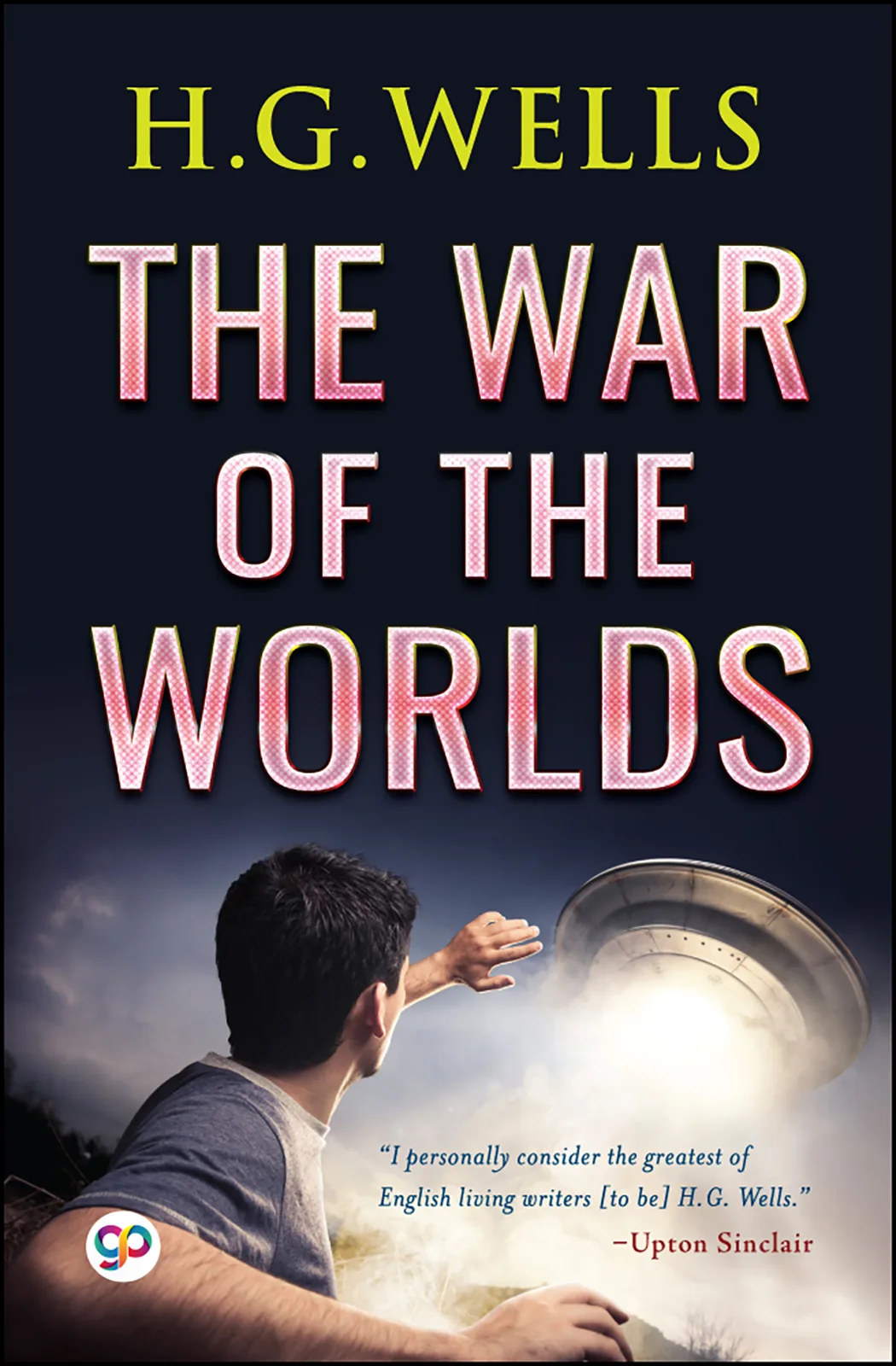
The War of the Worlds
Paperback
• 224 Pages
• INR 350.00
• English
• 9789354991936
No ratings yet
| Publisher | General Press |
|---|---|
| ISBN13 | 9789354991936 |
| ASIN/SKU | 9354991939 |
| Book Format | Paperback |
| Language | English |
| Pages | 224 |
| List Price | INR 350.00 |
| Subject Code | FIC028090, FIC028010, FIC036000, FIC036000 |
| Publishing Date | 15/08/2022 |
| Dimensions | 8.25 x 5.25 x 1.0 inches |
| Book Code | BD00067629 |
Buy this Book
Amazon Stores
Ebook Stores
Other Stores
Discover The War of the Worlds by H.G. Wells. This book is published by General Press in Paperback format, ISBN 9789354991936, ASIN 9354991939, under Mystery, Thriller and Suspense, American Literature, Classics.
Book Description
Originally published in December 1897, ‘The War of the Worlds’ is an early thrilling science fiction novel by H.G. Wells, an English writer.
The novel begins with humans watching the skies closely, fascinated with the worlds beyond Earth’s atmosphere. As astronomers and scientists hone in on some bizarre occurrences on Mars, their observations soon become terrifying—humans are not the only intelligent beings, and those other beings are also curious about humans.
Alien spacecraft start crashing into England and as Martians emerge from the ships, they begin intimidating the Earth and bringing destruction with every step. Cities are burned, families are torn apart, and human military power proves weak in the face of an unknown enemy. This story is about surviving in the face of destruction, the human desire to protect one’s home and loved ones, and a fascinating glance at how a harmful alien invasion could play out on Earth.
The novel begins with humans watching the skies closely, fascinated with the worlds beyond Earth’s atmosphere. As astronomers and scientists hone in on some bizarre occurrences on Mars, their observations soon become terrifying—humans are not the only intelligent beings, and those other beings are also curious about humans.
Alien spacecraft start crashing into England and as Martians emerge from the ships, they begin intimidating the Earth and bringing destruction with every step. Cities are burned, families are torn apart, and human military power proves weak in the face of an unknown enemy. This story is about surviving in the face of destruction, the human desire to protect one’s home and loved ones, and a fascinating glance at how a harmful alien invasion could play out on Earth.
Author Biography
Herbert George Wells was born in Bromley, Kent, England, on September 21, 1866. His father was a professional cricketer and sometime shopkeeper, his mother a former lady's maid. Although 'Bertie' left school at fourteen to become a draper's apprentice (a life he detested), he later won a scholarship to the Normal School of Science in London, where he studied with the famous Thomas Henry Huxley. He began to sell articles and short stories regularly in 1893. In 1895, his immediately successful novel rescued him from a life of penury on a schoolteacher's salary. His other 'scientific romances'—The Island of Dr. Moreau (1896), The Invisible Man (1897), The War of the Worlds (1898), The First Men in the Moon (1901), and The War in the Air (1908)—won him distinction as the father of science fiction.
Editorial Reviews
Editorial Reviews will be added soon…
Book Summary
H. G. Wells’s The War of the Worlds, published in 1898, is one of the most influential science-fiction novels ever written. On the surface, it is an exciting story about an invasion from Mars, but beneath its frightening action lies a thoughtful examination of human arrogance, survival, civilization, colonialism, and the fragility of human power. Wells turns the familiar world of Victorian England into a place of terror, showing how quickly confidence and social order can disappear when people face an enemy they cannot understand or defeat.
The story is narrated by an unnamed writer who lives in England and is interested in science and astronomy. He begins by explaining that human beings have become too confident in their position in the universe. They believe themselves to be intelligent and civilized, yet they rarely consider that other worlds might contain life more advanced than their own. Mars has been quietly observing Earth, and its inhabitants have apparently noticed the planet's resources and human population. What begins as distant scientific curiosity soon becomes a terrifying invasion.
The first sign of danger appears when strange objects fall from the sky and land in the countryside near Woking. At first, local people are curious rather than frightened. They gather around the enormous metal cylinders that have arrived from Mars, treating them almost as a scientific spectacle. Their confidence disappears when the cylinders open and the Martians emerge. The creatures are grotesque, with large heads, tentacle-like arms, and strange bodies adapted to a life very different from that of humans.
The Martians possess technology far beyond anything available on Earth. Their most terrifying weapon is a heat-ray, which can kill people instantly and destroy buildings. They also use enormous fighting machines, commonly described as tripods, which move rapidly across the landscape on mechanical legs. Human soldiers attempt to resist, but conventional weapons are largely ineffective. The first encounters demonstrate how unprepared humanity is for an enemy whose science and military power are vastly superior.
The narrator witnesses the destruction around Woking and barely escapes. As the invasion spreads, panic moves through the population. Roads become crowded with people trying to flee, while rumors and contradictory reports create even greater confusion. The government and military attempt to organize resistance, but the speed and strength of the Martian attack overwhelm them. Towns are abandoned, families are separated, and the normal structures of society begin to collapse.
One of the novel's most powerful features is the way Wells describes ordinary people responding to an extraordinary disaster. At first, many assume that the military will quickly solve the problem. This confidence gradually turns into fear as evidence of defeat becomes impossible to ignore. People who once lived secure and comfortable lives suddenly find themselves concerned with food, water, transportation, and simple survival. Wells shows that civilization can appear permanent only because people rarely see the systems that support it being destroyed.
During his escape, the narrator becomes separated from his wife and spends much of the story trying to survive while hoping that she is safe. His journey takes him through devastated communities and landscapes transformed by war. He sees abandoned homes, dead bodies, frightened refugees, and the terrible consequences of an invasion that has no respect for human life.
At one point, the narrator encounters an artilleryman who has survived the fighting. The artilleryman initially presents himself as a brave and practical soldier, but his ideas reveal how deeply the invasion has changed him. He imagines rebuilding human society after the Martians have taken control, suggesting that survivors may have to live underground and adapt to a new world. He even dreams of a future in which humans might learn enough from the Martians to eventually challenge them. His character represents both human resilience and the temptation to build grand plans without understanding the realities of the situation.
Another important encounter occurs when the narrator becomes trapped in a ruined house with a clergyman. The clergyman is deeply shaken by the invasion and struggles to reconcile the disaster with his religious beliefs. Unlike the narrator, who tries to understand events practically, the clergyman becomes increasingly helpless and frightened. Their relationship becomes tense as hunger, fear, and isolation affect them both. Through this episode, Wells explores how people respond psychologically when the beliefs that once gave them security are suddenly challenged.
The Martians themselves remain largely mysterious. They do not behave like conventional human invaders. They show little sympathy and appear to treat people as resources rather than individuals. Their behavior is especially horrifying because it reverses the usual assumptions about human superiority. Wells reminds readers that human beings have historically invaded other lands, conquered weaker peoples, and treated other living creatures as objects of exploitation. The Martian invasion therefore has an uncomfortable parallel with European colonialism.
The Martians eventually begin harvesting human blood for nourishment. This makes their presence even more disturbing because humans are no longer simply enemies; they are potential food. Wells deliberately makes the Martians resemble a superior predator entering a world in which another species has become vulnerable. The terror comes partly from realizing that the qualities humans use to define themselves as civilized may not matter to a stronger species.
Yet just when humanity seems certain to lose, the Martians suddenly begin to die. Their advanced technology cannot protect them from Earth's microscopic life. Because they have evolved on Mars, they lack immunity to the bacteria that naturally exist on Earth. Humans have lived alongside these microorganisms for generations, but the Martians have no such biological protection. Within a short time, the invaders collapse.
This ending is deeply ironic. Humanity does not defeat the Martians through superior intelligence, military strength, or technology. The invaders are destroyed by something so small that humans cannot even see it. Their greatest weapons are powerless against ordinary bacteria. Wells uses this unexpected conclusion to challenge human ideas about power. The strongest force is not always the most obvious one.
After the Martians die, society begins to recover. The narrator eventually discovers that his wife has survived, and they are reunited. Yet the experience has permanently changed him. The world may return to something resembling normality, but the memory of the invasion remains. Humans have learned that their civilization is not as secure as they once believed.
The novel's deeper message lies in this transformation. The War of the Worlds is not simply about aliens attacking Earth. It is about the dangers of arrogance. Victorian Britain was at the height of its imperial confidence, and Wells invites readers to imagine what it would feel like if a more powerful civilization treated Britain exactly as European powers had treated weaker societies elsewhere. The Martians become a disturbing mirror of humanity's own history.
The novel also emphasizes the unpredictability of survival. Humans survive not because they control events but because they are part of an ecosystem the Martians do not understand. Knowledge has limits, technology has limits, and military strength has limits. Life can be changed by forces that seem insignificant until they become decisive.
Ultimately, The War of the Worlds remains powerful because Wells combines suspense with serious social criticism. His story strips away the comforting belief that civilization is permanent and that humans are masters of nature. The invasion reveals fear, selfishness, courage, compassion, and desperation in ordinary people. At the same time, it reminds readers that survival often depends on humility and adaptability rather than strength alone. Wells's Martian invasion is therefore both a thrilling adventure and a warning: no civilization should assume that its power makes it invulnerable, because the universe is far larger, stranger, and less predictable than human beings like to imagine.
The story is narrated by an unnamed writer who lives in England and is interested in science and astronomy. He begins by explaining that human beings have become too confident in their position in the universe. They believe themselves to be intelligent and civilized, yet they rarely consider that other worlds might contain life more advanced than their own. Mars has been quietly observing Earth, and its inhabitants have apparently noticed the planet's resources and human population. What begins as distant scientific curiosity soon becomes a terrifying invasion.
The first sign of danger appears when strange objects fall from the sky and land in the countryside near Woking. At first, local people are curious rather than frightened. They gather around the enormous metal cylinders that have arrived from Mars, treating them almost as a scientific spectacle. Their confidence disappears when the cylinders open and the Martians emerge. The creatures are grotesque, with large heads, tentacle-like arms, and strange bodies adapted to a life very different from that of humans.
The Martians possess technology far beyond anything available on Earth. Their most terrifying weapon is a heat-ray, which can kill people instantly and destroy buildings. They also use enormous fighting machines, commonly described as tripods, which move rapidly across the landscape on mechanical legs. Human soldiers attempt to resist, but conventional weapons are largely ineffective. The first encounters demonstrate how unprepared humanity is for an enemy whose science and military power are vastly superior.
The narrator witnesses the destruction around Woking and barely escapes. As the invasion spreads, panic moves through the population. Roads become crowded with people trying to flee, while rumors and contradictory reports create even greater confusion. The government and military attempt to organize resistance, but the speed and strength of the Martian attack overwhelm them. Towns are abandoned, families are separated, and the normal structures of society begin to collapse.
One of the novel's most powerful features is the way Wells describes ordinary people responding to an extraordinary disaster. At first, many assume that the military will quickly solve the problem. This confidence gradually turns into fear as evidence of defeat becomes impossible to ignore. People who once lived secure and comfortable lives suddenly find themselves concerned with food, water, transportation, and simple survival. Wells shows that civilization can appear permanent only because people rarely see the systems that support it being destroyed.
During his escape, the narrator becomes separated from his wife and spends much of the story trying to survive while hoping that she is safe. His journey takes him through devastated communities and landscapes transformed by war. He sees abandoned homes, dead bodies, frightened refugees, and the terrible consequences of an invasion that has no respect for human life.
At one point, the narrator encounters an artilleryman who has survived the fighting. The artilleryman initially presents himself as a brave and practical soldier, but his ideas reveal how deeply the invasion has changed him. He imagines rebuilding human society after the Martians have taken control, suggesting that survivors may have to live underground and adapt to a new world. He even dreams of a future in which humans might learn enough from the Martians to eventually challenge them. His character represents both human resilience and the temptation to build grand plans without understanding the realities of the situation.
Another important encounter occurs when the narrator becomes trapped in a ruined house with a clergyman. The clergyman is deeply shaken by the invasion and struggles to reconcile the disaster with his religious beliefs. Unlike the narrator, who tries to understand events practically, the clergyman becomes increasingly helpless and frightened. Their relationship becomes tense as hunger, fear, and isolation affect them both. Through this episode, Wells explores how people respond psychologically when the beliefs that once gave them security are suddenly challenged.
The Martians themselves remain largely mysterious. They do not behave like conventional human invaders. They show little sympathy and appear to treat people as resources rather than individuals. Their behavior is especially horrifying because it reverses the usual assumptions about human superiority. Wells reminds readers that human beings have historically invaded other lands, conquered weaker peoples, and treated other living creatures as objects of exploitation. The Martian invasion therefore has an uncomfortable parallel with European colonialism.
The Martians eventually begin harvesting human blood for nourishment. This makes their presence even more disturbing because humans are no longer simply enemies; they are potential food. Wells deliberately makes the Martians resemble a superior predator entering a world in which another species has become vulnerable. The terror comes partly from realizing that the qualities humans use to define themselves as civilized may not matter to a stronger species.
Yet just when humanity seems certain to lose, the Martians suddenly begin to die. Their advanced technology cannot protect them from Earth's microscopic life. Because they have evolved on Mars, they lack immunity to the bacteria that naturally exist on Earth. Humans have lived alongside these microorganisms for generations, but the Martians have no such biological protection. Within a short time, the invaders collapse.
This ending is deeply ironic. Humanity does not defeat the Martians through superior intelligence, military strength, or technology. The invaders are destroyed by something so small that humans cannot even see it. Their greatest weapons are powerless against ordinary bacteria. Wells uses this unexpected conclusion to challenge human ideas about power. The strongest force is not always the most obvious one.
After the Martians die, society begins to recover. The narrator eventually discovers that his wife has survived, and they are reunited. Yet the experience has permanently changed him. The world may return to something resembling normality, but the memory of the invasion remains. Humans have learned that their civilization is not as secure as they once believed.
The novel's deeper message lies in this transformation. The War of the Worlds is not simply about aliens attacking Earth. It is about the dangers of arrogance. Victorian Britain was at the height of its imperial confidence, and Wells invites readers to imagine what it would feel like if a more powerful civilization treated Britain exactly as European powers had treated weaker societies elsewhere. The Martians become a disturbing mirror of humanity's own history.
The novel also emphasizes the unpredictability of survival. Humans survive not because they control events but because they are part of an ecosystem the Martians do not understand. Knowledge has limits, technology has limits, and military strength has limits. Life can be changed by forces that seem insignificant until they become decisive.
Ultimately, The War of the Worlds remains powerful because Wells combines suspense with serious social criticism. His story strips away the comforting belief that civilization is permanent and that humans are masters of nature. The invasion reveals fear, selfishness, courage, compassion, and desperation in ordinary people. At the same time, it reminds readers that survival often depends on humility and adaptability rather than strength alone. Wells's Martian invasion is therefore both a thrilling adventure and a warning: no civilization should assume that its power makes it invulnerable, because the universe is far larger, stranger, and less predictable than human beings like to imagine.
Sample Chapters
Sample Chapters will be added soon…
Reader Reviews
No reviews yet.
The War of the Worlds
Download Cover Image
Do you want to download the full cover image for The War of the Worlds?