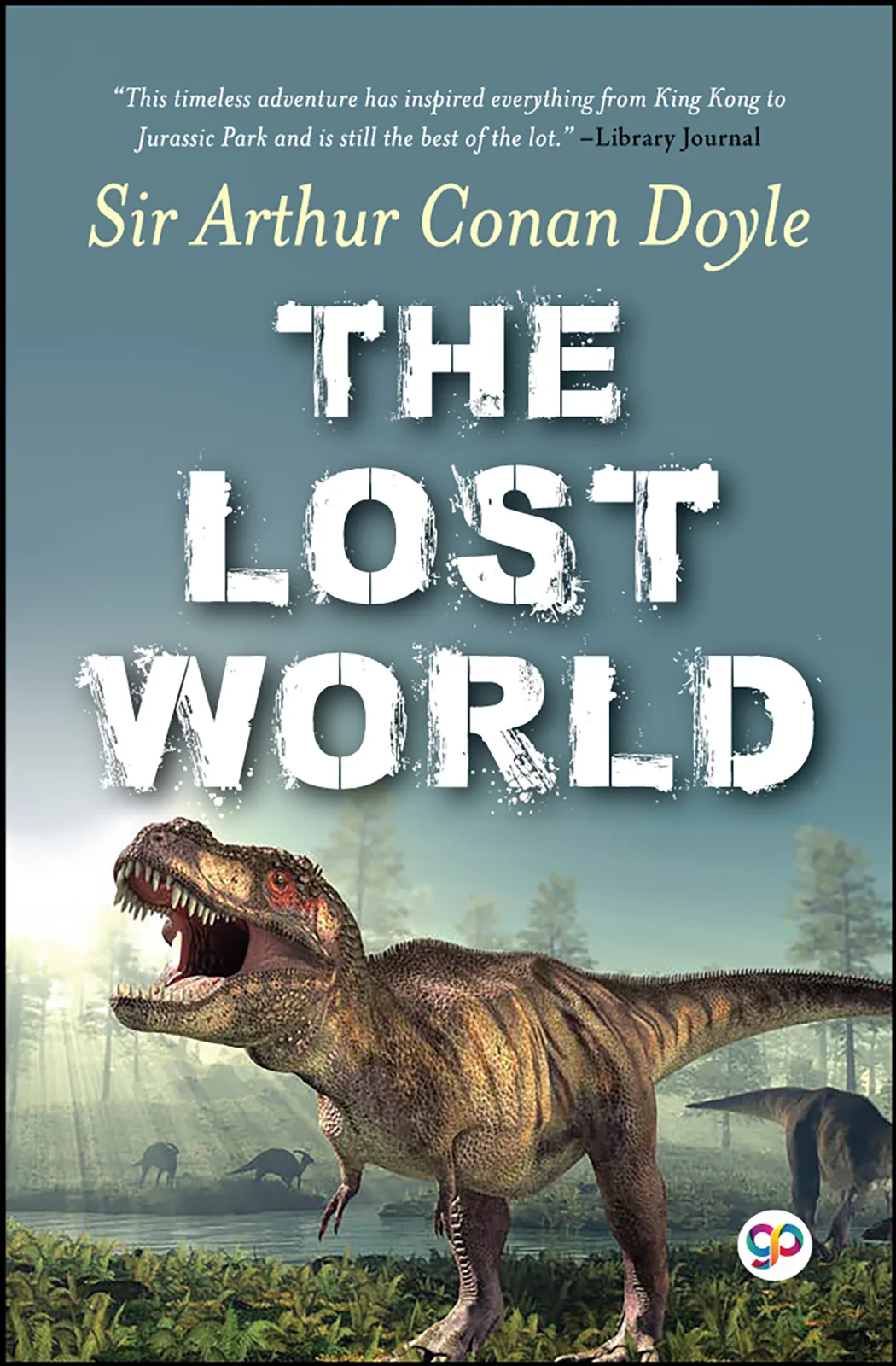
The Lost World
Paperback
• 224 Pages
• INR 325.00
• English
• 9789354996009
No ratings yet
| Publisher | General Press |
|---|---|
| ISBN13 | 9789354996009 |
| ASIN/SKU | 9354996000 |
| Book Format | Paperback |
| Language | English |
| Pages | 224 |
| List Price | INR 325.00 |
| Subject Code | FIC004000, FIC014000, FIC098000 |
| Publishing Date | 05/09/2023 |
| Dimensions | 8.25 x 5.25 x 1.0 inches |
| Book Code | BD00067641 |
Buy this Book
Amazon Stores
Ebook Stores
Other Stores
Discover The Lost World by Sir Arthur Conan Doyle. This book is published by General Press in Paperback format, ISBN 9789354996009, ASIN 9354996000, under Science Fiction and Fantasy, Dinosaur Fiction, Action and Adventure.
Book Description
First published in 1912, ‘The Lost World’ is a science fiction novel by British writer Arthur Conan Doyle, concerning an expedition to a plateau in the Amazon basin of South America where prehistoric animals still survive. The character of Professor Challenger was introduced in this book. The novel also describes a war between indigenous people and a vicious tribe of ape-like creatures.
Edward Malone, a young reporter for the Daily Gazette, asks his editor for a dangerous assignment to impress the woman he loves, Gladys, who wishes for a great man capable of brave deeds and actions. His task is to approach the notorious Professor Challenger, who dislikes the popular press intensely and physically assaults intrusive journalists. This classic tale of fantasy has inspired many successive works and is considered by many fans of the genre as one of the greatest science fiction stories ever written.
Edward Malone, a young reporter for the Daily Gazette, asks his editor for a dangerous assignment to impress the woman he loves, Gladys, who wishes for a great man capable of brave deeds and actions. His task is to approach the notorious Professor Challenger, who dislikes the popular press intensely and physically assaults intrusive journalists. This classic tale of fantasy has inspired many successive works and is considered by many fans of the genre as one of the greatest science fiction stories ever written.
Author Biography
Arthur Conan Doyle was born the third of ten siblings on 22 May 1859 in Edinburgh, Scotland. His father, Charles Altamont Doyle, was born in England of Irish descent, and his mother, born Mary Foley, was Irish. They were married in 1855. At the age of nine Conan Doyle was sent to the Roman Catholic Jesuit preparatory school, Hodder Place, Stonyhurst. He then went on to Stonyhurst College, leaving in 1875. From 1876 to 1881 he studied medicine at the University of Edinburgh. This required that he provide periodic medical assistance in the towns of Aston (now a district of Birmingham) and Sheffield. While studying, Conan Doyle began writing short stories. His first published story appeared in 'Chambers's Edinburgh Journal' before he was 20. Following his graduation, he was employed as a ship's doctor on the SS Mayumba during a voyage to the West African coast. He completed his doctorate on the subject of tabes dorsalis in 1885. In 1885, Conan Doyle married Louisa Hawkins, known as 'Touie'. She suffered from tuberculosis and died on 4 July 1906. The following year he married Jean Elizabeth Leckie, whom he had first met and fallen in love with in 1897. Due to his sense of loyalty he had maintained a purely platonic relationship with Jean while his first wife was alive. Jean died in London on 27 June 1940. Conan Doyle fathered five children. Two with his first wife—Mary Louise (28 January 1889 – 12 June 1976), and Arthur Alleyne Kingsley, known as Kingsley (15 November 1892 – 28 October 1918). With his second wife he had three children—Denis Percy Stewart (17 March 1909 – 9 March 1955), second husband in 1936 of Georgian Princess Nina Mdivani (circa 1910 – 19 February 1987; former sister-in-law of Barbara Hutton); Adrian Malcolm (19 November 1910–3 June 1970) and Jean Lena Annette (21 December 1912–18 November 1997). Conan Doyle was found clutching his chest in the hall of Windlesham, his house in Crowborough, East Sussex, on 7 July 1930. He had died of a heart attack at age 71. His last words were directed toward his wife: "You are wonderful."
Editorial Reviews
Editorial Reviews will be added soon…
Book Summary
Sir Arthur Conan Doyle’s The Lost World is a thrilling adventure novel that combines exploration, science, danger, friendship, and the wonder of discovering a world untouched by modern civilization. First published in 1912, the novel follows Edward Malone, a young journalist who longs to prove himself as a brave adventurer. His opportunity arrives when he becomes involved with the eccentric and formidable Professor Challenger, a scientist who claims that prehistoric creatures still survive in an isolated region of South America. What begins as an attempt to investigate Challenger’s extraordinary claims becomes an unforgettable expedition into a mysterious land where dinosaurs, primitive humans, and the forces of nature still dominate.
The story begins with Edward Malone, a reporter for the Daily Gazette, who is eager to impress the woman he loves, Gladys Hungerton. Gladys tells him that she admires heroic men who experience great adventures rather than ordinary men who simply live comfortable lives. Determined to prove that he is capable of courage, Malone accepts a dangerous assignment. He is asked to meet Professor George Edward Challenger, a controversial scientist whose recent claims about prehistoric life have made him the subject of ridicule among other scientists. Challenger insists that during an earlier expedition to South America he discovered evidence that dinosaurs and other ancient creatures are still alive. Almost nobody believes him.
Malone approaches Challenger carefully, but the professor quickly becomes suspicious and angry. He is a huge, aggressive, proud man who has little patience for journalists or scientists who challenge his authority. Nevertheless, Malone eventually earns his confidence and learns more about the proposed expedition. Challenger agrees to lead a new journey into the unexplored region, accompanied by Malone, Professor Summerlee, a skeptical scientist, and Lord John Roxton, an experienced hunter and explorer. Their personalities are very different. Challenger is confident and domineering, Summerlee is doubtful and argumentative, Roxton is calm and courageous, and Malone is young but increasingly determined to prove himself.
The expedition travels deep into the Amazon region and eventually reaches a strange plateau surrounded by cliffs. The place is almost impossible to reach, and once the explorers manage to enter it, they discover that Challenger’s extraordinary claims are true. The plateau is a living relic of prehistoric times. Huge dinosaurs roam across the landscape, while other ancient creatures survive in forests and swamps. The explorers are filled with both excitement and fear. They have entered a world separated from ordinary human civilization for countless ages.
Their discovery soon turns into a struggle for survival. The explorers encounter terrifying creatures, including giant dinosaurs that are powerful enough to destroy anything in their path. One particularly memorable danger comes from the enormous ape-like creatures that inhabit the region. The group must constantly remain alert because they cannot predict what creature may appear next. Their scientific curiosity is gradually overshadowed by the simple need to stay alive.
The plateau is not inhabited only by prehistoric animals. The explorers also discover two opposing groups of primitive human beings: ape-like creatures and a more advanced tribe of humans. These groups are enemies, and the explorers become caught in their conflict. Malone and his companions initially find themselves trapped and separated from one another. Their situation becomes increasingly desperate as they realize that escape from the plateau may be as difficult as surviving on it.
Lord John Roxton proves especially valuable during these dangerous moments. His courage, practical knowledge, and ability to remain calm under pressure make him a natural leader. Malone also grows significantly throughout the adventure. At the beginning, he wants mainly to prove himself to Gladys, but his experiences gradually give him a deeper understanding of courage. He learns that bravery is not simply about performing impressive acts; it is about remaining loyal, useful, and determined when circumstances become frightening.
The relationship between Challenger and Summerlee also changes during the expedition. At first, Summerlee doubts almost everything Challenger says. He believes that Challenger has exaggerated or misunderstood his discoveries. But once he sees the dinosaurs with his own eyes, his skepticism disappears. The experience becomes a triumph for Challenger, who finally has undeniable evidence supporting his theories. Yet the adventure also shows that scientific knowledge is not merely about being right. The explorers must use their intelligence practically if they are to survive.
Eventually, the group discovers a possible means of escape. They encounter evidence of valuable natural resources and become aware that the plateau may contain enormous scientific and economic significance. However, they understand that simply discovering such a place is not enough. They must return to civilization with proof of what they have seen. Their escape is dangerous and requires courage, cooperation, and ingenuity.
When the explorers finally return to England, Challenger is no longer merely the scientist whom everyone mocked. He has evidence that transforms his reputation. The explorers present proof of the prehistoric world they discovered, astonishing the scientific community and the public. Their journey changes the way people think about the history of life on Earth.
The novel’s deeper appeal lies not only in its dinosaurs and adventures but also in its portrayal of human character. Malone begins as an inexperienced young man seeking approval and gradually becomes a dependable adventurer. Roxton represents courage and practical wisdom, while Challenger represents intellectual confidence and stubborn determination. Summerlee represents skepticism and the importance of questioning extraordinary claims. Together, they create a balanced group whose differences become strengths during their journey.
The Lost World ultimately celebrates curiosity, courage, exploration, and the human desire to discover what lies beyond the boundaries of familiar experience. Doyle presents the unknown as both frightening and magnificent. The prehistoric plateau becomes a symbol of a world where humanity is no longer the dominant force and where nature exists in its rawest form. The novel reminds readers that knowledge often begins with the willingness to question what seems impossible. Through Malone’s eyes, the adventure becomes more than a search for dinosaurs: it becomes a journey from youthful insecurity to maturity, responsibility, and courage. With its vivid landscapes, memorable characters, suspenseful encounters, and sense of wonder, The Lost World remains one of the classic adventure novels of the early twentieth century.
The story begins with Edward Malone, a reporter for the Daily Gazette, who is eager to impress the woman he loves, Gladys Hungerton. Gladys tells him that she admires heroic men who experience great adventures rather than ordinary men who simply live comfortable lives. Determined to prove that he is capable of courage, Malone accepts a dangerous assignment. He is asked to meet Professor George Edward Challenger, a controversial scientist whose recent claims about prehistoric life have made him the subject of ridicule among other scientists. Challenger insists that during an earlier expedition to South America he discovered evidence that dinosaurs and other ancient creatures are still alive. Almost nobody believes him.
Malone approaches Challenger carefully, but the professor quickly becomes suspicious and angry. He is a huge, aggressive, proud man who has little patience for journalists or scientists who challenge his authority. Nevertheless, Malone eventually earns his confidence and learns more about the proposed expedition. Challenger agrees to lead a new journey into the unexplored region, accompanied by Malone, Professor Summerlee, a skeptical scientist, and Lord John Roxton, an experienced hunter and explorer. Their personalities are very different. Challenger is confident and domineering, Summerlee is doubtful and argumentative, Roxton is calm and courageous, and Malone is young but increasingly determined to prove himself.
The expedition travels deep into the Amazon region and eventually reaches a strange plateau surrounded by cliffs. The place is almost impossible to reach, and once the explorers manage to enter it, they discover that Challenger’s extraordinary claims are true. The plateau is a living relic of prehistoric times. Huge dinosaurs roam across the landscape, while other ancient creatures survive in forests and swamps. The explorers are filled with both excitement and fear. They have entered a world separated from ordinary human civilization for countless ages.
Their discovery soon turns into a struggle for survival. The explorers encounter terrifying creatures, including giant dinosaurs that are powerful enough to destroy anything in their path. One particularly memorable danger comes from the enormous ape-like creatures that inhabit the region. The group must constantly remain alert because they cannot predict what creature may appear next. Their scientific curiosity is gradually overshadowed by the simple need to stay alive.
The plateau is not inhabited only by prehistoric animals. The explorers also discover two opposing groups of primitive human beings: ape-like creatures and a more advanced tribe of humans. These groups are enemies, and the explorers become caught in their conflict. Malone and his companions initially find themselves trapped and separated from one another. Their situation becomes increasingly desperate as they realize that escape from the plateau may be as difficult as surviving on it.
Lord John Roxton proves especially valuable during these dangerous moments. His courage, practical knowledge, and ability to remain calm under pressure make him a natural leader. Malone also grows significantly throughout the adventure. At the beginning, he wants mainly to prove himself to Gladys, but his experiences gradually give him a deeper understanding of courage. He learns that bravery is not simply about performing impressive acts; it is about remaining loyal, useful, and determined when circumstances become frightening.
The relationship between Challenger and Summerlee also changes during the expedition. At first, Summerlee doubts almost everything Challenger says. He believes that Challenger has exaggerated or misunderstood his discoveries. But once he sees the dinosaurs with his own eyes, his skepticism disappears. The experience becomes a triumph for Challenger, who finally has undeniable evidence supporting his theories. Yet the adventure also shows that scientific knowledge is not merely about being right. The explorers must use their intelligence practically if they are to survive.
Eventually, the group discovers a possible means of escape. They encounter evidence of valuable natural resources and become aware that the plateau may contain enormous scientific and economic significance. However, they understand that simply discovering such a place is not enough. They must return to civilization with proof of what they have seen. Their escape is dangerous and requires courage, cooperation, and ingenuity.
When the explorers finally return to England, Challenger is no longer merely the scientist whom everyone mocked. He has evidence that transforms his reputation. The explorers present proof of the prehistoric world they discovered, astonishing the scientific community and the public. Their journey changes the way people think about the history of life on Earth.
The novel’s deeper appeal lies not only in its dinosaurs and adventures but also in its portrayal of human character. Malone begins as an inexperienced young man seeking approval and gradually becomes a dependable adventurer. Roxton represents courage and practical wisdom, while Challenger represents intellectual confidence and stubborn determination. Summerlee represents skepticism and the importance of questioning extraordinary claims. Together, they create a balanced group whose differences become strengths during their journey.
The Lost World ultimately celebrates curiosity, courage, exploration, and the human desire to discover what lies beyond the boundaries of familiar experience. Doyle presents the unknown as both frightening and magnificent. The prehistoric plateau becomes a symbol of a world where humanity is no longer the dominant force and where nature exists in its rawest form. The novel reminds readers that knowledge often begins with the willingness to question what seems impossible. Through Malone’s eyes, the adventure becomes more than a search for dinosaurs: it becomes a journey from youthful insecurity to maturity, responsibility, and courage. With its vivid landscapes, memorable characters, suspenseful encounters, and sense of wonder, The Lost World remains one of the classic adventure novels of the early twentieth century.
Sample Chapters
Sample Chapters will be added soon…
Reader Reviews
No reviews yet.
The Lost World