
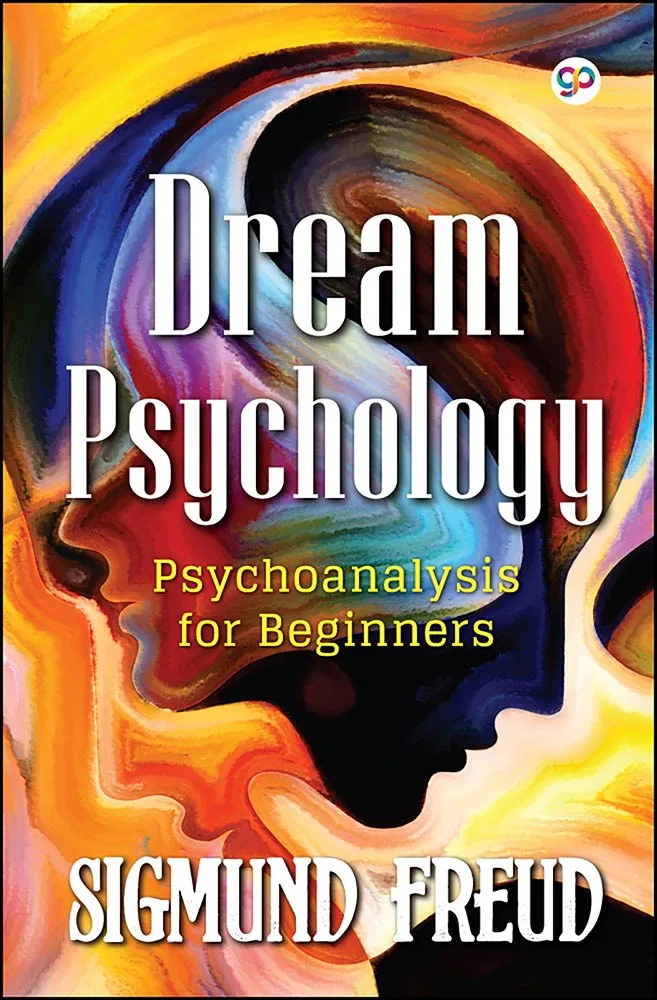
Dream Psychology
Hardcover
• 184 Pages
• INR 375.00
• English
• 9789354996092
No ratings yet
| Publisher | General Press |
|---|---|
| ISBN13 | 9789354996092 |
| ASIN/SKU | 9354996094 |
| Book Format | Hardcover |
| Language | English |
| Pages | 184 |
| List Price | INR 375.00 |
| Subject Code | PSY000000, PHI015000, PSY022000 |
| Publishing Date | 05/09/2023 |
| Dimensions | 8.25 x 5.25 x 1.0 inches |
| Book Code | BD00067654 |
Buy this Book
Amazon Stores
Ebook Stores
Other Stores
Discover Dream Psychology by Sigmund Freud. This book is published by General Press in Hardcover format, ISBN 9789354996092, ASIN 9354996094, under Non Fiction, Philosophy, Psychology.
Book Description
'Dream Psychology' by Sigmund Freud is a classic work of psychology and psychoanalysis that explores one of the most mysterious parts of human experience: the world of dreams. What if the strange, confusing images that appear while we sleep are not meaningless at all, but expressions of thoughts, wishes, fears, and emotions hidden beneath our conscious awareness? Freud’s influential study invites readers to look at dreams from this fascinating perspective, offering an accessible introduction to the ideas that helped shape modern thinking about the unconscious mind.
Drawing on his clinical observations and theories of psychoanalysis, Freud examines why people dream and what their dreams might reveal about their inner lives. He argues that dreams can provide a pathway into thoughts and desires that are often suppressed or pushed out of conscious awareness. To explain this, he considers the way ordinary experiences, memories, emotions, and unresolved conflicts can become transformed into symbolic and sometimes bewildering dream images. A dream may seem completely irrational on the surface, yet Freud suggests that beneath its strange appearance there can be an underlying psychological meaning.
A major theme of Dream Psychology is the process through which hidden mental material is disguised in dreams. Freud explores concepts such as wish fulfillment, symbolism, repression, and the difference between the dream as it is remembered and the deeper thoughts that may lie behind it. He also discusses how childhood experiences and everyday events can influence dream content, showing how the unconscious can remain active even when the conscious mind is at rest.
Rather than treating dreams simply as mysterious visions, Freud presents them as clues to the complicated workings of the human psyche. His ideas may challenge readers, especially when he connects seemingly innocent dream experiences with deeper emotional and psychological impulses. Whether one agrees with every aspect of his theory or not, the book remains an important and thought-provoking introduction to Freudian psychology.
For anyone interested in dreams, the unconscious mind, psychology, or the origins of psychoanalysis, 'Dream Psychology' offers a compelling journey into the hidden territory of human thought. Once you begin wondering what your own dreams might be trying to reveal, Freud’s ideas become difficult to ignore.
Drawing on his clinical observations and theories of psychoanalysis, Freud examines why people dream and what their dreams might reveal about their inner lives. He argues that dreams can provide a pathway into thoughts and desires that are often suppressed or pushed out of conscious awareness. To explain this, he considers the way ordinary experiences, memories, emotions, and unresolved conflicts can become transformed into symbolic and sometimes bewildering dream images. A dream may seem completely irrational on the surface, yet Freud suggests that beneath its strange appearance there can be an underlying psychological meaning.
A major theme of Dream Psychology is the process through which hidden mental material is disguised in dreams. Freud explores concepts such as wish fulfillment, symbolism, repression, and the difference between the dream as it is remembered and the deeper thoughts that may lie behind it. He also discusses how childhood experiences and everyday events can influence dream content, showing how the unconscious can remain active even when the conscious mind is at rest.
Rather than treating dreams simply as mysterious visions, Freud presents them as clues to the complicated workings of the human psyche. His ideas may challenge readers, especially when he connects seemingly innocent dream experiences with deeper emotional and psychological impulses. Whether one agrees with every aspect of his theory or not, the book remains an important and thought-provoking introduction to Freudian psychology.
For anyone interested in dreams, the unconscious mind, psychology, or the origins of psychoanalysis, 'Dream Psychology' offers a compelling journey into the hidden territory of human thought. Once you begin wondering what your own dreams might be trying to reveal, Freud’s ideas become difficult to ignore.
Author Biography
Born Sigismund Schlomo Freud in 1856 in Freiberg, Moravia, he moved with his family to Vienna, Austria, at a young age. A brilliant student, Freud entered the University of Vienna at seventeen to study medicine. Initially focusing on neurology and zoology, he conducted significant research on the nervous systems of marine life. After earning his medical degree, he began working at the Vienna General Hospital, where his fascination with the complex workings of the human brain gradually shifted his focus from the physical structures of nerves to the realm of psychological disorders.
Freud's pivotal transition occurred in the 1880s following his collaboration with physician Josef Breuer and his studies under French neurologist Jean-Martin Charcot. Intrigued by the treatment of hysteria through hypnosis, Freud began developing a revolutionary clinical method centered on dialogue. He posited that unexpressed, deeply repressed traumatic memories in the unconscious mind were the root cause of psychological distress. By encouraging patients to speak freely about their dreams, memories, and childhood experiences—a technique known as free association—Freud established the foundational framework of psychoanalysis.
In 1899, Freud published his seminal work, The Interpretation of Dreams, introducing the concept of the unconscious mind and arguing that dreams are disguised fulfillments of repressed wishes. This was followed by a series of highly influential and controversial publications outlining his theories on psychosexual development, the Oedipus complex, and the tripartite structure of the psyche: the id, ego, and superego. Although his ideas frequently scandalized the conservative Victorian medical establishment, they eventually attracted a dedicated circle of followers, transforming psychoanalysis into an international movement.
Despite battling painful jaw cancer for the last sixteen years of his life, Freud remained a remarkably prolific writer and clinician. In 1938, the Nazi annexation of Austria forced the eighty-two-year-old Freud, who was of Jewish descent, to flee Vienna for London to escape persecution. He died there the following year. While many of his specific clinical theories have been heavily criticized or discarded by modern psychiatry, Freud's profound cultural impact is undeniable. He forever altered the way humanity understands the subconscious, shaping not just psychology, but literature, art, and modern thought.
Freud's pivotal transition occurred in the 1880s following his collaboration with physician Josef Breuer and his studies under French neurologist Jean-Martin Charcot. Intrigued by the treatment of hysteria through hypnosis, Freud began developing a revolutionary clinical method centered on dialogue. He posited that unexpressed, deeply repressed traumatic memories in the unconscious mind were the root cause of psychological distress. By encouraging patients to speak freely about their dreams, memories, and childhood experiences—a technique known as free association—Freud established the foundational framework of psychoanalysis.
In 1899, Freud published his seminal work, The Interpretation of Dreams, introducing the concept of the unconscious mind and arguing that dreams are disguised fulfillments of repressed wishes. This was followed by a series of highly influential and controversial publications outlining his theories on psychosexual development, the Oedipus complex, and the tripartite structure of the psyche: the id, ego, and superego. Although his ideas frequently scandalized the conservative Victorian medical establishment, they eventually attracted a dedicated circle of followers, transforming psychoanalysis into an international movement.
Despite battling painful jaw cancer for the last sixteen years of his life, Freud remained a remarkably prolific writer and clinician. In 1938, the Nazi annexation of Austria forced the eighty-two-year-old Freud, who was of Jewish descent, to flee Vienna for London to escape persecution. He died there the following year. While many of his specific clinical theories have been heavily criticized or discarded by modern psychiatry, Freud's profound cultural impact is undeniable. He forever altered the way humanity understands the subconscious, shaping not just psychology, but literature, art, and modern thought.
Editorial Reviews
Editorial Reviews will be added soon…
Book Summary
Sigmund Freud’s Dream Psychology is a popular presentation of some of the central ideas found in his revolutionary work on dreams and the unconscious mind. Closely based on the ideas developed in The Interpretation of Dreams, the book explores why people dream, what dreams may reveal about hidden wishes and fears, and how the mind transforms unconscious material into strange images, stories, and symbols during sleep. Freud’s central claim is that dreams are not meaningless disturbances of sleep. They are psychological productions that can provide clues to parts of the mind that remain hidden during waking life.
At the center of Freud’s theory is the idea of the unconscious. Freud argues that the human mind contains thoughts, memories, wishes, impulses, and emotions that are not always available to conscious awareness. Some of these mental contents may be pushed out of consciousness because they are unacceptable, frightening, embarrassing, or incompatible with social and moral expectations. Yet repression does not make them disappear. They can continue to influence behavior and may find indirect expression in dreams.
Freud therefore treats dreams as a kind of doorway into the unconscious. During waking life, people are capable of controlling their thoughts and filtering out impulses that they consider inappropriate. During sleep, this conscious control becomes weaker. Unconscious wishes can then attempt to express themselves. However, they are not usually allowed to appear in their original form. The mind disguises them, creating the often confusing and symbolic quality of dreams.
This leads to Freud’s distinction between the manifest content and the latent content of a dream. The manifest content is the dream as the person remembers it—the characters, places, events, images, and emotions that appear on the surface. The latent content refers to the hidden thoughts, wishes, conflicts, and memories that Freud believes lie beneath that surface.
For example, a person may dream about taking a strange journey, meeting an unfamiliar person, or losing an important object. Freud would not necessarily interpret the dream literally. Instead, he would ask what personal associations these images have for the dreamer. The dream's visible story may be a disguised version of something emotionally significant.
One of Freud’s most important ideas is that dreams are wish fulfillments. At first, this claim may seem difficult to accept because many dreams are frightening, unpleasant, or confusing. Freud argues, however, that the wish does not have to appear directly in the dream. It may be transformed so extensively that the dreamer experiences anxiety rather than pleasure. A hidden wish may therefore be disguised by the mind because acknowledging it openly would create conflict.
Freud pays particular attention to childhood experiences. He believes that many unconscious wishes originate early in life and remain psychologically important even after the individual becomes an adult. Childhood desires may be forgotten consciously but continue to influence dreams and other forms of behavior. This is one reason Freud places such importance on personal history when interpreting dreams.
The process by which hidden thoughts become dream images is what Freud calls dream-work. Several mechanisms are involved. One is condensation, in which several different people, memories, or ideas become combined into a single dream figure or image. Another is displacement, in which emotional importance is transferred from one idea to another. Something that is deeply significant may appear in the dream as something apparently trivial, while a minor detail may carry enormous emotional weight.
Freud also discusses symbolism. Dreams often express ideas indirectly through images that represent something else. Certain objects, actions, or situations may have symbolic meanings, particularly in relation to sexuality, relationships, the body, or emotional conflict. Freud believes that dream symbolism helps disguise wishes that the conscious mind would find unacceptable.
However, an important part of Freud’s approach is that symbols should not always be interpreted using a fixed dictionary. Personal associations matter. The same image may mean different things to different people depending on their memories, experiences, fears, and desires. Dream interpretation therefore requires attention to the dreamer's individual psychological history.
Freud also emphasizes the importance of free association. Rather than simply asking what a dream symbol supposedly means in a universal sense, the dreamer is encouraged to describe whatever thoughts, memories, and feelings come to mind when thinking about each part of the dream. These associations can gradually lead toward the hidden material behind the dream.
The theory also explains why dreams can appear so strange. Dreams combine unrelated people, places, periods of life, and situations. Someone may dream of a childhood home while speaking with a person from the present, or may appear in a place that exists nowhere in reality. Freud sees this unusual logic as a result of dream-work. The unconscious does not organize experience according to the same rules as ordinary rational thought.
Another important subject is nightmares and anxiety dreams. If dreams are supposed to fulfill wishes, why do some dreams cause terror? Freud's answer is that the underlying wish may come into conflict with the dreamer's conscious moral standards. The disguise may fail or become insufficient, producing anxiety. The dream is therefore not necessarily a simple expression of desire; it is the result of conflict between different parts of the mind.
Freud also examines dreams that involve everyday experiences from the previous day. A recent event may provide the immediate material for a dream, but Freud believes that this recent experience often connects with older, deeper wishes or memories. The mind uses something recent as a starting point while drawing upon much older psychological material.
This theory reflects Freud’s broader understanding of human beings. He does not believe that conscious thought controls everything we do. Beneath rational decision-making lie emotional forces that may be unknown even to the person experiencing them. Dreams provide one of the clearest examples of this hidden mental activity.
One of the most interesting aspects of Freud's approach is his belief that small details matter. A forgotten name, an unusual object, a seemingly meaningless scene, or an unexpected person appearing in a dream may contain psychological significance. Nothing should automatically be dismissed as random. The interpreter must ask why the mind selected that particular image or memory.
At the same time, Dream Psychology reflects the limitations of Freud’s period. Some of his specific claims about universal dream symbols, sexuality, and the structure of the unconscious are controversial and are not accepted as established scientific facts today. Modern psychology generally understands dreaming through a wider range of neurological, cognitive, emotional, and psychological perspectives. Nevertheless, Freud's contribution remains historically enormous.
His greatest achievement was encouraging people to take dreams seriously as psychological experiences. Before psychoanalysis, dreams were often treated primarily as supernatural messages, meaningless mental activity, or curiosities. Freud presented them instead as meaningful expressions of inner life.
Ultimately, Dream Psychology is a book about the hidden dimensions of human experience. Freud asks us to consider that our conscious identity may be only part of who we are. Beneath everyday thoughts and decisions may exist wishes, fears, memories, and conflicts that continue to shape us without our awareness.
The lasting appeal of Freud’s theory lies in this invitation to look beneath appearances. A dream may seem absurd, random, or even frightening, yet Freud encourages us to ask what emotional truth might be hidden inside it. Whether or not one accepts all of his interpretations, the basic idea remains compelling: the mind has depths that are not immediately visible, and dreams can sometimes offer a glimpse into those hidden depths. In that sense, Dream Psychology remains an important introduction to Freud’s attempt to understand the mysterious relationship between conscious life, unconscious desire, memory, and imagination.
At the center of Freud’s theory is the idea of the unconscious. Freud argues that the human mind contains thoughts, memories, wishes, impulses, and emotions that are not always available to conscious awareness. Some of these mental contents may be pushed out of consciousness because they are unacceptable, frightening, embarrassing, or incompatible with social and moral expectations. Yet repression does not make them disappear. They can continue to influence behavior and may find indirect expression in dreams.
Freud therefore treats dreams as a kind of doorway into the unconscious. During waking life, people are capable of controlling their thoughts and filtering out impulses that they consider inappropriate. During sleep, this conscious control becomes weaker. Unconscious wishes can then attempt to express themselves. However, they are not usually allowed to appear in their original form. The mind disguises them, creating the often confusing and symbolic quality of dreams.
This leads to Freud’s distinction between the manifest content and the latent content of a dream. The manifest content is the dream as the person remembers it—the characters, places, events, images, and emotions that appear on the surface. The latent content refers to the hidden thoughts, wishes, conflicts, and memories that Freud believes lie beneath that surface.
For example, a person may dream about taking a strange journey, meeting an unfamiliar person, or losing an important object. Freud would not necessarily interpret the dream literally. Instead, he would ask what personal associations these images have for the dreamer. The dream's visible story may be a disguised version of something emotionally significant.
One of Freud’s most important ideas is that dreams are wish fulfillments. At first, this claim may seem difficult to accept because many dreams are frightening, unpleasant, or confusing. Freud argues, however, that the wish does not have to appear directly in the dream. It may be transformed so extensively that the dreamer experiences anxiety rather than pleasure. A hidden wish may therefore be disguised by the mind because acknowledging it openly would create conflict.
Freud pays particular attention to childhood experiences. He believes that many unconscious wishes originate early in life and remain psychologically important even after the individual becomes an adult. Childhood desires may be forgotten consciously but continue to influence dreams and other forms of behavior. This is one reason Freud places such importance on personal history when interpreting dreams.
The process by which hidden thoughts become dream images is what Freud calls dream-work. Several mechanisms are involved. One is condensation, in which several different people, memories, or ideas become combined into a single dream figure or image. Another is displacement, in which emotional importance is transferred from one idea to another. Something that is deeply significant may appear in the dream as something apparently trivial, while a minor detail may carry enormous emotional weight.
Freud also discusses symbolism. Dreams often express ideas indirectly through images that represent something else. Certain objects, actions, or situations may have symbolic meanings, particularly in relation to sexuality, relationships, the body, or emotional conflict. Freud believes that dream symbolism helps disguise wishes that the conscious mind would find unacceptable.
However, an important part of Freud’s approach is that symbols should not always be interpreted using a fixed dictionary. Personal associations matter. The same image may mean different things to different people depending on their memories, experiences, fears, and desires. Dream interpretation therefore requires attention to the dreamer's individual psychological history.
Freud also emphasizes the importance of free association. Rather than simply asking what a dream symbol supposedly means in a universal sense, the dreamer is encouraged to describe whatever thoughts, memories, and feelings come to mind when thinking about each part of the dream. These associations can gradually lead toward the hidden material behind the dream.
The theory also explains why dreams can appear so strange. Dreams combine unrelated people, places, periods of life, and situations. Someone may dream of a childhood home while speaking with a person from the present, or may appear in a place that exists nowhere in reality. Freud sees this unusual logic as a result of dream-work. The unconscious does not organize experience according to the same rules as ordinary rational thought.
Another important subject is nightmares and anxiety dreams. If dreams are supposed to fulfill wishes, why do some dreams cause terror? Freud's answer is that the underlying wish may come into conflict with the dreamer's conscious moral standards. The disguise may fail or become insufficient, producing anxiety. The dream is therefore not necessarily a simple expression of desire; it is the result of conflict between different parts of the mind.
Freud also examines dreams that involve everyday experiences from the previous day. A recent event may provide the immediate material for a dream, but Freud believes that this recent experience often connects with older, deeper wishes or memories. The mind uses something recent as a starting point while drawing upon much older psychological material.
This theory reflects Freud’s broader understanding of human beings. He does not believe that conscious thought controls everything we do. Beneath rational decision-making lie emotional forces that may be unknown even to the person experiencing them. Dreams provide one of the clearest examples of this hidden mental activity.
One of the most interesting aspects of Freud's approach is his belief that small details matter. A forgotten name, an unusual object, a seemingly meaningless scene, or an unexpected person appearing in a dream may contain psychological significance. Nothing should automatically be dismissed as random. The interpreter must ask why the mind selected that particular image or memory.
At the same time, Dream Psychology reflects the limitations of Freud’s period. Some of his specific claims about universal dream symbols, sexuality, and the structure of the unconscious are controversial and are not accepted as established scientific facts today. Modern psychology generally understands dreaming through a wider range of neurological, cognitive, emotional, and psychological perspectives. Nevertheless, Freud's contribution remains historically enormous.
His greatest achievement was encouraging people to take dreams seriously as psychological experiences. Before psychoanalysis, dreams were often treated primarily as supernatural messages, meaningless mental activity, or curiosities. Freud presented them instead as meaningful expressions of inner life.
Ultimately, Dream Psychology is a book about the hidden dimensions of human experience. Freud asks us to consider that our conscious identity may be only part of who we are. Beneath everyday thoughts and decisions may exist wishes, fears, memories, and conflicts that continue to shape us without our awareness.
The lasting appeal of Freud’s theory lies in this invitation to look beneath appearances. A dream may seem absurd, random, or even frightening, yet Freud encourages us to ask what emotional truth might be hidden inside it. Whether or not one accepts all of his interpretations, the basic idea remains compelling: the mind has depths that are not immediately visible, and dreams can sometimes offer a glimpse into those hidden depths. In that sense, Dream Psychology remains an important introduction to Freud’s attempt to understand the mysterious relationship between conscious life, unconscious desire, memory, and imagination.
Sample Chapters
Sample Chapters will be added soon…
Reader Reviews
No reviews yet.
Dream Psychology
Download Cover Image
Do you want to download the full cover image for Dream Psychology?