
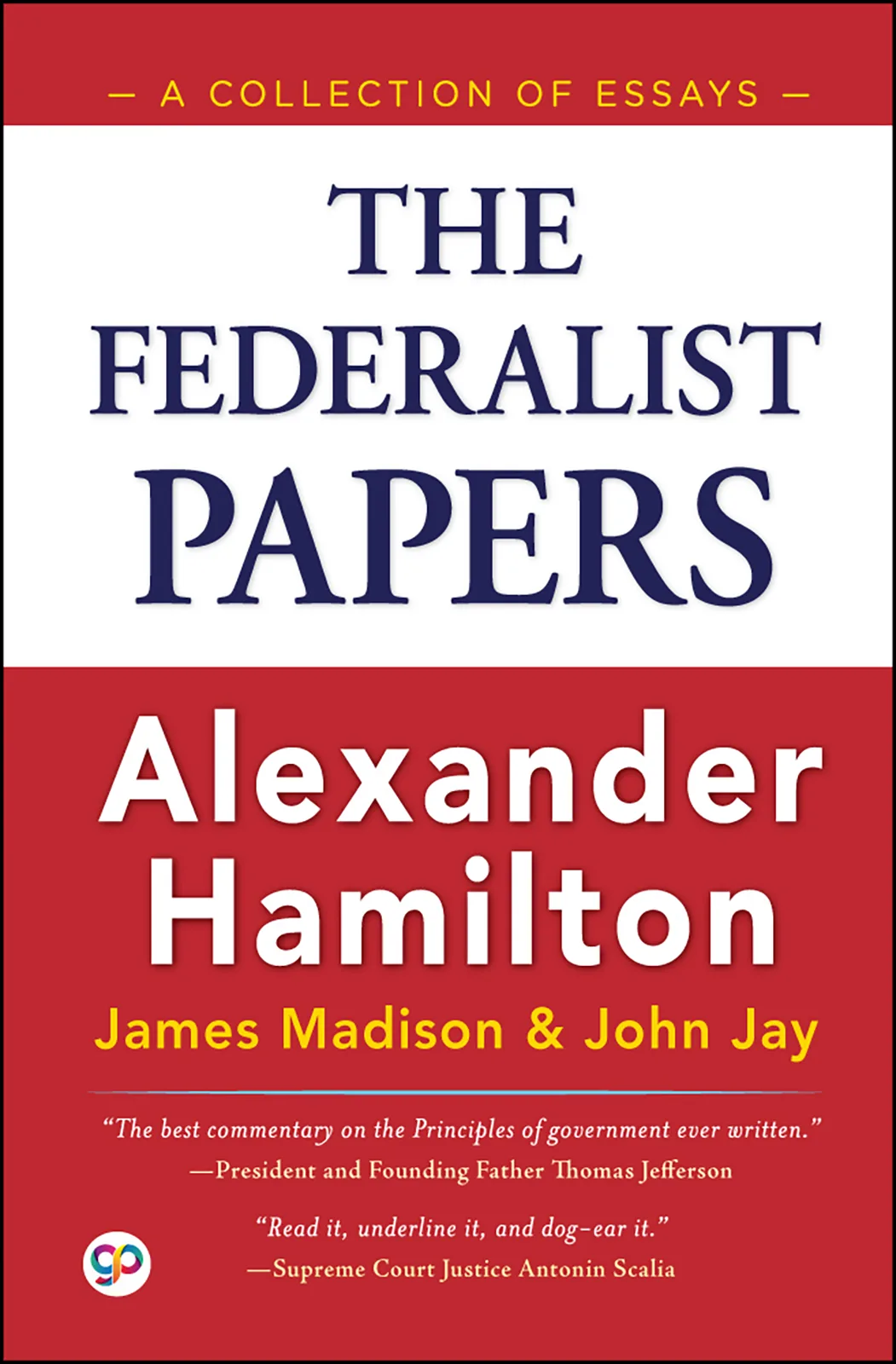
The Federalist Papers
Hardcover
• 616 Pages
• INR 750.00
• English
• 9789354992841
No ratings yet
| Publisher | General Press |
|---|---|
| ISBN13 | 9789354992841 |
| ASIN/SKU | 9354992846 |
| Book Format | Hardcover |
| Language | English |
| Pages | 616 |
| List Price | INR 750.00 |
| Subject Code | HIS001040, POL002000, POL006000 |
| Publishing Date | 01/06/2022 |
| Dimensions | 8.25 x 5.25 x 1.0 inches |
| Book Code | BD00067655 |
Buy this Book
Amazon Stores
Ebook Stores
Other Stores
Discover The Federalist Papers by Alexander Hamilton. This book is published by General Press in Hardcover format, ISBN 9789354992841, ASIN 9354992846, under Politics and Social Sciences, Politics, Nonfiction.
Book Description
What happens when a new nation is born, but no one can agree on how it should be governed? 'The Federalist Papers' by Alexander Hamilton is a landmark work of political philosophy, constitutional commentary, and American history that explores the arguments behind the creation and adoption of the United States Constitution. Written during a period of intense political uncertainty, the essays examine what kind of government could preserve liberty while also providing enough strength and stability to hold a young republic together.
Originally published under the shared pseudonym “Publius,” The Federalist Papers presents a sustained defense of the proposed Constitution. Alexander Hamilton, together with James Madison and John Jay, addresses the concerns of citizens who feared that a stronger federal government might threaten individual freedom or become too powerful. The essays explain why a carefully designed national government was considered necessary and explore subjects such as the separation of powers, checks and balances, federalism, taxation, national defense, representation, and the dangers of political factions.
Hamilton’s contributions are especially striking for their directness and practical reasoning. Rather than treating government as an abstract idea, the essays consider human ambition, competing interests, political rivalry, and the possibility of corruption. The central question running through the work is how political power can be structured so that government is capable of acting effectively without becoming a threat to the people it serves.
More than a historical document, this classic work offers readers a window into the political debates that shaped the American republic. Its discussions of liberty, authority, divided government, and constitutional power remain relevant to anyone interested in politics or the foundations of democracy. Whether read as American history, political theory, or constitutional commentary, 'The Federalist Papers' invites readers to look closely at the difficult choices involved in building a lasting government—and to discover why its arguments continue to provoke discussion centuries later.
Originally published under the shared pseudonym “Publius,” The Federalist Papers presents a sustained defense of the proposed Constitution. Alexander Hamilton, together with James Madison and John Jay, addresses the concerns of citizens who feared that a stronger federal government might threaten individual freedom or become too powerful. The essays explain why a carefully designed national government was considered necessary and explore subjects such as the separation of powers, checks and balances, federalism, taxation, national defense, representation, and the dangers of political factions.
Hamilton’s contributions are especially striking for their directness and practical reasoning. Rather than treating government as an abstract idea, the essays consider human ambition, competing interests, political rivalry, and the possibility of corruption. The central question running through the work is how political power can be structured so that government is capable of acting effectively without becoming a threat to the people it serves.
More than a historical document, this classic work offers readers a window into the political debates that shaped the American republic. Its discussions of liberty, authority, divided government, and constitutional power remain relevant to anyone interested in politics or the foundations of democracy. Whether read as American history, political theory, or constitutional commentary, 'The Federalist Papers' invites readers to look closely at the difficult choices involved in building a lasting government—and to discover why its arguments continue to provoke discussion centuries later.
Author Biography
Alexander Hamilton was born in the West Indies in 1757, the illegitimate child of a Scottish merchant. He came to the American colonies to study at King’s College (now Columbia University), and became an early and ardent supporter of the Revolutionary cause. During the Revolutionary War he was aide-de-camp to George Washington and a member of the Continental Congress. He was a leading figure at the Constitutional Convention (1787) and a principal author of The Federalist Papers. At first Secretary of the Treasury he articulated a policy of protection for manufacturing interests, strong central government, and establishment of a national bank. After leaving the Cabinet, he practiced law in New York. His personal attacks hindered the political career of the volatile Aaron Burr, who finally challenged him to a duel in 1804. Hamilton was shot, and died of his wounds.
‘John Jay’ (1747-1829) was a conservative lawyer who became a leading patriot. He was a minister to Spain (1780-82), the first Chief Justice of the U.S. Supreme Court (1789-95), and he negotiated the treaty of 1795 between the U.S. and Britain. His contributions to The Federalist Papers concern foreign affairs.
‘James Madison’ was born in 1751, the son of a Virginia planter. He worked for the Revolutionary cause as a member of the Continental Congress and the Virginia House of Delegates. The leader of deliberations at the Constitutional Convention, he fought for the adoption of the Constitution and the Bill of Rights. Through an ally of Hamilton on the Constitution he was a supporter of Jefferson’s agrarian policies. He was Jefferson’s Secretary of State (1801-9) and his successor as president (1809-17), but his presidency was marred by the unpopular War of 1812. Madison died in 1836
‘John Jay’ (1747-1829) was a conservative lawyer who became a leading patriot. He was a minister to Spain (1780-82), the first Chief Justice of the U.S. Supreme Court (1789-95), and he negotiated the treaty of 1795 between the U.S. and Britain. His contributions to The Federalist Papers concern foreign affairs.
‘James Madison’ was born in 1751, the son of a Virginia planter. He worked for the Revolutionary cause as a member of the Continental Congress and the Virginia House of Delegates. The leader of deliberations at the Constitutional Convention, he fought for the adoption of the Constitution and the Bill of Rights. Through an ally of Hamilton on the Constitution he was a supporter of Jefferson’s agrarian policies. He was Jefferson’s Secretary of State (1801-9) and his successor as president (1809-17), but his presidency was marred by the unpopular War of 1812. Madison died in 1836
Editorial Reviews
Editorial Reviews will be added soon…
Book Summary
The Federalist Papers is a collection of 85 essays written in 1787 and 1788 to defend and explain the proposed United States Constitution. Although the essays were written under the shared pseudonym “Publius” by Alexander Hamilton, James Madison, and John Jay, Hamilton wrote the largest number. The work was created during a critical moment in American history, when the new nation was struggling to determine how much power the national government should possess and how that power could be balanced against the rights and independence of the states. The essays are therefore both a defense of the Constitution and a detailed examination of how a successful republic might be organized.
The background to the book is the weakness of the government established under the Articles of Confederation. After independence from Britain, the American states were joined under a loose system in which the central government had limited authority. It had difficulty raising revenue, regulating trade, maintaining national stability, and responding effectively to conflicts among the states. Many political leaders feared that the new republic might become unstable or even collapse. The proposed Constitution attempted to create a stronger federal government, but its opponents worried that it would give the national government too much power and threaten individual liberty.
The Federalist essays were written to answer these objections. Hamilton, Madison, and Jay argue that the Constitution is not a threat to freedom but a carefully designed structure intended to preserve both liberty and effective government. Their basic problem is one that remains central to political life: government must be strong enough to protect society, but it must also be limited enough to prevent abuse.
Hamilton begins by presenting the constitutional question as a choice with enormous consequences. The American people, he argues, have an opportunity to determine whether the new union will succeed through a stable constitutional system or remain vulnerable to division and disorder. The essays therefore appeal not only to political theory but also to practical experience. The writers repeatedly ask what kind of government is most likely to protect the country from internal conflict, foreign threats, economic instability, and the ambitions of powerful individuals.
A major theme is the danger of faction. Factions are groups of citizens united by interests or passions that may conflict with the rights of others or the common good. The authors recognize that factions cannot simply be eliminated because disagreement is a natural part of a free society. Instead, political institutions must be designed to control their harmful effects. In Federalist No. 10, Madison famously argues that a large republic can actually help manage faction because a greater variety of interests makes it more difficult for one group to dominate the whole country. Instead of trying to destroy differences among citizens, the Constitution can use those differences to prevent concentrated political power.
The Federalist Papers also defend the idea of a representative government. The writers distinguish representative democracy from direct democracy and argue that elected representatives can refine and enlarge public opinion. Representatives, ideally chosen for their judgment and character, can study complicated issues and make decisions that serve the broader interests of society rather than simply responding to temporary passions.
Another major concern is the relationship between the federal government and the states. The authors defend federalism as a system in which political authority is divided between national and state governments. The national government should handle matters requiring national unity, such as defense, foreign affairs, and interstate concerns, while states should retain authority over local matters. This division is intended to prevent either level of government from becoming completely dominant.
Hamilton devotes considerable attention to the executive branch. In defending a single president, he argues that unity in the executive is essential for effective administration, especially in matters of national security and foreign policy. A single executive can act with greater speed, secrecy, and accountability than a committee. At the same time, the president is limited by elections, constitutional rules, and the other branches of government. Hamilton therefore presents energetic executive power not as inherently dangerous but as something that can be made compatible with liberty when properly restrained.
The judiciary receives similar attention. The authors argue that courts must be sufficiently independent to interpret and apply the Constitution without being controlled by political pressure. Federal judges, particularly those appointed for life during good behavior, can protect constitutional principles against temporary political passions. Judicial independence is therefore presented as an important safeguard for individual rights and constitutional government.
Perhaps the most important institutional principle in the Federalist Papers is the separation of powers. The Constitution divides government into legislative, executive, and judicial branches. Each branch has its own responsibilities, but none is completely independent of the others. Through checks and balances, each branch receives enough authority to resist encroachment by another. The purpose is not to make government inefficient for its own sake but to make concentrated power difficult.
The authors are realistic about human nature. They do not assume that political leaders will always be virtuous. Instead, they begin with the opposite assumption: people who possess power may be tempted to expand it. This leads to one of the most important ideas in the collection: government must be designed to control both the governed and those who govern. Institutional safeguards are necessary because political ambition can be dangerous when it is left unchecked. The famous argument that ambition should be made to counteract ambition captures this practical understanding of politics.
Hamilton also defends the federal government’s ability to raise taxes and maintain national defense. A government without adequate resources, he argues, cannot protect the country or fulfill its responsibilities. The ability to provide for common defense and national needs therefore requires real federal authority. The authors reject the idea that a weak government is automatically safer for liberty. In their view, excessive weakness can itself threaten freedom because disorder, economic instability, foreign interference, and internal conflict may eventually produce demands for stronger and less accountable authority.
The essays also address the size and structure of the Senate, the House of Representatives, the electoral system, treaties, federal courts, and the relationship between federal and state authority. Throughout these discussions, the writers attempt to show that the Constitution is a system of interconnected safeguards rather than a collection of isolated powers. Each institution has a purpose, and each is intended to operate within a larger balance.
The Federalist Papers are not neutral descriptions of the Constitution. They are persuasive political essays written to encourage ratification, and their authors sometimes interpret constitutional provisions in ways that reflect their own political objectives. Nevertheless, their importance extends far beyond the original ratification debate. They offer a sustained examination of constitutional design, political power, human nature, representation, federalism, and the protection of liberty.
Ultimately, The Federalist Papers argues that free government requires more than good intentions. It requires institutions carefully designed around the realities of human behavior. The authors believe that liberty is best protected when power is divided, ambition is checked, citizens are represented, and government possesses enough authority to perform its legitimate duties. Their central insight is both practical and enduring: the challenge of political freedom is not simply how to create government, but how to create a government strong enough to govern while structured strongly enough to prevent itself from becoming tyrannical. In this sense, the Federalist essays remain an important guide to understanding the ideas, compromises, and institutional principles behind the United States Constitution.
The background to the book is the weakness of the government established under the Articles of Confederation. After independence from Britain, the American states were joined under a loose system in which the central government had limited authority. It had difficulty raising revenue, regulating trade, maintaining national stability, and responding effectively to conflicts among the states. Many political leaders feared that the new republic might become unstable or even collapse. The proposed Constitution attempted to create a stronger federal government, but its opponents worried that it would give the national government too much power and threaten individual liberty.
The Federalist essays were written to answer these objections. Hamilton, Madison, and Jay argue that the Constitution is not a threat to freedom but a carefully designed structure intended to preserve both liberty and effective government. Their basic problem is one that remains central to political life: government must be strong enough to protect society, but it must also be limited enough to prevent abuse.
Hamilton begins by presenting the constitutional question as a choice with enormous consequences. The American people, he argues, have an opportunity to determine whether the new union will succeed through a stable constitutional system or remain vulnerable to division and disorder. The essays therefore appeal not only to political theory but also to practical experience. The writers repeatedly ask what kind of government is most likely to protect the country from internal conflict, foreign threats, economic instability, and the ambitions of powerful individuals.
A major theme is the danger of faction. Factions are groups of citizens united by interests or passions that may conflict with the rights of others or the common good. The authors recognize that factions cannot simply be eliminated because disagreement is a natural part of a free society. Instead, political institutions must be designed to control their harmful effects. In Federalist No. 10, Madison famously argues that a large republic can actually help manage faction because a greater variety of interests makes it more difficult for one group to dominate the whole country. Instead of trying to destroy differences among citizens, the Constitution can use those differences to prevent concentrated political power.
The Federalist Papers also defend the idea of a representative government. The writers distinguish representative democracy from direct democracy and argue that elected representatives can refine and enlarge public opinion. Representatives, ideally chosen for their judgment and character, can study complicated issues and make decisions that serve the broader interests of society rather than simply responding to temporary passions.
Another major concern is the relationship between the federal government and the states. The authors defend federalism as a system in which political authority is divided between national and state governments. The national government should handle matters requiring national unity, such as defense, foreign affairs, and interstate concerns, while states should retain authority over local matters. This division is intended to prevent either level of government from becoming completely dominant.
Hamilton devotes considerable attention to the executive branch. In defending a single president, he argues that unity in the executive is essential for effective administration, especially in matters of national security and foreign policy. A single executive can act with greater speed, secrecy, and accountability than a committee. At the same time, the president is limited by elections, constitutional rules, and the other branches of government. Hamilton therefore presents energetic executive power not as inherently dangerous but as something that can be made compatible with liberty when properly restrained.
The judiciary receives similar attention. The authors argue that courts must be sufficiently independent to interpret and apply the Constitution without being controlled by political pressure. Federal judges, particularly those appointed for life during good behavior, can protect constitutional principles against temporary political passions. Judicial independence is therefore presented as an important safeguard for individual rights and constitutional government.
Perhaps the most important institutional principle in the Federalist Papers is the separation of powers. The Constitution divides government into legislative, executive, and judicial branches. Each branch has its own responsibilities, but none is completely independent of the others. Through checks and balances, each branch receives enough authority to resist encroachment by another. The purpose is not to make government inefficient for its own sake but to make concentrated power difficult.
The authors are realistic about human nature. They do not assume that political leaders will always be virtuous. Instead, they begin with the opposite assumption: people who possess power may be tempted to expand it. This leads to one of the most important ideas in the collection: government must be designed to control both the governed and those who govern. Institutional safeguards are necessary because political ambition can be dangerous when it is left unchecked. The famous argument that ambition should be made to counteract ambition captures this practical understanding of politics.
Hamilton also defends the federal government’s ability to raise taxes and maintain national defense. A government without adequate resources, he argues, cannot protect the country or fulfill its responsibilities. The ability to provide for common defense and national needs therefore requires real federal authority. The authors reject the idea that a weak government is automatically safer for liberty. In their view, excessive weakness can itself threaten freedom because disorder, economic instability, foreign interference, and internal conflict may eventually produce demands for stronger and less accountable authority.
The essays also address the size and structure of the Senate, the House of Representatives, the electoral system, treaties, federal courts, and the relationship between federal and state authority. Throughout these discussions, the writers attempt to show that the Constitution is a system of interconnected safeguards rather than a collection of isolated powers. Each institution has a purpose, and each is intended to operate within a larger balance.
The Federalist Papers are not neutral descriptions of the Constitution. They are persuasive political essays written to encourage ratification, and their authors sometimes interpret constitutional provisions in ways that reflect their own political objectives. Nevertheless, their importance extends far beyond the original ratification debate. They offer a sustained examination of constitutional design, political power, human nature, representation, federalism, and the protection of liberty.
Ultimately, The Federalist Papers argues that free government requires more than good intentions. It requires institutions carefully designed around the realities of human behavior. The authors believe that liberty is best protected when power is divided, ambition is checked, citizens are represented, and government possesses enough authority to perform its legitimate duties. Their central insight is both practical and enduring: the challenge of political freedom is not simply how to create government, but how to create a government strong enough to govern while structured strongly enough to prevent itself from becoming tyrannical. In this sense, the Federalist essays remain an important guide to understanding the ideas, compromises, and institutional principles behind the United States Constitution.
Sample Chapters
Federalist No. 1 : General Introduction
For the Independent Journal. Saturday, October 27, 1787
HAMILTON
To the People of the State of New York:
After an unequivocal experience of the inefficacy of the subsisting federal government, you are called upon to deliberate on a new Constitution for the United States of America. The subject speaks its own importance; comprehending in its consequences nothing less than the existence of the UNION, the safety and welfare of the parts of which it is composed, the fate of an empire in many respects the most interesting in the world. It has been frequently remarked that it seems to have been reserved to the people of this country, by their conduct and example, to decide the important question, whether societies of men are really capable or not of establishing good government from reflection and choice, or whether they are forever destined to depend for their political constitutions on accident and force. If there be any truth in the remark, the crisis at which we are arrived may with propriety be regarded as the era in which that decision is to be made; and a wrong election of the part we shall act may, in this view, deserve to be considered as the general misfortune of mankind.
This idea will add the inducements of philanthropy to those of patriotism, to heighten the solicitude which all considerate and good men must feel for the event. Happy will it be if our choice should be directed by a judicious estimate of our true interests, unperplexed and unbiased by considerations not connected with the public good. But this is a thing more ardently to be wished than seriously to be expected. The plan offered to our deliberations affects too many particular interests, innovates upon too many local institutions, not to involve in its discussion a variety of objects foreign to its merits, and of views, passions and prejudices little favorable to the discovery of truth.
Among the most formidable of the obstacles which the new Constitution will have to encounter may readily be distinguished the obvious interest of a certain class of men in every State to resist all changes which may hazard a diminution of the power, emolument, and consequence of the offices they hold under the State establishments; and the perverted ambition of another class of men, who will either hope to aggrandize themselves by the confusions of their country, or will flatter themselves with fairer prospects of elevation from the subdivision of the empire into several partial confederacies than from its union under one government.
It is not, however, my design to dwell upon observations of this nature. I am well aware that it would be disingenuous to resolve indiscriminately the opposition of any set of men (merely because their situations might subject them to suspicion) into interested or ambitious views. Candor will oblige us to admit that even such men may be actuated by upright intentions; and it cannot be doubted that much of the opposition which has made its appearance, or may hereafter make its appearance, will spring from sources, blameless at least, if not respectable—the honest errors of minds led astray by preconceived jealousies and fears. So numerous indeed and so powerful are the causes which serve to give a false bias to the judgment, that we, upon many occasions, see wise and good men on the wrong as well as on the right side of questions of the first magnitude to society. This circumstance, if duly attended to, would furnish a lesson of moderation to those who are ever so much persuaded of their being in the right in any controversy. And a further reason for caution, in this respect, might be drawn from the reflection that we are not always sure that those who advocate the truth are influenced by purer principles than their antagonists. Ambition, avarice, personal animosity, party opposition, and many other motives not more laudable than these, are apt to operate as well upon those who support as those who oppose the right side of a question. Were there not even these inducements to moderation, nothing could be more ill-judged than that intolerant spirit which has, at all times, characterized political parties. For in politics, as in religion, it is equally absurd to aim at making proselytes by fire and sword. Heresies in either can rarely be cured by persecution.
And yet, however just these sentiments will be allowed to be, we have already sufficient indications that it will happen in this as in all former cases of great national discussion. A torrent of angry and malignant passions will be let loose. To judge from the conduct of the opposite parties, we shall be led to conclude that they will mutually hope to evince the justness of their opinions, and to increase the number of their converts by the loudness of their declamations and the bitterness of their invectives. An enlightened zeal for the energy and efficiency of government will be stigmatized as the offspring of a temper fond of despotic power and hostile to the principles of liberty. An over-scrupulous jealousy of danger to the rights of the people, which is more commonly the fault of the head than of the heart, will be represented as mere pretense and artifice, the stale bait for popularity at the expense of the public good. It will be forgotten, on the one hand, that jealousy is the usual concomitant of love, and that the noble enthusiasm of liberty is apt to be infected with a spirit of narrow and illiberal distrust. On the other hand, it will be equally forgotten that the vigor of government is essential to the security of liberty; that, in the contemplation of a sound and well-informed judgment, their interest can never be separated; and that a dangerous ambition more often lurks behind the specious mask of zeal for the rights of the people than under the forbidden appearance of zeal for the firmness and efficiency of government. History will teach us that the former has been found a much more certain road to the introduction of despotism than the latter, and that of those men who have overturned the liberties of republics, the greatest number have begun their career by paying an obsequious court to the people; commencing demagogues, and ending tyrants.
In the course of the preceding observations, I have had an eye, my fellow-citizens, to putting you upon your guard against all attempts, from whatever quarter, to influence your decision in a matter of the utmost moment to your welfare, by any impressions other than those which may result from the evidence of truth. You will, no doubt, at the same time, have collected from the general scope of them, that they proceed from a source not unfriendly to the new Constitution. Yes, my countrymen, I own to you that, after having given it an attentive consideration, I am clearly of opinion it is your interest to adopt it. I am convinced that this is the safest course for your liberty, your dignity, and your happiness. I affect not reserves which I do not feel. I will not amuse you with an appearance of deliberation when I have decided. I frankly acknowledge to you my convictions, and I will freely lay before you the reasons on which they are founded. The consciousness of good intentions disdains ambiguity. I shall not, however, multiply professions on this head. My motives must remain in the depository of my own breast. My arguments will be open to all, and may be judged of by all. They shall at least be offered in a spirit which will not disgrace the cause of truth.
I propose, in a series of papers, to discuss the following interesting particulars:
The utility of the union to your political prosperity the insufficiency of the present confederation to preserve that union the necessity of a government at least equally energetic with the one proposed, to the attainment of this object the conformity of the proposed constitution to the true principles of republican government its analogy to your own state constitution and lastly, the additional security which its adoption will afford to the preservation of that species of government, to liberty, and to property.
In the progress of this discussion I shall endeavor to give a satisfactory answer to all the objections which shall have made their appearance, that may seem to have any claim to your attention.
It may perhaps be thought superfluous to offer arguments to prove the utility of the UNION, a point, no doubt, deeply engraved on the hearts of the great body of the people in every State, and one, which it may be imagined, has no adversaries. But the fact is, that we already hear it whispered in the private circles of those who oppose the new Constitution, that the thirteen States are of too great extent for any general system, and that we must of necessity resort to separate confederacies of distinct portions of the whole. This doctrine will, in all probability, be gradually propagated, till it has votaries enough to countenance an open avowal of it. For nothing can be more evident, to those who are able to take an enlarged view of the subject, than the alternative of an adoption of the new Constitution or a dismemberment of the Union. It will therefore be of use to begin by examining the advantages of that Union, the certain evils, and the probable dangers, to which every State will be exposed from its dissolution. This shall accordingly constitute the subject of my next address.
Publius
Federalist No. 2 : Concerning Dangers from Foreign Force and Influence
For the Independent Journal. Wednesday, October 31, 1787
JAY
To the People of the State of New York:
When the people of America reflect that they are now called upon to decide a question, which, in its consequences, must prove one of the most important that ever engaged their attention, the propriety of their taking a very comprehensive, as well as a very serious, view of it, will be evident.
Nothing is more certain than the indispensable necessity of government, and it is equally undeniable, that whenever and however it is instituted, the people must cede to it some of their natural rights in order to vest it with requisite powers. It is well worthy of consideration therefore, whether it would conduce more to the interest of the people of America that they should, to all general purposes, be one nation, under one federal government, or that they should divide themselves into separate confederacies, and give to the head of each the same kind of powers which they are advised to place in one national government.
It has until lately been a received and uncontradicted opinion that the prosperity of the people of America depended on their continuing firmly united, and the wishes, prayers, and efforts of our best and wisest citizens have been constantly directed to that object. But politicians now appear, who insist that this opinion is erroneous, and that instead of looking for safety and happiness in union, we ought to seek it in a division of the States into distinct confederacies or sovereignties. However extraordinary this new doctrine may appear, it nevertheless has its advocates; and certain characters who were much opposed to it formerly, are at present of the number. Whatever may be the arguments or inducements which have wrought this change in the sentiments and declarations of these gentlemen, it certainly would not be wise in the people at large to adopt these new political tenets without being fully convinced that they are founded in truth and sound policy.
It has often given me pleasure to observe that independent America was not composed of detached and distant territories, but that one connected, fertile, wide-spreading country was the portion of our western sons of liberty. Providence has in a particular manner blessed it with a variety of soils and productions, and watered it with innumerable streams, for the delight and accommodation of its inhabitants. A succession of navigable waters forms a kind of chain round its borders, as if to bind it together; while the most noble rivers in the world, running at convenient distances, present them with highways for the easy communication of friendly aids, and the mutual transportation and exchange of their various commodities.
With equal pleasure I have as often taken notice that Providence has been pleased to give this one connected country to one united people—a people descended from the same ancestors, speaking the same language, professing the same religion, attached to the same principles of government, very similar in their manners and customs, and who, by their joint counsels, arms, and efforts, fighting side by side throughout a long and bloody war, have nobly established general liberty and independence.
This country and this people seem to have been made for each other, and it appears as if it was the design of Providence, that an inheritance so proper and convenient for a band of brethren, united to each other by the strongest ties, should never be split into a number of unsocial, jealous, and alien sovereignties.
Similar sentiments have hitherto prevailed among all orders and denominations of men among us. To all general purposes we have uniformly been one people each individual citizen everywhere enjoying the same national rights, privileges, and protection. As a nation we have made peace and war; as a nation we have vanquished our common enemies; as a nation we have formed alliances, and made treaties, and entered into various compacts and conventions with foreign states.
A strong sense of the value and blessings of union induced the people, at a very early period, to institute a federal government to preserve and perpetuate it. They formed it almost as soon as they had a political existence; nay, at a time when their habitations were in flames, when many of their citizens were bleeding, and when the progress of hostility and desolation left little room for those calm and mature inquiries and reflections which must ever precede the formation of a wise and well-balanced government for a free people. It is not to be wondered at, that a government instituted in times so inauspicious, should on experiment be found greatly deficient and inadequate to the purpose it was intended to answer.
This intelligent people perceived and regretted these defects. Still continuing no less attached to union than enamored of liberty, they observed the danger which immediately threatened the former and more remotely the latter; and being persuaded that ample security for both could only be found in a national government more wisely framed, they as with one voice, convened the late convention at Philadelphia, to take that important subject under consideration.
This convention composed of men who possessed the confidence of the people, and many of whom had become highly distinguished by their patriotism, virtue and wisdom, in times which tried the minds and hearts of men, undertook the arduous task. In the mild season of peace, with minds unoccupied by other subjects, they passed many months in cool, uninterrupted, and daily consultation; and finally, without having been awed by power, or influenced by any passions except love for their country, they presented and recommended to the people the plan produced by their joint and very unanimous councils.
Admit, for so is the fact, that this plan is only RECOMMENDED, not imposed, yet let it be remembered that it is neither recommended to BLIND approbation, nor to BLIND reprobation; but to that sedate and candid consideration which the magnitude and importance of the subject demand, and which it certainly ought to receive. But this (as was remarked in the foregoing number of this paper) is more to be wished than expected, that it may be so considered and examined. Experience on a former occasion teaches us not to be too sanguine in such hopes. It is not yet forgotten that well-grounded apprehensions of imminent danger induced the people of America to form the memorable Congress of 1774. That body recommended certain measures to their constituents, and the event proved their wisdom; yet it is fresh in our memories how soon the press began to teem with pamphlets and weekly papers against those very measures. Not only many of the officers of government, who obeyed the dictates of personal interest, but others, from a mistaken estimate of consequences, or the undue influence of former attachments, or whose ambition aimed at objects which did not correspond with the public good, were indefatigable in their efforts to persuade the people to reject the advice of that patriotic Congress. Many, indeed, were deceived and deluded, but the great majority of the people reasoned and decided judiciously; and happy they are in reflecting that they did so.
They considered that the Congress was composed of many wise and experienced men. That, being convened from different parts of the country, they brought with them and communicated to each other a variety of useful information. That, in the course of the time they passed together in inquiring into and discussing the true interests of their country, they must have acquired very accurate knowledge on that head. That they were individually interested in the public liberty and prosperity, and therefore that it was not less their inclination than their duty to recommend only such measures as, after the most mature deliberation, they really thought prudent and advisable.
These and similar considerations then induced the people to rely greatly on the judgment and integrity of the Congress; and they took their advice, notwithstanding the various arts and endeavors used to deter them from it. But if the people at large had reason to confide in the men of that Congress, few of whom had been fully tried or generally known, still greater reason have they now to respect the judgment and advice of the convention, for it is well known that some of the most distinguished members of that Congress, who have been since tried and justly approved for patriotism and abilities, and who have grown old in acquiring political information, were also members of this convention, and carried into it their accumulated knowledge and experience.
For the Independent Journal. Saturday, October 27, 1787
HAMILTON
To the People of the State of New York:
After an unequivocal experience of the inefficacy of the subsisting federal government, you are called upon to deliberate on a new Constitution for the United States of America. The subject speaks its own importance; comprehending in its consequences nothing less than the existence of the UNION, the safety and welfare of the parts of which it is composed, the fate of an empire in many respects the most interesting in the world. It has been frequently remarked that it seems to have been reserved to the people of this country, by their conduct and example, to decide the important question, whether societies of men are really capable or not of establishing good government from reflection and choice, or whether they are forever destined to depend for their political constitutions on accident and force. If there be any truth in the remark, the crisis at which we are arrived may with propriety be regarded as the era in which that decision is to be made; and a wrong election of the part we shall act may, in this view, deserve to be considered as the general misfortune of mankind.
This idea will add the inducements of philanthropy to those of patriotism, to heighten the solicitude which all considerate and good men must feel for the event. Happy will it be if our choice should be directed by a judicious estimate of our true interests, unperplexed and unbiased by considerations not connected with the public good. But this is a thing more ardently to be wished than seriously to be expected. The plan offered to our deliberations affects too many particular interests, innovates upon too many local institutions, not to involve in its discussion a variety of objects foreign to its merits, and of views, passions and prejudices little favorable to the discovery of truth.
Among the most formidable of the obstacles which the new Constitution will have to encounter may readily be distinguished the obvious interest of a certain class of men in every State to resist all changes which may hazard a diminution of the power, emolument, and consequence of the offices they hold under the State establishments; and the perverted ambition of another class of men, who will either hope to aggrandize themselves by the confusions of their country, or will flatter themselves with fairer prospects of elevation from the subdivision of the empire into several partial confederacies than from its union under one government.
It is not, however, my design to dwell upon observations of this nature. I am well aware that it would be disingenuous to resolve indiscriminately the opposition of any set of men (merely because their situations might subject them to suspicion) into interested or ambitious views. Candor will oblige us to admit that even such men may be actuated by upright intentions; and it cannot be doubted that much of the opposition which has made its appearance, or may hereafter make its appearance, will spring from sources, blameless at least, if not respectable—the honest errors of minds led astray by preconceived jealousies and fears. So numerous indeed and so powerful are the causes which serve to give a false bias to the judgment, that we, upon many occasions, see wise and good men on the wrong as well as on the right side of questions of the first magnitude to society. This circumstance, if duly attended to, would furnish a lesson of moderation to those who are ever so much persuaded of their being in the right in any controversy. And a further reason for caution, in this respect, might be drawn from the reflection that we are not always sure that those who advocate the truth are influenced by purer principles than their antagonists. Ambition, avarice, personal animosity, party opposition, and many other motives not more laudable than these, are apt to operate as well upon those who support as those who oppose the right side of a question. Were there not even these inducements to moderation, nothing could be more ill-judged than that intolerant spirit which has, at all times, characterized political parties. For in politics, as in religion, it is equally absurd to aim at making proselytes by fire and sword. Heresies in either can rarely be cured by persecution.
And yet, however just these sentiments will be allowed to be, we have already sufficient indications that it will happen in this as in all former cases of great national discussion. A torrent of angry and malignant passions will be let loose. To judge from the conduct of the opposite parties, we shall be led to conclude that they will mutually hope to evince the justness of their opinions, and to increase the number of their converts by the loudness of their declamations and the bitterness of their invectives. An enlightened zeal for the energy and efficiency of government will be stigmatized as the offspring of a temper fond of despotic power and hostile to the principles of liberty. An over-scrupulous jealousy of danger to the rights of the people, which is more commonly the fault of the head than of the heart, will be represented as mere pretense and artifice, the stale bait for popularity at the expense of the public good. It will be forgotten, on the one hand, that jealousy is the usual concomitant of love, and that the noble enthusiasm of liberty is apt to be infected with a spirit of narrow and illiberal distrust. On the other hand, it will be equally forgotten that the vigor of government is essential to the security of liberty; that, in the contemplation of a sound and well-informed judgment, their interest can never be separated; and that a dangerous ambition more often lurks behind the specious mask of zeal for the rights of the people than under the forbidden appearance of zeal for the firmness and efficiency of government. History will teach us that the former has been found a much more certain road to the introduction of despotism than the latter, and that of those men who have overturned the liberties of republics, the greatest number have begun their career by paying an obsequious court to the people; commencing demagogues, and ending tyrants.
In the course of the preceding observations, I have had an eye, my fellow-citizens, to putting you upon your guard against all attempts, from whatever quarter, to influence your decision in a matter of the utmost moment to your welfare, by any impressions other than those which may result from the evidence of truth. You will, no doubt, at the same time, have collected from the general scope of them, that they proceed from a source not unfriendly to the new Constitution. Yes, my countrymen, I own to you that, after having given it an attentive consideration, I am clearly of opinion it is your interest to adopt it. I am convinced that this is the safest course for your liberty, your dignity, and your happiness. I affect not reserves which I do not feel. I will not amuse you with an appearance of deliberation when I have decided. I frankly acknowledge to you my convictions, and I will freely lay before you the reasons on which they are founded. The consciousness of good intentions disdains ambiguity. I shall not, however, multiply professions on this head. My motives must remain in the depository of my own breast. My arguments will be open to all, and may be judged of by all. They shall at least be offered in a spirit which will not disgrace the cause of truth.
I propose, in a series of papers, to discuss the following interesting particulars:
The utility of the union to your political prosperity the insufficiency of the present confederation to preserve that union the necessity of a government at least equally energetic with the one proposed, to the attainment of this object the conformity of the proposed constitution to the true principles of republican government its analogy to your own state constitution and lastly, the additional security which its adoption will afford to the preservation of that species of government, to liberty, and to property.
In the progress of this discussion I shall endeavor to give a satisfactory answer to all the objections which shall have made their appearance, that may seem to have any claim to your attention.
It may perhaps be thought superfluous to offer arguments to prove the utility of the UNION, a point, no doubt, deeply engraved on the hearts of the great body of the people in every State, and one, which it may be imagined, has no adversaries. But the fact is, that we already hear it whispered in the private circles of those who oppose the new Constitution, that the thirteen States are of too great extent for any general system, and that we must of necessity resort to separate confederacies of distinct portions of the whole. This doctrine will, in all probability, be gradually propagated, till it has votaries enough to countenance an open avowal of it. For nothing can be more evident, to those who are able to take an enlarged view of the subject, than the alternative of an adoption of the new Constitution or a dismemberment of the Union. It will therefore be of use to begin by examining the advantages of that Union, the certain evils, and the probable dangers, to which every State will be exposed from its dissolution. This shall accordingly constitute the subject of my next address.
Publius
Federalist No. 2 : Concerning Dangers from Foreign Force and Influence
For the Independent Journal. Wednesday, October 31, 1787
JAY
To the People of the State of New York:
When the people of America reflect that they are now called upon to decide a question, which, in its consequences, must prove one of the most important that ever engaged their attention, the propriety of their taking a very comprehensive, as well as a very serious, view of it, will be evident.
Nothing is more certain than the indispensable necessity of government, and it is equally undeniable, that whenever and however it is instituted, the people must cede to it some of their natural rights in order to vest it with requisite powers. It is well worthy of consideration therefore, whether it would conduce more to the interest of the people of America that they should, to all general purposes, be one nation, under one federal government, or that they should divide themselves into separate confederacies, and give to the head of each the same kind of powers which they are advised to place in one national government.
It has until lately been a received and uncontradicted opinion that the prosperity of the people of America depended on their continuing firmly united, and the wishes, prayers, and efforts of our best and wisest citizens have been constantly directed to that object. But politicians now appear, who insist that this opinion is erroneous, and that instead of looking for safety and happiness in union, we ought to seek it in a division of the States into distinct confederacies or sovereignties. However extraordinary this new doctrine may appear, it nevertheless has its advocates; and certain characters who were much opposed to it formerly, are at present of the number. Whatever may be the arguments or inducements which have wrought this change in the sentiments and declarations of these gentlemen, it certainly would not be wise in the people at large to adopt these new political tenets without being fully convinced that they are founded in truth and sound policy.
It has often given me pleasure to observe that independent America was not composed of detached and distant territories, but that one connected, fertile, wide-spreading country was the portion of our western sons of liberty. Providence has in a particular manner blessed it with a variety of soils and productions, and watered it with innumerable streams, for the delight and accommodation of its inhabitants. A succession of navigable waters forms a kind of chain round its borders, as if to bind it together; while the most noble rivers in the world, running at convenient distances, present them with highways for the easy communication of friendly aids, and the mutual transportation and exchange of their various commodities.
With equal pleasure I have as often taken notice that Providence has been pleased to give this one connected country to one united people—a people descended from the same ancestors, speaking the same language, professing the same religion, attached to the same principles of government, very similar in their manners and customs, and who, by their joint counsels, arms, and efforts, fighting side by side throughout a long and bloody war, have nobly established general liberty and independence.
This country and this people seem to have been made for each other, and it appears as if it was the design of Providence, that an inheritance so proper and convenient for a band of brethren, united to each other by the strongest ties, should never be split into a number of unsocial, jealous, and alien sovereignties.
Similar sentiments have hitherto prevailed among all orders and denominations of men among us. To all general purposes we have uniformly been one people each individual citizen everywhere enjoying the same national rights, privileges, and protection. As a nation we have made peace and war; as a nation we have vanquished our common enemies; as a nation we have formed alliances, and made treaties, and entered into various compacts and conventions with foreign states.
A strong sense of the value and blessings of union induced the people, at a very early period, to institute a federal government to preserve and perpetuate it. They formed it almost as soon as they had a political existence; nay, at a time when their habitations were in flames, when many of their citizens were bleeding, and when the progress of hostility and desolation left little room for those calm and mature inquiries and reflections which must ever precede the formation of a wise and well-balanced government for a free people. It is not to be wondered at, that a government instituted in times so inauspicious, should on experiment be found greatly deficient and inadequate to the purpose it was intended to answer.
This intelligent people perceived and regretted these defects. Still continuing no less attached to union than enamored of liberty, they observed the danger which immediately threatened the former and more remotely the latter; and being persuaded that ample security for both could only be found in a national government more wisely framed, they as with one voice, convened the late convention at Philadelphia, to take that important subject under consideration.
This convention composed of men who possessed the confidence of the people, and many of whom had become highly distinguished by their patriotism, virtue and wisdom, in times which tried the minds and hearts of men, undertook the arduous task. In the mild season of peace, with minds unoccupied by other subjects, they passed many months in cool, uninterrupted, and daily consultation; and finally, without having been awed by power, or influenced by any passions except love for their country, they presented and recommended to the people the plan produced by their joint and very unanimous councils.
Admit, for so is the fact, that this plan is only RECOMMENDED, not imposed, yet let it be remembered that it is neither recommended to BLIND approbation, nor to BLIND reprobation; but to that sedate and candid consideration which the magnitude and importance of the subject demand, and which it certainly ought to receive. But this (as was remarked in the foregoing number of this paper) is more to be wished than expected, that it may be so considered and examined. Experience on a former occasion teaches us not to be too sanguine in such hopes. It is not yet forgotten that well-grounded apprehensions of imminent danger induced the people of America to form the memorable Congress of 1774. That body recommended certain measures to their constituents, and the event proved their wisdom; yet it is fresh in our memories how soon the press began to teem with pamphlets and weekly papers against those very measures. Not only many of the officers of government, who obeyed the dictates of personal interest, but others, from a mistaken estimate of consequences, or the undue influence of former attachments, or whose ambition aimed at objects which did not correspond with the public good, were indefatigable in their efforts to persuade the people to reject the advice of that patriotic Congress. Many, indeed, were deceived and deluded, but the great majority of the people reasoned and decided judiciously; and happy they are in reflecting that they did so.
They considered that the Congress was composed of many wise and experienced men. That, being convened from different parts of the country, they brought with them and communicated to each other a variety of useful information. That, in the course of the time they passed together in inquiring into and discussing the true interests of their country, they must have acquired very accurate knowledge on that head. That they were individually interested in the public liberty and prosperity, and therefore that it was not less their inclination than their duty to recommend only such measures as, after the most mature deliberation, they really thought prudent and advisable.
These and similar considerations then induced the people to rely greatly on the judgment and integrity of the Congress; and they took their advice, notwithstanding the various arts and endeavors used to deter them from it. But if the people at large had reason to confide in the men of that Congress, few of whom had been fully tried or generally known, still greater reason have they now to respect the judgment and advice of the convention, for it is well known that some of the most distinguished members of that Congress, who have been since tried and justly approved for patriotism and abilities, and who have grown old in acquiring political information, were also members of this convention, and carried into it their accumulated knowledge and experience.
Reader Reviews
No reviews yet.
The Federalist Papers
Download Cover Image
Do you want to download the full cover image for The Federalist Papers?