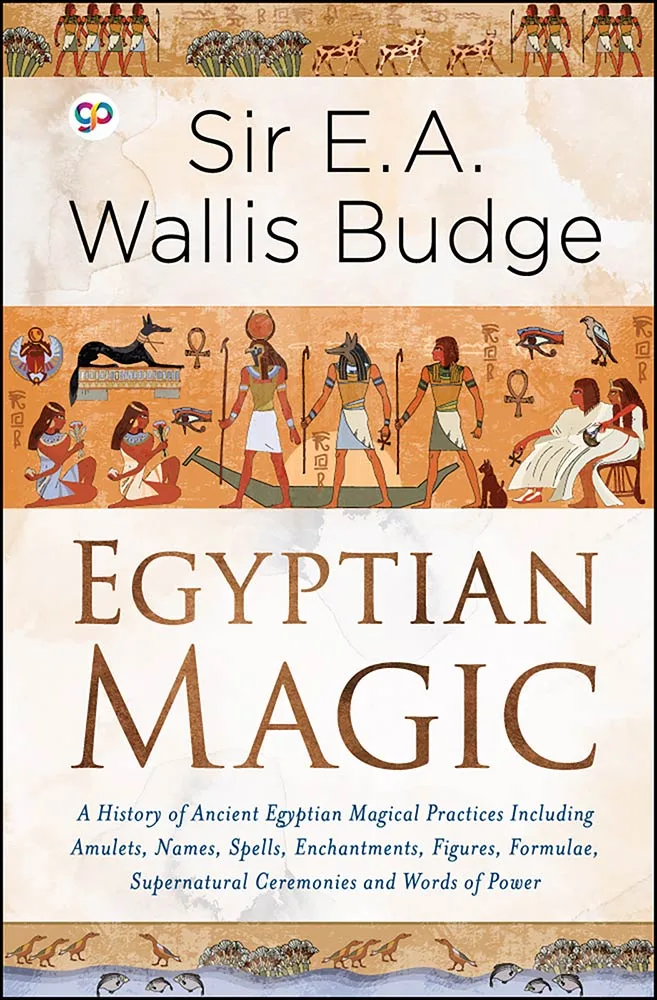
Egyptian Magic
Hardcover
• 192 Pages
• INR 395.00
• English
• 9789354996108
No ratings yet
| Publisher | General Press |
|---|---|
| ISBN13 | 9789354996108 |
| ASIN/SKU | 9354996108 |
| Book Format | Hardcover |
| Language | English |
| Pages | 192 |
| List Price | INR 395.00 |
| Subject Code | HIS002030, REL047000, HIS065000, REL114000 |
| Publishing Date | 05/09/2023 |
| Dimensions | 8.25 x 5.25 x 1.0 inches |
| Book Code | BD00067656 |
Buy this Book
Amazon Stores
Ebook Stores
Other Stores
Discover Egyptian Magic by Sir E.A. Wallis Budge. This book is published by General Press in Hardcover format, ISBN 9789354996108, ASIN 9354996108, under History, Mythology, Egyptology.
Book Description
‘Egyptian Magic’ is a well-known study by E.A. Wallis Budge, long curator of Egyptian antiquities at the British Museum, which sums up everything that is known about the wonder-working of ancient Egypt.
After a general discussion of the role of magic in Egyptian religion proper—Dr. Budge covers the powerful amulets that ward off evil spirits; the scarabs of immortality; the use of wax images and spirit placements; magical pictures and formulas; magic via the secret name; the magic of sounds; rituals; curses; destruction of hostile magic; determination of fortunate dates, and many of the other practices of the ancient Nile dwellers.
Many wonderful tales are told in these Egyptian stories; mind control, enforcing will upon animals, suspended animation, calling up the dead, finding ancient books of incredible magical power, and other miraculous events that we may or may not believe.
After a general discussion of the role of magic in Egyptian religion proper—Dr. Budge covers the powerful amulets that ward off evil spirits; the scarabs of immortality; the use of wax images and spirit placements; magical pictures and formulas; magic via the secret name; the magic of sounds; rituals; curses; destruction of hostile magic; determination of fortunate dates, and many of the other practices of the ancient Nile dwellers.
Many wonderful tales are told in these Egyptian stories; mind control, enforcing will upon animals, suspended animation, calling up the dead, finding ancient books of incredible magical power, and other miraculous events that we may or may not believe.
Author Biography
Sir E. A. Wallis Budge (1857–1934), whose full name was Sir Ernest Alfred Thompson Wallis Budge, was one of Britain's most prominent Egyptologists, Orientalists, linguists, and museum curators. His pioneering research on ancient Egypt and the civilizations of the Near East introduced generations of readers to the history, religion, mythology, and literature of the ancient world. Through his books, translations, and museum work, Budge played a major role in popularizing Egyptology during the late nineteenth and early twentieth centuries.
Budge was born on July 27, 1857, in Bodmin, Cornwall, England. Raised by his mother under modest circumstances, he developed an early fascination with ancient languages and civilizations. Largely self-taught in his youth, he impressed scholars with his exceptional aptitude for languages such as Hebrew, Syriac, and ancient Egyptian. His talent earned him the support of influential patrons, enabling him to study at the University of Cambridge, where he expanded his knowledge of Oriental languages and archaeology.
In 1883, Budge joined the British Museum, beginning a distinguished career that lasted more than forty years. He eventually became Keeper of Egyptian and Assyrian Antiquities, overseeing one of the world's most important collections of ancient artifacts. During numerous expeditions to Egypt and Mesopotamia, he acquired manuscripts, sculptures, papyri, and other archaeological treasures that greatly enriched the museum's holdings. His efforts helped preserve countless historical objects for future generations.
Budge was also a remarkably prolific author. He wrote more than a hundred books and scholarly works, many of which made ancient texts accessible to general readers. Among his best-known publications are The Egyptian Book of the Dead, Egyptian Magic, The Gods of the Egyptians, and Osiris and the Egyptian Resurrection. His translations and interpretations sparked widespread interest in ancient Egyptian religion, mythology, and funerary beliefs. Although some of his conclusions have been revised by later scholarship as Egyptology advanced, his contributions were instrumental in bringing the field to a broader audience.
Sir E. A. Wallis Budge died on November 23, 1934, in London. Today, he is remembered as one of the pioneering figures in Egyptology whose scholarship inspired countless students, historians, and enthusiasts. His lifelong dedication to preserving and interpreting the civilizations of the ancient Near East left an enduring legacy that continues to shape the study and appreciation of the ancient world.
Budge was born on July 27, 1857, in Bodmin, Cornwall, England. Raised by his mother under modest circumstances, he developed an early fascination with ancient languages and civilizations. Largely self-taught in his youth, he impressed scholars with his exceptional aptitude for languages such as Hebrew, Syriac, and ancient Egyptian. His talent earned him the support of influential patrons, enabling him to study at the University of Cambridge, where he expanded his knowledge of Oriental languages and archaeology.
In 1883, Budge joined the British Museum, beginning a distinguished career that lasted more than forty years. He eventually became Keeper of Egyptian and Assyrian Antiquities, overseeing one of the world's most important collections of ancient artifacts. During numerous expeditions to Egypt and Mesopotamia, he acquired manuscripts, sculptures, papyri, and other archaeological treasures that greatly enriched the museum's holdings. His efforts helped preserve countless historical objects for future generations.
Budge was also a remarkably prolific author. He wrote more than a hundred books and scholarly works, many of which made ancient texts accessible to general readers. Among his best-known publications are The Egyptian Book of the Dead, Egyptian Magic, The Gods of the Egyptians, and Osiris and the Egyptian Resurrection. His translations and interpretations sparked widespread interest in ancient Egyptian religion, mythology, and funerary beliefs. Although some of his conclusions have been revised by later scholarship as Egyptology advanced, his contributions were instrumental in bringing the field to a broader audience.
Sir E. A. Wallis Budge died on November 23, 1934, in London. Today, he is remembered as one of the pioneering figures in Egyptology whose scholarship inspired countless students, historians, and enthusiasts. His lifelong dedication to preserving and interpreting the civilizations of the ancient Near East left an enduring legacy that continues to shape the study and appreciation of the ancient world.
Editorial Reviews
Editorial Reviews will be added soon…
Book Summary
Sir E. A. Wallis Budge’s Egyptian Magic is an engaging exploration of the beliefs and practices that ancient Egyptians associated with magic. First published in 1899, the book examines a world in which religion, medicine, ritual, language, death, and everyday life were deeply connected. For the ancient Egyptians, magic was not simply a collection of mysterious tricks or supernatural performances. It was a practical power that could protect a person, heal illness, influence events, defeat enemies, preserve the dead, and help the soul survive after death. Budge’s study brings together inscriptions, papyri, amulets, religious texts, stories, and archaeological evidence to explain this remarkable worldview.
Budge begins with the antiquity of magical practices in Egypt. He suggests that magical ideas were extremely old, in some cases appearing to belong to a period before the elaborate Egyptian pantheon had fully developed. Magic was therefore not something added later to Egyptian religion; rather, it was deeply woven into the civilization’s religious imagination. The Egyptians believed that the universe operated according to certain invisible powers and that human beings could influence those powers through correct knowledge, ritual, objects, and words.
One of the most important ideas in the book is the extraordinary importance of words. To the Egyptians, a spoken name or correctly pronounced formula could possess genuine power. Knowledge was not merely intellectual. To know the true name of a god, spirit, person, or object could mean possessing power over it. This explains why magical texts contain long and sometimes complicated formulas. The magician had to know not only what to say but how, when, and in what circumstances to say it.
Budge devotes considerable attention to amulets, which were among the most familiar forms of Egyptian magic. These objects were worn, carried, placed on the body, or buried with the dead because they were believed to provide protection and magical assistance. Different stones, symbols, animals, and divine images had particular powers. The scarab, for example, became an important symbol associated with regeneration and renewed life, while the Eye of Horus represented protection, health, and restoration.
The importance of amulets becomes especially clear in connection with death and burial. The Egyptians regarded death not as complete extinction but as a transition into another form of existence. The dead person needed protection from dangers in the afterlife just as the living needed protection in this world. Amulets placed among the wrappings of a mummy therefore served a serious religious purpose. They were part of a larger system intended to preserve the body, protect the spirit, and help the deceased successfully navigate the world beyond death.
Budge next examines magical figures. Wax, clay, and other materials could be fashioned into representations of people, animals, or supernatural beings. The underlying idea was that an image could become connected with the person or force it represented. A properly prepared figure could therefore be used for protection, healing, or harmful purposes. This section reveals an important feature of Egyptian magical thinking: the boundary between an object and the thing it represented could be remarkably fluid.
The book then turns to magical pictures, formulas, and spells. Egyptian magical texts often combine words and images because neither was considered merely decorative. A picture could reinforce the power of a spoken formula, while a written spell could activate or strengthen the significance of an image. Magical papyri preserve instructions for a wide range of purposes, including protection from dangerous creatures, treatment of illness, protection against hostile spirits, and assistance in difficult circumstances.
One fascinating aspect of these formulas is their mixture of religion and practical need. A person suffering from illness might invoke Isis, Horus, Thoth, or another deity while recounting a mythological event. The logic was that if the god had once overcome a particular danger, the divine power that accomplished that victory could be called upon to overcome a similar danger in the present. Myth was therefore not simply a story about the past; it could become a tool for changing the present.
Budge gives special importance to magical names. The Egyptian concept of the name was much deeper than the modern idea of a personal label. A person’s name was intimately connected with identity and existence. To preserve the name was to help preserve the person. Conversely, destroying or manipulating a name could have serious consequences. The power of the secret name appears dramatically in the story of Ra and Isis, where Isis seeks knowledge of the sun-god’s hidden name. The story demonstrates Budge’s larger argument that knowledge and magical power were closely connected.
The book then explores magical ceremonies. Magic was rarely understood as simply possessing a magical object. Ritual action mattered. The magician might prepare himself, purify the surroundings, arrange objects in a particular manner, recite formulas, make offerings, draw or display symbols, and perform prescribed movements. Every detail could matter because the effectiveness of the ceremony depended upon correct performance.
This emphasis on precision reflects the Egyptian belief that the universe possessed an underlying order. Magical ritual worked because it reproduced or invoked that order. The magician was therefore not merely asking supernatural beings for favors. He was attempting to place himself within a cosmic system whose powers could be activated through knowledge and ritual.
In the final major section, Budge examines a wide variety of beliefs concerning demons, possession, dreams, ghosts, lucky and unlucky days, astrology, prophecy, transformations, and animal worship. This broad collection demonstrates how thoroughly magical thinking entered ordinary life. Dreams could be interpreted as messages or warnings. Certain days could be considered favorable or dangerous. Spirits could interfere with human beings. Animals could possess sacred associations because particular creatures were connected with particular gods.
The idea of transformation is especially important. Egyptian mythology contains numerous examples of gods taking different forms, and magical texts sometimes describe human beings or divine beings assuming animal or supernatural forms. Transformation represents the possibility of crossing ordinary boundaries between human, animal, divine, and spiritual existence.
Throughout the book, Budge repeatedly demonstrates that Egyptian magic cannot easily be separated from Egyptian religion. The same gods who received prayers could also be invoked in magical formulas. The same myths that explained the universe could become magical narratives used for protection or healing. The same symbols that decorated temples and tombs could function as protective devices.
At the heart of Egyptian Magic is therefore a simple but profound idea: the ancient Egyptian believed that the universe was filled with forces that could be understood and influenced through knowledge. Words, names, images, objects, rituals, and divine powers were all parts of this system.
Budge’s work is valuable because it allows modern readers to see ancient Egypt not merely as a civilization of pyramids, temples, and mummies, but as a culture whose people sought practical ways to deal with uncertainty, suffering, danger, and death. Magic gave them a language for confronting things they could not control through ordinary means.
At the same time, the book should be read as a work of early Egyptology rather than as the final word on ancient Egyptian religion. Modern scholarship has revised many of Budge’s interpretations, translations, and assumptions. Even so, his compilation remains historically important and remarkably rich in detail. His greatest achievement is perhaps the sense of coherence he gives to a vast collection of practices.
Ultimately, Egyptian Magic presents magic as an expression of the Egyptian desire to preserve life, defeat danger, maintain cosmic order, communicate with divine powers, and overcome death. Behind the spells and amulets lies something deeply human: the wish to find protection in an uncertain world. The ancient Egyptians believed that knowledge—especially knowledge of sacred words, names, symbols, and rituals—could provide that protection. Budge’s book invites us into that worldview and shows how magic became one of the most powerful ways through which ancient Egyptians understood their relationship with the visible and invisible worlds.
Budge begins with the antiquity of magical practices in Egypt. He suggests that magical ideas were extremely old, in some cases appearing to belong to a period before the elaborate Egyptian pantheon had fully developed. Magic was therefore not something added later to Egyptian religion; rather, it was deeply woven into the civilization’s religious imagination. The Egyptians believed that the universe operated according to certain invisible powers and that human beings could influence those powers through correct knowledge, ritual, objects, and words.
One of the most important ideas in the book is the extraordinary importance of words. To the Egyptians, a spoken name or correctly pronounced formula could possess genuine power. Knowledge was not merely intellectual. To know the true name of a god, spirit, person, or object could mean possessing power over it. This explains why magical texts contain long and sometimes complicated formulas. The magician had to know not only what to say but how, when, and in what circumstances to say it.
Budge devotes considerable attention to amulets, which were among the most familiar forms of Egyptian magic. These objects were worn, carried, placed on the body, or buried with the dead because they were believed to provide protection and magical assistance. Different stones, symbols, animals, and divine images had particular powers. The scarab, for example, became an important symbol associated with regeneration and renewed life, while the Eye of Horus represented protection, health, and restoration.
The importance of amulets becomes especially clear in connection with death and burial. The Egyptians regarded death not as complete extinction but as a transition into another form of existence. The dead person needed protection from dangers in the afterlife just as the living needed protection in this world. Amulets placed among the wrappings of a mummy therefore served a serious religious purpose. They were part of a larger system intended to preserve the body, protect the spirit, and help the deceased successfully navigate the world beyond death.
Budge next examines magical figures. Wax, clay, and other materials could be fashioned into representations of people, animals, or supernatural beings. The underlying idea was that an image could become connected with the person or force it represented. A properly prepared figure could therefore be used for protection, healing, or harmful purposes. This section reveals an important feature of Egyptian magical thinking: the boundary between an object and the thing it represented could be remarkably fluid.
The book then turns to magical pictures, formulas, and spells. Egyptian magical texts often combine words and images because neither was considered merely decorative. A picture could reinforce the power of a spoken formula, while a written spell could activate or strengthen the significance of an image. Magical papyri preserve instructions for a wide range of purposes, including protection from dangerous creatures, treatment of illness, protection against hostile spirits, and assistance in difficult circumstances.
One fascinating aspect of these formulas is their mixture of religion and practical need. A person suffering from illness might invoke Isis, Horus, Thoth, or another deity while recounting a mythological event. The logic was that if the god had once overcome a particular danger, the divine power that accomplished that victory could be called upon to overcome a similar danger in the present. Myth was therefore not simply a story about the past; it could become a tool for changing the present.
Budge gives special importance to magical names. The Egyptian concept of the name was much deeper than the modern idea of a personal label. A person’s name was intimately connected with identity and existence. To preserve the name was to help preserve the person. Conversely, destroying or manipulating a name could have serious consequences. The power of the secret name appears dramatically in the story of Ra and Isis, where Isis seeks knowledge of the sun-god’s hidden name. The story demonstrates Budge’s larger argument that knowledge and magical power were closely connected.
The book then explores magical ceremonies. Magic was rarely understood as simply possessing a magical object. Ritual action mattered. The magician might prepare himself, purify the surroundings, arrange objects in a particular manner, recite formulas, make offerings, draw or display symbols, and perform prescribed movements. Every detail could matter because the effectiveness of the ceremony depended upon correct performance.
This emphasis on precision reflects the Egyptian belief that the universe possessed an underlying order. Magical ritual worked because it reproduced or invoked that order. The magician was therefore not merely asking supernatural beings for favors. He was attempting to place himself within a cosmic system whose powers could be activated through knowledge and ritual.
In the final major section, Budge examines a wide variety of beliefs concerning demons, possession, dreams, ghosts, lucky and unlucky days, astrology, prophecy, transformations, and animal worship. This broad collection demonstrates how thoroughly magical thinking entered ordinary life. Dreams could be interpreted as messages or warnings. Certain days could be considered favorable or dangerous. Spirits could interfere with human beings. Animals could possess sacred associations because particular creatures were connected with particular gods.
The idea of transformation is especially important. Egyptian mythology contains numerous examples of gods taking different forms, and magical texts sometimes describe human beings or divine beings assuming animal or supernatural forms. Transformation represents the possibility of crossing ordinary boundaries between human, animal, divine, and spiritual existence.
Throughout the book, Budge repeatedly demonstrates that Egyptian magic cannot easily be separated from Egyptian religion. The same gods who received prayers could also be invoked in magical formulas. The same myths that explained the universe could become magical narratives used for protection or healing. The same symbols that decorated temples and tombs could function as protective devices.
At the heart of Egyptian Magic is therefore a simple but profound idea: the ancient Egyptian believed that the universe was filled with forces that could be understood and influenced through knowledge. Words, names, images, objects, rituals, and divine powers were all parts of this system.
Budge’s work is valuable because it allows modern readers to see ancient Egypt not merely as a civilization of pyramids, temples, and mummies, but as a culture whose people sought practical ways to deal with uncertainty, suffering, danger, and death. Magic gave them a language for confronting things they could not control through ordinary means.
At the same time, the book should be read as a work of early Egyptology rather than as the final word on ancient Egyptian religion. Modern scholarship has revised many of Budge’s interpretations, translations, and assumptions. Even so, his compilation remains historically important and remarkably rich in detail. His greatest achievement is perhaps the sense of coherence he gives to a vast collection of practices.
Ultimately, Egyptian Magic presents magic as an expression of the Egyptian desire to preserve life, defeat danger, maintain cosmic order, communicate with divine powers, and overcome death. Behind the spells and amulets lies something deeply human: the wish to find protection in an uncertain world. The ancient Egyptians believed that knowledge—especially knowledge of sacred words, names, symbols, and rituals—could provide that protection. Budge’s book invites us into that worldview and shows how magic became one of the most powerful ways through which ancient Egyptians understood their relationship with the visible and invisible worlds.
Sample Chapters
Sample Chapters will be added soon…
Reader Reviews
No reviews yet.
Egyptian Magic