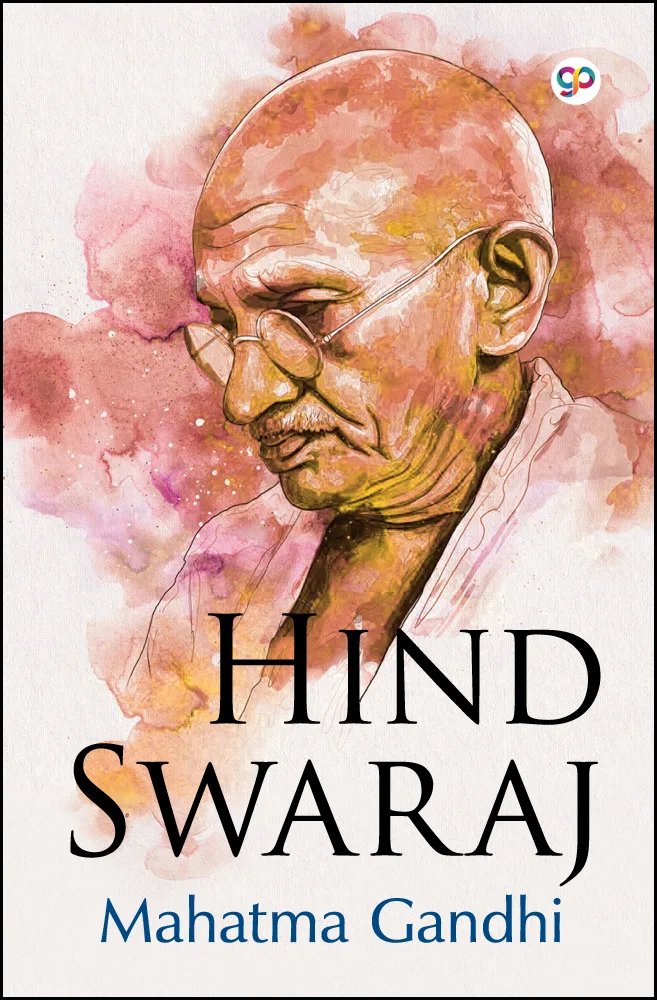
Hind Swaraj
Hardcover
• 120 Pages
• INR 245.00
• English
• 9789354996337
No ratings yet
| Publisher | General Press |
|---|---|
| ISBN13 | 9789354996337 |
| ASIN/SKU | 9354996337 |
| Book Format | Hardcover |
| Language | English |
| Pages | 120 |
| List Price | INR 245.00 |
| Subject Code | HIS017000, POL032000, POL007000 |
| Dimensions | 8.25 x 5.25 x 1.0 inches |
| Book Code | BD00067699 |
Buy this Book
Amazon Stores
Ebook Stores
Other Stores
Discover Hind Swaraj by Mahatma Gandhi. This book is published by General Press in Hardcover format, ISBN 9789354996337, ASIN 9354996337, under History, Politics, Indian Writing.
Book Description
Written almost a hundred years ago, "Hind Swaraj" continues to be relevant even today and is a primer for those seeking to understand the concept and true meaning of freedom. It was in this book that Gandhi for the first time formally expounded and explained his vision of Swaraj and the means that should be employed for its attainment. This provides insight into the workings of the mind of the man who ultimately went on to become Mahatama.
Mohandas Karamchand Gandhi was a prominent figure in the freedom struggle in India from British rule. He is also known as the 'The Father of the Nation', in India. In the year 1942, he played a key role in launching the Quit India movement, which was intended at forcing the British to leave the nation. He was thrown in prison and remained there for several years, due to other political offenses allegedly committed by him.
Mohandas Karamchand Gandhi was a prominent figure in the freedom struggle in India from British rule. He is also known as the 'The Father of the Nation', in India. In the year 1942, he played a key role in launching the Quit India movement, which was intended at forcing the British to leave the nation. He was thrown in prison and remained there for several years, due to other political offenses allegedly committed by him.
Author Biography
Born in 1869 in the coastal town of Porbandar, India, Mohandas Karamchand Gandhi was raised in a devout Hindu family heavily influenced by Jain pacifist teachings. After completing his early education in India, he traveled to London in 1888 to study law and jurisprudence. Upon passing the bar, he briefly attempted to establish a legal practice in Bombay before accepting a fateful year-long contract to work in South Africa in 1893.
Instead of a brief stint, Gandhi spent over two decades in South Africa, where he faced severe, systemic racial discrimination. These experiences fundamentally transformed him from a shy lawyer into a resilient civil rights activist. It was here that he first developed and implemented Satyagraha, his defining philosophy of nonviolent civil disobedience, successfully mobilizing the Indian expatriate community to protest oppressive colonial laws.
Returning to India in 1915, Gandhi brought his formidable organizing skills and moral authority to the Indian independence movement. Assuming leadership of the Indian National Congress, the "Mahatma" (Great Soul) orchestrated massive nationwide campaigns against British colonial rule, including the famous Salt March of 1930 and the "Quit India" movement of 1942. His methods relied entirely on peaceful non-cooperation, boycotts, and fasting, which continually captured the world's attention.
Throughout his life of activism, Gandhi was also a remarkably prolific writer and journalist. He founded and edited several influential newspapers, using them to advocate for social reforms, religious harmony, and the eradication of untouchability. His most enduring literary contribution is his deeply introspective autobiography, The Story of My Experiments with Truth, which detailed his lifelong pursuit of spiritual purity, dietary discipline, and the profound moral convictions that guided his political vision.
Though India finally achieved independence in 1947, the violent partition of the subcontinent into India and Pakistan left Gandhi deeply sorrowful. While tirelessly working to quell Hindu-Muslim communal violence, he was assassinated by a Hindu nationalist in January 1948 at the age of seventy-eight. He left behind an unparalleled legacy as the father of modern India and a global icon of peaceful resistance.
Instead of a brief stint, Gandhi spent over two decades in South Africa, where he faced severe, systemic racial discrimination. These experiences fundamentally transformed him from a shy lawyer into a resilient civil rights activist. It was here that he first developed and implemented Satyagraha, his defining philosophy of nonviolent civil disobedience, successfully mobilizing the Indian expatriate community to protest oppressive colonial laws.
Returning to India in 1915, Gandhi brought his formidable organizing skills and moral authority to the Indian independence movement. Assuming leadership of the Indian National Congress, the "Mahatma" (Great Soul) orchestrated massive nationwide campaigns against British colonial rule, including the famous Salt March of 1930 and the "Quit India" movement of 1942. His methods relied entirely on peaceful non-cooperation, boycotts, and fasting, which continually captured the world's attention.
Throughout his life of activism, Gandhi was also a remarkably prolific writer and journalist. He founded and edited several influential newspapers, using them to advocate for social reforms, religious harmony, and the eradication of untouchability. His most enduring literary contribution is his deeply introspective autobiography, The Story of My Experiments with Truth, which detailed his lifelong pursuit of spiritual purity, dietary discipline, and the profound moral convictions that guided his political vision.
Though India finally achieved independence in 1947, the violent partition of the subcontinent into India and Pakistan left Gandhi deeply sorrowful. While tirelessly working to quell Hindu-Muslim communal violence, he was assassinated by a Hindu nationalist in January 1948 at the age of seventy-eight. He left behind an unparalleled legacy as the father of modern India and a global icon of peaceful resistance.
Editorial Reviews
Editorial Reviews will be added soon…
Book Summary
Mahatma Gandhi’s Hind Swaraj, written in 1909, is one of the most important and challenging works in the history of modern Indian political thought. Written in the form of a conversation between an Editor and a Reader, the book is much more than an argument for India’s political independence from British rule. Gandhi uses the idea of swaraj—self-rule—to ask a much deeper question: What kind of freedom should India seek, and what kind of society should Indians build after achieving it?
Gandhi’s answer is deliberately provocative. He argues that simply replacing British rulers with Indian rulers would not constitute true independence. If Indians adopted the same materialistic values, political institutions, economic practices, and methods of domination that characterized modern Western civilization, India might become politically independent while remaining spiritually and morally unfree. For Gandhi, genuine swaraj begins with mastery over oneself.
The book opens with a conversation between a skeptical Reader and the Editor, who represents Gandhi’s own views. The Reader is impatient for political action and wants India to become free from British rule. He believes that modern political institutions, technology, industrialization, and revolutionary methods can help achieve this goal. The Editor challenges these assumptions throughout the book.
Gandhi begins by criticizing the idea that the British alone are responsible for India’s condition. He argues that British power in India survives partly because Indians cooperate with it. If Indians refused to assist an unjust system, its power would eventually weaken. This becomes one of the foundations of Gandhi’s later philosophy of non-cooperation.
But Gandhi goes further. He does not define British rule merely as the presence of British officials. The deeper problem, he believes, is the system of modern civilization itself. He is particularly suspicious of a civilization that measures progress through material wealth, industrial expansion, speed, consumption, and technological power. Such progress, in his view, can increase physical comfort while weakening moral discipline and human relationships.
This criticism of modern civilization is perhaps the most distinctive feature of Hind Swaraj. Gandhi argues that civilization should not be judged by how many machines a society possesses or how quickly people can travel. It should be judged by whether people become more self-controlled, compassionate, truthful, and capable of living responsibly.
His criticism of modern civilization is not simply a rejection of every invention or scientific discovery. Rather, he questions the assumption that technological progress is automatically human progress. A machine can make work easier, but if it encourages greed, unemployment, exploitation, or endless consumption, Gandhi believes society must ask whether that machine has genuinely improved human life.
The discussion of railways illustrates this argument. Gandhi acknowledges that railways have practical advantages, but he also believes that rapid transportation can spread harmful influences as easily as beneficial ones. His larger point is that technology is not morally neutral in its social consequences simply because it is efficient.
Gandhi also turns his attention to lawyers and the legal profession. He argues that modern legal systems can sometimes intensify conflicts rather than resolve them. Instead of encouraging people to settle disagreements through personal understanding and reconciliation, litigation may turn disputes into prolonged battles. Lawyers, in Gandhi’s criticism, can become part of a system that benefits from conflict.
Similarly, Gandhi criticizes doctors and modern medicine, not because he believes illness should be ignored, but because he worries that medicine can sometimes encourage people to neglect self-discipline. If unhealthy habits are continually followed by medical treatment, people may avoid taking responsibility for their own behavior. His broader principle is that genuine well-being requires discipline rather than dependence on external remedies alone.
One of Gandhi’s strongest arguments concerns political freedom. The Reader expects independence to mean the removal of British authority. Gandhi insists that this is insufficient. If Indians merely take over the institutions of British rule and continue to imitate British patterns of industrialization, centralized authority, and material ambition, then the fundamental problem remains.
For Gandhi, swaraj means much more than national sovereignty. It means self-government at both the individual and collective levels. A person who cannot control anger, greed, fear, or desire is not truly free. In the same way, a nation that replaces foreign rulers but remains dependent on material consumption and external systems of power has not achieved complete independence.
This idea makes Hind Swaraj a moral and philosophical text as much as a political one. Gandhi wants political liberation to be accompanied by personal transformation. Freedom begins with the individual.
The book also addresses violence and revolutionary nationalism. Gandhi understands why young Indians might be attracted to violent resistance against British rule. Colonial oppression creates anger, humiliation, and a desire for revenge. Yet he rejects assassination and violent revolution as methods of achieving lasting freedom.
His alternative is satyagraha, a term associated with the force of truth or truth-force. Satyagraha is not passive submission. It requires courage, discipline, willingness to suffer, and refusal to cooperate with injustice. The person practicing it does not seek to destroy the opponent but to appeal to the opponent’s conscience while refusing to participate in wrongdoing.
This distinction is crucial. Gandhi does not believe that nonviolence means doing nothing. On the contrary, nonviolent resistance requires active moral courage. A satyagrahi must be willing to endure imprisonment, suffering, and even personal loss rather than surrender to injustice.
Gandhi’s emphasis on suffering also reflects his belief that violence creates a cycle of hatred. If one group defeats another through violence, the defeated group may eventually seek revenge. Political freedom achieved through hatred can therefore reproduce the very structures of domination it was supposed to eliminate. Satyagraha attempts to break that cycle.
Another important part of Hind Swaraj is Gandhi’s vision of Indian society. He does not imagine freedom simply as the creation of a powerful centralized state. He places enormous importance on local communities, self-sufficient villages, simple living, ethical labor, and decentralized political authority.
His admiration for traditional Indian society should not be understood simply as nostalgia. Gandhi believes that local communities can encourage responsibility and human connection in ways that large centralized systems often cannot. His ideal society would emphasize needs rather than unlimited wants and would give dignity to manual work.
The spinning wheel, or charkha, became an important symbol of this philosophy. For Gandhi, spinning was not merely an economic activity. It represented self-reliance, dignity of labor, resistance to exploitative economic structures, and a rejection of excessive dependence on industrial production. The charkha symbolized the principle that political freedom should be supported by economic independence.
Gandhi also discusses the relationship between Indians and the British. Importantly, he does not treat British people as inherently evil. His criticism is directed toward systems of domination and the values that sustain them. He believes that Indians should oppose injustice without cultivating hatred toward individual British people.
This distinction between resisting a system and hating the people within it is fundamental to Gandhi’s philosophy. The goal of resistance should be conversion and reconciliation rather than revenge. An opponent can become a friend once the injustice between them has been removed.
The book’s language can sometimes be severe, and some of Gandhi’s judgments about modern institutions may seem extreme to contemporary readers. His criticisms of railways, doctors, lawyers, machinery, and industrial civilization have generated considerable debate. Yet these arguments become more understandable when viewed as part of his larger concern: the danger of confusing technological power with human progress.
The deepest message of Hind Swaraj is therefore a challenge to the conventional meaning of freedom. Gandhi asks readers to consider whether political independence is enough if people remain slaves to greed, fear, consumption, anger, and imitation. He argues that a nation cannot become genuinely free unless its people learn to govern themselves.
In this sense, Hind Swaraj is not simply a historical document about the Indian independence movement. It is a meditation on civilization and the responsibilities of freedom. Gandhi’s central question remains remarkably relevant: If we gain the power to govern ourselves but fail to change the habits and desires that produce exploitation, have we really become free?
Ultimately, Gandhi presents swaraj as a way of living rather than merely a political arrangement. It requires truthfulness, self-restraint, courage, simplicity, responsibility, and respect for others. Political independence is important, but it is only one part of the larger struggle. The real freedom Gandhi imagines begins when individuals and communities become capable of governing their own desires and acting according to conscience.
That is why Hind Swaraj remains such a significant book. It does not merely ask how India could defeat colonial rule. It asks what kind of human beings Indians—and, more broadly, modern people—should become once they are free. Gandhi’s answer is demanding but humane: true freedom is not the freedom to do whatever we want. It is the freedom to master ourselves, resist injustice without hatred, live with dignity, and build a society in which human well-being matters more than power, wealth, and endless material progress.
Gandhi’s answer is deliberately provocative. He argues that simply replacing British rulers with Indian rulers would not constitute true independence. If Indians adopted the same materialistic values, political institutions, economic practices, and methods of domination that characterized modern Western civilization, India might become politically independent while remaining spiritually and morally unfree. For Gandhi, genuine swaraj begins with mastery over oneself.
The book opens with a conversation between a skeptical Reader and the Editor, who represents Gandhi’s own views. The Reader is impatient for political action and wants India to become free from British rule. He believes that modern political institutions, technology, industrialization, and revolutionary methods can help achieve this goal. The Editor challenges these assumptions throughout the book.
Gandhi begins by criticizing the idea that the British alone are responsible for India’s condition. He argues that British power in India survives partly because Indians cooperate with it. If Indians refused to assist an unjust system, its power would eventually weaken. This becomes one of the foundations of Gandhi’s later philosophy of non-cooperation.
But Gandhi goes further. He does not define British rule merely as the presence of British officials. The deeper problem, he believes, is the system of modern civilization itself. He is particularly suspicious of a civilization that measures progress through material wealth, industrial expansion, speed, consumption, and technological power. Such progress, in his view, can increase physical comfort while weakening moral discipline and human relationships.
This criticism of modern civilization is perhaps the most distinctive feature of Hind Swaraj. Gandhi argues that civilization should not be judged by how many machines a society possesses or how quickly people can travel. It should be judged by whether people become more self-controlled, compassionate, truthful, and capable of living responsibly.
His criticism of modern civilization is not simply a rejection of every invention or scientific discovery. Rather, he questions the assumption that technological progress is automatically human progress. A machine can make work easier, but if it encourages greed, unemployment, exploitation, or endless consumption, Gandhi believes society must ask whether that machine has genuinely improved human life.
The discussion of railways illustrates this argument. Gandhi acknowledges that railways have practical advantages, but he also believes that rapid transportation can spread harmful influences as easily as beneficial ones. His larger point is that technology is not morally neutral in its social consequences simply because it is efficient.
Gandhi also turns his attention to lawyers and the legal profession. He argues that modern legal systems can sometimes intensify conflicts rather than resolve them. Instead of encouraging people to settle disagreements through personal understanding and reconciliation, litigation may turn disputes into prolonged battles. Lawyers, in Gandhi’s criticism, can become part of a system that benefits from conflict.
Similarly, Gandhi criticizes doctors and modern medicine, not because he believes illness should be ignored, but because he worries that medicine can sometimes encourage people to neglect self-discipline. If unhealthy habits are continually followed by medical treatment, people may avoid taking responsibility for their own behavior. His broader principle is that genuine well-being requires discipline rather than dependence on external remedies alone.
One of Gandhi’s strongest arguments concerns political freedom. The Reader expects independence to mean the removal of British authority. Gandhi insists that this is insufficient. If Indians merely take over the institutions of British rule and continue to imitate British patterns of industrialization, centralized authority, and material ambition, then the fundamental problem remains.
For Gandhi, swaraj means much more than national sovereignty. It means self-government at both the individual and collective levels. A person who cannot control anger, greed, fear, or desire is not truly free. In the same way, a nation that replaces foreign rulers but remains dependent on material consumption and external systems of power has not achieved complete independence.
This idea makes Hind Swaraj a moral and philosophical text as much as a political one. Gandhi wants political liberation to be accompanied by personal transformation. Freedom begins with the individual.
The book also addresses violence and revolutionary nationalism. Gandhi understands why young Indians might be attracted to violent resistance against British rule. Colonial oppression creates anger, humiliation, and a desire for revenge. Yet he rejects assassination and violent revolution as methods of achieving lasting freedom.
His alternative is satyagraha, a term associated with the force of truth or truth-force. Satyagraha is not passive submission. It requires courage, discipline, willingness to suffer, and refusal to cooperate with injustice. The person practicing it does not seek to destroy the opponent but to appeal to the opponent’s conscience while refusing to participate in wrongdoing.
This distinction is crucial. Gandhi does not believe that nonviolence means doing nothing. On the contrary, nonviolent resistance requires active moral courage. A satyagrahi must be willing to endure imprisonment, suffering, and even personal loss rather than surrender to injustice.
Gandhi’s emphasis on suffering also reflects his belief that violence creates a cycle of hatred. If one group defeats another through violence, the defeated group may eventually seek revenge. Political freedom achieved through hatred can therefore reproduce the very structures of domination it was supposed to eliminate. Satyagraha attempts to break that cycle.
Another important part of Hind Swaraj is Gandhi’s vision of Indian society. He does not imagine freedom simply as the creation of a powerful centralized state. He places enormous importance on local communities, self-sufficient villages, simple living, ethical labor, and decentralized political authority.
His admiration for traditional Indian society should not be understood simply as nostalgia. Gandhi believes that local communities can encourage responsibility and human connection in ways that large centralized systems often cannot. His ideal society would emphasize needs rather than unlimited wants and would give dignity to manual work.
The spinning wheel, or charkha, became an important symbol of this philosophy. For Gandhi, spinning was not merely an economic activity. It represented self-reliance, dignity of labor, resistance to exploitative economic structures, and a rejection of excessive dependence on industrial production. The charkha symbolized the principle that political freedom should be supported by economic independence.
Gandhi also discusses the relationship between Indians and the British. Importantly, he does not treat British people as inherently evil. His criticism is directed toward systems of domination and the values that sustain them. He believes that Indians should oppose injustice without cultivating hatred toward individual British people.
This distinction between resisting a system and hating the people within it is fundamental to Gandhi’s philosophy. The goal of resistance should be conversion and reconciliation rather than revenge. An opponent can become a friend once the injustice between them has been removed.
The book’s language can sometimes be severe, and some of Gandhi’s judgments about modern institutions may seem extreme to contemporary readers. His criticisms of railways, doctors, lawyers, machinery, and industrial civilization have generated considerable debate. Yet these arguments become more understandable when viewed as part of his larger concern: the danger of confusing technological power with human progress.
The deepest message of Hind Swaraj is therefore a challenge to the conventional meaning of freedom. Gandhi asks readers to consider whether political independence is enough if people remain slaves to greed, fear, consumption, anger, and imitation. He argues that a nation cannot become genuinely free unless its people learn to govern themselves.
In this sense, Hind Swaraj is not simply a historical document about the Indian independence movement. It is a meditation on civilization and the responsibilities of freedom. Gandhi’s central question remains remarkably relevant: If we gain the power to govern ourselves but fail to change the habits and desires that produce exploitation, have we really become free?
Ultimately, Gandhi presents swaraj as a way of living rather than merely a political arrangement. It requires truthfulness, self-restraint, courage, simplicity, responsibility, and respect for others. Political independence is important, but it is only one part of the larger struggle. The real freedom Gandhi imagines begins when individuals and communities become capable of governing their own desires and acting according to conscience.
That is why Hind Swaraj remains such a significant book. It does not merely ask how India could defeat colonial rule. It asks what kind of human beings Indians—and, more broadly, modern people—should become once they are free. Gandhi’s answer is demanding but humane: true freedom is not the freedom to do whatever we want. It is the freedom to master ourselves, resist injustice without hatred, live with dignity, and build a society in which human well-being matters more than power, wealth, and endless material progress.
Sample Chapters
Sample Chapters will be added soon…
Reader Reviews
No reviews yet.
Hind Swaraj