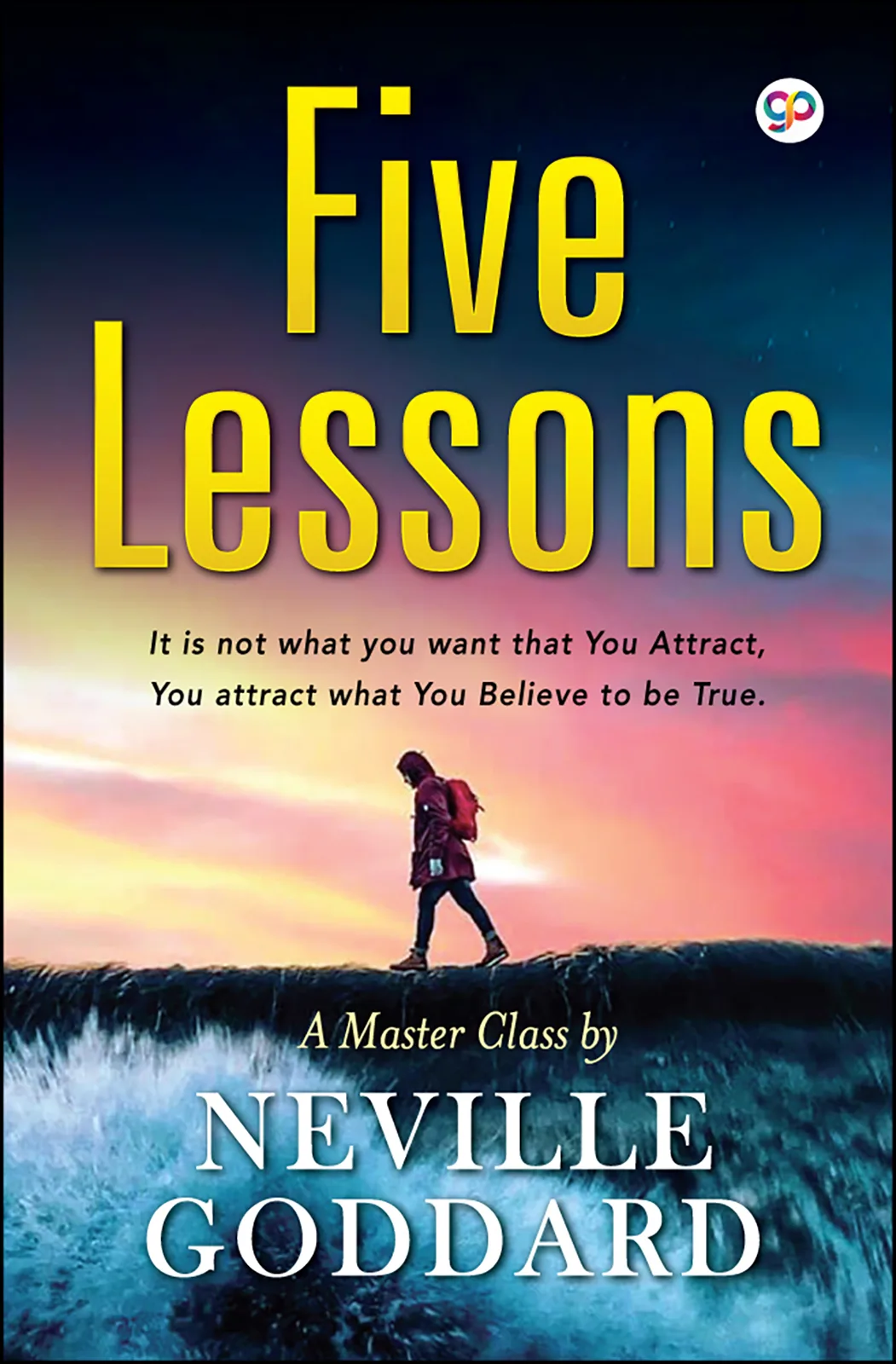
Five Lessons
Hardcover
• 136 Pages
• INR 325.00
• English
• 9789354994050
No ratings yet
| Publisher | General Press |
|---|---|
| ISBN13 | 9789354994050 |
| ASIN/SKU | 9354994059 |
| Book Format | Hardcover |
| Language | English |
| Pages | 136 |
| List Price | INR 325.00 |
| Subject Code | OCC014000, SEL032000, OCC019000 |
| Publishing Date | 01/06/2022 |
| Dimensions | 8.25 x 5.25 x 1.0 inches |
| Book Code | BD00067700 |
Buy this Book
Amazon Stores
Ebook Stores
Other Stores
Discover Five Lessons by Neville Goddard. This book is published by General Press in Hardcover format, ISBN 9789354994050, ASIN 9354994059, under Self-Help, Spirituality, Philosophy.
Book Description
In 1948, the modern mystic Neville Goddard delivered a groundbreaking series of lessons, which many consider to be the most transparent and competent illumination of his methods regarding mental creativity.
Neville Goddard is one of the most extraordinary and ardently practical spiritual thinkers of the past century. Writing and lecturing under the solitary name Neville, he enthralled audiences with one simple, radical idea—The human imagination is God. Whatever you think and feel, Neville taught, you literally out-picture in your world.
This exceptional lesson plan, supplemented with a bonus chapter by historian Mitch Horowitz, recreates Neville's master class, conserving his words exactly as students heard them at the time. These five lessons, plus a question-and-answer section, are the most explicit and unpretentious descriptions of the master’s techniques.
Neville Goddard is one of the most extraordinary and ardently practical spiritual thinkers of the past century. Writing and lecturing under the solitary name Neville, he enthralled audiences with one simple, radical idea—The human imagination is God. Whatever you think and feel, Neville taught, you literally out-picture in your world.
This exceptional lesson plan, supplemented with a bonus chapter by historian Mitch Horowitz, recreates Neville's master class, conserving his words exactly as students heard them at the time. These five lessons, plus a question-and-answer section, are the most explicit and unpretentious descriptions of the master’s techniques.
Author Biography
Neville Lancelot Goddard (1905–1972) was a prominent and highly influential teacher in the New Thought movement, best known for his philosophy on the creative power of the human imagination. Born in St. Michael, Barbados, Goddard moved to New York City in 1922 to study drama. While working as a dancer and actor, his interests shifted toward mysticism after meeting an eccentric Ethiopian rabbi named Abdullah, who mentored him in Kabbalah, esoteric Christianity, and the psychological interpretation of scripture.
Leaving the theater behind, Neville dedicated his life to teaching what he termed "The Law of Assumption"—the principle that one can manifest their desires by vividly assuming the feeling of the wish fulfilled. Unlike many of his contemporaries, he taught that the Bible was not a historical record but a psychological drama mapping the evolution of human consciousness, asserting that the divine creator is the human imagination itself.
Throughout the mid-20th century, he delivered hundreds of unscripted lectures across the United States and authored foundational metaphysical classics, including Feeling is the Secret and The Power of Awareness. Today, Goddard’s visionary teachings continue to experience a massive resurgence, profoundly shaping modern self-help, spirituality, and manifestation philosophies.
Leaving the theater behind, Neville dedicated his life to teaching what he termed "The Law of Assumption"—the principle that one can manifest their desires by vividly assuming the feeling of the wish fulfilled. Unlike many of his contemporaries, he taught that the Bible was not a historical record but a psychological drama mapping the evolution of human consciousness, asserting that the divine creator is the human imagination itself.
Throughout the mid-20th century, he delivered hundreds of unscripted lectures across the United States and authored foundational metaphysical classics, including Feeling is the Secret and The Power of Awareness. Today, Goddard’s visionary teachings continue to experience a massive resurgence, profoundly shaping modern self-help, spirituality, and manifestation philosophies.
Editorial Reviews
Editorial Reviews will be added soon…
Book Summary
Neville Goddard’s Five Lessons is one of the clearest and most concentrated expressions of his philosophy of imagination, consciousness, faith, and personal transformation. The book is based on a five-night series of lectures Goddard delivered in Los Angeles in 1948. Each lesson develops one part of a larger idea: that consciousness is the foundation of human experience, that the states we assume can become outward facts, and that changing our inner conception of ourselves is more powerful than trying to force the external world to change. The five lessons are titled “Consciousness Is the Only Reality,” “Assumptions Harden Into Fact,” “Thinking Fourth-Dimensionally,” “No One to Change But Self,” and “Remain Faithful to Your Idea.”
Goddard’s approach is spiritual, mystical, and psychological at the same time. He reads the Bible symbolically rather than as a straightforward historical record. For him, biblical characters and events represent movements and principles within human consciousness. Prayer is therefore not primarily a request made to an external deity. It is an imaginative act through which a person enters a different state of awareness. His purpose throughout the book is intensely practical: he wants readers to test these ideas through their own experience rather than merely accept them as abstract philosophy.
The first lesson, “Consciousness Is the Only Reality,” establishes the foundation for everything that follows. Goddard begins with the claim that awareness itself is the basic reality behind everything we experience. Before a person can possess anything, become anything, or experience anything, that person must first be conscious of being. His famous emphasis on “I AM” points to this most fundamental awareness. We may change our names, occupations, relationships, possessions, and circumstances, but beneath all these changes remains the simple awareness that we exist.
From this starting point, Goddard gives imagination a central role. He does not treat imagination as childish fantasy or as an escape from reality. Instead, he considers it a creative power. A person can imagine a condition that does not yet appear in the physical world and then mentally enter into the experience of already possessing it. The crucial step is not merely to picture something from a distance but to identify with it. In Goddard’s language, one moves from imagining something to imagining oneself as the person who already has or experiences it.
This is why he places such importance on feeling. Suppose someone desires financial security, a loving relationship, professional success, or a particular opportunity. Goddard does not advise endlessly thinking about the absence of that thing. Instead, he asks the person to imagine what it would feel like if the desire had already been fulfilled. The individual should mentally occupy the desired state rather than continually stare at the present circumstances and wish they were different.
The second lesson, “Assumptions Harden Into Fact,” develops this idea further. An assumption is more than a passing thought. It is a state that a person accepts as true. According to Goddard, repeatedly assuming a particular state gradually influences behavior, perception, relationships, and eventually circumstances. The important question is therefore not simply, “What do I want?” but “Who would I be if I already had it?”
This distinction is central to the entire book. Wanting something can keep a person psychologically separated from it. If someone constantly thinks, “I want to be successful,” the underlying message may remain, “I am not successful.” Goddard instead encourages the person to experience success inwardly first. The imagination becomes a rehearsal space in which the desired reality is treated as present rather than distant.
Goddard uses biblical stories to illustrate this principle. He interprets episodes such as the Passover, the story of Barabbas and Jesus, and other biblical narratives as symbolic representations of movement from one state of consciousness to another. The “crossing” involved in Passover becomes an image for leaving an old psychological condition and entering a new one.
The third lesson, “Thinking Fourth-Dimensionally,” introduces a broader understanding of time. Goddard argues that ordinary perception traps people in a three-dimensional view of reality. We see what exists now and assume that the present conditions determine what can happen next. He wants readers to reverse this habit. Instead of allowing the present to dictate the future, they should imagine the future condition they desire and mentally experience it as though it were already real.
This is what he means by thinking fourth-dimensionally. The future, in his view, is not simply something that passively arrives. It is a field of possibilities, and imagination allows a person to select and enter a particular possibility. The individual does not need to understand every practical step by which the desired outcome will appear. That concern belongs to the ordinary reasoning mind. The imaginative task is to establish the end result clearly and inhabit it inwardly.
Goddard illustrates this idea through personal stories, including his well-known account of a journey involving Barbados. The lesson he draws is that circumstances can rearrange themselves in unexpected ways once a person has firmly occupied the desired state. The point is not that imagination eliminates practical action. Rather, action becomes more naturally directed when a person’s inner assumption has changed.
The fourth lesson, “No One to Change But Self,” turns the teaching inward even more strongly. Goddard argues that people often spend enormous amounts of energy trying to change other people. They want a spouse, friend, employer, relative, or society to behave differently. His response is that the more productive place to begin is with one’s own conception of self.
The world, in his philosophy, functions like a mirror. If a person continually sees himself as rejected, powerless, unlucky, unworthy, or unsuccessful, he is likely to interpret events through those assumptions and behave in ways that reinforce them. If he changes his inner identity, the world begins to appear differently and relationships can change accordingly.
This does not mean that Goddard simply tells people to ignore unpleasant circumstances. Instead, he asks them not to give those circumstances the final authority over their imagination. A difficult present may be real in the immediate physical sense, but it does not have to become the permanent definition of the future. The individual can revise the inner story and begin living from a different conception of self.
One of the most practical techniques introduced in the book is the use of a relaxed, drowsy state before sleep. Goddard recommends becoming physically relaxed while remaining mentally capable of directing attention. In this condition, the mind is less occupied with ordinary distractions. The person can then imagine a short scene that would naturally occur if the desired event had already happened. The scene should be experienced rather than merely observed.
The fifth and final lesson, “Remain Faithful to Your Idea,” brings all the earlier teachings together. Having imagined a desired state and entered it emotionally, the individual must remain loyal to it. This is where persistence becomes essential. A person may have a powerful imaginative experience one evening and then abandon it the next morning because external circumstances look unchanged. Goddard warns against this constant movement between opposing assumptions.
Faith, in his system, is therefore not merely intellectual belief. It is sustained identification with a chosen state. The person continues to think, feel, and respond from the standpoint of the fulfilled desire. This does not require constant effort or obsessive visualization. In fact, Goddard repeatedly stresses the importance of relaxation. Once the desired state has been accepted inwardly, excessive effort can become counterproductive because it keeps attention fixed on the fact that the desire has not yet appeared.
The idea of the “feeling of the wish fulfilled” becomes the heart of the final lesson. The person asks a simple imaginative question: What would I be experiencing right now if this were already true? Perhaps it would be the feeling of relief after receiving good news, the quiet confidence of having achieved something, the warmth of being congratulated, or the peace of knowing that a long-standing problem has been resolved. The imagined experience should be simple, believable, and emotionally meaningful.
What makes Five Lessons distinctive is the consistency of its central message. Goddard approaches consciousness from several directions, but the argument remains remarkably unified. Consciousness gives rise to states of being; states are strengthened through assumption and feeling; imagination allows us to enter those states; and persistence allows them to become embodied in life. His biblical interpretations provide a spiritual framework, while his practical exercises give readers a method for experimentation.
At the same time, the book is best understood as a work of mystical self-help rather than as a scientific explanation of how the external world operates. Goddard presents his ideas with great certainty, but readers may interpret them differently. Some may see his teachings as a metaphysical claim that imagination directly creates circumstances; others may find their greatest value in the psychological effects of visualization, self-concept, attention, and expectation.
Ultimately, Five Lessons is about the possibility of becoming different by first imagining oneself differently. Goddard asks readers to stop treating the present self as a fixed identity and instead regard consciousness as something capable of movement and transformation. His central challenge is simple but demanding: choose the state you wish to inhabit, enter it sincerely in imagination, feel it as real, and remain faithful to it.
The lasting appeal of the book comes from this sense of inner possibility. Goddard does not tell readers that they must wait for the world to give them permission to change. He places the starting point inside the individual. Whether one accepts his metaphysical claims literally or approaches them as exercises in imagination and self-development, Five Lessons offers a powerful reminder that the stories people tell themselves about who they are can profoundly influence how they live. For Goddard, the deepest transformation begins not when circumstances change, but when consciousness changes first.
Goddard’s approach is spiritual, mystical, and psychological at the same time. He reads the Bible symbolically rather than as a straightforward historical record. For him, biblical characters and events represent movements and principles within human consciousness. Prayer is therefore not primarily a request made to an external deity. It is an imaginative act through which a person enters a different state of awareness. His purpose throughout the book is intensely practical: he wants readers to test these ideas through their own experience rather than merely accept them as abstract philosophy.
The first lesson, “Consciousness Is the Only Reality,” establishes the foundation for everything that follows. Goddard begins with the claim that awareness itself is the basic reality behind everything we experience. Before a person can possess anything, become anything, or experience anything, that person must first be conscious of being. His famous emphasis on “I AM” points to this most fundamental awareness. We may change our names, occupations, relationships, possessions, and circumstances, but beneath all these changes remains the simple awareness that we exist.
From this starting point, Goddard gives imagination a central role. He does not treat imagination as childish fantasy or as an escape from reality. Instead, he considers it a creative power. A person can imagine a condition that does not yet appear in the physical world and then mentally enter into the experience of already possessing it. The crucial step is not merely to picture something from a distance but to identify with it. In Goddard’s language, one moves from imagining something to imagining oneself as the person who already has or experiences it.
This is why he places such importance on feeling. Suppose someone desires financial security, a loving relationship, professional success, or a particular opportunity. Goddard does not advise endlessly thinking about the absence of that thing. Instead, he asks the person to imagine what it would feel like if the desire had already been fulfilled. The individual should mentally occupy the desired state rather than continually stare at the present circumstances and wish they were different.
The second lesson, “Assumptions Harden Into Fact,” develops this idea further. An assumption is more than a passing thought. It is a state that a person accepts as true. According to Goddard, repeatedly assuming a particular state gradually influences behavior, perception, relationships, and eventually circumstances. The important question is therefore not simply, “What do I want?” but “Who would I be if I already had it?”
This distinction is central to the entire book. Wanting something can keep a person psychologically separated from it. If someone constantly thinks, “I want to be successful,” the underlying message may remain, “I am not successful.” Goddard instead encourages the person to experience success inwardly first. The imagination becomes a rehearsal space in which the desired reality is treated as present rather than distant.
Goddard uses biblical stories to illustrate this principle. He interprets episodes such as the Passover, the story of Barabbas and Jesus, and other biblical narratives as symbolic representations of movement from one state of consciousness to another. The “crossing” involved in Passover becomes an image for leaving an old psychological condition and entering a new one.
The third lesson, “Thinking Fourth-Dimensionally,” introduces a broader understanding of time. Goddard argues that ordinary perception traps people in a three-dimensional view of reality. We see what exists now and assume that the present conditions determine what can happen next. He wants readers to reverse this habit. Instead of allowing the present to dictate the future, they should imagine the future condition they desire and mentally experience it as though it were already real.
This is what he means by thinking fourth-dimensionally. The future, in his view, is not simply something that passively arrives. It is a field of possibilities, and imagination allows a person to select and enter a particular possibility. The individual does not need to understand every practical step by which the desired outcome will appear. That concern belongs to the ordinary reasoning mind. The imaginative task is to establish the end result clearly and inhabit it inwardly.
Goddard illustrates this idea through personal stories, including his well-known account of a journey involving Barbados. The lesson he draws is that circumstances can rearrange themselves in unexpected ways once a person has firmly occupied the desired state. The point is not that imagination eliminates practical action. Rather, action becomes more naturally directed when a person’s inner assumption has changed.
The fourth lesson, “No One to Change But Self,” turns the teaching inward even more strongly. Goddard argues that people often spend enormous amounts of energy trying to change other people. They want a spouse, friend, employer, relative, or society to behave differently. His response is that the more productive place to begin is with one’s own conception of self.
The world, in his philosophy, functions like a mirror. If a person continually sees himself as rejected, powerless, unlucky, unworthy, or unsuccessful, he is likely to interpret events through those assumptions and behave in ways that reinforce them. If he changes his inner identity, the world begins to appear differently and relationships can change accordingly.
This does not mean that Goddard simply tells people to ignore unpleasant circumstances. Instead, he asks them not to give those circumstances the final authority over their imagination. A difficult present may be real in the immediate physical sense, but it does not have to become the permanent definition of the future. The individual can revise the inner story and begin living from a different conception of self.
One of the most practical techniques introduced in the book is the use of a relaxed, drowsy state before sleep. Goddard recommends becoming physically relaxed while remaining mentally capable of directing attention. In this condition, the mind is less occupied with ordinary distractions. The person can then imagine a short scene that would naturally occur if the desired event had already happened. The scene should be experienced rather than merely observed.
The fifth and final lesson, “Remain Faithful to Your Idea,” brings all the earlier teachings together. Having imagined a desired state and entered it emotionally, the individual must remain loyal to it. This is where persistence becomes essential. A person may have a powerful imaginative experience one evening and then abandon it the next morning because external circumstances look unchanged. Goddard warns against this constant movement between opposing assumptions.
Faith, in his system, is therefore not merely intellectual belief. It is sustained identification with a chosen state. The person continues to think, feel, and respond from the standpoint of the fulfilled desire. This does not require constant effort or obsessive visualization. In fact, Goddard repeatedly stresses the importance of relaxation. Once the desired state has been accepted inwardly, excessive effort can become counterproductive because it keeps attention fixed on the fact that the desire has not yet appeared.
The idea of the “feeling of the wish fulfilled” becomes the heart of the final lesson. The person asks a simple imaginative question: What would I be experiencing right now if this were already true? Perhaps it would be the feeling of relief after receiving good news, the quiet confidence of having achieved something, the warmth of being congratulated, or the peace of knowing that a long-standing problem has been resolved. The imagined experience should be simple, believable, and emotionally meaningful.
What makes Five Lessons distinctive is the consistency of its central message. Goddard approaches consciousness from several directions, but the argument remains remarkably unified. Consciousness gives rise to states of being; states are strengthened through assumption and feeling; imagination allows us to enter those states; and persistence allows them to become embodied in life. His biblical interpretations provide a spiritual framework, while his practical exercises give readers a method for experimentation.
At the same time, the book is best understood as a work of mystical self-help rather than as a scientific explanation of how the external world operates. Goddard presents his ideas with great certainty, but readers may interpret them differently. Some may see his teachings as a metaphysical claim that imagination directly creates circumstances; others may find their greatest value in the psychological effects of visualization, self-concept, attention, and expectation.
Ultimately, Five Lessons is about the possibility of becoming different by first imagining oneself differently. Goddard asks readers to stop treating the present self as a fixed identity and instead regard consciousness as something capable of movement and transformation. His central challenge is simple but demanding: choose the state you wish to inhabit, enter it sincerely in imagination, feel it as real, and remain faithful to it.
The lasting appeal of the book comes from this sense of inner possibility. Goddard does not tell readers that they must wait for the world to give them permission to change. He places the starting point inside the individual. Whether one accepts his metaphysical claims literally or approaches them as exercises in imagination and self-development, Five Lessons offers a powerful reminder that the stories people tell themselves about who they are can profoundly influence how they live. For Goddard, the deepest transformation begins not when circumstances change, but when consciousness changes first.
Sample Chapters
Lesson 1 : Consciousness is the Only Reality
This is going to be a very practical course. Therefore, I hope that everyone in this class has a very clear picture of what he desires, for I am convinced that you can realize your desires by the technique you will receive here this week in these five lessons.
That you may receive the full benefit of these instructions, let me state now that the Bible has no reference at all to any persons who ever existed, or to any event that ever occurred upon earth.
The ancient storytellers were not writing history but an allegorical picture lesson of certain basic principles, which they clothed in the garb of history, and they adapted these stories to the limited capacity of a most uncritical and credulous people.
Throughout the centuries we have mistakenly taken personifications for persons, allegory for history, the vehicle that conveyed the instruction for the instruction, and the gross first sense for the ultimate sense intended.
The difference between the form of the Bible and its substance is as great as the difference between a grain of corn and the life-germ within that grain. As our assimilative organs discriminate between food that can be built into our system and food that must be discarded, so do our awakened intuitive faculties discover beneath allegory and parable, the psychological life-germ of the Bible; and, feeding on this, we, too, cast off the form which conveyed the message.
The argument against the historicity of the Bible is too lengthy; consequently, it is not suitable for inclusion in this practical psychological interpretation of its stories. Therefore, I will waste no time in trying to convince you that the Bible is not a historical fact.
Tonight I will take four stories and show you what the ancient storytellers intended that you and I should see in these stories. The ancient teachers attached psychological truths to phallic and solar allegories. They did not know as much of the physical structure of man as do modern scientists, neither did they know as much about the heavens as do our modern astronomers. But the little they did know they used wisely and they built phallic and solar frames to which they tied the great psychological truths that they had discovered.
In the Old Testament you will find much of the phallic worship. Because it is not helpful, I am not going to emphasize it. I shall only show you how to interpret it.
Before we come to the first of the psychological dramas that you and I may use in a practical sense, let me state the two outstanding names of the Bible: the one you and I translate as GOD or JEHOVAH, and the one we call his son, which we have as JESUS.
The ancients spelled these names by using little symbols. The ancient tongue, called the Hebraic language, was not a tongue that you exploded with the breath. It was a mystical language never uttered by man. Those who understood it, understood it as mathematicians understand symbols of higher mathematics. It is not something people used to convey thought as I now use the English language.
They said that God’s name was spelled, YOD HEY VAV HEY. I shall take these symbols and in our normal, down-to-earth language, explain them in this manner.
The first letter, YOD, in the name GOD is a hand or a seed, not just a hand, but the hand of the director. If there is one organ of man that discriminates and sets him apart from the entire world of creation it is his hand. What we call a hand in the anthropoid ape is not a hand. It is used only for the purpose of conveying food to the mouth, or to swing from branch to branch. Man’s hand fashions, it molds. You cannot really express yourself without the hand. This is the builder’s hand, the hand of the director; it directs and molds and builds within your world.
The ancient storytellers called the first letter YOD, the hand, or the absolute seed out of which the whole of creation will come.
To the second letter, HE, they gave the symbol of a window. A window is an eye—the window is to the house what the eye is to the body.
The third letter, VAV, they called a nail. A nail is used for the purpose of binding things together. The conjunction “and” in the Hebraic tongue is simply the third letter, or VAV. If I want to say “man and woman,” I put the VAV in the middle, it binds them together.
The fourth and last letter, HEY, is another window or eye.
In this modern, down-to-earth language of ours, you can forget eyes and windows and hands and look at it in this manner. You are seated here now. This first letter, YOD, is your I AMness, your awareness. You are aware of being aware—that is the first letter. Out of this awareness all states of awareness come.
The second letter, HEY, called an eye, is your imagination, your ability to perceive. You imagine or perceive something which seems to be other than Self. As though you were lost in reverie and contemplated mental states in a detached manner, making the thinker and his thoughts separate entities.
The third letter, VAV, is your ability to feel you are that which you desire to be. As you feel you are it, you become aware of being it. To walk as though you were what you want to be is to take your desire out of the imaginary world and put the VAV upon it. You have completed the drama of creation. I am aware of something. Then I become aware of actually being that of which I was aware.
The fourth and last letter in the name of God is another HEY, another eye, meaning the visible objective world which constantly bears witness of that which I am conscious of being. You do nothing about the objective world; it always molds itself in harmony with that which you are conscious of being.
You are told this is the name by which all things are made, and without it there is nothing made that is made. The name is simply what you have now as you are seated here. You are conscious of being, aren’t you? Certainly you are. You are also conscious of something that is other than yourself: the room, the furniture, the people.
You may become selective now. Maybe you do not want to be other than what you are, or to own what you see. But you have the capacity to feel what it would be like were you now other than what you are. As you assume that you are that which you want to be, you have completed the name of God or the YOD HEY VAV HEY. The final result, the objectification of your assumption, is not your concern. It will come into view automatically as you assume the consciousness of being it.
Now let us turn to the Son’s name, for he gives the Son dominion over the world. You are that Son, you are the great Joshua, or Jesus, of the Bible. You know the name Joshua or Jehoshua we have Anglicized as Jesus.
The Son’s name is almost like the Father’s name. The first three letters of the Father’s name are the first three letters of the Son’s name, YOD HEY VAV, then you add a SHIN and an AYIN, making the Son’s name read, YOD HEY VAV SHIN AYIN.
You have heard what the first three are: YOD HEY VAV. YOD means that you are aware; HEY means that you are aware of something; and VAV means that you became aware of being that of which you were aware. You have dominion because you have the ability to conceive and to become that which you conceive. That is the power of creation.
But why is a SHIN put in the name of the Son? Because of the infinite mercy of our Father. Mind you, the Father and the Son are one. But when the Father becomes conscious of being man he puts within the condition called man that which he did not give unto himself. He puts a SHIN for this purpose: a SHIN is symbolized as a tooth.
A tooth is that which consumes, that which devours. I must have within me the power to consume that which I now dislike.
I, in my ignorance, brought to birth certain things I now dislike and would like to leave behind me. Were there not within me the flames that would consume it, I would be condemned forever to live in a world of all my mistakes. But there is a SHIN, or flame, within the name of the Son, which allows that Son to become detached from states He formerly expressed within the world. Man is incapable of seeing other than the contents of his own consciousness.
If I now become detached in consciousness from this room by turning my attention away from it, then, I am no longer conscious of it. There is something in me that devours it within me. It can only live within my objective world if I keep it alive within my consciousness.
It is the SHIN, or a tooth, in the Son’s name that gives him absolute dominion. Why could it not have been in the Father’s name? For this simple reason: Nothing can cease to be in the Father. Even the unlovely things cannot cease to be. If I once give it expression, forever and ever it remains locked within the dimensionally greater Self which is the Father. But I would not like to keep alive within my world all of my mistakes. So I, in my infinite mercy, gave to myself, when I became man, the power to become detached from these things that I, in my ignorance, brought to birth in my world.
These are the two names which give you dominion. You have dominion if, as you walk the earth, you know that your consciousness is God, the one and only reality. You become aware of something you would like to express or possess. You have the ability to feel that you are and possess that which but a moment before was imaginary. The final result, the embodying of your assumption, is completely outside of the offices of a three-dimensional mind. It comes to birth in a way that no man knows.
If these two names are clear in your mind’s eye, you will see that they are your eternal names. As you sit here, you are this YOD HEY VAV HEY; you are the YOD HEY VAV SHIN AYIN.
The stories of the Bible concern themselves exclusively with the power of imagination. They are really dramatizations of the technique of prayer, for prayer is the secret of changing the future. The Bible reveals the key by which man enters a dimensionally larger world for the purpose of changing the conditions of the lesser world in which he lives.
A prayer granted implies that something is done in consequence of the prayer, which otherwise would not have been done. Therefore, man is the spring of action, the directing mind, and the one who grants the prayer.
The stories of the Bible contain a powerful challenge to the thinking capacity of man. The underlying truth—that they are psychological dramas and not historical facts—demands reiteration, inasmuch as it is the only justification for the stories. With a little imagination we may easily trace the psychological sense in all the stories of the Bible.
“And God said, Let us make man in our image, and after our likeness: and let them have dominion over the fish of the sea, and over the fowl of the air, and over the cattle, and over all the earth, and over every creeping thing that creepeth upon the earth. So God created man in his own image, in the image of God created he him.”
— Gen. 1:26, 27
Here in the first chapter of the Bible the ancient teachers laid the foundation that God and man are one, and that man has dominion over all the earth. If God and man are one, then God can never be so far off as even to be near, for nearness implies separation.
The question arises: What is God? God is man’s consciousness, his awareness, his I AMness. The drama of life is a psychological one in which we bring circumstances to pass by our attitudes rather than by our acts. The cornerstone on which all things are based is man’s concept of himself. He acts as he does, and has the experiences that he does, because his concept of himself is what it is, and for no other reason. Had he a different concept of himself, he would act differently and have different experiences.
Man, by assuming the feeling of his wish fulfilled, alters his future in harmony with his assumption, for assumptions, though false, if sustained, will harden into fact.
The undisciplined mind finds it difficult to assume a state which is denied by the senses. But the ancient teachers discovered that sleep, or a state akin to sleep, aided man in making his assumption. Therefore, they dramatized the first creative act of man as one in which man was in a profound sleep. This not only sets the pattern for all future creative acts, but shows us that man has but one substance that is truly his to use in creating his world and that is himself.
“And the Lord God (man) caused a deep sleep to fall upon Adam and he slept: and he took one of his ribs, and closed up the flesh instead thereof; and the rib, which the Lord God had taken from man, made he a woman.”
—Gen. 2:21, 22
Before God fashions this woman for man he brings unto Adam the beasts of the field and the fowls of the air and has Adam name them. “Whatsoever Adam called every living creature, that was the name thereof.”
If you will take a concordance or a Bible dictionary and look up the word thigh as used in this story you will see that it has nothing to do with the thigh. It is defined as the soft parts that are creative in a man, that hang upon the thigh of a man.
The ancient storytellers used this phallic frame to reveal a great psychological truth. An angel is a messenger of God. You are God, as you have just discovered, for your consciousness is God, and you have an idea, a message. You are wrestling with an idea, for you do not know that you are already that which you contemplate, neither do you believe you could become it. You would like to, but you do not believe you could.
Who wrestles with the angel? Jacob. And the word Jacob, by definition, means the supplanter.
You would like to transform yourself and become that which reason and your senses deny. As you wrestle with your ideal, trying to feel that you are it, this is what happens. When you actually feel that you are it, something goes out of you. You may use the words, “Who has touched me, for I perceive virtue has gone out of me?”
You become for a moment, after a successful meditation, incapable of continuing in the act, as though it were a physical creative act. You are just as impotent after you have prayed successfully as you are after the physical creative act. When satisfaction is yours, you no longer hunger for it. If the hunger persists you did not explode the idea within you, you did not actually succeed in becoming conscious of being that which you wanted to be. There was still that thirst when you came out of the deep.
If I can feel that I am that which but a few seconds ago I knew I was not, but desired to be, then I am no longer hungry to be it. I am no longer thirsty because I feel satisfied in that state. Then something shrinks within me, not physically but in my feeling, in my consciousness, for that is the creativeness of man. He so shrinks in desire, he loses the desire to continue in this meditation. He does not halt physically, he simply has no desire to continue the meditative act.
“When you pray believe that you have received, and you shall receive.” When the physical creative act is completed, the sinew which is upon the hollow of man’s thigh shrinks, and man finds himself impotent or is halted. In like manner when a man prays successfully he believes that he is already that which he desired to be, therefore he cannot continue desiring to be that which he is already conscious of being. At the moment of satisfaction, physical and psychological, something goes out which in time bears witness to man’s creative power.
* * *
Our next story is in the 38th chapter of the book of Genesis. Here is a king whose name is Judah, the first three letters of whose name also begins YOD HEY VAV. Tamar is his daughter-in-law.
The word Tarmar means a palm tree or the most beautiful, the most comely. She is gracious and beautiful to look on and is called a palm tree. A tall, stately palm tree blossoms even in the desert—wherever it is there is an oasis. When you see the palm tree in the desert, there will be found what you seek most in that parched land. There is nothing more desirable to a man moving across a desert than the sight of a palm tree.
In our case, to be practical, our objective is the palm tree. That is the stately, beautiful one that we seek. Whatever it is that you and I want, what we truly desire, is personified in the story as Tamar the beautiful.
We are told she dresses herself in the veils of a harlot and sits in the public place. Her father-in-law, King Judah, comes by; and he is so in love with this one who is veiled that he offers her a kid to be intimate with her.
She said, “What will you give me as a pledge that you will give me a kid?”
Looking around he said, “What do you want me to give as a pledge?”
She answered, “Give me your ring, give me your bracelets, and give me your staff.”
Whereupon, he took from his hand the ring, and the bracelets, and gave them to her along with his sceptre. And he went in unto her and knew her, and she bore him a son.
That is the story; now for the interpretation. Man has one gift that is truly his to give, and that is himself. He has no other gift, as told you in the very first creative act of Adam by getting the woman out of himself. There was no other substance in the world but himself with which he could fashion the object of his desire. In like manner Judah had but one gift that was truly his to give—himself, as the ring, the bracelets, and the staff symbolized, for these were the symbols of his kingship.
Man offers that which is not himself, but life demands that he give the one thing that symbolizes himself. “Give me your ring, give me your bracelets, give me your sceptre.” These make the king. When he gives them he gives of himself.
You are the great King Judah. Before you can know your Tamar and make her bear your likeness in the world, you must go in unto her and give of self. Suppose I want security. I cannot get it by knowing people who have it. I cannot get it by pulling strings. I must become conscious of being secure.
Let us say I want to be healthy. Pills will not do it. Diet or climate will not do it. I must become conscious of being healthy by assuming the feeling of being healthy.
Perhaps I want to be lifted up in this world. Merely looking at kings and presidents and noble people and living in their reflection will not make me dignified. I must become conscious of being noble and dignified and walk as though I were that which I now want to be.
When I walk in that light I give of myself to the image that haunted my mind, and in time she bears me a child; which means I objectify a world in harmony with that which I am conscious of being.
You are King Judah and you are also Tamar. When you become conscious of being that which you want to be you are Tamar. Then you crystallize your desire within the world round about you.
No matter what stories you read in the Bible, no matter how many characters these ancient storytellers introduced into the drama, there is one thing you and I must always bear in mind—they all take place within the mind of the individual man. All the characters live in the mind of the individual man.
As you read the story, make it fit the pattern of self. Know that your consciousness is the only reality. Then know what you want to be. Then assume the feeling of being that which you want to be, and remain faithful to your assumption, living and acting on your conviction. Always make it fit that pattern.
* * *
Our third interpretation is the story of Isaac and his two sons: Esau and Jacob. The picture is drawn of a blind man being deceived by his second son into giving him the blessing which belonged to his first son. The story stresses the point that the deception was accomplished through the sense of touch.
This is going to be a very practical course. Therefore, I hope that everyone in this class has a very clear picture of what he desires, for I am convinced that you can realize your desires by the technique you will receive here this week in these five lessons.
That you may receive the full benefit of these instructions, let me state now that the Bible has no reference at all to any persons who ever existed, or to any event that ever occurred upon earth.
The ancient storytellers were not writing history but an allegorical picture lesson of certain basic principles, which they clothed in the garb of history, and they adapted these stories to the limited capacity of a most uncritical and credulous people.
Throughout the centuries we have mistakenly taken personifications for persons, allegory for history, the vehicle that conveyed the instruction for the instruction, and the gross first sense for the ultimate sense intended.
The difference between the form of the Bible and its substance is as great as the difference between a grain of corn and the life-germ within that grain. As our assimilative organs discriminate between food that can be built into our system and food that must be discarded, so do our awakened intuitive faculties discover beneath allegory and parable, the psychological life-germ of the Bible; and, feeding on this, we, too, cast off the form which conveyed the message.
The argument against the historicity of the Bible is too lengthy; consequently, it is not suitable for inclusion in this practical psychological interpretation of its stories. Therefore, I will waste no time in trying to convince you that the Bible is not a historical fact.
Tonight I will take four stories and show you what the ancient storytellers intended that you and I should see in these stories. The ancient teachers attached psychological truths to phallic and solar allegories. They did not know as much of the physical structure of man as do modern scientists, neither did they know as much about the heavens as do our modern astronomers. But the little they did know they used wisely and they built phallic and solar frames to which they tied the great psychological truths that they had discovered.
In the Old Testament you will find much of the phallic worship. Because it is not helpful, I am not going to emphasize it. I shall only show you how to interpret it.
Before we come to the first of the psychological dramas that you and I may use in a practical sense, let me state the two outstanding names of the Bible: the one you and I translate as GOD or JEHOVAH, and the one we call his son, which we have as JESUS.
The ancients spelled these names by using little symbols. The ancient tongue, called the Hebraic language, was not a tongue that you exploded with the breath. It was a mystical language never uttered by man. Those who understood it, understood it as mathematicians understand symbols of higher mathematics. It is not something people used to convey thought as I now use the English language.
They said that God’s name was spelled, YOD HEY VAV HEY. I shall take these symbols and in our normal, down-to-earth language, explain them in this manner.
The first letter, YOD, in the name GOD is a hand or a seed, not just a hand, but the hand of the director. If there is one organ of man that discriminates and sets him apart from the entire world of creation it is his hand. What we call a hand in the anthropoid ape is not a hand. It is used only for the purpose of conveying food to the mouth, or to swing from branch to branch. Man’s hand fashions, it molds. You cannot really express yourself without the hand. This is the builder’s hand, the hand of the director; it directs and molds and builds within your world.
The ancient storytellers called the first letter YOD, the hand, or the absolute seed out of which the whole of creation will come.
To the second letter, HE, they gave the symbol of a window. A window is an eye—the window is to the house what the eye is to the body.
The third letter, VAV, they called a nail. A nail is used for the purpose of binding things together. The conjunction “and” in the Hebraic tongue is simply the third letter, or VAV. If I want to say “man and woman,” I put the VAV in the middle, it binds them together.
The fourth and last letter, HEY, is another window or eye.
In this modern, down-to-earth language of ours, you can forget eyes and windows and hands and look at it in this manner. You are seated here now. This first letter, YOD, is your I AMness, your awareness. You are aware of being aware—that is the first letter. Out of this awareness all states of awareness come.
The second letter, HEY, called an eye, is your imagination, your ability to perceive. You imagine or perceive something which seems to be other than Self. As though you were lost in reverie and contemplated mental states in a detached manner, making the thinker and his thoughts separate entities.
The third letter, VAV, is your ability to feel you are that which you desire to be. As you feel you are it, you become aware of being it. To walk as though you were what you want to be is to take your desire out of the imaginary world and put the VAV upon it. You have completed the drama of creation. I am aware of something. Then I become aware of actually being that of which I was aware.
The fourth and last letter in the name of God is another HEY, another eye, meaning the visible objective world which constantly bears witness of that which I am conscious of being. You do nothing about the objective world; it always molds itself in harmony with that which you are conscious of being.
You are told this is the name by which all things are made, and without it there is nothing made that is made. The name is simply what you have now as you are seated here. You are conscious of being, aren’t you? Certainly you are. You are also conscious of something that is other than yourself: the room, the furniture, the people.
You may become selective now. Maybe you do not want to be other than what you are, or to own what you see. But you have the capacity to feel what it would be like were you now other than what you are. As you assume that you are that which you want to be, you have completed the name of God or the YOD HEY VAV HEY. The final result, the objectification of your assumption, is not your concern. It will come into view automatically as you assume the consciousness of being it.
Now let us turn to the Son’s name, for he gives the Son dominion over the world. You are that Son, you are the great Joshua, or Jesus, of the Bible. You know the name Joshua or Jehoshua we have Anglicized as Jesus.
The Son’s name is almost like the Father’s name. The first three letters of the Father’s name are the first three letters of the Son’s name, YOD HEY VAV, then you add a SHIN and an AYIN, making the Son’s name read, YOD HEY VAV SHIN AYIN.
You have heard what the first three are: YOD HEY VAV. YOD means that you are aware; HEY means that you are aware of something; and VAV means that you became aware of being that of which you were aware. You have dominion because you have the ability to conceive and to become that which you conceive. That is the power of creation.
But why is a SHIN put in the name of the Son? Because of the infinite mercy of our Father. Mind you, the Father and the Son are one. But when the Father becomes conscious of being man he puts within the condition called man that which he did not give unto himself. He puts a SHIN for this purpose: a SHIN is symbolized as a tooth.
A tooth is that which consumes, that which devours. I must have within me the power to consume that which I now dislike.
I, in my ignorance, brought to birth certain things I now dislike and would like to leave behind me. Were there not within me the flames that would consume it, I would be condemned forever to live in a world of all my mistakes. But there is a SHIN, or flame, within the name of the Son, which allows that Son to become detached from states He formerly expressed within the world. Man is incapable of seeing other than the contents of his own consciousness.
If I now become detached in consciousness from this room by turning my attention away from it, then, I am no longer conscious of it. There is something in me that devours it within me. It can only live within my objective world if I keep it alive within my consciousness.
It is the SHIN, or a tooth, in the Son’s name that gives him absolute dominion. Why could it not have been in the Father’s name? For this simple reason: Nothing can cease to be in the Father. Even the unlovely things cannot cease to be. If I once give it expression, forever and ever it remains locked within the dimensionally greater Self which is the Father. But I would not like to keep alive within my world all of my mistakes. So I, in my infinite mercy, gave to myself, when I became man, the power to become detached from these things that I, in my ignorance, brought to birth in my world.
These are the two names which give you dominion. You have dominion if, as you walk the earth, you know that your consciousness is God, the one and only reality. You become aware of something you would like to express or possess. You have the ability to feel that you are and possess that which but a moment before was imaginary. The final result, the embodying of your assumption, is completely outside of the offices of a three-dimensional mind. It comes to birth in a way that no man knows.
If these two names are clear in your mind’s eye, you will see that they are your eternal names. As you sit here, you are this YOD HEY VAV HEY; you are the YOD HEY VAV SHIN AYIN.
The stories of the Bible concern themselves exclusively with the power of imagination. They are really dramatizations of the technique of prayer, for prayer is the secret of changing the future. The Bible reveals the key by which man enters a dimensionally larger world for the purpose of changing the conditions of the lesser world in which he lives.
A prayer granted implies that something is done in consequence of the prayer, which otherwise would not have been done. Therefore, man is the spring of action, the directing mind, and the one who grants the prayer.
The stories of the Bible contain a powerful challenge to the thinking capacity of man. The underlying truth—that they are psychological dramas and not historical facts—demands reiteration, inasmuch as it is the only justification for the stories. With a little imagination we may easily trace the psychological sense in all the stories of the Bible.
“And God said, Let us make man in our image, and after our likeness: and let them have dominion over the fish of the sea, and over the fowl of the air, and over the cattle, and over all the earth, and over every creeping thing that creepeth upon the earth. So God created man in his own image, in the image of God created he him.”
— Gen. 1:26, 27
Here in the first chapter of the Bible the ancient teachers laid the foundation that God and man are one, and that man has dominion over all the earth. If God and man are one, then God can never be so far off as even to be near, for nearness implies separation.
The question arises: What is God? God is man’s consciousness, his awareness, his I AMness. The drama of life is a psychological one in which we bring circumstances to pass by our attitudes rather than by our acts. The cornerstone on which all things are based is man’s concept of himself. He acts as he does, and has the experiences that he does, because his concept of himself is what it is, and for no other reason. Had he a different concept of himself, he would act differently and have different experiences.
Man, by assuming the feeling of his wish fulfilled, alters his future in harmony with his assumption, for assumptions, though false, if sustained, will harden into fact.
The undisciplined mind finds it difficult to assume a state which is denied by the senses. But the ancient teachers discovered that sleep, or a state akin to sleep, aided man in making his assumption. Therefore, they dramatized the first creative act of man as one in which man was in a profound sleep. This not only sets the pattern for all future creative acts, but shows us that man has but one substance that is truly his to use in creating his world and that is himself.
“And the Lord God (man) caused a deep sleep to fall upon Adam and he slept: and he took one of his ribs, and closed up the flesh instead thereof; and the rib, which the Lord God had taken from man, made he a woman.”
—Gen. 2:21, 22
Before God fashions this woman for man he brings unto Adam the beasts of the field and the fowls of the air and has Adam name them. “Whatsoever Adam called every living creature, that was the name thereof.”
If you will take a concordance or a Bible dictionary and look up the word thigh as used in this story you will see that it has nothing to do with the thigh. It is defined as the soft parts that are creative in a man, that hang upon the thigh of a man.
The ancient storytellers used this phallic frame to reveal a great psychological truth. An angel is a messenger of God. You are God, as you have just discovered, for your consciousness is God, and you have an idea, a message. You are wrestling with an idea, for you do not know that you are already that which you contemplate, neither do you believe you could become it. You would like to, but you do not believe you could.
Who wrestles with the angel? Jacob. And the word Jacob, by definition, means the supplanter.
You would like to transform yourself and become that which reason and your senses deny. As you wrestle with your ideal, trying to feel that you are it, this is what happens. When you actually feel that you are it, something goes out of you. You may use the words, “Who has touched me, for I perceive virtue has gone out of me?”
You become for a moment, after a successful meditation, incapable of continuing in the act, as though it were a physical creative act. You are just as impotent after you have prayed successfully as you are after the physical creative act. When satisfaction is yours, you no longer hunger for it. If the hunger persists you did not explode the idea within you, you did not actually succeed in becoming conscious of being that which you wanted to be. There was still that thirst when you came out of the deep.
If I can feel that I am that which but a few seconds ago I knew I was not, but desired to be, then I am no longer hungry to be it. I am no longer thirsty because I feel satisfied in that state. Then something shrinks within me, not physically but in my feeling, in my consciousness, for that is the creativeness of man. He so shrinks in desire, he loses the desire to continue in this meditation. He does not halt physically, he simply has no desire to continue the meditative act.
“When you pray believe that you have received, and you shall receive.” When the physical creative act is completed, the sinew which is upon the hollow of man’s thigh shrinks, and man finds himself impotent or is halted. In like manner when a man prays successfully he believes that he is already that which he desired to be, therefore he cannot continue desiring to be that which he is already conscious of being. At the moment of satisfaction, physical and psychological, something goes out which in time bears witness to man’s creative power.
* * *
Our next story is in the 38th chapter of the book of Genesis. Here is a king whose name is Judah, the first three letters of whose name also begins YOD HEY VAV. Tamar is his daughter-in-law.
The word Tarmar means a palm tree or the most beautiful, the most comely. She is gracious and beautiful to look on and is called a palm tree. A tall, stately palm tree blossoms even in the desert—wherever it is there is an oasis. When you see the palm tree in the desert, there will be found what you seek most in that parched land. There is nothing more desirable to a man moving across a desert than the sight of a palm tree.
In our case, to be practical, our objective is the palm tree. That is the stately, beautiful one that we seek. Whatever it is that you and I want, what we truly desire, is personified in the story as Tamar the beautiful.
We are told she dresses herself in the veils of a harlot and sits in the public place. Her father-in-law, King Judah, comes by; and he is so in love with this one who is veiled that he offers her a kid to be intimate with her.
She said, “What will you give me as a pledge that you will give me a kid?”
Looking around he said, “What do you want me to give as a pledge?”
She answered, “Give me your ring, give me your bracelets, and give me your staff.”
Whereupon, he took from his hand the ring, and the bracelets, and gave them to her along with his sceptre. And he went in unto her and knew her, and she bore him a son.
That is the story; now for the interpretation. Man has one gift that is truly his to give, and that is himself. He has no other gift, as told you in the very first creative act of Adam by getting the woman out of himself. There was no other substance in the world but himself with which he could fashion the object of his desire. In like manner Judah had but one gift that was truly his to give—himself, as the ring, the bracelets, and the staff symbolized, for these were the symbols of his kingship.
Man offers that which is not himself, but life demands that he give the one thing that symbolizes himself. “Give me your ring, give me your bracelets, give me your sceptre.” These make the king. When he gives them he gives of himself.
You are the great King Judah. Before you can know your Tamar and make her bear your likeness in the world, you must go in unto her and give of self. Suppose I want security. I cannot get it by knowing people who have it. I cannot get it by pulling strings. I must become conscious of being secure.
Let us say I want to be healthy. Pills will not do it. Diet or climate will not do it. I must become conscious of being healthy by assuming the feeling of being healthy.
Perhaps I want to be lifted up in this world. Merely looking at kings and presidents and noble people and living in their reflection will not make me dignified. I must become conscious of being noble and dignified and walk as though I were that which I now want to be.
When I walk in that light I give of myself to the image that haunted my mind, and in time she bears me a child; which means I objectify a world in harmony with that which I am conscious of being.
You are King Judah and you are also Tamar. When you become conscious of being that which you want to be you are Tamar. Then you crystallize your desire within the world round about you.
No matter what stories you read in the Bible, no matter how many characters these ancient storytellers introduced into the drama, there is one thing you and I must always bear in mind—they all take place within the mind of the individual man. All the characters live in the mind of the individual man.
As you read the story, make it fit the pattern of self. Know that your consciousness is the only reality. Then know what you want to be. Then assume the feeling of being that which you want to be, and remain faithful to your assumption, living and acting on your conviction. Always make it fit that pattern.
* * *
Our third interpretation is the story of Isaac and his two sons: Esau and Jacob. The picture is drawn of a blind man being deceived by his second son into giving him the blessing which belonged to his first son. The story stresses the point that the deception was accomplished through the sense of touch.
Reader Reviews
No reviews yet.
Five Lessons