
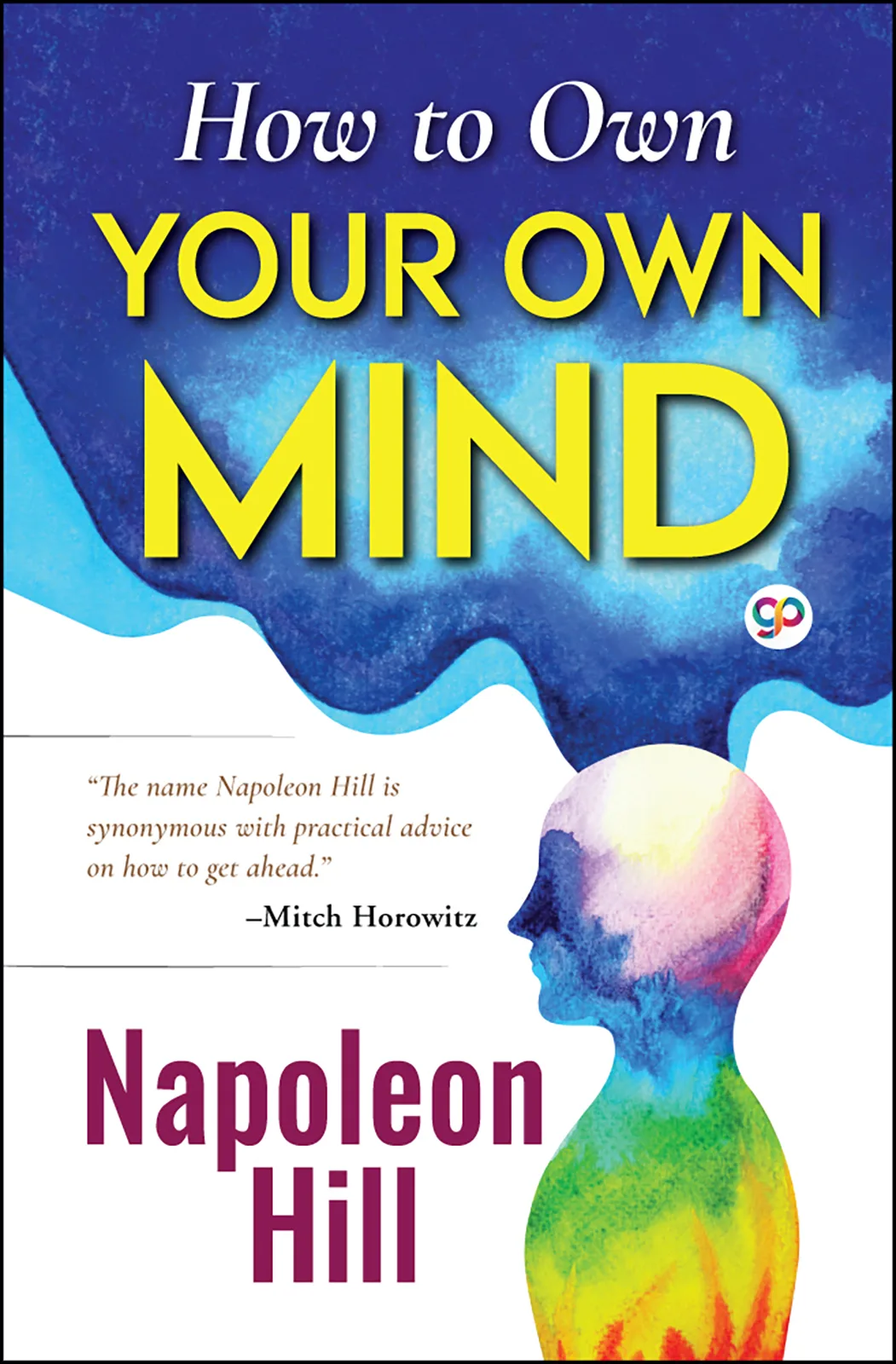
How to Own Your Own Mind
Hardcover
• 248 Pages
• INR 425.00
• English
• 9789354994067
No ratings yet
| Publisher | General Press |
|---|---|
| ISBN13 | 9789354994067 |
| ASIN/SKU | 9354994067 |
| Book Format | Hardcover |
| Language | English |
| Pages | 248 |
| List Price | INR 425.00 |
| Subject Code | SEL027000, SEL030000, SEL036000 |
| Publishing Date | 01/06/2022 |
| Dimensions | 8.25 x 5.25 x 1.0 inches |
| Book Code | BD00067702 |
Buy this Book
Amazon Stores
Ebook Stores
Other Stores
Discover How to Own Your Own Mind by Napoleon Hill. This book is published by General Press in Hardcover format, ISBN 9789354994067, ASIN 9354994067, under Self-Help, Personal Transformation, Self-Management.
Book Description
In 'How to Own Your Own Mind' is Napoleon Hill's classic lesson on how to organize your thinking to attain success. This is one of the most influential books which actually helps us to understand the way we should process our minds. The reader will receive a one-of-a-kind master class on how to think for success from motivational pioneer and author of Think and Grow Rich.
In its effective chapters, Hill demonstrates how to organize, prioritize, and act on information so that it translates into opportunity. It explains the difference between imagination and creative vision and how our mind becomes desperate to find solutions to problems if we are persistent. Knowledge is not power. Only applied knowledge is power. This book teaches you how to use what you know, and how to know what’s worth knowing.
“The name Napoleon Hill is synonymous with practical advice on how to get ahead.”—Mitch Horowitz, CNBC
In its effective chapters, Hill demonstrates how to organize, prioritize, and act on information so that it translates into opportunity. It explains the difference between imagination and creative vision and how our mind becomes desperate to find solutions to problems if we are persistent. Knowledge is not power. Only applied knowledge is power. This book teaches you how to use what you know, and how to know what’s worth knowing.
“The name Napoleon Hill is synonymous with practical advice on how to get ahead.”—Mitch Horowitz, CNBC
Author Biography
Napoleon Hill was an American author in the area of the new thought movement who was one of the earliest producers of the modern genre of personal-success literature. He is widely considered to be one of the great writers on success. His teachings have gone on to influence entire generations of success seekers, setting the standard for the foundations of today's motivational thinking. His most famous work—'Think and Grow Rich' (1937), is one of the best-selling books of all time (at the time of Hill's death in 1970, Think and Grow Rich had sold 20 million copies). Hill's works examined the power of personal beliefs, and the role they play in personal success. He became an advisor to President Franklin D. Roosevelt from 1933 to 1936.
"What the mind of man can conceive and believe, it can achieve" is one of Hill's hallmark expressions. How achievement actually occurs, and a formula for it that puts success in reach of the average person, were the focal points of Hill's books.
"What the mind of man can conceive and believe, it can achieve" is one of Hill's hallmark expressions. How achievement actually occurs, and a formula for it that puts success in reach of the average person, were the focal points of Hill's books.
Editorial Reviews
Editorial Reviews will be added soon…
Book Summary
Napoleon Hill’s How to Own Your Own Mind is a practical self-help book about one of the most important questions a person can ask: who is really in control of your thoughts? First published in its modern form in 2017 from material that had been kept unpublished since 1941, the book presents Hill’s ideas on creative vision, organized thought, and controlled attention. It belongs firmly to the same tradition of success philosophy that made Hill famous through Think and Grow Rich. The central message is simple but demanding: success begins when you stop allowing circumstances, habits, fears, and other people to control your thinking and learn to direct your mind toward a definite purpose.
The title How to Own Your Own Mind can initially sound like a promise of complete mental control, but Hill is really talking about disciplined thinking. Human beings have enormous mental potential, yet much of that potential is wasted because thoughts are scattered. We react to events instead of thinking deliberately about them. We collect information without knowing how to use it. We start projects without a clear objective and then become discouraged when results do not appear quickly. Hill argues that the difference between merely having a mind and actually using it effectively lies in direction, concentration, and purpose.
One of the book’s most important ideas is Creative Vision. Hill believes that achievement begins with the ability to see possibilities before they become obvious to everyone else. Imagination is not merely a source of entertainment or daydreaming; it is a tool for creating plans and discovering opportunities. The official description of the book emphasizes this broader process of organizing and prioritizing information so that it can be transformed into opportunity.
Creative vision, therefore, is more than having a clever idea. An idea becomes valuable when someone can recognize its potential and connect it with a practical purpose. Hill distinguishes between simply imagining something and using imagination constructively. A person may have dozens of ideas every day, but without judgment, planning, and action, those ideas remain mental possibilities. Creative vision allows a person to look at a problem and ask a different question: what opportunity is hidden inside this situation?
This is particularly relevant to work and business. Many opportunities do not arrive in a perfect package. They may appear as difficulties, inefficiencies, unmet needs, or situations that other people overlook. Hill encourages readers to train themselves to see beyond the obvious. Instead of accepting circumstances exactly as they are, the successful thinker learns to imagine what they could become.
The second major theme is Organized Thought, and this is where the book becomes especially practical. Hill argues that thinking becomes powerful when it is arranged around a definite purpose. Random thoughts consume mental energy, while organized thoughts move toward an objective. The book’s contents explicitly identify organized thought as one of its three central chapters, followed by material discussing Andrew Carnegie’s views on the subject.
For Hill, the starting point is a Definite Major Purpose. A person needs to know what he or she is trying to accomplish before deciding how to accomplish it. Without a clear destination, even hard work can become wasted effort. A person can be busy every day and still make little meaningful progress because activity is not the same thing as achievement.
This principle connects with one of Hill’s recurring ideas: desire must be converted into a specific objective. Merely wishing for success is not enough. The desire needs a clear direction, a plan, and sustained effort. Once the goal becomes definite, the mind can begin selecting information, opportunities, relationships, and actions that support it.
Hill also stresses the difference between knowledge and applied knowledge. The publisher’s description summarizes this point by saying that knowledge becomes valuable when it is used. A person may read hundreds of books, attend courses, collect qualifications, and listen to successful people, but none of that automatically produces results. Knowledge has to be organized and applied to a real purpose.
This is one of the most useful lessons in the book because it challenges the common assumption that learning itself equals progress. Learning matters, but Hill asks the reader to go one step further: What will you do with what you know? Which information is actually relevant to your goal? Which ideas can be converted into action? Which facts are distractions rather than useful tools?
Organized thought also requires self-discipline. The mind naturally moves from one subject to another. Fear, excitement, anger, social pressure, and temporary pleasures can all interrupt concentration. Hill believes that successful people develop the ability to bring their thoughts back to the objective they have chosen. This does not mean ignoring emotions or pretending that difficulties do not exist. It means refusing to let every passing emotion determine what you do next.
The third central theme is Controlled Attention. In many ways, this is the heart of the book. Creative vision gives the mind something worthwhile to pursue, organized thought provides structure, and controlled attention supplies the concentration necessary to stay with the objective.
Controlled attention means deliberately directing mental energy toward the most important task rather than allowing it to be scattered among countless distractions. Hill sees attention as a form of personal power. If a person cannot concentrate long enough to develop an idea, solve a problem, or complete a plan, even considerable intelligence may produce little practical achievement.
The concept is particularly important because Hill’s philosophy places great emphasis on persistence. People often abandon worthwhile goals not because those goals are impossible, but because they become distracted, discouraged, or impatient. Controlled attention helps protect a goal from these interruptions. It allows a person to continue thinking about a problem until a better answer appears.
Hill also connects controlled attention with willpower. Willpower is not presented simply as the ability to force yourself through unpleasant tasks. It is the capacity to choose what deserves your attention and then remain mentally committed to it. When distractions appear, willpower helps you return to the chosen objective.
Another important idea is the Master Mind principle. Hill does not suggest that owning your own mind means doing everything alone. On the contrary, organized thinking can become stronger through cooperation with other people. A Master Mind alliance brings together individuals who contribute knowledge, experience, ideas, and encouragement toward a common purpose. This principle is one of the bridges between individual mental discipline and collective achievement.
The value of such an alliance is practical. No individual knows everything. One person may understand finance, another marketing, another technology, and another human behavior. When these different forms of knowledge are deliberately combined, they can produce solutions that none of the participants could easily create alone. Hill therefore sees intelligent cooperation as a force multiplier.
At the same time, the book places responsibility firmly on the individual. Other people can advise you, encourage you, or contribute expertise, but they cannot decide your purpose for you. To own your own mind means accepting responsibility for your decisions and refusing to surrender your mental direction to circumstances.
This leads naturally to Hill’s discussion of faith, expectation, persistence, and belief. His philosophy assumes that what a person repeatedly thinks about can influence attitudes and actions. A person who expects failure may hesitate, avoid opportunities, and give up early. Someone who believes that a goal is possible is more likely to experiment, persist, and look for solutions.
This does not mean that positive thinking magically guarantees success. Rather, Hill’s argument is that belief changes behavior. When you believe that an objective is worth pursuing, you are more likely to invest attention in it. You are more willing to learn from setbacks instead of interpreting them as final defeats. In that sense, mental attitude becomes connected to practical action.
One of the strongest lessons in How to Own Your Own Mind is therefore the relationship between thought and action. Thinking is necessary, but thinking without action becomes another form of procrastination. Hill wants readers to think before acting, but he does not want them to remain trapped in endless planning. The purpose of organized thought is to produce better decisions and more purposeful action. The publisher similarly describes the book as a guide to organizing, prioritizing, and acting on information so that it can become opportunity.
The book can also be understood as a warning against mental passivity. It is easy to let newspapers, social media, public opinion, family expectations, financial worries, or temporary failures determine what we think about all day. Hill asks the reader to reverse that relationship. Instead of allowing the outside world to dictate the direction of the mind, decide what deserves your attention and deliberately return to it.
This is perhaps why the book remains relevant even though Hill’s examples and language come from an earlier era. Modern life has created more distractions, not fewer. Information is constantly available, but information overload can make organized thinking more difficult. The challenge today is not simply finding information; it is deciding which information deserves attention and turning useful knowledge into meaningful action.
Ultimately, How to Own Your Own Mind is a book about mental ownership. Its core lesson is that achievement begins with control over thought. Creative vision teaches you to imagine possibilities. Organized thought teaches you to arrange ideas around a definite purpose. Controlled attention teaches you to keep your mental energy focused long enough to turn those ideas into results. The book’s published contents explicitly organize its central material around these three concepts: Creative Vision, Organized Thought, and Controlled Attention.
The greatest value of Napoleon Hill’s book is not in any single motivational phrase but in the larger discipline it encourages. Decide what you want. Understand why you want it. Gather the knowledge required to pursue it. Organize that knowledge into a workable plan. Surround yourself with people who can strengthen your thinking. Then concentrate your attention and continue acting despite distractions and setbacks.
In the end, owning your own mind does not mean controlling every thought that enters your head. It means becoming more deliberate about which thoughts you accept, develop, and act upon. Hill’s philosophy asks the reader to move from passive thinking to purposeful thinking and from purposeful thinking to purposeful action. For anyone interested in Napoleon Hill’s success philosophy, personal development, goal setting, mental discipline, or the practical use of focused thought, How to Own Your Own Mind offers a concise extension of ideas that run throughout his work. Its enduring message is straightforward: your circumstances may influence your life, but the direction of your mind plays a powerful role in determining what you do with those circumstances.
The title How to Own Your Own Mind can initially sound like a promise of complete mental control, but Hill is really talking about disciplined thinking. Human beings have enormous mental potential, yet much of that potential is wasted because thoughts are scattered. We react to events instead of thinking deliberately about them. We collect information without knowing how to use it. We start projects without a clear objective and then become discouraged when results do not appear quickly. Hill argues that the difference between merely having a mind and actually using it effectively lies in direction, concentration, and purpose.
One of the book’s most important ideas is Creative Vision. Hill believes that achievement begins with the ability to see possibilities before they become obvious to everyone else. Imagination is not merely a source of entertainment or daydreaming; it is a tool for creating plans and discovering opportunities. The official description of the book emphasizes this broader process of organizing and prioritizing information so that it can be transformed into opportunity.
Creative vision, therefore, is more than having a clever idea. An idea becomes valuable when someone can recognize its potential and connect it with a practical purpose. Hill distinguishes between simply imagining something and using imagination constructively. A person may have dozens of ideas every day, but without judgment, planning, and action, those ideas remain mental possibilities. Creative vision allows a person to look at a problem and ask a different question: what opportunity is hidden inside this situation?
This is particularly relevant to work and business. Many opportunities do not arrive in a perfect package. They may appear as difficulties, inefficiencies, unmet needs, or situations that other people overlook. Hill encourages readers to train themselves to see beyond the obvious. Instead of accepting circumstances exactly as they are, the successful thinker learns to imagine what they could become.
The second major theme is Organized Thought, and this is where the book becomes especially practical. Hill argues that thinking becomes powerful when it is arranged around a definite purpose. Random thoughts consume mental energy, while organized thoughts move toward an objective. The book’s contents explicitly identify organized thought as one of its three central chapters, followed by material discussing Andrew Carnegie’s views on the subject.
For Hill, the starting point is a Definite Major Purpose. A person needs to know what he or she is trying to accomplish before deciding how to accomplish it. Without a clear destination, even hard work can become wasted effort. A person can be busy every day and still make little meaningful progress because activity is not the same thing as achievement.
This principle connects with one of Hill’s recurring ideas: desire must be converted into a specific objective. Merely wishing for success is not enough. The desire needs a clear direction, a plan, and sustained effort. Once the goal becomes definite, the mind can begin selecting information, opportunities, relationships, and actions that support it.
Hill also stresses the difference between knowledge and applied knowledge. The publisher’s description summarizes this point by saying that knowledge becomes valuable when it is used. A person may read hundreds of books, attend courses, collect qualifications, and listen to successful people, but none of that automatically produces results. Knowledge has to be organized and applied to a real purpose.
This is one of the most useful lessons in the book because it challenges the common assumption that learning itself equals progress. Learning matters, but Hill asks the reader to go one step further: What will you do with what you know? Which information is actually relevant to your goal? Which ideas can be converted into action? Which facts are distractions rather than useful tools?
Organized thought also requires self-discipline. The mind naturally moves from one subject to another. Fear, excitement, anger, social pressure, and temporary pleasures can all interrupt concentration. Hill believes that successful people develop the ability to bring their thoughts back to the objective they have chosen. This does not mean ignoring emotions or pretending that difficulties do not exist. It means refusing to let every passing emotion determine what you do next.
The third central theme is Controlled Attention. In many ways, this is the heart of the book. Creative vision gives the mind something worthwhile to pursue, organized thought provides structure, and controlled attention supplies the concentration necessary to stay with the objective.
Controlled attention means deliberately directing mental energy toward the most important task rather than allowing it to be scattered among countless distractions. Hill sees attention as a form of personal power. If a person cannot concentrate long enough to develop an idea, solve a problem, or complete a plan, even considerable intelligence may produce little practical achievement.
The concept is particularly important because Hill’s philosophy places great emphasis on persistence. People often abandon worthwhile goals not because those goals are impossible, but because they become distracted, discouraged, or impatient. Controlled attention helps protect a goal from these interruptions. It allows a person to continue thinking about a problem until a better answer appears.
Hill also connects controlled attention with willpower. Willpower is not presented simply as the ability to force yourself through unpleasant tasks. It is the capacity to choose what deserves your attention and then remain mentally committed to it. When distractions appear, willpower helps you return to the chosen objective.
Another important idea is the Master Mind principle. Hill does not suggest that owning your own mind means doing everything alone. On the contrary, organized thinking can become stronger through cooperation with other people. A Master Mind alliance brings together individuals who contribute knowledge, experience, ideas, and encouragement toward a common purpose. This principle is one of the bridges between individual mental discipline and collective achievement.
The value of such an alliance is practical. No individual knows everything. One person may understand finance, another marketing, another technology, and another human behavior. When these different forms of knowledge are deliberately combined, they can produce solutions that none of the participants could easily create alone. Hill therefore sees intelligent cooperation as a force multiplier.
At the same time, the book places responsibility firmly on the individual. Other people can advise you, encourage you, or contribute expertise, but they cannot decide your purpose for you. To own your own mind means accepting responsibility for your decisions and refusing to surrender your mental direction to circumstances.
This leads naturally to Hill’s discussion of faith, expectation, persistence, and belief. His philosophy assumes that what a person repeatedly thinks about can influence attitudes and actions. A person who expects failure may hesitate, avoid opportunities, and give up early. Someone who believes that a goal is possible is more likely to experiment, persist, and look for solutions.
This does not mean that positive thinking magically guarantees success. Rather, Hill’s argument is that belief changes behavior. When you believe that an objective is worth pursuing, you are more likely to invest attention in it. You are more willing to learn from setbacks instead of interpreting them as final defeats. In that sense, mental attitude becomes connected to practical action.
One of the strongest lessons in How to Own Your Own Mind is therefore the relationship between thought and action. Thinking is necessary, but thinking without action becomes another form of procrastination. Hill wants readers to think before acting, but he does not want them to remain trapped in endless planning. The purpose of organized thought is to produce better decisions and more purposeful action. The publisher similarly describes the book as a guide to organizing, prioritizing, and acting on information so that it can become opportunity.
The book can also be understood as a warning against mental passivity. It is easy to let newspapers, social media, public opinion, family expectations, financial worries, or temporary failures determine what we think about all day. Hill asks the reader to reverse that relationship. Instead of allowing the outside world to dictate the direction of the mind, decide what deserves your attention and deliberately return to it.
This is perhaps why the book remains relevant even though Hill’s examples and language come from an earlier era. Modern life has created more distractions, not fewer. Information is constantly available, but information overload can make organized thinking more difficult. The challenge today is not simply finding information; it is deciding which information deserves attention and turning useful knowledge into meaningful action.
Ultimately, How to Own Your Own Mind is a book about mental ownership. Its core lesson is that achievement begins with control over thought. Creative vision teaches you to imagine possibilities. Organized thought teaches you to arrange ideas around a definite purpose. Controlled attention teaches you to keep your mental energy focused long enough to turn those ideas into results. The book’s published contents explicitly organize its central material around these three concepts: Creative Vision, Organized Thought, and Controlled Attention.
The greatest value of Napoleon Hill’s book is not in any single motivational phrase but in the larger discipline it encourages. Decide what you want. Understand why you want it. Gather the knowledge required to pursue it. Organize that knowledge into a workable plan. Surround yourself with people who can strengthen your thinking. Then concentrate your attention and continue acting despite distractions and setbacks.
In the end, owning your own mind does not mean controlling every thought that enters your head. It means becoming more deliberate about which thoughts you accept, develop, and act upon. Hill’s philosophy asks the reader to move from passive thinking to purposeful thinking and from purposeful thinking to purposeful action. For anyone interested in Napoleon Hill’s success philosophy, personal development, goal setting, mental discipline, or the practical use of focused thought, How to Own Your Own Mind offers a concise extension of ideas that run throughout his work. Its enduring message is straightforward: your circumstances may influence your life, but the direction of your mind plays a powerful role in determining what you do with those circumstances.
Sample Chapters
Chapter 1 : Creative Vision
A Philosopher said, “The imagination is the workshop of man wherein is fashioned the pattern of all his achievements.” Another thinker described it as “the workshop of the soul wherein man’s hopes and desires are made ready for material expression.”
This chapter describes the methods by which some of the great leaders of America have, through the application of Creative Vision, made the American way of life the envy of the world.
This chapter begins in the private study of Andrew Carnegie in 1908, with me, Napoleon Hill, as the student and reporter.
HILL : Mr. Carnegie, you have said that Creative Vision is one of the principles of individual achievement. Will you analyze this principle and describe how one may make practical use of it?
CARNEGIE : First of all, let us have a clear understanding of the meaning of the term “Creative Vision,” as we are here using it, by explaining that this is not merely another name for imagination. It is the ability to recognize opportunities and take action to benefit from them. An important element of Creative Vision is the use of the imagination.
There are two types of imagination. One is known as synthetic imagination and the other as creative imagination.
Synthetic imagination consists of the act of combining recognized ideas, concepts, plans, facts, and principles in new arrangements. The old axiom “There is nothing new under the sun” grew out of the fact that the majority of things which seem to be new are nothing but a rearrangement of that which is old. Practically all the patents recorded in the Patent Office are nothing more than old ideas which have been arranged in a new order, or given a new use. Patents which do not come under this heading are known as “basic patents” and they are the work of Creative Imagination; that is, they are based on newly created ideas which have not been previously used or recognized.
Creative Imagination has its source, as far as science has been able to determine, in the subconscious mind, wherein exists, through some power unknown to science, the ability to perceive and interpret new ideas. It is believed, by some, that the faculty of Creative Imagination truly is “the workshop of the soul.” Of one fact we can be sure, and that is the undeniable reality of the existence of a faculty of the mind through which some men perceive and interpret new ideas never before known to man. Later I shall cite well-known examples of such ability. Moreover, I shall endeavor to describe how this ability may be developed and made to serve practical ends.
HILL : Which of the two types of imagination is used more often in the field of industry, and in the ordinary walks of life?
CARNEGIE : Synthetic imagination is more commonly used. Creative imagination, as the name implies, is used only by those who have attained the means to apply this unusual skill.
HILL : Will you mention examples of the application of both types of imagination, giving as many of the details as possible in order that the practical methods of application of these principles may be understood?
CARNEGIE : Well, let us take the work of Thomas A. Edison, for example. By studying his achievements we shall see how he made use of both types of imagination, although he used the synthetic type more often.
His first invention to attract worldwide attention was created by bringing together, in a new combination, two old and well-known principles. I refer to the incandescent electric lamp, the perfection of which was attained only after Mr. Edison had tried more than ten thousand different combinations of old ideas without satisfactory results.
HILL : Do you mean, Mr. Carnegie, that Mr. Edison had the persistence to keep on trying in the face of ten thousand failures?
CARNEGIE : Yes, I mean just that! And I may as well here call your attention to the fact that men with a keen sense of imagination seldom quit trying until they find the answer to their problems.
Mr. Edison perfected the incandescent electric lamp by combining two well-known principles in a new way. The first of these principles was the established fact that by applying electric energy to both ends of a piece of wire a resistance is established through which the wire becomes heated to a white glow that will produce light. That principle had been known long before the time of Mr. Edison’s experiments with the electric lamp, but the trouble arose from the fact that no way had been found to control the heat. Perhaps the facts would be better understood if I said that no form of metal or other substance had been found that could carry the necessary amount of heat to make a satisfactory light for more than a few seconds. The intense heat of the electricity soon burned out the metal.
After trying every known substance he could find, without discovering anything that would serve the desired purpose, Mr. Edison stumbled upon another well-known principle which proved to be the answer to his problem. I say he “stumbled” upon it, but perhaps that is not the precise way the principle came to his attention. Of that I shall have more to say later on. At any rate, there came into his mind the well-known principle by which charcoal is produced, and he recognized in it the answer to the problem that had caused him more than ten thousand failures.
Briefly explained, charcoal is produced by placing a pile of wood on the ground, setting it on fire, and then covering the whole pile with dirt. The dirt permits just enough air to pass through to the fire to keep it alive and smoldering but not enough to enable the fire to blaze. The smoldering process continues until the wood becomes charred through and through, leaving the log intact, in the form of a substance known as charcoal.
You of course learned, in the study of physics, that where there is no oxygen there can be no fire; that by controlling the inflow of oxygen the amount of heat of the fire can be controlled proportionately.
Mr. Edison had known of this principle long before he began experimenting with the electric lamp, but not until after he had gone through thousands of tests did he think of it as being the principle for which he was searching.
As soon as this principle was recognized as the one for which he was searching, he went into his laboratory, placed a coiled wire in a bottle, pumped out all the air, sealed the bottle with wax, applied the electric energy to the two ends of the wire, and lo! the world’s first successful incandescent electric lamp was born. The crudely constructed lamp burned for more than eight hours.
Of course it is obvious as to what had happened. By placing the wire in a vacuum that contained no oxygen it could be heated sufficiently to cause it to produce a light without its burning out entirely, as it had done when left in the open air. That same principle is used in the making of all incandescent electric lamps today, although the method has been greatly refined until the modern electric lamp is much more efficient than it was when Edison first discovered how to control the heat.
Now, let us go back to the question as to how Mr. Edison came to think of combining these two old principles in a new way. I said he “stumbled” upon the idea of using the charcoal principle as a means of controlling the heat of the electric energy. But that is not exactly the way this idea occurred to him.
Here begins, then, the entry into the picture of the principle of creative imagination. By his repetition of thought in connection with his problem, carried on over a long period of time, through thousands of experiments, Mr. Edison either consciously or unconsciously charged his subconscious mind with a clear picture of his problem, and, by some queer power which no one understands, his subconscious mind handed over to him the solution to his problem, in the form of a “hunch” that caused him to think of the charcoal principle.
In describing the experience many years afterward, Mr. Edison said that when the “hunch” came to him he recognized it immediately as being the missing link for which he had been searching. Moreover, he felt assured it would work, even before he tested it. He made the further significant statement that when the idea of using the charcoal principle “flashed into his mind” it brought with it a feeling of assurance of its suitability such as did not accompany any one of the other thousands of similar ideas he had tested, through synthetic imagination.
From this statement we may draw the conclusion that the subconscious mind not only has the power to create the solution to problems, but it also has a means of forcing one to recognize the solution when it is presented to the conscious mind.
Wherever you find a prosperous business, you will come upon some individual who has Creative Vision.
HILL : From what you have said, Mr. Carnegie, I conclude that persistence was of the essence of Mr. Edison’s discovery of the solution to his problem.
CARNEGIE : Yes, and some other factors, too. First of all, he began his research with definiteness of purpose, thus applying perhaps the most important of the principles of individual achievement. He knew the nature of his problem, but equally as important as this, he was determined to find its solution. Therefore he backed his definiteness of purpose with an obsessional desire for its attainment. Obsessional desire is the state of mind which serves to clear the mind of fear and doubt and self-imposed limitations, thereby opening the way for that state of mind known as Faith. By his refusal to accept defeat, through more than ten thousand failures, Mr. Edison prepared his mind for the application of Faith.
HILL : Were all of Mr. Edison’s inventions created through the joint application of creative imagination and synthetic imagination, as in the case of the incandescent electric lamp?
CARNEGIE : Oh, no! Not by any means. The majority of his inventions were created solely through the aid of synthetic imagination, by the trial-and-error method of experimentation. But he did complete one invention solely through the aid of creative imagination, and as far as I know, this was the only invention he perfected through this principle alone. I have reference to the phonograph. That was a new idea. No one before Edison, as far as is known, had ever produced a machine that would record and reproduce the vibrations of sound.
HILL : What technique did Mr. Edison use in the application of creative imagination in perfecting the talking machine?
CARNEGIE : The technique was very simple. He impressed his subconscious mind with the idea of a talking machine and there passed over to his conscious mind a perfect plan for the building of such a machine.
HILL : Do you mean that Edison relied on creative imagination entirely?
CARNEGIE : Yes, entirely! And one of the strange features of this particular invention of Mr. Edison’s is the fact that the plan which his subconscious mind yielded to him worked almost from the first attempt to apply it. The idea of how such a machine could be produced “flashed” into Edison’s mind. He sat down then and there and drew a rough picture of the machine, handed it to his model maker and asked him to produce the machine, and in a matter of hours it had been finished, tested, and lo! it worked. Of course the machine was crude, but it was sufficient to prove that Edison’s creative imagination had not failed him.
HILL : You say that Mr. Edison “impressed his subconscious mind” with the idea of a talking machine. Now, how did he go about doing this, and how long did it require before his subconscious mind handed over to him the working principle of the machine?
CARNEGIE : I am not sure that Mr. Edison stated exactly how long he had been thinking of such a machine before his subconscious mind picked up his thoughts and translated them into a perfected plan, but I am under the impression it was not more than a few weeks, at most. Perhaps not more than a few days. His method of impressing his subconscious mind with his desire consisted of the simple procedure of converting that desire into an obsession. That is, the thought of a machine that would record and reproduce sound became the dominating thought of his mind. He focused his mind on it, through concentration of his interest, and made it the major occupant of his mind from day to day until this form of autosuggestion penetrated his subconscious mind and registered a clear picture of his desire.
HILL : Is that the way one connects the conscious mind with the subconscious, Mr. Carnegie?
CARNEGIE : Yes, that is the simplest known method. You see, therefore, why I have emphasized the importance of intensifying one’s desires until they become obsessional. A deep, burning desire is picked up by the subconscious and acted upon much more definitely and quickly than an ordinary desire. A mere wish appears to make no impression on the subconscious! Many people become confused as to the difference between a wish and a burning desire which has been stimulated into obsessional proportions by the repetition of thought in connection with the desire.
HILL : If I understand you correctly, Mr. Carnegie, the element of repetition is important. Why?
CARNEGIE : Because repetition of thought creates “thought habits” in the mind which cause the mind to go right on working on an idea without one’s conscious effort. Apparently the subconscious concerns itself first with those thoughts which have become habits and especially if the thoughts have been strongly emotionalized by a deep and burning desire for their realization.
HILL : Then anyone may make use of creative imagination by the simple process of charging his subconscious mind with definite desires?
CARNEGIE : Yes, there is nothing to hinder anyone from using this principle, but you must remember that practical results are obtained only by those who have gained discipline over their thought habits, through the process of concentration of interest and desire. Fleeting thoughts which come and go intermittently, and mere wishes, which are about the extent of the average person’s thinking, make no impression whatsoever on the subconscious mind.
HILL : Will you mention some additional examples of the practical application of the two types of imagination?
CARNEGIE : Well, take the experience of Henry Ford, in connection with his perfection of a self-propelled vehicle, for example. The idea of such a vehicle was first suggested to him by a steam-propelled tractor that was being used to haul a threshing machine. From the first time that he saw the tractor his mind began to work on the idea of a horseless buggy.
At first he used only the principle of synthetic imagination by centering his mind on ways and means of converting the steam tractor into a rapid-moving vehicle for the transportation of passengers. The idea became obsessional with him, and it had the effect of conveying his burning desire to his subconscious mind where it was picked up and acted upon. The action of the subconscious mind suggested to him the use of an internal combustion engine to take the place of the steam engine, and he went to work immediately on the creation of such an engine. Of course he had the experiments of other men in connection with internal combustion gas engines as a guide, but his problem was to find a way to convey the power of the engine to the wheels of a vehicle. He kept his mind charged with his major purpose until, step by step, his subconscious mind presented him with ideas with which he perfected the planetary system of power transmission which enabled him to perfect his first working model of an automobile.
HILL : Will you describe the major factors which entered into the modus operandi of Mr. Ford’s mind while he was perfecting the automobile?
CARNEGIE : Yes, that will be very easy. And when I describe them you will have a clear understanding of the working principles used by all successful men, as well as a clear picture of the Ford mind, viz.:
a) Mr. Ford was motivated by a definite purpose, which is the first step in all individual achievements.
b) He stimulated his purpose into an obsession by concentrating his thoughts upon it.
c) He converted his purpose into definite plans, through the principle of Organized Individual Endeavor, and put his plans into action with unabating persistence.
d) He made use of the Master Mind principle, first, by the harmonious aid of his wife, and second, by gaining counsel from others who had experimented with internal combustion engines and methods of power transmission. Still later, of course, when he began to produce automobiles for sale, he made a still more extensive use of the Master Mind principle by allying himself with the Dodge brothers and other mechanics and engineers skilled in the sort of mechanical problems he had to solve.
e) Back of all this effort was the power of Applied Faith, which he acquired as the result of his intense desire for achievement in connection with his Definite Major Purpose.
HILL : Summarized briefly, Mr. Ford’s success was due to his having adopted a Definite Major Purpose which he fanned into a white heat flame of obsession, thus leading to the stimulation of both the faculties of synthetic imagination and creative imagination. Does that state the facts?
CARNEGIE : That tells the story in one sentence! The part of the story that should be emphasized is the fact that Mr. Ford moved with persistence! At first he met with one form of defeat after another. One of his major difficulties was lack of capital with which to carry on his research, before he perfected his automobile. After that came a still greater difficulty in connection with procuring the necessary operating capital to produce his automobiles in quantity production. Then followed a series of difficulties, such as disagreements with the members of his Master Mind group, and other similar problems, all of which called for persistence and determination. These qualities Mr. Ford possesses, and I think we might say that he owes his success to his ability to know exactly what he wants and his capacity to stand by his wants with unrelenting persistence.
If one single quality stands out in the Ford character, above all others, it is his capacity for persistence. Let me remind you, again, that definiteness of purpose, backed with a form of persistence that assumes the proportion of an obsession, is the greatest of all stimulants of both the synthetic and the creative forms of imagination. The mind of man is provided with a power which forces the subconscious mind to accept and to act upon obsessional desires that are definitely planned.
HILL : Will you now cite some other examples of the practical application of imagination?
CARNEGIE : Take, for example, Dr. Alexander Graham Bell’s research in connection with the modern telephone. Here we have an example of the use of creative imagination, for Bell’s invention was new. Let us say that he, like Edison, “stumbled” upon the principle that made the telephone practical, while searching for some mechanical device with which he could create a hearing aid for his wife, whose hearing was impaired.
Here, again, we find a man who was inspired by a definite purpose which assumed obsessional proportions. His keen sympathy for his wife was the factor that gave obsessional force to his purpose. In this case, as in all others where men give obsessional proportions to their desires, a definite motive was behind his desire. Motive is the beginning of all desires.
A Philosopher said, “The imagination is the workshop of man wherein is fashioned the pattern of all his achievements.” Another thinker described it as “the workshop of the soul wherein man’s hopes and desires are made ready for material expression.”
This chapter describes the methods by which some of the great leaders of America have, through the application of Creative Vision, made the American way of life the envy of the world.
This chapter begins in the private study of Andrew Carnegie in 1908, with me, Napoleon Hill, as the student and reporter.
HILL : Mr. Carnegie, you have said that Creative Vision is one of the principles of individual achievement. Will you analyze this principle and describe how one may make practical use of it?
CARNEGIE : First of all, let us have a clear understanding of the meaning of the term “Creative Vision,” as we are here using it, by explaining that this is not merely another name for imagination. It is the ability to recognize opportunities and take action to benefit from them. An important element of Creative Vision is the use of the imagination.
There are two types of imagination. One is known as synthetic imagination and the other as creative imagination.
Synthetic imagination consists of the act of combining recognized ideas, concepts, plans, facts, and principles in new arrangements. The old axiom “There is nothing new under the sun” grew out of the fact that the majority of things which seem to be new are nothing but a rearrangement of that which is old. Practically all the patents recorded in the Patent Office are nothing more than old ideas which have been arranged in a new order, or given a new use. Patents which do not come under this heading are known as “basic patents” and they are the work of Creative Imagination; that is, they are based on newly created ideas which have not been previously used or recognized.
Creative Imagination has its source, as far as science has been able to determine, in the subconscious mind, wherein exists, through some power unknown to science, the ability to perceive and interpret new ideas. It is believed, by some, that the faculty of Creative Imagination truly is “the workshop of the soul.” Of one fact we can be sure, and that is the undeniable reality of the existence of a faculty of the mind through which some men perceive and interpret new ideas never before known to man. Later I shall cite well-known examples of such ability. Moreover, I shall endeavor to describe how this ability may be developed and made to serve practical ends.
HILL : Which of the two types of imagination is used more often in the field of industry, and in the ordinary walks of life?
CARNEGIE : Synthetic imagination is more commonly used. Creative imagination, as the name implies, is used only by those who have attained the means to apply this unusual skill.
HILL : Will you mention examples of the application of both types of imagination, giving as many of the details as possible in order that the practical methods of application of these principles may be understood?
CARNEGIE : Well, let us take the work of Thomas A. Edison, for example. By studying his achievements we shall see how he made use of both types of imagination, although he used the synthetic type more often.
His first invention to attract worldwide attention was created by bringing together, in a new combination, two old and well-known principles. I refer to the incandescent electric lamp, the perfection of which was attained only after Mr. Edison had tried more than ten thousand different combinations of old ideas without satisfactory results.
HILL : Do you mean, Mr. Carnegie, that Mr. Edison had the persistence to keep on trying in the face of ten thousand failures?
CARNEGIE : Yes, I mean just that! And I may as well here call your attention to the fact that men with a keen sense of imagination seldom quit trying until they find the answer to their problems.
Mr. Edison perfected the incandescent electric lamp by combining two well-known principles in a new way. The first of these principles was the established fact that by applying electric energy to both ends of a piece of wire a resistance is established through which the wire becomes heated to a white glow that will produce light. That principle had been known long before the time of Mr. Edison’s experiments with the electric lamp, but the trouble arose from the fact that no way had been found to control the heat. Perhaps the facts would be better understood if I said that no form of metal or other substance had been found that could carry the necessary amount of heat to make a satisfactory light for more than a few seconds. The intense heat of the electricity soon burned out the metal.
After trying every known substance he could find, without discovering anything that would serve the desired purpose, Mr. Edison stumbled upon another well-known principle which proved to be the answer to his problem. I say he “stumbled” upon it, but perhaps that is not the precise way the principle came to his attention. Of that I shall have more to say later on. At any rate, there came into his mind the well-known principle by which charcoal is produced, and he recognized in it the answer to the problem that had caused him more than ten thousand failures.
Briefly explained, charcoal is produced by placing a pile of wood on the ground, setting it on fire, and then covering the whole pile with dirt. The dirt permits just enough air to pass through to the fire to keep it alive and smoldering but not enough to enable the fire to blaze. The smoldering process continues until the wood becomes charred through and through, leaving the log intact, in the form of a substance known as charcoal.
You of course learned, in the study of physics, that where there is no oxygen there can be no fire; that by controlling the inflow of oxygen the amount of heat of the fire can be controlled proportionately.
Mr. Edison had known of this principle long before he began experimenting with the electric lamp, but not until after he had gone through thousands of tests did he think of it as being the principle for which he was searching.
As soon as this principle was recognized as the one for which he was searching, he went into his laboratory, placed a coiled wire in a bottle, pumped out all the air, sealed the bottle with wax, applied the electric energy to the two ends of the wire, and lo! the world’s first successful incandescent electric lamp was born. The crudely constructed lamp burned for more than eight hours.
Of course it is obvious as to what had happened. By placing the wire in a vacuum that contained no oxygen it could be heated sufficiently to cause it to produce a light without its burning out entirely, as it had done when left in the open air. That same principle is used in the making of all incandescent electric lamps today, although the method has been greatly refined until the modern electric lamp is much more efficient than it was when Edison first discovered how to control the heat.
Now, let us go back to the question as to how Mr. Edison came to think of combining these two old principles in a new way. I said he “stumbled” upon the idea of using the charcoal principle as a means of controlling the heat of the electric energy. But that is not exactly the way this idea occurred to him.
Here begins, then, the entry into the picture of the principle of creative imagination. By his repetition of thought in connection with his problem, carried on over a long period of time, through thousands of experiments, Mr. Edison either consciously or unconsciously charged his subconscious mind with a clear picture of his problem, and, by some queer power which no one understands, his subconscious mind handed over to him the solution to his problem, in the form of a “hunch” that caused him to think of the charcoal principle.
In describing the experience many years afterward, Mr. Edison said that when the “hunch” came to him he recognized it immediately as being the missing link for which he had been searching. Moreover, he felt assured it would work, even before he tested it. He made the further significant statement that when the idea of using the charcoal principle “flashed into his mind” it brought with it a feeling of assurance of its suitability such as did not accompany any one of the other thousands of similar ideas he had tested, through synthetic imagination.
From this statement we may draw the conclusion that the subconscious mind not only has the power to create the solution to problems, but it also has a means of forcing one to recognize the solution when it is presented to the conscious mind.
Wherever you find a prosperous business, you will come upon some individual who has Creative Vision.
HILL : From what you have said, Mr. Carnegie, I conclude that persistence was of the essence of Mr. Edison’s discovery of the solution to his problem.
CARNEGIE : Yes, and some other factors, too. First of all, he began his research with definiteness of purpose, thus applying perhaps the most important of the principles of individual achievement. He knew the nature of his problem, but equally as important as this, he was determined to find its solution. Therefore he backed his definiteness of purpose with an obsessional desire for its attainment. Obsessional desire is the state of mind which serves to clear the mind of fear and doubt and self-imposed limitations, thereby opening the way for that state of mind known as Faith. By his refusal to accept defeat, through more than ten thousand failures, Mr. Edison prepared his mind for the application of Faith.
HILL : Were all of Mr. Edison’s inventions created through the joint application of creative imagination and synthetic imagination, as in the case of the incandescent electric lamp?
CARNEGIE : Oh, no! Not by any means. The majority of his inventions were created solely through the aid of synthetic imagination, by the trial-and-error method of experimentation. But he did complete one invention solely through the aid of creative imagination, and as far as I know, this was the only invention he perfected through this principle alone. I have reference to the phonograph. That was a new idea. No one before Edison, as far as is known, had ever produced a machine that would record and reproduce the vibrations of sound.
HILL : What technique did Mr. Edison use in the application of creative imagination in perfecting the talking machine?
CARNEGIE : The technique was very simple. He impressed his subconscious mind with the idea of a talking machine and there passed over to his conscious mind a perfect plan for the building of such a machine.
HILL : Do you mean that Edison relied on creative imagination entirely?
CARNEGIE : Yes, entirely! And one of the strange features of this particular invention of Mr. Edison’s is the fact that the plan which his subconscious mind yielded to him worked almost from the first attempt to apply it. The idea of how such a machine could be produced “flashed” into Edison’s mind. He sat down then and there and drew a rough picture of the machine, handed it to his model maker and asked him to produce the machine, and in a matter of hours it had been finished, tested, and lo! it worked. Of course the machine was crude, but it was sufficient to prove that Edison’s creative imagination had not failed him.
HILL : You say that Mr. Edison “impressed his subconscious mind” with the idea of a talking machine. Now, how did he go about doing this, and how long did it require before his subconscious mind handed over to him the working principle of the machine?
CARNEGIE : I am not sure that Mr. Edison stated exactly how long he had been thinking of such a machine before his subconscious mind picked up his thoughts and translated them into a perfected plan, but I am under the impression it was not more than a few weeks, at most. Perhaps not more than a few days. His method of impressing his subconscious mind with his desire consisted of the simple procedure of converting that desire into an obsession. That is, the thought of a machine that would record and reproduce sound became the dominating thought of his mind. He focused his mind on it, through concentration of his interest, and made it the major occupant of his mind from day to day until this form of autosuggestion penetrated his subconscious mind and registered a clear picture of his desire.
HILL : Is that the way one connects the conscious mind with the subconscious, Mr. Carnegie?
CARNEGIE : Yes, that is the simplest known method. You see, therefore, why I have emphasized the importance of intensifying one’s desires until they become obsessional. A deep, burning desire is picked up by the subconscious and acted upon much more definitely and quickly than an ordinary desire. A mere wish appears to make no impression on the subconscious! Many people become confused as to the difference between a wish and a burning desire which has been stimulated into obsessional proportions by the repetition of thought in connection with the desire.
HILL : If I understand you correctly, Mr. Carnegie, the element of repetition is important. Why?
CARNEGIE : Because repetition of thought creates “thought habits” in the mind which cause the mind to go right on working on an idea without one’s conscious effort. Apparently the subconscious concerns itself first with those thoughts which have become habits and especially if the thoughts have been strongly emotionalized by a deep and burning desire for their realization.
HILL : Then anyone may make use of creative imagination by the simple process of charging his subconscious mind with definite desires?
CARNEGIE : Yes, there is nothing to hinder anyone from using this principle, but you must remember that practical results are obtained only by those who have gained discipline over their thought habits, through the process of concentration of interest and desire. Fleeting thoughts which come and go intermittently, and mere wishes, which are about the extent of the average person’s thinking, make no impression whatsoever on the subconscious mind.
HILL : Will you mention some additional examples of the practical application of the two types of imagination?
CARNEGIE : Well, take the experience of Henry Ford, in connection with his perfection of a self-propelled vehicle, for example. The idea of such a vehicle was first suggested to him by a steam-propelled tractor that was being used to haul a threshing machine. From the first time that he saw the tractor his mind began to work on the idea of a horseless buggy.
At first he used only the principle of synthetic imagination by centering his mind on ways and means of converting the steam tractor into a rapid-moving vehicle for the transportation of passengers. The idea became obsessional with him, and it had the effect of conveying his burning desire to his subconscious mind where it was picked up and acted upon. The action of the subconscious mind suggested to him the use of an internal combustion engine to take the place of the steam engine, and he went to work immediately on the creation of such an engine. Of course he had the experiments of other men in connection with internal combustion gas engines as a guide, but his problem was to find a way to convey the power of the engine to the wheels of a vehicle. He kept his mind charged with his major purpose until, step by step, his subconscious mind presented him with ideas with which he perfected the planetary system of power transmission which enabled him to perfect his first working model of an automobile.
HILL : Will you describe the major factors which entered into the modus operandi of Mr. Ford’s mind while he was perfecting the automobile?
CARNEGIE : Yes, that will be very easy. And when I describe them you will have a clear understanding of the working principles used by all successful men, as well as a clear picture of the Ford mind, viz.:
a) Mr. Ford was motivated by a definite purpose, which is the first step in all individual achievements.
b) He stimulated his purpose into an obsession by concentrating his thoughts upon it.
c) He converted his purpose into definite plans, through the principle of Organized Individual Endeavor, and put his plans into action with unabating persistence.
d) He made use of the Master Mind principle, first, by the harmonious aid of his wife, and second, by gaining counsel from others who had experimented with internal combustion engines and methods of power transmission. Still later, of course, when he began to produce automobiles for sale, he made a still more extensive use of the Master Mind principle by allying himself with the Dodge brothers and other mechanics and engineers skilled in the sort of mechanical problems he had to solve.
e) Back of all this effort was the power of Applied Faith, which he acquired as the result of his intense desire for achievement in connection with his Definite Major Purpose.
HILL : Summarized briefly, Mr. Ford’s success was due to his having adopted a Definite Major Purpose which he fanned into a white heat flame of obsession, thus leading to the stimulation of both the faculties of synthetic imagination and creative imagination. Does that state the facts?
CARNEGIE : That tells the story in one sentence! The part of the story that should be emphasized is the fact that Mr. Ford moved with persistence! At first he met with one form of defeat after another. One of his major difficulties was lack of capital with which to carry on his research, before he perfected his automobile. After that came a still greater difficulty in connection with procuring the necessary operating capital to produce his automobiles in quantity production. Then followed a series of difficulties, such as disagreements with the members of his Master Mind group, and other similar problems, all of which called for persistence and determination. These qualities Mr. Ford possesses, and I think we might say that he owes his success to his ability to know exactly what he wants and his capacity to stand by his wants with unrelenting persistence.
If one single quality stands out in the Ford character, above all others, it is his capacity for persistence. Let me remind you, again, that definiteness of purpose, backed with a form of persistence that assumes the proportion of an obsession, is the greatest of all stimulants of both the synthetic and the creative forms of imagination. The mind of man is provided with a power which forces the subconscious mind to accept and to act upon obsessional desires that are definitely planned.
HILL : Will you now cite some other examples of the practical application of imagination?
CARNEGIE : Take, for example, Dr. Alexander Graham Bell’s research in connection with the modern telephone. Here we have an example of the use of creative imagination, for Bell’s invention was new. Let us say that he, like Edison, “stumbled” upon the principle that made the telephone practical, while searching for some mechanical device with which he could create a hearing aid for his wife, whose hearing was impaired.
Here, again, we find a man who was inspired by a definite purpose which assumed obsessional proportions. His keen sympathy for his wife was the factor that gave obsessional force to his purpose. In this case, as in all others where men give obsessional proportions to their desires, a definite motive was behind his desire. Motive is the beginning of all desires.
Reader Reviews
No reviews yet.
How to Own Your Own Mind
Download Cover Image
Do you want to download the full cover image for How to Own Your Own Mind?