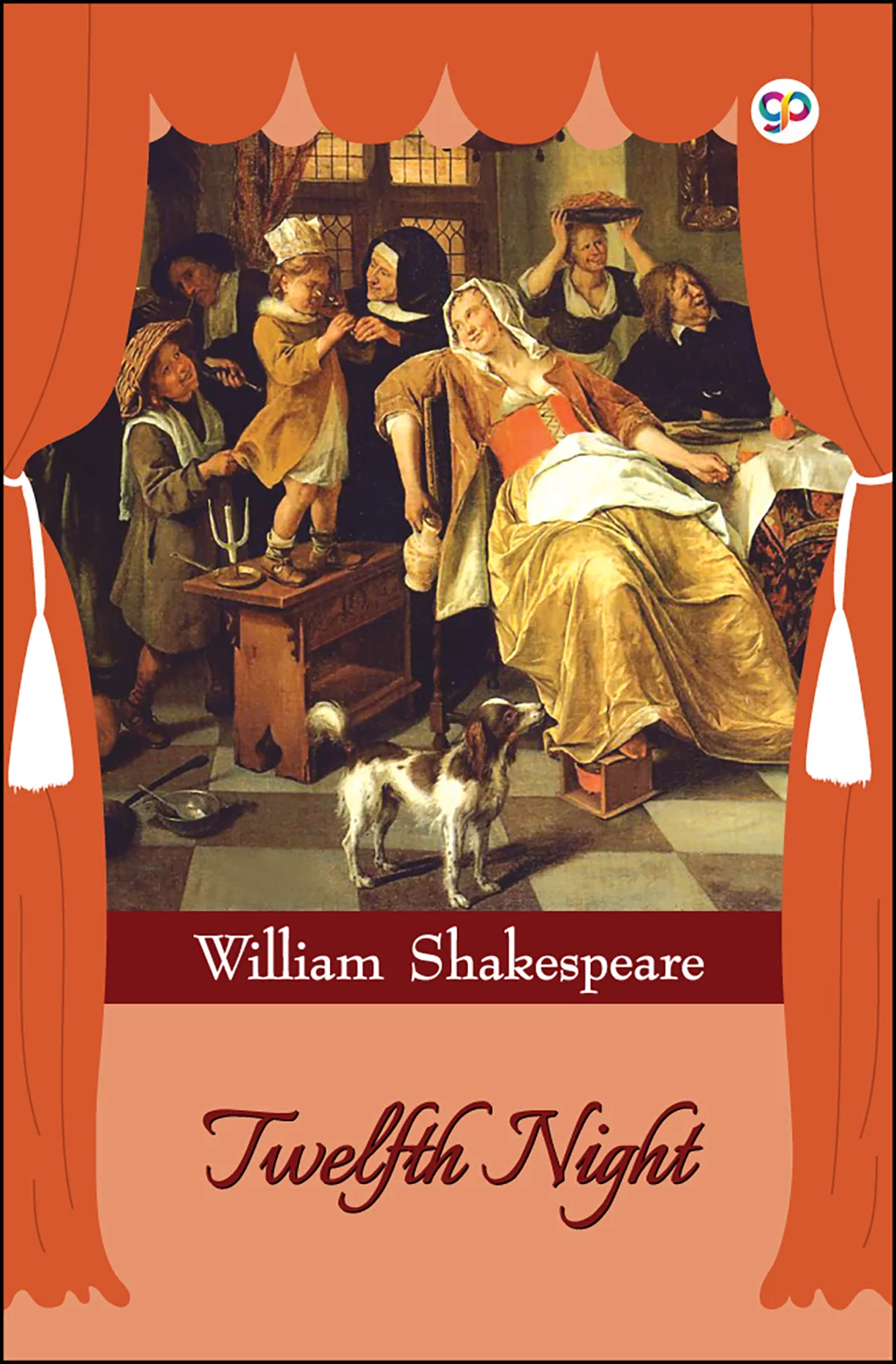
Twelfth Night
Hardcover
• 112 Pages
• INR 225.00
• English
• 9789354994111
No ratings yet
| Publisher | General Press |
|---|---|
| ISBN13 | 9789354994111 |
| ASIN/SKU | 9354994113 |
| Book Format | Hardcover |
| Language | English |
| Pages | 112 |
| List Price | INR 225.00 |
| Subject Code | DRA003000, DRA004000, DRA010000, FIC004000 |
| Publishing Date | 01/06/2022 |
| Dimensions | 8.25 x 5.25 x 1.0 inches |
| Book Code | BD00067706 |
Buy this Book
Amazon Stores
Ebook Stores
Other Stores
Discover Twelfth Night by William Shakespeare. This book is published by General Press in Hardcover format, ISBN 9789354994111, ASIN 9354994113, under Literature and Fiction, British and Irish Classics, Drama.
Book Description
First published in 1602, ‘Twelfth Night’ is an amusingly comic tale of faulty identities by William Shakespeare, an English playwright, poet, and actor. He is widely considered the most splendid writer in the English language and the world’s most remarkable dramatist.
It twists around the physical resemblance between Sebastian and his twin sister, Viola, each of whom, when separated after a shipwreck, believes the other to be dead. The dramatic fling begins when Viola assumes the identity of Cesario, a page in the household of the Duke of Orsino. The Duke is fascinated by Countess Olivia, who spurns him for the newly arrived young page. The subsequent confusion—all of which is pleasantly settled when Viola and Sebastian meet once again.
Sufficed with some of the most satisfactory comedic scenes in the English language, this delightful masterpiece remains one of Shakespeare's most popular and most performed comedies.
It twists around the physical resemblance between Sebastian and his twin sister, Viola, each of whom, when separated after a shipwreck, believes the other to be dead. The dramatic fling begins when Viola assumes the identity of Cesario, a page in the household of the Duke of Orsino. The Duke is fascinated by Countess Olivia, who spurns him for the newly arrived young page. The subsequent confusion—all of which is pleasantly settled when Viola and Sebastian meet once again.
Sufficed with some of the most satisfactory comedic scenes in the English language, this delightful masterpiece remains one of Shakespeare's most popular and most performed comedies.
Author Biography
William Shakespeare (baptised 26 April 1564) was an English poet and playwright, widely regarded as the greatest writer in the English language and the world's pre-eminent dramatist. He is often called England's national poet and the 'Bard of Avon' (or simply "The Bard"). His surviving works consist of 37 plays, 154 sonnets, two long narrative poems, and several other poems. His plays have been translated into every major living language.
Shakespeare was born and raised in Stratford-upon-Avon. Scholars believe that he died on his fifty-second birthday, coinciding with St George’s Day. At the age of 18 he married Anne Hathaway, who bore him three children: Susanna, twins Hamnet and Judith. Between 1585 and 1592 he began a successful career in London as an actor, writer, and part owner of the playing company the Lord Chamberlain's Men, later known as the King's Men. He appears to have retired to Stratford around 1613, where he died three years later.
Shakespeare produced most of his known work between 1590 and 1613. His early plays were mainly comedies and histories, genres he raised to the peak of sophistication and artistry by the end of the sixteenth century. Next he wrote mainly tragedies until about 1608. He was a respected poet and playwright in his own day, but his reputation did not rise to its present heights until the nineteenth century. The Romantics, in particular, acclaimed Shakespeare's genius, and the Victorians hero-worshipped Shakespeare. In the twentieth century, his work was repeatedly adopted and rediscovered by new movements in scholarship and performance. His plays remain highly popular today and are consistently performed and reinterpreted in diverse cultural and political contexts throughout the world.
Shakespeare was born and raised in Stratford-upon-Avon. Scholars believe that he died on his fifty-second birthday, coinciding with St George’s Day. At the age of 18 he married Anne Hathaway, who bore him three children: Susanna, twins Hamnet and Judith. Between 1585 and 1592 he began a successful career in London as an actor, writer, and part owner of the playing company the Lord Chamberlain's Men, later known as the King's Men. He appears to have retired to Stratford around 1613, where he died three years later.
Shakespeare produced most of his known work between 1590 and 1613. His early plays were mainly comedies and histories, genres he raised to the peak of sophistication and artistry by the end of the sixteenth century. Next he wrote mainly tragedies until about 1608. He was a respected poet and playwright in his own day, but his reputation did not rise to its present heights until the nineteenth century. The Romantics, in particular, acclaimed Shakespeare's genius, and the Victorians hero-worshipped Shakespeare. In the twentieth century, his work was repeatedly adopted and rediscovered by new movements in scholarship and performance. His plays remain highly popular today and are consistently performed and reinterpreted in diverse cultural and political contexts throughout the world.
Editorial Reviews
Editorial Reviews will be added soon…
Book Summary
William Shakespeare’s Twelfth Night, or What You Will is one of his most celebrated romantic comedies, combining love, mistaken identity, disguise, comedy, ambition, and emotional confusion into a story that is both entertaining and surprisingly thoughtful. Probably written around 1600–1602, the play is set in the fictional land of Illyria and revolves primarily around Viola, a young woman separated from her twin brother Sebastian after a shipwreck. Believing that Sebastian has drowned, Viola disguises herself as a young man named Cesario and enters the service of Duke Orsino. From this simple disguise develops a complicated love triangle in which Orsino loves Olivia, Olivia falls in love with Cesario, and Viola, secretly in love with Orsino, cannot reveal her true identity. At the same time, a comic subplot involving Malvolio, Sir Toby Belch, Maria, Sir Andrew Aguecheek, and Feste creates another world of deception and foolishness.
The story begins with Duke Orsino, the ruler of Illyria, consumed by his love for Countess Olivia. Orsino is constantly thinking and speaking about love, music, beauty, and emotional longing. His famous opening statement, “If music be the food of love, play on,” immediately establishes one of the central concerns of the play: the strange and often irrational nature of romantic desire. Olivia, however, refuses to return Orsino’s affection because she is mourning the recent death of her brother. She has announced that she will withdraw from romantic relationships for several years. Orsino continues to pursue her despite her refusal, suggesting that he may be as fascinated by the experience of being in love as he is by Olivia herself.
At the same time, a violent shipwreck changes Viola’s life. Viola survives and reaches the coast of Illyria, but she believes that her beloved twin brother Sebastian has been killed in the disaster. Alone in a foreign country, she understands that she is vulnerable as a young woman and decides that the safest way to survive is to disguise herself as a man. She takes the name Cesario and enters the service of Duke Orsino. The disguise gives Viola independence and protection, but it also creates the central complication of the story because everyone begins to respond to Cesario as though he were a young man. Viola is intelligent, emotionally sensitive, and practical, and her ability to adapt makes her one of Shakespeare’s most appealing comic protagonists.
Orsino soon becomes fond of Cesario and decides to use the young page as a messenger in his courtship of Olivia. This creates an especially painful situation for Viola because she has already fallen in love with Orsino. She must therefore deliver love messages from the man she loves to another woman. When Viola visits Olivia, however, the situation takes an unexpected turn. Olivia does not fall in love with Orsino through Cesario’s words; instead, she becomes attracted to Cesario himself. Viola therefore finds herself trapped in a complicated emotional triangle. She loves Orsino, Orsino loves Olivia, and Olivia loves Cesario, who is actually Viola. The dramatic irony is powerful because Viola understands the whole situation while the other characters remain unaware of her true identity.
Olivia’s attraction to Cesario is important because it demonstrates how unpredictable Shakespeare believes love can be. Olivia has rejected Orsino repeatedly, yet she quickly becomes fascinated by the person who represents Orsino’s opposite: a young messenger who is honest, articulate, emotionally perceptive, and seemingly unattainable. Viola herself is also forced to confront the strange power of appearance. Although she is a woman, she is treated as a man because of her clothing and behavior. Shakespeare uses this situation to explore the difference between biological identity, social identity, and personal desire. The disguise is initially a practical survival strategy, but it gradually becomes a source of emotional and romantic ambiguity.
Alongside the romantic plot, Shakespeare develops a second comic storyline at Olivia’s household. Here we meet Sir Toby Belch, Olivia’s loud, drunken, pleasure-loving uncle; Sir Andrew Aguecheek, a foolish and wealthy man who hopes to marry Olivia; Maria, Olivia’s clever waiting-gentlewoman; Feste, the witty clown; and Malvolio, Olivia’s stern and self-important steward. These characters represent a completely different form of life from the emotional seriousness of Orsino and Viola. Sir Toby and his companions enjoy drinking, singing, joking, and staying awake at night, while Malvolio constantly criticizes their behavior. The conflict between them eventually produces one of the play’s most famous comic episodes: the humiliation of Malvolio.
Maria decides to take revenge on Malvolio by forging a letter that appears to have been written by Olivia. The letter is carefully designed to exploit Malvolio’s vanity. It makes him believe that Olivia secretly loves him and instructs him to behave in ridiculous ways, including smiling constantly and wearing yellow stockings with cross-garters. Malvolio eagerly obeys because he dreams not only of marrying Olivia but also of rising socially and gaining greater power. His foolish ambition makes him an easy target for the prank. When Olivia sees his strange behavior, she assumes that he has become mentally disturbed and allows the others to confine him.
The Malvolio subplot is funny, but it also gives Twelfth Night a darker dimension. Malvolio is certainly arrogant, judgmental, and humorless, but the treatment he receives is cruel. The prank moves beyond harmless comedy into psychological humiliation. He is locked in darkness and subjected to further deception, including Feste’s disguise as Sir Topas. Malvolio insists that he is sane, but nobody takes him seriously. Eventually, he writes to Olivia asking for help. When the deception is finally exposed, Malvolio leaves the story furious and promises revenge. The fact that the main romantic characters receive happy endings while Malvolio departs bitterly reminds readers that Shakespeare’s comedy is not entirely innocent or uncomplicated.
Meanwhile, the second half of the story depends upon the discovery that Sebastian has actually survived the shipwreck. He has been rescued by Antonio, a sailor who becomes deeply devoted to him and follows him to Illyria despite the danger involved. Sebastian looks almost exactly like Viola, and because Viola is still disguised as Cesario, his arrival creates an extraordinary chain of mistaken identities. People who see Sebastian believe they are seeing Cesario, while people who know Cesario assume that Sebastian must be another version of the same person. Shakespeare uses the identical twins to transform Viola’s private disguise into a public catastrophe of confusion.
The confusion reaches a comic climax when Sir Andrew challenges Cesario to a duel because he is jealous of Olivia’s attraction to the young page. Neither Sir Andrew nor Cesario actually wants to fight, but Sir Toby encourages the situation for his own amusement. Antonio then arrives and mistakes Viola for Sebastian. Because Antonio has risked himself to protect Sebastian, he is shocked when Viola does not acknowledge him. He is arrested, and his disappointment adds an unexpectedly serious emotional note to the comedy. Soon afterward, Sebastian himself encounters Sir Andrew and Sir Toby. Because they mistake him for Cesario, Sebastian becomes involved in the conflict without understanding its origin.
The greatest misunderstanding occurs when Olivia encounters Sebastian and believes that he is Cesario. Unlike Viola, Sebastian has no knowledge of Olivia’s feelings or of the complicated events surrounding his sister. He is simply surprised by Olivia’s immediate affection. Nevertheless, he is attracted to her and agrees to marry her. This decision seems absurd if viewed realistically, but it fits the play’s larger world, where love frequently arrives suddenly and reason struggles to keep up. Olivia consequently believes she has won the love of Cesario, while Sebastian believes he has unexpectedly found a beautiful and wealthy woman who genuinely desires him.
The final act brings the various confusions together. Orsino, still pursuing Olivia, arrives with Viola disguised as Cesario. Olivia publicly treats Sebastian as her husband, creating an apparently impossible situation. Viola herself cannot understand what has happened. Then Sebastian appears. When the twins finally stand together, the central mystery of the play is solved. Everyone realizes that Viola and Sebastian are separate people and that Viola has been disguised as Cesario. The reunion is emotionally important because Viola discovers that the brother she believed dead is alive, while Sebastian finally learns that his sister has survived the shipwreck.
The revelation also resolves the love triangle. Orsino gradually recognizes that his feelings for Cesario have become more complicated than ordinary friendship or affection. Once Viola’s identity is revealed, Orsino accepts her as a woman and asks her to marry him. Olivia remains married to Sebastian, whose resemblance to Cesario had originally caused the confusion. The romantic disorder therefore settles into a conventional comic ending: Viola and Orsino are united, Olivia and Sebastian are married, and the characters who have found love celebrate the restoration of order. Sir Toby and Maria have also married, adding another union to the conclusion.
Yet Twelfth Night is more than a simple romantic comedy. One of its most important themes is the unpredictable nature of love. Almost every major character experiences desire, but desire rarely behaves rationally. Orsino begins by believing himself passionately devoted to Olivia, yet his feelings change when he develops a close relationship with Cesario. Olivia quickly abandons her resistance to love when she meets Cesario. Viola loves quietly and patiently while hiding her feelings. Even Malvolio’s supposed love is mixed with his desire for social advancement. Shakespeare therefore presents love as powerful, unstable, comic, and sometimes painful rather than as a perfectly logical emotion.
Another major theme is disguise and mistaken identity. Viola’s disguise is necessary for survival, but it also gives her access to experiences that would otherwise be impossible. As Cesario, she can speak freely to Orsino and Olivia and occupy a social position unavailable to her as an unknown young woman. The disguise also makes other characters reveal themselves. Olivia’s attraction to Cesario demonstrates that desire can exist independently of the categories people believe they understand. Shakespeare never allows the disguise to become merely a plot device; it becomes a way of asking questions about identity, appearance, attraction, and social expectations.
The play also explores the relationship between appearance and reality. Almost everyone in Twelfth Night believes something that is not entirely true. Orsino believes that Olivia is the perfect object of his love. Olivia believes Cesario is the person she desires. Malvolio believes Olivia loves him because he wants the letter to be genuine. Sir Andrew believes himself to be a courageous suitor, although his behavior repeatedly proves otherwise. Even Viola and Sebastian believe that they have lost one another. The comedy comes from these misunderstandings, but Shakespeare uses them to suggest something deeper: human beings often construct reality according to what they hope, fear, or desire to be true.
Folly and wisdom are also closely connected in Twelfth Night. Feste, the fool, is often among the wisest people in the play. His jokes and wordplay allow him to say uncomfortable truths that other characters cannot express directly. By contrast, supposedly respectable characters frequently behave foolishly. Sir Andrew is foolish because of his vanity, Malvolio because of his ambition, Orsino because of his self-absorbed romantic melancholy, and Olivia because she allows sudden passion to override caution. Shakespeare consequently reverses ordinary social expectations: the fool can understand human nature better than the noble characters who believe themselves sophisticated.
The title Twelfth Night itself evokes a festive period associated with temporary disorder, celebration, role reversal, music, disguise, and misrule. This atmosphere is perfectly suited to Shakespeare’s story because the normal social order of Illyria is repeatedly overturned. A woman becomes a man, a servant believes himself destined for aristocratic power, a fool speaks wisdom, a supposedly respectable household becomes a place of drunken revelry, and romantic relationships form through mistaken identities. The play eventually restores social order, but it does not completely erase the strange possibilities revealed during the period of disorder.
The ending of Twelfth Night is therefore both joyful and slightly bittersweet. The lovers are united, the twins are reunited, and the major misunderstandings are resolved. Yet Malvolio’s final promise of revenge and Feste’s closing song prevent the ending from becoming a completely simple celebration. Shakespeare reminds us that comedy does not erase pain. Some characters have genuinely suffered, and not every wound disappears merely because the central romantic problems have been solved. This mixture of happiness and melancholy is one reason the play continues to feel emotionally rich.
Overall, Twelfth Night is a brilliant Shakespearean comedy about love, identity, disguise, mistaken identity, ambition, social class, gender, deception, and the human tendency to misunderstand both ourselves and other people. Its plot is deliberately complicated, but its central idea is remarkably clear: people often fall in love with appearances, fantasies, possibilities, and versions of others that exist largely in their own minds. Viola’s disguise exposes this truth more clearly than anything else in the play. Through humor and confusion, Shakespeare shows that identity is not always as fixed as society assumes and that love rarely follows the orderly path people expect. For readers looking for a Twelfth Night summary, Twelfth Night plot analysis, Twelfth Night character analysis, or an explanation of its major themes, the play ultimately offers a timeless lesson: human beings are complicated, desire is unpredictable, and sometimes it takes confusion before people can finally see one another clearly.
The story begins with Duke Orsino, the ruler of Illyria, consumed by his love for Countess Olivia. Orsino is constantly thinking and speaking about love, music, beauty, and emotional longing. His famous opening statement, “If music be the food of love, play on,” immediately establishes one of the central concerns of the play: the strange and often irrational nature of romantic desire. Olivia, however, refuses to return Orsino’s affection because she is mourning the recent death of her brother. She has announced that she will withdraw from romantic relationships for several years. Orsino continues to pursue her despite her refusal, suggesting that he may be as fascinated by the experience of being in love as he is by Olivia herself.
At the same time, a violent shipwreck changes Viola’s life. Viola survives and reaches the coast of Illyria, but she believes that her beloved twin brother Sebastian has been killed in the disaster. Alone in a foreign country, she understands that she is vulnerable as a young woman and decides that the safest way to survive is to disguise herself as a man. She takes the name Cesario and enters the service of Duke Orsino. The disguise gives Viola independence and protection, but it also creates the central complication of the story because everyone begins to respond to Cesario as though he were a young man. Viola is intelligent, emotionally sensitive, and practical, and her ability to adapt makes her one of Shakespeare’s most appealing comic protagonists.
Orsino soon becomes fond of Cesario and decides to use the young page as a messenger in his courtship of Olivia. This creates an especially painful situation for Viola because she has already fallen in love with Orsino. She must therefore deliver love messages from the man she loves to another woman. When Viola visits Olivia, however, the situation takes an unexpected turn. Olivia does not fall in love with Orsino through Cesario’s words; instead, she becomes attracted to Cesario himself. Viola therefore finds herself trapped in a complicated emotional triangle. She loves Orsino, Orsino loves Olivia, and Olivia loves Cesario, who is actually Viola. The dramatic irony is powerful because Viola understands the whole situation while the other characters remain unaware of her true identity.
Olivia’s attraction to Cesario is important because it demonstrates how unpredictable Shakespeare believes love can be. Olivia has rejected Orsino repeatedly, yet she quickly becomes fascinated by the person who represents Orsino’s opposite: a young messenger who is honest, articulate, emotionally perceptive, and seemingly unattainable. Viola herself is also forced to confront the strange power of appearance. Although she is a woman, she is treated as a man because of her clothing and behavior. Shakespeare uses this situation to explore the difference between biological identity, social identity, and personal desire. The disguise is initially a practical survival strategy, but it gradually becomes a source of emotional and romantic ambiguity.
Alongside the romantic plot, Shakespeare develops a second comic storyline at Olivia’s household. Here we meet Sir Toby Belch, Olivia’s loud, drunken, pleasure-loving uncle; Sir Andrew Aguecheek, a foolish and wealthy man who hopes to marry Olivia; Maria, Olivia’s clever waiting-gentlewoman; Feste, the witty clown; and Malvolio, Olivia’s stern and self-important steward. These characters represent a completely different form of life from the emotional seriousness of Orsino and Viola. Sir Toby and his companions enjoy drinking, singing, joking, and staying awake at night, while Malvolio constantly criticizes their behavior. The conflict between them eventually produces one of the play’s most famous comic episodes: the humiliation of Malvolio.
Maria decides to take revenge on Malvolio by forging a letter that appears to have been written by Olivia. The letter is carefully designed to exploit Malvolio’s vanity. It makes him believe that Olivia secretly loves him and instructs him to behave in ridiculous ways, including smiling constantly and wearing yellow stockings with cross-garters. Malvolio eagerly obeys because he dreams not only of marrying Olivia but also of rising socially and gaining greater power. His foolish ambition makes him an easy target for the prank. When Olivia sees his strange behavior, she assumes that he has become mentally disturbed and allows the others to confine him.
The Malvolio subplot is funny, but it also gives Twelfth Night a darker dimension. Malvolio is certainly arrogant, judgmental, and humorless, but the treatment he receives is cruel. The prank moves beyond harmless comedy into psychological humiliation. He is locked in darkness and subjected to further deception, including Feste’s disguise as Sir Topas. Malvolio insists that he is sane, but nobody takes him seriously. Eventually, he writes to Olivia asking for help. When the deception is finally exposed, Malvolio leaves the story furious and promises revenge. The fact that the main romantic characters receive happy endings while Malvolio departs bitterly reminds readers that Shakespeare’s comedy is not entirely innocent or uncomplicated.
Meanwhile, the second half of the story depends upon the discovery that Sebastian has actually survived the shipwreck. He has been rescued by Antonio, a sailor who becomes deeply devoted to him and follows him to Illyria despite the danger involved. Sebastian looks almost exactly like Viola, and because Viola is still disguised as Cesario, his arrival creates an extraordinary chain of mistaken identities. People who see Sebastian believe they are seeing Cesario, while people who know Cesario assume that Sebastian must be another version of the same person. Shakespeare uses the identical twins to transform Viola’s private disguise into a public catastrophe of confusion.
The confusion reaches a comic climax when Sir Andrew challenges Cesario to a duel because he is jealous of Olivia’s attraction to the young page. Neither Sir Andrew nor Cesario actually wants to fight, but Sir Toby encourages the situation for his own amusement. Antonio then arrives and mistakes Viola for Sebastian. Because Antonio has risked himself to protect Sebastian, he is shocked when Viola does not acknowledge him. He is arrested, and his disappointment adds an unexpectedly serious emotional note to the comedy. Soon afterward, Sebastian himself encounters Sir Andrew and Sir Toby. Because they mistake him for Cesario, Sebastian becomes involved in the conflict without understanding its origin.
The greatest misunderstanding occurs when Olivia encounters Sebastian and believes that he is Cesario. Unlike Viola, Sebastian has no knowledge of Olivia’s feelings or of the complicated events surrounding his sister. He is simply surprised by Olivia’s immediate affection. Nevertheless, he is attracted to her and agrees to marry her. This decision seems absurd if viewed realistically, but it fits the play’s larger world, where love frequently arrives suddenly and reason struggles to keep up. Olivia consequently believes she has won the love of Cesario, while Sebastian believes he has unexpectedly found a beautiful and wealthy woman who genuinely desires him.
The final act brings the various confusions together. Orsino, still pursuing Olivia, arrives with Viola disguised as Cesario. Olivia publicly treats Sebastian as her husband, creating an apparently impossible situation. Viola herself cannot understand what has happened. Then Sebastian appears. When the twins finally stand together, the central mystery of the play is solved. Everyone realizes that Viola and Sebastian are separate people and that Viola has been disguised as Cesario. The reunion is emotionally important because Viola discovers that the brother she believed dead is alive, while Sebastian finally learns that his sister has survived the shipwreck.
The revelation also resolves the love triangle. Orsino gradually recognizes that his feelings for Cesario have become more complicated than ordinary friendship or affection. Once Viola’s identity is revealed, Orsino accepts her as a woman and asks her to marry him. Olivia remains married to Sebastian, whose resemblance to Cesario had originally caused the confusion. The romantic disorder therefore settles into a conventional comic ending: Viola and Orsino are united, Olivia and Sebastian are married, and the characters who have found love celebrate the restoration of order. Sir Toby and Maria have also married, adding another union to the conclusion.
Yet Twelfth Night is more than a simple romantic comedy. One of its most important themes is the unpredictable nature of love. Almost every major character experiences desire, but desire rarely behaves rationally. Orsino begins by believing himself passionately devoted to Olivia, yet his feelings change when he develops a close relationship with Cesario. Olivia quickly abandons her resistance to love when she meets Cesario. Viola loves quietly and patiently while hiding her feelings. Even Malvolio’s supposed love is mixed with his desire for social advancement. Shakespeare therefore presents love as powerful, unstable, comic, and sometimes painful rather than as a perfectly logical emotion.
Another major theme is disguise and mistaken identity. Viola’s disguise is necessary for survival, but it also gives her access to experiences that would otherwise be impossible. As Cesario, she can speak freely to Orsino and Olivia and occupy a social position unavailable to her as an unknown young woman. The disguise also makes other characters reveal themselves. Olivia’s attraction to Cesario demonstrates that desire can exist independently of the categories people believe they understand. Shakespeare never allows the disguise to become merely a plot device; it becomes a way of asking questions about identity, appearance, attraction, and social expectations.
The play also explores the relationship between appearance and reality. Almost everyone in Twelfth Night believes something that is not entirely true. Orsino believes that Olivia is the perfect object of his love. Olivia believes Cesario is the person she desires. Malvolio believes Olivia loves him because he wants the letter to be genuine. Sir Andrew believes himself to be a courageous suitor, although his behavior repeatedly proves otherwise. Even Viola and Sebastian believe that they have lost one another. The comedy comes from these misunderstandings, but Shakespeare uses them to suggest something deeper: human beings often construct reality according to what they hope, fear, or desire to be true.
Folly and wisdom are also closely connected in Twelfth Night. Feste, the fool, is often among the wisest people in the play. His jokes and wordplay allow him to say uncomfortable truths that other characters cannot express directly. By contrast, supposedly respectable characters frequently behave foolishly. Sir Andrew is foolish because of his vanity, Malvolio because of his ambition, Orsino because of his self-absorbed romantic melancholy, and Olivia because she allows sudden passion to override caution. Shakespeare consequently reverses ordinary social expectations: the fool can understand human nature better than the noble characters who believe themselves sophisticated.
The title Twelfth Night itself evokes a festive period associated with temporary disorder, celebration, role reversal, music, disguise, and misrule. This atmosphere is perfectly suited to Shakespeare’s story because the normal social order of Illyria is repeatedly overturned. A woman becomes a man, a servant believes himself destined for aristocratic power, a fool speaks wisdom, a supposedly respectable household becomes a place of drunken revelry, and romantic relationships form through mistaken identities. The play eventually restores social order, but it does not completely erase the strange possibilities revealed during the period of disorder.
The ending of Twelfth Night is therefore both joyful and slightly bittersweet. The lovers are united, the twins are reunited, and the major misunderstandings are resolved. Yet Malvolio’s final promise of revenge and Feste’s closing song prevent the ending from becoming a completely simple celebration. Shakespeare reminds us that comedy does not erase pain. Some characters have genuinely suffered, and not every wound disappears merely because the central romantic problems have been solved. This mixture of happiness and melancholy is one reason the play continues to feel emotionally rich.
Overall, Twelfth Night is a brilliant Shakespearean comedy about love, identity, disguise, mistaken identity, ambition, social class, gender, deception, and the human tendency to misunderstand both ourselves and other people. Its plot is deliberately complicated, but its central idea is remarkably clear: people often fall in love with appearances, fantasies, possibilities, and versions of others that exist largely in their own minds. Viola’s disguise exposes this truth more clearly than anything else in the play. Through humor and confusion, Shakespeare shows that identity is not always as fixed as society assumes and that love rarely follows the orderly path people expect. For readers looking for a Twelfth Night summary, Twelfth Night plot analysis, Twelfth Night character analysis, or an explanation of its major themes, the play ultimately offers a timeless lesson: human beings are complicated, desire is unpredictable, and sometimes it takes confusion before people can finally see one another clearly.
Sample Chapters
Characters in the Play
ORSINO, ‘Duke of Illyria’.
OLIVIA, a countess.
VIOLA, who disguises herself as Cesario.
SEBASTIAN, Viola’s twin brother.
ANTONIO, friend of Sebastian.
SIR TOBY BELCH, kinsman of Olivia.
SIR ANDREW AGUECHEEK, Sir Toby’s companion.
MALVOLIO, Olivia’s steward.
MARIA, Olivia’s maid.
FABIAN, member of Olivia’s household.
CLOWN (Feste), Olivia’s jester.
VALENTINE and CURIO, gentlemen attending Orsino.
CAPTAIN of ship, friend of Viola.
OFFICERS serving Orsino.
SERVANT to Olivia.
PRIEST.
LORDS, SAILORS, MUSICIANS and ATTENDANTS.
Act 1
Scene 1. A room in the duke’s palace.
Music. Enter ORSINO, Duke of Illyria, CURIO and other LORDS. The music ceases.
DUKE : If music be the food of love, play on,
Give me excess of it; that, surfeiting,
The appetite may sicken, and so die. [Music resumes.]
That strain again! It had a dying fall:
O, it came o’er my ear like the sweet sound
That breathes upon a bank of violets,
Stealing and giving odour. Enough, no more!
’Tis not so sweet now as it was before. [Music ceases.]
O spirit of love, how quick and fresh art thou,
That, notwithstanding thy capacity
Receiveth as the sea, nought enters there,
Of what validity and pitch soe’er,
But falls into abatement and low price
Even in a minute. So full of shapes is fancy,
That it alone is high fantastical.
CURIO : Will you go hunt, my lord?
DUKE : What, Curio?
CURIO : The hart.
DUKE : Why, so I do, the noblest that I have:
O, when mine eyes did see Olivia first,
Methought she purged the air of pestilence;
That instant was I turned into a hart,
And my desires, like fell and cruel hounds,
E’er since pursue me.
Enter VALENTINE.
How now, what news from her?
VALENT. : So please my lord, I might not be admitted,
But from her handmaid do return this answer:
The element itself, till seven years hence,
Shall not behold her face at ample view;
But like a cloistress she will veilèd walk,
And water once a day her chamber round
With eye-offending brine: all this to season
A brother’s dead love, which she would keep fresh
And lasting, in her sad remembrance.
DUKE : O she that hath a heart of that fine frame
To pay this debt of love but to a brother,
How will she love, when the rich golden shaft
Hath killed the flock of all affections else
That live in her; when liver, brain and heart,
These sovereign thrones, are all supplied and filled,
Her sweet perfections, with one self king!
Away before me to sweet beds of flowers:
Love-thoughts lie rich, when canopied with bowers.
[Exeunt.
ORSINO, ‘Duke of Illyria’.
OLIVIA, a countess.
VIOLA, who disguises herself as Cesario.
SEBASTIAN, Viola’s twin brother.
ANTONIO, friend of Sebastian.
SIR TOBY BELCH, kinsman of Olivia.
SIR ANDREW AGUECHEEK, Sir Toby’s companion.
MALVOLIO, Olivia’s steward.
MARIA, Olivia’s maid.
FABIAN, member of Olivia’s household.
CLOWN (Feste), Olivia’s jester.
VALENTINE and CURIO, gentlemen attending Orsino.
CAPTAIN of ship, friend of Viola.
OFFICERS serving Orsino.
SERVANT to Olivia.
PRIEST.
LORDS, SAILORS, MUSICIANS and ATTENDANTS.
Act 1
Scene 1. A room in the duke’s palace.
Music. Enter ORSINO, Duke of Illyria, CURIO and other LORDS. The music ceases.
DUKE : If music be the food of love, play on,
Give me excess of it; that, surfeiting,
The appetite may sicken, and so die. [Music resumes.]
That strain again! It had a dying fall:
O, it came o’er my ear like the sweet sound
That breathes upon a bank of violets,
Stealing and giving odour. Enough, no more!
’Tis not so sweet now as it was before. [Music ceases.]
O spirit of love, how quick and fresh art thou,
That, notwithstanding thy capacity
Receiveth as the sea, nought enters there,
Of what validity and pitch soe’er,
But falls into abatement and low price
Even in a minute. So full of shapes is fancy,
That it alone is high fantastical.
CURIO : Will you go hunt, my lord?
DUKE : What, Curio?
CURIO : The hart.
DUKE : Why, so I do, the noblest that I have:
O, when mine eyes did see Olivia first,
Methought she purged the air of pestilence;
That instant was I turned into a hart,
And my desires, like fell and cruel hounds,
E’er since pursue me.
Enter VALENTINE.
How now, what news from her?
VALENT. : So please my lord, I might not be admitted,
But from her handmaid do return this answer:
The element itself, till seven years hence,
Shall not behold her face at ample view;
But like a cloistress she will veilèd walk,
And water once a day her chamber round
With eye-offending brine: all this to season
A brother’s dead love, which she would keep fresh
And lasting, in her sad remembrance.
DUKE : O she that hath a heart of that fine frame
To pay this debt of love but to a brother,
How will she love, when the rich golden shaft
Hath killed the flock of all affections else
That live in her; when liver, brain and heart,
These sovereign thrones, are all supplied and filled,
Her sweet perfections, with one self king!
Away before me to sweet beds of flowers:
Love-thoughts lie rich, when canopied with bowers.
[Exeunt.
Reader Reviews
No reviews yet.
Twelfth Night