
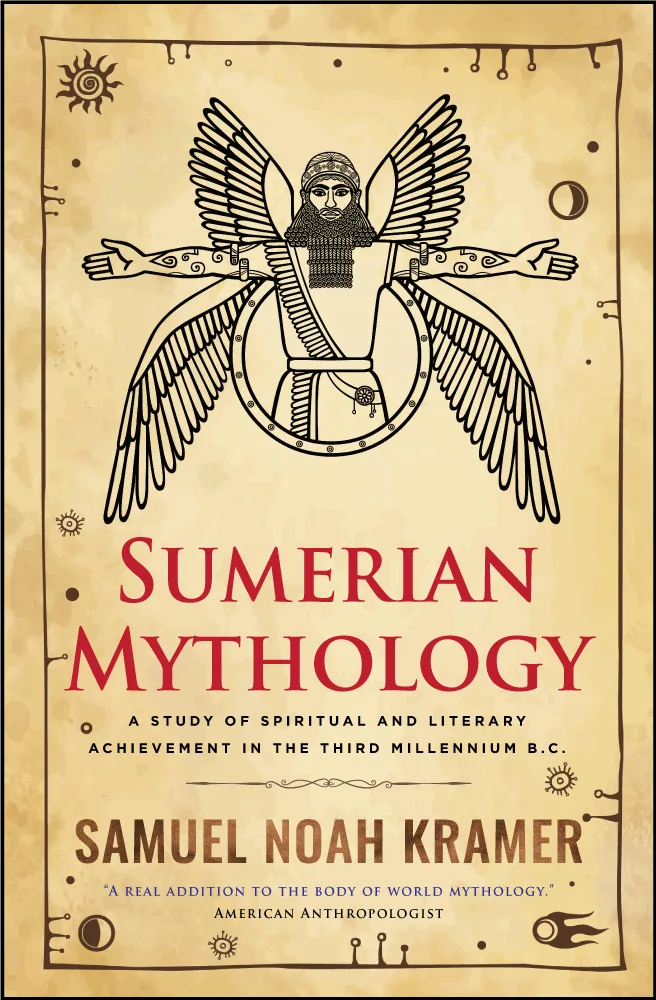
Sumerian Mythology
Paperback
• 184 Pages
• INR 245.00
• English
• 9789354996368
No ratings yet
| Publisher | General Press |
|---|---|
| ISBN13 | 9789354996368 |
| ASIN/SKU | 9354996361 |
| Book Format | Paperback |
| Language | English |
| Pages | 184 |
| List Price | INR 245.00 |
| Subject Code | HIS002000, PHI002000, SOC002000 |
| Dimensions | 8.25 x 5.25 x 1.0 inches |
| Book Code | BD00067707 |
Buy this Book
Amazon Stores
Ebook Stores
Other Stores
Discover Sumerian Mythology by Samuel Noah Kramer. This book is published by General Press in Paperback format, ISBN 9789354996368, ASIN 9354996361, under Religion and Spirituality, History, Mythology.
Book Description
First published in 1944, "Sumerian Mythology" was written by Samuel Noah Kramer, a leading figure in the creation of the modern discipline of Sumerology. He was the first to piece together, decipher, and edit major works of Sumerian mythology and literature.
The Sumerians were a non-Semitic, non-Indo-European people who flourished in southern Babylonia from the beginning of the fourth to the end of the third millennium B.C. During this long stretch of time the Sumerians, whose racial and linguistic affiliations are still unclassifiable, represented the dominant cultural group of the entire Near East.
The Sumerians were the pragmatic and gifted people who created what was probably the first high civilization in the history of man. This book is an unparalleled compendium of what is known about them.
"First, the linguistic difficulties. Sumerian is neither a Semitic nor an Indo-European language. It belongs to the so-called agglutinative type of languages exemplified by Turkish, Hungarian, and Finnish."
— Samuel Noah Kramer (Sumerian Mythology)
The Sumerians were a non-Semitic, non-Indo-European people who flourished in southern Babylonia from the beginning of the fourth to the end of the third millennium B.C. During this long stretch of time the Sumerians, whose racial and linguistic affiliations are still unclassifiable, represented the dominant cultural group of the entire Near East.
The Sumerians were the pragmatic and gifted people who created what was probably the first high civilization in the history of man. This book is an unparalleled compendium of what is known about them.
"First, the linguistic difficulties. Sumerian is neither a Semitic nor an Indo-European language. It belongs to the so-called agglutinative type of languages exemplified by Turkish, Hungarian, and Finnish."
— Samuel Noah Kramer (Sumerian Mythology)
Author Biography
Dr. Samuel Noah Kramer, Ph.D. (University of Pennsylvania, 1929; born Simcha Kramer), was a historian, philologist, and Assyriologist, particularly renowned as an expert in the language and history of Sumer. He was Clark Research Professor Emeritus of Assyriology at the University of Pennsylvania, where he was also Curator Emeritus of the Tablet Collections.
Dr. Kramer is often credited with the virtual creation of Sumerian cuneiform literature as an academic field, in which he wrote some 30 books for both academic and popular audiences. was a member of the American Oriental Society, Archeological Institute of America, Society of Biblical Literature and American Philosophical Society, which awarded him its John Frederick Lewis Prize.
Dr. Kramer is often credited with the virtual creation of Sumerian cuneiform literature as an academic field, in which he wrote some 30 books for both academic and popular audiences. was a member of the American Oriental Society, Archeological Institute of America, Society of Biblical Literature and American Philosophical Society, which awarded him its John Frederick Lewis Prize.
Editorial Reviews
Editorial Reviews will be added soon…
Book Summary
Sumerian Mythology by Samuel Noah Kramer is a pioneering work that introduces readers to the religious beliefs, myths, and literary traditions of one of the world's earliest civilizations. Drawing upon ancient cuneiform tablets recovered from Mesopotamia, Kramer reconstructs the stories and ideas that shaped the spiritual life of the Sumerians, who flourished in southern Mesopotamia thousands of years before the rise of classical Greece or Rome. Rather than presenting mythology as a collection of fanciful tales, the book reveals how these narratives expressed the Sumerians' understanding of the universe, the gods, kingship, nature, morality, and the human condition.
The book begins by placing Sumerian civilization in its historical context. The Sumerians developed one of the earliest known systems of writing, established complex cities, and created sophisticated legal, agricultural, and religious institutions. Their myths were not isolated stories but part of a broader worldview that connected every aspect of life to divine authority. Temples stood at the center of each city, serving not only as places of worship but also as cultural, political, and economic institutions.
Kramer explains that Sumerian mythology developed gradually over centuries through oral tradition before being recorded on clay tablets in cuneiform script. Because many tablets survived only in fragments, reconstructing these stories required careful scholarly comparison and interpretation. Throughout the book, Kramer demonstrates both the richness of the surviving material and the challenges involved in understanding texts written more than four thousand years ago.
At the heart of Sumerian mythology is a vast pantheon of gods and goddesses, each governing different aspects of the universe. The gods are portrayed as immensely powerful yet deeply personal beings with emotions, ambitions, disagreements, and responsibilities. They create order, regulate nature, establish justice, and influence the destiny of individuals and nations. Unlike later philosophical ideas of a distant deity, the Sumerian gods actively participate in the world's affairs and frequently interact with humanity.
Among the most important divine figures is An, the sky god, who represents supreme authority and the highest realm of heaven. Closely associated with him is Enlil, often depicted as the ruler of the earthly world and the divine force responsible for maintaining order. Enki, the god of wisdom, fresh water, craftsmanship, and creative intelligence, emerges as one of the most compassionate and resourceful figures in Sumerian tradition. Inanna, the powerful goddess of love, fertility, beauty, and war, embodies both creative energy and fierce determination, making her one of the most fascinating personalities in ancient mythology.
A central theme running throughout the book is the establishment of cosmic order. The myths describe how the gods organized the universe, assigned responsibilities among themselves, and created systems that allowed both nature and human society to function. Rivers, seasons, agriculture, cities, and kingship were all understood as gifts or institutions originating from divine action. The world was not viewed as random but as a carefully structured reality sustained by sacred authority.
Creation stories occupy an important place within this framework. Rather than offering a single, unified account, the Sumerian tradition preserves several narratives explaining different aspects of creation. These stories describe the separation of heaven and earth, the emergence of natural forces, and the origins of humanity. Human beings are often portrayed as having been created to assist the gods by maintaining temples, cultivating the land, and preserving social order. This perspective reflects the Sumerians' belief that human life carried both privilege and responsibility.
The book also explores myths concerning divine conflict and cooperation. The gods frequently debate, negotiate, and occasionally oppose one another, yet these interactions usually contribute to maintaining balance within the universe. Kramer highlights how these stories resemble political life in ancient city-states, where authority was shared, challenged, and reaffirmed through councils and assemblies. In this way, mythology reflected familiar patterns of governance while projecting them onto a cosmic scale.
One of the most memorable sections examines the myths surrounding Inanna. Her stories portray a deity of remarkable complexity, combining tenderness with strength, ambition with vulnerability, and love with destructive power. Through her adventures, the myths explore themes of authority, transformation, desire, sacrifice, and renewal. Kramer demonstrates that these narratives reveal a sophisticated understanding of both human emotion and political symbolism.
Enki's role provides another recurring theme. Often acting through wisdom rather than force, he resolves conflicts, protects civilization, and encourages creativity. He is associated with fresh water, knowledge, craftsmanship, and practical intelligence. In many myths, Enki represents thoughtful problem-solving and the beneficial use of knowledge, balancing the authority exercised by other divine figures.
Kingship also occupies a significant place in Sumerian mythology. Rulers were regarded not merely as political leaders but as individuals chosen or approved by the gods. Their legitimacy depended upon maintaining justice, protecting the people, and preserving harmony between the divine and human worlds. Kramer explains that myth reinforced political authority by presenting kingship as part of the cosmic order established by the gods themselves.
The relationship between humanity and the divine is portrayed as one of dependence and reverence. People sought the favor of the gods through prayer, offerings, festivals, and temple rituals. At the same time, the myths acknowledge that human beings possess limited understanding of divine purposes. Fortune and misfortune alike were often interpreted as expressions of the gods' will, encouraging humility before powers greater than oneself.
Nature itself is deeply woven into Sumerian mythology. Rivers, fertile plains, storms, mountains, and celestial bodies all possess religious significance. Since the Sumerians depended heavily upon agriculture, they viewed natural cycles as visible expressions of divine activity. Fertility, rainfall, harvests, and seasonal changes were celebrated through myths that connected everyday survival with sacred meaning.
Kramer also demonstrates how Sumerian mythology influenced later civilizations throughout Mesopotamia. Many themes, symbols, and narrative patterns reappear in Akkadian, Babylonian, and Assyrian literature. Certain ideas concerning creation, floods, divine kingship, wisdom, and heroic quests eventually found echoes in later traditions across the ancient Near East. While these later cultures developed their own distinctive beliefs, the Sumerians laid much of the literary and religious foundation upon which they were built.
An important strength of the book lies in its scholarly approach. Kramer does not simply retell myths as entertaining stories. He explains how archaeologists discovered the tablets, how linguists translated the ancient language, and how historians reconstructed damaged texts by comparing multiple sources. This allows readers to appreciate not only the myths themselves but also the remarkable process through which modern scholarship has recovered voices from one of humanity's earliest civilizations.
Throughout the work, Kramer emphasizes that mythology served practical as well as spiritual purposes. These stories explained the origins of institutions, justified social customs, reinforced ethical values, and strengthened community identity. Far from being mere fiction, they formed an essential part of how the Sumerians understood themselves and their place within the universe.
Ultimately, Sumerian Mythology offers far more than an introduction to ancient legends. It opens a window into the imagination, beliefs, and intellectual achievements of a civilization whose influence continues to shape humanity's cultural heritage. Through Samuel Noah Kramer's careful scholarship and engaging explanations, readers gain an appreciation for the richness of Sumerian thought and the enduring power of myth to explore questions about creation, authority, wisdom, mortality, and humanity's relationship with the divine. The book remains an essential resource for anyone interested in the origins of mythology, religion, and the earliest literary traditions of the ancient world.
The book begins by placing Sumerian civilization in its historical context. The Sumerians developed one of the earliest known systems of writing, established complex cities, and created sophisticated legal, agricultural, and religious institutions. Their myths were not isolated stories but part of a broader worldview that connected every aspect of life to divine authority. Temples stood at the center of each city, serving not only as places of worship but also as cultural, political, and economic institutions.
Kramer explains that Sumerian mythology developed gradually over centuries through oral tradition before being recorded on clay tablets in cuneiform script. Because many tablets survived only in fragments, reconstructing these stories required careful scholarly comparison and interpretation. Throughout the book, Kramer demonstrates both the richness of the surviving material and the challenges involved in understanding texts written more than four thousand years ago.
At the heart of Sumerian mythology is a vast pantheon of gods and goddesses, each governing different aspects of the universe. The gods are portrayed as immensely powerful yet deeply personal beings with emotions, ambitions, disagreements, and responsibilities. They create order, regulate nature, establish justice, and influence the destiny of individuals and nations. Unlike later philosophical ideas of a distant deity, the Sumerian gods actively participate in the world's affairs and frequently interact with humanity.
Among the most important divine figures is An, the sky god, who represents supreme authority and the highest realm of heaven. Closely associated with him is Enlil, often depicted as the ruler of the earthly world and the divine force responsible for maintaining order. Enki, the god of wisdom, fresh water, craftsmanship, and creative intelligence, emerges as one of the most compassionate and resourceful figures in Sumerian tradition. Inanna, the powerful goddess of love, fertility, beauty, and war, embodies both creative energy and fierce determination, making her one of the most fascinating personalities in ancient mythology.
A central theme running throughout the book is the establishment of cosmic order. The myths describe how the gods organized the universe, assigned responsibilities among themselves, and created systems that allowed both nature and human society to function. Rivers, seasons, agriculture, cities, and kingship were all understood as gifts or institutions originating from divine action. The world was not viewed as random but as a carefully structured reality sustained by sacred authority.
Creation stories occupy an important place within this framework. Rather than offering a single, unified account, the Sumerian tradition preserves several narratives explaining different aspects of creation. These stories describe the separation of heaven and earth, the emergence of natural forces, and the origins of humanity. Human beings are often portrayed as having been created to assist the gods by maintaining temples, cultivating the land, and preserving social order. This perspective reflects the Sumerians' belief that human life carried both privilege and responsibility.
The book also explores myths concerning divine conflict and cooperation. The gods frequently debate, negotiate, and occasionally oppose one another, yet these interactions usually contribute to maintaining balance within the universe. Kramer highlights how these stories resemble political life in ancient city-states, where authority was shared, challenged, and reaffirmed through councils and assemblies. In this way, mythology reflected familiar patterns of governance while projecting them onto a cosmic scale.
One of the most memorable sections examines the myths surrounding Inanna. Her stories portray a deity of remarkable complexity, combining tenderness with strength, ambition with vulnerability, and love with destructive power. Through her adventures, the myths explore themes of authority, transformation, desire, sacrifice, and renewal. Kramer demonstrates that these narratives reveal a sophisticated understanding of both human emotion and political symbolism.
Enki's role provides another recurring theme. Often acting through wisdom rather than force, he resolves conflicts, protects civilization, and encourages creativity. He is associated with fresh water, knowledge, craftsmanship, and practical intelligence. In many myths, Enki represents thoughtful problem-solving and the beneficial use of knowledge, balancing the authority exercised by other divine figures.
Kingship also occupies a significant place in Sumerian mythology. Rulers were regarded not merely as political leaders but as individuals chosen or approved by the gods. Their legitimacy depended upon maintaining justice, protecting the people, and preserving harmony between the divine and human worlds. Kramer explains that myth reinforced political authority by presenting kingship as part of the cosmic order established by the gods themselves.
The relationship between humanity and the divine is portrayed as one of dependence and reverence. People sought the favor of the gods through prayer, offerings, festivals, and temple rituals. At the same time, the myths acknowledge that human beings possess limited understanding of divine purposes. Fortune and misfortune alike were often interpreted as expressions of the gods' will, encouraging humility before powers greater than oneself.
Nature itself is deeply woven into Sumerian mythology. Rivers, fertile plains, storms, mountains, and celestial bodies all possess religious significance. Since the Sumerians depended heavily upon agriculture, they viewed natural cycles as visible expressions of divine activity. Fertility, rainfall, harvests, and seasonal changes were celebrated through myths that connected everyday survival with sacred meaning.
Kramer also demonstrates how Sumerian mythology influenced later civilizations throughout Mesopotamia. Many themes, symbols, and narrative patterns reappear in Akkadian, Babylonian, and Assyrian literature. Certain ideas concerning creation, floods, divine kingship, wisdom, and heroic quests eventually found echoes in later traditions across the ancient Near East. While these later cultures developed their own distinctive beliefs, the Sumerians laid much of the literary and religious foundation upon which they were built.
An important strength of the book lies in its scholarly approach. Kramer does not simply retell myths as entertaining stories. He explains how archaeologists discovered the tablets, how linguists translated the ancient language, and how historians reconstructed damaged texts by comparing multiple sources. This allows readers to appreciate not only the myths themselves but also the remarkable process through which modern scholarship has recovered voices from one of humanity's earliest civilizations.
Throughout the work, Kramer emphasizes that mythology served practical as well as spiritual purposes. These stories explained the origins of institutions, justified social customs, reinforced ethical values, and strengthened community identity. Far from being mere fiction, they formed an essential part of how the Sumerians understood themselves and their place within the universe.
Ultimately, Sumerian Mythology offers far more than an introduction to ancient legends. It opens a window into the imagination, beliefs, and intellectual achievements of a civilization whose influence continues to shape humanity's cultural heritage. Through Samuel Noah Kramer's careful scholarship and engaging explanations, readers gain an appreciation for the richness of Sumerian thought and the enduring power of myth to explore questions about creation, authority, wisdom, mortality, and humanity's relationship with the divine. The book remains an essential resource for anyone interested in the origins of mythology, religion, and the earliest literary traditions of the ancient world.
Sample Chapters
Sample Chapters will be added soon…
Reader Reviews
No reviews yet.
Sumerian Mythology
Download Cover Image
Do you want to download the full cover image for Sumerian Mythology?