
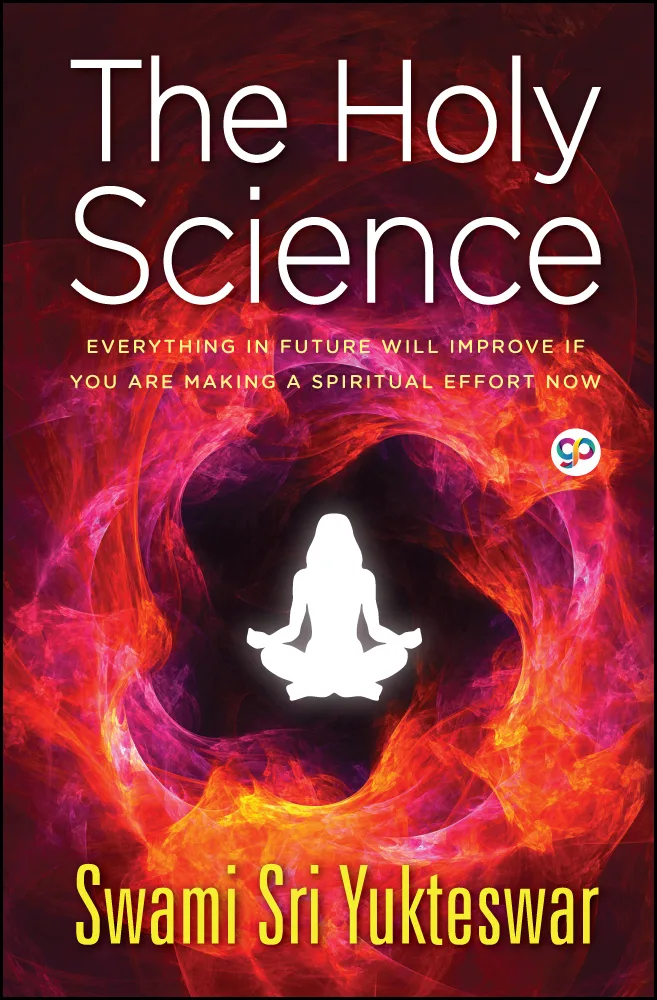
The Holy Science
Hardcover
• 96 Pages
• INR 245.00
• English
• 9789354996429
No ratings yet
| Publisher | General Press |
|---|---|
| ISBN13 | 9789354996429 |
| ASIN/SKU | 9354996426 |
| Book Format | Hardcover |
| Language | English |
| Pages | 96 |
| List Price | INR 245.00 |
| Subject Code | PHI013000, REL032000, PHI022000 |
| Dimensions | 8.25 x 5.25 x 1.0 inches |
| Book Code | BD00067717 |
Buy this Book
Amazon Stores
Ebook Stores
Other Stores
Discover The Holy Science by Swami Sri Yukteswar. This book is published by General Press in Hardcover format, ISBN 9789354996429, ASIN 9354996426, under Non Fiction, Hinduism, Astrology.
Book Description
"The Holy Science" was written by Sri Yukteswar at the behest of Mahavatar Babaji. In it, Sri Yukteswar compares Sanskrit slokas to the writings of the New Testament. Also explained is the great cycle of world ages (yugas). Yukteshwar was an educator, astronomer, a Jyotisha (Vedic astrologer), a yogi, and a believer in the Bhagavad Gita and the Bible. He was a disciple of Lahiri Mahasaya of Varanasi and a member of the Giri branch of the swami order.
"The purpose of this book is to show as clearly as possible that there is an essential unity in all religions; that there is no difference in the truths inculcated by the various faiths; that there is but one method by which the world, both external and internal, has evolved; and that there is but one Goal admitted by all scriptures." —Swami Sri Yukteswar Giri
"The purpose of this book is to show as clearly as possible that there is an essential unity in all religions; that there is no difference in the truths inculcated by the various faiths; that there is but one method by which the world, both external and internal, has evolved; and that there is but one Goal admitted by all scriptures." —Swami Sri Yukteswar Giri
Author Biography
Yukteswar was an educator, astronomer, a Jyotisha (Vedic astrologer), a yogi, and a scholar of the Bhagavad Gita and the Bible.
Yukteswar's teacher guru, who guided his spiritual development, was Lahiri Mahasaya.
In 1894, Lahiri Mahasaya's guru, Mahavatar Babaji, asked Yogteswar to write a book on the underlying harmony between Christian and Hindu scriptures. Yukteswar's book 'The Holy Science' was thus written.
Yukteswar took on many disciples. Most famously, he was the beloved guru of Paramahansa Yogananda, who brought Yoga to the West through moving to America, and through his book, Autobiography of a Yogi , which mentions Yukteswar extensively.
Another of Yukteswar's disciples, Satyeswarananda Giri , also wrote yogic books at the encouragement of Yukteswar.
Yukteswar's teacher guru, who guided his spiritual development, was Lahiri Mahasaya.
In 1894, Lahiri Mahasaya's guru, Mahavatar Babaji, asked Yogteswar to write a book on the underlying harmony between Christian and Hindu scriptures. Yukteswar's book 'The Holy Science' was thus written.
Yukteswar took on many disciples. Most famously, he was the beloved guru of Paramahansa Yogananda, who brought Yoga to the West through moving to America, and through his book, Autobiography of a Yogi , which mentions Yukteswar extensively.
Another of Yukteswar's disciples, Satyeswarananda Giri , also wrote yogic books at the encouragement of Yukteswar.
Editorial Reviews
Editorial Reviews will be added soon…
Book Summary
Swami Sri Yukteswar Giri’s The Holy Science, originally published in 1894, is a short but ambitious spiritual text that attempts to demonstrate an underlying unity between the teachings of Hinduism and Christianity. Its original Sanskrit title, Kaivalya Darsanam, can be understood in relation to the philosophical idea of liberation or ultimate spiritual freedom. Sri Yukteswar presents the book as an attempt to reconcile the essential truths of the Vedas and the Christian Bible, arguing that apparently different religious traditions point toward the same spiritual reality. The work is divided into four chapters—The Gospel, The Goal of Life, The Procedure, and The Revelation—and combines Vedantic philosophy, Yoga, astrology, cosmology, and Christian symbolism. It is especially known for its discussion of the four Yugas, or cosmic ages, and for its distinctive interpretation of spiritual evolution. (ananda.org)
The purpose of The Holy Science is stated in the introduction: Sri Yukteswar wants to show the essential unity underlying the teachings of the great spiritual traditions. He specifically seeks to demonstrate the agreement between the principles found in the ancient Indian scriptures and the teachings attributed to Jesus Christ. This comparative approach is central to the book. Sri Yukteswar does not argue that one religion must defeat another. Instead, he claims that religious traditions have often preserved fragments of a universal spiritual science and that a deeper understanding reveals their common foundation. (ananda.org)
The first chapter, “The Gospel,” begins with the concept of Prakriti, the creative nature or material principle through which the universe becomes manifest. Sri Yukteswar describes creation in terms of fundamental principles that correspond to both Indian philosophical thought and Christian theological symbolism. He explains the relationship between spirit and matter, consciousness and creation, and uses concepts such as Aum or Om to describe the primordial vibration associated with manifestation. For him, the universe is not spiritually meaningless matter. It is an expression of a deeper divine reality.
Sri Yukteswar’s interpretation of the Christian Trinity is particularly important. He seeks parallels between the Christian concepts of the Father, Son, and Holy Ghost and the metaphysical principles found in Indian philosophy. The Father represents the transcendent spiritual source, the Son is associated with divine consciousness or Christ Consciousness, and the Holy Ghost is associated with the creative vibration through which manifestation occurs. This does not simply amount to saying that the names are different. Sri Yukteswar argues that the underlying spiritual principles are fundamentally related. In this way, he attempts to read Christianity through the conceptual framework of Vedanta and Yoga.
The concept of Christ Consciousness is central to this synthesis. Sri Yukteswar distinguishes between Jesus as a historical individual and the universal consciousness represented by the Christ principle. Christ, in this interpretation, is not merely a name belonging to one historical person but a state or principle of divine consciousness accessible through spiritual realization. Jesus is understood as someone who embodied this consciousness to an extraordinary degree. This interpretation later became especially influential through Paramahansa Yogananda, Sri Yukteswar’s disciple, whose teachings presented Jesus and Krishna as expressions of the same universal spiritual truth.
The book then turns toward the nature of humanity and the problem of spiritual ignorance. Sri Yukteswar teaches that human beings are essentially spiritual but become identified with the material world. This identification creates the experience of separation, limitation, desire, and suffering. The purpose of spiritual life is therefore not to acquire something entirely new but to awaken to what is already present at the deepest level of consciousness. The individual soul is connected with the divine reality, but ignorance prevents that unity from being directly experienced.
This leads into the second chapter, “The Goal of Life.” Sri Yukteswar argues that the ultimate purpose of human existence is liberation. Material success, pleasure, status, and intellectual achievement may have value within ordinary life, but they cannot provide permanent fulfillment because everything in the material world is subject to change. Human beings repeatedly pursue temporary satisfactions only to discover that they eventually disappear. The spiritual quest begins when a person recognizes that lasting happiness cannot be found solely through external circumstances.
Liberation, or kaivalya, represents freedom from the limitations created by ignorance and attachment. The individual must gradually discover the difference between the eternal Self and the changing world of experience. This process does not require rejecting the world in a simplistic sense. Instead, it requires developing a correct understanding of one's relationship with it. The spiritual seeker learns to use the material world without becoming enslaved by it.
Sri Yukteswar also presents a distinctive understanding of human development. People exist at different levels of consciousness, and spiritual growth involves expanding awareness. At lower levels, people are strongly identified with physical existence and sensory desires. As consciousness develops, moral awareness, discrimination, intuition, and spiritual insight become stronger. The ultimate goal is realization of the divine nature of the Self.
The third chapter, “The Procedure,” describes the practical path toward this realization. Sri Yukteswar emphasizes the importance of disciplined spiritual practice, self-control, discrimination, and meditation. Intellectual understanding alone is insufficient. A person can read thousands of books about spirituality and still remain spiritually immature. Direct experience must accompany philosophical knowledge. The seeker therefore needs a method through which consciousness can be refined.
This emphasis on practice is characteristic of Yoga. Sri Yukteswar presents spiritual evolution as something that can be accelerated through appropriate discipline. The mind must become calm enough to perceive deeper realities. Desire, attachment, and sensory restlessness create obstacles because they keep attention directed outward. Meditation helps reverse this tendency by drawing awareness inward.
The book also places significant importance on Pranayama, the regulation of life force through breath. In Sri Yukteswar’s system, breath and mind are closely connected. When the breath becomes restless, the mind tends to become restless; when the breath is regulated, mental activity can become calmer. This is one reason yogic breathing practices are presented as important tools for spiritual development. The body is not treated as an obstacle to spirituality but as part of a system through which consciousness can be refined.
Sri Yukteswar’s teachings also involve the subtle concept of Prana, or life energy. He describes the human being as more than a physical organism. Life and consciousness operate through subtler principles that cannot be understood adequately through material observation alone. Yogic practice therefore aims to develop awareness of these deeper dimensions. This is connected with traditional Indian concepts concerning the life force, subtle channels, and spiritual centers.
One of the most distinctive parts of The Holy Science is Sri Yukteswar’s discussion of astrology. He does not present astrology simply as a method for predicting individual events. Instead, he connects celestial influences with broader cycles of human consciousness. His discussion of the zodiac and planetary influences forms part of his attempt to describe how cosmic patterns relate to spiritual evolution.
This leads directly to his famous interpretation of the Yugas, the four great ages described in Indian cosmology. Sri Yukteswar challenges the long chronological calculations commonly associated with the traditional Yuga system. He argues that the cycles are much shorter and that humanity moves through recurring periods of spiritual advancement and decline. His model includes Kali Yuga, Dwapara Yuga, Treta Yuga, and Satya Yuga, with transitional periods between them. (ananda.org)
According to Sri Yukteswar, the Yugas represent changing levels of human consciousness. Kali Yuga, often described as the darkest or most materially oriented age, is associated with limited understanding and strong identification with the physical world. Dwapara Yuga represents a period of expanding awareness, in which humanity begins to understand subtler forces such as energy and electricity. Treta Yuga represents an even higher level of spiritual development, while Satya Yuga, the age of truth, represents the highest collective consciousness in the cycle.
This interpretation gives The Holy Science an unusual historical perspective. Sri Yukteswar does not view history as a simple line of continuous progress. Instead, human consciousness moves through cycles. Periods of materialism can be followed by periods of greater spiritual awareness. The model is therefore both cyclical and evolutionary. Humanity can advance spiritually, decline, and advance again.
Sri Yukteswar’s Yuga theory later became famous through Paramahansa Yogananda’s Autobiography of a Yogi, which introduced millions of readers to Sri Yukteswar’s teachings. Yogananda described his guru as a spiritually advanced teacher and emphasized the importance of The Holy Science as a key to understanding the relationship between ancient Indian spirituality and Christianity. The book consequently occupies an important place in the history of modern yoga and global spiritual literature.
The fourth chapter, “The Revelation,” brings together many of the themes introduced earlier. Sri Yukteswar explains the relationship between individual consciousness and divine consciousness and presents spiritual realization as the direct experience of unity. The seeker gradually moves beyond identification with the limited ego and discovers a deeper reality. Revelation is therefore not merely the acceptance of information communicated by an external authority. It is an awakening of consciousness.
The ego plays a major role in the problem of human limitation. The ordinary person identifies with body, personality, possessions, social position, memories, and desires. These identities are constantly changing, yet the person experiences them as the self. Spiritual practice reveals that there is a deeper dimension of consciousness beneath these temporary identities. Liberation involves recognizing and experiencing that deeper reality.
Sri Yukteswar’s understanding of religious unity follows naturally from this doctrine. If the deepest spiritual reality is one, then different religions can be understood as different cultural expressions of a universal truth. Christianity, Hinduism, and other traditions may use different vocabulary, symbols, rituals, and stories while pointing toward the same fundamental reality. The task of the spiritual seeker is to recognize the underlying unity without necessarily denying the distinctiveness of individual traditions.
The book’s treatment of Jesus is therefore particularly significant. Sri Yukteswar sees Jesus as a realized spiritual master whose teachings contain universal truths. Concepts such as the kingdom of God, the Holy Ghost, Christ, and spiritual rebirth are interpreted through a yogic and Vedantic framework. This approach is one of the reasons the book has appealed strongly to readers interested in the relationship between Christianity and Eastern spirituality.
At the same time, The Holy Science should be read within its historical and philosophical context. Sri Yukteswar’s interpretations of Christian doctrine are not representative of mainstream Christian theology, and his astrological and cosmological claims are not established by modern scientific evidence. The book is best approached as a spiritual-philosophical work rather than a scientific textbook. Its value lies in its attempt to create a coherent metaphysical synthesis and to encourage readers to explore spiritual practice for themselves.
The deepest message of The Holy Science is that human beings are engaged in a process of awakening. Life may initially appear to be a struggle for material survival and personal satisfaction, but Sri Yukteswar believes that a deeper purpose lies beneath these concerns. Human consciousness can expand. The mind can become calmer. The distinction between religions can be understood at a deeper level. The seeker can move beyond ego-centered identity and experience unity with the divine.
For readers searching for an in-depth summary of The Holy Science by Swami Sri Yukteswar, the book can ultimately be understood as a compact spiritual map of reality. It begins with the relationship between spirit and creation, explores the unity of Hindu and Christian teachings, explains the goal of human life as liberation, presents meditation and yogic discipline as practical methods of spiritual development, and describes cosmic cycles through the doctrine of the Yugas. Its central idea is that all genuine spiritual traditions point toward the same ultimate truth and that human beings are capable of realizing that truth through disciplined inner transformation.
What makes The Holy Science enduringly compelling is the boldness of its vision. Sri Yukteswar asks readers to look beyond the surface differences between religions and search for their common spiritual foundation. He presents Jesus and Krishna not as representatives of mutually exclusive spiritual worlds but as figures whose teachings can be understood within a universal framework of divine consciousness. He also insists that spirituality should not remain merely theoretical: knowledge must become experience through meditation, self-discipline, and awakening. Ultimately, The Holy Science is a book about unity—unity between religions, between matter and spirit, between individual consciousness and divine reality, and between humanity's present condition and its potential for spiritual evolution. Its invitation is simple but profound: look beyond external forms, cultivate inner awareness, and discover the deeper truth that, according to Sri Yukteswar, lies at the heart of all authentic spiritual seeking.
The purpose of The Holy Science is stated in the introduction: Sri Yukteswar wants to show the essential unity underlying the teachings of the great spiritual traditions. He specifically seeks to demonstrate the agreement between the principles found in the ancient Indian scriptures and the teachings attributed to Jesus Christ. This comparative approach is central to the book. Sri Yukteswar does not argue that one religion must defeat another. Instead, he claims that religious traditions have often preserved fragments of a universal spiritual science and that a deeper understanding reveals their common foundation. (ananda.org)
The first chapter, “The Gospel,” begins with the concept of Prakriti, the creative nature or material principle through which the universe becomes manifest. Sri Yukteswar describes creation in terms of fundamental principles that correspond to both Indian philosophical thought and Christian theological symbolism. He explains the relationship between spirit and matter, consciousness and creation, and uses concepts such as Aum or Om to describe the primordial vibration associated with manifestation. For him, the universe is not spiritually meaningless matter. It is an expression of a deeper divine reality.
Sri Yukteswar’s interpretation of the Christian Trinity is particularly important. He seeks parallels between the Christian concepts of the Father, Son, and Holy Ghost and the metaphysical principles found in Indian philosophy. The Father represents the transcendent spiritual source, the Son is associated with divine consciousness or Christ Consciousness, and the Holy Ghost is associated with the creative vibration through which manifestation occurs. This does not simply amount to saying that the names are different. Sri Yukteswar argues that the underlying spiritual principles are fundamentally related. In this way, he attempts to read Christianity through the conceptual framework of Vedanta and Yoga.
The concept of Christ Consciousness is central to this synthesis. Sri Yukteswar distinguishes between Jesus as a historical individual and the universal consciousness represented by the Christ principle. Christ, in this interpretation, is not merely a name belonging to one historical person but a state or principle of divine consciousness accessible through spiritual realization. Jesus is understood as someone who embodied this consciousness to an extraordinary degree. This interpretation later became especially influential through Paramahansa Yogananda, Sri Yukteswar’s disciple, whose teachings presented Jesus and Krishna as expressions of the same universal spiritual truth.
The book then turns toward the nature of humanity and the problem of spiritual ignorance. Sri Yukteswar teaches that human beings are essentially spiritual but become identified with the material world. This identification creates the experience of separation, limitation, desire, and suffering. The purpose of spiritual life is therefore not to acquire something entirely new but to awaken to what is already present at the deepest level of consciousness. The individual soul is connected with the divine reality, but ignorance prevents that unity from being directly experienced.
This leads into the second chapter, “The Goal of Life.” Sri Yukteswar argues that the ultimate purpose of human existence is liberation. Material success, pleasure, status, and intellectual achievement may have value within ordinary life, but they cannot provide permanent fulfillment because everything in the material world is subject to change. Human beings repeatedly pursue temporary satisfactions only to discover that they eventually disappear. The spiritual quest begins when a person recognizes that lasting happiness cannot be found solely through external circumstances.
Liberation, or kaivalya, represents freedom from the limitations created by ignorance and attachment. The individual must gradually discover the difference between the eternal Self and the changing world of experience. This process does not require rejecting the world in a simplistic sense. Instead, it requires developing a correct understanding of one's relationship with it. The spiritual seeker learns to use the material world without becoming enslaved by it.
Sri Yukteswar also presents a distinctive understanding of human development. People exist at different levels of consciousness, and spiritual growth involves expanding awareness. At lower levels, people are strongly identified with physical existence and sensory desires. As consciousness develops, moral awareness, discrimination, intuition, and spiritual insight become stronger. The ultimate goal is realization of the divine nature of the Self.
The third chapter, “The Procedure,” describes the practical path toward this realization. Sri Yukteswar emphasizes the importance of disciplined spiritual practice, self-control, discrimination, and meditation. Intellectual understanding alone is insufficient. A person can read thousands of books about spirituality and still remain spiritually immature. Direct experience must accompany philosophical knowledge. The seeker therefore needs a method through which consciousness can be refined.
This emphasis on practice is characteristic of Yoga. Sri Yukteswar presents spiritual evolution as something that can be accelerated through appropriate discipline. The mind must become calm enough to perceive deeper realities. Desire, attachment, and sensory restlessness create obstacles because they keep attention directed outward. Meditation helps reverse this tendency by drawing awareness inward.
The book also places significant importance on Pranayama, the regulation of life force through breath. In Sri Yukteswar’s system, breath and mind are closely connected. When the breath becomes restless, the mind tends to become restless; when the breath is regulated, mental activity can become calmer. This is one reason yogic breathing practices are presented as important tools for spiritual development. The body is not treated as an obstacle to spirituality but as part of a system through which consciousness can be refined.
Sri Yukteswar’s teachings also involve the subtle concept of Prana, or life energy. He describes the human being as more than a physical organism. Life and consciousness operate through subtler principles that cannot be understood adequately through material observation alone. Yogic practice therefore aims to develop awareness of these deeper dimensions. This is connected with traditional Indian concepts concerning the life force, subtle channels, and spiritual centers.
One of the most distinctive parts of The Holy Science is Sri Yukteswar’s discussion of astrology. He does not present astrology simply as a method for predicting individual events. Instead, he connects celestial influences with broader cycles of human consciousness. His discussion of the zodiac and planetary influences forms part of his attempt to describe how cosmic patterns relate to spiritual evolution.
This leads directly to his famous interpretation of the Yugas, the four great ages described in Indian cosmology. Sri Yukteswar challenges the long chronological calculations commonly associated with the traditional Yuga system. He argues that the cycles are much shorter and that humanity moves through recurring periods of spiritual advancement and decline. His model includes Kali Yuga, Dwapara Yuga, Treta Yuga, and Satya Yuga, with transitional periods between them. (ananda.org)
According to Sri Yukteswar, the Yugas represent changing levels of human consciousness. Kali Yuga, often described as the darkest or most materially oriented age, is associated with limited understanding and strong identification with the physical world. Dwapara Yuga represents a period of expanding awareness, in which humanity begins to understand subtler forces such as energy and electricity. Treta Yuga represents an even higher level of spiritual development, while Satya Yuga, the age of truth, represents the highest collective consciousness in the cycle.
This interpretation gives The Holy Science an unusual historical perspective. Sri Yukteswar does not view history as a simple line of continuous progress. Instead, human consciousness moves through cycles. Periods of materialism can be followed by periods of greater spiritual awareness. The model is therefore both cyclical and evolutionary. Humanity can advance spiritually, decline, and advance again.
Sri Yukteswar’s Yuga theory later became famous through Paramahansa Yogananda’s Autobiography of a Yogi, which introduced millions of readers to Sri Yukteswar’s teachings. Yogananda described his guru as a spiritually advanced teacher and emphasized the importance of The Holy Science as a key to understanding the relationship between ancient Indian spirituality and Christianity. The book consequently occupies an important place in the history of modern yoga and global spiritual literature.
The fourth chapter, “The Revelation,” brings together many of the themes introduced earlier. Sri Yukteswar explains the relationship between individual consciousness and divine consciousness and presents spiritual realization as the direct experience of unity. The seeker gradually moves beyond identification with the limited ego and discovers a deeper reality. Revelation is therefore not merely the acceptance of information communicated by an external authority. It is an awakening of consciousness.
The ego plays a major role in the problem of human limitation. The ordinary person identifies with body, personality, possessions, social position, memories, and desires. These identities are constantly changing, yet the person experiences them as the self. Spiritual practice reveals that there is a deeper dimension of consciousness beneath these temporary identities. Liberation involves recognizing and experiencing that deeper reality.
Sri Yukteswar’s understanding of religious unity follows naturally from this doctrine. If the deepest spiritual reality is one, then different religions can be understood as different cultural expressions of a universal truth. Christianity, Hinduism, and other traditions may use different vocabulary, symbols, rituals, and stories while pointing toward the same fundamental reality. The task of the spiritual seeker is to recognize the underlying unity without necessarily denying the distinctiveness of individual traditions.
The book’s treatment of Jesus is therefore particularly significant. Sri Yukteswar sees Jesus as a realized spiritual master whose teachings contain universal truths. Concepts such as the kingdom of God, the Holy Ghost, Christ, and spiritual rebirth are interpreted through a yogic and Vedantic framework. This approach is one of the reasons the book has appealed strongly to readers interested in the relationship between Christianity and Eastern spirituality.
At the same time, The Holy Science should be read within its historical and philosophical context. Sri Yukteswar’s interpretations of Christian doctrine are not representative of mainstream Christian theology, and his astrological and cosmological claims are not established by modern scientific evidence. The book is best approached as a spiritual-philosophical work rather than a scientific textbook. Its value lies in its attempt to create a coherent metaphysical synthesis and to encourage readers to explore spiritual practice for themselves.
The deepest message of The Holy Science is that human beings are engaged in a process of awakening. Life may initially appear to be a struggle for material survival and personal satisfaction, but Sri Yukteswar believes that a deeper purpose lies beneath these concerns. Human consciousness can expand. The mind can become calmer. The distinction between religions can be understood at a deeper level. The seeker can move beyond ego-centered identity and experience unity with the divine.
For readers searching for an in-depth summary of The Holy Science by Swami Sri Yukteswar, the book can ultimately be understood as a compact spiritual map of reality. It begins with the relationship between spirit and creation, explores the unity of Hindu and Christian teachings, explains the goal of human life as liberation, presents meditation and yogic discipline as practical methods of spiritual development, and describes cosmic cycles through the doctrine of the Yugas. Its central idea is that all genuine spiritual traditions point toward the same ultimate truth and that human beings are capable of realizing that truth through disciplined inner transformation.
What makes The Holy Science enduringly compelling is the boldness of its vision. Sri Yukteswar asks readers to look beyond the surface differences between religions and search for their common spiritual foundation. He presents Jesus and Krishna not as representatives of mutually exclusive spiritual worlds but as figures whose teachings can be understood within a universal framework of divine consciousness. He also insists that spirituality should not remain merely theoretical: knowledge must become experience through meditation, self-discipline, and awakening. Ultimately, The Holy Science is a book about unity—unity between religions, between matter and spirit, between individual consciousness and divine reality, and between humanity's present condition and its potential for spiritual evolution. Its invitation is simple but profound: look beyond external forms, cultivate inner awareness, and discover the deeper truth that, according to Sri Yukteswar, lies at the heart of all authentic spiritual seeking.
Sample Chapters
Sample Chapters will be added soon…
Reader Reviews
No reviews yet.
The Holy Science
Download Cover Image
Do you want to download the full cover image for The Holy Science?