
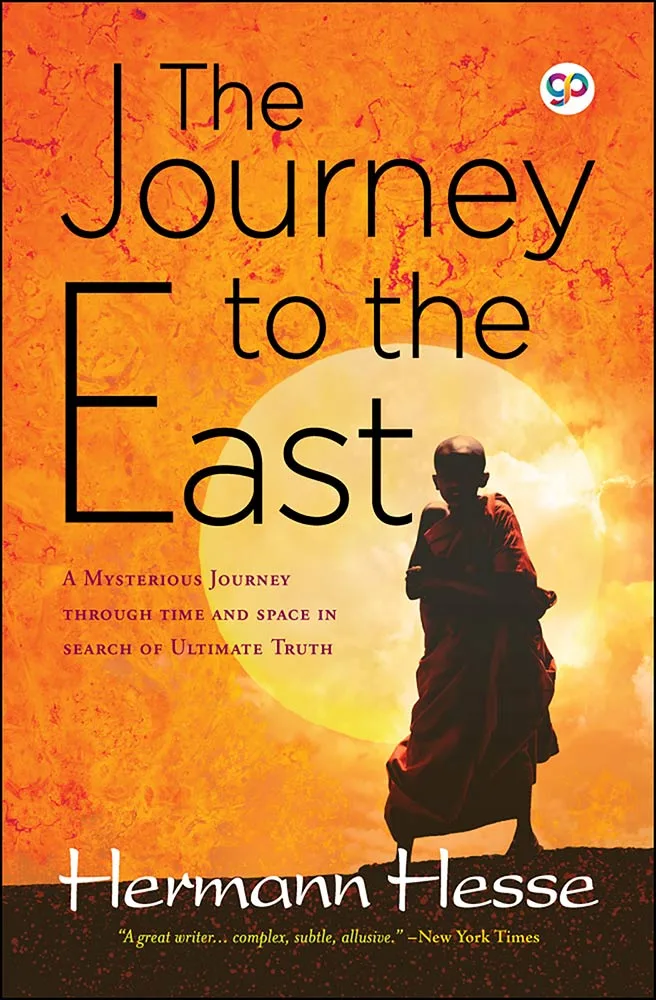
The Journey to the East
Paperback
• 96 Pages
• INR 245.00
• English
• 9789354994241
No ratings yet
| Publisher | General Press |
|---|---|
| ISBN13 | 9789354994241 |
| ASIN/SKU | 9354994245 |
| Book Format | Paperback |
| Language | English |
| Pages | 96 |
| List Price | INR 245.00 |
| Subject Code | FIC019000, FIC014000, FIC078000, FIC002000 |
| Publishing Date | 01/08/2022 |
| Dimensions | 8.25 x 5.25 x 1.0 inches |
| Book Code | BD00067719 |
Buy this Book
Amazon Stores
Ebook Stores
Other Stores
Discover The Journey to the East by Hermann Hesse. This book is published by General Press in Paperback format, ISBN 9789354994241, ASIN 9354994245, under Literature and Fiction, European Literature, Classics.
Book Description
What does it mean to seek something sacred — and what happens when you lose your way before you ever arrive? These are the questions that pulse quietly through 'The Journey to the East' by Hermann Hesse, a luminous work of philosophical fiction that reads less like a conventional novel and more like a waking dream about faith, community, and the strange nature of spiritual longing.
The story follows H.H., a narrator who once belonged to a mysterious and timeless fellowship known simply as the League. This grand company of seekers — drawn from different eras, different worlds, even different realities — set out together on a great pilgrimage toward the East, a destination that is as much a state of inner being as it is a place on any map. The journey is rich with wonder and meaning, and H.H. treasures the memory of it. But something went wrong. The expedition seemed to fall apart. A key figure disappeared, the group scattered, and H.H. was left alone, unable to fully remember or make sense of what happened.
Years later, he attempts to write down the story of the journey — and finds, to his growing despair, that he cannot. Memory fails him. The deeper he digs, the more the experience seems to dissolve. Hesse uses this predicament not as a plot device but as a profound meditation on how we narrate our own spiritual lives, and how easily we can convince ourselves that we have lost something that may never have been lost at all.
The book is short — barely a novella — but its density of meaning rewards slow, attentive reading. Hesse weaves in characters and references from history, mythology, and his own other works, creating the feeling of a world far larger than the page can contain. For anyone who has ever felt spiritually adrift, or wondered whether the path they abandoned might still be waiting for them, this quietly astonishing book has something urgent to say.
The story follows H.H., a narrator who once belonged to a mysterious and timeless fellowship known simply as the League. This grand company of seekers — drawn from different eras, different worlds, even different realities — set out together on a great pilgrimage toward the East, a destination that is as much a state of inner being as it is a place on any map. The journey is rich with wonder and meaning, and H.H. treasures the memory of it. But something went wrong. The expedition seemed to fall apart. A key figure disappeared, the group scattered, and H.H. was left alone, unable to fully remember or make sense of what happened.
Years later, he attempts to write down the story of the journey — and finds, to his growing despair, that he cannot. Memory fails him. The deeper he digs, the more the experience seems to dissolve. Hesse uses this predicament not as a plot device but as a profound meditation on how we narrate our own spiritual lives, and how easily we can convince ourselves that we have lost something that may never have been lost at all.
The book is short — barely a novella — but its density of meaning rewards slow, attentive reading. Hesse weaves in characters and references from history, mythology, and his own other works, creating the feeling of a world far larger than the page can contain. For anyone who has ever felt spiritually adrift, or wondered whether the path they abandoned might still be waiting for them, this quietly astonishing book has something urgent to say.
Author Biography
Born in Calw, Germany, in 1877, Hermann Hesse grew up in a strict family of Pietist missionaries. Expected to follow in his parents' footsteps and enter the ministry, the young Hesse actively rebelled against his rigid religious schooling. He eventually abandoned his seminary studies, worked as an apprentice in various bookshops, and dedicated himself to poetry and writing, finding his first taste of literary success with the publication of his novel Peter Camenzind in 1904.
Despite this early achievement, the outbreak of World War I, combined with marital struggles and the death of his father, plunged Hesse into a severe emotional crisis. Seeking relief, he underwent psychoanalysis with a disciple of Carl Jung. This profound encounter with psychoanalytic theory fundamentally shifted his artistic focus inward, transforming his literature into an intense exploration of the subconscious mind, human duality, and the individual's restless search for authentic identity.
This introspective journey fueled the creation of his most enduring masterpieces. In 1919, he published Demian, a striking exploration of self-realization that deeply resonated with a disillusioned post-war generation. He followed this with Siddhartha in 1922, a novel born from his lifelong fascination with Eastern philosophy and the quest for spiritual enlightenment. A few years later, Steppenwolf (1927) cemented his international reputation by brilliantly capturing the existential angst and fractured psyche of the modern individual.
Hesse’s literary career culminated with his magnum opus, The Glass Bead Game, published in 1943. In 1946, he was awarded the Nobel Prize in Literature for his deeply inspired writings, which consistently championed classical humanitarian ideals. Hesse spent the latter half of his life as a Swiss citizen in the quiet village of Montagnola, dedicating his time to writing, gardening, and painting watercolors until his death in 1962.
Despite this early achievement, the outbreak of World War I, combined with marital struggles and the death of his father, plunged Hesse into a severe emotional crisis. Seeking relief, he underwent psychoanalysis with a disciple of Carl Jung. This profound encounter with psychoanalytic theory fundamentally shifted his artistic focus inward, transforming his literature into an intense exploration of the subconscious mind, human duality, and the individual's restless search for authentic identity.
This introspective journey fueled the creation of his most enduring masterpieces. In 1919, he published Demian, a striking exploration of self-realization that deeply resonated with a disillusioned post-war generation. He followed this with Siddhartha in 1922, a novel born from his lifelong fascination with Eastern philosophy and the quest for spiritual enlightenment. A few years later, Steppenwolf (1927) cemented his international reputation by brilliantly capturing the existential angst and fractured psyche of the modern individual.
Hesse’s literary career culminated with his magnum opus, The Glass Bead Game, published in 1943. In 1946, he was awarded the Nobel Prize in Literature for his deeply inspired writings, which consistently championed classical humanitarian ideals. Hesse spent the latter half of his life as a Swiss citizen in the quiet village of Montagnola, dedicating his time to writing, gardening, and painting watercolors until his death in 1962.
Editorial Reviews
Editorial Reviews will be added soon…
Book Summary
Hermann Hesse’s The Journey to the East is a short but deeply symbolic novel about spiritual searching, faith, memory, and the meaning of a journey. First published in 1932, the book follows a narrator who joins a mysterious spiritual fellowship on a journey toward the East. What initially appears to be a physical expedition gradually becomes a journey into the inner self. Through the narrator’s experiences, Hesse explores the difficulty of maintaining faith, the danger of ego, the importance of service, and the possibility that the greatest truths are found not through achievement but through surrender and humility.
The story is told by an unnamed narrator who looks back on a journey he once undertook with a group called the League. The League is a mysterious spiritual brotherhood whose members come from different cultures and historical periods. They travel together toward the East, but their destination is not simply a geographical place. The East represents a spiritual realm, a source of wisdom, and a mysterious goal that each traveler understands differently. The members of the League are united by a shared belief that the journey has a higher purpose.
Among the travelers is Leo, a servant who at first seems like a minor figure. He is cheerful, patient, generous, and remarkably helpful. He carries luggage, prepares meals, sings songs, encourages tired travelers, and quietly assists everyone around him. The narrator and the other members of the group gradually become accustomed to Leo’s presence. Although he appears to be merely a servant, there is something unusual about him. His calmness and kindness give the journey a sense of harmony.
The journey itself is filled with strange and almost dreamlike experiences. The travelers move through unfamiliar landscapes and encounter people, stories, legends, and symbolic events. The boundaries between historical periods and ordinary reality are often blurred. Hesse intentionally creates an atmosphere in which different cultures and traditions seem to exist together. The East is therefore not presented as a precise geographical destination but as a symbolic place where spiritual knowledge, art, religion, and human experience meet.
The narrator believes deeply in the League and its mission. He trusts its rules and accepts the authority of its leaders. At first, he sees the journey as a collective spiritual undertaking in which every member has a meaningful role. However, as difficulties arise, tensions begin to appear. The travelers experience confusion, fatigue, and disagreements. Their commitment is tested, and the narrator gradually becomes less certain about the journey.
The crucial turning point occurs when Leo disappears. His absence seems small at first, but the group soon discovers how much depended upon him. Without Leo, practical problems become difficult to solve. More importantly, the emotional unity of the travelers begins to collapse. The narrator becomes increasingly anxious and confused. The journey loses its sense of direction, and the members begin to blame one another.
Eventually, the group falls apart. The narrator becomes separated from the others and feels abandoned. His confidence in the League is shaken. He returns to ordinary life carrying the painful memory of the failed journey. For years, he remains haunted by what happened. He cannot fully understand whether the journey was real, whether he failed the League, or whether he misunderstood its purpose from the beginning.
This part of the story reveals an important theme: spiritual journeys are often tested not by dramatic obstacles but by the weakness of the human ego. The narrator believes he is serving a higher cause, yet his faith depends partly on the presence of others and on his expectation that the journey will proceed according to a particular plan. When circumstances become difficult, his confidence disappears. Hesse suggests that faith based entirely on external structures can easily collapse.
Years later, the narrator tries to reconstruct what happened. He becomes involved with a society connected to the League and attempts to explain his experience. During this search, he encounters Leo again. This reunion transforms his understanding of the past.
The narrator discovers that Leo was not merely a servant. He was closely connected with the highest leadership of the League. The apparently humble servant had been far more important than the narrator realized. Leo’s true significance becomes clear only after the narrator has experienced failure and loss. The person he once regarded as an ordinary helper was actually one of the central spiritual figures of the journey.
This revelation forces the narrator to reconsider his earlier behavior. He realizes that he had failed to recognize greatness because he was looking for it in the wrong places. He had expected spiritual authority to appear in obvious forms, while Leo expressed it through humility and service. Leo never demanded recognition. He helped others without seeking praise, and his quiet presence held the group together.
The story therefore presents service as a profound form of spiritual strength. Leo’s power does not come from domination, knowledge, or public authority. It comes from his willingness to serve. Hesse contrasts this with the narrator’s more self-conscious search for meaning. The narrator wants to understand the journey intellectually, while Leo simply lives its values.
Memory is another major theme. The narrator’s understanding of the journey changes as he grows older. At first, he sees it as a failure. Later, he begins to realize that the failure itself was necessary for his spiritual development. What seemed like the end of the journey becomes part of a larger process of understanding. Hesse suggests that human beings often cannot recognize the meaning of an experience while they are living through it. Time, reflection, and humility may reveal meanings that were invisible at the time.
The idea of the “East” is deliberately mysterious. It can be understood as a place of spiritual awakening, but it can also represent the deeper center of the self. The journey toward the East is therefore an inward movement. The travelers seek something beyond ordinary life, yet the story gradually suggests that the desired truth cannot simply be reached by traveling to a distant location. It must be discovered through changes in consciousness.
Hesse also emphasizes the unity of different spiritual and cultural traditions. The League includes people associated with different historical periods and backgrounds, suggesting that genuine spiritual wisdom is not limited to one culture or one historical moment. The East becomes a symbolic meeting point where different traditions can coexist. The journey is ultimately a search for a deeper unity beneath the apparent divisions of human experience.
The narrator’s transformation is therefore less about acquiring new information than about changing his attitude. He must move from pride toward humility, from dependence on external certainty toward inner faith, and from the desire to be important toward the willingness to serve. The loss of Leo becomes the experience that exposes these weaknesses.
Ultimately, The Journey to the East is a meditation on what it means to seek something greater than oneself. Hesse suggests that spiritual truth cannot be forced or possessed through intellectual effort alone. The seeker must learn patience, trust, humility, and selflessness. The most important guide may not be the person who speaks the most or appears the most powerful, but the one who quietly serves others.
The journey in the novel is therefore both literal and symbolic. The travelers move toward an imagined East, but the narrator’s deepest journey occurs within his own mind and character. His failure becomes a lesson, his memories become a source of understanding, and Leo becomes a symbol of the humble wisdom he had failed to recognize. In the end, Hesse leaves readers with the sense that the true spiritual journey is not about reaching a spectacular destination. It is about becoming capable of recognizing meaning, accepting mystery, serving others, and discovering that what we seek outside ourselves may ultimately require a transformation within.
The story is told by an unnamed narrator who looks back on a journey he once undertook with a group called the League. The League is a mysterious spiritual brotherhood whose members come from different cultures and historical periods. They travel together toward the East, but their destination is not simply a geographical place. The East represents a spiritual realm, a source of wisdom, and a mysterious goal that each traveler understands differently. The members of the League are united by a shared belief that the journey has a higher purpose.
Among the travelers is Leo, a servant who at first seems like a minor figure. He is cheerful, patient, generous, and remarkably helpful. He carries luggage, prepares meals, sings songs, encourages tired travelers, and quietly assists everyone around him. The narrator and the other members of the group gradually become accustomed to Leo’s presence. Although he appears to be merely a servant, there is something unusual about him. His calmness and kindness give the journey a sense of harmony.
The journey itself is filled with strange and almost dreamlike experiences. The travelers move through unfamiliar landscapes and encounter people, stories, legends, and symbolic events. The boundaries between historical periods and ordinary reality are often blurred. Hesse intentionally creates an atmosphere in which different cultures and traditions seem to exist together. The East is therefore not presented as a precise geographical destination but as a symbolic place where spiritual knowledge, art, religion, and human experience meet.
The narrator believes deeply in the League and its mission. He trusts its rules and accepts the authority of its leaders. At first, he sees the journey as a collective spiritual undertaking in which every member has a meaningful role. However, as difficulties arise, tensions begin to appear. The travelers experience confusion, fatigue, and disagreements. Their commitment is tested, and the narrator gradually becomes less certain about the journey.
The crucial turning point occurs when Leo disappears. His absence seems small at first, but the group soon discovers how much depended upon him. Without Leo, practical problems become difficult to solve. More importantly, the emotional unity of the travelers begins to collapse. The narrator becomes increasingly anxious and confused. The journey loses its sense of direction, and the members begin to blame one another.
Eventually, the group falls apart. The narrator becomes separated from the others and feels abandoned. His confidence in the League is shaken. He returns to ordinary life carrying the painful memory of the failed journey. For years, he remains haunted by what happened. He cannot fully understand whether the journey was real, whether he failed the League, or whether he misunderstood its purpose from the beginning.
This part of the story reveals an important theme: spiritual journeys are often tested not by dramatic obstacles but by the weakness of the human ego. The narrator believes he is serving a higher cause, yet his faith depends partly on the presence of others and on his expectation that the journey will proceed according to a particular plan. When circumstances become difficult, his confidence disappears. Hesse suggests that faith based entirely on external structures can easily collapse.
Years later, the narrator tries to reconstruct what happened. He becomes involved with a society connected to the League and attempts to explain his experience. During this search, he encounters Leo again. This reunion transforms his understanding of the past.
The narrator discovers that Leo was not merely a servant. He was closely connected with the highest leadership of the League. The apparently humble servant had been far more important than the narrator realized. Leo’s true significance becomes clear only after the narrator has experienced failure and loss. The person he once regarded as an ordinary helper was actually one of the central spiritual figures of the journey.
This revelation forces the narrator to reconsider his earlier behavior. He realizes that he had failed to recognize greatness because he was looking for it in the wrong places. He had expected spiritual authority to appear in obvious forms, while Leo expressed it through humility and service. Leo never demanded recognition. He helped others without seeking praise, and his quiet presence held the group together.
The story therefore presents service as a profound form of spiritual strength. Leo’s power does not come from domination, knowledge, or public authority. It comes from his willingness to serve. Hesse contrasts this with the narrator’s more self-conscious search for meaning. The narrator wants to understand the journey intellectually, while Leo simply lives its values.
Memory is another major theme. The narrator’s understanding of the journey changes as he grows older. At first, he sees it as a failure. Later, he begins to realize that the failure itself was necessary for his spiritual development. What seemed like the end of the journey becomes part of a larger process of understanding. Hesse suggests that human beings often cannot recognize the meaning of an experience while they are living through it. Time, reflection, and humility may reveal meanings that were invisible at the time.
The idea of the “East” is deliberately mysterious. It can be understood as a place of spiritual awakening, but it can also represent the deeper center of the self. The journey toward the East is therefore an inward movement. The travelers seek something beyond ordinary life, yet the story gradually suggests that the desired truth cannot simply be reached by traveling to a distant location. It must be discovered through changes in consciousness.
Hesse also emphasizes the unity of different spiritual and cultural traditions. The League includes people associated with different historical periods and backgrounds, suggesting that genuine spiritual wisdom is not limited to one culture or one historical moment. The East becomes a symbolic meeting point where different traditions can coexist. The journey is ultimately a search for a deeper unity beneath the apparent divisions of human experience.
The narrator’s transformation is therefore less about acquiring new information than about changing his attitude. He must move from pride toward humility, from dependence on external certainty toward inner faith, and from the desire to be important toward the willingness to serve. The loss of Leo becomes the experience that exposes these weaknesses.
Ultimately, The Journey to the East is a meditation on what it means to seek something greater than oneself. Hesse suggests that spiritual truth cannot be forced or possessed through intellectual effort alone. The seeker must learn patience, trust, humility, and selflessness. The most important guide may not be the person who speaks the most or appears the most powerful, but the one who quietly serves others.
The journey in the novel is therefore both literal and symbolic. The travelers move toward an imagined East, but the narrator’s deepest journey occurs within his own mind and character. His failure becomes a lesson, his memories become a source of understanding, and Leo becomes a symbol of the humble wisdom he had failed to recognize. In the end, Hesse leaves readers with the sense that the true spiritual journey is not about reaching a spectacular destination. It is about becoming capable of recognizing meaning, accepting mystery, serving others, and discovering that what we seek outside ourselves may ultimately require a transformation within.
Sample Chapters
Sample Chapters will be added soon…
Reader Reviews
No reviews yet.
The Journey to the East
Download Cover Image
Do you want to download the full cover image for The Journey to the East?