
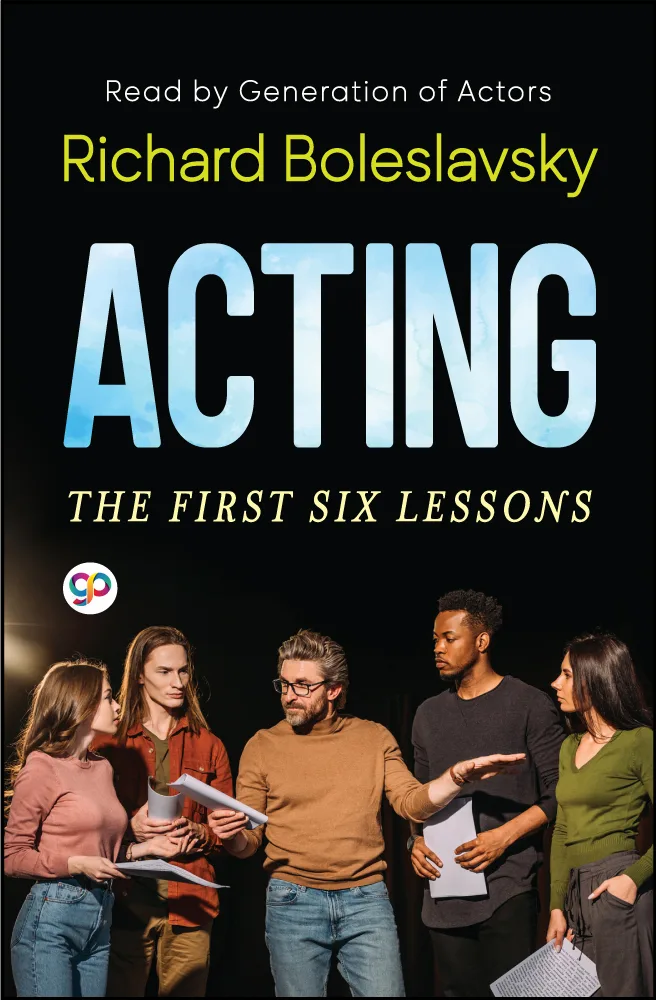
Acting: The First Six Lessons
Paperback
• 112 Pages
• INR 199.00
• English
• 9789354996504
No ratings yet
| Publisher | General Press |
|---|---|
| ISBN13 | 9789354996504 |
| ASIN/SKU | 9354996507 |
| Book Format | Paperback |
| Language | English |
| Pages | 112 |
| List Price | INR 199.00 |
| Subject Code | PER001000, PER011000, PER009000 |
| Dimensions | 8.25 x 5.25 x 1.0 inches |
| Book Code | BD00067733 |
Buy this Book
Amazon Stores
Ebook Stores
Other Stores
Discover Acting: The First Six Lessons by Richard Boleslavsky. This book is published by General Press in Paperback format, ISBN 9789354996504, ASIN 9354996507, under Literature and Fiction, Drama, Acting and Auditioning.
Book Description
The Master acting teacher Richard Boleslavsky presents his acting theory and technique in a lively and accessible narrative form. Widely considered a must-have for beginning as well as established actors, Boleslavsky's work has long helped actors better understand the craft of acting and what it takes to grow as an artist. He has taught generations of some of the best stage and screen actors and actresses. Written in the form of a series of dialogues, these lessons aim to inform and instruct the budding actor on some of the basic principles of acting and learning to act.
Richard Boleslavsky (1889–1937) was a Polish actor and director. He was a member of the Moscow Art Theatre and director of its First Studio. He immigrated to New York in the 1920s and was the first teacher of the Stanislavski system of acting in the West. He went on to produce plays on Broadway and was a leading Hollywood director in the 1930s.
Richard Boleslavsky (1889–1937) was a Polish actor and director. He was a member of the Moscow Art Theatre and director of its First Studio. He immigrated to New York in the 1920s and was the first teacher of the Stanislavski system of acting in the West. He went on to produce plays on Broadway and was a leading Hollywood director in the 1930s.
Author Biography
Richard Boleslavsky (1889-1937) was a Polish actor and director. He was a member of the Moscow Art Theatre and director of its First Studio. He immigrated to New York in the 1920s and was the first teacher of the Stanislavski system of acting in the West. He went on to produce plays on Broadway and was a leading Hollywood director in the 1930s. His knowledge of the theater was based on an impressive depth and breadth of experience.
Editorial Reviews
Editorial Reviews will be added soon…
Book Summary
Richard Boleslavsky’s Acting: The First Six Lessons is a classic introduction to the art of acting, written as a series of conversations between a teacher and a young actress. First published in 1933, the book presents the foundations of theatrical performance in a simple, practical, and deeply human way. Rather than treating acting as a mysterious gift possessed only by naturally talented performers, Boleslavsky presents it as a discipline that requires imagination, concentration, emotional understanding, physical control, observation, and continuous practice. The book is especially valuable because its lessons are not limited to acting techniques; they also explore what it means to live attentively and honestly as an artist.
The book is structured around six lessons, each focusing on an essential element of acting. The teacher patiently guides the young actress through her questions, mistakes, impatience, and discoveries. This conversational form makes the book approachable. The reader feels less like someone studying a technical manual and more like a student sitting in an acting class. Boleslavsky understands that a beginning actor can easily become confused by abstract advice, so he turns difficult artistic ideas into concrete experiences and exercises.
The first lesson focuses on concentration. For Boleslavsky, an actor must learn to concentrate completely on the imaginary circumstances of a scene. Simply standing on a stage and saying words is not enough. The performer must be able to direct attention away from the audience and toward the reality of the character’s world. This requires tremendous mental discipline. The actor must be able to imagine objects that are not physically present, respond to invisible circumstances, and remain absorbed in the dramatic situation even while hundreds of people are watching.
Boleslavsky’s idea of concentration is broader than simply “paying attention.” It involves the ability to make imagination so vivid that an imagined circumstance can produce a genuine response. An actor might have to behave as though a particular room, person, object, memory, or event exists even when none of it is actually present. The actor therefore learns to build an inner reality that supports the outward performance.
The second lesson is devoted to memory of emotion. Boleslavsky argues that an actor needs access to emotional experiences in order to portray human feelings convincingly. Instead of merely pretending to be sad, frightened, joyful, or angry, the actor can draw upon remembered emotional experiences and allow those feelings to inform the character. However, the purpose is not simply to reproduce a personal memory mechanically. The actor must transform personal experience into something that serves the character and the dramatic situation.
This lesson reflects Boleslavsky’s connection with the developing tradition of psychological acting associated with Konstantin Stanislavski and the Moscow Art Theatre. The emphasis is on inner truth rather than superficial imitation. A performer should not merely make the face look sad or the voice sound angry. The feeling should have a believable inner source. At the same time, Boleslavsky recognizes that an actor must learn to control emotion rather than become completely overwhelmed by it. Artistic performance requires both emotional access and artistic discipline.
The third lesson turns to dramatic action. Boleslavsky explains that acting is not simply about experiencing feelings; it is about doing something with those feelings. Every character wants something, and that desire creates action. A scene becomes alive when the actor understands what the character is trying to achieve. Even apparently quiet moments can contain strong dramatic action if the character is pursuing an objective.
This idea encourages actors to think beyond individual lines. A sentence may have different meanings depending on what the character wants when saying it. The same words can express love, fear, manipulation, jealousy, hope, or desperation depending on the circumstances. The actor therefore needs to understand the character’s objective and the obstacles standing in the way. Acting becomes a process of pursuing something rather than merely reciting dialogue.
The fourth lesson explores characterization. Here Boleslavsky emphasizes observation and imagination. Actors must learn to notice the details of human behavior: the way people walk, speak, sit, react, hesitate, look at others, and use their hands. Ordinary life becomes an enormous source of material for the actor. A performer who observes carefully can build believable characters from small details.
Yet imitation alone is not enough. The actor must combine observation with imagination. A character is not simply a collection of physical habits. The performer must understand the person’s inner world, including desires, fears, contradictions, memories, and relationships. Boleslavsky encourages the actor to enter the character’s circumstances imaginatively rather than judging the character from the outside. Even unpleasant or morally questionable characters must be approached with understanding if they are to be portrayed convincingly.
The fifth lesson deals with rhythm. Boleslavsky treats rhythm as an important but often misunderstood part of acting. Rhythm is not limited to the speed at which lines are spoken. It includes the movement and energy of a scene, the changing intensity of emotions, pauses, gestures, speech patterns, and the relationship between different moments of performance. Just as music has rhythm, drama has an inner rhythm that helps determine how a scene lives and develops.
A skilled actor learns to recognize when a scene should move quickly and when it needs stillness. A pause can sometimes communicate more than a sentence. A sudden change in tempo can reveal a character’s emotional transformation. Rhythm also prevents performances from becoming monotonous. Even when the dialogue remains simple, variations in pace, intensity, silence, and movement can create dramatic life.
The sixth and final lesson focuses on characterization through the body and the actor’s complete artistic development. Boleslavsky brings together many of the principles introduced earlier and emphasizes the importance of physical expression. The actor’s body must become a flexible instrument capable of communicating thought and feeling. Movement should not be decorative or artificial; it should grow naturally from the character and the circumstances.
This final lesson also reinforces the idea that acting requires the whole person. The actor needs imagination, emotional sensitivity, concentration, intelligence, physical awareness, and discipline. None of these qualities can be developed overnight. Acting is a lifelong process of observation and learning. The young actress begins the book eager to discover the secrets of performance, but she gradually learns that there is no single trick that will make someone a great actor. The craft demands patience and sustained effort.
One of the book’s greatest strengths is its humane understanding of actors. Boleslavsky does not treat performers as machines that must reproduce a particular technique. He recognizes their doubts, insecurities, excitement, and desire to express themselves. His teacher is demanding but encouraging, and the conversations often suggest that artistic growth requires humility. A beginner must be willing to make mistakes, observe carefully, and keep learning.
Ultimately, Acting: The First Six Lessons is a book about discovering truth through imagination. Boleslavsky teaches that convincing acting comes from a deep connection between inner experience and outward action. Concentration makes the imaginary world believable; emotional memory provides psychological depth; dramatic action gives scenes purpose; characterization transforms observation into human individuality; rhythm gives performance movement; and physical expression allows the inner life to become visible.
The enduring appeal of the book lies in its belief that acting is both an art and a way of understanding people. To become a better actor, one must become a better observer of human life. One must notice emotions, contradictions, habits, silences, gestures, desires, and fears. In that sense, Boleslavsky’s six lessons reach beyond the theatre. They encourage readers to pay closer attention to the richness of human experience. The book ultimately presents acting not as pretending to be someone else, but as learning to understand another human being so deeply that the character can live truthfully through the performer.
The book is structured around six lessons, each focusing on an essential element of acting. The teacher patiently guides the young actress through her questions, mistakes, impatience, and discoveries. This conversational form makes the book approachable. The reader feels less like someone studying a technical manual and more like a student sitting in an acting class. Boleslavsky understands that a beginning actor can easily become confused by abstract advice, so he turns difficult artistic ideas into concrete experiences and exercises.
The first lesson focuses on concentration. For Boleslavsky, an actor must learn to concentrate completely on the imaginary circumstances of a scene. Simply standing on a stage and saying words is not enough. The performer must be able to direct attention away from the audience and toward the reality of the character’s world. This requires tremendous mental discipline. The actor must be able to imagine objects that are not physically present, respond to invisible circumstances, and remain absorbed in the dramatic situation even while hundreds of people are watching.
Boleslavsky’s idea of concentration is broader than simply “paying attention.” It involves the ability to make imagination so vivid that an imagined circumstance can produce a genuine response. An actor might have to behave as though a particular room, person, object, memory, or event exists even when none of it is actually present. The actor therefore learns to build an inner reality that supports the outward performance.
The second lesson is devoted to memory of emotion. Boleslavsky argues that an actor needs access to emotional experiences in order to portray human feelings convincingly. Instead of merely pretending to be sad, frightened, joyful, or angry, the actor can draw upon remembered emotional experiences and allow those feelings to inform the character. However, the purpose is not simply to reproduce a personal memory mechanically. The actor must transform personal experience into something that serves the character and the dramatic situation.
This lesson reflects Boleslavsky’s connection with the developing tradition of psychological acting associated with Konstantin Stanislavski and the Moscow Art Theatre. The emphasis is on inner truth rather than superficial imitation. A performer should not merely make the face look sad or the voice sound angry. The feeling should have a believable inner source. At the same time, Boleslavsky recognizes that an actor must learn to control emotion rather than become completely overwhelmed by it. Artistic performance requires both emotional access and artistic discipline.
The third lesson turns to dramatic action. Boleslavsky explains that acting is not simply about experiencing feelings; it is about doing something with those feelings. Every character wants something, and that desire creates action. A scene becomes alive when the actor understands what the character is trying to achieve. Even apparently quiet moments can contain strong dramatic action if the character is pursuing an objective.
This idea encourages actors to think beyond individual lines. A sentence may have different meanings depending on what the character wants when saying it. The same words can express love, fear, manipulation, jealousy, hope, or desperation depending on the circumstances. The actor therefore needs to understand the character’s objective and the obstacles standing in the way. Acting becomes a process of pursuing something rather than merely reciting dialogue.
The fourth lesson explores characterization. Here Boleslavsky emphasizes observation and imagination. Actors must learn to notice the details of human behavior: the way people walk, speak, sit, react, hesitate, look at others, and use their hands. Ordinary life becomes an enormous source of material for the actor. A performer who observes carefully can build believable characters from small details.
Yet imitation alone is not enough. The actor must combine observation with imagination. A character is not simply a collection of physical habits. The performer must understand the person’s inner world, including desires, fears, contradictions, memories, and relationships. Boleslavsky encourages the actor to enter the character’s circumstances imaginatively rather than judging the character from the outside. Even unpleasant or morally questionable characters must be approached with understanding if they are to be portrayed convincingly.
The fifth lesson deals with rhythm. Boleslavsky treats rhythm as an important but often misunderstood part of acting. Rhythm is not limited to the speed at which lines are spoken. It includes the movement and energy of a scene, the changing intensity of emotions, pauses, gestures, speech patterns, and the relationship between different moments of performance. Just as music has rhythm, drama has an inner rhythm that helps determine how a scene lives and develops.
A skilled actor learns to recognize when a scene should move quickly and when it needs stillness. A pause can sometimes communicate more than a sentence. A sudden change in tempo can reveal a character’s emotional transformation. Rhythm also prevents performances from becoming monotonous. Even when the dialogue remains simple, variations in pace, intensity, silence, and movement can create dramatic life.
The sixth and final lesson focuses on characterization through the body and the actor’s complete artistic development. Boleslavsky brings together many of the principles introduced earlier and emphasizes the importance of physical expression. The actor’s body must become a flexible instrument capable of communicating thought and feeling. Movement should not be decorative or artificial; it should grow naturally from the character and the circumstances.
This final lesson also reinforces the idea that acting requires the whole person. The actor needs imagination, emotional sensitivity, concentration, intelligence, physical awareness, and discipline. None of these qualities can be developed overnight. Acting is a lifelong process of observation and learning. The young actress begins the book eager to discover the secrets of performance, but she gradually learns that there is no single trick that will make someone a great actor. The craft demands patience and sustained effort.
One of the book’s greatest strengths is its humane understanding of actors. Boleslavsky does not treat performers as machines that must reproduce a particular technique. He recognizes their doubts, insecurities, excitement, and desire to express themselves. His teacher is demanding but encouraging, and the conversations often suggest that artistic growth requires humility. A beginner must be willing to make mistakes, observe carefully, and keep learning.
Ultimately, Acting: The First Six Lessons is a book about discovering truth through imagination. Boleslavsky teaches that convincing acting comes from a deep connection between inner experience and outward action. Concentration makes the imaginary world believable; emotional memory provides psychological depth; dramatic action gives scenes purpose; characterization transforms observation into human individuality; rhythm gives performance movement; and physical expression allows the inner life to become visible.
The enduring appeal of the book lies in its belief that acting is both an art and a way of understanding people. To become a better actor, one must become a better observer of human life. One must notice emotions, contradictions, habits, silences, gestures, desires, and fears. In that sense, Boleslavsky’s six lessons reach beyond the theatre. They encourage readers to pay closer attention to the richness of human experience. The book ultimately presents acting not as pretending to be someone else, but as learning to understand another human being so deeply that the character can live truthfully through the performer.
Sample Chapters
Sample Chapters will be added soon…
Reader Reviews
No reviews yet.
Acting: The First Six Lessons
Download Cover Image
Do you want to download the full cover image for Acting: The First Six Lessons?