
The Kybalion: A Study of Hermetic Philosophy of Ancient Egypt and Greece
Paperback
• 136 Pages
• INR 245.00
• English
• 9789354994579
No ratings yet
| Publisher | General Press |
|---|---|
| ISBN13 | 9789354994579 |
| ASIN/SKU | 9354994571 |
| Book Format | Paperback |
| Language | English |
| Pages | 136 |
| List Price | INR 245.00 |
| Subject Code | REL047000, PHI005000, PHI002000 |
| Publishing Date | 22/09/2022 |
| Dimensions | 8.25 x 5.25 x 1.0 inches |
| Book Code | BD00067754 |
Buy this Book
Amazon Stores
Ebook Stores
Other Stores
Discover The Kybalion: A Study of Hermetic Philosophy of Ancient Egypt and Greece by Three Initiates. This book is published by General Press in Paperback format, ISBN 9789354994579, ASIN 9354994571, under Non Fiction, Spirituality, Philosophy.
Book Description
‘The Kybalion: A Study of the Hermetic Philosophy of Ancient Egypt and Greece’ is a book originally published in 1908 by Three Initiates (often identified as the New Thought pioneer William Walker Atkinson) that appears to convey the teachings of Hermes Trismegistus. The precepts of Hermetic philosophy remained shrouded in secrecy for more than two thousand years, clouded by obscure language and dense allegories.
Here you will be introduced to the Seven Hermetic Principles, a foundation upon which one can build their own personal spiritual path. A modern Hermetic tract, it has been widely influential in New Age circles since the twentieth century.
This concise guide offers a modern interpretation of the doctrine, distilling its teachings with seven compelling principles that can be applied to self-development in daily life. It is a concise and elegant treatise on occultism and High Magic in Greece and Egypt.
Here you will be introduced to the Seven Hermetic Principles, a foundation upon which one can build their own personal spiritual path. A modern Hermetic tract, it has been widely influential in New Age circles since the twentieth century.
This concise guide offers a modern interpretation of the doctrine, distilling its teachings with seven compelling principles that can be applied to self-development in daily life. It is a concise and elegant treatise on occultism and High Magic in Greece and Egypt.
Author Biography
According to legend, the ancient Egyptian sage Hermes Trismegistus is the father of astrology, alchemy, and other magical arts. His Hermetic philosophy was instrumental in the development of esoteric thought. This anonymous guide, written a century ago by "Three Initiates," offers a distillation of Hermetic doctrine.
Editorial Reviews
Editorial Reviews will be added soon…
Book Summary
The Kybalion: A Study of the Hermetic Philosophy of Ancient Egypt and Greece is one of the most widely discussed books in modern occult and metaphysical literature. Published in the early twentieth century under the name “Three Initiates,” the book presents itself as a concise explanation of the ancient Hermetic teachings associated with Hermes Trismegistus. Its central purpose is to offer readers a unified framework for understanding reality, consciousness, human behavior, and spiritual development through what it calls the Seven Hermetic Principles. The book’s contents are organized around Mentalism, Correspondence, Vibration, Polarity, Rhythm, Cause and Effect, and Gender, followed by discussions of mental transmutation, the nature of “The All,” different planes of existence, and practical Hermetic axioms.
At the heart of The Kybalion is a simple but profound proposition: reality is not merely something that happens outside us; consciousness and mind are fundamental to the way reality is experienced and understood. The book describes the ultimate reality as “The All,” an infinite and unknowable spiritual reality that it characterizes as universal mind. From this perspective, the visible universe is not separate from the divine or ultimate reality but exists within it. This idea becomes the foundation for everything that follows. If the universe is fundamentally mental, then changing one’s understanding, attention, emotional habits, and mental patterns becomes a form of spiritual transformation. The book therefore treats philosophy not simply as an intellectual exercise but as a practical discipline for mastering one’s inner life.
The first major teaching is the Principle of Mentalism, which states that the universe is fundamentally mental in nature. This does not mean, in the ordinary sense, that a person can simply imagine something and make it physically appear. Rather, The Kybalion argues that mind is the underlying reality through which existence is structured and experienced. Human beings live within a universe whose phenomena are ultimately expressions of a deeper universal intelligence. This principle also gives the individual a sense of responsibility: if our mental states influence how we interpret the world, then learning to understand and govern the mind becomes essential to personal growth. Thoughts, beliefs, expectations, fears, and desires are not treated as insignificant events but as forces that shape human experience.
The second principle is Correspondence, traditionally summarized through the famous Hermetic idea that there is a relationship between different levels of existence. The Kybalion applies this concept to physical, mental, and spiritual planes, suggesting that patterns found at one level can help us understand patterns at another. In practical terms, this encourages readers to look for recurring structures rather than viewing every problem as completely isolated. A conflict in relationships, for example, may reflect a deeper conflict within the individual. Similarly, understanding the workings of one's own mind may provide clues for understanding broader patterns of human behavior. The principle is therefore presented as a method of reasoning from the known toward the unknown.
The Principle of Vibration introduces another important idea: nothing is completely static. Everything exists in motion or varying degrees of vibration. In The Kybalion, differences between physical, mental, and spiritual phenomena are explained partly through differences in vibrational states. The practical significance of this teaching lies in the claim that mental states can be changed. A person overwhelmed by anger, fear, sadness, or anxiety does not necessarily have to remain permanently trapped in that state. Through attention, discipline, and deliberate mental practice, the individual can gradually shift toward a different state. This is one reason the book has remained attractive to readers interested in manifestation, consciousness, meditation, self-mastery, and personal transformation.
The Principle of Polarity develops the idea that apparent opposites are often different degrees of the same underlying thing. Hot and cold, for instance, can be understood as different positions along a single scale of temperature. The book extends this reasoning to mental and emotional experiences. Love and hate, courage and fear, attraction and repulsion may appear completely opposed, yet they can also be viewed as different degrees or expressions along a continuum. This concept becomes especially important because it gives The Kybalion a practical approach to emotional transformation. Instead of believing that a negative state must simply be suppressed, the reader is encouraged to understand its opposite and gradually shift the mind toward a more desirable pole.
This leads naturally into one of the book's most important practical concepts: mental transmutation. The term “alchemy” in The Kybalion is primarily presented as an inner process rather than the literal transformation of metals into gold. Mental states can supposedly be transformed from one condition into another through disciplined application of Hermetic principles. A person who understands the relationship between mental states, polarity, vibration, and attention can learn to work with the mind rather than simply being controlled by it. In this sense, the true alchemist is someone who can consciously transform destructive mental patterns into more constructive ones.
The Principle of Rhythm explains why human experience often moves in cycles. Life contains periods of expansion and contraction, activity and rest, confidence and doubt, success and disappointment. According to the book, this rhythmic movement operates throughout existence, including on the mental and emotional levels. The danger is becoming completely identified with each swing of the emotional pendulum. When life is going well, a person may become excessively confident; when circumstances deteriorate, that same person may collapse into despair. The Hermetic approach is to develop enough inner balance to recognize the rhythm without being completely controlled by it. The objective is not to deny life's changes but to become more stable while moving through them.
The sixth principle, Cause and Effect, argues that events do not occur without causes. The Kybalion rejects the idea of meaningless chance and maintains that phenomena operate according to laws, even when those laws are not understood by ordinary people. This teaching has a strong psychological dimension. People are frequently influenced by habits, social pressures, circumstances, inherited tendencies, and the actions of others. The book describes ordinary individuals as being carried along by these forces, while the Hermetic student attempts to become more conscious of them. The ideal is to move from being merely an effect of circumstances toward becoming a more deliberate cause in one's own life.
The seventh principle is Gender, which the book says operates throughout nature and existence. It presents masculine and feminine principles as complementary creative forces rather than merely biological categories. Importantly, the text itself distinguishes its philosophical treatment of gender from sexual or sensual interpretations and warns against reducing the principle to crude forms of occult sexuality. Later, the book applies the principle to mental gender, suggesting that creative thought involves complementary functions associated symbolically with masculine and feminine aspects. In this framework, creation requires both initiative and receptivity, both directed will and the capacity to receive and develop an idea.
After establishing the seven principles, The Kybalion turns toward the nature of The All. Here the book confronts one of its deepest philosophical problems: if ultimate reality is infinite, eternal, and beyond ordinary human categories, how can it be described at all? The answer is necessarily limited. “The All” cannot be completely defined because any definition would place boundaries around something supposedly infinite. The book therefore uses concepts such as universal mind and spirit as approximations. This part of the work is less about providing a conventional definition of God and more about encouraging readers to think beyond simplistic divisions between spirit and matter, creator and creation, or inner and outer reality.
The discussion of the Mental Universe follows naturally from this conception. If The All is universal mind, then individual consciousness exists within a larger field of reality rather than existing as an entirely separate phenomenon. The book uses this worldview to explain why thought, consciousness, and spiritual development occupy such an important place in Hermetic philosophy. The individual does not create the universe through personal fantasy, but the individual's mental life participates in a reality that is understood as fundamentally mental. This distinction is important because it prevents the book's philosophy from being reduced to the simplistic modern slogan that “you can think anything into existence.”
Another significant section concerns the planes of correspondence. The Kybalion describes physical, mental, and spiritual planes and argues that the same seven principles operate throughout them. The purpose is not merely to create a supernatural map of the universe but to show how the principles can be applied across different levels of experience. A law observed psychologically may have an analogous expression spiritually or physically. The Hermetic student therefore learns to look for relationships between levels rather than treating each realm as completely disconnected.
The chapters devoted specifically to vibration, polarity, rhythm, causation, and gender deepen the earlier explanations and turn them into a more systematic philosophy. The book repeatedly returns to the idea that knowledge becomes valuable only when it can be applied. Understanding that emotions fluctuate is not enough; one must learn how to remain centered while they fluctuate. Knowing that circumstances have causes is not enough; one must become more conscious of the causes one is creating. Understanding polarity is not enough; one must learn how to redirect destructive mental tendencies. In this way, The Kybalion presents spiritual wisdom as a discipline of self-mastery.
The final section, “Hermetic Axioms,” gathers together practical conclusions from the preceding teachings. The emphasis falls heavily on mental discipline, conscious attention, emotional control, and the ability to rise above automatic reactions. One of the book's most memorable ideas is that human beings can become less like passive pieces moved around by circumstances and more like conscious participants in the “game” of life. This does not mean that individuals control every event. Rather, it means that they can increasingly control their responses, interpretations, habits, and choices.
Ultimately, the central message of The Kybalion is that self-mastery begins with understanding the laws that appear to govern consciousness and existence. Its seven principles form a connected worldview rather than seven unrelated ideas. Mentalism establishes mind as fundamental; Correspondence connects different levels of reality; Vibration explains movement and changing states; Polarity explains opposites; Rhythm explains cycles; Cause and Effect explains lawful relationships; and Gender describes complementary creative forces. Together they provide the conceptual foundation for mental transmutation—the transformation of one's inner condition through knowledge and practice.
For readers searching for a summary of The Kybalion, an explanation of the seven Hermetic principles, Hermetic philosophy, mental transmutation, the law of vibration, the principle of polarity, or the meaning of “The All,” the book can be understood as a compact manual of metaphysical thought and psychological self-discipline. Its greatest appeal lies in the way it turns abstract spiritual philosophy into a language of everyday experience. Fear, ambition, emotional swings, habits, relationships, thoughts, and personal choices all become material for philosophical practice.
At the same time, The Kybalion is best approached as a work of modern esoteric philosophy inspired by Hermetic traditions, rather than as a straightforward historical record of ancient Egyptian and Greek philosophy. Although it presents itself as a statement of ancient Hermetic wisdom, the book was published in the early twentieth century, and its relationship to earlier Hermetic texts is a subject of scholarly discussion. The original work appeared under the pseudonym “Three Initiates,” whose identities have traditionally been uncertain. This historical distinction does not diminish the book's influence, but it does help readers understand what kind of book they are reading.
In the end, The Kybalion is less a conventional book of doctrine than an invitation to observe the mind and the patterns of life more carefully. Its enduring lesson is that wisdom is not simply the accumulation of mysterious knowledge. It is the gradual development of awareness, balance, discipline, and deliberate action. Whether a reader approaches it as occult philosophy, spiritual literature, a historical artifact of modern metaphysical thought, or a guide to self-reflection, its seven principles provide a memorable framework for asking some of the oldest human questions: What is reality? What is consciousness? Why do our emotional states change? How much freedom do we really possess? And how can we become less reactive and more intentional in the way we live? Those questions explain why The Kybalion continues to attract readers more than a century after its publication.
At the heart of The Kybalion is a simple but profound proposition: reality is not merely something that happens outside us; consciousness and mind are fundamental to the way reality is experienced and understood. The book describes the ultimate reality as “The All,” an infinite and unknowable spiritual reality that it characterizes as universal mind. From this perspective, the visible universe is not separate from the divine or ultimate reality but exists within it. This idea becomes the foundation for everything that follows. If the universe is fundamentally mental, then changing one’s understanding, attention, emotional habits, and mental patterns becomes a form of spiritual transformation. The book therefore treats philosophy not simply as an intellectual exercise but as a practical discipline for mastering one’s inner life.
The first major teaching is the Principle of Mentalism, which states that the universe is fundamentally mental in nature. This does not mean, in the ordinary sense, that a person can simply imagine something and make it physically appear. Rather, The Kybalion argues that mind is the underlying reality through which existence is structured and experienced. Human beings live within a universe whose phenomena are ultimately expressions of a deeper universal intelligence. This principle also gives the individual a sense of responsibility: if our mental states influence how we interpret the world, then learning to understand and govern the mind becomes essential to personal growth. Thoughts, beliefs, expectations, fears, and desires are not treated as insignificant events but as forces that shape human experience.
The second principle is Correspondence, traditionally summarized through the famous Hermetic idea that there is a relationship between different levels of existence. The Kybalion applies this concept to physical, mental, and spiritual planes, suggesting that patterns found at one level can help us understand patterns at another. In practical terms, this encourages readers to look for recurring structures rather than viewing every problem as completely isolated. A conflict in relationships, for example, may reflect a deeper conflict within the individual. Similarly, understanding the workings of one's own mind may provide clues for understanding broader patterns of human behavior. The principle is therefore presented as a method of reasoning from the known toward the unknown.
The Principle of Vibration introduces another important idea: nothing is completely static. Everything exists in motion or varying degrees of vibration. In The Kybalion, differences between physical, mental, and spiritual phenomena are explained partly through differences in vibrational states. The practical significance of this teaching lies in the claim that mental states can be changed. A person overwhelmed by anger, fear, sadness, or anxiety does not necessarily have to remain permanently trapped in that state. Through attention, discipline, and deliberate mental practice, the individual can gradually shift toward a different state. This is one reason the book has remained attractive to readers interested in manifestation, consciousness, meditation, self-mastery, and personal transformation.
The Principle of Polarity develops the idea that apparent opposites are often different degrees of the same underlying thing. Hot and cold, for instance, can be understood as different positions along a single scale of temperature. The book extends this reasoning to mental and emotional experiences. Love and hate, courage and fear, attraction and repulsion may appear completely opposed, yet they can also be viewed as different degrees or expressions along a continuum. This concept becomes especially important because it gives The Kybalion a practical approach to emotional transformation. Instead of believing that a negative state must simply be suppressed, the reader is encouraged to understand its opposite and gradually shift the mind toward a more desirable pole.
This leads naturally into one of the book's most important practical concepts: mental transmutation. The term “alchemy” in The Kybalion is primarily presented as an inner process rather than the literal transformation of metals into gold. Mental states can supposedly be transformed from one condition into another through disciplined application of Hermetic principles. A person who understands the relationship between mental states, polarity, vibration, and attention can learn to work with the mind rather than simply being controlled by it. In this sense, the true alchemist is someone who can consciously transform destructive mental patterns into more constructive ones.
The Principle of Rhythm explains why human experience often moves in cycles. Life contains periods of expansion and contraction, activity and rest, confidence and doubt, success and disappointment. According to the book, this rhythmic movement operates throughout existence, including on the mental and emotional levels. The danger is becoming completely identified with each swing of the emotional pendulum. When life is going well, a person may become excessively confident; when circumstances deteriorate, that same person may collapse into despair. The Hermetic approach is to develop enough inner balance to recognize the rhythm without being completely controlled by it. The objective is not to deny life's changes but to become more stable while moving through them.
The sixth principle, Cause and Effect, argues that events do not occur without causes. The Kybalion rejects the idea of meaningless chance and maintains that phenomena operate according to laws, even when those laws are not understood by ordinary people. This teaching has a strong psychological dimension. People are frequently influenced by habits, social pressures, circumstances, inherited tendencies, and the actions of others. The book describes ordinary individuals as being carried along by these forces, while the Hermetic student attempts to become more conscious of them. The ideal is to move from being merely an effect of circumstances toward becoming a more deliberate cause in one's own life.
The seventh principle is Gender, which the book says operates throughout nature and existence. It presents masculine and feminine principles as complementary creative forces rather than merely biological categories. Importantly, the text itself distinguishes its philosophical treatment of gender from sexual or sensual interpretations and warns against reducing the principle to crude forms of occult sexuality. Later, the book applies the principle to mental gender, suggesting that creative thought involves complementary functions associated symbolically with masculine and feminine aspects. In this framework, creation requires both initiative and receptivity, both directed will and the capacity to receive and develop an idea.
After establishing the seven principles, The Kybalion turns toward the nature of The All. Here the book confronts one of its deepest philosophical problems: if ultimate reality is infinite, eternal, and beyond ordinary human categories, how can it be described at all? The answer is necessarily limited. “The All” cannot be completely defined because any definition would place boundaries around something supposedly infinite. The book therefore uses concepts such as universal mind and spirit as approximations. This part of the work is less about providing a conventional definition of God and more about encouraging readers to think beyond simplistic divisions between spirit and matter, creator and creation, or inner and outer reality.
The discussion of the Mental Universe follows naturally from this conception. If The All is universal mind, then individual consciousness exists within a larger field of reality rather than existing as an entirely separate phenomenon. The book uses this worldview to explain why thought, consciousness, and spiritual development occupy such an important place in Hermetic philosophy. The individual does not create the universe through personal fantasy, but the individual's mental life participates in a reality that is understood as fundamentally mental. This distinction is important because it prevents the book's philosophy from being reduced to the simplistic modern slogan that “you can think anything into existence.”
Another significant section concerns the planes of correspondence. The Kybalion describes physical, mental, and spiritual planes and argues that the same seven principles operate throughout them. The purpose is not merely to create a supernatural map of the universe but to show how the principles can be applied across different levels of experience. A law observed psychologically may have an analogous expression spiritually or physically. The Hermetic student therefore learns to look for relationships between levels rather than treating each realm as completely disconnected.
The chapters devoted specifically to vibration, polarity, rhythm, causation, and gender deepen the earlier explanations and turn them into a more systematic philosophy. The book repeatedly returns to the idea that knowledge becomes valuable only when it can be applied. Understanding that emotions fluctuate is not enough; one must learn how to remain centered while they fluctuate. Knowing that circumstances have causes is not enough; one must become more conscious of the causes one is creating. Understanding polarity is not enough; one must learn how to redirect destructive mental tendencies. In this way, The Kybalion presents spiritual wisdom as a discipline of self-mastery.
The final section, “Hermetic Axioms,” gathers together practical conclusions from the preceding teachings. The emphasis falls heavily on mental discipline, conscious attention, emotional control, and the ability to rise above automatic reactions. One of the book's most memorable ideas is that human beings can become less like passive pieces moved around by circumstances and more like conscious participants in the “game” of life. This does not mean that individuals control every event. Rather, it means that they can increasingly control their responses, interpretations, habits, and choices.
Ultimately, the central message of The Kybalion is that self-mastery begins with understanding the laws that appear to govern consciousness and existence. Its seven principles form a connected worldview rather than seven unrelated ideas. Mentalism establishes mind as fundamental; Correspondence connects different levels of reality; Vibration explains movement and changing states; Polarity explains opposites; Rhythm explains cycles; Cause and Effect explains lawful relationships; and Gender describes complementary creative forces. Together they provide the conceptual foundation for mental transmutation—the transformation of one's inner condition through knowledge and practice.
For readers searching for a summary of The Kybalion, an explanation of the seven Hermetic principles, Hermetic philosophy, mental transmutation, the law of vibration, the principle of polarity, or the meaning of “The All,” the book can be understood as a compact manual of metaphysical thought and psychological self-discipline. Its greatest appeal lies in the way it turns abstract spiritual philosophy into a language of everyday experience. Fear, ambition, emotional swings, habits, relationships, thoughts, and personal choices all become material for philosophical practice.
At the same time, The Kybalion is best approached as a work of modern esoteric philosophy inspired by Hermetic traditions, rather than as a straightforward historical record of ancient Egyptian and Greek philosophy. Although it presents itself as a statement of ancient Hermetic wisdom, the book was published in the early twentieth century, and its relationship to earlier Hermetic texts is a subject of scholarly discussion. The original work appeared under the pseudonym “Three Initiates,” whose identities have traditionally been uncertain. This historical distinction does not diminish the book's influence, but it does help readers understand what kind of book they are reading.
In the end, The Kybalion is less a conventional book of doctrine than an invitation to observe the mind and the patterns of life more carefully. Its enduring lesson is that wisdom is not simply the accumulation of mysterious knowledge. It is the gradual development of awareness, balance, discipline, and deliberate action. Whether a reader approaches it as occult philosophy, spiritual literature, a historical artifact of modern metaphysical thought, or a guide to self-reflection, its seven principles provide a memorable framework for asking some of the oldest human questions: What is reality? What is consciousness? Why do our emotional states change? How much freedom do we really possess? And how can we become less reactive and more intentional in the way we live? Those questions explain why The Kybalion continues to attract readers more than a century after its publication.
Sample Chapters
Sample Chapters will be added soon…
Reader Reviews
No reviews yet.
The Kybalion: A Study of Hermetic Philosophy of Ancient Egypt and Greece
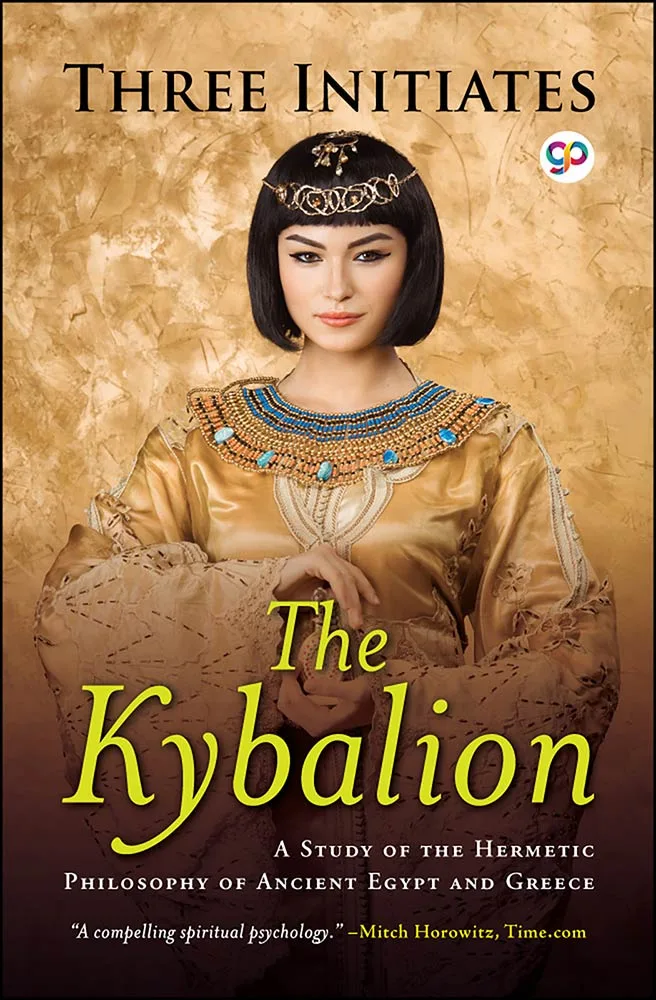
Download Cover Image
Do you want to download the full cover image for The Kybalion: A Study of Hermetic Philosophy of Ancient Egypt and Greece?