
Man and Superman
Hardcover
• 272 Pages
• INR 495.00
• English
• 9789354994739
No ratings yet
| Publisher | General Press |
|---|---|
| ISBN13 | 9789354994739 |
| ASIN/SKU | 9354994733 |
| Book Format | Hardcover |
| Language | English |
| Pages | 272 |
| List Price | INR 495.00 |
| Subject Code | DRA018000, LIT004230, PHI016000 |
| Publishing Date | 22/09/2022 |
| Dimensions | 8.25 x 5.25 x 1.0 inches |
| Book Code | BD00067768 |
Buy this Book
Amazon Stores
Ebook Stores
Other Stores
Discover Man and Superman by George Bernard Shaw. This book is published by General Press in Hardcover format, ISBN 9789354994739, ASIN 9354994733, under Literature and Fiction, Drama, Humor and Satire.
Book Description
‘Man and Superman’ is one of the finest and most devilish four-act dramas, written by George Bernard Shaw in 1903. Shaw was an Irish playwright, critic, polemicist and political activist. The series was written in response to calls for Shaw to write a play based on the Don Juan theme. It opened at the Royal Court Theatre in London on 23 May 1905, but it omitted the third act.
It portrays Don Juan as the quarry instead of the huntsman. John Tanner, upon discovering that his beautiful ward plans to marry him, flees to the Sierra Nevada mountain range, where he is captured by a group of rebels.
Tanner falls asleep, and dreams of the famous ‘Don Juan in Hell’ sequence, which features a sparkling Shavian debate among Don Juan, the Devil, and a talkative statue. With its fairy-tale ending and a cast literally from hell, it is a hilarious cocktail of farce, Nietzschean philosophy, and Mozart's Don Giovanni.
It portrays Don Juan as the quarry instead of the huntsman. John Tanner, upon discovering that his beautiful ward plans to marry him, flees to the Sierra Nevada mountain range, where he is captured by a group of rebels.
Tanner falls asleep, and dreams of the famous ‘Don Juan in Hell’ sequence, which features a sparkling Shavian debate among Don Juan, the Devil, and a talkative statue. With its fairy-tale ending and a cast literally from hell, it is a hilarious cocktail of farce, Nietzschean philosophy, and Mozart's Don Giovanni.
Author Biography
George Bernard Shaw (1856-1950) was born in Dublin, the son of a civil servant. His education was irregular, due to his dislike of any organized training. After working in an estate agent’s office for a while he moved to London as a young man (1876), where he established himself as a leading music and theatre critic in the eighties and nineties and became a prominent member of the Fabian Society, for which he composed many pamphlets. He began his literary career as a novelist; as a fervent advocate of the new theatre of Ibsen (The Quintessence of Ibsenism, 1891) he decided to write plays in order to illustrate his criticism of the English stage. His earliest dramas were called appropriately Plays Pleasant and Unpleasant (1898). Among these, Widower’s Houses and Mrs. Warren’s Profession savagely attack social hypocrisy, while in plays such as Arms and the Man and The Man of Destiny the criticism is less fierce. Shaw’s radical rationalism, his utter disregard of conventions, his keen dialectic interest and verbal wit often turn the stage into a forum of ideas, and nowhere more openly than in the famous discourses on the Life Force, «Don Juan in Hell», the third act of the dramatization of woman’s love chase of man, Man and Superman (1903).
In the plays of his later period discussion sometimes drowns the drama, in Back to Methuselah (1921), although in the same period he worked on his masterpiece Saint Joan (1923), in which he rewrites the well-known story of the French maiden and extends it from the Middle Ages to the present.
Other important plays by Shaw are Caesar and Cleopatra (1901), a historical play filled with allusions to modern times, and Androcles and the Lion (1912), in which he exercised a kind of retrospective history and from modern movements drew deductions for the Christian era. In Major Barbara (1905), one of Shaw’s most successful «discussion» plays, the audience’s attention is held by the power of the witty argumentation that man can achieve aesthetic salvation only through political activity, not as an individual. The Doctor’s Dilemma (1906), facetiously classified as a tragedy by Shaw, is really a comedy the humour of which is directed at the medical profession. Candida (1898), with social attitudes toward sex relations as objects of his satire, and Pygmalion (1912), a witty study of phonetics as well as a clever treatment of middle-class morality and class distinction, proved some of Shaw’s greatest successes on the stage. It is a combination of the dramatic, the comic, and the social corrective that gives Shaw’s comedies their special flavour.
Shaw’s complete works appeared in thirty-six volumes between 1930 and 1950, the year of his death.
In the plays of his later period discussion sometimes drowns the drama, in Back to Methuselah (1921), although in the same period he worked on his masterpiece Saint Joan (1923), in which he rewrites the well-known story of the French maiden and extends it from the Middle Ages to the present.
Other important plays by Shaw are Caesar and Cleopatra (1901), a historical play filled with allusions to modern times, and Androcles and the Lion (1912), in which he exercised a kind of retrospective history and from modern movements drew deductions for the Christian era. In Major Barbara (1905), one of Shaw’s most successful «discussion» plays, the audience’s attention is held by the power of the witty argumentation that man can achieve aesthetic salvation only through political activity, not as an individual. The Doctor’s Dilemma (1906), facetiously classified as a tragedy by Shaw, is really a comedy the humour of which is directed at the medical profession. Candida (1898), with social attitudes toward sex relations as objects of his satire, and Pygmalion (1912), a witty study of phonetics as well as a clever treatment of middle-class morality and class distinction, proved some of Shaw’s greatest successes on the stage. It is a combination of the dramatic, the comic, and the social corrective that gives Shaw’s comedies their special flavour.
Shaw’s complete works appeared in thirty-six volumes between 1930 and 1950, the year of his death.
Editorial Reviews
Editorial Reviews will be added soon…
Book Summary
George Bernard Shaw’s Man and Superman is far more than a romantic comedy about a man who does not want to get married. First published in 1903 and later staged in 1905, the play combines witty social comedy, unconventional romance, political argument, and serious philosophical speculation. Shaw himself presented it as “A Comedy and a Philosophy,” and that description captures its unusual character.
At the heart of Man and Superman is a simple but provocative question: What is humanity trying to become? Shaw’s answer involves evolution, intelligence, desire, marriage, gender, morality, and what he calls the Life Force—the creative energy that pushes living beings toward higher forms of existence. The “Superman” in the title represents an imagined future human being who has developed beyond ordinary limitations and can consciously participate in humanity’s evolution.
The play is also a clever reworking of the traditional Don Juan story. Instead of presenting Don Juan as a man constantly pursuing women, Shaw turns the situation upside down. His modern Don Juan, John Tanner, is a passionate intellectual who wants to escape marriage, while Ann Whitefield is the woman determined to capture him.
The Story Begins: Ann Whitefield and Her Two Guardians
The play opens after the death of Mr. Whitefield, the father of Ann Whitefield. His will creates an unusual arrangement: Ann is placed under the joint guardianship of the conservative Roebuck Ramsden and the radical John Tanner.
Ramsden represents the respectable Victorian establishment. He believes in social order, convention, morality, and conventional ideas about marriage. Tanner is almost his complete opposite. He is wealthy, outspoken, politically radical, suspicious of institutions, and openly hostile toward marriage. He has even written The Revolutionist’s Handbook and Pocket Companion, a provocative political work expressing his revolutionary ideas. The handbook appears as an appendix to the play and extends Shaw’s philosophical arguments beyond the stage.
Tanner immediately dislikes the idea of being Ann’s guardian. He fears that his involvement with her will eventually lead to the very institution he hates most: marriage.
Ann, however, is not the helpless young woman the men imagine her to be.
She is intelligent, self-controlled, charming, and remarkably determined. She understands people extremely well and knows how to influence them without appearing forceful. This makes her one of Shaw’s most interesting female characters. She does not simply wait for men to decide her future. She has already decided what she wants.
And what she wants is Tanner.
Octavius: The Man Who Loves Ann
The romantic triangle becomes clear through Octavius Robinson, known affectionately as Tavy. Octavius is a sensitive young poet who is deeply in love with Ann. Unlike Tanner, he genuinely admires her and dreams of marrying her.
From the outside, Octavius appears to be the obvious choice for Ann. He is gentle, romantic, artistic, and devoted. Tanner, by contrast, seems argumentative, arrogant, and obsessed with his theories.
Yet Ann does not choose the man who adores her.
She wants Tanner precisely because he resists her.
This reversal is central to Shaw’s comedy. In traditional romantic stories, the man pursues the woman. In Man and Superman, the woman becomes the active force. Ann pursues Tanner while Tanner spends much of the play trying to escape her.
Shaw uses this reversal not merely for humor but to question traditional assumptions about courtship and sexual attraction. The play explores attraction as a powerful biological and social force rather than simply as sentimental romance.
Tanner’s Great Escape
Tanner becomes increasingly convinced that Ann intends to trap him into marriage. His response is to run away.
He leaves England with his chauffeur, Henry Straker, and eventually becomes involved with Mendoza, a bandit who captures him.
Even here Shaw refuses to follow ordinary adventure-story conventions. Tanner does not behave like a conventional prisoner. He begins talking with Mendoza, arguing about politics, society, and revolution. The supposedly dangerous criminal becomes another opportunity for philosophical conversation.
Tanner’s escape is therefore both physical and symbolic. He believes he can escape Ann, marriage, and the social structures he despises. But Shaw is already preparing the audience for the central irony: Tanner can run from Ann, but he cannot run from the Life Force.
The Famous “Don Juan in Hell” Episode
The philosophical center of Man and Superman comes in Act III, the famous dream sequence known as “Don Juan in Hell.” It is so substantial and self-contained that it is often performed separately from the rest of the play.
While Tanner is sleeping, the characters of the ordinary world become figures from the Don Juan legend.
Tanner becomes Don Juan.
Ann becomes Dona Ana.
Ramsden becomes the Statue.
Mendoza becomes the Devil.
The dream transforms the romantic conflict into a philosophical debate about human existence.
The Devil argues for pleasure. From his perspective, Hell is attractive because it is comfortable, beautiful, and free from the burdens of purpose. Why struggle to become something greater when people can simply enjoy themselves?
Don Juan rejects this philosophy.
For him, existence has a purpose. Human beings are not meant merely to consume pleasure, reproduce, and die. They possess intelligence, and intelligence gives them the ability to reflect upon existence and consciously participate in evolution.
This leads to Shaw’s most important philosophical idea: the Life Force.
The Life Force and the Superman
The Life Force is the creative impulse within life itself. It is not simply biological survival. It is a drive toward greater consciousness and higher development.
Shaw takes inspiration from evolutionary thought and engages with ideas associated with philosophers such as Friedrich Nietzsche, although his concept of the Superman is not simply a repetition of Nietzsche’s philosophy. The play presents humanity as unfinished: human beings are part of an evolutionary process that may eventually produce a higher form of human existence.
The Superman is therefore not merely a physically stronger person.
He represents a more conscious human being—someone capable of understanding the forces shaping life and cooperating intelligently with them.
For Shaw, intellect matters enormously because human beings have the ability to think about their own existence. A person who merely follows instinct remains limited. A person who understands the direction of life and acts consciously can help humanity move forward.
This makes the title Man and Superman deeply significant. “Man” represents humanity as it currently exists; “Superman” represents the possibility of what humanity might become.
Ann Whitefield and the Life Force
One of Shaw’s boldest ideas is that women play a crucial role in the evolutionary process.
Ann is not simply trying to marry Tanner because she happens to love him. Shaw presents her as an embodiment of the Life Force. She knows what she wants, and she relentlessly moves toward it.
Tanner believes that he is the intellectual master of the situation. He analyzes everything. He explains marriage, society, politics, sexual attraction, and human nature.
But Ann does not need a theory.
She simply acts.
That creates one of the play’s great ironies: Tanner understands the Life Force intellectually, while Ann embodies it practically.
Tanner thinks he is escaping biology through philosophy, but Shaw suggests that philosophy itself cannot make a human being independent of the deeper forces of life.
Ann wants Tanner because she believes he is the right man for the future she imagines. Her determination is therefore connected to Shaw’s larger argument about reproduction and evolution. The union of Ann’s instinctive energy and Tanner’s intellectual capacity becomes symbolically important to the possibility of producing the Superman.
Marriage as a Battle of Wills
Marriage in Man and Superman is not presented as a simple expression of romantic love.
Instead, Shaw treats marriage as an institution through which people negotiate power, desire, responsibility, and social expectations.
Tanner considers marriage a form of imprisonment. He wants freedom and independence. Ann sees marriage differently. She understands it as part of the natural and social organization of human life.
This conflict gives the play much of its humor.
Tanner repeatedly announces that he will never marry Ann. The more firmly he declares his independence, the more certain Ann becomes that she will eventually win.
His resistance almost becomes part of her attraction to him.
The irony is that Tanner, who prides himself on being a revolutionary thinker, proves less capable of resisting Ann than he imagines. His intellectual arguments cannot protect him from emotional and biological forces.
Morality, Hypocrisy, and Social Convention
Shaw also attacks conventional morality throughout the play.
Characters who consider themselves respectable are not necessarily more honest or ethical than the radicals they criticize. Ramsden, for example, represents traditional morality but is frequently exposed as limited by his assumptions.
Violet Robinson provides another comic challenge to conventional morality. She appears to have become pregnant outside marriage, creating a scandal. Yet the situation is not what society assumes. Her story exposes the tendency of respectable society to judge appearances before discovering facts.
Shaw repeatedly shows that social morality can become a performance. People defend rules because those rules make society comfortable, not necessarily because the rules are inherently wise.
This is one reason Shaw’s comedy remains sharp: he does not simply ask whether people obey moral rules; he asks whether those rules deserve to be obeyed.
Tanner and Ann: The Real Meaning of the Romance
The final relationship between Tanner and Ann is deliberately more complicated than a conventional love story.
Tanner begins the play believing that he is the independent thinker and Ann is the conventional woman he must avoid. Gradually, however, the power relationship reverses.
Ann is far more strategically capable than Tanner.
She understands him.
She knows his weaknesses.
She knows when to appear innocent and when to assert herself.
And, most importantly, she does not take his declarations of independence at face value.
Tanner eventually recognizes that his resistance is failing. The man who spends the play explaining why marriage is impossible finally finds himself moving toward it.
This is not simply a defeat.
Shaw suggests that Tanner’s surrender may actually be part of his development. The intellectual revolutionary cannot become “superhuman” by rejecting life. He must engage with it.
The Life Force demands participation, not escape.
Why “Don Juan” Matters
Shaw’s use of Don Juan is one of the most inventive elements of the play.
Traditional Don Juan is famous for pursuing women. Shaw turns him into a man pursued by a woman.
The transformation allows Shaw to question the old stereotype of male sexual dominance. Ann becomes the pursuer, while Tanner becomes the reluctant object of desire.
In “Don Juan in Hell,” the familiar romantic story is transformed into a debate about the meaning of life. Don Juan is no longer primarily interested in seduction. He wants knowledge, consciousness, and purpose.
The dream therefore reveals what the surface comedy has been saying all along: the struggle between Tanner and Ann is also a struggle between intellect and instinct, freedom and continuity, individual independence and the evolutionary demands of life.
The Central Themes of Man and Superman
The play brings several major themes together.
The Life Force is perhaps the most important. Shaw imagines life as an active creative process that pushes humanity toward greater consciousness.
The Superman represents humanity’s possible future. Shaw asks whether human beings can evolve beyond their present limitations through intelligence and conscious action.
Love and marriage are treated less sentimentally than in conventional romantic comedy. Shaw presents them as powerful social and biological forces.
Gender roles are deliberately reversed. Ann is the pursuer, while Tanner is the reluctant romantic target.
Intellect versus instinct runs throughout the play. Tanner possesses enormous intellectual energy, while Ann possesses extraordinary instinctive certainty.
Morality and hypocrisy are also central. Shaw challenges the assumption that socially approved behavior is automatically morally superior.
Conclusion: What Does Man and Superman Really Mean?
Man and Superman is ultimately a comedy about a man who thinks he is escaping marriage but discovers that he cannot escape life itself.
John Tanner believes that freedom means refusing social conventions. Ann Whitefield demonstrates another kind of freedom: the ability to understand what she wants and pursue it without apology.
Their conflict becomes Shaw’s larger philosophical argument.
Human beings are not finished creatures. They are part of an ongoing process. Intelligence gives humanity the possibility of consciously directing that process. But intelligence cannot exist in isolation from instinct, desire, reproduction, society, and the deeper forces of life.
That is why the title is so important. Shaw is interested in the distance between Man—the imperfect human being of the present—and the Superman, the more conscious and capable being that humanity might become.
The play’s lasting appeal comes from the fact that Shaw never separates philosophy from ordinary human behavior. His biggest questions emerge through arguments about marriage, love, money, politics, sex, social respectability, and personal freedom. The result is funny, provocative, sometimes deliberately outrageous, and surprisingly serious.
For readers searching for a summary of Man and Superman by George Bernard Shaw, the central idea can therefore be stated simply: Shaw uses the comic struggle between John Tanner and Ann Whitefield to explore whether human beings are controlled by instinct or capable of consciously shaping their future. Through the idea of the Life Force and the imagined Superman, he argues that humanity's greatest task is not merely to survive, but to become more intelligent, purposeful, and fully conscious of what life is trying to achieve.
In the end, Tanner’s greatest mistake is believing that he can defeat the Life Force simply by understanding it. Ann does not need to defeat him intellectually. She simply keeps moving forward. And Shaw leaves us with the amusing but profound possibility that the supposedly revolutionary man may become part of the very evolutionary process he spent the entire play trying to escape.
At the heart of Man and Superman is a simple but provocative question: What is humanity trying to become? Shaw’s answer involves evolution, intelligence, desire, marriage, gender, morality, and what he calls the Life Force—the creative energy that pushes living beings toward higher forms of existence. The “Superman” in the title represents an imagined future human being who has developed beyond ordinary limitations and can consciously participate in humanity’s evolution.
The play is also a clever reworking of the traditional Don Juan story. Instead of presenting Don Juan as a man constantly pursuing women, Shaw turns the situation upside down. His modern Don Juan, John Tanner, is a passionate intellectual who wants to escape marriage, while Ann Whitefield is the woman determined to capture him.
The Story Begins: Ann Whitefield and Her Two Guardians
The play opens after the death of Mr. Whitefield, the father of Ann Whitefield. His will creates an unusual arrangement: Ann is placed under the joint guardianship of the conservative Roebuck Ramsden and the radical John Tanner.
Ramsden represents the respectable Victorian establishment. He believes in social order, convention, morality, and conventional ideas about marriage. Tanner is almost his complete opposite. He is wealthy, outspoken, politically radical, suspicious of institutions, and openly hostile toward marriage. He has even written The Revolutionist’s Handbook and Pocket Companion, a provocative political work expressing his revolutionary ideas. The handbook appears as an appendix to the play and extends Shaw’s philosophical arguments beyond the stage.
Tanner immediately dislikes the idea of being Ann’s guardian. He fears that his involvement with her will eventually lead to the very institution he hates most: marriage.
Ann, however, is not the helpless young woman the men imagine her to be.
She is intelligent, self-controlled, charming, and remarkably determined. She understands people extremely well and knows how to influence them without appearing forceful. This makes her one of Shaw’s most interesting female characters. She does not simply wait for men to decide her future. She has already decided what she wants.
And what she wants is Tanner.
Octavius: The Man Who Loves Ann
The romantic triangle becomes clear through Octavius Robinson, known affectionately as Tavy. Octavius is a sensitive young poet who is deeply in love with Ann. Unlike Tanner, he genuinely admires her and dreams of marrying her.
From the outside, Octavius appears to be the obvious choice for Ann. He is gentle, romantic, artistic, and devoted. Tanner, by contrast, seems argumentative, arrogant, and obsessed with his theories.
Yet Ann does not choose the man who adores her.
She wants Tanner precisely because he resists her.
This reversal is central to Shaw’s comedy. In traditional romantic stories, the man pursues the woman. In Man and Superman, the woman becomes the active force. Ann pursues Tanner while Tanner spends much of the play trying to escape her.
Shaw uses this reversal not merely for humor but to question traditional assumptions about courtship and sexual attraction. The play explores attraction as a powerful biological and social force rather than simply as sentimental romance.
Tanner’s Great Escape
Tanner becomes increasingly convinced that Ann intends to trap him into marriage. His response is to run away.
He leaves England with his chauffeur, Henry Straker, and eventually becomes involved with Mendoza, a bandit who captures him.
Even here Shaw refuses to follow ordinary adventure-story conventions. Tanner does not behave like a conventional prisoner. He begins talking with Mendoza, arguing about politics, society, and revolution. The supposedly dangerous criminal becomes another opportunity for philosophical conversation.
Tanner’s escape is therefore both physical and symbolic. He believes he can escape Ann, marriage, and the social structures he despises. But Shaw is already preparing the audience for the central irony: Tanner can run from Ann, but he cannot run from the Life Force.
The Famous “Don Juan in Hell” Episode
The philosophical center of Man and Superman comes in Act III, the famous dream sequence known as “Don Juan in Hell.” It is so substantial and self-contained that it is often performed separately from the rest of the play.
While Tanner is sleeping, the characters of the ordinary world become figures from the Don Juan legend.
Tanner becomes Don Juan.
Ann becomes Dona Ana.
Ramsden becomes the Statue.
Mendoza becomes the Devil.
The dream transforms the romantic conflict into a philosophical debate about human existence.
The Devil argues for pleasure. From his perspective, Hell is attractive because it is comfortable, beautiful, and free from the burdens of purpose. Why struggle to become something greater when people can simply enjoy themselves?
Don Juan rejects this philosophy.
For him, existence has a purpose. Human beings are not meant merely to consume pleasure, reproduce, and die. They possess intelligence, and intelligence gives them the ability to reflect upon existence and consciously participate in evolution.
This leads to Shaw’s most important philosophical idea: the Life Force.
The Life Force and the Superman
The Life Force is the creative impulse within life itself. It is not simply biological survival. It is a drive toward greater consciousness and higher development.
Shaw takes inspiration from evolutionary thought and engages with ideas associated with philosophers such as Friedrich Nietzsche, although his concept of the Superman is not simply a repetition of Nietzsche’s philosophy. The play presents humanity as unfinished: human beings are part of an evolutionary process that may eventually produce a higher form of human existence.
The Superman is therefore not merely a physically stronger person.
He represents a more conscious human being—someone capable of understanding the forces shaping life and cooperating intelligently with them.
For Shaw, intellect matters enormously because human beings have the ability to think about their own existence. A person who merely follows instinct remains limited. A person who understands the direction of life and acts consciously can help humanity move forward.
This makes the title Man and Superman deeply significant. “Man” represents humanity as it currently exists; “Superman” represents the possibility of what humanity might become.
Ann Whitefield and the Life Force
One of Shaw’s boldest ideas is that women play a crucial role in the evolutionary process.
Ann is not simply trying to marry Tanner because she happens to love him. Shaw presents her as an embodiment of the Life Force. She knows what she wants, and she relentlessly moves toward it.
Tanner believes that he is the intellectual master of the situation. He analyzes everything. He explains marriage, society, politics, sexual attraction, and human nature.
But Ann does not need a theory.
She simply acts.
That creates one of the play’s great ironies: Tanner understands the Life Force intellectually, while Ann embodies it practically.
Tanner thinks he is escaping biology through philosophy, but Shaw suggests that philosophy itself cannot make a human being independent of the deeper forces of life.
Ann wants Tanner because she believes he is the right man for the future she imagines. Her determination is therefore connected to Shaw’s larger argument about reproduction and evolution. The union of Ann’s instinctive energy and Tanner’s intellectual capacity becomes symbolically important to the possibility of producing the Superman.
Marriage as a Battle of Wills
Marriage in Man and Superman is not presented as a simple expression of romantic love.
Instead, Shaw treats marriage as an institution through which people negotiate power, desire, responsibility, and social expectations.
Tanner considers marriage a form of imprisonment. He wants freedom and independence. Ann sees marriage differently. She understands it as part of the natural and social organization of human life.
This conflict gives the play much of its humor.
Tanner repeatedly announces that he will never marry Ann. The more firmly he declares his independence, the more certain Ann becomes that she will eventually win.
His resistance almost becomes part of her attraction to him.
The irony is that Tanner, who prides himself on being a revolutionary thinker, proves less capable of resisting Ann than he imagines. His intellectual arguments cannot protect him from emotional and biological forces.
Morality, Hypocrisy, and Social Convention
Shaw also attacks conventional morality throughout the play.
Characters who consider themselves respectable are not necessarily more honest or ethical than the radicals they criticize. Ramsden, for example, represents traditional morality but is frequently exposed as limited by his assumptions.
Violet Robinson provides another comic challenge to conventional morality. She appears to have become pregnant outside marriage, creating a scandal. Yet the situation is not what society assumes. Her story exposes the tendency of respectable society to judge appearances before discovering facts.
Shaw repeatedly shows that social morality can become a performance. People defend rules because those rules make society comfortable, not necessarily because the rules are inherently wise.
This is one reason Shaw’s comedy remains sharp: he does not simply ask whether people obey moral rules; he asks whether those rules deserve to be obeyed.
Tanner and Ann: The Real Meaning of the Romance
The final relationship between Tanner and Ann is deliberately more complicated than a conventional love story.
Tanner begins the play believing that he is the independent thinker and Ann is the conventional woman he must avoid. Gradually, however, the power relationship reverses.
Ann is far more strategically capable than Tanner.
She understands him.
She knows his weaknesses.
She knows when to appear innocent and when to assert herself.
And, most importantly, she does not take his declarations of independence at face value.
Tanner eventually recognizes that his resistance is failing. The man who spends the play explaining why marriage is impossible finally finds himself moving toward it.
This is not simply a defeat.
Shaw suggests that Tanner’s surrender may actually be part of his development. The intellectual revolutionary cannot become “superhuman” by rejecting life. He must engage with it.
The Life Force demands participation, not escape.
Why “Don Juan” Matters
Shaw’s use of Don Juan is one of the most inventive elements of the play.
Traditional Don Juan is famous for pursuing women. Shaw turns him into a man pursued by a woman.
The transformation allows Shaw to question the old stereotype of male sexual dominance. Ann becomes the pursuer, while Tanner becomes the reluctant object of desire.
In “Don Juan in Hell,” the familiar romantic story is transformed into a debate about the meaning of life. Don Juan is no longer primarily interested in seduction. He wants knowledge, consciousness, and purpose.
The dream therefore reveals what the surface comedy has been saying all along: the struggle between Tanner and Ann is also a struggle between intellect and instinct, freedom and continuity, individual independence and the evolutionary demands of life.
The Central Themes of Man and Superman
The play brings several major themes together.
The Life Force is perhaps the most important. Shaw imagines life as an active creative process that pushes humanity toward greater consciousness.
The Superman represents humanity’s possible future. Shaw asks whether human beings can evolve beyond their present limitations through intelligence and conscious action.
Love and marriage are treated less sentimentally than in conventional romantic comedy. Shaw presents them as powerful social and biological forces.
Gender roles are deliberately reversed. Ann is the pursuer, while Tanner is the reluctant romantic target.
Intellect versus instinct runs throughout the play. Tanner possesses enormous intellectual energy, while Ann possesses extraordinary instinctive certainty.
Morality and hypocrisy are also central. Shaw challenges the assumption that socially approved behavior is automatically morally superior.
Conclusion: What Does Man and Superman Really Mean?
Man and Superman is ultimately a comedy about a man who thinks he is escaping marriage but discovers that he cannot escape life itself.
John Tanner believes that freedom means refusing social conventions. Ann Whitefield demonstrates another kind of freedom: the ability to understand what she wants and pursue it without apology.
Their conflict becomes Shaw’s larger philosophical argument.
Human beings are not finished creatures. They are part of an ongoing process. Intelligence gives humanity the possibility of consciously directing that process. But intelligence cannot exist in isolation from instinct, desire, reproduction, society, and the deeper forces of life.
That is why the title is so important. Shaw is interested in the distance between Man—the imperfect human being of the present—and the Superman, the more conscious and capable being that humanity might become.
The play’s lasting appeal comes from the fact that Shaw never separates philosophy from ordinary human behavior. His biggest questions emerge through arguments about marriage, love, money, politics, sex, social respectability, and personal freedom. The result is funny, provocative, sometimes deliberately outrageous, and surprisingly serious.
For readers searching for a summary of Man and Superman by George Bernard Shaw, the central idea can therefore be stated simply: Shaw uses the comic struggle between John Tanner and Ann Whitefield to explore whether human beings are controlled by instinct or capable of consciously shaping their future. Through the idea of the Life Force and the imagined Superman, he argues that humanity's greatest task is not merely to survive, but to become more intelligent, purposeful, and fully conscious of what life is trying to achieve.
In the end, Tanner’s greatest mistake is believing that he can defeat the Life Force simply by understanding it. Ann does not need to defeat him intellectually. She simply keeps moving forward. And Shaw leaves us with the amusing but profound possibility that the supposedly revolutionary man may become part of the very evolutionary process he spent the entire play trying to escape.
Sample Chapters
Sample Chapters will be added soon…
Reader Reviews
No reviews yet.
Man and Superman
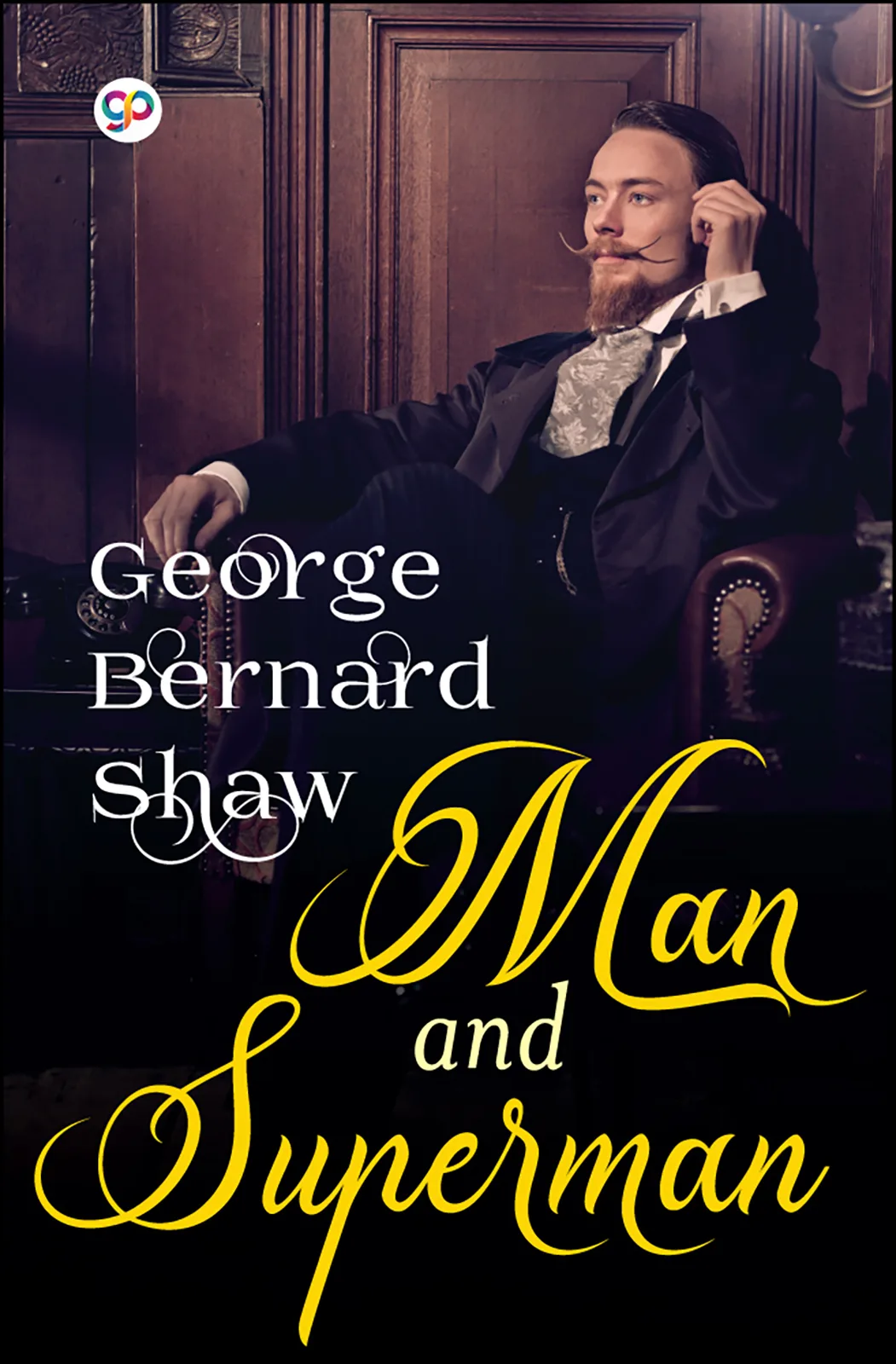
Download Cover Image
Do you want to download the full cover image for Man and Superman?