
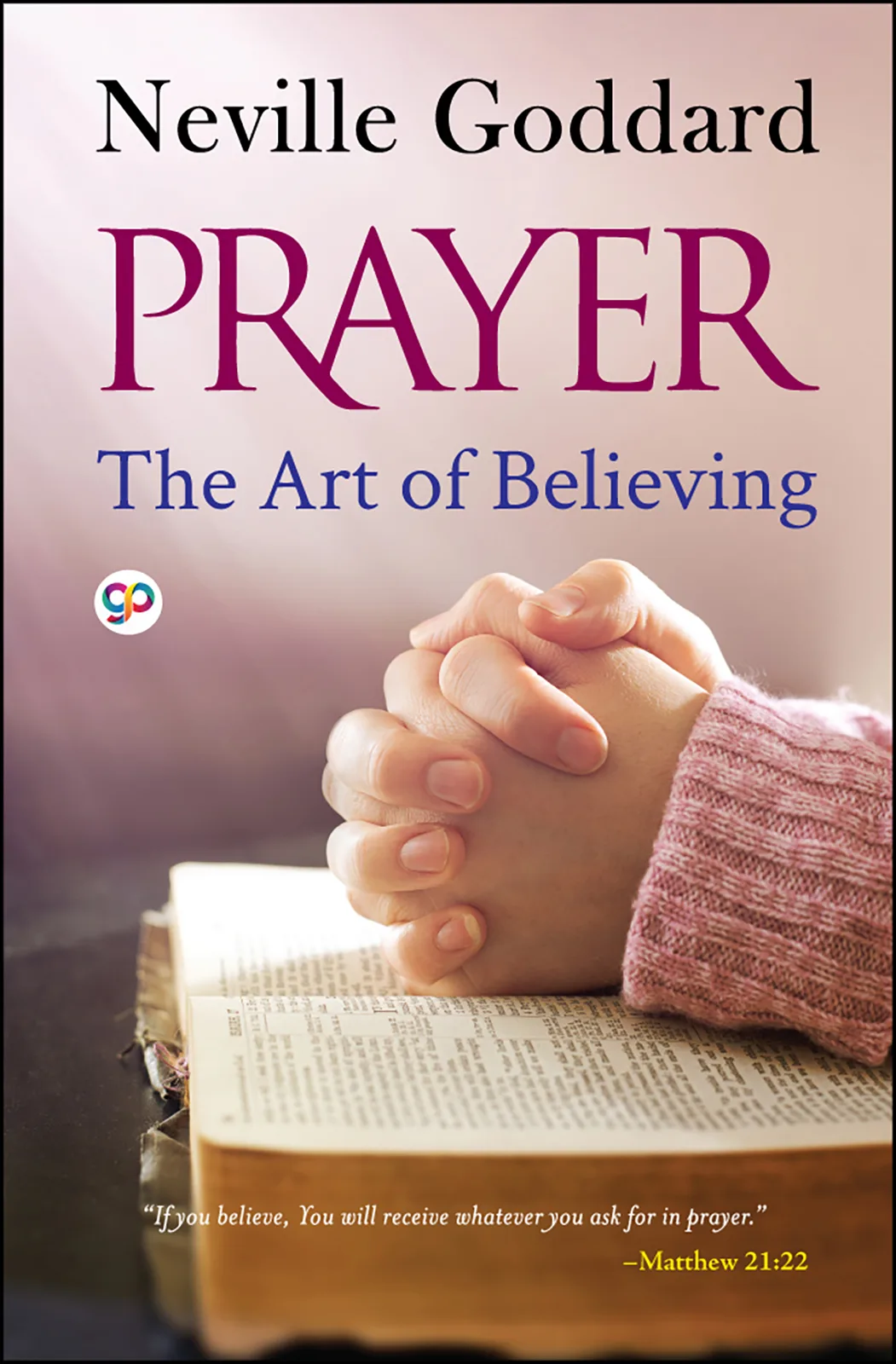
Prayer: The Art of Believing
Hardcover
• 80 Pages
• INR 295.00
• English
• 9789354994746
No ratings yet
| Publisher | General Press |
|---|---|
| ISBN13 | 9789354994746 |
| ASIN/SKU | 9354994741 |
| Book Format | Hardcover |
| Language | English |
| Pages | 80 |
| List Price | INR 295.00 |
| Subject Code | OCC010000, SEL027000, REL012070, REL012120 |
| Publishing Date | 22/09/2022 |
| Dimensions | 8.25 x 5.25 x 1.0 inches |
| Book Code | BD00067769 |
Buy this Book
Amazon Stores
Ebook Stores
Other Stores
Discover Prayer: The Art of Believing by Neville Goddard. This book is published by General Press in Hardcover format, ISBN 9789354994746, ASIN 9354994741, under Religion and Spirituality, New Thought, Mysticism.
Book Description
First published in 1945, ‘Prayer: The Art of Believing’ by Neville Goddard, is a powerful book that reveals how and why the power of faithful prayer works in a very real way and how it is the answer to the world’s problems. Prayer is the master key. A key may fit one door of a house, but when it fits all doors it may well claim to be a master key.
Neville wrote, “This book is an attempt to reduce the unknown to the known, by pointing out conditions on which prayers are answered, and without which they cannot be answered.” Understanding human imagination and how our belief system impacts our reality is incredibly important in being able to work with manifestation.
Neville wrote, “This book is an attempt to reduce the unknown to the known, by pointing out conditions on which prayers are answered, and without which they cannot be answered.” Understanding human imagination and how our belief system impacts our reality is incredibly important in being able to work with manifestation.
Author Biography
Neville Lancelot Goddard (1905–1972) was a prominent and highly influential teacher in the New Thought movement, best known for his philosophy on the creative power of the human imagination. Born in St. Michael, Barbados, Goddard moved to New York City in 1922 to study drama. While working as a dancer and actor, his interests shifted toward mysticism after meeting an eccentric Ethiopian rabbi named Abdullah, who mentored him in Kabbalah, esoteric Christianity, and the psychological interpretation of scripture.
Leaving the theater behind, Neville dedicated his life to teaching what he termed "The Law of Assumption"—the principle that one can manifest their desires by vividly assuming the feeling of the wish fulfilled. Unlike many of his contemporaries, he taught that the Bible was not a historical record but a psychological drama mapping the evolution of human consciousness, asserting that the divine creator is the human imagination itself.
Throughout the mid-20th century, he delivered hundreds of unscripted lectures across the United States and authored foundational metaphysical classics, including Feeling is the Secret and The Power of Awareness. Today, Goddard’s visionary teachings continue to experience a massive resurgence, profoundly shaping modern self-help, spirituality, and manifestation philosophies.
Leaving the theater behind, Neville dedicated his life to teaching what he termed "The Law of Assumption"—the principle that one can manifest their desires by vividly assuming the feeling of the wish fulfilled. Unlike many of his contemporaries, he taught that the Bible was not a historical record but a psychological drama mapping the evolution of human consciousness, asserting that the divine creator is the human imagination itself.
Throughout the mid-20th century, he delivered hundreds of unscripted lectures across the United States and authored foundational metaphysical classics, including Feeling is the Secret and The Power of Awareness. Today, Goddard’s visionary teachings continue to experience a massive resurgence, profoundly shaping modern self-help, spirituality, and manifestation philosophies.
Editorial Reviews
Editorial Reviews will be added soon…
Book Summary
Prayer: The Art of Believing by Neville Goddard is a concise but influential work of mystical and New Thought spirituality that presents a very different understanding of prayer. Published in 1945, the book argues that prayer is not primarily a matter of pleading with an external power for something that does not yet exist. Instead, Neville Goddard describes prayer as an active discipline of consciousness in which a person imagines, feels, and accepts a desired condition as though it were already true. The book contains seven chapters—“Law of Reversibility,” “Dual Nature of Consciousness,” “Imagination and Faith,” “Controlled Reverie,” “Law of Thought Transmission,” “Good Tidings,” and “The Greatest Prayer.” For readers searching for a Prayer: The Art of Believing summary, Neville Goddard prayer method, Neville Goddard manifestation teachings, law of assumption explained, feeling of the wish fulfilled, or how Neville Goddard says prayer works, the book can be understood as a practical philosophy of belief in which imagination, feeling, and inner conviction become the foundation of prayer.
Goddard begins with a simple but radical proposition: prayer is an art and therefore requires practice. He rejects empty repetition, elaborate ceremony, and prayer performed merely as an outward religious ritual. For him, the important part of prayer happens inwardly. A person must become quiet enough to control attention and imagination. Instead of mechanically repeating words, the individual should consciously create an inner experience that corresponds to the desired result. Goddard believes that prayer becomes effective when faith is joined with understanding, because belief alone can remain passive unless a person understands how to direct it.
This immediately changes the ordinary meaning of prayer. Traditional petitionary prayer often begins with a problem: a person lacks money, health, companionship, success, peace, or some other desired condition and asks God to provide it. Goddard's approach begins from the opposite direction. He asks the person to mentally occupy the condition in which the problem has already been resolved. If someone wants financial security, the question is not simply, “How can I get money?” but, “What would I feel if I were already financially secure?” If someone wants reconciliation, the person imagines the conversation that would occur after reconciliation. If someone desires recognition for their work, they imagine receiving congratulations or hearing someone acknowledge the accomplishment. Prayer therefore becomes an exercise in experiencing the end result rather than dwelling upon the present lack.
The first chapter, “Law of Reversibility,” supplies the theoretical foundation for this approach. Goddard argues that transformations can be understood in reverse: if one condition can produce another, the resulting condition can also be used to reproduce the original condition. He applies this principle to psychology and prayer. If an external event can create a particular feeling, then, according to Goddard, deliberately creating that feeling can help produce the corresponding external condition. In his framework, the emotional state associated with a fulfilled desire becomes a kind of cause rather than merely an effect.
This idea leads directly to what later became one of the most recognizable elements of Neville Goddard's teachings: feeling the wish fulfilled. The practitioner does not merely picture an object from a distance. The goal is to feel the emotional reality of already possessing the desired condition. A person who wants a new home might imagine standing inside it, noticing its familiar details, hearing someone congratulate them, or feeling the relief and satisfaction of finally having a place they love. The imagined scene is valuable because it implies that the desired event has already occurred. The mind is invited to experience the result rather than continuously rehearsing the absence of the result.
Goddard's second chapter, “Dual Nature of Consciousness,” examines the relationship between the conscious and subconscious aspects of mind. He presents consciousness as having different levels of operation. The conscious mind reasons, evaluates, chooses, and directs attention, while the subconscious accepts impressions and expresses them in ways that are less directly controlled by ordinary reasoning. For Goddard, this distinction explains why intellectual statements are often ineffective when they contradict a person's deeper emotional assumptions. Someone may consciously say, “I am confident,” while inwardly expecting rejection. In such a situation, the deeper conviction remains dominant.
This is why belief in Neville Goddard's philosophy is more than repeating affirmations. If a person repeatedly says, “I am successful,” but inwardly feels anxiety, failure, or unworthiness, the words alone do not represent genuine belief. Goddard wants the desired state to become emotionally believable. The practitioner gradually changes the inner assumption until the new condition feels natural rather than forced. The deeper objective is therefore a transformation of state: the individual moves from being someone who wants a particular result to someone who inwardly experiences that result as already accomplished.
The third chapter, “Imagination and Faith,” develops the relationship between these two ideas. For Goddard, imagination is not merely fantasy or escapism. It is a creative faculty through which a person can mentally experience situations that are not yet visible to the senses. Faith gives imagination conviction. A person imagines the desired condition and then accepts it inwardly as true. In this sense, faith is not simply hoping that something might happen someday. It is the decision to experience the desired condition now in consciousness.
This emphasis on imagination is one reason Prayer: The Art of Believing has become particularly influential among readers interested in manifestation, visualization, self-concept, and the law of assumption. Goddard's approach asks readers to stop treating the external world as the only evidence of what is possible. The senses reveal the current situation, but the imagination can represent a different possibility. Prayer becomes the disciplined process of giving that possibility emotional reality.
Goddard also distinguishes faith from willpower. Willpower often involves force: a person tries to convince themselves of something while another part of the mind continues to resist it. Goddard believes that this struggle is unnecessary. The desired state should instead become natural through imagination and repeated feeling. When the assumption feels ordinary, the practitioner no longer needs to force themselves to believe it. This is a subtle but important distinction. The aim is not to shout oneself into optimism but to cultivate an inner experience that gradually feels familiar and convincing.
The fourth chapter, “Controlled Reverie,” explains how Goddard believes this inner state can be cultivated. He recommends a relaxed condition in which ordinary mental activity becomes quieter and imagination becomes more receptive. This state is especially useful before sleep, when the mind is less occupied with external distractions. Rather than constructing a complicated fantasy, the practitioner creates a short, simple scene that would naturally occur if the desire had already been fulfilled. The scene is then experienced repeatedly from the first-person point of view.
For example, someone seeking a new job might imagine shaking hands with a friend who says, “Congratulations on your new position.” Someone hoping to repair a relationship might imagine receiving a warm message from the other person. Someone seeking a creative achievement might imagine holding the completed work and hearing praise from someone whose opinion matters. The exact scene is less important than its implication: the desired event has already happened. Goddard's method therefore places great importance on simplicity, emotional realism, and relaxation.
The fifth chapter, “Law of Thought Transmission,” extends his philosophy into relationships. Goddard proposes that people can influence one another through mental states and assumptions even without direct conversation. This becomes particularly important in his discussion of praying for another person. Instead of repeatedly imagining someone's illness, failure, sadness, or difficulty, he encourages the practitioner to imagine that person as already experiencing the desired condition. If a friend is struggling, for example, the prayer should not continually reinforce the picture of the friend as helpless. Instead, the practitioner imagines the friend healthy, successful, peaceful, or relieved.
This chapter reveals an important ethical aspect of Goddard's approach. Prayer is not presented merely as a technique for obtaining possessions. It can also become a way of changing one's perception of other people. Rather than mentally imprisoning someone in their current circumstances, the practitioner imagines their potential fulfillment. The underlying idea is that the inner picture we maintain of another person matters. Goddard therefore encourages readers to replace mental criticism and fearful expectations with images of well-being.
The sixth chapter, “Good Tidings,” turns toward the practical application of the method. Goddard emphasizes the importance of having a clearly defined objective. A vague wish is difficult to imagine because it has no definite shape. The practitioner should therefore determine exactly what fulfillment would look and feel like. What would they see? What would someone say to them? What would they hear? How would they feel if the problem had already disappeared?
This leads naturally to the importance of mental conversations. Much of human thinking occurs through silent conversations with other people. We replay old arguments, imagine future confrontations, anticipate criticism, and mentally rehearse disappointment. Goddard argues that these inner conversations can reinforce unwanted states. If someone constantly imagines being rejected, they are repeatedly giving emotional attention to rejection. The alternative is to deliberately imagine conversations that imply the desired outcome. Instead of rehearsing failure, the person rehearses success; instead of imagining criticism, they imagine appreciation; instead of replaying conflict, they imagine reconciliation.
The seventh chapter, “The Greatest Prayer,” brings the book's ideas to their highest spiritual level. Goddard argues that the most profound form of prayer involves using imagination to see good in oneself and others. The imagination should not merely be a tool for personal acquisition. It should become a means of transforming perception. If another person is struggling, one can imagine them restored. If someone is unhappy, one can mentally experience them as joyful. If someone is experiencing failure, one can imagine them succeeding.
This is significant because Goddard's philosophy places considerable responsibility on the individual. The person is encouraged to examine not only spoken prayers but also private assumptions, expectations, judgments, and inner conversations. A person may verbally pray for peace while mentally rehearsing conflict all day. They may pray for abundance while continually imagining poverty. They may ask for love while inwardly expecting rejection. Goddard's method attempts to bring these contradictions into awareness and replace them with a more consistent inner state.
The central message of Prayer: The Art of Believing can therefore be summarized as a movement from petition to assumption. Instead of praying from the feeling that something is absent, the practitioner prays from the feeling that it is present. Instead of begging for an answer, the practitioner imagines the answer already received. Instead of focusing on the problem, the practitioner focuses on the fulfilled condition. Instead of forcing belief through willpower, the practitioner cultivates a relaxed feeling of naturalness.
Goddard's philosophy also emphasizes persistence. A single moment of imagination is not necessarily enough to transform a deeply established mental habit. People carry assumptions about themselves and their circumstances that may have been reinforced for years. Changing those assumptions requires returning repeatedly to the desired state. When doubt appears, the practitioner returns to the imaginal scene. When circumstances seem contradictory, the practitioner refuses, within Goddard's framework, to let present appearances determine the final inner conclusion.
For modern readers, it is important to distinguish Goddard's spiritual claims from established scientific findings. His concepts of the subconscious, thought transmission, and the law of reversibility belong to his own mystical and metaphysical system and should not be treated automatically as experimentally verified scientific laws. The book is best approached as a work of spiritual philosophy and imaginative practice. Its ideas about attention, expectation, visualization, self-talk, and emotional rehearsal may be psychologically interesting, but Goddard's broader claim that imagined states directly create external events is a metaphysical proposition rather than a settled scientific fact.
For readers looking for a detailed summary of Prayer: The Art of Believing by Neville Goddard, the seven chapters form a clear progression. The first explains the proposed law behind prayer; the second examines conscious and subconscious aspects of mind; the third connects imagination with faith; the fourth provides the practice of controlled reverie; the fifth applies the method to relationships and prayer for others; the sixth emphasizes clear objectives and constructive mental conversations; and the seventh presents imaginative perception of good as the highest expression of prayer. Together, these chapters form a compact system for understanding prayer as an inward discipline.
Ultimately, Prayer: The Art of Believing by Neville Goddard is a book about the power of inner conviction. Goddard asks readers to stop treating prayer as a desperate attempt to persuade an outside force and instead explore what happens when a desired condition is accepted inwardly as already fulfilled. His method rests on imagination, feeling, faith, relaxation, persistence, and deliberate control of mental conversations. The book's most enduring idea is simple: pray from fulfillment rather than from lack. Imagine the conversation that would happen after success, feel the relief that would accompany the solution, accept the desired state as real within consciousness, and allow that assumption to become natural. Whether one accepts Goddard's metaphysical explanation literally or reads the book as a philosophy of imagination and self-directed attention, Prayer: The Art of Believing remains a distinctive and influential work because it turns prayer into an active examination of consciousness. Its deeper invitation is not merely to ask for a different life, but to examine the inner state from which one is living—and to consciously choose a more hopeful, purposeful, and constructive one.
Goddard begins with a simple but radical proposition: prayer is an art and therefore requires practice. He rejects empty repetition, elaborate ceremony, and prayer performed merely as an outward religious ritual. For him, the important part of prayer happens inwardly. A person must become quiet enough to control attention and imagination. Instead of mechanically repeating words, the individual should consciously create an inner experience that corresponds to the desired result. Goddard believes that prayer becomes effective when faith is joined with understanding, because belief alone can remain passive unless a person understands how to direct it.
This immediately changes the ordinary meaning of prayer. Traditional petitionary prayer often begins with a problem: a person lacks money, health, companionship, success, peace, or some other desired condition and asks God to provide it. Goddard's approach begins from the opposite direction. He asks the person to mentally occupy the condition in which the problem has already been resolved. If someone wants financial security, the question is not simply, “How can I get money?” but, “What would I feel if I were already financially secure?” If someone wants reconciliation, the person imagines the conversation that would occur after reconciliation. If someone desires recognition for their work, they imagine receiving congratulations or hearing someone acknowledge the accomplishment. Prayer therefore becomes an exercise in experiencing the end result rather than dwelling upon the present lack.
The first chapter, “Law of Reversibility,” supplies the theoretical foundation for this approach. Goddard argues that transformations can be understood in reverse: if one condition can produce another, the resulting condition can also be used to reproduce the original condition. He applies this principle to psychology and prayer. If an external event can create a particular feeling, then, according to Goddard, deliberately creating that feeling can help produce the corresponding external condition. In his framework, the emotional state associated with a fulfilled desire becomes a kind of cause rather than merely an effect.
This idea leads directly to what later became one of the most recognizable elements of Neville Goddard's teachings: feeling the wish fulfilled. The practitioner does not merely picture an object from a distance. The goal is to feel the emotional reality of already possessing the desired condition. A person who wants a new home might imagine standing inside it, noticing its familiar details, hearing someone congratulate them, or feeling the relief and satisfaction of finally having a place they love. The imagined scene is valuable because it implies that the desired event has already occurred. The mind is invited to experience the result rather than continuously rehearsing the absence of the result.
Goddard's second chapter, “Dual Nature of Consciousness,” examines the relationship between the conscious and subconscious aspects of mind. He presents consciousness as having different levels of operation. The conscious mind reasons, evaluates, chooses, and directs attention, while the subconscious accepts impressions and expresses them in ways that are less directly controlled by ordinary reasoning. For Goddard, this distinction explains why intellectual statements are often ineffective when they contradict a person's deeper emotional assumptions. Someone may consciously say, “I am confident,” while inwardly expecting rejection. In such a situation, the deeper conviction remains dominant.
This is why belief in Neville Goddard's philosophy is more than repeating affirmations. If a person repeatedly says, “I am successful,” but inwardly feels anxiety, failure, or unworthiness, the words alone do not represent genuine belief. Goddard wants the desired state to become emotionally believable. The practitioner gradually changes the inner assumption until the new condition feels natural rather than forced. The deeper objective is therefore a transformation of state: the individual moves from being someone who wants a particular result to someone who inwardly experiences that result as already accomplished.
The third chapter, “Imagination and Faith,” develops the relationship between these two ideas. For Goddard, imagination is not merely fantasy or escapism. It is a creative faculty through which a person can mentally experience situations that are not yet visible to the senses. Faith gives imagination conviction. A person imagines the desired condition and then accepts it inwardly as true. In this sense, faith is not simply hoping that something might happen someday. It is the decision to experience the desired condition now in consciousness.
This emphasis on imagination is one reason Prayer: The Art of Believing has become particularly influential among readers interested in manifestation, visualization, self-concept, and the law of assumption. Goddard's approach asks readers to stop treating the external world as the only evidence of what is possible. The senses reveal the current situation, but the imagination can represent a different possibility. Prayer becomes the disciplined process of giving that possibility emotional reality.
Goddard also distinguishes faith from willpower. Willpower often involves force: a person tries to convince themselves of something while another part of the mind continues to resist it. Goddard believes that this struggle is unnecessary. The desired state should instead become natural through imagination and repeated feeling. When the assumption feels ordinary, the practitioner no longer needs to force themselves to believe it. This is a subtle but important distinction. The aim is not to shout oneself into optimism but to cultivate an inner experience that gradually feels familiar and convincing.
The fourth chapter, “Controlled Reverie,” explains how Goddard believes this inner state can be cultivated. He recommends a relaxed condition in which ordinary mental activity becomes quieter and imagination becomes more receptive. This state is especially useful before sleep, when the mind is less occupied with external distractions. Rather than constructing a complicated fantasy, the practitioner creates a short, simple scene that would naturally occur if the desire had already been fulfilled. The scene is then experienced repeatedly from the first-person point of view.
For example, someone seeking a new job might imagine shaking hands with a friend who says, “Congratulations on your new position.” Someone hoping to repair a relationship might imagine receiving a warm message from the other person. Someone seeking a creative achievement might imagine holding the completed work and hearing praise from someone whose opinion matters. The exact scene is less important than its implication: the desired event has already happened. Goddard's method therefore places great importance on simplicity, emotional realism, and relaxation.
The fifth chapter, “Law of Thought Transmission,” extends his philosophy into relationships. Goddard proposes that people can influence one another through mental states and assumptions even without direct conversation. This becomes particularly important in his discussion of praying for another person. Instead of repeatedly imagining someone's illness, failure, sadness, or difficulty, he encourages the practitioner to imagine that person as already experiencing the desired condition. If a friend is struggling, for example, the prayer should not continually reinforce the picture of the friend as helpless. Instead, the practitioner imagines the friend healthy, successful, peaceful, or relieved.
This chapter reveals an important ethical aspect of Goddard's approach. Prayer is not presented merely as a technique for obtaining possessions. It can also become a way of changing one's perception of other people. Rather than mentally imprisoning someone in their current circumstances, the practitioner imagines their potential fulfillment. The underlying idea is that the inner picture we maintain of another person matters. Goddard therefore encourages readers to replace mental criticism and fearful expectations with images of well-being.
The sixth chapter, “Good Tidings,” turns toward the practical application of the method. Goddard emphasizes the importance of having a clearly defined objective. A vague wish is difficult to imagine because it has no definite shape. The practitioner should therefore determine exactly what fulfillment would look and feel like. What would they see? What would someone say to them? What would they hear? How would they feel if the problem had already disappeared?
This leads naturally to the importance of mental conversations. Much of human thinking occurs through silent conversations with other people. We replay old arguments, imagine future confrontations, anticipate criticism, and mentally rehearse disappointment. Goddard argues that these inner conversations can reinforce unwanted states. If someone constantly imagines being rejected, they are repeatedly giving emotional attention to rejection. The alternative is to deliberately imagine conversations that imply the desired outcome. Instead of rehearsing failure, the person rehearses success; instead of imagining criticism, they imagine appreciation; instead of replaying conflict, they imagine reconciliation.
The seventh chapter, “The Greatest Prayer,” brings the book's ideas to their highest spiritual level. Goddard argues that the most profound form of prayer involves using imagination to see good in oneself and others. The imagination should not merely be a tool for personal acquisition. It should become a means of transforming perception. If another person is struggling, one can imagine them restored. If someone is unhappy, one can mentally experience them as joyful. If someone is experiencing failure, one can imagine them succeeding.
This is significant because Goddard's philosophy places considerable responsibility on the individual. The person is encouraged to examine not only spoken prayers but also private assumptions, expectations, judgments, and inner conversations. A person may verbally pray for peace while mentally rehearsing conflict all day. They may pray for abundance while continually imagining poverty. They may ask for love while inwardly expecting rejection. Goddard's method attempts to bring these contradictions into awareness and replace them with a more consistent inner state.
The central message of Prayer: The Art of Believing can therefore be summarized as a movement from petition to assumption. Instead of praying from the feeling that something is absent, the practitioner prays from the feeling that it is present. Instead of begging for an answer, the practitioner imagines the answer already received. Instead of focusing on the problem, the practitioner focuses on the fulfilled condition. Instead of forcing belief through willpower, the practitioner cultivates a relaxed feeling of naturalness.
Goddard's philosophy also emphasizes persistence. A single moment of imagination is not necessarily enough to transform a deeply established mental habit. People carry assumptions about themselves and their circumstances that may have been reinforced for years. Changing those assumptions requires returning repeatedly to the desired state. When doubt appears, the practitioner returns to the imaginal scene. When circumstances seem contradictory, the practitioner refuses, within Goddard's framework, to let present appearances determine the final inner conclusion.
For modern readers, it is important to distinguish Goddard's spiritual claims from established scientific findings. His concepts of the subconscious, thought transmission, and the law of reversibility belong to his own mystical and metaphysical system and should not be treated automatically as experimentally verified scientific laws. The book is best approached as a work of spiritual philosophy and imaginative practice. Its ideas about attention, expectation, visualization, self-talk, and emotional rehearsal may be psychologically interesting, but Goddard's broader claim that imagined states directly create external events is a metaphysical proposition rather than a settled scientific fact.
For readers looking for a detailed summary of Prayer: The Art of Believing by Neville Goddard, the seven chapters form a clear progression. The first explains the proposed law behind prayer; the second examines conscious and subconscious aspects of mind; the third connects imagination with faith; the fourth provides the practice of controlled reverie; the fifth applies the method to relationships and prayer for others; the sixth emphasizes clear objectives and constructive mental conversations; and the seventh presents imaginative perception of good as the highest expression of prayer. Together, these chapters form a compact system for understanding prayer as an inward discipline.
Ultimately, Prayer: The Art of Believing by Neville Goddard is a book about the power of inner conviction. Goddard asks readers to stop treating prayer as a desperate attempt to persuade an outside force and instead explore what happens when a desired condition is accepted inwardly as already fulfilled. His method rests on imagination, feeling, faith, relaxation, persistence, and deliberate control of mental conversations. The book's most enduring idea is simple: pray from fulfillment rather than from lack. Imagine the conversation that would happen after success, feel the relief that would accompany the solution, accept the desired state as real within consciousness, and allow that assumption to become natural. Whether one accepts Goddard's metaphysical explanation literally or reads the book as a philosophy of imagination and self-directed attention, Prayer: The Art of Believing remains a distinctive and influential work because it turns prayer into an active examination of consciousness. Its deeper invitation is not merely to ask for a different life, but to examine the inner state from which one is living—and to consciously choose a more hopeful, purposeful, and constructive one.
Sample Chapters
Chapter 1
Law of Reversibility
“Pray for my soul, more things are wrought by prayer than this world dreams of” (Tennyson).
Prayer is an art and requires practice. The first requirement is a controlled imagination. Parade and vain repetitions are foreign to prayer. Its exercise requires tranquility and peace of mind, “Use not vain repetitions,” for prayer is done in secret and “thy Father which seeth in secret shall reward thee openly.” The ceremonies that are customarily used in prayer are mere superstitions and have been invented to give prayer an air of solemnity. Those who do practice the art of prayer are often ignorant of the laws that control it. They attribute the results obtained to the ceremonies and mistake the letter for the spirit. The essence of prayer is faith; but faith must be permeated with understanding to be given that active quality which it does not possess when standing alone. “Therefore, get wisdom; and with all thy getting get understanding.”
This book is an attempt to reduce the unknown to the known, by pointing out conditions on which prayers are answered, and without which they cannot be answered. It defines the conditions governing prayer in laws that are simply a generalization of our observations.
The universal law of reversibility is the foundation on which its claims are based.
Mechanical motion caused by speech was known for a long time before anyone dreamed of the possibility of an inverse transformation, that is, the reproduction of speech by mechanical motion (the phonograph). For a long time electricity was produced by friction without ever a thought that friction, in turn, could be produced by electricity. Whether or not man succeeds in reversing the transformation of a force, he knows, nevertheless, that all transformations of force are reversible. If heat can produce mechanical motion, so mechanical motion can produce heat. If electricity produces magnetism, magnetism too can develop electric currents. If the voice can cause undulatory currents, so can such currents reproduce the voice, and so on. Cause and effect, energy and matter, action and reaction are the same and inter-convertible.
This law is of the highest importance, because it enables you to foresee the inverse transformation once the direct transformation is verified. If you knew how you would feel were you to realize your objective, then, inversely, you would know what state you could realize were you to awaken in yourself such feeling. The injunction, to pray believing that you already possess what you pray for, is based upon a knowledge of the law of inverse transformation. If your realized prayer produces in you a definite feeling or state of consciousness, then, inversely, that particular feeling or state of consciousness must produce your realized prayer. Because all transformations of force are reversible, you should always assume the feeling of your fulfilled wish.
You should awaken within you the feeling that you are and have that which heretofore you desired to be and possess. This is easily done by contemplating the joy that would be yours were your objective an accomplished fact, so that you live and move and have your being in the feeling that your wish is realized.
The feeling of the wish fulfilled, if assumed and sustained, must objectify the state that would have created it. This law explains why “Faith is the substance of things hoped for, the evidence of things not seen” and why “He calleth things that are not seen as though they were and things that were not seen become seen.” Assume the feeling of your wish fulfilled and continue feeling that it is fulfilled until that which you feel objectifies itself.
If a physical fact can produce a psychological state, a psychological state can produce a physical fact. If the effect (a) can be produced by the cause (b), then inversely, the effect (b) can be produced by the cause (a). Therefore I say unto you, “What things soever ye desire, when ye pray, believe that ye have received them, and ye shall have them” (Mark 11:24).
Chapter 2
Dual Nature of Consciousness
A clear concept of the dual nature of man’s consciousness must be the basis of all true prayer. Consciousness includes a subconscious as well as a conscious part. The infinitely greater part of consciousness lies below the sphere of objective consciousness. The subconscious is the most important part of consciousness. It is the cause of voluntary action. The subconscious is what a man is. The conscious is what a man knows. “I and my Father are one but my Father is greater than I.” The conscious and subconscious are one, but the subconscious is greater than the conscious.
“I of myself can do nothing, the Father within me He doeth the work.” I, objective consciousness, of myself can do nothing; the Father, the subconscious, He doeth the work. The subconscious is that in which everything is known, in which everything is possible, to which everything goes, from which everything comes, which belongs to all, to which all have access.
What we are conscious of is constructed out of what we are not conscious of. Not only do our subconscious assumptions influence our behavior but they also fashion the pattern of our objective existence. They alone have the power to say, “Let us make man—objective manifestations—in our image, after our likeness.” The whole of creation is asleep within the deep of man and is awakened to objective existence by his subconscious assumptions. Within that blankness we call sleep there is a consciousness in unsleeping vigilance, and while the body sleeps this unsleeping being releases from the treasure house of eternity the subconscious assumptions of man.
Prayer is the key which unlocks the infinite storehouse. “Prove me now herewith, saith the Lord of hosts, if I will not open you the windows of heaven, and pour you out a blessing, that there shall not be room enough to receive it.” Prayer modifies or completely changes our subconscious assumptions, and a change of assumption is a change of expression.
The conscious mind reasons inductively from observation, experience and education. It therefore finds it difficult to believe what the five senses and inductive reason deny. The subconscious reasons deductively and is never concerned with the truth or falsity of the premise but proceeds on the assumption of the correctness of the premise and objectifies results which are consistent with the premise. This distinction must be clearly seen by all who would master the art of praying. No true grasp of the science of prayer can be really obtained until the laws governing the dual nature of consciousness are understood and the importance of the subconscious realized.
Prayer—the art of believing what is denied by the senses—deals almost entirely with the subconscious. Through prayer, the subconscious is suggested into acceptance of the wish fulfilled, and, reasoning deductively, logically unfolds it to its legitimate end. “Far greater is He that is in you than he that is in the world.”
The subjective mind is the diffused consciousness that animates the world; it is the spirit that giveth life. In all substance is a single soul—subjective mind. Through all creation runs this one unbroken subjective mind. Thought and feeling fused into beliefs impress modifications upon it, charge it with a mission, which mission it faithfully executes.
The conscious mind originates premises. The subjective mind unfolds them to their logical ends. Were the subjective mind not so limited in its initiative power of reasoning, objective man could not be held responsible for his actions in the world. Man transmits ideas to the subconscious through his feelings. The subconscious transmits ideas from mind to mind through telepathy. Your unexpressed convictions of others are transmitted to them without their conscious knowledge or consent, and if subconsciously accepted by them will influence their behavior.
The only ideas they subconsciously reject are your ideas of them which they could not wish to be true of anyone. Whatever they could wish for others can be believed of them, and by the law of belief which governs subjective reasoning they are compelled to subjectively accept, and therefore objectively express, accordingly.
The subjective mind is completely controlled by suggestion. Ideas are best suggested when the objective mind is partly subjective, that is, when the objective senses are diminished or held in abeyance. This partly subjective state can best be described as controlled reverie, wherein the mind is passive but capable of functioning with absorption. It is a concentration of attention. There must be no conflict in your mind when you are praying. Turn from what is to what ought to be. Assume the mood of fulfilled desire, and by the universal law of reversibility you will realize your desire.
Law of Reversibility
“Pray for my soul, more things are wrought by prayer than this world dreams of” (Tennyson).
Prayer is an art and requires practice. The first requirement is a controlled imagination. Parade and vain repetitions are foreign to prayer. Its exercise requires tranquility and peace of mind, “Use not vain repetitions,” for prayer is done in secret and “thy Father which seeth in secret shall reward thee openly.” The ceremonies that are customarily used in prayer are mere superstitions and have been invented to give prayer an air of solemnity. Those who do practice the art of prayer are often ignorant of the laws that control it. They attribute the results obtained to the ceremonies and mistake the letter for the spirit. The essence of prayer is faith; but faith must be permeated with understanding to be given that active quality which it does not possess when standing alone. “Therefore, get wisdom; and with all thy getting get understanding.”
This book is an attempt to reduce the unknown to the known, by pointing out conditions on which prayers are answered, and without which they cannot be answered. It defines the conditions governing prayer in laws that are simply a generalization of our observations.
The universal law of reversibility is the foundation on which its claims are based.
Mechanical motion caused by speech was known for a long time before anyone dreamed of the possibility of an inverse transformation, that is, the reproduction of speech by mechanical motion (the phonograph). For a long time electricity was produced by friction without ever a thought that friction, in turn, could be produced by electricity. Whether or not man succeeds in reversing the transformation of a force, he knows, nevertheless, that all transformations of force are reversible. If heat can produce mechanical motion, so mechanical motion can produce heat. If electricity produces magnetism, magnetism too can develop electric currents. If the voice can cause undulatory currents, so can such currents reproduce the voice, and so on. Cause and effect, energy and matter, action and reaction are the same and inter-convertible.
This law is of the highest importance, because it enables you to foresee the inverse transformation once the direct transformation is verified. If you knew how you would feel were you to realize your objective, then, inversely, you would know what state you could realize were you to awaken in yourself such feeling. The injunction, to pray believing that you already possess what you pray for, is based upon a knowledge of the law of inverse transformation. If your realized prayer produces in you a definite feeling or state of consciousness, then, inversely, that particular feeling or state of consciousness must produce your realized prayer. Because all transformations of force are reversible, you should always assume the feeling of your fulfilled wish.
You should awaken within you the feeling that you are and have that which heretofore you desired to be and possess. This is easily done by contemplating the joy that would be yours were your objective an accomplished fact, so that you live and move and have your being in the feeling that your wish is realized.
The feeling of the wish fulfilled, if assumed and sustained, must objectify the state that would have created it. This law explains why “Faith is the substance of things hoped for, the evidence of things not seen” and why “He calleth things that are not seen as though they were and things that were not seen become seen.” Assume the feeling of your wish fulfilled and continue feeling that it is fulfilled until that which you feel objectifies itself.
If a physical fact can produce a psychological state, a psychological state can produce a physical fact. If the effect (a) can be produced by the cause (b), then inversely, the effect (b) can be produced by the cause (a). Therefore I say unto you, “What things soever ye desire, when ye pray, believe that ye have received them, and ye shall have them” (Mark 11:24).
Chapter 2
Dual Nature of Consciousness
A clear concept of the dual nature of man’s consciousness must be the basis of all true prayer. Consciousness includes a subconscious as well as a conscious part. The infinitely greater part of consciousness lies below the sphere of objective consciousness. The subconscious is the most important part of consciousness. It is the cause of voluntary action. The subconscious is what a man is. The conscious is what a man knows. “I and my Father are one but my Father is greater than I.” The conscious and subconscious are one, but the subconscious is greater than the conscious.
“I of myself can do nothing, the Father within me He doeth the work.” I, objective consciousness, of myself can do nothing; the Father, the subconscious, He doeth the work. The subconscious is that in which everything is known, in which everything is possible, to which everything goes, from which everything comes, which belongs to all, to which all have access.
What we are conscious of is constructed out of what we are not conscious of. Not only do our subconscious assumptions influence our behavior but they also fashion the pattern of our objective existence. They alone have the power to say, “Let us make man—objective manifestations—in our image, after our likeness.” The whole of creation is asleep within the deep of man and is awakened to objective existence by his subconscious assumptions. Within that blankness we call sleep there is a consciousness in unsleeping vigilance, and while the body sleeps this unsleeping being releases from the treasure house of eternity the subconscious assumptions of man.
Prayer is the key which unlocks the infinite storehouse. “Prove me now herewith, saith the Lord of hosts, if I will not open you the windows of heaven, and pour you out a blessing, that there shall not be room enough to receive it.” Prayer modifies or completely changes our subconscious assumptions, and a change of assumption is a change of expression.
The conscious mind reasons inductively from observation, experience and education. It therefore finds it difficult to believe what the five senses and inductive reason deny. The subconscious reasons deductively and is never concerned with the truth or falsity of the premise but proceeds on the assumption of the correctness of the premise and objectifies results which are consistent with the premise. This distinction must be clearly seen by all who would master the art of praying. No true grasp of the science of prayer can be really obtained until the laws governing the dual nature of consciousness are understood and the importance of the subconscious realized.
Prayer—the art of believing what is denied by the senses—deals almost entirely with the subconscious. Through prayer, the subconscious is suggested into acceptance of the wish fulfilled, and, reasoning deductively, logically unfolds it to its legitimate end. “Far greater is He that is in you than he that is in the world.”
The subjective mind is the diffused consciousness that animates the world; it is the spirit that giveth life. In all substance is a single soul—subjective mind. Through all creation runs this one unbroken subjective mind. Thought and feeling fused into beliefs impress modifications upon it, charge it with a mission, which mission it faithfully executes.
The conscious mind originates premises. The subjective mind unfolds them to their logical ends. Were the subjective mind not so limited in its initiative power of reasoning, objective man could not be held responsible for his actions in the world. Man transmits ideas to the subconscious through his feelings. The subconscious transmits ideas from mind to mind through telepathy. Your unexpressed convictions of others are transmitted to them without their conscious knowledge or consent, and if subconsciously accepted by them will influence their behavior.
The only ideas they subconsciously reject are your ideas of them which they could not wish to be true of anyone. Whatever they could wish for others can be believed of them, and by the law of belief which governs subjective reasoning they are compelled to subjectively accept, and therefore objectively express, accordingly.
The subjective mind is completely controlled by suggestion. Ideas are best suggested when the objective mind is partly subjective, that is, when the objective senses are diminished or held in abeyance. This partly subjective state can best be described as controlled reverie, wherein the mind is passive but capable of functioning with absorption. It is a concentration of attention. There must be no conflict in your mind when you are praying. Turn from what is to what ought to be. Assume the mood of fulfilled desire, and by the universal law of reversibility you will realize your desire.
Reader Reviews
No reviews yet.
Prayer: The Art of Believing
Download Cover Image
Do you want to download the full cover image for Prayer: The Art of Believing?