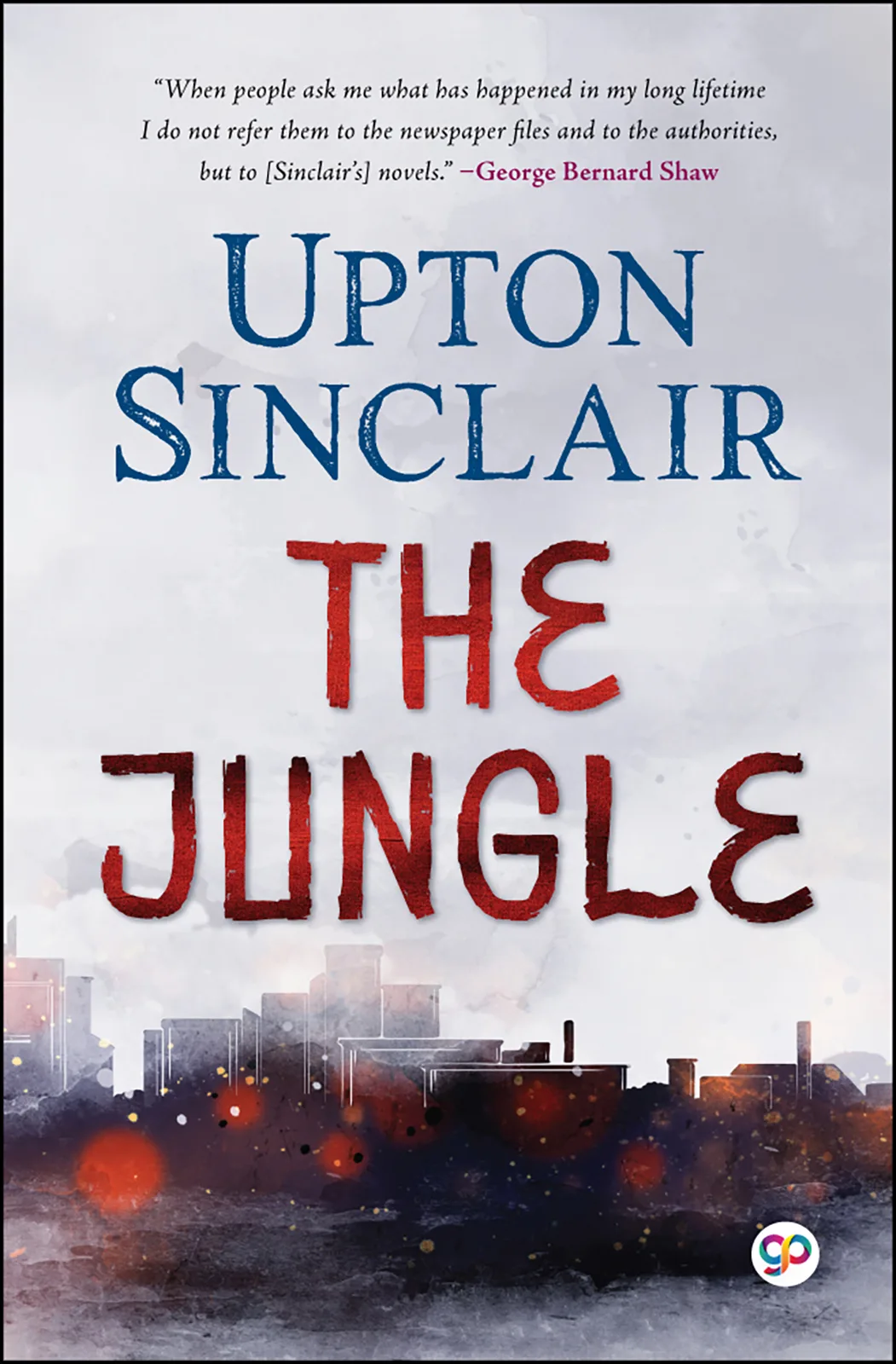
The Jungle
Hardcover
• 400 Pages
• INR 625.00
• English
• 9789354994821
No ratings yet
| Publisher | General Press |
|---|---|
| ISBN13 | 9789354994821 |
| ASIN/SKU | 9354994822 |
| Book Format | Hardcover |
| Language | English |
| Pages | 400 |
| List Price | INR 625.00 |
| Subject Code | FIC004000, JUV002270, FIC014000 |
| Publishing Date | 22/09/2022 |
| Dimensions | 8.25 x 5.25 x 1.0 inches |
| Book Code | BD00067775 |
Buy this Book
Amazon Stores
Ebook Stores
Other Stores
Discover The Jungle by Upton Sinclair. This book is published by General Press in Hardcover format, ISBN 9789354994821, ASIN 9354994822, under Literature and Fiction, Historical Fiction, Social Protest Fiction.
Book Description
First published in 1905, ‘The Jungle’ was written by Upton Sinclair, an American writer, political activist, and the 1934 Democratic Party nominee for Governor of California who wrote nearly 100 books and other works in several genres.
Sinclair wrote the novel to portray the lives of immigrants in the United States in Chicago and similar industrialized cities. Many readers were most concerned with his exposure to health violations and unsanitary practices in the American meatpacking industry during the early 20th century, based on an investigation he did for a socialist newspaper.
The book depicts working class poverty, the lack of social support, harsh and unpleasant living and working conditions, and hopelessness among many workers. These elements are contrasted with the deeply rooted corruption of people in power. A review by the writer Jack London called it, “The Uncle Tom's Cabin of wage slavery.”
Sinclair wrote the novel to portray the lives of immigrants in the United States in Chicago and similar industrialized cities. Many readers were most concerned with his exposure to health violations and unsanitary practices in the American meatpacking industry during the early 20th century, based on an investigation he did for a socialist newspaper.
The book depicts working class poverty, the lack of social support, harsh and unpleasant living and working conditions, and hopelessness among many workers. These elements are contrasted with the deeply rooted corruption of people in power. A review by the writer Jack London called it, “The Uncle Tom's Cabin of wage slavery.”
Author Biography
Upton Sinclair was born September 20, 1878. He was a bestselling American author and journalist who penned more than one hundred books, plays, and journalistic articles during the course of his career. He received the Pulitzer Prize for Literature in 1943. Time magazine called him a man with every gift except humor and silence.” He died on November 25, 1968.
Upton Sinclair was a journalist and the author of over two dozen books, including The Brass Check, King Coal, and Oil!. He was a prominent social and political activist who narrowly missed being elected governor of California in 1934.
Upton Sinclair was a journalist and the author of over two dozen books, including The Brass Check, King Coal, and Oil!. He was a prominent social and political activist who narrowly missed being elected governor of California in 1934.
Editorial Reviews
Editorial Reviews will be added soon…
Book Summary
The Jungle by Upton Sinclair is a landmark novel that combines a deeply personal family story with a powerful critique of industrial capitalism in early twentieth-century America. First published in 1906, the novel follows the struggles of a Lithuanian immigrant family as they pursue the American Dream, only to discover a harsh reality marked by poverty, exploitation, corruption, and social inequality. While Sinclair intended the novel to expose the suffering of workers, it also became famous for revealing shocking conditions in the meatpacking industry, leading to widespread public outrage and significant food safety reforms.
The story centers on Jurgis Rudkus, a strong, optimistic young man who immigrates to Chicago with his fiancée, Ona Lukoszaite, and several members of their extended family. Like countless immigrants arriving in the United States during this period, they believe that hard work and determination will allow them to build a comfortable and secure life. Filled with hope, they settle in the city's bustling immigrant community, convinced that America offers endless opportunities for those willing to work.
Soon after arriving, however, the family discovers that life is far more difficult than they imagined. They purchase a modest house through a complicated financial arrangement that appears affordable but gradually reveals itself to be filled with hidden costs and unfair terms. Instead of becoming homeowners in the traditional sense, they find themselves trapped by debts they can barely manage. Sinclair uses this experience to illustrate how inexperienced immigrants were often exploited by dishonest businesses eager to profit from their dreams.
The family members quickly enter Chicago's enormous meatpacking industry, where nearly everyone, regardless of age or physical condition, must work simply to survive. The factories are portrayed as relentless machines that value production above human well-being. Workers perform repetitive, exhausting labor under dangerous conditions for long hours and low wages. Injuries are common, job security is almost nonexistent, and employees can be replaced with little concern for their welfare.
Jurgis initially responds with determination rather than despair. His guiding belief is that hard work will eventually overcome every obstacle. He trusts employers, obeys supervisors, and accepts difficult conditions because he believes success will come with perseverance. Yet as time passes, he learns that personal effort alone cannot overcome a system built on exploitation. Each setback reveals another layer of injustice, gradually eroding his faith in the promises that brought him to America.
Sinclair also focuses on the immense emotional burden carried by immigrant families. Every member contributes financially, including women, elderly relatives, and even children whenever possible. Illness, accidents, or temporary unemployment can threaten the survival of the entire household. The family constantly struggles to balance basic necessities such as food, rent, heating, and medical care, leaving little room for hope or security.
One of the novel's most striking themes is the dehumanizing effect of industrial labor. Workers are treated less as individuals than as interchangeable parts within an enormous economic system. Their physical strength is consumed by demanding work, while their emotional resilience is worn down by uncertainty and constant financial pressure. Sinclair suggests that industries driven solely by profit often overlook the humanity of the people whose labor sustains them.
The novel also exposes widespread corruption extending far beyond the factory floor. Employers manipulate wages, politicians accept bribes, and legal institutions frequently favor powerful business interests over ordinary workers. Honest effort rarely guarantees success because the system itself is deeply unequal. Through these interconnected examples, Sinclair argues that exploitation is not the result of a few dishonest individuals but is embedded within larger economic and political structures.
Family relationships form the emotional heart of the novel. Despite their hardships, the characters continually support one another with remarkable resilience. They celebrate small victories, comfort one another during times of grief, and sacrifice personal desires for the well-being of the family. Yet relentless poverty places extraordinary strain on these bonds. Sinclair portrays how economic insecurity affects not only financial stability but also health, dignity, hope, and emotional well-being.
As Jurgis faces repeated disappointments, his character undergoes significant transformation. The confident young immigrant gradually becomes disillusioned with the ideals he once embraced. His experiences force him to question whether the society around him truly rewards honesty, hard work, and perseverance. Sinclair carefully traces this psychological journey, showing how repeated injustice can alter a person's beliefs and reshape his understanding of the world.
Another important aspect of the novel is its vivid depiction of the meatpacking industry itself. Sinclair describes unsanitary working environments, unsafe food-handling practices, and the overwhelming pressure to maximize production regardless of quality or public health. Although these descriptions occupy only part of the novel, they had an enormous impact on readers. Public concern over these conditions contributed to reforms in food inspection and regulation, demonstrating the power of literature to influence public policy.
Throughout the story, Sinclair repeatedly contrasts the promise of the American Dream with the reality experienced by many immigrants. America is presented as a land of opportunity, yet countless newcomers encounter barriers that make advancement extremely difficult. Language differences, unfamiliar laws, economic inequality, and limited political influence leave many vulnerable to exploitation. The novel does not deny the possibility of success but argues that opportunity is often unevenly distributed.
As the narrative progresses, Jurgis encounters people from many walks of life, each offering different perspectives on society and survival. These encounters broaden his understanding of the economic and political forces shaping individual lives. Gradually, he begins to recognize that many of his personal struggles are shared by thousands of other workers facing similar conditions. This growing awareness shifts his focus from individual hardship to broader questions about justice, fairness, and social responsibility.
One of Sinclair's central arguments is that society should be judged by how it treats its most vulnerable members. He believes that economic systems should exist to improve human lives rather than sacrifice people for profit. Through the experiences of Jurgis and his family, the novel asks readers to consider whether wealth and industrial growth have real value if they come at the expense of human dignity.
Despite its often bleak portrayal of poverty and exploitation, The Jungle ultimately offers a vision of hope rooted in collective action and social reform. Sinclair suggests that meaningful change requires more than individual determination; it demands cooperation, public awareness, and institutions committed to justice. The novel encourages readers to imagine a society in which workers are treated fairly, businesses operate responsibly, and governments protect the common good instead of powerful interests.
Sinclair's writing combines journalistic observation with emotional storytelling. His descriptions of Chicago's industrial landscape are vivid and unforgettable, while his portrayal of immigrant life remains deeply compassionate. Rather than presenting his characters as symbols alone, he depicts them as ordinary people striving to build meaningful lives under extraordinarily difficult circumstances.
More than a century after its publication, The Jungle continues to resonate because its central themes remain relevant. Questions about workers' rights, corporate responsibility, immigration, income inequality, consumer protection, and the balance between profit and human welfare still shape public debate around the world. The novel serves as both a moving human story and a passionate call for social justice.
Ultimately, The Jungle is not simply a novel about one immigrant family or one industry. It is a profound examination of hope tested by hardship, of courage in the face of adversity, and of the enduring belief that societies can become more humane when they recognize the dignity and worth of every individual. Through Jurgis Rudkus's journey, Upton Sinclair challenges readers to look beyond appearances, confront uncomfortable truths, and consider how compassion and reform can create a more just and equitable world.
The story centers on Jurgis Rudkus, a strong, optimistic young man who immigrates to Chicago with his fiancée, Ona Lukoszaite, and several members of their extended family. Like countless immigrants arriving in the United States during this period, they believe that hard work and determination will allow them to build a comfortable and secure life. Filled with hope, they settle in the city's bustling immigrant community, convinced that America offers endless opportunities for those willing to work.
Soon after arriving, however, the family discovers that life is far more difficult than they imagined. They purchase a modest house through a complicated financial arrangement that appears affordable but gradually reveals itself to be filled with hidden costs and unfair terms. Instead of becoming homeowners in the traditional sense, they find themselves trapped by debts they can barely manage. Sinclair uses this experience to illustrate how inexperienced immigrants were often exploited by dishonest businesses eager to profit from their dreams.
The family members quickly enter Chicago's enormous meatpacking industry, where nearly everyone, regardless of age or physical condition, must work simply to survive. The factories are portrayed as relentless machines that value production above human well-being. Workers perform repetitive, exhausting labor under dangerous conditions for long hours and low wages. Injuries are common, job security is almost nonexistent, and employees can be replaced with little concern for their welfare.
Jurgis initially responds with determination rather than despair. His guiding belief is that hard work will eventually overcome every obstacle. He trusts employers, obeys supervisors, and accepts difficult conditions because he believes success will come with perseverance. Yet as time passes, he learns that personal effort alone cannot overcome a system built on exploitation. Each setback reveals another layer of injustice, gradually eroding his faith in the promises that brought him to America.
Sinclair also focuses on the immense emotional burden carried by immigrant families. Every member contributes financially, including women, elderly relatives, and even children whenever possible. Illness, accidents, or temporary unemployment can threaten the survival of the entire household. The family constantly struggles to balance basic necessities such as food, rent, heating, and medical care, leaving little room for hope or security.
One of the novel's most striking themes is the dehumanizing effect of industrial labor. Workers are treated less as individuals than as interchangeable parts within an enormous economic system. Their physical strength is consumed by demanding work, while their emotional resilience is worn down by uncertainty and constant financial pressure. Sinclair suggests that industries driven solely by profit often overlook the humanity of the people whose labor sustains them.
The novel also exposes widespread corruption extending far beyond the factory floor. Employers manipulate wages, politicians accept bribes, and legal institutions frequently favor powerful business interests over ordinary workers. Honest effort rarely guarantees success because the system itself is deeply unequal. Through these interconnected examples, Sinclair argues that exploitation is not the result of a few dishonest individuals but is embedded within larger economic and political structures.
Family relationships form the emotional heart of the novel. Despite their hardships, the characters continually support one another with remarkable resilience. They celebrate small victories, comfort one another during times of grief, and sacrifice personal desires for the well-being of the family. Yet relentless poverty places extraordinary strain on these bonds. Sinclair portrays how economic insecurity affects not only financial stability but also health, dignity, hope, and emotional well-being.
As Jurgis faces repeated disappointments, his character undergoes significant transformation. The confident young immigrant gradually becomes disillusioned with the ideals he once embraced. His experiences force him to question whether the society around him truly rewards honesty, hard work, and perseverance. Sinclair carefully traces this psychological journey, showing how repeated injustice can alter a person's beliefs and reshape his understanding of the world.
Another important aspect of the novel is its vivid depiction of the meatpacking industry itself. Sinclair describes unsanitary working environments, unsafe food-handling practices, and the overwhelming pressure to maximize production regardless of quality or public health. Although these descriptions occupy only part of the novel, they had an enormous impact on readers. Public concern over these conditions contributed to reforms in food inspection and regulation, demonstrating the power of literature to influence public policy.
Throughout the story, Sinclair repeatedly contrasts the promise of the American Dream with the reality experienced by many immigrants. America is presented as a land of opportunity, yet countless newcomers encounter barriers that make advancement extremely difficult. Language differences, unfamiliar laws, economic inequality, and limited political influence leave many vulnerable to exploitation. The novel does not deny the possibility of success but argues that opportunity is often unevenly distributed.
As the narrative progresses, Jurgis encounters people from many walks of life, each offering different perspectives on society and survival. These encounters broaden his understanding of the economic and political forces shaping individual lives. Gradually, he begins to recognize that many of his personal struggles are shared by thousands of other workers facing similar conditions. This growing awareness shifts his focus from individual hardship to broader questions about justice, fairness, and social responsibility.
One of Sinclair's central arguments is that society should be judged by how it treats its most vulnerable members. He believes that economic systems should exist to improve human lives rather than sacrifice people for profit. Through the experiences of Jurgis and his family, the novel asks readers to consider whether wealth and industrial growth have real value if they come at the expense of human dignity.
Despite its often bleak portrayal of poverty and exploitation, The Jungle ultimately offers a vision of hope rooted in collective action and social reform. Sinclair suggests that meaningful change requires more than individual determination; it demands cooperation, public awareness, and institutions committed to justice. The novel encourages readers to imagine a society in which workers are treated fairly, businesses operate responsibly, and governments protect the common good instead of powerful interests.
Sinclair's writing combines journalistic observation with emotional storytelling. His descriptions of Chicago's industrial landscape are vivid and unforgettable, while his portrayal of immigrant life remains deeply compassionate. Rather than presenting his characters as symbols alone, he depicts them as ordinary people striving to build meaningful lives under extraordinarily difficult circumstances.
More than a century after its publication, The Jungle continues to resonate because its central themes remain relevant. Questions about workers' rights, corporate responsibility, immigration, income inequality, consumer protection, and the balance between profit and human welfare still shape public debate around the world. The novel serves as both a moving human story and a passionate call for social justice.
Ultimately, The Jungle is not simply a novel about one immigrant family or one industry. It is a profound examination of hope tested by hardship, of courage in the face of adversity, and of the enduring belief that societies can become more humane when they recognize the dignity and worth of every individual. Through Jurgis Rudkus's journey, Upton Sinclair challenges readers to look beyond appearances, confront uncomfortable truths, and consider how compassion and reform can create a more just and equitable world.
Sample Chapters
Sample Chapters will be added soon…
Reader Reviews
No reviews yet.
The Jungle