
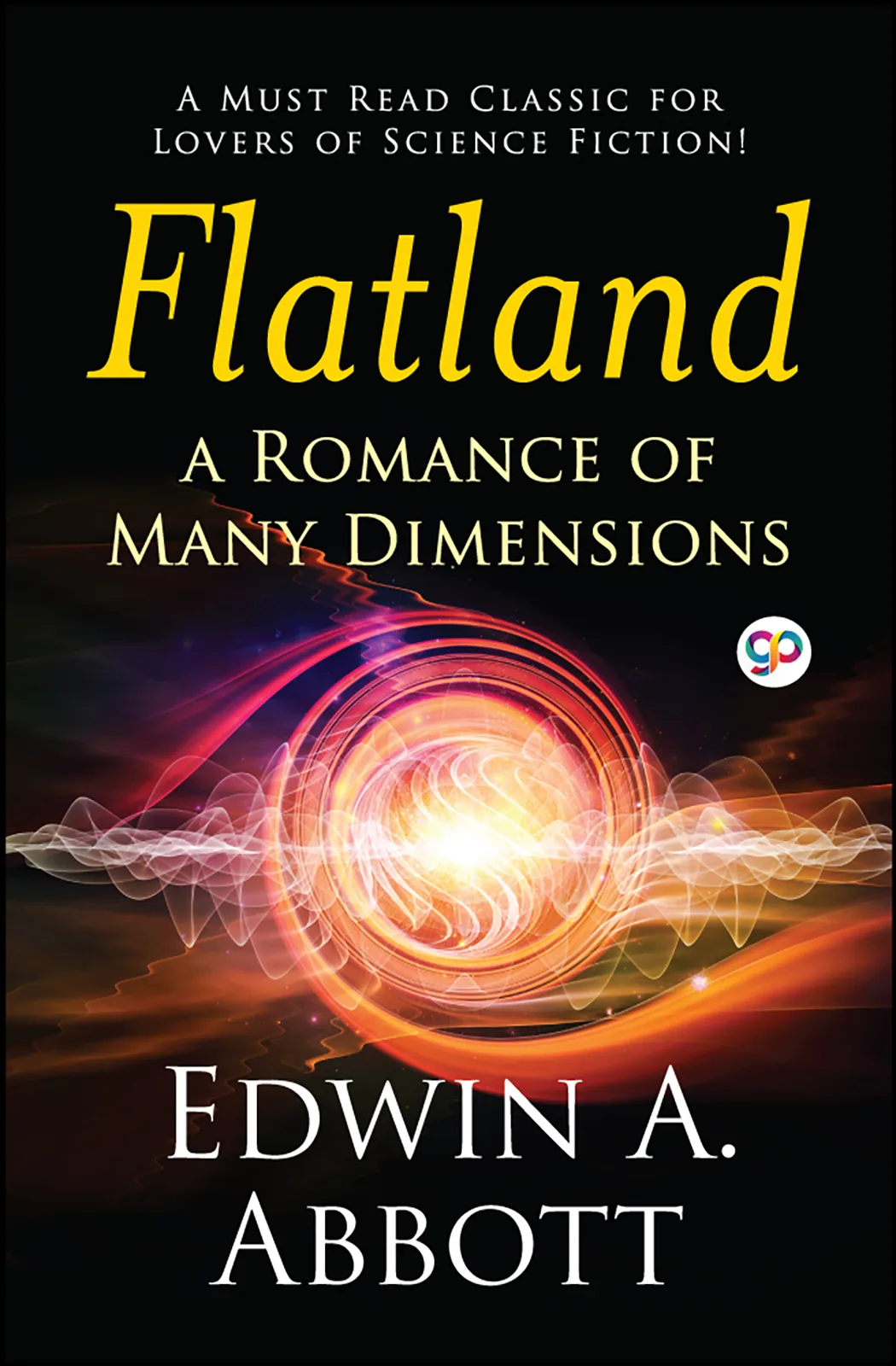
Flatland: A Romance of Many Dimensions
Paperback
• 136 Pages
• INR 200.00
• English
• 9789354995125
No ratings yet
| Publisher | General Press |
|---|---|
| ISBN13 | 9789354995125 |
| ASIN/SKU | 9354995128 |
| Book Format | Paperback |
| Language | English |
| Pages | 136 |
| List Price | INR 200.00 |
| Subject Code | FIC028010, FIC052000, FIC039000, FIC004000 |
| Publishing Date | 15/12/2022 |
| Dimensions | 8.25 x 5.25 x 1.0 inches |
| Book Code | BD00067783 |
Buy this Book
Amazon Stores
Ebook Stores
Other Stores
Discover Flatland: A Romance of Many Dimensions by Edwin A. Abbott. This book is published by General Press in Paperback format, ISBN 9789354995125, ASIN 9354995128, under Science Fiction and Fantasy, Mathematical Fantasy, Classic Science Fiction.
Book Description
‘Flatland: A Romance of Many Dimensions’ is one of the most original pieces of fiction ever written by Edwin A. Abbott, an English theologian, clergyman, educator, and Shakespearean scholar. This is a satirical mathematical novella that also examines English society during the Victorian era.
It describes the journeys of A. Square, a mathematician, and resident of the two-dimensional Flatland, where women-thin, straight lines are the lowliest of shapes, and where men may have any number of sides, depending on their social status. Through strange occurrences that bring him into contact with a host of geometric forms, Square has adventures in Spaceland (three dimensions), Lineland (one dimension), and Pointland (no dimensions) and ultimately entertains thoughts of visiting a land of four dimensions—a revolutionary idea for which he is returned to his two-dimensional world. Charmingly illustrated by the author, Flatland is not only fascinating reading; it is still a first-rate fictional introduction to the concept of the multiple dimensions of space.
This masterpiece of science (and mathematical) fiction is a delightfully unique and highly entertaining satire that has charmed readers for more than 100 years.
It describes the journeys of A. Square, a mathematician, and resident of the two-dimensional Flatland, where women-thin, straight lines are the lowliest of shapes, and where men may have any number of sides, depending on their social status. Through strange occurrences that bring him into contact with a host of geometric forms, Square has adventures in Spaceland (three dimensions), Lineland (one dimension), and Pointland (no dimensions) and ultimately entertains thoughts of visiting a land of four dimensions—a revolutionary idea for which he is returned to his two-dimensional world. Charmingly illustrated by the author, Flatland is not only fascinating reading; it is still a first-rate fictional introduction to the concept of the multiple dimensions of space.
This masterpiece of science (and mathematical) fiction is a delightfully unique and highly entertaining satire that has charmed readers for more than 100 years.
Author Biography
Edwin Abbott Abbott (1838-1926) has been ranked as one of the leading scholars and theologians of the Victorian era. He received highest honors in mathematics, classics, and theology at St. John's College, Cambridge, and in 1862 began a brilliant career, during which he served as schoolmaster of some of England's outstanding schools. At the same time he distinguished himself as a scholar, and in 1889 he retired to his studies. Although Flatland, a literary jeu d'esprit, has given pleasure to thousands of readers over many generations, Abbott is best known for his scholarly works, especially his Shakespearian Grammar and his life of Francis Bacon, and for a number of theological discussions.
Editorial Reviews
Editorial Reviews will be added soon…
Book Summary
Flatland: A Romance of Many Dimensions by Edwin A. Abbott is a remarkably imaginative novella that uses geometry to talk about society, prejudice, knowledge, imagination, and the limits of human understanding. First published in 1884, the book presents itself as the memoir of “A Square,” an inhabitant of a strange two-dimensional world. Abbott was a schoolmaster, theologian, and scholar, and he combines mathematical ideas with sharp social satire. Beneath its playful descriptions of triangles, squares, polygons, and circles lies a serious question: How much of reality can we understand when our minds are trapped inside the limits of what we already believe?
Flatland is a world without height. Everything exists on a flat surface, and its inhabitants are geometric figures. Men are polygons, while women are represented as simple straight lines. Society is rigidly organized according to shape. The number of sides a male figure possesses determines his social position: triangles occupy lower positions, while figures with many sides stand higher in society, with the perfect Circle representing the priestly and ruling class. Thus geometry becomes a metaphor for the class system of Victorian England. A person's shape is not merely an appearance; it determines his education, occupation, privileges, and social respect.
The narrator, A Square, belongs to the respectable middle-to-upper levels of Flatland society. He is educated, thoughtful, and reasonably curious, but he is also a product of his culture. This is important because Abbott does not make him a completely enlightened hero. The Square can recognize some forms of injustice while remaining blind to others. He accepts many of the prejudices of his society, particularly the inferior position assigned to women and lower classes. His journey is therefore not simply a journey through space; it is a journey away from intellectual certainty.
Abbott spends considerable time describing how Flatlanders recognize one another. Because they can see only along the two-dimensional plane, a figure does not appear to another figure as a complete shape. Instead, the visible form is essentially a line. To distinguish people, Flatlanders use several methods, including touch and visual recognition based on subtle differences in angles and shape. Fog also plays an important role because distant objects appear less clearly. These details may initially seem amusingly technical, but they establish one of the book's central ideas: what we see depends upon the limitations of our senses.
The social system becomes increasingly disturbing as the story progresses. Women, being straight lines, are regarded as intellectually and socially inferior. Their shape is even treated as dangerous because a sharp line can accidentally injure someone. Consequently, elaborate rules control women's movement and behavior. Abbott's satire exposes the absurdity of constructing social hierarchies from arbitrary physical characteristics. The inhabitants of Flatland consider their system perfectly natural, just as societies often regard their own customs and prejudices as obvious truths.
The lower classes suffer even more severely. Irregular figures, especially irregular triangles, are treated with suspicion and contempt. Regularity of shape is associated with moral worth, intelligence, and social respectability. Abbott deliberately makes this logic ridiculous, showing how easily societies turn accidental or inherited characteristics into excuses for discrimination. At the same time, the system has a mechanism for upward movement: through carefully regulated hereditary and biological processes, descendants may acquire more sides and thus enter a higher social class. The possibility of advancement, however, does not remove the underlying injustice of the hierarchy.
One of the most revealing episodes concerns the discovery of color. A figure named Chromatistes introduces the possibility of painting figures with colors, potentially allowing people to identify themselves more easily and perhaps weakening the established social order. The ruling authorities fear this development because it could destroy their monopoly over recognition and status. Color becomes politically dangerous. The government suppresses the movement, demonstrating how authoritarian institutions often resist new ideas not because those ideas are false, but because they threaten existing power.
This section of the book makes Abbott's larger purpose clear. Flatland is not merely a mathematical fantasy. It is a satire of a society that has convinced itself that its hierarchy is natural and permanent. The geometric language makes familiar social prejudices look strange. When a polygon says that he is superior because he has more sides than another figure, the argument sounds absurd. Abbott encourages readers to ask whether some of the hierarchies accepted in their own world are equally arbitrary.
The story then moves from social criticism toward its famous exploration of dimensions. A Square dreams that he visits Lineland, a one-dimensional world. The inhabitants of Lineland live on a single line and cannot imagine anything beyond it. The Square tries to explain the existence of a second dimension, but the King of Lineland cannot understand what he is talking about. From the king's perspective, the Square's claims are impossible because they contradict everything that the king knows about reality.
This episode is one of Abbott's most powerful ideas. The Square looks at the people of Lineland and immediately sees their intellectual limitation. Yet the reader soon realizes that the Square himself suffers from exactly the same limitation. He laughs at Lineland's inability to understand two dimensions, while he is unable to imagine three.
That lesson becomes unavoidable when a mysterious visitor arrives: a Sphere from Spaceland, a three-dimensional world. To the inhabitants of Flatland, the Sphere appears only as a circle. As the Sphere passes through their plane, the Square observes a changing circle—first small, then larger, and then smaller again. He naturally interprets what he sees according to the concepts available to him. The Sphere explains that he is not a circle at all but a three-dimensional solid whose intersection with Flatland appears as a circle.
The Square initially refuses to believe him. His resistance is understandable because he is not stupid. In fact, he is intelligent and mathematically trained. His problem is deeper: his imagination has been trained to exclude the very possibility he is being asked to consider. He can reason perfectly well within two dimensions, but he cannot immediately imagine what lies outside them.
The Sphere therefore tries to explain the third dimension through analogy. If a Flatlander cannot rise above the plane, then a three-dimensional being can enter Flatland in a way that is invisible to its inhabitants. The Square gradually begins to understand. Eventually, the Sphere physically carries him out of Flatland and into Spaceland. For the first time, the Square experiences three dimensions directly.
The experience transforms him. He can now look down upon Flatland and see things that were previously hidden. He can see inside enclosed figures without breaking their walls. He can observe the arrangement of objects in ways impossible for a Flatlander. What had seemed supernatural is revealed as an ordinary consequence of possessing an additional dimension.
Yet Abbott makes the lesson more complicated. The Square, having discovered the third dimension, immediately begins wondering whether there might be a fourth dimension. If a two-dimensional creature can be astonished by three dimensions, why should a three-dimensional creature assume that three dimensions are the ultimate limit? This is where the book becomes a meditation on intellectual humility. The dedication itself invites inhabitants of “Space” to imagine four, five, or even six dimensions, suggesting that the enlargement of imagination should produce greater modesty.
When the Square returns to Flatland and tries to share what he has learned, he encounters the same resistance that he himself once displayed. His society cannot accept the existence of another dimension. Worse, the authorities see his ideas as dangerous. A truth that challenges the official understanding of reality becomes a form of heresy. The Square is eventually imprisoned for spreading the doctrine of the third dimension.
This ending connects the mathematical and social strands of the story. The same society that suppresses color also suppresses dimensional thought. In both cases, those in power fear ideas that might weaken established boundaries. The Square's prison becomes a symbol of the mental prison from which he has escaped but into which his society remains locked.
The most humane aspect of Flatland is that Abbott does not present ignorance as something belonging only to foolish people. Even the intelligent Square is trapped by the assumptions of his culture. He is capable of growth precisely because he experiences the discomfort of discovering that his previous certainty was incomplete. His journey suggests that education is not simply acquiring more facts. It is learning to recognize the limits of one's own perspective.
The book also explores the relationship between science, imagination, and what might be called spiritual revelation. The discovery of a higher dimension resembles a religious awakening: the individual encounters something that cannot initially be explained using ordinary categories and must undergo a transformation of understanding. Abbott, who was himself a theologian, uses this experience to suggest that imagination can open doors that rigid certainty keeps closed.
Ultimately, Flatland is a book about seeing beyond boundaries. Its mathematical argument is elegant, but its human message is even more enduring. We are all, in some sense, inhabitants of Flatland. We see only a portion of reality, inherit assumptions from our societies, and often mistake familiarity for truth. We may laugh at people whose understanding seems narrow while remaining unaware of the boundaries around our own thinking.
A Square's greatest achievement is therefore not that he learns about the third dimension. It is that he learns that there may always be something beyond what he currently understands. His final condition is tragic because society rejects the truth he has discovered, but it is also hopeful because his imagination can no longer be completely imprisoned.
More than a century after its publication, Flatland remains powerful because its central challenge is universal: What if reality is larger than the world we have been taught to accept? Abbott uses simple shapes to ask difficult questions about prejudice, power, knowledge, science, and humility. The book encourages us to question rigid categories, to listen to unfamiliar ideas, and to remember that intelligence without imagination can become another kind of blindness.
In the end, Flatland is not really about squares and spheres. It is about human beings. It asks us to look at our own world as strangely and critically as the Square learns to look at his. And perhaps its deepest lesson is the simplest one: the limits of our vision are not necessarily the limits of reality.
Flatland is a world without height. Everything exists on a flat surface, and its inhabitants are geometric figures. Men are polygons, while women are represented as simple straight lines. Society is rigidly organized according to shape. The number of sides a male figure possesses determines his social position: triangles occupy lower positions, while figures with many sides stand higher in society, with the perfect Circle representing the priestly and ruling class. Thus geometry becomes a metaphor for the class system of Victorian England. A person's shape is not merely an appearance; it determines his education, occupation, privileges, and social respect.
The narrator, A Square, belongs to the respectable middle-to-upper levels of Flatland society. He is educated, thoughtful, and reasonably curious, but he is also a product of his culture. This is important because Abbott does not make him a completely enlightened hero. The Square can recognize some forms of injustice while remaining blind to others. He accepts many of the prejudices of his society, particularly the inferior position assigned to women and lower classes. His journey is therefore not simply a journey through space; it is a journey away from intellectual certainty.
Abbott spends considerable time describing how Flatlanders recognize one another. Because they can see only along the two-dimensional plane, a figure does not appear to another figure as a complete shape. Instead, the visible form is essentially a line. To distinguish people, Flatlanders use several methods, including touch and visual recognition based on subtle differences in angles and shape. Fog also plays an important role because distant objects appear less clearly. These details may initially seem amusingly technical, but they establish one of the book's central ideas: what we see depends upon the limitations of our senses.
The social system becomes increasingly disturbing as the story progresses. Women, being straight lines, are regarded as intellectually and socially inferior. Their shape is even treated as dangerous because a sharp line can accidentally injure someone. Consequently, elaborate rules control women's movement and behavior. Abbott's satire exposes the absurdity of constructing social hierarchies from arbitrary physical characteristics. The inhabitants of Flatland consider their system perfectly natural, just as societies often regard their own customs and prejudices as obvious truths.
The lower classes suffer even more severely. Irregular figures, especially irregular triangles, are treated with suspicion and contempt. Regularity of shape is associated with moral worth, intelligence, and social respectability. Abbott deliberately makes this logic ridiculous, showing how easily societies turn accidental or inherited characteristics into excuses for discrimination. At the same time, the system has a mechanism for upward movement: through carefully regulated hereditary and biological processes, descendants may acquire more sides and thus enter a higher social class. The possibility of advancement, however, does not remove the underlying injustice of the hierarchy.
One of the most revealing episodes concerns the discovery of color. A figure named Chromatistes introduces the possibility of painting figures with colors, potentially allowing people to identify themselves more easily and perhaps weakening the established social order. The ruling authorities fear this development because it could destroy their monopoly over recognition and status. Color becomes politically dangerous. The government suppresses the movement, demonstrating how authoritarian institutions often resist new ideas not because those ideas are false, but because they threaten existing power.
This section of the book makes Abbott's larger purpose clear. Flatland is not merely a mathematical fantasy. It is a satire of a society that has convinced itself that its hierarchy is natural and permanent. The geometric language makes familiar social prejudices look strange. When a polygon says that he is superior because he has more sides than another figure, the argument sounds absurd. Abbott encourages readers to ask whether some of the hierarchies accepted in their own world are equally arbitrary.
The story then moves from social criticism toward its famous exploration of dimensions. A Square dreams that he visits Lineland, a one-dimensional world. The inhabitants of Lineland live on a single line and cannot imagine anything beyond it. The Square tries to explain the existence of a second dimension, but the King of Lineland cannot understand what he is talking about. From the king's perspective, the Square's claims are impossible because they contradict everything that the king knows about reality.
This episode is one of Abbott's most powerful ideas. The Square looks at the people of Lineland and immediately sees their intellectual limitation. Yet the reader soon realizes that the Square himself suffers from exactly the same limitation. He laughs at Lineland's inability to understand two dimensions, while he is unable to imagine three.
That lesson becomes unavoidable when a mysterious visitor arrives: a Sphere from Spaceland, a three-dimensional world. To the inhabitants of Flatland, the Sphere appears only as a circle. As the Sphere passes through their plane, the Square observes a changing circle—first small, then larger, and then smaller again. He naturally interprets what he sees according to the concepts available to him. The Sphere explains that he is not a circle at all but a three-dimensional solid whose intersection with Flatland appears as a circle.
The Square initially refuses to believe him. His resistance is understandable because he is not stupid. In fact, he is intelligent and mathematically trained. His problem is deeper: his imagination has been trained to exclude the very possibility he is being asked to consider. He can reason perfectly well within two dimensions, but he cannot immediately imagine what lies outside them.
The Sphere therefore tries to explain the third dimension through analogy. If a Flatlander cannot rise above the plane, then a three-dimensional being can enter Flatland in a way that is invisible to its inhabitants. The Square gradually begins to understand. Eventually, the Sphere physically carries him out of Flatland and into Spaceland. For the first time, the Square experiences three dimensions directly.
The experience transforms him. He can now look down upon Flatland and see things that were previously hidden. He can see inside enclosed figures without breaking their walls. He can observe the arrangement of objects in ways impossible for a Flatlander. What had seemed supernatural is revealed as an ordinary consequence of possessing an additional dimension.
Yet Abbott makes the lesson more complicated. The Square, having discovered the third dimension, immediately begins wondering whether there might be a fourth dimension. If a two-dimensional creature can be astonished by three dimensions, why should a three-dimensional creature assume that three dimensions are the ultimate limit? This is where the book becomes a meditation on intellectual humility. The dedication itself invites inhabitants of “Space” to imagine four, five, or even six dimensions, suggesting that the enlargement of imagination should produce greater modesty.
When the Square returns to Flatland and tries to share what he has learned, he encounters the same resistance that he himself once displayed. His society cannot accept the existence of another dimension. Worse, the authorities see his ideas as dangerous. A truth that challenges the official understanding of reality becomes a form of heresy. The Square is eventually imprisoned for spreading the doctrine of the third dimension.
This ending connects the mathematical and social strands of the story. The same society that suppresses color also suppresses dimensional thought. In both cases, those in power fear ideas that might weaken established boundaries. The Square's prison becomes a symbol of the mental prison from which he has escaped but into which his society remains locked.
The most humane aspect of Flatland is that Abbott does not present ignorance as something belonging only to foolish people. Even the intelligent Square is trapped by the assumptions of his culture. He is capable of growth precisely because he experiences the discomfort of discovering that his previous certainty was incomplete. His journey suggests that education is not simply acquiring more facts. It is learning to recognize the limits of one's own perspective.
The book also explores the relationship between science, imagination, and what might be called spiritual revelation. The discovery of a higher dimension resembles a religious awakening: the individual encounters something that cannot initially be explained using ordinary categories and must undergo a transformation of understanding. Abbott, who was himself a theologian, uses this experience to suggest that imagination can open doors that rigid certainty keeps closed.
Ultimately, Flatland is a book about seeing beyond boundaries. Its mathematical argument is elegant, but its human message is even more enduring. We are all, in some sense, inhabitants of Flatland. We see only a portion of reality, inherit assumptions from our societies, and often mistake familiarity for truth. We may laugh at people whose understanding seems narrow while remaining unaware of the boundaries around our own thinking.
A Square's greatest achievement is therefore not that he learns about the third dimension. It is that he learns that there may always be something beyond what he currently understands. His final condition is tragic because society rejects the truth he has discovered, but it is also hopeful because his imagination can no longer be completely imprisoned.
More than a century after its publication, Flatland remains powerful because its central challenge is universal: What if reality is larger than the world we have been taught to accept? Abbott uses simple shapes to ask difficult questions about prejudice, power, knowledge, science, and humility. The book encourages us to question rigid categories, to listen to unfamiliar ideas, and to remember that intelligence without imagination can become another kind of blindness.
In the end, Flatland is not really about squares and spheres. It is about human beings. It asks us to look at our own world as strangely and critically as the Square learns to look at his. And perhaps its deepest lesson is the simplest one: the limits of our vision are not necessarily the limits of reality.
Sample Chapters
Sample Chapters will be added soon…
Reader Reviews
No reviews yet.
Flatland: A Romance of Many Dimensions
Download Cover Image
Do you want to download the full cover image for Flatland: A Romance of Many Dimensions?