
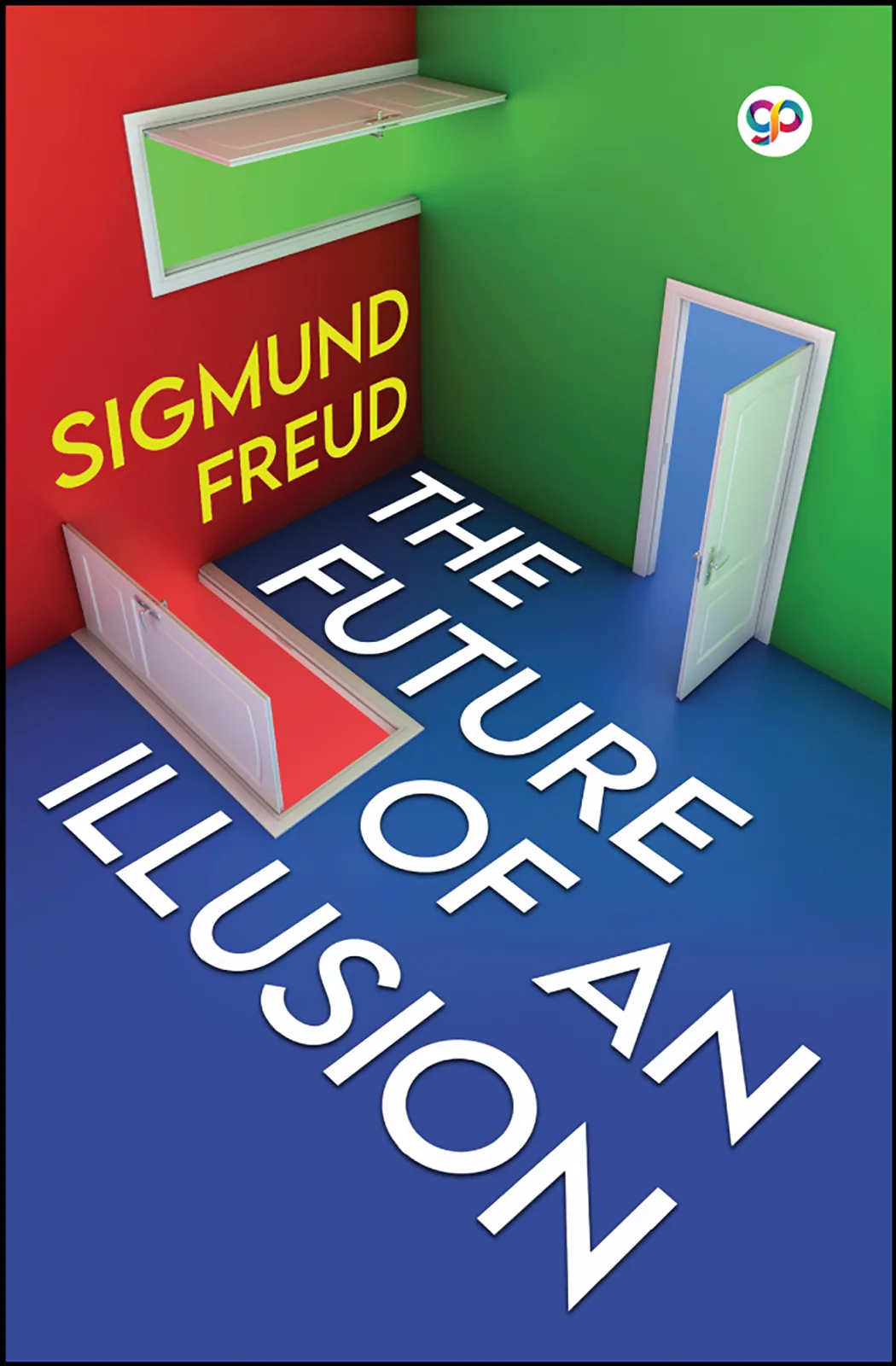
The Future of an Illusion
Paperback
• 80 Pages
• INR 200.00
• English
• 9789354995187
No ratings yet
| Publisher | General Press |
|---|---|
| ISBN13 | 9789354995187 |
| ASIN/SKU | 9354995187 |
| Book Format | Paperback |
| Language | English |
| Pages | 80 |
| List Price | INR 200.00 |
| Subject Code | PSY045060, LIT024050, PSY003000, MED105000 |
| Publishing Date | 15/12/2022 |
| Dimensions | 8.25 x 5.25 x 1.0 inches |
| Book Code | BD00067789 |
Buy this Book
Amazon Stores
Ebook Stores
Other Stores
Discover The Future of an Illusion by Sigmund Freud. This book is published by General Press in Paperback format, ISBN 9789354995187, ASIN 9354995187, under Non Fiction, Philosophy of Religion, Psychology of Religion.
Book Description
First published in 1927, ‘The Future of an Illusion’ examines the roots of society and religion, written by Sigmund Freud, an Austrian neurologist and the founder of psychoanalysis, a clinical method for evaluating and treating pathologies in the psyche through dialogue between a patient and a psychoanalyst.
This is Freud's best-known and most assertive psychoanalytic investigation of religion and is the fruition of a lifelong practice of reflection. Freud uses his understanding of psychology to examine the roots of both civilization and religion. This takes the form of a comprehensive essay, with Freud forming an argument throughout its chapters about the history of religion and the part it should play in society’s future.
Freud wrote a number of influential books that popularized his psychoanalytic theories, such as ‘The Interpretation of Dreams’ (1899) and ‘The Ego and the Id’ (1923).
“Immorality, no less than morality, has at all times found support in religion.”
—Sigmund Freud, The Future of an Illusion
This is Freud's best-known and most assertive psychoanalytic investigation of religion and is the fruition of a lifelong practice of reflection. Freud uses his understanding of psychology to examine the roots of both civilization and religion. This takes the form of a comprehensive essay, with Freud forming an argument throughout its chapters about the history of religion and the part it should play in society’s future.
Freud wrote a number of influential books that popularized his psychoanalytic theories, such as ‘The Interpretation of Dreams’ (1899) and ‘The Ego and the Id’ (1923).
“Immorality, no less than morality, has at all times found support in religion.”
—Sigmund Freud, The Future of an Illusion
Author Biography
Born Sigismund Schlomo Freud in 1856 in Freiberg, Moravia, he moved with his family to Vienna, Austria, at a young age. A brilliant student, Freud entered the University of Vienna at seventeen to study medicine. Initially focusing on neurology and zoology, he conducted significant research on the nervous systems of marine life. After earning his medical degree, he began working at the Vienna General Hospital, where his fascination with the complex workings of the human brain gradually shifted his focus from the physical structures of nerves to the realm of psychological disorders.
Freud's pivotal transition occurred in the 1880s following his collaboration with physician Josef Breuer and his studies under French neurologist Jean-Martin Charcot. Intrigued by the treatment of hysteria through hypnosis, Freud began developing a revolutionary clinical method centered on dialogue. He posited that unexpressed, deeply repressed traumatic memories in the unconscious mind were the root cause of psychological distress. By encouraging patients to speak freely about their dreams, memories, and childhood experiences—a technique known as free association—Freud established the foundational framework of psychoanalysis.
In 1899, Freud published his seminal work, The Interpretation of Dreams, introducing the concept of the unconscious mind and arguing that dreams are disguised fulfillments of repressed wishes. This was followed by a series of highly influential and controversial publications outlining his theories on psychosexual development, the Oedipus complex, and the tripartite structure of the psyche: the id, ego, and superego. Although his ideas frequently scandalized the conservative Victorian medical establishment, they eventually attracted a dedicated circle of followers, transforming psychoanalysis into an international movement.
Despite battling painful jaw cancer for the last sixteen years of his life, Freud remained a remarkably prolific writer and clinician. In 1938, the Nazi annexation of Austria forced the eighty-two-year-old Freud, who was of Jewish descent, to flee Vienna for London to escape persecution. He died there the following year. While many of his specific clinical theories have been heavily criticized or discarded by modern psychiatry, Freud's profound cultural impact is undeniable. He forever altered the way humanity understands the subconscious, shaping not just psychology, but literature, art, and modern thought.
Freud's pivotal transition occurred in the 1880s following his collaboration with physician Josef Breuer and his studies under French neurologist Jean-Martin Charcot. Intrigued by the treatment of hysteria through hypnosis, Freud began developing a revolutionary clinical method centered on dialogue. He posited that unexpressed, deeply repressed traumatic memories in the unconscious mind were the root cause of psychological distress. By encouraging patients to speak freely about their dreams, memories, and childhood experiences—a technique known as free association—Freud established the foundational framework of psychoanalysis.
In 1899, Freud published his seminal work, The Interpretation of Dreams, introducing the concept of the unconscious mind and arguing that dreams are disguised fulfillments of repressed wishes. This was followed by a series of highly influential and controversial publications outlining his theories on psychosexual development, the Oedipus complex, and the tripartite structure of the psyche: the id, ego, and superego. Although his ideas frequently scandalized the conservative Victorian medical establishment, they eventually attracted a dedicated circle of followers, transforming psychoanalysis into an international movement.
Despite battling painful jaw cancer for the last sixteen years of his life, Freud remained a remarkably prolific writer and clinician. In 1938, the Nazi annexation of Austria forced the eighty-two-year-old Freud, who was of Jewish descent, to flee Vienna for London to escape persecution. He died there the following year. While many of his specific clinical theories have been heavily criticized or discarded by modern psychiatry, Freud's profound cultural impact is undeniable. He forever altered the way humanity understands the subconscious, shaping not just psychology, but literature, art, and modern thought.
Editorial Reviews
Editorial Reviews will be added soon…
Book Summary
Sigmund Freud’s The Future of an Illusion, first published in 1927, is one of his most direct and controversial examinations of religion. Written in the later period of Freud’s career, the book applies psychoanalytic ideas to a question much larger than individual psychology: Why do human beings believe in religion, and what might happen to civilization if religious belief eventually loses its authority? Freud argues that religion arises from powerful psychological needs, particularly humanity’s experience of helplessness, fear of nature, suffering, death, and the demands of civilized society. He calls religious doctrines “illusions” because, in his view, they are strongly shaped by wishes rather than established through evidence. At the same time, he acknowledges that religion has played an enormous role in maintaining civilization and helping people cope with life’s hardships. The book is therefore not simply an attack on religion; it is an attempt to explain why religion is so psychologically powerful and to speculate about a future in which reason and science might gradually take its place.
Freud begins by considering civilization itself. Before discussing religion, he asks what makes organized human society possible. For Freud, civilization represents humanity’s attempt to control nature, develop knowledge, produce material resources, and regulate relationships between people. Yet civilization comes with a cost. Human beings possess powerful instincts and desires, but society cannot allow everyone to satisfy every desire whenever they wish. People must accept restrictions on aggression, sexuality, selfishness, and other impulses. Civilization therefore depends upon instinctual renunciation. This creates an unavoidable tension: the very social order that protects people from chaos also frustrates some of their deepest wishes.
This tension is crucial to Freud’s argument because he does not imagine human beings as naturally cooperative creatures who simply need education to become good citizens. He sees human nature as containing powerful antisocial and destructive tendencies. If everyone acted entirely according to instinct, social life would quickly become impossible. Laws, customs, moral rules, institutions, and authorities therefore impose restrictions. But these restrictions generate resentment. People may obey the rules of civilization while privately wishing they did not have to. Freud’s question is how society can persuade people to accept these sacrifices without constantly relying on physical force.
Religion, he argues, has historically been one of civilization’s most effective answers. Religious beliefs transform social rules into sacred commands. Instead of simply saying that people should not steal, kill, or violate certain moral boundaries because society requires restraint, religion can present these prohibitions as the commands of God. Religious authority therefore gives moral rules a supernatural foundation. A person is not merely obeying other human beings; they believe they are obeying a divine power who sees everything and can reward or punish them beyond this life.
Freud recognizes that this arrangement has practical value. Religious belief can make civilization easier to maintain because it gives people powerful reasons to control their instincts. The promise of divine justice also addresses a problem that ordinary society cannot solve: many good people suffer while many bad people prosper. Human institutions cannot always correct this imbalance. Religion responds by promising a final moral order in which justice will ultimately prevail. The suffering person can therefore believe that present injustice is temporary and that a higher power will eventually set things right.
This idea leads Freud to the psychological origins of religion. He argues that human beings are profoundly vulnerable. Nature can produce earthquakes, storms, disease, famine, accidents, and death. Human beings possess intelligence, but their intelligence does not eliminate their physical vulnerability. Children experience this helplessness particularly strongly. A child depends upon parents for protection, food, comfort, and safety. The father, especially in Freud’s framework, becomes an important figure of authority and protection. As the child grows, the realization that the father is also limited and mortal can leave a psychological need for a more powerful protector.
Freud believes that religion transfers this emotional structure onto the universe. Human beings imagine an all-powerful divine father who controls nature, watches over humanity, establishes justice, and provides protection. The religious conception of God therefore fulfills psychological wishes that originate in childhood. The Library of Congress summarizes Freud’s argument by noting that he saw the child’s experience of helplessness as giving rise to the desire for an all-powerful, protective, and just father.
This is one of the book’s central ideas: religious belief is rooted in wish fulfillment. People want the universe to be morally ordered. They want suffering to have meaning. They want death not to be the end. They want justice to triumph. They want protection from forces beyond their control. Religion, Freud argues, creates beliefs that satisfy these powerful wishes. The strength of religious belief therefore comes partly from the emotional strength of the desires behind it. Religion is not merely an intellectual mistake. It is psychologically attractive because it answers some of humanity’s deepest fears and hopes.
Freud’s use of the word “illusion” requires careful attention. He does not mean simply that every religious proposition has been proven false. An illusion, in his technical sense, is a belief in which wish fulfillment plays a decisive role. An illusion may happen to be true, although its psychological origin is what makes it an illusion. This distinction is important because Freud is not claiming that every religious belief has been scientifically disproven. Rather, he argues that believers often accept religious claims because they satisfy wishes, not because those claims have been independently verified.
Freud then examines the ways religious ideas acquire authority. Believers inherit them from earlier generations, receive traditions and supposed evidence from the past, and often grow up in environments where questioning fundamental beliefs is discouraged. Religion therefore becomes part of the psychological structure of civilization from childhood onward. A child is taught religious ideas before possessing the intellectual independence necessary to evaluate them critically. As an adult, those ideas may feel self-evident because they have been deeply integrated into emotional and cultural life.
Freud sees this as especially significant in the education of children. He argues that religious instruction can encourage intellectual dependence because children are taught that certain questions are settled in advance and should not be challenged. For Freud, this conflicts with the scientific attitude, which requires claims to remain open to examination. His concern is not simply that particular religious doctrines may be wrong. He believes that training people to accept unverifiable claims can weaken their willingness to think independently.
The comparison between religion and neurosis also plays a major role. Freud had previously explored similarities between obsessive behavior and religious ritual, and in The Future of an Illusion he extends the comparison to religion as a cultural phenomenon. Rituals, prohibitions, guilt, repetitive practices, and fears of punishment can resemble features of obsessive-compulsive behavior. Freud therefore describes religion as something like a collective psychological defense against anxiety. His argument is provocative: religion may protect individuals from unbearable fears, but it may do so by creating a structured system of beliefs and behaviors that itself resembles a form of psychological compulsion.
However, Freud does not ignore religion’s positive social function. This is an important part of the book. He understands that religion has helped civilization regulate behavior and give people emotional stability. For some individuals, religious belief may provide comfort when life becomes difficult. The promise of divine protection can make the world feel less frightening, while belief in an afterlife can reduce the terror associated with death. Freud therefore does not treat religion as something that exists for no reason. Its persistence is explained by the psychological benefits it provides.
This creates a central dilemma for Freud. If religion is removed, what will take its place? People still have instincts. They still experience fear, suffering, injustice, and death. Society still requires moral rules. If religious authority disappears, will people simply decide that they no longer have to obey those rules? Freud considers this objection seriously. He recognizes that not everyone is equally prepared to live according to secular rational principles. A highly educated person may understand why laws and moral norms are necessary without believing that they were commanded by God. But Freud worries about people who have not developed the intellectual or emotional resources to replace religious authority with rational motivation.
His response is that civilization must eventually undertake a gradual process of education to reality. Instead of protecting people from difficult truths through comforting illusions, society should teach them to confront reality honestly. Human beings should learn that nature is not controlled by a personal supernatural protector, that death is unavoidable, and that moral rules must be justified by their value to human life and society rather than merely by divine command.
Science occupies a privileged position in this future. Freud believes scientific inquiry has an advantage because it does not promise certainty where evidence is unavailable. Science advances by questioning, testing, correcting, and revising its conclusions. Religious systems, by contrast, often begin with doctrines that are treated as sacred and therefore protected from criticism. Freud hopes that humanity will increasingly develop the intellectual courage to tolerate uncertainty rather than escape uncertainty through wish-fulfilling beliefs.
Yet Freud’s faith in science is not simply a claim that science can make human beings happy. He understands that reality can be painful. Science cannot eliminate death, suffering, or every natural danger. It can increase human knowledge and control over nature, but it cannot promise that life will always be comfortable. This is precisely why Freud considers the transition away from religion psychologically difficult. Religion offers consolation that scientific thinking may not provide.
The book therefore presents a conflict between comfort and truth. Religious belief can make reality easier to bear, while scientific rationality may require people to accept frightening or disappointing facts. Freud believes that intellectual maturity requires choosing reality even when reality is painful. He compares this process to the development of an individual. Children initially depend upon parents and comforting explanations; mature adults eventually recognize that parents are not all-powerful and that life contains risks that cannot be eliminated. Freud imagines civilization undergoing a similar psychological maturation.
This analogy between the individual and civilization is central to the book’s conclusion. A child may need certain illusions during early development, but an adult is expected to become more independent. Freud sees religion as potentially playing a similar role in the history of humanity. Religious beliefs may have been useful during earlier stages of civilization, when humans had limited scientific knowledge and were especially vulnerable to nature. But as knowledge expands, Freud believes humanity should become increasingly capable of confronting reality without supernatural protection.
His argument is therefore cautiously optimistic. He does not expect religion to disappear overnight. Freud recognizes that religious belief is deeply rooted in culture, family life, morality, tradition, and emotional experience. Replacing it would be a long and difficult process. Nevertheless, he believes reason can gradually become stronger. His ideal future is not one in which people become morally empty because they no longer believe in God. Instead, he imagines a society in which people accept responsibility for morality themselves and use reason, education, science, and social cooperation to build a better civilization.
Freud’s position also reveals an important tension within his own argument. He wants people to abandon comforting illusions, yet his faith in the eventual triumph of reason contains an element of hope. He recognizes that human beings need psychological support, but he believes maturity requires finding more reality-based forms of support. Rather than expecting divine justice, people must work toward justice themselves. Rather than expecting supernatural protection, they must cooperate to reduce human vulnerability. Rather than expecting immortality, they must accept mortality and make meaningful use of the life they actually possess.
The book’s historical significance is considerable. The Future of an Illusion appeared in 1927, during a period of profound intellectual and political uncertainty in Europe. Freud’s critique of religion formed part of his broader effort to understand civilization, morality, aggression, and the psychological forces shaping collective life. It also anticipates themes that he would explore more fully in Civilization and Its Discontents, particularly the tension between individual instincts and the demands of social order.
At the same time, modern readers should approach Freud’s conclusions critically. His psychoanalytic explanation of religion is influential but not an established scientific explanation of religious belief. Contemporary psychology of religion recognizes many possible motivations for faith, including social identity, community, moral formation, meaning-making, attachment, personal experience, and cultural transmission. Freud’s theory captures one dimension of religious psychology—especially the human desire for protection and certainty—but it does not necessarily account for the full variety of religious experience.
His prediction that science would eventually replace religion has also proved much less straightforward than he anticipated. Religious belief has persisted across highly educated and scientifically advanced societies. Many religious thinkers have also argued that science and religion answer different kinds of questions rather than being direct competitors. Freud’s critique nevertheless remains important because it asks a question that continues to matter: Are our deepest beliefs shaped by our desire for them to be true?
Ultimately, The Future of an Illusion is a book about humanity’s struggle to face reality. Freud argues that religion grows out of helplessness, fear, longing, and the need for protection. It transforms the wish for a powerful parent into the idea of a divine father who governs nature, guarantees justice, and offers hope beyond death. Religion has helped civilization survive by giving moral rules greater authority and by providing emotional consolation. But Freud believes that humanity eventually needs to outgrow this dependence and develop the courage to live according to reason and reality.
For readers searching for an in-depth summary of The Future of an Illusion by Sigmund Freud, the book’s central argument can be expressed simply: religion is powerful because human beings deeply desire what it promises. Freud does not think religious belief persists merely because people are intellectually careless; he believes it satisfies some of the oldest and strongest human wishes—security, justice, meaning, protection, and immortality. His controversial proposal is that civilization should gradually replace these wish-based certainties with education, scientific inquiry, rational morality, and an honest acceptance of reality. Whether readers agree with Freud or reject his conclusions, the book remains an important work because it turns the psychological tools of psychoanalysis toward one of humanity’s oldest institutions and asks an enduring question: when we believe something deeply, are we responding to evidence—or are we also responding to what we desperately wish were true?
Freud begins by considering civilization itself. Before discussing religion, he asks what makes organized human society possible. For Freud, civilization represents humanity’s attempt to control nature, develop knowledge, produce material resources, and regulate relationships between people. Yet civilization comes with a cost. Human beings possess powerful instincts and desires, but society cannot allow everyone to satisfy every desire whenever they wish. People must accept restrictions on aggression, sexuality, selfishness, and other impulses. Civilization therefore depends upon instinctual renunciation. This creates an unavoidable tension: the very social order that protects people from chaos also frustrates some of their deepest wishes.
This tension is crucial to Freud’s argument because he does not imagine human beings as naturally cooperative creatures who simply need education to become good citizens. He sees human nature as containing powerful antisocial and destructive tendencies. If everyone acted entirely according to instinct, social life would quickly become impossible. Laws, customs, moral rules, institutions, and authorities therefore impose restrictions. But these restrictions generate resentment. People may obey the rules of civilization while privately wishing they did not have to. Freud’s question is how society can persuade people to accept these sacrifices without constantly relying on physical force.
Religion, he argues, has historically been one of civilization’s most effective answers. Religious beliefs transform social rules into sacred commands. Instead of simply saying that people should not steal, kill, or violate certain moral boundaries because society requires restraint, religion can present these prohibitions as the commands of God. Religious authority therefore gives moral rules a supernatural foundation. A person is not merely obeying other human beings; they believe they are obeying a divine power who sees everything and can reward or punish them beyond this life.
Freud recognizes that this arrangement has practical value. Religious belief can make civilization easier to maintain because it gives people powerful reasons to control their instincts. The promise of divine justice also addresses a problem that ordinary society cannot solve: many good people suffer while many bad people prosper. Human institutions cannot always correct this imbalance. Religion responds by promising a final moral order in which justice will ultimately prevail. The suffering person can therefore believe that present injustice is temporary and that a higher power will eventually set things right.
This idea leads Freud to the psychological origins of religion. He argues that human beings are profoundly vulnerable. Nature can produce earthquakes, storms, disease, famine, accidents, and death. Human beings possess intelligence, but their intelligence does not eliminate their physical vulnerability. Children experience this helplessness particularly strongly. A child depends upon parents for protection, food, comfort, and safety. The father, especially in Freud’s framework, becomes an important figure of authority and protection. As the child grows, the realization that the father is also limited and mortal can leave a psychological need for a more powerful protector.
Freud believes that religion transfers this emotional structure onto the universe. Human beings imagine an all-powerful divine father who controls nature, watches over humanity, establishes justice, and provides protection. The religious conception of God therefore fulfills psychological wishes that originate in childhood. The Library of Congress summarizes Freud’s argument by noting that he saw the child’s experience of helplessness as giving rise to the desire for an all-powerful, protective, and just father.
This is one of the book’s central ideas: religious belief is rooted in wish fulfillment. People want the universe to be morally ordered. They want suffering to have meaning. They want death not to be the end. They want justice to triumph. They want protection from forces beyond their control. Religion, Freud argues, creates beliefs that satisfy these powerful wishes. The strength of religious belief therefore comes partly from the emotional strength of the desires behind it. Religion is not merely an intellectual mistake. It is psychologically attractive because it answers some of humanity’s deepest fears and hopes.
Freud’s use of the word “illusion” requires careful attention. He does not mean simply that every religious proposition has been proven false. An illusion, in his technical sense, is a belief in which wish fulfillment plays a decisive role. An illusion may happen to be true, although its psychological origin is what makes it an illusion. This distinction is important because Freud is not claiming that every religious belief has been scientifically disproven. Rather, he argues that believers often accept religious claims because they satisfy wishes, not because those claims have been independently verified.
Freud then examines the ways religious ideas acquire authority. Believers inherit them from earlier generations, receive traditions and supposed evidence from the past, and often grow up in environments where questioning fundamental beliefs is discouraged. Religion therefore becomes part of the psychological structure of civilization from childhood onward. A child is taught religious ideas before possessing the intellectual independence necessary to evaluate them critically. As an adult, those ideas may feel self-evident because they have been deeply integrated into emotional and cultural life.
Freud sees this as especially significant in the education of children. He argues that religious instruction can encourage intellectual dependence because children are taught that certain questions are settled in advance and should not be challenged. For Freud, this conflicts with the scientific attitude, which requires claims to remain open to examination. His concern is not simply that particular religious doctrines may be wrong. He believes that training people to accept unverifiable claims can weaken their willingness to think independently.
The comparison between religion and neurosis also plays a major role. Freud had previously explored similarities between obsessive behavior and religious ritual, and in The Future of an Illusion he extends the comparison to religion as a cultural phenomenon. Rituals, prohibitions, guilt, repetitive practices, and fears of punishment can resemble features of obsessive-compulsive behavior. Freud therefore describes religion as something like a collective psychological defense against anxiety. His argument is provocative: religion may protect individuals from unbearable fears, but it may do so by creating a structured system of beliefs and behaviors that itself resembles a form of psychological compulsion.
However, Freud does not ignore religion’s positive social function. This is an important part of the book. He understands that religion has helped civilization regulate behavior and give people emotional stability. For some individuals, religious belief may provide comfort when life becomes difficult. The promise of divine protection can make the world feel less frightening, while belief in an afterlife can reduce the terror associated with death. Freud therefore does not treat religion as something that exists for no reason. Its persistence is explained by the psychological benefits it provides.
This creates a central dilemma for Freud. If religion is removed, what will take its place? People still have instincts. They still experience fear, suffering, injustice, and death. Society still requires moral rules. If religious authority disappears, will people simply decide that they no longer have to obey those rules? Freud considers this objection seriously. He recognizes that not everyone is equally prepared to live according to secular rational principles. A highly educated person may understand why laws and moral norms are necessary without believing that they were commanded by God. But Freud worries about people who have not developed the intellectual or emotional resources to replace religious authority with rational motivation.
His response is that civilization must eventually undertake a gradual process of education to reality. Instead of protecting people from difficult truths through comforting illusions, society should teach them to confront reality honestly. Human beings should learn that nature is not controlled by a personal supernatural protector, that death is unavoidable, and that moral rules must be justified by their value to human life and society rather than merely by divine command.
Science occupies a privileged position in this future. Freud believes scientific inquiry has an advantage because it does not promise certainty where evidence is unavailable. Science advances by questioning, testing, correcting, and revising its conclusions. Religious systems, by contrast, often begin with doctrines that are treated as sacred and therefore protected from criticism. Freud hopes that humanity will increasingly develop the intellectual courage to tolerate uncertainty rather than escape uncertainty through wish-fulfilling beliefs.
Yet Freud’s faith in science is not simply a claim that science can make human beings happy. He understands that reality can be painful. Science cannot eliminate death, suffering, or every natural danger. It can increase human knowledge and control over nature, but it cannot promise that life will always be comfortable. This is precisely why Freud considers the transition away from religion psychologically difficult. Religion offers consolation that scientific thinking may not provide.
The book therefore presents a conflict between comfort and truth. Religious belief can make reality easier to bear, while scientific rationality may require people to accept frightening or disappointing facts. Freud believes that intellectual maturity requires choosing reality even when reality is painful. He compares this process to the development of an individual. Children initially depend upon parents and comforting explanations; mature adults eventually recognize that parents are not all-powerful and that life contains risks that cannot be eliminated. Freud imagines civilization undergoing a similar psychological maturation.
This analogy between the individual and civilization is central to the book’s conclusion. A child may need certain illusions during early development, but an adult is expected to become more independent. Freud sees religion as potentially playing a similar role in the history of humanity. Religious beliefs may have been useful during earlier stages of civilization, when humans had limited scientific knowledge and were especially vulnerable to nature. But as knowledge expands, Freud believes humanity should become increasingly capable of confronting reality without supernatural protection.
His argument is therefore cautiously optimistic. He does not expect religion to disappear overnight. Freud recognizes that religious belief is deeply rooted in culture, family life, morality, tradition, and emotional experience. Replacing it would be a long and difficult process. Nevertheless, he believes reason can gradually become stronger. His ideal future is not one in which people become morally empty because they no longer believe in God. Instead, he imagines a society in which people accept responsibility for morality themselves and use reason, education, science, and social cooperation to build a better civilization.
Freud’s position also reveals an important tension within his own argument. He wants people to abandon comforting illusions, yet his faith in the eventual triumph of reason contains an element of hope. He recognizes that human beings need psychological support, but he believes maturity requires finding more reality-based forms of support. Rather than expecting divine justice, people must work toward justice themselves. Rather than expecting supernatural protection, they must cooperate to reduce human vulnerability. Rather than expecting immortality, they must accept mortality and make meaningful use of the life they actually possess.
The book’s historical significance is considerable. The Future of an Illusion appeared in 1927, during a period of profound intellectual and political uncertainty in Europe. Freud’s critique of religion formed part of his broader effort to understand civilization, morality, aggression, and the psychological forces shaping collective life. It also anticipates themes that he would explore more fully in Civilization and Its Discontents, particularly the tension between individual instincts and the demands of social order.
At the same time, modern readers should approach Freud’s conclusions critically. His psychoanalytic explanation of religion is influential but not an established scientific explanation of religious belief. Contemporary psychology of religion recognizes many possible motivations for faith, including social identity, community, moral formation, meaning-making, attachment, personal experience, and cultural transmission. Freud’s theory captures one dimension of religious psychology—especially the human desire for protection and certainty—but it does not necessarily account for the full variety of religious experience.
His prediction that science would eventually replace religion has also proved much less straightforward than he anticipated. Religious belief has persisted across highly educated and scientifically advanced societies. Many religious thinkers have also argued that science and religion answer different kinds of questions rather than being direct competitors. Freud’s critique nevertheless remains important because it asks a question that continues to matter: Are our deepest beliefs shaped by our desire for them to be true?
Ultimately, The Future of an Illusion is a book about humanity’s struggle to face reality. Freud argues that religion grows out of helplessness, fear, longing, and the need for protection. It transforms the wish for a powerful parent into the idea of a divine father who governs nature, guarantees justice, and offers hope beyond death. Religion has helped civilization survive by giving moral rules greater authority and by providing emotional consolation. But Freud believes that humanity eventually needs to outgrow this dependence and develop the courage to live according to reason and reality.
For readers searching for an in-depth summary of The Future of an Illusion by Sigmund Freud, the book’s central argument can be expressed simply: religion is powerful because human beings deeply desire what it promises. Freud does not think religious belief persists merely because people are intellectually careless; he believes it satisfies some of the oldest and strongest human wishes—security, justice, meaning, protection, and immortality. His controversial proposal is that civilization should gradually replace these wish-based certainties with education, scientific inquiry, rational morality, and an honest acceptance of reality. Whether readers agree with Freud or reject his conclusions, the book remains an important work because it turns the psychological tools of psychoanalysis toward one of humanity’s oldest institutions and asks an enduring question: when we believe something deeply, are we responding to evidence—or are we also responding to what we desperately wish were true?
Sample Chapters
Sample Chapters will be added soon…
Reader Reviews
No reviews yet.
The Future of an Illusion
Download Cover Image
Do you want to download the full cover image for The Future of an Illusion?