
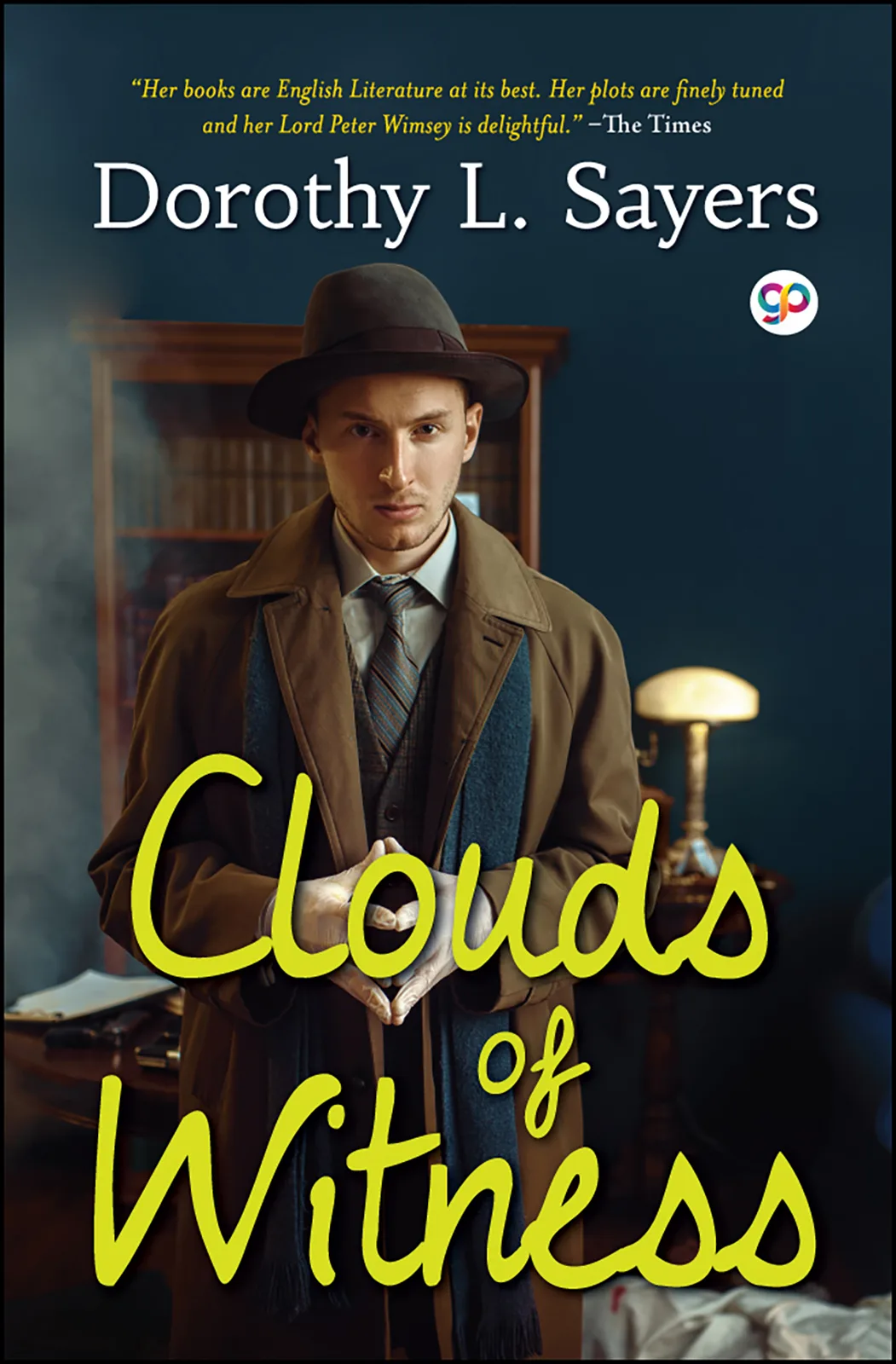
Clouds of Witness
Hardcover
• 280 Pages
• INR 425.00
• English
• 9789354995347
No ratings yet
| Publisher | General Press |
|---|---|
| ISBN13 | 9789354995347 |
| ASIN/SKU | 9354995349 |
| Book Format | Hardcover |
| Language | English |
| Pages | 280 |
| List Price | INR 425.00 |
| Subject Code | FIC031010, FIC000000, FIC022000, FIC022040 |
| Publishing Date | 15/12/2022 |
| Dimensions | 8.25 x 5.25 x 1.0 inches |
| Book Code | BD00067798 |
Buy this Book
Amazon Stores
Ebook Stores
Other Stores
Discover Clouds of Witness by Dorothy L. Sayers. This book is published by General Press in Hardcover format, ISBN 9789354995347, ASIN 9354995349, under Mystery, Thriller and Suspense, Traditional British Detective Mysteries, Cozy Mysteries.
Book Description
First published in 1926, ‘Clouds of Witness’ is a mystery novel by Dorothy L. Sayers, an English crime writer, poet, and student of classical and modern languages, best known for her mysteries, a series of novels and short stories set between the First and Second World Wars.
As Lord Peter Wimsey appreciates his time in Corsica, he's brought back to actuality when all of the headlines declare that his brother, Gerald, has been charged with murder. Gerald, who had been on a hunting expedition at the family's estate in Yorkshire with his brother-in-law, had gotten into a fight with the man about his disgraceful past. Hours later, the man is dead, and Gerald is the primary suspect. As Gerald claims his integrity, it's up to Wimsey to figure out who the real killer is and save his brother.
As Lord Peter Wimsey appreciates his time in Corsica, he's brought back to actuality when all of the headlines declare that his brother, Gerald, has been charged with murder. Gerald, who had been on a hunting expedition at the family's estate in Yorkshire with his brother-in-law, had gotten into a fight with the man about his disgraceful past. Hours later, the man is dead, and Gerald is the primary suspect. As Gerald claims his integrity, it's up to Wimsey to figure out who the real killer is and save his brother.
Author Biography
Dorothy L. Sayers (1893-1957) was a playwright, scholar, and acclaimed author of mysteries, best known for her books starring the gentleman sleuth Lord Peter Wimsey.
Born in Oxford, England, Sayers, whose father was a reverend, grew up in the Bluntisham rectory and won a scholarship to Oxford University where she studied modern languages and worked at the publishing house Blackwell's, which published her first book of poetry in 1916.
Years later, working as an advertising copywriter, Sayers began work on Whose Body?, a mystery novel featuring dapper detective Lord Peter Wimsey. Over the next two decades, Sayers published ten more Wimsey novels and several short stories, crafting a character whose complexity was unusual for the mystery novels of the time.
In 1936, Sayers brought Lord Peter Wimsey to the stage in a production of Busman's Honeymoon, a story which she would publish as a novel the following year. The play was so successful that she gave up mystery writing to focus on the stage, producing a series of religious works culminating in The Man Born to Be King (1941) a radio drama about the life of Jesus.
She also wrote theological essays and criticism during and after World War II, and in 1949 published the first volume of a translation of Dante's Divine Comedy (which she considered to be her best work).
Born in Oxford, England, Sayers, whose father was a reverend, grew up in the Bluntisham rectory and won a scholarship to Oxford University where she studied modern languages and worked at the publishing house Blackwell's, which published her first book of poetry in 1916.
Years later, working as an advertising copywriter, Sayers began work on Whose Body?, a mystery novel featuring dapper detective Lord Peter Wimsey. Over the next two decades, Sayers published ten more Wimsey novels and several short stories, crafting a character whose complexity was unusual for the mystery novels of the time.
In 1936, Sayers brought Lord Peter Wimsey to the stage in a production of Busman's Honeymoon, a story which she would publish as a novel the following year. The play was so successful that she gave up mystery writing to focus on the stage, producing a series of religious works culminating in The Man Born to Be King (1941) a radio drama about the life of Jesus.
She also wrote theological essays and criticism during and after World War II, and in 1949 published the first volume of a translation of Dante's Divine Comedy (which she considered to be her best work).
Editorial Reviews
Editorial Reviews will be added soon…
Book Summary
Dorothy L. Sayers’s Clouds of Witness, published in 1926, is the second novel featuring Lord Peter Wimsey and one of the finest examples of the classic Golden Age country-house mystery. The story begins with an apparently straightforward murder: Captain Denis Cathcart, fiancé of Lord Peter’s sister, Lady Mary Wimsey, is found shot outside the conservatory of the Wimsey family’s shooting lodge in Yorkshire. The evidence points almost immediately toward Lord Peter’s older brother, Gerald, the Duke of Denver. What follows is a complicated investigation involving hidden relationships, false appearances, missing letters, mysterious footprints, international secrets, and a remarkable chain of coincidences.
Lord Peter is initially far from England, enjoying a holiday in Corsica after the events of his earlier investigation. His peaceful escape from crime ends abruptly when his valet and trusted assistant, Bunter, shows him a newspaper announcing that Gerald has been arrested for murder. Peter immediately returns to England. The case is deeply personal: his brother is facing the possibility of conviction, and the victim was the man engaged to marry his beloved sister Mary. Peter is therefore not investigating merely as an amateur detective. He is trying to save his family from disgrace and, potentially, his brother from the most serious punishment.
The circumstances surrounding Cathcart’s death seem devastating for Gerald. At about three o’clock in the morning, Gerald claims to have discovered Cathcart’s body outside the conservatory. Lady Mary was nearby and, on seeing her brother kneeling over the body, exclaimed that Gerald had killed him. Even more damaging, the bullet came from Gerald’s revolver. Gerald also admits that he had quarrelled violently with Cathcart earlier that evening. Yet he refuses to explain exactly where he had been between the quarrel and the discovery of the body. His silence makes him appear almost deliberately guilty.
The quarrel itself seems to provide an obvious motive. Gerald had received a letter from an old friend, Tom Freeborn, warning him that Cathcart was a professional card cheat. Gerald confronted Cathcart, who did not deny the accusation. The argument became heated, and Cathcart announced that he was breaking off his engagement to Mary. Gerald, furious at the insult to his sister, ordered him to leave the house. Cathcart went out into the cold, rainy night. Soon afterward, he was dead.
Peter and Inspector Charles Parker begin examining the evidence more carefully. They discover details that do not fit the obvious theory. There are unexplained footprints around the lodge, a small piece of jewelry in the shape of a green-eyed cat, and evidence that more than one person may have been moving around the grounds that night. Lady Mary is also behaving strangely. Rather than openly explaining what she was doing at three in the morning, she retreats into apparent illness and refuses to give a complete account of her movements.
Peter gradually discovers that the mystery involves far more than Gerald and Cathcart. Cathcart had lived much of his adult life in Paris, where he maintained a secret relationship with a woman named Simone Vonderaa. His financial circumstances had deteriorated badly after the First World War, and maintaining Simone’s expensive lifestyle had contributed to his gambling and dishonesty. Eventually, Cathcart became desperate enough to cheat at cards, a secret that threatened his reputation and career.
At the same time, Cathcart’s relationship with Mary was not the conventional romantic engagement it appeared to be. Mary had agreed to marry him largely as a practical arrangement. She wanted independence and an established household, while Cathcart needed the financial security that marriage into the Wimsey family could provide. Neither was deeply in love. More importantly, Mary had another relationship: she was still attached to George Goyles, a young man with strong political convictions who had previously been unable to provide her with the secure future she desired. When Goyles finally seemed capable of supporting a marriage, Mary decided to elope with him.
This creates one of the novel’s most important complications. Mary and Goyles independently planned to leave England at approximately three in the morning—the very time at which Cathcart was found dying. Their secret plans make Mary appear suspicious, while Goyles becomes another possible suspect. Parker, who has developed feelings for Mary, is particularly distressed when evidence from Paris seems to implicate her in Cathcart’s death.
Goyles is eventually questioned and admits that he had been near Riddlesdale Lodge that night. He says he arrived shortly before three, climbed over a wall, and approached the conservatory because he was expecting to meet Mary. He claims that he stumbled over Cathcart’s body without knowing who the dead man was. His story initially makes matters worse, but Peter begins recognizing a crucial pattern: several people were acting independently that night, and their unrelated actions happened to intersect at exactly the wrong moment.
Peter eventually travels to Paris to investigate Cathcart’s past. There he uncovers evidence concerning Simone and discovers that Cathcart’s emotional life is essential to understanding the tragedy. A particularly important clue is the green-eyed cat jewel, which connects Cathcart with Simone and helps reveal the truth behind his private life.
The breakthrough comes when Peter reconstructs the timing of Cathcart’s final hours. The shooting did not necessarily occur at three o’clock. Evidence from the gamekeeper indicates that a shot was heard much earlier, around 11:30. Medical testimony later establishes that the wound was not immediately fatal and that Cathcart could have remained alive for several hours afterward. This transforms the entire case. The body discovered at three does not prove that the shooting happened at three.
The truth is finally revealed during the Duke’s trial before the House of Lords, a historically unusual proceeding made necessary by Gerald’s status as a peer. Peter has obtained decisive evidence from America: a letter written by Cathcart himself shortly before his death. The letter is addressed to Simone and explains everything. Cathcart had discovered that Simone was leaving him for a wealthy American. Already ruined financially and emotionally, he believed that the end had come. He admits his gambling and cheating, explains how desperately he had tried to maintain Simone’s affection, and reveals that he had decided to kill himself. He deliberately intended his death to appear as suicide and mentions that Gerald’s revolver was conveniently available.
Thus, the apparent murder was actually a suicide, complicated by a series of extraordinary coincidences. Gerald did not kill Cathcart. Mary did not kill him either, although she later falsely claims responsibility in an attempt to protect Goyles. Goyles was present because of his secret plan to elope with Mary, while Gerald’s movements and silence make him appear guilty. Each person is concealing something, but none of their secrets explains the death.
The title Clouds of Witness captures the novel’s central idea beautifully. The witnesses surrounding the crime do not provide a simple path to the truth because each person sees only one part of the night. Their secrets, fears, misunderstandings, and private motives create a “cloud” around what actually happened.
Ultimately, Sayers uses the mystery to explore the difference between appearance and truth. Gerald looks guilty but is innocent. Mary looks like a grieving fiancée but is secretly planning to escape with another man. Goyles looks like a possible murderer but is merely frightened and unreliable. Cathcart appears to have been murdered, yet his own final act creates the illusion of murder.
The novel is therefore more than an ingenious detective puzzle. It is a study of human weakness, pride, love, shame, and secrecy. Lord Peter solves the case not simply by discovering a hidden murderer but by patiently separating several independent stories that have become tangled together. In doing so, he proves that the truth can sometimes be stranger than the most elaborate crime—and that, behind a mystery crowded with witnesses, the most important voice may ultimately belong to the dead man himself.
Lord Peter is initially far from England, enjoying a holiday in Corsica after the events of his earlier investigation. His peaceful escape from crime ends abruptly when his valet and trusted assistant, Bunter, shows him a newspaper announcing that Gerald has been arrested for murder. Peter immediately returns to England. The case is deeply personal: his brother is facing the possibility of conviction, and the victim was the man engaged to marry his beloved sister Mary. Peter is therefore not investigating merely as an amateur detective. He is trying to save his family from disgrace and, potentially, his brother from the most serious punishment.
The circumstances surrounding Cathcart’s death seem devastating for Gerald. At about three o’clock in the morning, Gerald claims to have discovered Cathcart’s body outside the conservatory. Lady Mary was nearby and, on seeing her brother kneeling over the body, exclaimed that Gerald had killed him. Even more damaging, the bullet came from Gerald’s revolver. Gerald also admits that he had quarrelled violently with Cathcart earlier that evening. Yet he refuses to explain exactly where he had been between the quarrel and the discovery of the body. His silence makes him appear almost deliberately guilty.
The quarrel itself seems to provide an obvious motive. Gerald had received a letter from an old friend, Tom Freeborn, warning him that Cathcart was a professional card cheat. Gerald confronted Cathcart, who did not deny the accusation. The argument became heated, and Cathcart announced that he was breaking off his engagement to Mary. Gerald, furious at the insult to his sister, ordered him to leave the house. Cathcart went out into the cold, rainy night. Soon afterward, he was dead.
Peter and Inspector Charles Parker begin examining the evidence more carefully. They discover details that do not fit the obvious theory. There are unexplained footprints around the lodge, a small piece of jewelry in the shape of a green-eyed cat, and evidence that more than one person may have been moving around the grounds that night. Lady Mary is also behaving strangely. Rather than openly explaining what she was doing at three in the morning, she retreats into apparent illness and refuses to give a complete account of her movements.
Peter gradually discovers that the mystery involves far more than Gerald and Cathcart. Cathcart had lived much of his adult life in Paris, where he maintained a secret relationship with a woman named Simone Vonderaa. His financial circumstances had deteriorated badly after the First World War, and maintaining Simone’s expensive lifestyle had contributed to his gambling and dishonesty. Eventually, Cathcart became desperate enough to cheat at cards, a secret that threatened his reputation and career.
At the same time, Cathcart’s relationship with Mary was not the conventional romantic engagement it appeared to be. Mary had agreed to marry him largely as a practical arrangement. She wanted independence and an established household, while Cathcart needed the financial security that marriage into the Wimsey family could provide. Neither was deeply in love. More importantly, Mary had another relationship: she was still attached to George Goyles, a young man with strong political convictions who had previously been unable to provide her with the secure future she desired. When Goyles finally seemed capable of supporting a marriage, Mary decided to elope with him.
This creates one of the novel’s most important complications. Mary and Goyles independently planned to leave England at approximately three in the morning—the very time at which Cathcart was found dying. Their secret plans make Mary appear suspicious, while Goyles becomes another possible suspect. Parker, who has developed feelings for Mary, is particularly distressed when evidence from Paris seems to implicate her in Cathcart’s death.
Goyles is eventually questioned and admits that he had been near Riddlesdale Lodge that night. He says he arrived shortly before three, climbed over a wall, and approached the conservatory because he was expecting to meet Mary. He claims that he stumbled over Cathcart’s body without knowing who the dead man was. His story initially makes matters worse, but Peter begins recognizing a crucial pattern: several people were acting independently that night, and their unrelated actions happened to intersect at exactly the wrong moment.
Peter eventually travels to Paris to investigate Cathcart’s past. There he uncovers evidence concerning Simone and discovers that Cathcart’s emotional life is essential to understanding the tragedy. A particularly important clue is the green-eyed cat jewel, which connects Cathcart with Simone and helps reveal the truth behind his private life.
The breakthrough comes when Peter reconstructs the timing of Cathcart’s final hours. The shooting did not necessarily occur at three o’clock. Evidence from the gamekeeper indicates that a shot was heard much earlier, around 11:30. Medical testimony later establishes that the wound was not immediately fatal and that Cathcart could have remained alive for several hours afterward. This transforms the entire case. The body discovered at three does not prove that the shooting happened at three.
The truth is finally revealed during the Duke’s trial before the House of Lords, a historically unusual proceeding made necessary by Gerald’s status as a peer. Peter has obtained decisive evidence from America: a letter written by Cathcart himself shortly before his death. The letter is addressed to Simone and explains everything. Cathcart had discovered that Simone was leaving him for a wealthy American. Already ruined financially and emotionally, he believed that the end had come. He admits his gambling and cheating, explains how desperately he had tried to maintain Simone’s affection, and reveals that he had decided to kill himself. He deliberately intended his death to appear as suicide and mentions that Gerald’s revolver was conveniently available.
Thus, the apparent murder was actually a suicide, complicated by a series of extraordinary coincidences. Gerald did not kill Cathcart. Mary did not kill him either, although she later falsely claims responsibility in an attempt to protect Goyles. Goyles was present because of his secret plan to elope with Mary, while Gerald’s movements and silence make him appear guilty. Each person is concealing something, but none of their secrets explains the death.
The title Clouds of Witness captures the novel’s central idea beautifully. The witnesses surrounding the crime do not provide a simple path to the truth because each person sees only one part of the night. Their secrets, fears, misunderstandings, and private motives create a “cloud” around what actually happened.
Ultimately, Sayers uses the mystery to explore the difference between appearance and truth. Gerald looks guilty but is innocent. Mary looks like a grieving fiancée but is secretly planning to escape with another man. Goyles looks like a possible murderer but is merely frightened and unreliable. Cathcart appears to have been murdered, yet his own final act creates the illusion of murder.
The novel is therefore more than an ingenious detective puzzle. It is a study of human weakness, pride, love, shame, and secrecy. Lord Peter solves the case not simply by discovering a hidden murderer but by patiently separating several independent stories that have become tangled together. In doing so, he proves that the truth can sometimes be stranger than the most elaborate crime—and that, behind a mystery crowded with witnesses, the most important voice may ultimately belong to the dead man himself.
Sample Chapters
Sample Chapters will be added soon…
Reader Reviews
No reviews yet.
Clouds of Witness
Download Cover Image
Do you want to download the full cover image for Clouds of Witness?