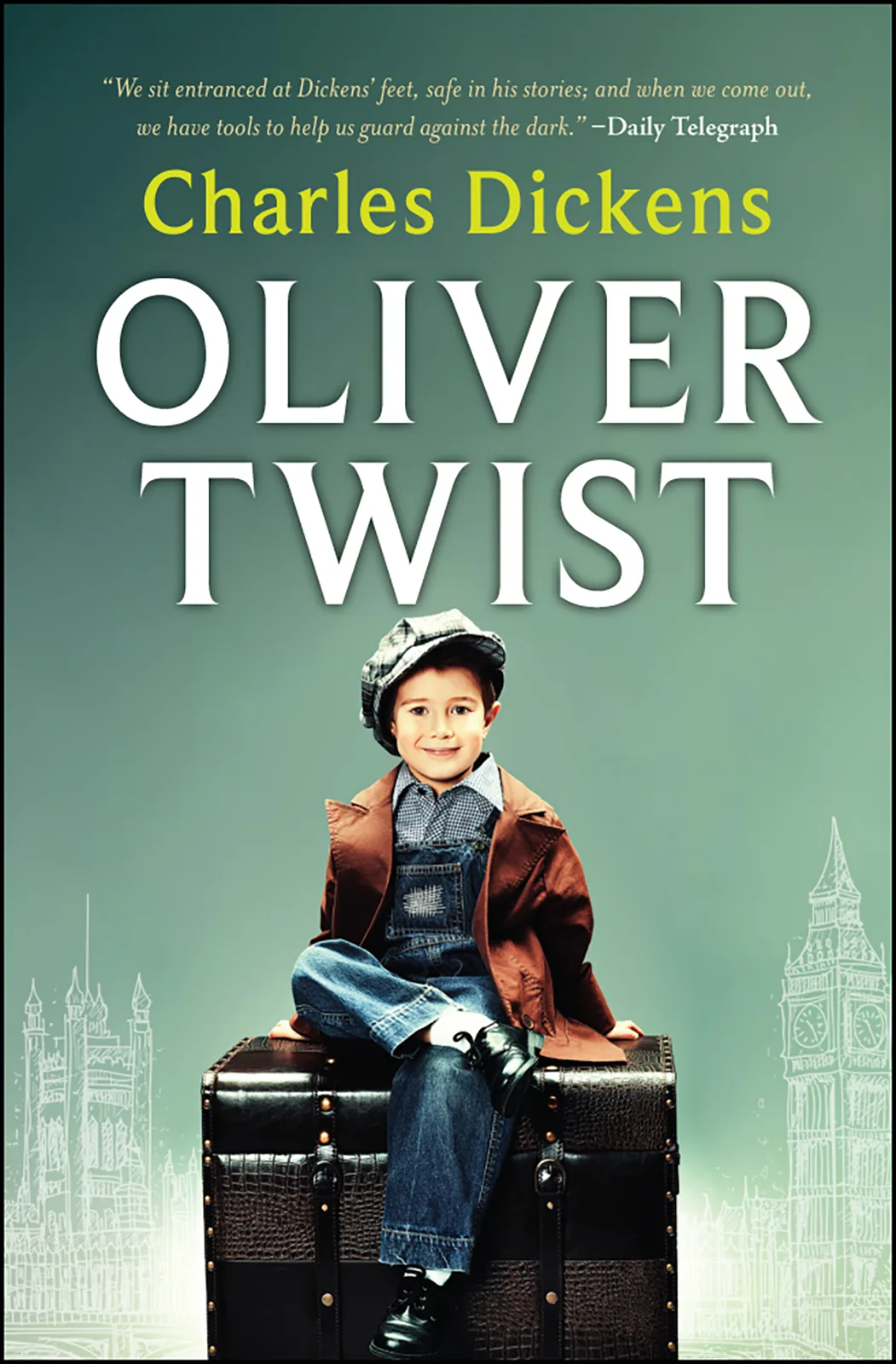
Oliver Twist
Hardcover
• 424 Pages
• INR 645.00
• English
• 9789354995408
No ratings yet
| Publisher | General Press |
|---|---|
| ISBN13 | 9789354995408 |
| ASIN/SKU | 9354995403 |
| Book Format | Hardcover |
| Language | English |
| Pages | 424 |
| List Price | INR 645.00 |
| Subject Code | FIC004000, FIC029000, FIC019000 |
| Publishing Date | 15/12/2022 |
| Dimensions | 8.25 x 5.25 x 1.0 inches |
| Book Code | BD00067803 |
Buy this Book
Amazon Stores
Ebook Stores
Other Stores
Discover Oliver Twist by Charles Dickens. This book is published by General Press in Hardcover format, ISBN 9789354995408, ASIN 9354995403, under Literature and Fiction, Historical Fiction, British Literature.
Book Description
Originally published in 1838, ‘Oliver Twist’ is one of the most admired novels by Charles Dickens, an English writer, and social critic. Dickens created some of the world's best-known fictional characters and is regarded by many as the greatest novelist of the Victorian era.
It is the story of a young orphan who dares to say, "Please, sir, I want some more." After escaping from the dark and dismal workhouse where he was born, Oliver finds himself on the mean streets of Victorian-era London and is unwittingly recruited into a scabrous gang of scheming urchins. In this band of petty thieves, Oliver encounters the extraordinary and vibrant characters that have captured audiences' imaginations for more than 150 years: the loathsome Fagin, the beautiful and tragic Nancy, the crafty Artful Dodger, and the terrifying Bill Sikes, perhaps one of the greatest villains of all time.
Rife with Dickens's disturbing descriptions of street life, the novel is buoyed by the purity of the orphan Oliver. Though he is treated with cruelty and surrounded by coarseness for most of his life, his pious innocence leads him at last to salvation-and the shocking discovery of his true identity.
It is the story of a young orphan who dares to say, "Please, sir, I want some more." After escaping from the dark and dismal workhouse where he was born, Oliver finds himself on the mean streets of Victorian-era London and is unwittingly recruited into a scabrous gang of scheming urchins. In this band of petty thieves, Oliver encounters the extraordinary and vibrant characters that have captured audiences' imaginations for more than 150 years: the loathsome Fagin, the beautiful and tragic Nancy, the crafty Artful Dodger, and the terrifying Bill Sikes, perhaps one of the greatest villains of all time.
Rife with Dickens's disturbing descriptions of street life, the novel is buoyed by the purity of the orphan Oliver. Though he is treated with cruelty and surrounded by coarseness for most of his life, his pious innocence leads him at last to salvation-and the shocking discovery of his true identity.
Author Biography
Charles Dickens (7 February 1812 – 9 June 1870) was an English writer and social critic. He created some of the world's best-known fictional characters and is regarded as the greatest novelist of the Victorian era. His works enjoyed unprecedented popularity during his lifetime, and by the twentieth century critics and scholars had recognised him as a literary genius. His novels and short stories enjoy lasting popularity.
The second of eight children, he grew up in a family frequently beset by financial insecurity. At age eleven, Dickens was taken out of school and sent to work in London backing warehouse, where his job was to paste labels on bottles for six shillings a week. His father John Dickens, was a warmhearted but improvident man. When he was condemned the Marshela Prison for unpaid debts, he unwisely agreed that Charles should stay in lodgings and continue working while the rest of the family joined him in jail. This three-month separation caused Charles much pain; his experiences as a child alone in a huge city—cold, isolated with barely enough to eat—haunted him for the rest of his life.
When the family fortunes improved, Charles went back to school, after which he became an office boy, a freelance reporter and finally an author. With Pickwick Papers (1836-7) he achieved immediate fame; in a few years he was easily the most popular and respected writer of his time. It has been estimated that one out of every ten persons in Victorian England was a Dickens reader. Oliver Twist (1837), Nicholas Nickleby (1838-9) and The Old Curiosity Shop (1840-41) were huge successes. Martin Chuzzlewit (1843-4) was less so, but Dickens followed it with his unforgettable, A Christmas Carol (1843), Bleak House (1852-3), Hard Times (1854) and Little Dorrit (1855-7) reveal his deepening concern for the injustices of British Society. A Tale of Two Cities (1859), Great Expectations (1860-1) and Our Mutual Friend (1864-5) complete his major works.
Dickens's marriage to Catherine Hoggarth produced ten children but ended in separation in 1858. In that year he began a series of exhausting public readings; his health gradually declined. After putting in a full day's work at his home at Gads Hill, Kent on June 8, 1870, Dickens suffered a stroke, and he died the following day.
He was a sympathiser with the poor, the suffering, and the oppressed; and by his death, one of England's greatest writers is lost to the world.
The second of eight children, he grew up in a family frequently beset by financial insecurity. At age eleven, Dickens was taken out of school and sent to work in London backing warehouse, where his job was to paste labels on bottles for six shillings a week. His father John Dickens, was a warmhearted but improvident man. When he was condemned the Marshela Prison for unpaid debts, he unwisely agreed that Charles should stay in lodgings and continue working while the rest of the family joined him in jail. This three-month separation caused Charles much pain; his experiences as a child alone in a huge city—cold, isolated with barely enough to eat—haunted him for the rest of his life.
When the family fortunes improved, Charles went back to school, after which he became an office boy, a freelance reporter and finally an author. With Pickwick Papers (1836-7) he achieved immediate fame; in a few years he was easily the most popular and respected writer of his time. It has been estimated that one out of every ten persons in Victorian England was a Dickens reader. Oliver Twist (1837), Nicholas Nickleby (1838-9) and The Old Curiosity Shop (1840-41) were huge successes. Martin Chuzzlewit (1843-4) was less so, but Dickens followed it with his unforgettable, A Christmas Carol (1843), Bleak House (1852-3), Hard Times (1854) and Little Dorrit (1855-7) reveal his deepening concern for the injustices of British Society. A Tale of Two Cities (1859), Great Expectations (1860-1) and Our Mutual Friend (1864-5) complete his major works.
Dickens's marriage to Catherine Hoggarth produced ten children but ended in separation in 1858. In that year he began a series of exhausting public readings; his health gradually declined. After putting in a full day's work at his home at Gads Hill, Kent on June 8, 1870, Dickens suffered a stroke, and he died the following day.
He was a sympathiser with the poor, the suffering, and the oppressed; and by his death, one of England's greatest writers is lost to the world.
Editorial Reviews
Editorial Reviews will be added soon…
Book Summary
Oliver Twist by Charles Dickens is one of the most famous novels in English literature and a powerful social criticism of poverty, child exploitation, crime, and the harsh treatment of the poor in nineteenth-century England. First published serially between 1837 and 1839, the novel follows Oliver, an orphaned boy who grows up in miserable conditions before becoming entangled with a gang of criminals in London. Although the story contains adventure, mystery, suspense, humor, and melodrama, its deeper purpose is to expose the cruelty of institutions that claim to care for vulnerable people while actually treating them as burdens. Dickens combines a moving story of innocence with a sharp portrait of Victorian society, making Oliver Twist both an entertaining classic and an important work of social criticism.
The story begins with Oliver's birth in a parish workhouse. His mother dies shortly after giving birth to him, leaving the child without parents or protection. Because Oliver is born into poverty, his early life is controlled by the harsh workhouse system. He receives very little food, affection, or personal attention. The adults responsible for him treat him as a social problem rather than as a human child. His name is given according to an arbitrary naming system, reinforcing the impression that he has no meaningful identity or family history.
Oliver grows up among other poor children in an institution where food is scarce and discipline is severe. The famous episode in which Oliver asks for “more” food becomes the first major confrontation between the child and the system that controls him. After receiving his tiny portion of gruel, Oliver approaches the authorities and politely asks for another serving. His request is treated as an outrageous act of rebellion. Instead of recognizing the boy's basic hunger, the officials interpret his behavior as evidence of dangerous character. Dickens uses this scene to expose the absurdity and cruelty of a system in which a starving child can be punished for asking for enough food to survive.
Oliver is subsequently apprenticed to an undertaker named Mr. Sowerberry. Although his new circumstances initially appear to offer a way out of the workhouse, Oliver continues to suffer humiliation and neglect. Mrs. Sowerberry treats him poorly, while Noah Claypole, another servant, bullies him. Noah insults Oliver's dead mother, provoking the boy into a rare act of resistance. Oliver attacks Noah and is punished severely for defending himself. This episode shows an important pattern in the novel: institutions and adults often punish Oliver for reacting to abuse rather than protecting him from the abuse itself.
After this experience, Oliver decides to run away. He travels toward London, hoping that the city will offer him a better life. Instead, he encounters Jack Dawkins, better known as the Artful Dodger. The Dodger appears friendly and offers Oliver food and shelter. Innocent and inexperienced, Oliver follows him to London and is introduced to a group of criminals led by Fagin.
Fagin is one of the novel's most important characters. He trains homeless boys to steal from people in the streets and organizes their activities for his own benefit. The boys are taught to pick pockets and bring their stolen goods back to Fagin. Oliver does not initially understand the true nature of the group. Because he has experienced so little kindness, he is grateful for the food and companionship he receives. His innocence makes him particularly vulnerable to manipulation.
Fagin's criminal world provides Dickens with a disturbing contrast to the workhouse. Both systems exploit children, although in different ways. The workhouse deprives Oliver through institutional neglect, while Fagin exploits vulnerable children by turning them into thieves. In both environments, children are treated as instruments rather than as human beings with rights and dignity. Dickens therefore suggests that poverty creates conditions in which children can easily be trapped by people who take advantage of their vulnerability.
Another major figure in the criminal underworld is Bill Sikes, a violent thief who represents a much more brutal form of criminality. Sikes is accompanied by his dog, Bull's-eye, and is feared by the other members of the gang. His partner, Nancy, is one of the novel's most complicated characters. Nancy participates in the criminal world but retains a strong capacity for compassion. She recognizes Oliver's innocence and gradually becomes emotionally committed to protecting him. Her moral conflict becomes one of the most tragic elements of the story.
Oliver's first involvement in a robbery changes his life. Fagin sends him out with the Artful Dodger and another boy, Charley Bates. Oliver is horrified when he realizes that the boys are attempting to steal from an elderly gentleman, Mr. Brownlow. When Oliver tries to escape, he is mistakenly believed to be the thief and is arrested. This misunderstanding becomes an important turning point because Brownlow eventually discovers that Oliver is innocent.
Mr. Brownlow provides Oliver with something he has almost never experienced: genuine kindness from an adult. He gives the boy clean clothes, food, shelter, and care. Oliver begins to recover physically and emotionally. For the first time, he experiences the possibility of a stable home. Brownlow also becomes curious about Oliver's origins, particularly because the boy resembles a portrait in his house. This mystery introduces the second major dimension of the novel: Oliver's unknown family history.
Dickens gradually reveals that Oliver's identity is connected to a complicated family story involving Edwin Leeford, Oliver's father, and the boy's mother, Agnes Fleming. Oliver is therefore not simply an anonymous orphan. He has a legitimate family history that has been concealed from him. His birth has been surrounded by secrecy, social shame, inheritance disputes, and betrayal. This mystery drives much of the second half of the novel.
The villainous Monks, whose real name is Edward Leeford, is particularly important. He is Oliver's half-brother and is determined to destroy Oliver's chances of receiving his rightful inheritance. Monks has an intense personal interest in keeping Oliver's identity secret. He cooperates with Fagin because he believes that turning Oliver into a criminal will make it easier to discredit him and prevent him from claiming his inheritance.
This part of the story shows that Oliver's danger comes from more than poverty. Powerful adults are actively manipulating his circumstances. His innocence is threatened not simply because he is poor but because people with selfish motives are prepared to exploit his vulnerability. Dickens uses this plot to connect social injustice with family secrecy, wealth, inheritance, and class.
Meanwhile, Fagin and Sikes remain determined to bring Oliver back into the criminal world. Nancy understands that Oliver is in grave danger. She secretly meets with Mr. Brownlow and reveals information about Monks and Fagin's plans. Her actions are extraordinarily courageous because Sikes and Fagin would punish her severely if they discovered her betrayal. Nancy's decision demonstrates that moral goodness can survive even in people who have been trapped in destructive environments.
Nancy's tragedy is central to the novel. Sikes eventually discovers that she has been helping Oliver and Brownlow. In a horrifying act of violence, he murders her. Dickens presents her death as one of the most devastating consequences of the criminal world. Nancy is not portrayed simply as a criminal; she is a deeply conflicted person whose capacity for love and sacrifice makes her death especially painful.
Sikes's guilt and fear eventually consume him. After Nancy's murder, he becomes increasingly desperate and isolated. His attempt to escape ends in his death when he accidentally hangs himself while trying to flee across rooftops. Dickens uses this conclusion to show the destructive consequences of violence. Sikes has spent his life controlling others through fear, but ultimately he is destroyed by the very violence he has embraced.
Fagin is eventually arrested and brought to trial. His fate is much more severe. He is sentenced to death, and Dickens's portrayal of his final days is grim and disturbing. The once-confident criminal organizer becomes a frightened prisoner awaiting execution. Through Fagin's downfall, Dickens closes the criminal part of the story with a strong sense of punishment and moral consequence.
The mystery of Oliver's identity is eventually resolved. Brownlow discovers the truth about Oliver's family and learns that Monks has deliberately tried to destroy his younger brother's future. Monks is forced to acknowledge Oliver's legitimate claim to part of the family inheritance. Oliver is finally given the family history and social identity that had been denied to him since birth.
One of the most significant elements of the ending is Oliver's relationship with Mr. Brownlow. Brownlow adopts him and provides the loving home that Oliver has lacked throughout his childhood. Oliver's life changes completely. Instead of growing up in poverty, violence, and crime, he receives education, affection, stability, and protection. Dickens uses this transformation to contrast the conditions that produce suffering with those that allow a child to flourish.
The novel's ending also deals with several secondary characters. The Artful Dodger is eventually captured and punished, while Charley Bates begins to reject the criminal life and tries to become a respectable person. This suggests that environment matters but does not completely determine a person's future. People can change when they escape destructive circumstances.
A major theme of Oliver Twist is therefore the treatment of poor children. Dickens strongly criticizes the Victorian workhouse system and the attitudes that surrounded poverty. The novel challenges the belief that poor people are poor because they are morally inferior. Oliver is poor, but he is fundamentally good. His goodness remains intact despite hunger, violence, neglect, and criminal influence. Dickens uses Oliver to challenge the assumption that poverty is evidence of bad character.
Another major theme is innocence versus corruption. Oliver represents innocence placed in an environment filled with corruption. Nearly every stage of his journey threatens to destroy his moral character. Yet he repeatedly refuses to become what others want him to become. Fagin wants him to become a thief; Monks wants him disgraced; Sikes threatens him with violence; the workhouse treats him as worthless. Oliver survives because his essential innocence remains intact.
The novel also explores the relationship between poverty and crime. Dickens does not excuse criminal behavior, but he shows how poverty, homelessness, hunger, and neglect create conditions in which vulnerable children can be recruited into criminal networks. Fagin's gang exists partly because there are children living on the streets who have nowhere else to go. Dickens therefore asks readers to consider whether society can punish crime effectively while ignoring the conditions that help produce it.
The character of Nancy complicates the simple distinction between good and evil. She is involved in crime but demonstrates extraordinary loyalty and compassion. Through her, Dickens suggests that morality is not always determined by social respectability. Someone considered a criminal may possess greater courage and humanity than people who appear respectable. This is one reason Nancy remains one of the most memorable characters in the novel.
Ultimately, Oliver Twist by Charles Dickens is a story about an innocent child struggling to survive a society that repeatedly fails him. His journey from the workhouse to the criminal underworld and finally to a secure home exposes the inequalities and contradictions of Victorian England. Dickens combines suspense, mystery, humor, social criticism, and emotional drama to show how poverty and institutional cruelty can damage vulnerable people. At the same time, he insists that compassion, friendship, and moral courage can survive even in the darkest circumstances.
For readers searching for an Oliver Twist summary, Oliver Twist analysis, Oliver Twist characters, Oliver Twist themes, Oliver Twist plot summary, Oliver's character, Fagin and the Artful Dodger, Nancy's role in Oliver Twist, Victorian poverty, Dickens's social criticism, or the ending of Oliver Twist explained, the novel's central message is clear: children deserve protection, dignity, food, education, and love, regardless of their social position. Oliver's innocence becomes a powerful way for Dickens to expose the cruelty of a society that often blamed the poor for their suffering. More than a century and a half after its publication, Oliver Twist remains compelling because its central questions are still recognizable: What happens to children when society fails them? Can goodness survive in a corrupt environment? And what responsibility does a community have toward its most vulnerable members? Dickens answers through Oliver's story with both anger and hope, showing that compassion can change a life—but that society must also confront the conditions that make such compassion necessary.
The story begins with Oliver's birth in a parish workhouse. His mother dies shortly after giving birth to him, leaving the child without parents or protection. Because Oliver is born into poverty, his early life is controlled by the harsh workhouse system. He receives very little food, affection, or personal attention. The adults responsible for him treat him as a social problem rather than as a human child. His name is given according to an arbitrary naming system, reinforcing the impression that he has no meaningful identity or family history.
Oliver grows up among other poor children in an institution where food is scarce and discipline is severe. The famous episode in which Oliver asks for “more” food becomes the first major confrontation between the child and the system that controls him. After receiving his tiny portion of gruel, Oliver approaches the authorities and politely asks for another serving. His request is treated as an outrageous act of rebellion. Instead of recognizing the boy's basic hunger, the officials interpret his behavior as evidence of dangerous character. Dickens uses this scene to expose the absurdity and cruelty of a system in which a starving child can be punished for asking for enough food to survive.
Oliver is subsequently apprenticed to an undertaker named Mr. Sowerberry. Although his new circumstances initially appear to offer a way out of the workhouse, Oliver continues to suffer humiliation and neglect. Mrs. Sowerberry treats him poorly, while Noah Claypole, another servant, bullies him. Noah insults Oliver's dead mother, provoking the boy into a rare act of resistance. Oliver attacks Noah and is punished severely for defending himself. This episode shows an important pattern in the novel: institutions and adults often punish Oliver for reacting to abuse rather than protecting him from the abuse itself.
After this experience, Oliver decides to run away. He travels toward London, hoping that the city will offer him a better life. Instead, he encounters Jack Dawkins, better known as the Artful Dodger. The Dodger appears friendly and offers Oliver food and shelter. Innocent and inexperienced, Oliver follows him to London and is introduced to a group of criminals led by Fagin.
Fagin is one of the novel's most important characters. He trains homeless boys to steal from people in the streets and organizes their activities for his own benefit. The boys are taught to pick pockets and bring their stolen goods back to Fagin. Oliver does not initially understand the true nature of the group. Because he has experienced so little kindness, he is grateful for the food and companionship he receives. His innocence makes him particularly vulnerable to manipulation.
Fagin's criminal world provides Dickens with a disturbing contrast to the workhouse. Both systems exploit children, although in different ways. The workhouse deprives Oliver through institutional neglect, while Fagin exploits vulnerable children by turning them into thieves. In both environments, children are treated as instruments rather than as human beings with rights and dignity. Dickens therefore suggests that poverty creates conditions in which children can easily be trapped by people who take advantage of their vulnerability.
Another major figure in the criminal underworld is Bill Sikes, a violent thief who represents a much more brutal form of criminality. Sikes is accompanied by his dog, Bull's-eye, and is feared by the other members of the gang. His partner, Nancy, is one of the novel's most complicated characters. Nancy participates in the criminal world but retains a strong capacity for compassion. She recognizes Oliver's innocence and gradually becomes emotionally committed to protecting him. Her moral conflict becomes one of the most tragic elements of the story.
Oliver's first involvement in a robbery changes his life. Fagin sends him out with the Artful Dodger and another boy, Charley Bates. Oliver is horrified when he realizes that the boys are attempting to steal from an elderly gentleman, Mr. Brownlow. When Oliver tries to escape, he is mistakenly believed to be the thief and is arrested. This misunderstanding becomes an important turning point because Brownlow eventually discovers that Oliver is innocent.
Mr. Brownlow provides Oliver with something he has almost never experienced: genuine kindness from an adult. He gives the boy clean clothes, food, shelter, and care. Oliver begins to recover physically and emotionally. For the first time, he experiences the possibility of a stable home. Brownlow also becomes curious about Oliver's origins, particularly because the boy resembles a portrait in his house. This mystery introduces the second major dimension of the novel: Oliver's unknown family history.
Dickens gradually reveals that Oliver's identity is connected to a complicated family story involving Edwin Leeford, Oliver's father, and the boy's mother, Agnes Fleming. Oliver is therefore not simply an anonymous orphan. He has a legitimate family history that has been concealed from him. His birth has been surrounded by secrecy, social shame, inheritance disputes, and betrayal. This mystery drives much of the second half of the novel.
The villainous Monks, whose real name is Edward Leeford, is particularly important. He is Oliver's half-brother and is determined to destroy Oliver's chances of receiving his rightful inheritance. Monks has an intense personal interest in keeping Oliver's identity secret. He cooperates with Fagin because he believes that turning Oliver into a criminal will make it easier to discredit him and prevent him from claiming his inheritance.
This part of the story shows that Oliver's danger comes from more than poverty. Powerful adults are actively manipulating his circumstances. His innocence is threatened not simply because he is poor but because people with selfish motives are prepared to exploit his vulnerability. Dickens uses this plot to connect social injustice with family secrecy, wealth, inheritance, and class.
Meanwhile, Fagin and Sikes remain determined to bring Oliver back into the criminal world. Nancy understands that Oliver is in grave danger. She secretly meets with Mr. Brownlow and reveals information about Monks and Fagin's plans. Her actions are extraordinarily courageous because Sikes and Fagin would punish her severely if they discovered her betrayal. Nancy's decision demonstrates that moral goodness can survive even in people who have been trapped in destructive environments.
Nancy's tragedy is central to the novel. Sikes eventually discovers that she has been helping Oliver and Brownlow. In a horrifying act of violence, he murders her. Dickens presents her death as one of the most devastating consequences of the criminal world. Nancy is not portrayed simply as a criminal; she is a deeply conflicted person whose capacity for love and sacrifice makes her death especially painful.
Sikes's guilt and fear eventually consume him. After Nancy's murder, he becomes increasingly desperate and isolated. His attempt to escape ends in his death when he accidentally hangs himself while trying to flee across rooftops. Dickens uses this conclusion to show the destructive consequences of violence. Sikes has spent his life controlling others through fear, but ultimately he is destroyed by the very violence he has embraced.
Fagin is eventually arrested and brought to trial. His fate is much more severe. He is sentenced to death, and Dickens's portrayal of his final days is grim and disturbing. The once-confident criminal organizer becomes a frightened prisoner awaiting execution. Through Fagin's downfall, Dickens closes the criminal part of the story with a strong sense of punishment and moral consequence.
The mystery of Oliver's identity is eventually resolved. Brownlow discovers the truth about Oliver's family and learns that Monks has deliberately tried to destroy his younger brother's future. Monks is forced to acknowledge Oliver's legitimate claim to part of the family inheritance. Oliver is finally given the family history and social identity that had been denied to him since birth.
One of the most significant elements of the ending is Oliver's relationship with Mr. Brownlow. Brownlow adopts him and provides the loving home that Oliver has lacked throughout his childhood. Oliver's life changes completely. Instead of growing up in poverty, violence, and crime, he receives education, affection, stability, and protection. Dickens uses this transformation to contrast the conditions that produce suffering with those that allow a child to flourish.
The novel's ending also deals with several secondary characters. The Artful Dodger is eventually captured and punished, while Charley Bates begins to reject the criminal life and tries to become a respectable person. This suggests that environment matters but does not completely determine a person's future. People can change when they escape destructive circumstances.
A major theme of Oliver Twist is therefore the treatment of poor children. Dickens strongly criticizes the Victorian workhouse system and the attitudes that surrounded poverty. The novel challenges the belief that poor people are poor because they are morally inferior. Oliver is poor, but he is fundamentally good. His goodness remains intact despite hunger, violence, neglect, and criminal influence. Dickens uses Oliver to challenge the assumption that poverty is evidence of bad character.
Another major theme is innocence versus corruption. Oliver represents innocence placed in an environment filled with corruption. Nearly every stage of his journey threatens to destroy his moral character. Yet he repeatedly refuses to become what others want him to become. Fagin wants him to become a thief; Monks wants him disgraced; Sikes threatens him with violence; the workhouse treats him as worthless. Oliver survives because his essential innocence remains intact.
The novel also explores the relationship between poverty and crime. Dickens does not excuse criminal behavior, but he shows how poverty, homelessness, hunger, and neglect create conditions in which vulnerable children can be recruited into criminal networks. Fagin's gang exists partly because there are children living on the streets who have nowhere else to go. Dickens therefore asks readers to consider whether society can punish crime effectively while ignoring the conditions that help produce it.
The character of Nancy complicates the simple distinction between good and evil. She is involved in crime but demonstrates extraordinary loyalty and compassion. Through her, Dickens suggests that morality is not always determined by social respectability. Someone considered a criminal may possess greater courage and humanity than people who appear respectable. This is one reason Nancy remains one of the most memorable characters in the novel.
Ultimately, Oliver Twist by Charles Dickens is a story about an innocent child struggling to survive a society that repeatedly fails him. His journey from the workhouse to the criminal underworld and finally to a secure home exposes the inequalities and contradictions of Victorian England. Dickens combines suspense, mystery, humor, social criticism, and emotional drama to show how poverty and institutional cruelty can damage vulnerable people. At the same time, he insists that compassion, friendship, and moral courage can survive even in the darkest circumstances.
For readers searching for an Oliver Twist summary, Oliver Twist analysis, Oliver Twist characters, Oliver Twist themes, Oliver Twist plot summary, Oliver's character, Fagin and the Artful Dodger, Nancy's role in Oliver Twist, Victorian poverty, Dickens's social criticism, or the ending of Oliver Twist explained, the novel's central message is clear: children deserve protection, dignity, food, education, and love, regardless of their social position. Oliver's innocence becomes a powerful way for Dickens to expose the cruelty of a society that often blamed the poor for their suffering. More than a century and a half after its publication, Oliver Twist remains compelling because its central questions are still recognizable: What happens to children when society fails them? Can goodness survive in a corrupt environment? And what responsibility does a community have toward its most vulnerable members? Dickens answers through Oliver's story with both anger and hope, showing that compassion can change a life—but that society must also confront the conditions that make such compassion necessary.
Sample Chapters
Chapter 1
TREATS OF THE PLACE TWIST WAS BORN AND OF THE CIRCUMSTANCES WHERE OLIVER ATTENDING HIS BIRTH
Among other public buildings in a certain town, which for many reasons it will be prudent to refrain from mentioning, and to which I will assign no fictitious name, there is one anciently common to most towns, great or small: to wit, a workhouse; and in this workhouse was born; on a day and date which I need not trouble myself to repeat, inasmuch as it can be of no possible consequence to the reader, in this stage of the business at all events; the item of mortality whose name is prefixed to the head of this chapter.
For a long time after it was ushered into this world of sorrow and trouble, by the parish surgeon, it remained a matter of considerable doubt whether the child would survive to bear any name at all; in which case it is somewhat more than probable that these memoirs would never have appeared; or, if they had, that being comprised within a couple of pages, they would have possessed the inestimable merit of being the most concise and faithful specimen of biography, extant in the literature of any age or country.
Although I am not disposed to maintain that the being born in a workhouse, is in itself the most fortunate and enviable circumstance that can possibly befall a human being, I do mean to say that in this particular instance, it was the best thing for Oliver Twist that could by possibility have occurred. The fact is, that there was considerable difficulty in inducing Oliver to take upon himself the office of respiration,—a troublesome practice, but one which custom has rendered necessary to our easy existence; and for some time he lay gasping on a little flock mattress, rather unequally poised between this world and the next: the balance being decidedly in favour of the latter. Now, if, during this brief period, Oliver had been surrounded by careful grandmothers, anxious aunts, experienced nurses, and doctors of profound wisdom, he would most inevitably and indubitably have been killed in no time. There being nobody by, however, but a pauper old woman, who was rendered rather misty by an unwonted allowance of beer; and a parish surgeon who did such matters by contract; Oliver and Nature fought out the point between them. The result was, that, after a few struggles, Oliver breathed, sneezed, and proceeded to advertise to the inmates of the workhouse the fact of a new burden having been imposed upon the parish, by setting up as loud a cry as could reasonably have been expected from a male infant who had not been possessed of that very useful appendage, a voice, for a much longer space of time than three minutes and a quarter.
As Oliver gave this first proof of the free and proper action of his lungs, the patchwork coverlet which was carelessly flung over the iron bedstead, rustled; the pale face of a young woman was raised feebly from the pillow; and a faint voice imperfectly articulated the words, “Let me see the child, and die.”
The surgeon had been sitting with his face turned towards the fire: giving the palms of his hands a warm and a rub alternately. As the young woman spoke, he rose, and advancing to the bed’s head, said, with more kindness than might have been expected of him:
“Oh, you must not talk about dying yet.”
“Lor bless her dear heart, no!” interposed the nurse, hastily depositing in her pocket a green glass bottle, the contents of which she had been tasting in a corner with evident satisfaction.
“Lor bless her dear heart, when she has lived as long as I have, sir, and had thirteen children of her own, and all on ’em dead except two, and them in the wurkus with me, she’ll know better than to take on in that way, bless her dear heart! Think what it is to be a mother, there’s a dear young lamb do.”
Apparently this consolatory perspective of a mother’s prospects failed in producing its due effect. The patient shook her head, and stretched out her hand towards the child.
The surgeon deposited it in her arms. She imprinted her cold white lips passionately on its forehead; passed her hands over her face; gazed wildly round; shuddered; fell back—and died. They chafed her breast, hands, and temples; but the blood had stopped forever. They talked of hope and comfort. They had been strangers too long.
“It’s all over, Mrs. Thin gummy!” said the surgeon at last.
“Ah, poor dear, so it is!” said the nurse, picking up the cork of the green bottle, which had fallen out on the pillow, as she stooped to take up the child. “Poor dear!”
“You needn’t mind sending up to me, if the child cries, nurse,” said the surgeon, putting on his gloves with great deliberation. “It’s very likely it will be troublesome. Give it a little gruel if it is.” He put on his hat, and, pausing by the bed-side on his way to the door, added, “She was a good-looking girl, too; where did she come from?”
“She was brought here last night,” replied the old woman, “by the overseer’s order. She was found lying in the street. She had walked some distance, for her shoes were worn to pieces; but where she came from, or where she was going to, nobody knows.”
The surgeon leaned over the body, and raised the left hand. “The old story,” he said, shaking his head: “no wedding-ring, I see. Ah! Good-night!”
The medical gentleman walked away to dinner; and the nurse, having once more applied herself to the green bottle, sat down on a low chair before the fire, and proceeded to dress the infant.
What an excellent example of the power of dress, young Oliver Twist was! Wrapped in the blanket which had hitherto formed his only covering, he might have been the child of a nobleman or a beggar; it would have been hard for the haughtiest stranger to have assigned him his proper station in society. But now that he was enveloped in the old calico robes which had grown yellow in the same service, he was badged and ticketed, and fell into his place at once—a parish child—the orphan of a workhouse—the humble, half-starved drudge—to be cuffed and buffeted through the world—despised by all, and pitied by none.
Oliver cried lustily. If he could have known that he was an orphan, left to the tender mercies of church-wardens and overseers, perhaps he would have cried the louder.
Chapter 2
TREATS OF OLIVER TWIST’S GROWTH, EDUCATION, AND BOARD
For the next eight or ten months, Oliver was the victim of a systematic course of treachery and deception. He was brought up by hand. The hungry and destitute situation of the infant orphan was duly reported by the workhouse authorities to the parish authorities. The parish authorities inquired with dignity of the workhouse authorities, whether there was no female then domiciled in “the house” who was in a situation to impart to Oliver Twist, the consolation and nourishment of which he stood in need. The workhouse authorities replied with humility, that there was not. Upon this, the parish authorities magnanimously and humanely resolved, that Oliver should be “farmed,” or, in other words, that he should be dispatched to a branch-workhouse some three miles off, where twenty or thirty other juvenile offenders against the poor-laws, rolled about the floor all day, without the inconvenience of too much food or too much clothing, under the parental superintendence of an elderly female, who received the culprits at and for the consideration of sevenpence-halfpenny per small head per week. Sevenpence-halfpenny’s worth per week is a good round diet for a child; a great deal may be got for sevenpence-halfpenny, quite enough to overload its stomach, and make it uncomfortable. The elderly female was a woman of wisdom and experience; she knew what was good for children; and she had a very accurate perception of what was good for herself. So, she appropriated the greater part of the weekly stipend to her own use, and consigned the rising parochial generation to even a shorter allowance than was originally provided for them. Thereby finding in the lowest depth a deeper still; and proving herself a very great experimental philosopher.
Everybody knows the story of another experimental philosopher who had a great theory about a horse being able to live without eating, and who demonstrated it so well, that he had got his own horse down to a straw a day, and would unquestionably have rendered him a very spirited and rampacious animal on nothing at all, if he had not died, four-and-twenty hours before he was to have had his first comfortable bait of air. Unfortunately for the experimental philosophy of the female to whose protecting care Oliver Twist was delivered over, a similar result usually attended the operation of her system; for at the very moment when the child had contrived to exist upon the smallest possible portion of the weakest possible food, it did perversely happen in eight and a half cases out of ten, either that it sickened from want and cold, or fell into the fire from neglect, or got half-smothered by accident; in any one of which cases, the miserable little being was usually summoned into another world, and there gathered to the fathers it had never known in this.
Occasionally, when there was some more than usually interesting inquest upon a parish child who had been overlooked in turning up a bedstead, or inadvertently scalded to death when there happened to be a washing—though the latter accident was very scarce, anything approaching to a washing being of rare occurrence in the farm—the jury would take it into their heads to ask troublesome questions, or the parishioners would rebelliously affix their signatures to a remonstrance. But these impertinences were speedily checked by the evidence of the surgeon, and the testimony of the beadle; the former of whom had always opened the body and found nothing inside (which was very probable indeed), and the latter of whom invariably swore whatever the parish wanted; which was very self-devotional. Besides, the board made periodical pilgrimages to the farm, and always sent the beadle the day before, to say they were going. The children were neat and clean to behold, when they went; and what more would the people have!
It cannot be expected that this system of farming would produce any very extraordinary or luxuriant crop. Oliver Twist’s ninth birthday found him a pale thin child, somewhat diminutive in stature, and decidedly small in circumference. But nature or inheritance had implanted a good sturdy spirit in Oliver’s breast. It had had plenty of room to expand, thanks to the spare diet of the establishment; and perhaps to this circumstance may be attributed his having any ninth birth-day at all. Be this as it may, however, it was his ninth birthday; and he was keeping it in the coal-cellar with a select party of two other young gentleman, who, after participating with him in a sound thrashing, had been locked up for atrociously presuming to be hungry, when Mrs. Mann, the good lady of the house, was unexpectedly startled by the apparition of Mr. Bumble, the beadle, striving to undo the wicket of the garden-gate.
“Goodness gracious! Is that you, Mr. Bumble, sir?” said Mrs. Mann, thrusting her head out of the window in well-affected ecstasies of joy. “(Susan, takes Oliver and them two brats upstairs, and wash ’em directly.)—My heart alive! Mr. Bumble, how glad I am to see you, sure-ly!”
Now, Mr. Bumble was a fat man, and a choleric; so, instead of responding to this open-hearted salutation in a kindred spirit, he gave the little wicket a tremendous shake, and then bestowed upon it a kick which could have emanated from no leg but a beadle’s.
“Lor, only think,” said Mrs. Mann, running out,—for the three boys had been removed by this time,—“only think of that! That I should have forgotten that the gate was bolted on the inside, on account of them dear children! Walk in sir; walk in, pray, Mr. Bumble, do, sir.”
Although this invitation was accompanied with a curtsey that might have softened the heart of a church-warden, it by no means mollified the beadle.
“Do you think this respectful or proper conduct, Mrs. Mann,” inquired Mr. Bumble, grasping his cane, “to keep the parish officers a waiting at your garden-gate, when they come here upon porochial business with the porochial orphans? Are you aweer, Mrs. Mann, that you are, as I may say, a porochial delegate, and a stipendiary?”
“I’m sure Mr. Bumble, that I was only a telling one or two of the dear children as is so fond of you, that it was you a coming,” replied Mrs. Mann with great humility.
Mr. Bumble had a great idea of his oratorical powers and his importance. He had displayed the one, and vindicated the other. He relaxed.
“Well, well, Mrs. Mann,” he replied in a calmer tone; “it may be as you say; it may be. Lead the way in, Mrs. Mann, for I come on business, and have something to say.”
Mrs. Mann ushered the beadle into a small parlour with a brick floor; placed a seat for him; and officiously deposited his cocked hat and cane on the table before him. Mr. Bumble wiped from his forehead the perspiration which his walk had engendered, glanced complacently at the cocked hat, and smiled. Yes, he smiled. Beadles are but men: and Mr. Bumble smiled.
“Now don’t you be offended at what I’m a going to say,” observed Mrs. Mann, with captivating sweetness. “You’ve had a long walk, you know, or I wouldn’t mention it. Now, will you take a little drop of some think, Mr. Bumble?”
“Not a drop. Nor a drop,” said Mr. Bumble, waving his right hand in a dignified, but placid manner.
“I think you will,” said Mrs. Mann, who had noticed the tone of the refusal, and the gesture that had accompanied it. “Just a leetle drop, with a little cold water, and a lump of sugar.”
Mr. Bumble coughed.
“Now, just a leetle drop,” said Mrs. Mann persuasively.
“What is it?” inquired the beadle.
“Why, it’s what I’m obliged to keep a little of in the house, to put into the blessed infants’ Daffy, when they ain’t well, Mr. Bumble,” replied Mrs. Mann as she opened a corner cupboard, and took down a bottle and glass. “It’s gin. I’ll not deceive you, Mr. B. It’s gin.”
“Do you give the children Daffy, Mrs. Mann?” inquired Bumble, following with his eyes the interesting process of mixing.
“Ah, bless ’em, that I do, dear as it is,” replied the nurse. “I couldn’t see ’em suffer before my very eyes, you know sir.”
“No”; said Mr. Bumble approvingly; “no, you could not. You are a humane woman, Mrs. Mann.” (Here she set down the glass.) “I shall take a early opportunity of mentioning it to the board, Mrs. Mann.” (He drew it towards him.) “You feel as a mother, Mrs. Mann.” (He stirred the gin-and-water.) “I—I drink your health with cheerfulness, Mrs. Mann”; and he swallowed half of it.
“And now about business,” said the beadle, taking out a leathern pocket-book. “The child that was half-baptized Oliver Twist, is nine year old to-day.”
“Bless him!” interposed Mrs. Mann, inflaming her left eye with the corner of her apron.
“And notwithstanding a offered reward of ten pound, which was afterwards increased to twenty pound. Notwithstanding the most superlative, and, I may say, supernat’ral exertions on the part of this parish,” said Bumble, “we have never been able to discover who is his father, or what was his mother’s settlement, name, or condition.”
Mrs. Mann raised her hands in astonishment; but added, after a moment’s reflection, “How comes he to have any name at all, then?”
The beadle drew himself up with great pride, and said, “I inwented it.”
“You, Mr. Bumble!”
“I, Mrs. Mann. We name our fondlings in alphabetical order. The last was a S,—Swubble, I named him. This was a T,—Twist, I named him. The next one comes will be Unwin, and the next Vilkins. I have got names ready made to the end of the alphabet, and all the way through it again, when we come to Z.”
“Why, you’re quite a literary character, sir!” said Mrs. Mann.
“Well, well,” said the beadle, evidently gratified with the compliment; “perhaps I may be. Perhaps I may be, Mrs. Mann.” He finished the gin-and-water, and added, “Oliver being now too old to remain here, the board have determined to have him back into the house. I have come out myself to take him there. So let me see him at once.”
“I’ll fetch him directly,” said Mrs. Mann, leaving the room for that purpose. Oliver, having had by this time as much of the outer coat of dirt which encrusted his face and hands, removed, as could be scrubbed off in one washing, was led into the room by his benevolent protectress.
“Make a bow to the gentleman, Oliver,” said Mrs. Mann.
Oliver made a bow, which was divided between the beadle on the chair, and the cocked hat on the table.
“Will you go along with me, Oliver?” said Mr. Bumble, in a majestic voice.
Oliver was about to say that he would go along with anybody with great readiness, when, glancing upward, he caught sight of Mrs. Mann, who had got behind the beadle’s chair, and was shaking her fist at him with a furious countenance. He took the hint at once, for the fist had been too often impressed upon his body not to be deeply impressed upon his recollection.
“Will she go with me?” inquired poor Oliver.
“No, she can’t,” replied Mr. Bumble. “But she’ll come and see you sometimes.”
This was no very great consolation to the child. Young as he was, however, he had sense enough to make a feint of feeling great regret at going away. It was no very difficult matter for the boy to call tears into his eyes. Hunger and recent ill-usage are great assistants if you want to cry; and Oliver cried very naturally indeed. Mrs. Mann gave him a thousand embraces, and what Oliver wanted a great deal more, a piece of bread and butter, less he should seem too hungry when he got to the workhouse. With the slice of bread in his hand, and the little brown-cloth parish cap on his head, Oliver was then led away by Mr. Bumble from the wretched home where one kind word or look had never lighted the gloom of his infant years. And yet he burst into an agony of childish grief, as the cottage-gate closed after him. Wretched as were the little companions in misery he was leaving behind, they were the only friends he had ever known; and a sense of his loneliness in the great wide world, sank into the child’s heart for the first time.
Mr. Bumble walked on with long strides; little Oliver, firmly grasping his gold-laced cuff, trotted beside him, inquiring at the end of every quarter of a mile whether they were “nearly there.” To these interrogations Mr. Bumble returned very brief and snappish replies; for the temporary blandness which gin-and-water awakens in some bosoms had by this time evaporated; and he was once again a beadle.
Oliver had not been within the walls of the workhouse a quarter of an hour, and had scarcely completed the demolition of a second slice of bread, when Mr. Bumble, who had handed him over to the care of an old woman, returned; and, telling him it was a board night, informed him that the board had said he was to appear before it forthwith.
Not having a very clearly defined notion of what a live board was, Oliver was rather astounded by this intelligence, and was not quite certain whether he ought to laugh or cry. He had no time to think about the matter, however; for Mr. Bumble gave him a tap on the head, with his cane, to wake him up: and another on the back to make him lively: and bidding him to follow, conducted him into a large white-washed room, where eight or ten fat gentlemen were sitting round a table. At the top of the table, seated in an arm-chair rather higher than the rest, was a particularly fat gentleman with a very round, red face.
“Bow to the board,” said Bumble. Oliver brushed away two or three tears that were lingering in his eyes; and seeing no board but the table, fortunately bowed to that.
TREATS OF THE PLACE TWIST WAS BORN AND OF THE CIRCUMSTANCES WHERE OLIVER ATTENDING HIS BIRTH
Among other public buildings in a certain town, which for many reasons it will be prudent to refrain from mentioning, and to which I will assign no fictitious name, there is one anciently common to most towns, great or small: to wit, a workhouse; and in this workhouse was born; on a day and date which I need not trouble myself to repeat, inasmuch as it can be of no possible consequence to the reader, in this stage of the business at all events; the item of mortality whose name is prefixed to the head of this chapter.
For a long time after it was ushered into this world of sorrow and trouble, by the parish surgeon, it remained a matter of considerable doubt whether the child would survive to bear any name at all; in which case it is somewhat more than probable that these memoirs would never have appeared; or, if they had, that being comprised within a couple of pages, they would have possessed the inestimable merit of being the most concise and faithful specimen of biography, extant in the literature of any age or country.
Although I am not disposed to maintain that the being born in a workhouse, is in itself the most fortunate and enviable circumstance that can possibly befall a human being, I do mean to say that in this particular instance, it was the best thing for Oliver Twist that could by possibility have occurred. The fact is, that there was considerable difficulty in inducing Oliver to take upon himself the office of respiration,—a troublesome practice, but one which custom has rendered necessary to our easy existence; and for some time he lay gasping on a little flock mattress, rather unequally poised between this world and the next: the balance being decidedly in favour of the latter. Now, if, during this brief period, Oliver had been surrounded by careful grandmothers, anxious aunts, experienced nurses, and doctors of profound wisdom, he would most inevitably and indubitably have been killed in no time. There being nobody by, however, but a pauper old woman, who was rendered rather misty by an unwonted allowance of beer; and a parish surgeon who did such matters by contract; Oliver and Nature fought out the point between them. The result was, that, after a few struggles, Oliver breathed, sneezed, and proceeded to advertise to the inmates of the workhouse the fact of a new burden having been imposed upon the parish, by setting up as loud a cry as could reasonably have been expected from a male infant who had not been possessed of that very useful appendage, a voice, for a much longer space of time than three minutes and a quarter.
As Oliver gave this first proof of the free and proper action of his lungs, the patchwork coverlet which was carelessly flung over the iron bedstead, rustled; the pale face of a young woman was raised feebly from the pillow; and a faint voice imperfectly articulated the words, “Let me see the child, and die.”
The surgeon had been sitting with his face turned towards the fire: giving the palms of his hands a warm and a rub alternately. As the young woman spoke, he rose, and advancing to the bed’s head, said, with more kindness than might have been expected of him:
“Oh, you must not talk about dying yet.”
“Lor bless her dear heart, no!” interposed the nurse, hastily depositing in her pocket a green glass bottle, the contents of which she had been tasting in a corner with evident satisfaction.
“Lor bless her dear heart, when she has lived as long as I have, sir, and had thirteen children of her own, and all on ’em dead except two, and them in the wurkus with me, she’ll know better than to take on in that way, bless her dear heart! Think what it is to be a mother, there’s a dear young lamb do.”
Apparently this consolatory perspective of a mother’s prospects failed in producing its due effect. The patient shook her head, and stretched out her hand towards the child.
The surgeon deposited it in her arms. She imprinted her cold white lips passionately on its forehead; passed her hands over her face; gazed wildly round; shuddered; fell back—and died. They chafed her breast, hands, and temples; but the blood had stopped forever. They talked of hope and comfort. They had been strangers too long.
“It’s all over, Mrs. Thin gummy!” said the surgeon at last.
“Ah, poor dear, so it is!” said the nurse, picking up the cork of the green bottle, which had fallen out on the pillow, as she stooped to take up the child. “Poor dear!”
“You needn’t mind sending up to me, if the child cries, nurse,” said the surgeon, putting on his gloves with great deliberation. “It’s very likely it will be troublesome. Give it a little gruel if it is.” He put on his hat, and, pausing by the bed-side on his way to the door, added, “She was a good-looking girl, too; where did she come from?”
“She was brought here last night,” replied the old woman, “by the overseer’s order. She was found lying in the street. She had walked some distance, for her shoes were worn to pieces; but where she came from, or where she was going to, nobody knows.”
The surgeon leaned over the body, and raised the left hand. “The old story,” he said, shaking his head: “no wedding-ring, I see. Ah! Good-night!”
The medical gentleman walked away to dinner; and the nurse, having once more applied herself to the green bottle, sat down on a low chair before the fire, and proceeded to dress the infant.
What an excellent example of the power of dress, young Oliver Twist was! Wrapped in the blanket which had hitherto formed his only covering, he might have been the child of a nobleman or a beggar; it would have been hard for the haughtiest stranger to have assigned him his proper station in society. But now that he was enveloped in the old calico robes which had grown yellow in the same service, he was badged and ticketed, and fell into his place at once—a parish child—the orphan of a workhouse—the humble, half-starved drudge—to be cuffed and buffeted through the world—despised by all, and pitied by none.
Oliver cried lustily. If he could have known that he was an orphan, left to the tender mercies of church-wardens and overseers, perhaps he would have cried the louder.
Chapter 2
TREATS OF OLIVER TWIST’S GROWTH, EDUCATION, AND BOARD
For the next eight or ten months, Oliver was the victim of a systematic course of treachery and deception. He was brought up by hand. The hungry and destitute situation of the infant orphan was duly reported by the workhouse authorities to the parish authorities. The parish authorities inquired with dignity of the workhouse authorities, whether there was no female then domiciled in “the house” who was in a situation to impart to Oliver Twist, the consolation and nourishment of which he stood in need. The workhouse authorities replied with humility, that there was not. Upon this, the parish authorities magnanimously and humanely resolved, that Oliver should be “farmed,” or, in other words, that he should be dispatched to a branch-workhouse some three miles off, where twenty or thirty other juvenile offenders against the poor-laws, rolled about the floor all day, without the inconvenience of too much food or too much clothing, under the parental superintendence of an elderly female, who received the culprits at and for the consideration of sevenpence-halfpenny per small head per week. Sevenpence-halfpenny’s worth per week is a good round diet for a child; a great deal may be got for sevenpence-halfpenny, quite enough to overload its stomach, and make it uncomfortable. The elderly female was a woman of wisdom and experience; she knew what was good for children; and she had a very accurate perception of what was good for herself. So, she appropriated the greater part of the weekly stipend to her own use, and consigned the rising parochial generation to even a shorter allowance than was originally provided for them. Thereby finding in the lowest depth a deeper still; and proving herself a very great experimental philosopher.
Everybody knows the story of another experimental philosopher who had a great theory about a horse being able to live without eating, and who demonstrated it so well, that he had got his own horse down to a straw a day, and would unquestionably have rendered him a very spirited and rampacious animal on nothing at all, if he had not died, four-and-twenty hours before he was to have had his first comfortable bait of air. Unfortunately for the experimental philosophy of the female to whose protecting care Oliver Twist was delivered over, a similar result usually attended the operation of her system; for at the very moment when the child had contrived to exist upon the smallest possible portion of the weakest possible food, it did perversely happen in eight and a half cases out of ten, either that it sickened from want and cold, or fell into the fire from neglect, or got half-smothered by accident; in any one of which cases, the miserable little being was usually summoned into another world, and there gathered to the fathers it had never known in this.
Occasionally, when there was some more than usually interesting inquest upon a parish child who had been overlooked in turning up a bedstead, or inadvertently scalded to death when there happened to be a washing—though the latter accident was very scarce, anything approaching to a washing being of rare occurrence in the farm—the jury would take it into their heads to ask troublesome questions, or the parishioners would rebelliously affix their signatures to a remonstrance. But these impertinences were speedily checked by the evidence of the surgeon, and the testimony of the beadle; the former of whom had always opened the body and found nothing inside (which was very probable indeed), and the latter of whom invariably swore whatever the parish wanted; which was very self-devotional. Besides, the board made periodical pilgrimages to the farm, and always sent the beadle the day before, to say they were going. The children were neat and clean to behold, when they went; and what more would the people have!
It cannot be expected that this system of farming would produce any very extraordinary or luxuriant crop. Oliver Twist’s ninth birthday found him a pale thin child, somewhat diminutive in stature, and decidedly small in circumference. But nature or inheritance had implanted a good sturdy spirit in Oliver’s breast. It had had plenty of room to expand, thanks to the spare diet of the establishment; and perhaps to this circumstance may be attributed his having any ninth birth-day at all. Be this as it may, however, it was his ninth birthday; and he was keeping it in the coal-cellar with a select party of two other young gentleman, who, after participating with him in a sound thrashing, had been locked up for atrociously presuming to be hungry, when Mrs. Mann, the good lady of the house, was unexpectedly startled by the apparition of Mr. Bumble, the beadle, striving to undo the wicket of the garden-gate.
“Goodness gracious! Is that you, Mr. Bumble, sir?” said Mrs. Mann, thrusting her head out of the window in well-affected ecstasies of joy. “(Susan, takes Oliver and them two brats upstairs, and wash ’em directly.)—My heart alive! Mr. Bumble, how glad I am to see you, sure-ly!”
Now, Mr. Bumble was a fat man, and a choleric; so, instead of responding to this open-hearted salutation in a kindred spirit, he gave the little wicket a tremendous shake, and then bestowed upon it a kick which could have emanated from no leg but a beadle’s.
“Lor, only think,” said Mrs. Mann, running out,—for the three boys had been removed by this time,—“only think of that! That I should have forgotten that the gate was bolted on the inside, on account of them dear children! Walk in sir; walk in, pray, Mr. Bumble, do, sir.”
Although this invitation was accompanied with a curtsey that might have softened the heart of a church-warden, it by no means mollified the beadle.
“Do you think this respectful or proper conduct, Mrs. Mann,” inquired Mr. Bumble, grasping his cane, “to keep the parish officers a waiting at your garden-gate, when they come here upon porochial business with the porochial orphans? Are you aweer, Mrs. Mann, that you are, as I may say, a porochial delegate, and a stipendiary?”
“I’m sure Mr. Bumble, that I was only a telling one or two of the dear children as is so fond of you, that it was you a coming,” replied Mrs. Mann with great humility.
Mr. Bumble had a great idea of his oratorical powers and his importance. He had displayed the one, and vindicated the other. He relaxed.
“Well, well, Mrs. Mann,” he replied in a calmer tone; “it may be as you say; it may be. Lead the way in, Mrs. Mann, for I come on business, and have something to say.”
Mrs. Mann ushered the beadle into a small parlour with a brick floor; placed a seat for him; and officiously deposited his cocked hat and cane on the table before him. Mr. Bumble wiped from his forehead the perspiration which his walk had engendered, glanced complacently at the cocked hat, and smiled. Yes, he smiled. Beadles are but men: and Mr. Bumble smiled.
“Now don’t you be offended at what I’m a going to say,” observed Mrs. Mann, with captivating sweetness. “You’ve had a long walk, you know, or I wouldn’t mention it. Now, will you take a little drop of some think, Mr. Bumble?”
“Not a drop. Nor a drop,” said Mr. Bumble, waving his right hand in a dignified, but placid manner.
“I think you will,” said Mrs. Mann, who had noticed the tone of the refusal, and the gesture that had accompanied it. “Just a leetle drop, with a little cold water, and a lump of sugar.”
Mr. Bumble coughed.
“Now, just a leetle drop,” said Mrs. Mann persuasively.
“What is it?” inquired the beadle.
“Why, it’s what I’m obliged to keep a little of in the house, to put into the blessed infants’ Daffy, when they ain’t well, Mr. Bumble,” replied Mrs. Mann as she opened a corner cupboard, and took down a bottle and glass. “It’s gin. I’ll not deceive you, Mr. B. It’s gin.”
“Do you give the children Daffy, Mrs. Mann?” inquired Bumble, following with his eyes the interesting process of mixing.
“Ah, bless ’em, that I do, dear as it is,” replied the nurse. “I couldn’t see ’em suffer before my very eyes, you know sir.”
“No”; said Mr. Bumble approvingly; “no, you could not. You are a humane woman, Mrs. Mann.” (Here she set down the glass.) “I shall take a early opportunity of mentioning it to the board, Mrs. Mann.” (He drew it towards him.) “You feel as a mother, Mrs. Mann.” (He stirred the gin-and-water.) “I—I drink your health with cheerfulness, Mrs. Mann”; and he swallowed half of it.
“And now about business,” said the beadle, taking out a leathern pocket-book. “The child that was half-baptized Oliver Twist, is nine year old to-day.”
“Bless him!” interposed Mrs. Mann, inflaming her left eye with the corner of her apron.
“And notwithstanding a offered reward of ten pound, which was afterwards increased to twenty pound. Notwithstanding the most superlative, and, I may say, supernat’ral exertions on the part of this parish,” said Bumble, “we have never been able to discover who is his father, or what was his mother’s settlement, name, or condition.”
Mrs. Mann raised her hands in astonishment; but added, after a moment’s reflection, “How comes he to have any name at all, then?”
The beadle drew himself up with great pride, and said, “I inwented it.”
“You, Mr. Bumble!”
“I, Mrs. Mann. We name our fondlings in alphabetical order. The last was a S,—Swubble, I named him. This was a T,—Twist, I named him. The next one comes will be Unwin, and the next Vilkins. I have got names ready made to the end of the alphabet, and all the way through it again, when we come to Z.”
“Why, you’re quite a literary character, sir!” said Mrs. Mann.
“Well, well,” said the beadle, evidently gratified with the compliment; “perhaps I may be. Perhaps I may be, Mrs. Mann.” He finished the gin-and-water, and added, “Oliver being now too old to remain here, the board have determined to have him back into the house. I have come out myself to take him there. So let me see him at once.”
“I’ll fetch him directly,” said Mrs. Mann, leaving the room for that purpose. Oliver, having had by this time as much of the outer coat of dirt which encrusted his face and hands, removed, as could be scrubbed off in one washing, was led into the room by his benevolent protectress.
“Make a bow to the gentleman, Oliver,” said Mrs. Mann.
Oliver made a bow, which was divided between the beadle on the chair, and the cocked hat on the table.
“Will you go along with me, Oliver?” said Mr. Bumble, in a majestic voice.
Oliver was about to say that he would go along with anybody with great readiness, when, glancing upward, he caught sight of Mrs. Mann, who had got behind the beadle’s chair, and was shaking her fist at him with a furious countenance. He took the hint at once, for the fist had been too often impressed upon his body not to be deeply impressed upon his recollection.
“Will she go with me?” inquired poor Oliver.
“No, she can’t,” replied Mr. Bumble. “But she’ll come and see you sometimes.”
This was no very great consolation to the child. Young as he was, however, he had sense enough to make a feint of feeling great regret at going away. It was no very difficult matter for the boy to call tears into his eyes. Hunger and recent ill-usage are great assistants if you want to cry; and Oliver cried very naturally indeed. Mrs. Mann gave him a thousand embraces, and what Oliver wanted a great deal more, a piece of bread and butter, less he should seem too hungry when he got to the workhouse. With the slice of bread in his hand, and the little brown-cloth parish cap on his head, Oliver was then led away by Mr. Bumble from the wretched home where one kind word or look had never lighted the gloom of his infant years. And yet he burst into an agony of childish grief, as the cottage-gate closed after him. Wretched as were the little companions in misery he was leaving behind, they were the only friends he had ever known; and a sense of his loneliness in the great wide world, sank into the child’s heart for the first time.
Mr. Bumble walked on with long strides; little Oliver, firmly grasping his gold-laced cuff, trotted beside him, inquiring at the end of every quarter of a mile whether they were “nearly there.” To these interrogations Mr. Bumble returned very brief and snappish replies; for the temporary blandness which gin-and-water awakens in some bosoms had by this time evaporated; and he was once again a beadle.
Oliver had not been within the walls of the workhouse a quarter of an hour, and had scarcely completed the demolition of a second slice of bread, when Mr. Bumble, who had handed him over to the care of an old woman, returned; and, telling him it was a board night, informed him that the board had said he was to appear before it forthwith.
Not having a very clearly defined notion of what a live board was, Oliver was rather astounded by this intelligence, and was not quite certain whether he ought to laugh or cry. He had no time to think about the matter, however; for Mr. Bumble gave him a tap on the head, with his cane, to wake him up: and another on the back to make him lively: and bidding him to follow, conducted him into a large white-washed room, where eight or ten fat gentlemen were sitting round a table. At the top of the table, seated in an arm-chair rather higher than the rest, was a particularly fat gentleman with a very round, red face.
“Bow to the board,” said Bumble. Oliver brushed away two or three tears that were lingering in his eyes; and seeing no board but the table, fortunately bowed to that.
Reader Reviews
No reviews yet.
Oliver Twist