
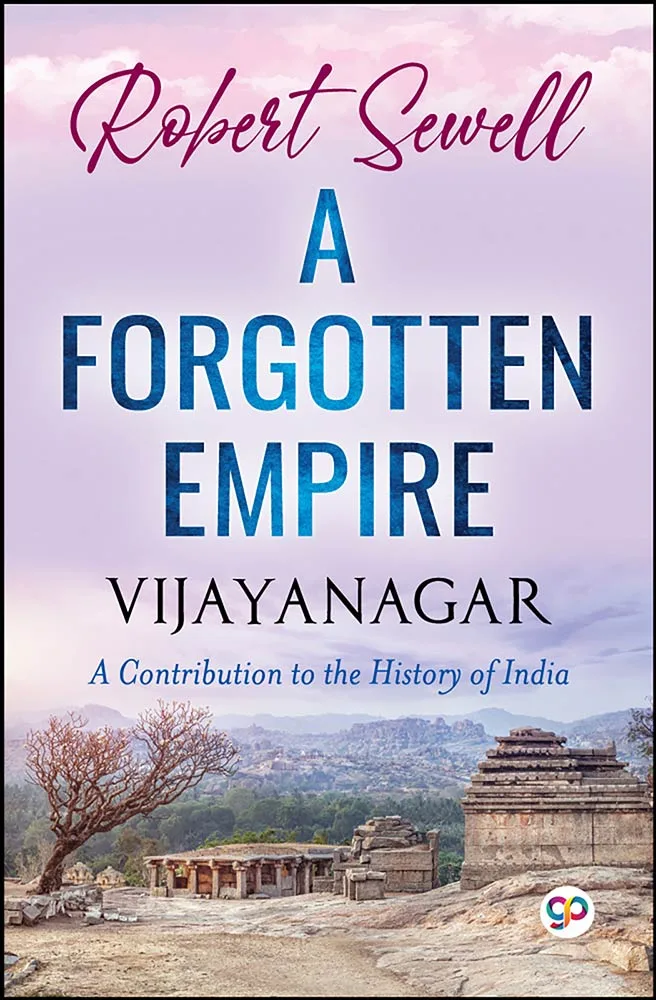
A Forgotten Empire: Vijayanagar
Paperback
• 416 Pages
• INR 595.00
• English
• 9789354995859
No ratings yet
| Publisher | General Press |
|---|---|
| ISBN13 | 9789354995859 |
| ASIN/SKU | 9354995853 |
| Book Format | Paperback |
| Language | English |
| Pages | 416 |
| List Price | INR 595.00 |
| Subject Code | HIS050000, HIS048000, HIS002000, HIS003000 |
| Publishing Date | 05/09/2023 |
| Dimensions | 8.25 x 5.25 x 1.0 inches |
| Book Code | BD00067813 |
Buy this Book
Amazon Stores
Ebook Stores
Other Stores
Discover A Forgotten Empire: Vijayanagar by Robert Sewell. This book is published by General Press in Paperback format, ISBN 9789354995859, ASIN 9354995853, under History, Social Sciences, Indian History.
Book Description
'A Forgotten Empire: Vijayanagar' by Robert Sewell is a landmark work of historical non-fiction that rescues one of South Asia's greatest civilizations from the edges of obscurity and places it firmly where it belongs — at the center of India's rich and complex past. First published in 1900, this meticulously researched book reads with the quiet authority of a scholar who has spent years sifting through dusty chronicles and crumbling inscriptions to piece together a story that the world had largely left untold.
The empire Sewell writes about — Vijayanagar, meaning "City of Victory" — rose in southern India in the fourteenth century and grew into one of the most powerful and prosperous kingdoms the subcontinent had ever seen. At its height, it was a sprawling empire of staggering wealth, home to magnificent temples, thriving trade routes, and a cosmopolitan capital that dazzled foreign visitors. Portuguese travelers who passed through in the fifteenth and sixteenth centuries described a city that rivaled anything they had seen in Europe. And yet, for reasons both political and historical, this empire slipped from mainstream memory — its ruins swallowed by jungle, its story gathering dust in archives few people thought to open.
Sewell draws heavily on two remarkable contemporary accounts written by Portuguese observers, which he translates and presents alongside his own historical narrative. These eyewitness descriptions give the book a vivid, almost cinematic quality — you can almost see the bustling markets, the jeweled courtiers, and the grand processions as you read. He also traces the political history of Vijayanagar with careful detail, charting its rise through strong rulers, its cultural flowering, and the gathering storm of conflict that would eventually test its foundations.
What makes this book genuinely moving is the sense of loss that runs beneath its pages — the feeling of encountering something magnificent that the world forgot too soon. If you have ever been drawn to lost civilizations and the stories they leave behind in stone, this book will feel like finding a hidden door into a world you never knew existed.
The empire Sewell writes about — Vijayanagar, meaning "City of Victory" — rose in southern India in the fourteenth century and grew into one of the most powerful and prosperous kingdoms the subcontinent had ever seen. At its height, it was a sprawling empire of staggering wealth, home to magnificent temples, thriving trade routes, and a cosmopolitan capital that dazzled foreign visitors. Portuguese travelers who passed through in the fifteenth and sixteenth centuries described a city that rivaled anything they had seen in Europe. And yet, for reasons both political and historical, this empire slipped from mainstream memory — its ruins swallowed by jungle, its story gathering dust in archives few people thought to open.
Sewell draws heavily on two remarkable contemporary accounts written by Portuguese observers, which he translates and presents alongside his own historical narrative. These eyewitness descriptions give the book a vivid, almost cinematic quality — you can almost see the bustling markets, the jeweled courtiers, and the grand processions as you read. He also traces the political history of Vijayanagar with careful detail, charting its rise through strong rulers, its cultural flowering, and the gathering storm of conflict that would eventually test its foundations.
What makes this book genuinely moving is the sense of loss that runs beneath its pages — the feeling of encountering something magnificent that the world forgot too soon. If you have ever been drawn to lost civilizations and the stories they leave behind in stone, this book will feel like finding a hidden door into a world you never knew existed.
Author Biography
Robert Sewell (1845–1925) was a British civil servant, historian, archaeologist, and author whose meticulous research helped preserve the history of South India. Best known for his pioneering studies of the Vijayanagara Empire, Sewell combined administrative experience with a deep passion for historical scholarship. His writings remain valuable references for historians and readers interested in India's medieval past, archaeology, and cultural heritage.
Sewell was born on October 19, 1845, in the Isle of Wight, England. He received his education in Britain before joining the Indian Civil Service, one of the most prestigious administrative bodies of the British Empire. In the late nineteenth century, he was posted to the Madras Presidency, where he served in a variety of administrative roles. During his years in India, he developed a lasting fascination with the country's rich history, ancient monuments, inscriptions, and forgotten kingdoms.
While carrying out his official duties, Sewell devoted much of his free time to historical and archaeological research. He traveled extensively, examined ancient sites, and studied inscriptions and historical records with exceptional care. His most significant contribution came through his research on the Vijayanagara Empire, one of the greatest Hindu kingdoms in Indian history. His landmark work, A Forgotten Empire (Vijayanagar): A Contribution to the History of India (1900), introduced many English-speaking readers to the remarkable achievements of the empire and helped revive scholarly interest in its history. Drawing upon Portuguese travel accounts, inscriptions, and local sources, the book became a foundational text in the study of Vijayanagara.
Sewell also prepared important catalogues of archaeological remains and inscriptions in southern India. His attention to detail and commitment to preserving historical records made his work especially valuable during a period when many ancient sites had not yet been systematically documented. Although later scholarship has refined and expanded upon some of his conclusions, his research laid an important foundation for future historians and archaeologists.
Robert Sewell retired to England after a distinguished career and continued his scholarly pursuits until his death on February 29, 1925. Today, he is remembered as one of the earliest Western historians to undertake serious, systematic research into the history of the Vijayanagara Empire. His dedication to historical inquiry and preservation has ensured that his work remains an enduring part of Indian historiography and archaeological scholarship.
Sewell was born on October 19, 1845, in the Isle of Wight, England. He received his education in Britain before joining the Indian Civil Service, one of the most prestigious administrative bodies of the British Empire. In the late nineteenth century, he was posted to the Madras Presidency, where he served in a variety of administrative roles. During his years in India, he developed a lasting fascination with the country's rich history, ancient monuments, inscriptions, and forgotten kingdoms.
While carrying out his official duties, Sewell devoted much of his free time to historical and archaeological research. He traveled extensively, examined ancient sites, and studied inscriptions and historical records with exceptional care. His most significant contribution came through his research on the Vijayanagara Empire, one of the greatest Hindu kingdoms in Indian history. His landmark work, A Forgotten Empire (Vijayanagar): A Contribution to the History of India (1900), introduced many English-speaking readers to the remarkable achievements of the empire and helped revive scholarly interest in its history. Drawing upon Portuguese travel accounts, inscriptions, and local sources, the book became a foundational text in the study of Vijayanagara.
Sewell also prepared important catalogues of archaeological remains and inscriptions in southern India. His attention to detail and commitment to preserving historical records made his work especially valuable during a period when many ancient sites had not yet been systematically documented. Although later scholarship has refined and expanded upon some of his conclusions, his research laid an important foundation for future historians and archaeologists.
Robert Sewell retired to England after a distinguished career and continued his scholarly pursuits until his death on February 29, 1925. Today, he is remembered as one of the earliest Western historians to undertake serious, systematic research into the history of the Vijayanagara Empire. His dedication to historical inquiry and preservation has ensured that his work remains an enduring part of Indian historiography and archaeological scholarship.
Editorial Reviews
Editorial Reviews will be added soon…
Book Summary
Robert Sewell's "A Forgotten Empire: Vijayanagar" is a remarkable historical work that brings back to life one of the greatest kingdoms in the history of South India. First published in 1900, the book draws heavily on the accounts of Portuguese travelers, Persian ambassadors, and other foreign visitors who witnessed the empire during its height. Through these vivid descriptions, Sewell reconstructs the rise, glory, administration, culture, and eventual decline of the Vijayanagar Empire. Rather than presenting history as a dry collection of dates and events, he paints a detailed picture of a powerful civilization that once stood as a symbol of wealth, military strength, religious tolerance, and artistic achievement. His work reminds readers that although the empire eventually disappeared, its legacy remains deeply rooted in India's cultural and historical heritage.
The story begins with the founding of the Vijayanagar Empire in the fourteenth century by the brothers Harihara and Bukka. At a time when much of southern India faced repeated invasions and political instability, the founders established a new capital on the banks of the Tungabhadra River. Protected by rugged hills and natural fortifications, Vijayanagar quickly grew into a secure and prosperous city. Sewell explains how the rulers combined military power with capable administration, allowing the kingdom to expand steadily while maintaining internal stability. The empire soon became a strong defender of southern Indian traditions and served as a political and cultural center that attracted merchants, scholars, artists, and travelers from many parts of the world.
One of the most fascinating aspects of the book is its detailed description of the magnificent capital city. Foreign visitors were astonished by its enormous size, impressive architecture, and carefully planned streets. Sewell recounts their observations of grand temples, royal palaces, bustling markets, beautiful gardens, massive gateways, and extensive irrigation systems. The city was surrounded by multiple layers of fortifications, while wide roads connected commercial districts filled with precious gems, fine textiles, spices, horses, and luxury goods. According to the travelers, Vijayanagar rivaled or even surpassed many of the great cities of Europe and Asia in wealth and splendor. These firsthand accounts help readers imagine the vibrant daily life of a city that was once among the richest urban centers in the world.
Sewell also examines the political organization and military strength that enabled the empire to flourish for centuries. The kings maintained a powerful central authority while relying on provincial governors and local chieftains to administer distant territories. A large standing army, supported by cavalry, elephants, infantry, and fortified strongholds, protected the kingdom from external threats. Horses imported through international trade played a particularly important role in the military, making maritime commerce essential to the empire's defense. The rulers invested heavily in maintaining discipline, securing borders, and expanding their influence, allowing Vijayanagar to become the dominant political force across much of southern India.
Religion and culture occupy an equally important place in Sewell's narrative. Although the empire is often remembered as a stronghold of Hindu rule, the author emphasizes that its rulers generally displayed remarkable religious tolerance. Temples received generous patronage, while scholars, poets, musicians, and artists found encouragement under royal protection. Festivals were celebrated with extraordinary grandeur, attracting thousands of participants from across the kingdom. Literature flourished in several regional languages, and temple architecture reached new heights of artistic excellence. Sewell's descriptions reveal a society where religion, art, education, and public life were closely connected, creating a rich cultural environment that influenced generations long after the empire's fall.
Economic prosperity forms another major theme of the book. Vijayanagar's success rested not only on military victories but also on agriculture, irrigation, taxation, and extensive international trade. Fertile lands were supported by reservoirs, canals, and water management systems that increased agricultural production. Merchants traded with Arabia, Persia, Southeast Asia, and European powers, bringing valuable goods into the kingdom while exporting textiles, spices, precious stones, and other commodities. Bustling marketplaces reflected the empire's commercial vitality, and foreign traders often commented on the abundance of goods available. Sewell demonstrates that the kingdom's economic strength was a key reason for its political stability and remarkable urban development.
The reign of Krishnadevaraya receives special attention as the golden age of the empire. Widely regarded as Vijayanagar's greatest ruler, he combined military brilliance with administrative skill and a deep appreciation for literature and the arts. Under his leadership, the empire reached the height of its territorial expansion, economic prosperity, and cultural achievement. Sewell describes Krishnadevaraya as an energetic and capable monarch who personally led military campaigns while ensuring justice and efficient governance. His patronage of poets, scholars, and temple construction left a lasting mark on South Indian culture, making his reign one of the most celebrated periods in Indian history.
Despite its immense strength, the empire eventually faced growing internal divisions and external pressures. Sewell carefully traces how political rivalries, shifting alliances, and conflicts with neighboring Deccan Sultanates gradually weakened the kingdom. The decisive turning point came with the Battle of Talikota in 1565, where a united coalition of Sultanates defeated the Vijayanagar army. The victorious forces entered the capital, leading to widespread destruction and abandonment of one of the world's greatest cities. Although successor rulers continued to govern from other locations for some time, the empire never recovered its former power or influence. Sewell presents this tragedy not merely as a military defeat but as the collapse of a remarkable civilization whose achievements had once inspired admiration across continents.
In the concluding portions of the book, Sewell reflects on the historical significance of Vijayanagar and the importance of preserving its memory. He argues that despite its extraordinary accomplishments, the empire had been largely overlooked in mainstream historical writing. By assembling evidence from foreign travel accounts, inscriptions, and surviving ruins, he seeks to restore Vijayanagar to its rightful place in world history. A Forgotten Empire: Vijayanagar is therefore much more than a record of kings and battles; it is a tribute to a civilization that excelled in governance, architecture, commerce, culture, and religious life. The book invites readers to appreciate the resilience, creativity, and vision of a society whose magnificent ruins still stand as silent witnesses to one of India's greatest imperial achievements.
The story begins with the founding of the Vijayanagar Empire in the fourteenth century by the brothers Harihara and Bukka. At a time when much of southern India faced repeated invasions and political instability, the founders established a new capital on the banks of the Tungabhadra River. Protected by rugged hills and natural fortifications, Vijayanagar quickly grew into a secure and prosperous city. Sewell explains how the rulers combined military power with capable administration, allowing the kingdom to expand steadily while maintaining internal stability. The empire soon became a strong defender of southern Indian traditions and served as a political and cultural center that attracted merchants, scholars, artists, and travelers from many parts of the world.
One of the most fascinating aspects of the book is its detailed description of the magnificent capital city. Foreign visitors were astonished by its enormous size, impressive architecture, and carefully planned streets. Sewell recounts their observations of grand temples, royal palaces, bustling markets, beautiful gardens, massive gateways, and extensive irrigation systems. The city was surrounded by multiple layers of fortifications, while wide roads connected commercial districts filled with precious gems, fine textiles, spices, horses, and luxury goods. According to the travelers, Vijayanagar rivaled or even surpassed many of the great cities of Europe and Asia in wealth and splendor. These firsthand accounts help readers imagine the vibrant daily life of a city that was once among the richest urban centers in the world.
Sewell also examines the political organization and military strength that enabled the empire to flourish for centuries. The kings maintained a powerful central authority while relying on provincial governors and local chieftains to administer distant territories. A large standing army, supported by cavalry, elephants, infantry, and fortified strongholds, protected the kingdom from external threats. Horses imported through international trade played a particularly important role in the military, making maritime commerce essential to the empire's defense. The rulers invested heavily in maintaining discipline, securing borders, and expanding their influence, allowing Vijayanagar to become the dominant political force across much of southern India.
Religion and culture occupy an equally important place in Sewell's narrative. Although the empire is often remembered as a stronghold of Hindu rule, the author emphasizes that its rulers generally displayed remarkable religious tolerance. Temples received generous patronage, while scholars, poets, musicians, and artists found encouragement under royal protection. Festivals were celebrated with extraordinary grandeur, attracting thousands of participants from across the kingdom. Literature flourished in several regional languages, and temple architecture reached new heights of artistic excellence. Sewell's descriptions reveal a society where religion, art, education, and public life were closely connected, creating a rich cultural environment that influenced generations long after the empire's fall.
Economic prosperity forms another major theme of the book. Vijayanagar's success rested not only on military victories but also on agriculture, irrigation, taxation, and extensive international trade. Fertile lands were supported by reservoirs, canals, and water management systems that increased agricultural production. Merchants traded with Arabia, Persia, Southeast Asia, and European powers, bringing valuable goods into the kingdom while exporting textiles, spices, precious stones, and other commodities. Bustling marketplaces reflected the empire's commercial vitality, and foreign traders often commented on the abundance of goods available. Sewell demonstrates that the kingdom's economic strength was a key reason for its political stability and remarkable urban development.
The reign of Krishnadevaraya receives special attention as the golden age of the empire. Widely regarded as Vijayanagar's greatest ruler, he combined military brilliance with administrative skill and a deep appreciation for literature and the arts. Under his leadership, the empire reached the height of its territorial expansion, economic prosperity, and cultural achievement. Sewell describes Krishnadevaraya as an energetic and capable monarch who personally led military campaigns while ensuring justice and efficient governance. His patronage of poets, scholars, and temple construction left a lasting mark on South Indian culture, making his reign one of the most celebrated periods in Indian history.
Despite its immense strength, the empire eventually faced growing internal divisions and external pressures. Sewell carefully traces how political rivalries, shifting alliances, and conflicts with neighboring Deccan Sultanates gradually weakened the kingdom. The decisive turning point came with the Battle of Talikota in 1565, where a united coalition of Sultanates defeated the Vijayanagar army. The victorious forces entered the capital, leading to widespread destruction and abandonment of one of the world's greatest cities. Although successor rulers continued to govern from other locations for some time, the empire never recovered its former power or influence. Sewell presents this tragedy not merely as a military defeat but as the collapse of a remarkable civilization whose achievements had once inspired admiration across continents.
In the concluding portions of the book, Sewell reflects on the historical significance of Vijayanagar and the importance of preserving its memory. He argues that despite its extraordinary accomplishments, the empire had been largely overlooked in mainstream historical writing. By assembling evidence from foreign travel accounts, inscriptions, and surviving ruins, he seeks to restore Vijayanagar to its rightful place in world history. A Forgotten Empire: Vijayanagar is therefore much more than a record of kings and battles; it is a tribute to a civilization that excelled in governance, architecture, commerce, culture, and religious life. The book invites readers to appreciate the resilience, creativity, and vision of a society whose magnificent ruins still stand as silent witnesses to one of India's greatest imperial achievements.
Sample Chapters
Chapter 1: Introduction
Introductory remarks – Sources of information – Sketch of history of Southern India down to A.D. 1336 – A Hindu bulwark against Muhammadanconquest – The opening date, as given by Nuniz, wrong—“TogaoMamede” or Muhammad Taghlaq of Delhi – His career and character.
In the year 1336 A.D., during the reign of Edward III. of England, there occurred in India an event which almost instantaneously changed the political condition of the entire south. With that date the volume of ancient history in that tract closes and the modern begins. It is the epoch of transition from the Old to the New.
This event was the foundation of the city and kingdom of Vijayanagar. Prior to A.D. 1336 all Southern India had lain under the domination of the ancient Hindu kingdoms,—kingdoms so old that their origin has never been traced, but which are mentioned in Buddhist edicts rock-cut sixteen centuries earlier; the Pandiyans at Madura, the Cholas at Tanjore, and others. When Vijayanagar sprang into existence the past was done with forever, and the monarchs of the new state became lords or overlords of the territories lying between the Dakhan and Ceylon.
There was no miracle in this. It was the natural result of the persistent efforts made by the Muhammadans to conquer all India. When these dreaded invaders reached the Krishna River the Hindus to their south, stricken with terror, combined, and gathered in haste to the new standard which alone seemed to offer some hope of protection. The decayed old states crumbled away into nothingness, and the fighting kings of Vijayanagar became the saviours of the south for two and a half centuries.
And yet in the present day the very existence of this kingdom is hardly remembered in India; while its once magnificent capital, planted on the extreme northern border of its dominions and bearing the proud title of the “City of Victory,” has entirely disappeared save for a few scattered ruins of buildings that were once temples or palaces, and for the long lines of massive walls that constituted its defences. Even the name has died out of men’s minds and memories, and the remains that mark its site are known only as the ruins lying near the little village of Hampe.
Its rulers, however, in their day swayed the destinies of an empire far larger than Austria, and the city is declared by a succession of European visitors in the fifteenth and sixteenth centuries to have been marvellous for size and prosperity – a city with which for richness and magnificence no known western capital could compare. Its importance is shown by the fact that almost all the struggles of the Portuguese on the western coast were carried on for the purpose of securing its maritime trade; and that when the empire fell in 1565, the prosperity of Portuguese Goa fell with it never to rise again.
Our very scanty knowledge of the events that succeeded one another in the large area dominated by the kings of Vijayanagar has been hitherto derived partly from the scattered remarks of European travellers and the desultory references in their writings to the politics of the inhabitants of India; partly from the summaries compiled by careful mediaeval historians such as Barros, Couto, and Correa, who, though to a certain degree interested in the general condition of the country, yet confined themselves mostly to recording the deeds of the European colonisers for the enlightenment of their European readers; partly from the chronicles of a few Muhammadan writers of the period, who often wrote in fear of the displeasure of their own lords; and partly from Hindu inscriptions recording grants of lands to temples and religious institutions, which documents, when viewed as state papers, seldom yield us more than a few names and dates. The two chronicles, however, translated and printed at the end of this volume, will be seen to throw a flood of light upon the condition of the city of Vijayanagar early in the sixteenth century, and upon the history of its successive dynasties; and for the rest I have attempted, as an introduction to these chronicles, to collect all available materials from the different authorities alluded to and to weld them into a consecutive whole, so as to form a foundation upon which may hereafter be constructed a regular history of the Vijayanagar empire. The result will perhaps seem disjointed, crude, and uninteresting; but let it be remembered that it is only a first attempt. I have little doubt that before very long the whole history of Southern India will be compiled by some writer gifted with the power of “making the dry bones live;” but meanwhile the bones themselves must be collected and pieced together, and my duty has been to try and construct at least the main portions of the skeleton.
Before proceeding to details we must shortly glance at the political condition of India in the first half of the fourteenth century, remembering that up to that time the Peninsula had been held by a number of distinct Hindu kingdoms, those of the Pandiyans at Madura and of the Cholas at Tanjore being the most important.
The year 1001 A.D. saw the first inroad into India of the Muhammadans from over the north-west border, under their great leader Mahmud of Ghazni. He invaded first the plains of the Punjab, then Multan, and afterwards other places. Year after year he pressed forward and again retired. In 1021 he was at Kalinga; in 1023 in Kathiawar; but in no case did he make good his foothold on the country. His expeditions were raids and nothing more. Other invasions, however, followed in quick succession, and after the lapse of two centuries the Muhammadans were firmly and permanently established at Delhi. War followed war, and from that period Northern India knew no rest. At the end of the thirteenth century the Muhammadans began to press southwards into the Dakhan. In 1293 Ala-ud-din Khilji, nephew of the king of Delhi, captured Devagiri. Four years later Gujarat was attacked. In 1303 the reduction of Warangal was attempted. In 1306 there was a fresh expedition to Devagiri. In 1309 Malik Kafur, the celebrated general, with an immense force swept into the Dakhan and captured Warangal. The old capital of the Hoysala Ballalas at Dvarasamudra was taken in 1310, and Malik Kafur went to the Malabar coast where he erected a mosque, and afterwards returned to his master with enormous booty. Fresh fighting took place in 1312. Six years later Mubarak of Delhi marched to Devagiri and inhumanly flayed alive it’s unfortunate prince, Haripala Deva, setting up his head at the gate of his own city. In 1323 Warangal fell.
Thus the period at which our history opens, about the year 1330, found the whole of Northern India down to the Vindhya mountains firmly under Moslem rule, while the followers of that faith had overrun the Dakhan and were threatening the south with the same fate. South of the Krishna the whole country was still under Hindu domination, but the supremacy of the old dynasties was shaken to its base by the rapidly advancing terror from the north. With the accession in 1325 of Muhammad Taghlaq of Delhi things became worse still. Marvellous stories of his extraordinary proceedings circulated amongst the inhabitants of the Peninsula, and there seemed to be no bound to his intolerance, ambition, and ferocity.
Everything, therefore, seemed to be leading up to but one inevitable end – the ruin and devastation of the Hindu provinces; the annihilation of their old royal houses, the destruction of their religion, their temples, their cities. All that the dwellers in the south held most dear seemed tottering to its fall.
Suddenly, about the year 1344 A.D., there was a check to this wave of foreign invasion – a stop – a halt – then a solid wall of opposition; and for 250 years Southern India was saved.
The check was caused by a combination of small Hindu states – two of them already defeated, Warangal and Dvarasamudra – defeated, and therefore in all probability not over-confident; the third, the tiny principality of Anegundi. The solid wall consisted of Anegundi grown into the great empire of the Vijayanagar. To the kings of this house all the nations of the south submitted.
If a straight line be drawn on the map of India from Bombay to Madras, about half-way across will be found the River Tungabhadra, which, itself a combination of two streams running northwards from Maisur, flows in a wide circuit north and east to join the Krishna not far from Kurnool. In the middle of its course the Tungabhadra cuts through a wild rocky country lying about forty miles north-west of Bellary, and north of the railway line which runs from that place to Dharwar. At this point, on the north bank of the river, there existed about the year 1330 a fortified town called Anegundi, the “Nagundym” of our chronicles, which was the residence of a family of chiefs owning a small state in the neighbourhood. They had, in former years, taken advantage of the lofty hills of granite which cover that tract to construct a strong citadel having its base on the stream. Fordable at no point within many miles the river was full of running water at all seasons of the year, and in flood times formed in its confined bed a turbulent rushing torrent with dangerous falls in several places. Of the Anegundi chiefs we know little, but they were probably feudatories of the Hoysala Ballalas. Firishtah declares that they had existed as a ruling family for seven hundred years prior to the year 1350 A.D.
The chronicle of Nuniz gives a definite account of how the sovereigns of Vijayanagar first began to acquire the power which afterwards became so extensive. This account may or may not be accurate in all details, but it at least tallies fairly with the epigraphical and other records of the time. According to him, Muhammad Taghlaq of Delhi, having reduced Gujarat, marched southwards through the Dakhan Balaghat, or high lands above the western ghats, and a little previous to the year 1336 seized the town and fortress of Anegundi. Its chief was slain, with all the members of his family. After a futile attempt to govern this territory by means of a deputy, Muhammad raised to the dignity of chief of the state its late minister, a man whom Nuniz calls “Deorao,” for “Deva Raya.” or Harihara Deva I. The new chief founded the city of Vijayanagar on the south bank of the river opposite Anegundi and made his residence there, with the aid of the great religious teacher Madhava, wisely holding that to place the river between him and the ever-marauding Moslems was to establish himself and his people in a condition of greater security than before. He was succeeded by “one called Bucarao” (Bukka), who reigned thirty-seven years, and the next king was the latter’s son, “Pureoyre Deo” (Harihara Deva II.).
We know from other sources that part at least of this story is correct. Harihara I. and Bukka were the first two kings and were brothers, while the third king, Harihara II., was certainly the son of Bukka.
The success of the early kings was phenomenal. Ibn Batuta, who was in India from 1333 to 1342, states that even in his day a Muhammadan chief on the western coast was subject to Harihara I., whom he calls “Haraib” or “Harib,” from “Hariyappa” another form of the king’s name; while a hundred years later Abdur Razzak, envoy from Persia, tells us that the king of Vijayanagar was then lord of all Southern India, from sea to sea and from the Dakhan to Cape Comorin—“from the frontier of Serendib (Ceylon) to the extremities of the country of Kalbergah… His troops amount in number to eleven lak,” I.E. 1,100,000. Even so early as 1378 A.D., according to Firishtah, the Raya of Vijayanagar was “in power, wealth, and extent of country” greatly the superior of the Bahmani king of the Dakhan.
The old southern states appear (we have little history to guide us) to have in general submitted peaceably to the rule of the new monarchy. They were perhaps glad to submit if only the dreaded foreigners could be kept out of the country. And thus by leaps and bounds the petty state grew to be a kingdom, and the kingdom expanded till it became an empire. Civil war and rebellion amongst the Muhammadans helped Harihara and Bukka in their enterprise. Sick of the tyranny and excesses of Muhammad Taghlaq, the Dakhan revolted in 1347, and the independent kingdom of the Bahmanis was for a time firmly established.
The chronicle of Nuniz opens with the following sentence:—
“In the year twelve hundred and thirty these parts of India were ruled by a greater monarch than had ever reigned. This was the king of Dili, who by force of arms and soldiers made war on Cambaya for many years, taking and destroying in that period the land of Guzarate which belongs to Cambaya, and in the end he became its lord.”
After this the king of Delhi advanced against Vijayanagar by way of the Balaghat.
This date is a century too early, as already pointed out. The sovereign referred to is stated in the following note (entered by Nuniz at the end of Chapter xx., which closes the historical portion of his narrative) to have been called “Togao Mamede.”
“This king of Delhi they say was a Moor, who was called Togao Mamede. He is held among the Hindus as a saint. They relate that once while he was offering prayer to God, there came to him four arms with four hands; and that every time he prayed roses fell to him from out of heaven. He was a great conqueror, he held a large part of this earth under his dominion, he subdued… (blank in original) kings, and slew them, and flayed them, and brought their skins with him; so that besides his own name, he received the nickname… which means ‘lord of… skins of kings;’ he was chief of many people.
“There is a story telling how he fell into a passion on account of (BEING GIVEN?) eighteen letters (OF THE ALPHABET TO HIS NAME?), when according to his own reckoning he was entitled to twenty-four. There are tales of him which do indeed seem most marvellous of the things that he did; as, for instance, how he made ready an army because one day in the morning, while standing dressing at a window which was closed, a ray of the sun came into his eyes, and he cried out that he would not rest until he had killed or vanquished whomsoever had dared to enter his apartments while he was dressing. All his nobles could not dissuade him from his purpose, even though they told him it was the sun that had done it, a thing without which they could not live, that it was a celestial thing and was located in the sky, and that he could never do any harm to it. With all this he made his forces ready, saying that he must go in search of his enemy, and as he was going along with large forces raised in the country through which he began his march so much dust arose that it obscured the sun. When he lost sight of it he made fresh inquiries as to what the thing was, and the captains told him that there was now no reason for him to wait, and that he might return home since he had put to flight him whom he had come to seek. Content with this, the king returned by the road that he had taken in his search for the sun, saying that since his enemy had fled he was satisfied.
“Other extravagances are told of him which make him out a great lord, as, for instance, that being in the Charamaodel country he was told that certain leagues distant in the sea there was a very great island, and its land was gold, and the stones of its houses and those which were produced in the ground were rubies and diamonds: in which island there was a pagoda, whither came the angels from heaven to play music and dance. Being covetous of being the lord of this land, he determined to go there, but not in ships because he had not enough for so many people, so he began to cart a great quantity of stones and earth and to throw it into the sea in order to fill it up, so that he might reach the island; and putting this in hand with great labour he did so much that he crossed over to the island of Ceyllao, which is twelve or fifteen leagues off, This causeway that he made was, it is said, in course of time eaten away by the sea, and its remains now cause the shoals of Chillao. Melliquiniby, his captain-general, seeing how much labour was being spent in a thing so impossible, made ready two ships in a port of Charamaodell which he loaded with much gold and precious stones, and forged some despatches as of an embassy sent in the name of the king of the island, in which he professed his obedience and sent presents; and after this the king did not proceed any further with his causeway.
“In memory of this work he made a very large pagoda, which is still there; it is a great place of pilgrimage.
“There are two thousand of these and similar stories with which I hope at some time to trouble your honour; and with other better ones, if God gives me life. I kiss your honour’s hand.”
To conclusively establish the fact that this account can only refer to Muhammad Taghlaq of Delhi, who reigned from 1325 to 1351, it is necessary that we should look into the known character of that monarch and the events of his reign.
Nuniz states that his “Togao Mamede” conquered Gujarat, was at war with Bengal, and had trouble with the Turkomans on the borders of Sheik Ismail, I.E. Persia. To take these in reverse order. Early in the reign of Muhammad Taghlaq vast hordes of Moghuls invaded the Punjab and advanced almost unopposed to Delhi, where the king bought them off by payment of immense sums of money. Next as to Bengal. Prior to his reign that province had been subdued, had given trouble, and had again been reduced. In his reign it was crushed under the iron hand of a viceroy from Delhi, Ghiyas-ud-din Bahadur “Bura,” who before long attempted to render himself independent. He styled himself Bahadur Shah, and issued his own coinage. In 1327 (A.H. 728) the legends on his coins acknowledge the overlordship of Delhi, but two years later they describe him as independent king of Bengal. In 1333 Muhammad issued his own coinage for Bengal and proceeded against the rebel. He defeated him, captured him, flayed him alive, and causing his skin to be stuffed with straw ordered it to be paraded through the provinces of the empire as a warning to ambitious governors. With reference to Gujarat, Nuniz has been led into a slight error. Muhammad Taghlaq certainly did go there, but only in 1347. What he did do was to conquer the Dakhan. Firishtah mentions among his conquests Dvarasamudra, Malabar, Anegundi (under the name “Kampila,” for a reason that will presently be explained), Warangal, &c, and these places “were as effectually incorporated with his empire as the villages in the vicinity of Delhi.” He also held Gujarat firmly. If, therefore, we venture to correct Nuniz in this respect, and say that “Togao Mamede” made war on the “Dakhan” instead of on “Gujarat,” and then advanced against Anegundi (wrongly called “Vijayanagar,” which place was not as yet founded) we shall probably be not far from the truth. The history of “Togao Mamede” so far is the history of Muhammad Taghlaq.
Then as to the extraordinary stories told of him. True or not, they apply to that sovereign. Muhammad is described by contemporary writers as having been one of the wonders of the age. He was very liberal, especially to those learned in the arts. He established hospitals for the sick and alm-houses for widows and orphans. He was the most eloquent and accomplished prince of his time. He was skilled in many sciences, such as physic, logic, astronomy, and mathematics. He studied the philosophies and metaphysics of Greece, and was very strict in religious observances.
Introductory remarks – Sources of information – Sketch of history of Southern India down to A.D. 1336 – A Hindu bulwark against Muhammadanconquest – The opening date, as given by Nuniz, wrong—“TogaoMamede” or Muhammad Taghlaq of Delhi – His career and character.
In the year 1336 A.D., during the reign of Edward III. of England, there occurred in India an event which almost instantaneously changed the political condition of the entire south. With that date the volume of ancient history in that tract closes and the modern begins. It is the epoch of transition from the Old to the New.
This event was the foundation of the city and kingdom of Vijayanagar. Prior to A.D. 1336 all Southern India had lain under the domination of the ancient Hindu kingdoms,—kingdoms so old that their origin has never been traced, but which are mentioned in Buddhist edicts rock-cut sixteen centuries earlier; the Pandiyans at Madura, the Cholas at Tanjore, and others. When Vijayanagar sprang into existence the past was done with forever, and the monarchs of the new state became lords or overlords of the territories lying between the Dakhan and Ceylon.
There was no miracle in this. It was the natural result of the persistent efforts made by the Muhammadans to conquer all India. When these dreaded invaders reached the Krishna River the Hindus to their south, stricken with terror, combined, and gathered in haste to the new standard which alone seemed to offer some hope of protection. The decayed old states crumbled away into nothingness, and the fighting kings of Vijayanagar became the saviours of the south for two and a half centuries.
And yet in the present day the very existence of this kingdom is hardly remembered in India; while its once magnificent capital, planted on the extreme northern border of its dominions and bearing the proud title of the “City of Victory,” has entirely disappeared save for a few scattered ruins of buildings that were once temples or palaces, and for the long lines of massive walls that constituted its defences. Even the name has died out of men’s minds and memories, and the remains that mark its site are known only as the ruins lying near the little village of Hampe.
Its rulers, however, in their day swayed the destinies of an empire far larger than Austria, and the city is declared by a succession of European visitors in the fifteenth and sixteenth centuries to have been marvellous for size and prosperity – a city with which for richness and magnificence no known western capital could compare. Its importance is shown by the fact that almost all the struggles of the Portuguese on the western coast were carried on for the purpose of securing its maritime trade; and that when the empire fell in 1565, the prosperity of Portuguese Goa fell with it never to rise again.
Our very scanty knowledge of the events that succeeded one another in the large area dominated by the kings of Vijayanagar has been hitherto derived partly from the scattered remarks of European travellers and the desultory references in their writings to the politics of the inhabitants of India; partly from the summaries compiled by careful mediaeval historians such as Barros, Couto, and Correa, who, though to a certain degree interested in the general condition of the country, yet confined themselves mostly to recording the deeds of the European colonisers for the enlightenment of their European readers; partly from the chronicles of a few Muhammadan writers of the period, who often wrote in fear of the displeasure of their own lords; and partly from Hindu inscriptions recording grants of lands to temples and religious institutions, which documents, when viewed as state papers, seldom yield us more than a few names and dates. The two chronicles, however, translated and printed at the end of this volume, will be seen to throw a flood of light upon the condition of the city of Vijayanagar early in the sixteenth century, and upon the history of its successive dynasties; and for the rest I have attempted, as an introduction to these chronicles, to collect all available materials from the different authorities alluded to and to weld them into a consecutive whole, so as to form a foundation upon which may hereafter be constructed a regular history of the Vijayanagar empire. The result will perhaps seem disjointed, crude, and uninteresting; but let it be remembered that it is only a first attempt. I have little doubt that before very long the whole history of Southern India will be compiled by some writer gifted with the power of “making the dry bones live;” but meanwhile the bones themselves must be collected and pieced together, and my duty has been to try and construct at least the main portions of the skeleton.
Before proceeding to details we must shortly glance at the political condition of India in the first half of the fourteenth century, remembering that up to that time the Peninsula had been held by a number of distinct Hindu kingdoms, those of the Pandiyans at Madura and of the Cholas at Tanjore being the most important.
The year 1001 A.D. saw the first inroad into India of the Muhammadans from over the north-west border, under their great leader Mahmud of Ghazni. He invaded first the plains of the Punjab, then Multan, and afterwards other places. Year after year he pressed forward and again retired. In 1021 he was at Kalinga; in 1023 in Kathiawar; but in no case did he make good his foothold on the country. His expeditions were raids and nothing more. Other invasions, however, followed in quick succession, and after the lapse of two centuries the Muhammadans were firmly and permanently established at Delhi. War followed war, and from that period Northern India knew no rest. At the end of the thirteenth century the Muhammadans began to press southwards into the Dakhan. In 1293 Ala-ud-din Khilji, nephew of the king of Delhi, captured Devagiri. Four years later Gujarat was attacked. In 1303 the reduction of Warangal was attempted. In 1306 there was a fresh expedition to Devagiri. In 1309 Malik Kafur, the celebrated general, with an immense force swept into the Dakhan and captured Warangal. The old capital of the Hoysala Ballalas at Dvarasamudra was taken in 1310, and Malik Kafur went to the Malabar coast where he erected a mosque, and afterwards returned to his master with enormous booty. Fresh fighting took place in 1312. Six years later Mubarak of Delhi marched to Devagiri and inhumanly flayed alive it’s unfortunate prince, Haripala Deva, setting up his head at the gate of his own city. In 1323 Warangal fell.
Thus the period at which our history opens, about the year 1330, found the whole of Northern India down to the Vindhya mountains firmly under Moslem rule, while the followers of that faith had overrun the Dakhan and were threatening the south with the same fate. South of the Krishna the whole country was still under Hindu domination, but the supremacy of the old dynasties was shaken to its base by the rapidly advancing terror from the north. With the accession in 1325 of Muhammad Taghlaq of Delhi things became worse still. Marvellous stories of his extraordinary proceedings circulated amongst the inhabitants of the Peninsula, and there seemed to be no bound to his intolerance, ambition, and ferocity.
Everything, therefore, seemed to be leading up to but one inevitable end – the ruin and devastation of the Hindu provinces; the annihilation of their old royal houses, the destruction of their religion, their temples, their cities. All that the dwellers in the south held most dear seemed tottering to its fall.
Suddenly, about the year 1344 A.D., there was a check to this wave of foreign invasion – a stop – a halt – then a solid wall of opposition; and for 250 years Southern India was saved.
The check was caused by a combination of small Hindu states – two of them already defeated, Warangal and Dvarasamudra – defeated, and therefore in all probability not over-confident; the third, the tiny principality of Anegundi. The solid wall consisted of Anegundi grown into the great empire of the Vijayanagar. To the kings of this house all the nations of the south submitted.
If a straight line be drawn on the map of India from Bombay to Madras, about half-way across will be found the River Tungabhadra, which, itself a combination of two streams running northwards from Maisur, flows in a wide circuit north and east to join the Krishna not far from Kurnool. In the middle of its course the Tungabhadra cuts through a wild rocky country lying about forty miles north-west of Bellary, and north of the railway line which runs from that place to Dharwar. At this point, on the north bank of the river, there existed about the year 1330 a fortified town called Anegundi, the “Nagundym” of our chronicles, which was the residence of a family of chiefs owning a small state in the neighbourhood. They had, in former years, taken advantage of the lofty hills of granite which cover that tract to construct a strong citadel having its base on the stream. Fordable at no point within many miles the river was full of running water at all seasons of the year, and in flood times formed in its confined bed a turbulent rushing torrent with dangerous falls in several places. Of the Anegundi chiefs we know little, but they were probably feudatories of the Hoysala Ballalas. Firishtah declares that they had existed as a ruling family for seven hundred years prior to the year 1350 A.D.
The chronicle of Nuniz gives a definite account of how the sovereigns of Vijayanagar first began to acquire the power which afterwards became so extensive. This account may or may not be accurate in all details, but it at least tallies fairly with the epigraphical and other records of the time. According to him, Muhammad Taghlaq of Delhi, having reduced Gujarat, marched southwards through the Dakhan Balaghat, or high lands above the western ghats, and a little previous to the year 1336 seized the town and fortress of Anegundi. Its chief was slain, with all the members of his family. After a futile attempt to govern this territory by means of a deputy, Muhammad raised to the dignity of chief of the state its late minister, a man whom Nuniz calls “Deorao,” for “Deva Raya.” or Harihara Deva I. The new chief founded the city of Vijayanagar on the south bank of the river opposite Anegundi and made his residence there, with the aid of the great religious teacher Madhava, wisely holding that to place the river between him and the ever-marauding Moslems was to establish himself and his people in a condition of greater security than before. He was succeeded by “one called Bucarao” (Bukka), who reigned thirty-seven years, and the next king was the latter’s son, “Pureoyre Deo” (Harihara Deva II.).
We know from other sources that part at least of this story is correct. Harihara I. and Bukka were the first two kings and were brothers, while the third king, Harihara II., was certainly the son of Bukka.
The success of the early kings was phenomenal. Ibn Batuta, who was in India from 1333 to 1342, states that even in his day a Muhammadan chief on the western coast was subject to Harihara I., whom he calls “Haraib” or “Harib,” from “Hariyappa” another form of the king’s name; while a hundred years later Abdur Razzak, envoy from Persia, tells us that the king of Vijayanagar was then lord of all Southern India, from sea to sea and from the Dakhan to Cape Comorin—“from the frontier of Serendib (Ceylon) to the extremities of the country of Kalbergah… His troops amount in number to eleven lak,” I.E. 1,100,000. Even so early as 1378 A.D., according to Firishtah, the Raya of Vijayanagar was “in power, wealth, and extent of country” greatly the superior of the Bahmani king of the Dakhan.
The old southern states appear (we have little history to guide us) to have in general submitted peaceably to the rule of the new monarchy. They were perhaps glad to submit if only the dreaded foreigners could be kept out of the country. And thus by leaps and bounds the petty state grew to be a kingdom, and the kingdom expanded till it became an empire. Civil war and rebellion amongst the Muhammadans helped Harihara and Bukka in their enterprise. Sick of the tyranny and excesses of Muhammad Taghlaq, the Dakhan revolted in 1347, and the independent kingdom of the Bahmanis was for a time firmly established.
The chronicle of Nuniz opens with the following sentence:—
“In the year twelve hundred and thirty these parts of India were ruled by a greater monarch than had ever reigned. This was the king of Dili, who by force of arms and soldiers made war on Cambaya for many years, taking and destroying in that period the land of Guzarate which belongs to Cambaya, and in the end he became its lord.”
After this the king of Delhi advanced against Vijayanagar by way of the Balaghat.
This date is a century too early, as already pointed out. The sovereign referred to is stated in the following note (entered by Nuniz at the end of Chapter xx., which closes the historical portion of his narrative) to have been called “Togao Mamede.”
“This king of Delhi they say was a Moor, who was called Togao Mamede. He is held among the Hindus as a saint. They relate that once while he was offering prayer to God, there came to him four arms with four hands; and that every time he prayed roses fell to him from out of heaven. He was a great conqueror, he held a large part of this earth under his dominion, he subdued… (blank in original) kings, and slew them, and flayed them, and brought their skins with him; so that besides his own name, he received the nickname… which means ‘lord of… skins of kings;’ he was chief of many people.
“There is a story telling how he fell into a passion on account of (BEING GIVEN?) eighteen letters (OF THE ALPHABET TO HIS NAME?), when according to his own reckoning he was entitled to twenty-four. There are tales of him which do indeed seem most marvellous of the things that he did; as, for instance, how he made ready an army because one day in the morning, while standing dressing at a window which was closed, a ray of the sun came into his eyes, and he cried out that he would not rest until he had killed or vanquished whomsoever had dared to enter his apartments while he was dressing. All his nobles could not dissuade him from his purpose, even though they told him it was the sun that had done it, a thing without which they could not live, that it was a celestial thing and was located in the sky, and that he could never do any harm to it. With all this he made his forces ready, saying that he must go in search of his enemy, and as he was going along with large forces raised in the country through which he began his march so much dust arose that it obscured the sun. When he lost sight of it he made fresh inquiries as to what the thing was, and the captains told him that there was now no reason for him to wait, and that he might return home since he had put to flight him whom he had come to seek. Content with this, the king returned by the road that he had taken in his search for the sun, saying that since his enemy had fled he was satisfied.
“Other extravagances are told of him which make him out a great lord, as, for instance, that being in the Charamaodel country he was told that certain leagues distant in the sea there was a very great island, and its land was gold, and the stones of its houses and those which were produced in the ground were rubies and diamonds: in which island there was a pagoda, whither came the angels from heaven to play music and dance. Being covetous of being the lord of this land, he determined to go there, but not in ships because he had not enough for so many people, so he began to cart a great quantity of stones and earth and to throw it into the sea in order to fill it up, so that he might reach the island; and putting this in hand with great labour he did so much that he crossed over to the island of Ceyllao, which is twelve or fifteen leagues off, This causeway that he made was, it is said, in course of time eaten away by the sea, and its remains now cause the shoals of Chillao. Melliquiniby, his captain-general, seeing how much labour was being spent in a thing so impossible, made ready two ships in a port of Charamaodell which he loaded with much gold and precious stones, and forged some despatches as of an embassy sent in the name of the king of the island, in which he professed his obedience and sent presents; and after this the king did not proceed any further with his causeway.
“In memory of this work he made a very large pagoda, which is still there; it is a great place of pilgrimage.
“There are two thousand of these and similar stories with which I hope at some time to trouble your honour; and with other better ones, if God gives me life. I kiss your honour’s hand.”
To conclusively establish the fact that this account can only refer to Muhammad Taghlaq of Delhi, who reigned from 1325 to 1351, it is necessary that we should look into the known character of that monarch and the events of his reign.
Nuniz states that his “Togao Mamede” conquered Gujarat, was at war with Bengal, and had trouble with the Turkomans on the borders of Sheik Ismail, I.E. Persia. To take these in reverse order. Early in the reign of Muhammad Taghlaq vast hordes of Moghuls invaded the Punjab and advanced almost unopposed to Delhi, where the king bought them off by payment of immense sums of money. Next as to Bengal. Prior to his reign that province had been subdued, had given trouble, and had again been reduced. In his reign it was crushed under the iron hand of a viceroy from Delhi, Ghiyas-ud-din Bahadur “Bura,” who before long attempted to render himself independent. He styled himself Bahadur Shah, and issued his own coinage. In 1327 (A.H. 728) the legends on his coins acknowledge the overlordship of Delhi, but two years later they describe him as independent king of Bengal. In 1333 Muhammad issued his own coinage for Bengal and proceeded against the rebel. He defeated him, captured him, flayed him alive, and causing his skin to be stuffed with straw ordered it to be paraded through the provinces of the empire as a warning to ambitious governors. With reference to Gujarat, Nuniz has been led into a slight error. Muhammad Taghlaq certainly did go there, but only in 1347. What he did do was to conquer the Dakhan. Firishtah mentions among his conquests Dvarasamudra, Malabar, Anegundi (under the name “Kampila,” for a reason that will presently be explained), Warangal, &c, and these places “were as effectually incorporated with his empire as the villages in the vicinity of Delhi.” He also held Gujarat firmly. If, therefore, we venture to correct Nuniz in this respect, and say that “Togao Mamede” made war on the “Dakhan” instead of on “Gujarat,” and then advanced against Anegundi (wrongly called “Vijayanagar,” which place was not as yet founded) we shall probably be not far from the truth. The history of “Togao Mamede” so far is the history of Muhammad Taghlaq.
Then as to the extraordinary stories told of him. True or not, they apply to that sovereign. Muhammad is described by contemporary writers as having been one of the wonders of the age. He was very liberal, especially to those learned in the arts. He established hospitals for the sick and alm-houses for widows and orphans. He was the most eloquent and accomplished prince of his time. He was skilled in many sciences, such as physic, logic, astronomy, and mathematics. He studied the philosophies and metaphysics of Greece, and was very strict in religious observances.
Reader Reviews
No reviews yet.
A Forgotten Empire: Vijayanagar
Download Cover Image
Do you want to download the full cover image for A Forgotten Empire: Vijayanagar?