
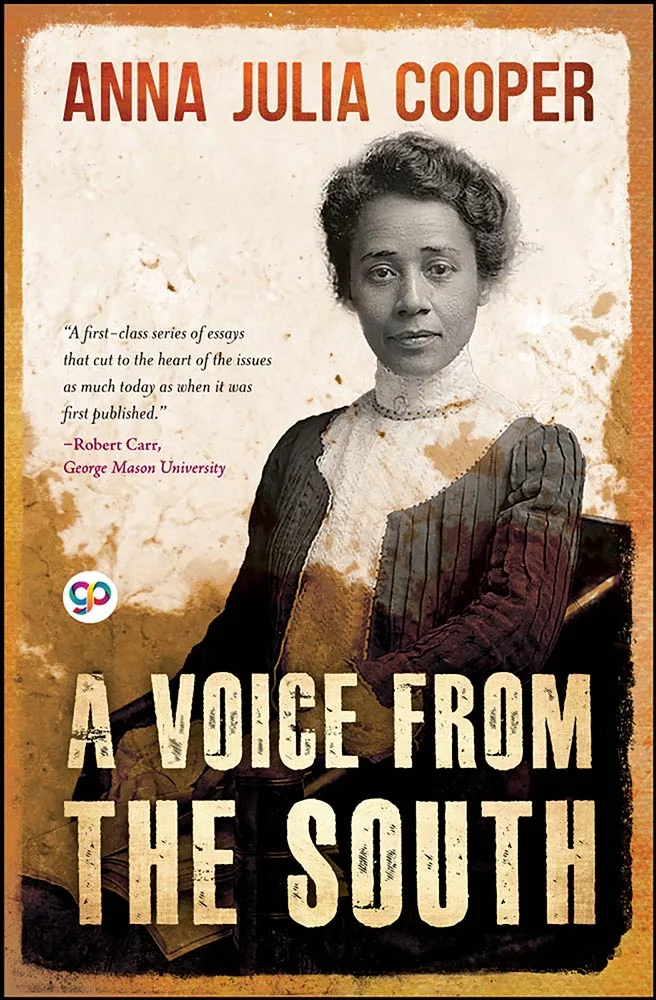
A Voice from the South
Paperback
• 208 Pages
• INR 295.00
• English
• 9789354995866
No ratings yet
| Publisher | General Press |
|---|---|
| ISBN13 | 9789354995866 |
| ASIN/SKU | 9354995861 |
| Book Format | Paperback |
| Language | English |
| Pages | 208 |
| List Price | INR 295.00 |
| Subject Code | LCO010000, HIS056000, SOC010000, SOC072000 |
| Publishing Date | 05/09/2023 |
| Dimensions | 8.25 x 5.25 x 1.0 inches |
| Book Code | BD00067814 |
Buy this Book
Amazon Stores
Ebook Stores
Other Stores
Discover A Voice from the South by Anna Julia Cooper. This book is published by General Press in Paperback format, ISBN 9789354995866, ASIN 9354995861, under Literature and Fiction, Classics, African American History.
Book Description
Anna Julia Cooper’s "A Voice from the South" is a groundbreaking, deeply compassionate masterpiece that laid the foundation for Black feminist thought. Published in 1892, this collection of essays emerges from the unique, often silenced perspective of a Black woman in post-Reconstruction America. Cooper writes with piercing lucidity, arguing that the uplift of the entire African American community—and indeed, the moral progress of the nation itself—hinges entirely upon the education and empowerment of Black women. She famously declared that when and where she enters, 'the whole Negro race enters with me'.
With remarkable grace and fierce intellectual rigor, Cooper dismantles the intersecting prejudices of racism and sexism. She gently but firmly challenges white feminists for ignoring the plight of Black women, while simultaneously holding Black male leaders accountable for marginalizing their sisters. Yet, her tone is never simply one of condemnation; it is an empathetic, urgent plea for universal human rights. She champions the immense, untapped potential of Black women, who had endured the most crushing oppressions yet remained the quiet, stabilizing backbone of their communities.
'A Voice from the South' is far more than a historical treatise. It is a profoundly humane and visionary work that echoes through generations. Cooper’s brilliant, soaring prose reminds us that true equality can only be achieved when society listens to its most marginalized voices, making her book a timeless testament to resilience, dignity, and the unyielding pursuit of justice.
With remarkable grace and fierce intellectual rigor, Cooper dismantles the intersecting prejudices of racism and sexism. She gently but firmly challenges white feminists for ignoring the plight of Black women, while simultaneously holding Black male leaders accountable for marginalizing their sisters. Yet, her tone is never simply one of condemnation; it is an empathetic, urgent plea for universal human rights. She champions the immense, untapped potential of Black women, who had endured the most crushing oppressions yet remained the quiet, stabilizing backbone of their communities.
'A Voice from the South' is far more than a historical treatise. It is a profoundly humane and visionary work that echoes through generations. Cooper’s brilliant, soaring prose reminds us that true equality can only be achieved when society listens to its most marginalized voices, making her book a timeless testament to resilience, dignity, and the unyielding pursuit of justice.
Author Biography
Anna Julia Cooper (1858–1964) was an American educator, author, scholar, and civil rights advocate whose work profoundly shaped discussions on race, gender, education, and social justice. A pioneering intellectual, she believed that education was the key to personal growth and national progress. Through her writing, teaching, and public advocacy, Cooper championed equal opportunities for African Americans and women, earning recognition as one of the most influential thinkers of her era. Today, she is regarded as a foundational figure in Black feminism and American educational reform.
Born into slavery on August 10, 1858, in Raleigh, North Carolina, Cooper experienced the hardships of a society marked by racial inequality. Following the American Civil War, she gained access to education at St. Augustine's Normal School, where her exceptional academic ability quickly became evident. Despite facing discrimination because of both her race and gender, she pursued higher education with determination. She later graduated from Oberlin College, becoming one of the few African American women of her generation to earn a college degree.
Cooper devoted much of her life to teaching and educational leadership. As principal of the M Street High School in Washington, D.C., she transformed the institution into one of the nation's leading academic schools for African American students. She firmly believed that Black students deserved the same rigorous education offered elsewhere and encouraged them to pursue excellence in scholarship and leadership. Her commitment to lifelong learning led her to earn a doctorate from the University of Paris (Sorbonne) in 1925, making her one of the first African American women to receive a Ph.D.
In 1892, Cooper published her landmark book, A Voice from the South by a Black Woman of the South. In this influential work, she argued that the advancement of African American women was essential to the progress of society as a whole. Combining thoughtful analysis with personal insight, she addressed issues of racial equality, women's rights, education, and moral responsibility with remarkable clarity and conviction.
Anna Julia Cooper lived to the age of 105, witnessing extraordinary social change while remaining committed to justice and education throughout her life. Her writings continue to inspire scholars, educators, and activists around the world. Remembered for her courage, wisdom, and unwavering belief in the transformative power of learning, Cooper's legacy endures as a powerful voice for equality, dignity, and human potential.
Born into slavery on August 10, 1858, in Raleigh, North Carolina, Cooper experienced the hardships of a society marked by racial inequality. Following the American Civil War, she gained access to education at St. Augustine's Normal School, where her exceptional academic ability quickly became evident. Despite facing discrimination because of both her race and gender, she pursued higher education with determination. She later graduated from Oberlin College, becoming one of the few African American women of her generation to earn a college degree.
Cooper devoted much of her life to teaching and educational leadership. As principal of the M Street High School in Washington, D.C., she transformed the institution into one of the nation's leading academic schools for African American students. She firmly believed that Black students deserved the same rigorous education offered elsewhere and encouraged them to pursue excellence in scholarship and leadership. Her commitment to lifelong learning led her to earn a doctorate from the University of Paris (Sorbonne) in 1925, making her one of the first African American women to receive a Ph.D.
In 1892, Cooper published her landmark book, A Voice from the South by a Black Woman of the South. In this influential work, she argued that the advancement of African American women was essential to the progress of society as a whole. Combining thoughtful analysis with personal insight, she addressed issues of racial equality, women's rights, education, and moral responsibility with remarkable clarity and conviction.
Anna Julia Cooper lived to the age of 105, witnessing extraordinary social change while remaining committed to justice and education throughout her life. Her writings continue to inspire scholars, educators, and activists around the world. Remembered for her courage, wisdom, and unwavering belief in the transformative power of learning, Cooper's legacy endures as a powerful voice for equality, dignity, and human potential.
Editorial Reviews
Editorial Reviews will be added soon…
Book Summary
Published in 1892, Anna Julia Cooper’s "A Voice from the South" stands as a monumental work in American literature and a foundational text for what would eventually become known as intersectional Black feminism. Writing during a period marked by the violent backlash of the Jim Crow era and the burgeoning women’s suffrage movement, Cooper boldly inserted herself into a national conversation that largely ignored Black women. She wrote with the conviction that the unique experiences of Black women provided them with an unparalleled perspective on the dual burdens of racism and sexism. Her book is not merely a collection of essays; it is a profound manifesto arguing that the social, intellectual, and spiritual elevation of Black women is the absolute prerequisite for the uplift of the entire Black race and the moral redemption of America itself.
The beating heart of Cooper’s argument rests on the idea that Black women occupy a unique and vital position in the social fabric of the nation. She famously articulated this by stating that only the Black woman could say, "when and where I enter, in the quiet, undisputed dignity of my womanhood... then and there the whole Negro race enters with me." Cooper recognized that Black men could advocate for racial equality, and white women could advocate for gender equality, but neither group could speak to the compounded oppression faced by Black women. Because they were marginalized by both their race and their gender, Cooper argued that Black women were the ultimate litmus test for American democracy. To liberate the Black woman was to dismantle the entire intertwined system of race and gender oppression, thereby liberating everyone.
A central pillar of Cooper’s strategy for this liberation was education, specifically the higher education of women. In a time when society debated whether women should be educated beyond domestic duties, and whether Black people were even capable of higher intellectual achievement, Cooper fiercely defended the intellectual capacity of Black women. She vehemently rejected the idea that higher education would make women unmarriageable or strip them of their femininity. Instead, she argued that intellectual development was a fundamental human right and essential for women to fulfill their potential as leaders, mothers, and active citizens. She believed that an educated Black womanhood would serve as a powerful counter-narrative to racist stereotypes and provide the community with the teachers, thinkers, and moral guides necessary to navigate a hostile society.
In her essays, Cooper did not shy away from critiquing the white feminist movement of her time, holding prominent figures accountable for their racism and exclusionary tactics. She observed that white women, in their quest for the vote and equal rights, often threw Black Americans under the bus to appease Southern white supremacists. Cooper argued that a women’s movement that ignored the plight of Black women was inherently hypocritical and morally bankrupt. She insisted that true feminism could not be a zero-sum game where white women advanced by stepping on the backs of Black women. Her vision of women’s rights was universally inclusive, arguing that the cause of freedom is not the cause of a race or a sect, but the cause of humanity, demanding solidarity across racial lines.
Similarly, Cooper held a mirror up to Black male leadership, challenging the patriarchal attitudes that often sidelined women within their own communities. While she stood firmly alongside Black men in the fight against white supremacy and racial terror, she was acutely aware that the race could not truly progress if it only focused on the advancement of its men. She pointed out that Black men, while fighting for their own political and social rights, often expected Black women to remain in the background, confined to traditional domestic roles. Cooper demanded that Black men recognize women as equal partners in the struggle for racial uplift. She warned that ignoring the voices and potential of Black women was a self-defeating strategy that would only slow the overall progress of the race.
Woven throughout Cooper’s sociological and political arguments is a deep, abiding Christian faith that served as the moral anchor for her philosophy. However, she drew a sharp distinction between the true, liberating teachings of Christ and the corrupted, hypocritical Christianity practiced by white supremacists and former slaveholders. Cooper used religious frameworks to argue for universal equality, positing that a God of justice would not sanction the subjugation of any group. She challenged the American church to live up to its own ideals, arguing that the true measure of a nation’s Christian character was not its wealth or power, but how it treated its most vulnerable and marginalized citizens. For Cooper, the fight for civil rights and women's rights was inextricably linked to spiritual righteousness.
Beyond her focus on women and sociology, Cooper devoted a significant portion of her book to analyzing American culture, literature, and representation. She was deeply critical of how Black people were portrayed in mainstream literature, noting that white authors frequently relied on degrading caricatures, minstrel stereotypes, and romanticized visions of the antebellum South. Cooper argued that these false narratives were dangerous because they shaped public perception and justified racial violence. She issued a powerful call for Black writers and artists to tell their own stories and control their own narratives. She believed that authentic representation was a crucial weapon in the fight against racism, as it would force white America to confront the humanity, complexity, and undeniable dignity of Black life.
When addressing what was commonly referred to in her era as the "race problem," Cooper flipped the script entirely. She refused to accept the premise that the existence of Black people in America was a problem to be solved. Instead, she framed the issue as a profound moral and democratic test for the white American establishment. The real "problem," she argued, was white racism, prejudice, and the failure of the nation to live up to the ideals articulated in its founding documents. She envisioned an America that thrived on its diversity, comparing the nation to a choir where different voices, rather than assimilating into a single tone, harmonize to create a richer, more complex song. Her vision was one of pluralism and mutual respect, deeply challenging the segregationist logic of her day.
Today, the legacy of 'A Voice from the South' is recognized as a masterclass in prophetic writing and social critique. Anna Julia Cooper articulated the concepts of intersectionality and Black feminist thought decades before those terms were even coined by modern scholars. Her uncompromising demand that Black women be centered in the fight for both racial and gender equality shifted the paradigm of social justice movements. By insisting that all forms of oppression are linked and must be fought simultaneously, Cooper provided a timeless blueprint for liberation. Her voice, echoing from the post-Reconstruction South, remains powerfully relevant, reminding us that true equality is achieved not by focusing on the most privileged among the marginalized, but by uplifting those who are the most silenced and oppressed.
The beating heart of Cooper’s argument rests on the idea that Black women occupy a unique and vital position in the social fabric of the nation. She famously articulated this by stating that only the Black woman could say, "when and where I enter, in the quiet, undisputed dignity of my womanhood... then and there the whole Negro race enters with me." Cooper recognized that Black men could advocate for racial equality, and white women could advocate for gender equality, but neither group could speak to the compounded oppression faced by Black women. Because they were marginalized by both their race and their gender, Cooper argued that Black women were the ultimate litmus test for American democracy. To liberate the Black woman was to dismantle the entire intertwined system of race and gender oppression, thereby liberating everyone.
A central pillar of Cooper’s strategy for this liberation was education, specifically the higher education of women. In a time when society debated whether women should be educated beyond domestic duties, and whether Black people were even capable of higher intellectual achievement, Cooper fiercely defended the intellectual capacity of Black women. She vehemently rejected the idea that higher education would make women unmarriageable or strip them of their femininity. Instead, she argued that intellectual development was a fundamental human right and essential for women to fulfill their potential as leaders, mothers, and active citizens. She believed that an educated Black womanhood would serve as a powerful counter-narrative to racist stereotypes and provide the community with the teachers, thinkers, and moral guides necessary to navigate a hostile society.
In her essays, Cooper did not shy away from critiquing the white feminist movement of her time, holding prominent figures accountable for their racism and exclusionary tactics. She observed that white women, in their quest for the vote and equal rights, often threw Black Americans under the bus to appease Southern white supremacists. Cooper argued that a women’s movement that ignored the plight of Black women was inherently hypocritical and morally bankrupt. She insisted that true feminism could not be a zero-sum game where white women advanced by stepping on the backs of Black women. Her vision of women’s rights was universally inclusive, arguing that the cause of freedom is not the cause of a race or a sect, but the cause of humanity, demanding solidarity across racial lines.
Similarly, Cooper held a mirror up to Black male leadership, challenging the patriarchal attitudes that often sidelined women within their own communities. While she stood firmly alongside Black men in the fight against white supremacy and racial terror, she was acutely aware that the race could not truly progress if it only focused on the advancement of its men. She pointed out that Black men, while fighting for their own political and social rights, often expected Black women to remain in the background, confined to traditional domestic roles. Cooper demanded that Black men recognize women as equal partners in the struggle for racial uplift. She warned that ignoring the voices and potential of Black women was a self-defeating strategy that would only slow the overall progress of the race.
Woven throughout Cooper’s sociological and political arguments is a deep, abiding Christian faith that served as the moral anchor for her philosophy. However, she drew a sharp distinction between the true, liberating teachings of Christ and the corrupted, hypocritical Christianity practiced by white supremacists and former slaveholders. Cooper used religious frameworks to argue for universal equality, positing that a God of justice would not sanction the subjugation of any group. She challenged the American church to live up to its own ideals, arguing that the true measure of a nation’s Christian character was not its wealth or power, but how it treated its most vulnerable and marginalized citizens. For Cooper, the fight for civil rights and women's rights was inextricably linked to spiritual righteousness.
Beyond her focus on women and sociology, Cooper devoted a significant portion of her book to analyzing American culture, literature, and representation. She was deeply critical of how Black people were portrayed in mainstream literature, noting that white authors frequently relied on degrading caricatures, minstrel stereotypes, and romanticized visions of the antebellum South. Cooper argued that these false narratives were dangerous because they shaped public perception and justified racial violence. She issued a powerful call for Black writers and artists to tell their own stories and control their own narratives. She believed that authentic representation was a crucial weapon in the fight against racism, as it would force white America to confront the humanity, complexity, and undeniable dignity of Black life.
When addressing what was commonly referred to in her era as the "race problem," Cooper flipped the script entirely. She refused to accept the premise that the existence of Black people in America was a problem to be solved. Instead, she framed the issue as a profound moral and democratic test for the white American establishment. The real "problem," she argued, was white racism, prejudice, and the failure of the nation to live up to the ideals articulated in its founding documents. She envisioned an America that thrived on its diversity, comparing the nation to a choir where different voices, rather than assimilating into a single tone, harmonize to create a richer, more complex song. Her vision was one of pluralism and mutual respect, deeply challenging the segregationist logic of her day.
Today, the legacy of 'A Voice from the South' is recognized as a masterclass in prophetic writing and social critique. Anna Julia Cooper articulated the concepts of intersectionality and Black feminist thought decades before those terms were even coined by modern scholars. Her uncompromising demand that Black women be centered in the fight for both racial and gender equality shifted the paradigm of social justice movements. By insisting that all forms of oppression are linked and must be fought simultaneously, Cooper provided a timeless blueprint for liberation. Her voice, echoing from the post-Reconstruction South, remains powerfully relevant, reminding us that true equality is achieved not by focusing on the most privileged among the marginalized, but by uplifting those who are the most silenced and oppressed.
Sample Chapters
Part 1 : Soprano Obligato
For they the Royal-hearted Women are
Who nobly love the noblest, yet have grace
For needy, suffering lives in lowliest place;
Carrying a choicer sunlight in their smile,
The heavenliest ray that pitieth the vile.
* * *
Though I were happy, throned beside the king,
I should be tender to each little thing
With hurt warm breast, that had no speech to tell
Its inward pangs; and I would soothe it well
With tender touch and with a low, soft moan
For company.
—George Eliot
Chapter 1 : Womanhood a Vital Element in the Regeneration and Progress of a Race
The two sources from which, perhaps, modern civilization has derived its noble and ennobling ideal of woman are Christianity and the Feudal System.
In Oriental countries woman has been uniformly devoted to a life of ignorance, infamy, and complete stagnation. The Chinese shoe of to-day does not more entirely dwarf, cramp, and destroy her physical powers, than have the customs, laws, and social instincts, which from remotest ages have governed our Sister of the East, enervated and blighted her mental and moral life.
Mahomet makes no account of woman whatever in his polity. The Koran, which, unlike our Bible, was a product and not a growth, tried to address itself to the needs of Arabian civilization as Mahomet with his circumscribed powers saw them. The Arab was a nomad. Home to him meant his present camping place. That deity who, according to our western ideals, makes and sanctifies the home, was to him a transient bauble to be toyed with so long as it gave pleasure and then to be thrown aside for a new one. As a personality, an individual soul, capable of eternal growth and unlimited development, and destined to mould and shape the civilization of the future to an incalculable extent, Mahomet did not know woman. There was no hereafter, no paradise for her. The heaven of the Mussulman is peopled and made gladsome not by the departed wife, or sister, or mother, but by houri—a figment of Mahomet’s brain, partaking of the ethereal qualities of angels, yet imbued with all the vices and inanity of Oriental women. The harem here, and—“dust to dust” hereafter, this was the hope, the inspiration, the summum bonum of the Eastern woman’s life! With what result on the life of the nation, the “Unspeakable Turk,” the “sick man” of modern Europe can to-day exemplify.
Says a certain writer: “The private life of the Turk is vilest of the vile, unprogressive, unambitious, and inconceivably low.” And yet Turkey is not without her great men. She has produced most brilliant minds; men skilled in all the intricacies of diplomacy and statesmanship; men whose intellects could grapple with the deep problems of empire and manipulate the subtle agencies which check-mate kings. But these minds were not the normal outgrowth of a healthy trunk. They seemed rather ephemeral excrescencies which shoot far out with all the vigor and promise, apparently, of strong branches; but soon alas fall into decay and ugliness because there is no soundness in the root, no life-giving sap, permeating, strengthening and perpetuating the whole. There is a worm at the core! The homelife is impure! And when we look for fruit, like apples of Sodom, it crumbles within our grasp into dust and ashes.
It is pleasing to turn from this effete and immobile civilization to a society still fresh and vigorous, whose seed is in itself, and whose very name is synonymous with all that is progressive, elevating and inspiring, viz., the European bud and the American flower of modern civilization.
And here let me say parenthetically that our satisfaction in American institutions rests not on the fruition we now enjoy, but springs rather from the possibilities and promise that are inherent in the system, though as yet, perhaps, far in the future.
“Happiness,” says Madame de Stael, “consists not in perfections attained, but in a sense of progress, the result of our own endeavor under conspiring circumstances toward a goal which continually advances and broadens and deepens till it is swallowed up in the Infinite.” Such conditions in embryo are all that we claim for the land of the West. We have not yet reached our ideal in American civilization. The pessimists even declare that we are not marching in that direction. But there can be no doubt that here in America is the arena in which the next triumph of civilization is to be won; and here too we find promise abundant and possibilities infinite.
Now let us see on what basis this hope for our country primarily and fundamentally rests. Can anyone doubt that it is chiefly on the homelife and on the influence of good women in those homes? Says Macaulay: “You may judge a nation’s rank in the scale of civilization from the way they treat their women.” And Emerson, “I have thought that a sufficient measure of civilization is the influence of good women.” Now this high regard for woman, this germ of a prolific idea which in our own day is bearing such rich and varied fruit, was ingrafted into European civilization, we have said, from two sources, the Christian Church and the Feudal System. For although the Feudal System can in no sense be said to have originated the idea, yet there can be no doubt that the habits of life and modes of thought to which Feudalism gave rise, materially fostered and developed it; for they gave us chivalry, than which no institution has more sensibly magnified and elevated woman’s position in society.
Tacitus dwells on the tender regard for woman entertained by these rugged barbarians before they left their northern homes to overrun Europe. Old Norse legends too, and primitive poems, all breathe the same spirit of love of home and veneration for the pure and noble influence there presiding—the wife, the sister, the mother.
And when later on we see the settled life of the Middle Ages “oozing out,” as M. Guizot expresses it, from the plundering and pillaging life of barbarism and crystallizing into the Feudal System, the tiger of the field is brought once more within the charmed circle of the goddesses of his castle, and his imagination weaves around them a halo whose reflection possibly has not yet altogether vanished.
It is true the spirit of Christianity had not yet put the seal of catholicity on this sentiment. Chivalry, according to Bascom, was but the toning down and softening of a rough and lawless period. It gave a roseate glow to a bitter winter’s day. Those who looked out from castle windows revelled in its “amethyst tints.” But God’s poor, the weak, the unlovely, the commonplace were still freezing and starving none the less in unpitied, unrelieved loneliness.
Respect for woman, the much lauded chivalry of the Middle Ages, meant what I fear it still means to some men in our own day—respect for the elect few among whom they expect to consort.
The idea of the radical amelioration of womankind, reverence for woman as woman regardless of rank, wealth, or culture, was to come from that rich and bounteous fountain from which flow all our liberal and universal ideas—the Gospel of Jesus Christ.
And yet the Christian Church at the time of which we have been speaking would seem to have been doing even less to protect and elevate woman than the little done by secular society. The Church as an organization committed a double offense against woman in the Middle Ages. Making of marriage a sacrament and at the same time insisting on the celibacy of the clergy and other religious orders, she gave an inferior if not an impure character to the marriage relation, especially fitted to reflect discredit on woman. Would this were all or the worst! but the Church by the licentiousness of its chosen servants invaded the household and established too often as vicious connections those relations which it forbade to assume openly and in good faith. “Thus,” to use the words of our authority, “the religious corps became as numerous, as searching, and as unclean as the frogs of Egypt, which penetrated into all quarters, into the ovens and kneading troughs, leaving their filthy trail wherever they went.” Says Chaucer with characteristic satire, speaking of the Friars:
‘Women may now go safely up and doun,
In every bush, and under every tree,
Ther is non other incubus but he,
And he ne will don hem no dishonour.’
Henry, Bishop of Liege, could unblushingly boast the birth of twenty-two children in fourteen years.
It may help us under some of the perplexities which beset our way in “the one Catholic and Apostolic Church” to-day, to recall some of the corruptions and incongruities against which the Bride of Christ has had to struggle in her past history and in spite of which she has kept, through many vicissitudes, the faith once delivered to the saints. Individuals, organizations, whole sections of the Church militant may outrage the Christ whom they profess, may ruthlessly trample under foot both the spirit and the letter of his precepts, yet not till we hear the voices audibly saying “Come let us depart hence,” shall we cease to believe and cling to the promise, “I am with you to the end of the world.”
“Yet saints their watch are keeping,
The cry goes up ‘How long!’
And soon the night of weeping
Shall be the morn of song.”
However much then the facts of any particular period of history may seem to deny it, I for one do not doubt that the source of the vitalizing principle of woman’s development and amelioration is the Christian Church, so far as that church is coincident with Christianity.
Christ gave ideals not formulæ. The Gospel is a germ requiring millennia for its growth and ripening. It needs and at the same time helps to form around itself a soil enriched in civilization, and perfected in culture and insight without which the embryo can neither be unfolded or comprehended. With all the strides our civilization has made from the first to the nineteenth century, we can boast not an idea, not a principle of action, not a progressive social force but was already mutely foreshadowed, or directly enjoined in that simple tale of a meek and lowly life. The quiet face of the Nazarene is ever seen a little way ahead, never too far to come down to and touch the life of the lowest in days the darkest, yet ever leading onward, still onward, the tottering childish feet of our strangely boastful civilization.
By laying down for woman the same code of morality, the same standard of purity, as for man; by refusing to countenance the shameless and equally guilty monsters who were gloating over her fall,—graciously stooping in all the majesty of his own spotlessness to wipe away the filth and grime of her guilty past and bid her go in peace and sin no more; and again in the moments of his own careworn and footsore dejection, turning trustfully and lovingly, away from the heartless snubbing and sneers, away from the cruel malignity of mobs and prelates in the dusty marts of Jerusalem to the ready sympathy, loving appreciation and unfaltering friendship of that quiet home at Bethany; and even at the last, by his dying bequest to the disciple whom he loved, signifying the protection and tender regard to be extended to that sorrowing mother and ever afterward to the sex she represented;—throughout his life and in his death he has given to men a rule and guide for the estimation of woman as an equal, as a helper, as a friend, and as a sacred charge to be sheltered and cared for with a brother’s love and sympathy, lessons which nineteen centuries’ gigantic strides in knowledge, arts, and sciences, in social and ethical principles have not been able to probe to their depth or to exhaust in practice.
It seems not too much to say then of the vitalizing, regenerating, and progressive influence of womanhood on the civilization of to-day, that, while it was foreshadowed among Germanic nations in the far away dawn of their history as a narrow, sickly and stunted growth, it yet owes its catholicity and power, the deepening of its roots and broadening of its branches to Christianity.
The union of these two forces, the Barbaric and the Christian, was not long delayed after the Fall of the Empire. The Church, which fell with Rome, finding herself in danger of being swallowed up by barbarism, with characteristic vigor and fertility of resources, addressed herself immediately to the task of conquering her conquerers. The means chosen does credit to her power of penetration and adaptability, as well as to her profound, unerring, all-compassing diplomacy; and makes us even now wonder if aught human can successfully and ultimately withstand her far-seeing designs and brilliant policy, or gainsay her well-earned claim to the word Catholic.
She saw the barbarian, little more developed than a wild beast. She forbore to antagonize and mystify his warlike nature by a full blaze of the heart searching and humanizing tenets of her great Head. She said little of the rule “If thy brother smite thee on one cheek, turn to him the other also;” but thought it sufficient for the needs of those times, to establish the so-called “Truce of God” under which men were bound to abstain from butchering one another for three days of each week and on Church festivals. In other words, she respected their individuality: non-resistance pure and simple being for them an utter impossibility, she contented herself with less radical measures calculated to lead up finally to the full measure of the benevolence of Christ.
Next she took advantage of the barbarian’s sensuous love of gaudy display and put all her magnificent garments on. She could not capture him by physical force, she would dazzle him by gorgeous spectacles. It is said that Romanism gained more in pomp and ritual during this trying period of the Dark Ages than throughout all her former history.
The result was she carried her point. Once more Rome laid her ambitious hand on the temporal power, and allied with Charlemagne, aspired to rule the world through a civilization dominated by Christianity and permeated by the traditions and instincts of those sturdy barbarians.
Here was the confluence of the two streams we have been tracing, which, united now, stretch before us as a broad majestic river. In regard to woman it was the meeting of two noble and ennobling forces, two kindred ideas the resultant of which, we doubt not, is destined to be a potent force in the betterment of the world.
Now after our appeal to history comparing nations destitute of this force and so destitute also of the principle of progress, with other nations among whom the influence of woman is prominent coupled with a brisk, progressive, satisfying civilization,—if in addition we find this strong presumptive evidence corroborated by reason and experience, we may conclude that these two equally varying concomitants are linked as cause and effect; in other words, that the position of woman in society determines the vital elements of its regeneration and progress.
Now that this is so on a priori grounds all must admit. And this not because woman is better or stronger or wiser than man, but from the nature of the case, because it is she who must first form the man by directing the earliest impulses of his character.
Byron and Wordsworth were both geniuses and would have stamped themselves on the thought of their age under any circumstances; and yet we find the one a savor of life unto life, the other of death unto death. “Byron, like a rocket, shot his way upward with scorn and repulsion, flamed out in wild, explosive, brilliant excesses and disappeared in darkness made all the more palpable.”
Wordsworth lent of his gifts to reinforce that “power in the Universe which makes for righteousness” by taking the harp handed him from Heaven and using it to swell the strains of angelic choirs. Two locomotives equally mighty stand facing opposite tracks; the one to rush headlong to destruction with all its precious freight, the other to toil grandly and gloriously up the steep embattlements to Heaven and to God. Who—who can say what a world of consequences hung on the first placing and starting of these enormous forces!
Woman, Mother,—your responsibility is one that might make angels tremble and fear to take hold! To trifle with it, to ignore or misuse it, is to treat lightly the most sacred and solemn trust ever confided by God to human kind. The training of children is a task on which an infinity of weal or woe depends. Who does not covet it? Yet who does not stand awe-struck before its momentous issues! It is a matter of small moment, it seems to me, whether that lovely girl in whose accomplishments you take such pride and delight, can enter the gay and crowded salon with the ease and elegance of this or that French or English gentlewoman, compared with the decision as to whether her individuality is going to reinforce the good or the evil elements of the world. The lace and the diamonds, the dance and the theater, gain a new significance when scanned in their bearings on such issues. Their influence on the individual personality, and through her on the society and civilization which she vitalizes and inspires—all this and more must be weighed in the balance before the jury can return a just and intelligent verdict as to the innocence or banefulness of these apparently simple amusements.
Now the fact of woman’s influence on society being granted, what are its practical bearings on the work which brought together this conference of colored clergy and laymen in Washington? “We come not here to talk.” Life is too busy, too pregnant with meaning and far reaching consequences to allow you to come this far for mere intellectual entertainment.
The vital agency of womanhood in the regeneration and progress of a race, as a general question, is conceded almost before it is fairly stated. I confess one of the difficulties for me in the subject assigned lay in its obviousness. The plea is taken away by the opposite attorney’s granting the whole question.
“Woman’s influence on social progress”—who in Christendom doubts or questions it? One may as well be called on to prove that the sun is the source of light and heat and energy to this many-sided little world.
Nor, on the other hand, could it have been intended that I should apply the position when taken and proven, to the needs and responsibilities of the women of our race in the South. For is it not written, “Cursed is he that cometh after the king?” and has not the King already preceded me in “The Black Woman of the South”?
They have had both Moses and the Prophets in Dr. Crummell and if they hear not him, neither would they be persuaded though one came up from the South.
I would beg, however, with the Doctor’s permission, to add my plea for the Colored Girls of the South:—that large, bright, promising fatally beautiful class that stand shivering like a delicate plantlet before the fury of tempestuous elements, so full of promise and possibilities, yet so sure of destruction; often without a father to whom they dare apply the loving term, often without a stronger brother to espouse their cause and defend their honor with his life’s blood; in the midst of pitfalls and snares, waylaid by the lower classes of white men, with no shelter, no protection nearer than the great blue vault above, which half conceals and half reveals the one Care-Taker they know so little of. Oh, save them, help them, shield, train, develop, teach, inspire them! Snatch them, in God’s name, as brands from the burning! There is material in them well worth your while, the hope in germ of a staunch, helpful, regenerating womanhood on which, primarily, rests the foundation stones of our future as a race.
For they the Royal-hearted Women are
Who nobly love the noblest, yet have grace
For needy, suffering lives in lowliest place;
Carrying a choicer sunlight in their smile,
The heavenliest ray that pitieth the vile.
* * *
Though I were happy, throned beside the king,
I should be tender to each little thing
With hurt warm breast, that had no speech to tell
Its inward pangs; and I would soothe it well
With tender touch and with a low, soft moan
For company.
—George Eliot
Chapter 1 : Womanhood a Vital Element in the Regeneration and Progress of a Race
The two sources from which, perhaps, modern civilization has derived its noble and ennobling ideal of woman are Christianity and the Feudal System.
In Oriental countries woman has been uniformly devoted to a life of ignorance, infamy, and complete stagnation. The Chinese shoe of to-day does not more entirely dwarf, cramp, and destroy her physical powers, than have the customs, laws, and social instincts, which from remotest ages have governed our Sister of the East, enervated and blighted her mental and moral life.
Mahomet makes no account of woman whatever in his polity. The Koran, which, unlike our Bible, was a product and not a growth, tried to address itself to the needs of Arabian civilization as Mahomet with his circumscribed powers saw them. The Arab was a nomad. Home to him meant his present camping place. That deity who, according to our western ideals, makes and sanctifies the home, was to him a transient bauble to be toyed with so long as it gave pleasure and then to be thrown aside for a new one. As a personality, an individual soul, capable of eternal growth and unlimited development, and destined to mould and shape the civilization of the future to an incalculable extent, Mahomet did not know woman. There was no hereafter, no paradise for her. The heaven of the Mussulman is peopled and made gladsome not by the departed wife, or sister, or mother, but by houri—a figment of Mahomet’s brain, partaking of the ethereal qualities of angels, yet imbued with all the vices and inanity of Oriental women. The harem here, and—“dust to dust” hereafter, this was the hope, the inspiration, the summum bonum of the Eastern woman’s life! With what result on the life of the nation, the “Unspeakable Turk,” the “sick man” of modern Europe can to-day exemplify.
Says a certain writer: “The private life of the Turk is vilest of the vile, unprogressive, unambitious, and inconceivably low.” And yet Turkey is not without her great men. She has produced most brilliant minds; men skilled in all the intricacies of diplomacy and statesmanship; men whose intellects could grapple with the deep problems of empire and manipulate the subtle agencies which check-mate kings. But these minds were not the normal outgrowth of a healthy trunk. They seemed rather ephemeral excrescencies which shoot far out with all the vigor and promise, apparently, of strong branches; but soon alas fall into decay and ugliness because there is no soundness in the root, no life-giving sap, permeating, strengthening and perpetuating the whole. There is a worm at the core! The homelife is impure! And when we look for fruit, like apples of Sodom, it crumbles within our grasp into dust and ashes.
It is pleasing to turn from this effete and immobile civilization to a society still fresh and vigorous, whose seed is in itself, and whose very name is synonymous with all that is progressive, elevating and inspiring, viz., the European bud and the American flower of modern civilization.
And here let me say parenthetically that our satisfaction in American institutions rests not on the fruition we now enjoy, but springs rather from the possibilities and promise that are inherent in the system, though as yet, perhaps, far in the future.
“Happiness,” says Madame de Stael, “consists not in perfections attained, but in a sense of progress, the result of our own endeavor under conspiring circumstances toward a goal which continually advances and broadens and deepens till it is swallowed up in the Infinite.” Such conditions in embryo are all that we claim for the land of the West. We have not yet reached our ideal in American civilization. The pessimists even declare that we are not marching in that direction. But there can be no doubt that here in America is the arena in which the next triumph of civilization is to be won; and here too we find promise abundant and possibilities infinite.
Now let us see on what basis this hope for our country primarily and fundamentally rests. Can anyone doubt that it is chiefly on the homelife and on the influence of good women in those homes? Says Macaulay: “You may judge a nation’s rank in the scale of civilization from the way they treat their women.” And Emerson, “I have thought that a sufficient measure of civilization is the influence of good women.” Now this high regard for woman, this germ of a prolific idea which in our own day is bearing such rich and varied fruit, was ingrafted into European civilization, we have said, from two sources, the Christian Church and the Feudal System. For although the Feudal System can in no sense be said to have originated the idea, yet there can be no doubt that the habits of life and modes of thought to which Feudalism gave rise, materially fostered and developed it; for they gave us chivalry, than which no institution has more sensibly magnified and elevated woman’s position in society.
Tacitus dwells on the tender regard for woman entertained by these rugged barbarians before they left their northern homes to overrun Europe. Old Norse legends too, and primitive poems, all breathe the same spirit of love of home and veneration for the pure and noble influence there presiding—the wife, the sister, the mother.
And when later on we see the settled life of the Middle Ages “oozing out,” as M. Guizot expresses it, from the plundering and pillaging life of barbarism and crystallizing into the Feudal System, the tiger of the field is brought once more within the charmed circle of the goddesses of his castle, and his imagination weaves around them a halo whose reflection possibly has not yet altogether vanished.
It is true the spirit of Christianity had not yet put the seal of catholicity on this sentiment. Chivalry, according to Bascom, was but the toning down and softening of a rough and lawless period. It gave a roseate glow to a bitter winter’s day. Those who looked out from castle windows revelled in its “amethyst tints.” But God’s poor, the weak, the unlovely, the commonplace were still freezing and starving none the less in unpitied, unrelieved loneliness.
Respect for woman, the much lauded chivalry of the Middle Ages, meant what I fear it still means to some men in our own day—respect for the elect few among whom they expect to consort.
The idea of the radical amelioration of womankind, reverence for woman as woman regardless of rank, wealth, or culture, was to come from that rich and bounteous fountain from which flow all our liberal and universal ideas—the Gospel of Jesus Christ.
And yet the Christian Church at the time of which we have been speaking would seem to have been doing even less to protect and elevate woman than the little done by secular society. The Church as an organization committed a double offense against woman in the Middle Ages. Making of marriage a sacrament and at the same time insisting on the celibacy of the clergy and other religious orders, she gave an inferior if not an impure character to the marriage relation, especially fitted to reflect discredit on woman. Would this were all or the worst! but the Church by the licentiousness of its chosen servants invaded the household and established too often as vicious connections those relations which it forbade to assume openly and in good faith. “Thus,” to use the words of our authority, “the religious corps became as numerous, as searching, and as unclean as the frogs of Egypt, which penetrated into all quarters, into the ovens and kneading troughs, leaving their filthy trail wherever they went.” Says Chaucer with characteristic satire, speaking of the Friars:
‘Women may now go safely up and doun,
In every bush, and under every tree,
Ther is non other incubus but he,
And he ne will don hem no dishonour.’
Henry, Bishop of Liege, could unblushingly boast the birth of twenty-two children in fourteen years.
It may help us under some of the perplexities which beset our way in “the one Catholic and Apostolic Church” to-day, to recall some of the corruptions and incongruities against which the Bride of Christ has had to struggle in her past history and in spite of which she has kept, through many vicissitudes, the faith once delivered to the saints. Individuals, organizations, whole sections of the Church militant may outrage the Christ whom they profess, may ruthlessly trample under foot both the spirit and the letter of his precepts, yet not till we hear the voices audibly saying “Come let us depart hence,” shall we cease to believe and cling to the promise, “I am with you to the end of the world.”
“Yet saints their watch are keeping,
The cry goes up ‘How long!’
And soon the night of weeping
Shall be the morn of song.”
However much then the facts of any particular period of history may seem to deny it, I for one do not doubt that the source of the vitalizing principle of woman’s development and amelioration is the Christian Church, so far as that church is coincident with Christianity.
Christ gave ideals not formulæ. The Gospel is a germ requiring millennia for its growth and ripening. It needs and at the same time helps to form around itself a soil enriched in civilization, and perfected in culture and insight without which the embryo can neither be unfolded or comprehended. With all the strides our civilization has made from the first to the nineteenth century, we can boast not an idea, not a principle of action, not a progressive social force but was already mutely foreshadowed, or directly enjoined in that simple tale of a meek and lowly life. The quiet face of the Nazarene is ever seen a little way ahead, never too far to come down to and touch the life of the lowest in days the darkest, yet ever leading onward, still onward, the tottering childish feet of our strangely boastful civilization.
By laying down for woman the same code of morality, the same standard of purity, as for man; by refusing to countenance the shameless and equally guilty monsters who were gloating over her fall,—graciously stooping in all the majesty of his own spotlessness to wipe away the filth and grime of her guilty past and bid her go in peace and sin no more; and again in the moments of his own careworn and footsore dejection, turning trustfully and lovingly, away from the heartless snubbing and sneers, away from the cruel malignity of mobs and prelates in the dusty marts of Jerusalem to the ready sympathy, loving appreciation and unfaltering friendship of that quiet home at Bethany; and even at the last, by his dying bequest to the disciple whom he loved, signifying the protection and tender regard to be extended to that sorrowing mother and ever afterward to the sex she represented;—throughout his life and in his death he has given to men a rule and guide for the estimation of woman as an equal, as a helper, as a friend, and as a sacred charge to be sheltered and cared for with a brother’s love and sympathy, lessons which nineteen centuries’ gigantic strides in knowledge, arts, and sciences, in social and ethical principles have not been able to probe to their depth or to exhaust in practice.
It seems not too much to say then of the vitalizing, regenerating, and progressive influence of womanhood on the civilization of to-day, that, while it was foreshadowed among Germanic nations in the far away dawn of their history as a narrow, sickly and stunted growth, it yet owes its catholicity and power, the deepening of its roots and broadening of its branches to Christianity.
The union of these two forces, the Barbaric and the Christian, was not long delayed after the Fall of the Empire. The Church, which fell with Rome, finding herself in danger of being swallowed up by barbarism, with characteristic vigor and fertility of resources, addressed herself immediately to the task of conquering her conquerers. The means chosen does credit to her power of penetration and adaptability, as well as to her profound, unerring, all-compassing diplomacy; and makes us even now wonder if aught human can successfully and ultimately withstand her far-seeing designs and brilliant policy, or gainsay her well-earned claim to the word Catholic.
She saw the barbarian, little more developed than a wild beast. She forbore to antagonize and mystify his warlike nature by a full blaze of the heart searching and humanizing tenets of her great Head. She said little of the rule “If thy brother smite thee on one cheek, turn to him the other also;” but thought it sufficient for the needs of those times, to establish the so-called “Truce of God” under which men were bound to abstain from butchering one another for three days of each week and on Church festivals. In other words, she respected their individuality: non-resistance pure and simple being for them an utter impossibility, she contented herself with less radical measures calculated to lead up finally to the full measure of the benevolence of Christ.
Next she took advantage of the barbarian’s sensuous love of gaudy display and put all her magnificent garments on. She could not capture him by physical force, she would dazzle him by gorgeous spectacles. It is said that Romanism gained more in pomp and ritual during this trying period of the Dark Ages than throughout all her former history.
The result was she carried her point. Once more Rome laid her ambitious hand on the temporal power, and allied with Charlemagne, aspired to rule the world through a civilization dominated by Christianity and permeated by the traditions and instincts of those sturdy barbarians.
Here was the confluence of the two streams we have been tracing, which, united now, stretch before us as a broad majestic river. In regard to woman it was the meeting of two noble and ennobling forces, two kindred ideas the resultant of which, we doubt not, is destined to be a potent force in the betterment of the world.
Now after our appeal to history comparing nations destitute of this force and so destitute also of the principle of progress, with other nations among whom the influence of woman is prominent coupled with a brisk, progressive, satisfying civilization,—if in addition we find this strong presumptive evidence corroborated by reason and experience, we may conclude that these two equally varying concomitants are linked as cause and effect; in other words, that the position of woman in society determines the vital elements of its regeneration and progress.
Now that this is so on a priori grounds all must admit. And this not because woman is better or stronger or wiser than man, but from the nature of the case, because it is she who must first form the man by directing the earliest impulses of his character.
Byron and Wordsworth were both geniuses and would have stamped themselves on the thought of their age under any circumstances; and yet we find the one a savor of life unto life, the other of death unto death. “Byron, like a rocket, shot his way upward with scorn and repulsion, flamed out in wild, explosive, brilliant excesses and disappeared in darkness made all the more palpable.”
Wordsworth lent of his gifts to reinforce that “power in the Universe which makes for righteousness” by taking the harp handed him from Heaven and using it to swell the strains of angelic choirs. Two locomotives equally mighty stand facing opposite tracks; the one to rush headlong to destruction with all its precious freight, the other to toil grandly and gloriously up the steep embattlements to Heaven and to God. Who—who can say what a world of consequences hung on the first placing and starting of these enormous forces!
Woman, Mother,—your responsibility is one that might make angels tremble and fear to take hold! To trifle with it, to ignore or misuse it, is to treat lightly the most sacred and solemn trust ever confided by God to human kind. The training of children is a task on which an infinity of weal or woe depends. Who does not covet it? Yet who does not stand awe-struck before its momentous issues! It is a matter of small moment, it seems to me, whether that lovely girl in whose accomplishments you take such pride and delight, can enter the gay and crowded salon with the ease and elegance of this or that French or English gentlewoman, compared with the decision as to whether her individuality is going to reinforce the good or the evil elements of the world. The lace and the diamonds, the dance and the theater, gain a new significance when scanned in their bearings on such issues. Their influence on the individual personality, and through her on the society and civilization which she vitalizes and inspires—all this and more must be weighed in the balance before the jury can return a just and intelligent verdict as to the innocence or banefulness of these apparently simple amusements.
Now the fact of woman’s influence on society being granted, what are its practical bearings on the work which brought together this conference of colored clergy and laymen in Washington? “We come not here to talk.” Life is too busy, too pregnant with meaning and far reaching consequences to allow you to come this far for mere intellectual entertainment.
The vital agency of womanhood in the regeneration and progress of a race, as a general question, is conceded almost before it is fairly stated. I confess one of the difficulties for me in the subject assigned lay in its obviousness. The plea is taken away by the opposite attorney’s granting the whole question.
“Woman’s influence on social progress”—who in Christendom doubts or questions it? One may as well be called on to prove that the sun is the source of light and heat and energy to this many-sided little world.
Nor, on the other hand, could it have been intended that I should apply the position when taken and proven, to the needs and responsibilities of the women of our race in the South. For is it not written, “Cursed is he that cometh after the king?” and has not the King already preceded me in “The Black Woman of the South”?
They have had both Moses and the Prophets in Dr. Crummell and if they hear not him, neither would they be persuaded though one came up from the South.
I would beg, however, with the Doctor’s permission, to add my plea for the Colored Girls of the South:—that large, bright, promising fatally beautiful class that stand shivering like a delicate plantlet before the fury of tempestuous elements, so full of promise and possibilities, yet so sure of destruction; often without a father to whom they dare apply the loving term, often without a stronger brother to espouse their cause and defend their honor with his life’s blood; in the midst of pitfalls and snares, waylaid by the lower classes of white men, with no shelter, no protection nearer than the great blue vault above, which half conceals and half reveals the one Care-Taker they know so little of. Oh, save them, help them, shield, train, develop, teach, inspire them! Snatch them, in God’s name, as brands from the burning! There is material in them well worth your while, the hope in germ of a staunch, helpful, regenerating womanhood on which, primarily, rests the foundation stones of our future as a race.
Reader Reviews
No reviews yet.
A Voice from the South
Download Cover Image
Do you want to download the full cover image for A Voice from the South?