
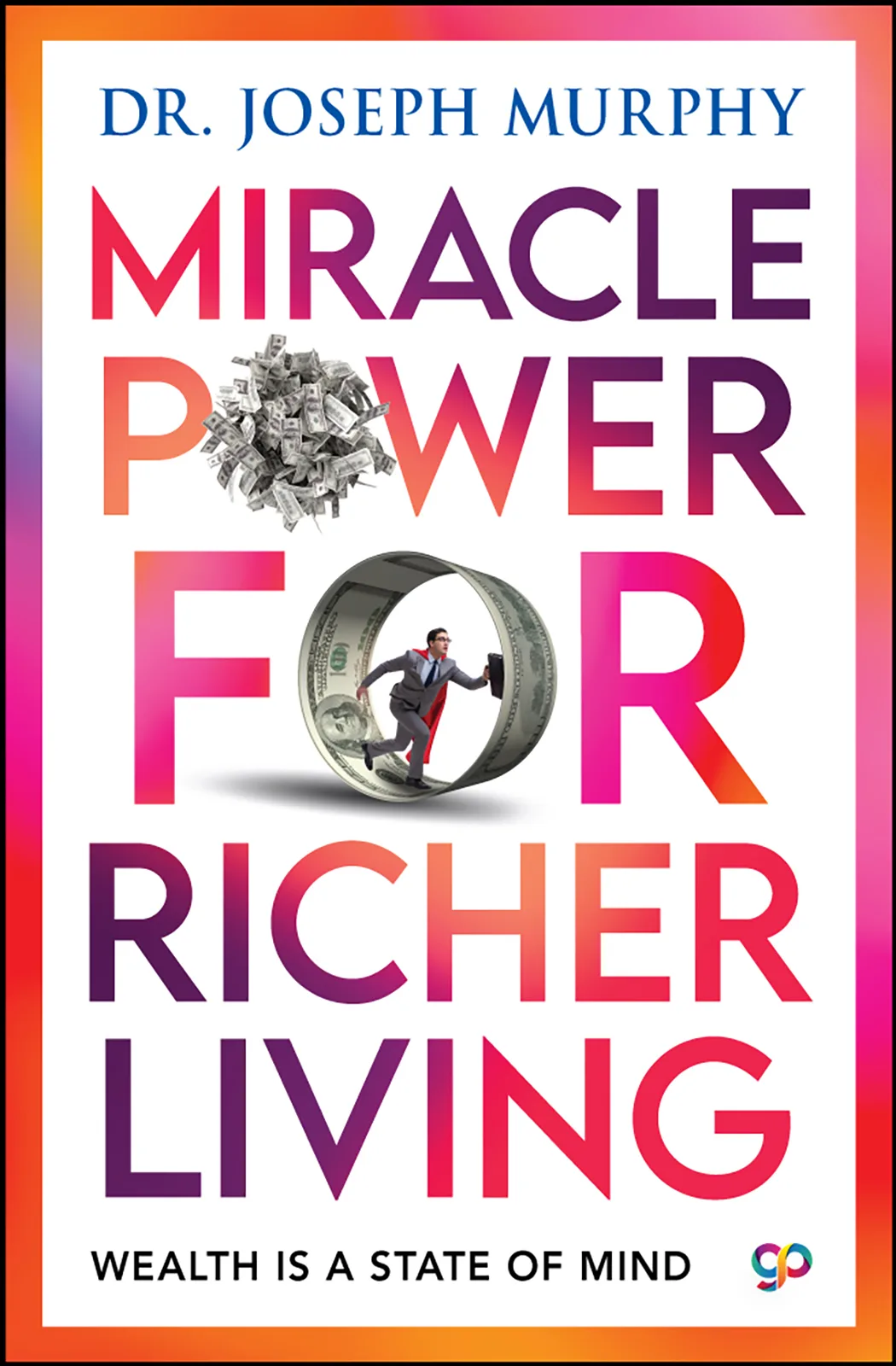
Miracle Power For Richer Living
Paperback
• 228 Pages
• INR 295.00
• English
• 9789354997365
No ratings yet
| Publisher | General Press |
|---|---|
| ISBN13 | 9789354997365 |
| ASIN/SKU | 9354997368 |
| Book Format | Paperback |
| Language | English |
| Pages | 228 |
| List Price | INR 295.00 |
| Subject Code | BUS046000, SEL021000, SEL023000 |
| Publishing Date | 13/01/2023 |
| Dimensions | 8.25 x 5.25 x 1.0 inches |
| Book Code | BD00067833 |
Buy this Book
Amazon Stores
Ebook Stores
Other Stores
Discover Miracle Power For Richer Living by Joseph Murphy. This book is published by General Press in Paperback format, ISBN 9789354997365, ASIN 9354997368, under Self-Help, Personal Finance, New Thought.
Book Description
‘Miracle Power for Richer Living’ by Dr. Joseph Murphy reveals the astonishing miracle power that can release a flood tide of abundance into your life. Step-by-step, in crystal clear language, explains exactly what to do and how to do it to unlock what Dr. Murphy calls the ‘Treasure House of Infinity’ and automatically reap a golden harvest of wealth, power, friendship, and spiritual prosperity.
In this, Dr. Joseph Murphy grows on his theory that the latent powers inherent in our subconscious can improve our lives. This tremendous power can improve our health; create wealth; overcome debilitating factors such as alcoholism and drug addiction; improve marital relations; and, in general, provide guidance in making key decisions.
Dr. Joseph Murphy has been acclaimed as a significant figure in the human potential movement. He was one of the best-selling authors in the mid-twentieth century. With thirty books to his credit, his most notable, ‘The Power of Your Subconscious Mind’, has sold millions of copies and has been translated into seventeen languages. Dr. Murphy wrote, taught, counseled, and lectured to thousands of people worldwide as Minister-Director of the Church of Divine Science in Los Angeles and through his daily radio program.
In this, Dr. Joseph Murphy grows on his theory that the latent powers inherent in our subconscious can improve our lives. This tremendous power can improve our health; create wealth; overcome debilitating factors such as alcoholism and drug addiction; improve marital relations; and, in general, provide guidance in making key decisions.
Dr. Joseph Murphy has been acclaimed as a significant figure in the human potential movement. He was one of the best-selling authors in the mid-twentieth century. With thirty books to his credit, his most notable, ‘The Power of Your Subconscious Mind’, has sold millions of copies and has been translated into seventeen languages. Dr. Murphy wrote, taught, counseled, and lectured to thousands of people worldwide as Minister-Director of the Church of Divine Science in Los Angeles and through his daily radio program.
Author Biography
Born in 1898 in County Cork, Ireland, Joseph Murphy was raised in a devout Catholic family and initially studied for the priesthood within the Jesuit order. However, his expanding intellectual curiosity soon led him to question traditional orthodox teachings. In his early twenties, he made the pivotal decision to leave the seminary and emigrate to the United States, arriving in New York City with very little money. There, he worked as a pharmacist while continuing his intense spiritual and philosophical explorations.
In America, Murphy became deeply immersed in the New Thought movement, studying under prominent spiritual teachers like Ernest Holmes and Emmet Fox. His unyielding quest for spiritual understanding also took him to India, where he spent significant time studying Eastern religions and Hindu philosophy. This diverse theological education allowed him to uniquely synthesize Eastern spiritual traditions with Western psychological concepts, forming the bedrock of his later teachings on the power of the human mind.
Upon returning to the United States, Murphy relocated to Los Angeles and became an ordained minister of the Church of Divine Science. Over the next several decades, he built one of the largest New Thought congregations in the country. His dynamic weekly Sunday lectures attracted thousands of attendees, and his popular radio broadcasts reached millions globally, establishing him as a premier voice in the mid-twentieth century self-help and human potential movements.
Murphy's enduring legacy was firmly cemented in 1963 with the publication of his masterpiece, The Power of Your Subconscious Mind. The book elegantly combined spiritual wisdom with practical psychological techniques, arguing that individuals can dramatically alter their reality, health, and success by reprogramming their subconscious beliefs. It quickly became a massive international bestseller and remains a foundational text in modern personal development literature, continuing to inspire countless readers long after Murphy's death in 1981.
In America, Murphy became deeply immersed in the New Thought movement, studying under prominent spiritual teachers like Ernest Holmes and Emmet Fox. His unyielding quest for spiritual understanding also took him to India, where he spent significant time studying Eastern religions and Hindu philosophy. This diverse theological education allowed him to uniquely synthesize Eastern spiritual traditions with Western psychological concepts, forming the bedrock of his later teachings on the power of the human mind.
Upon returning to the United States, Murphy relocated to Los Angeles and became an ordained minister of the Church of Divine Science. Over the next several decades, he built one of the largest New Thought congregations in the country. His dynamic weekly Sunday lectures attracted thousands of attendees, and his popular radio broadcasts reached millions globally, establishing him as a premier voice in the mid-twentieth century self-help and human potential movements.
Murphy's enduring legacy was firmly cemented in 1963 with the publication of his masterpiece, The Power of Your Subconscious Mind. The book elegantly combined spiritual wisdom with practical psychological techniques, arguing that individuals can dramatically alter their reality, health, and success by reprogramming their subconscious beliefs. It quickly became a massive international bestseller and remains a foundational text in modern personal development literature, continuing to inspire countless readers long after Murphy's death in 1981.
Editorial Reviews
Editorial Reviews will be added soon…
Book Summary
Miracle Power for Richer Living by Joseph Murphy is a classic New Thought and self-help book about the relationship between the subconscious mind, prayer, belief, prosperity, health, relationships, and personal success. Murphy's central idea is that the human mind contains a deep, creative power that can be directed toward richer and more satisfying living. The book teaches readers how to use affirmative thinking, visualization, meditation, prayer, and constructive beliefs to overcome mental obstacles and create conditions for greater abundance. Modern editions describe the book as a practical guide to unlocking what Murphy calls the inner “Treasure House of Infinity,” with the promise of spiritual, mental, material, and financial prosperity. Although Murphy's claims about the subconscious belong to the metaphysical tradition of twentieth-century New Thought rather than contemporary scientific psychology, the book remains popular because its language is optimistic, practical, and focused on changing the way people think about themselves and their possibilities.
At the heart of Miracle Power for Richer Living is Murphy's belief that wealth begins as a state of consciousness. He does not use the word “riches” only to mean money. For him, a truly rich life includes health, peace of mind, friendship, satisfying relationships, meaningful work, confidence, wisdom, and spiritual well-being. Financial prosperity is one expression of abundance, but it is not the whole of it. This broad understanding of wealth gives the book a more expansive message than a simple guide to attracting money. Murphy wants readers to replace a mentality of scarcity with a consciousness of possibility. His argument is that people frequently limit themselves before external circumstances have had the opportunity to change because they have accepted fear, failure, poverty, guilt, or inadequacy as permanent truths.
The book therefore begins with a fundamental question: What prevents people from experiencing the abundance they desire? Murphy's answer is largely mental. People may consciously want success while unconsciously expecting failure. They may pray for prosperity while constantly thinking about debt, poverty, rejection, or disaster. They may say they want health while repeatedly imagining illness. They may desire a happy relationship while carrying resentment, suspicion, or fear into every interaction. Murphy argues that this conflict between conscious wishes and deeper habitual beliefs can undermine a person's efforts. His solution is to bring the subconscious mind into harmony with the goals and values the person consciously chooses.
This is where Murphy's familiar concept of the subconscious mind becomes central. He views the subconscious as a powerful inner intelligence that responds to repeated thoughts, beliefs, mental pictures, and emotional impressions. In his framework, the subconscious does not critically debate every idea placed before it. Instead, ideas that are accepted deeply enough can influence behavior, perception, habits, and circumstances. The practical implication is straightforward: if a person repeatedly feeds the mind with fear and defeat, those patterns can become self-reinforcing; if the person deliberately cultivates confidence, abundance, health, and constructive expectation, the mind can begin operating in a more productive direction.
Murphy repeatedly emphasizes that merely wishing for something is not enough. The person must learn how to impress the subconscious mind with a new pattern of thought. This is why affirmations and meditation appear throughout the book. The author recommends calm, repeated statements that express the condition a person wants to embody. Rather than obsessing over how a desired result will appear, the reader is encouraged to focus on the conviction that the good they seek is possible and that the deeper intelligence of the mind can help reveal the appropriate path.
A particularly important theme is the relationship between prayer and mental imagery. Murphy does not present prayer simply as asking an external power for a favor. Prayer becomes a means of directing consciousness. The person imagines the desired outcome, feels gratitude for it, and repeatedly accepts it as a possibility. In Murphy's system, this combination of faith, emotional acceptance, and repetition is intended to communicate a clear idea to the subconscious. The emphasis is less on frantic effort and more on cultivating a quiet inner certainty.
This explains another recurring lesson of the book: people can sometimes obtain the opposite of what they consciously pray for because their deeper emotional patterns contradict their words. Murphy uses practical examples to illustrate this principle. A person might say, “I want success,” but spend the day imagining failure. Someone might pray for financial security but constantly repeat, “I never have enough money.” Another person might want a harmonious marriage while mentally rehearsing anger and resentment. According to Murphy, these contradictory mental patterns create what can be described as a divided consciousness. His solution is to make thought, feeling, expectation, and prayer more consistent.
The book is particularly concerned with wealth and financial success. Murphy argues that poverty consciousness can become an invisible barrier. If a person constantly sees money as something scarce, difficult, immoral, or unavailable, that mental attitude can affect confidence, decisions, relationships, and willingness to recognize opportunities. Conversely, a consciousness of abundance can encourage initiative and constructive action. Modern descriptions of the book emphasize its formulas and techniques for creating “free flowing wealth” and overcoming mental obstacles to prosperity. Murphy's message is therefore not simply “think about money.” It is to develop an inner sense that prosperity is compatible with one's values and that receiving and creating wealth need not be accompanied by guilt or fear.
Murphy also gives considerable attention to work and career advancement. His stories often feature ordinary people who use prayer, visualization, positive expectation, and mental discipline to overcome professional difficulties or discover new opportunities. The detailed contents of related editions include examples involving salespeople, junior executives, businessmen, promotions, increased salaries, and improved decision-making. These stories serve as demonstrations of his philosophy: the mind should not be treated merely as something that reacts to circumstances. It should be trained to search for possibilities, solutions, and constructive courses of action.
Another major theme is the healing power of the mind. Murphy frequently connects constructive thought, faith, prayer, and the healing process. He believes that the subconscious contains a healing intelligence and that positive mental states can contribute to physical and emotional well-being. He also discusses examples involving people struggling with difficult personal conditions and presents prayer and constructive belief as important tools. Modern descriptions of the book similarly state that Murphy applies his theory of subconscious power to health, relationships, addiction, decision-making, and other areas of life.
A contemporary reader should approach these claims carefully. Murphy's spiritual philosophy should not be confused with established medical evidence, and positive thinking or prayer should not be presented as a substitute for professional medical treatment. What remains useful in this portion of the book is its emphasis on the psychological effects of hope, calmness, constructive self-talk, and a sense of personal possibility. Murphy's larger message is that the way people mentally approach a problem can affect how they respond to it, even when the external situation itself cannot be immediately changed.
Relationships are another area in which Murphy applies his philosophy. He believes that resentment, jealousy, anger, and fear can become destructive mental habits. If someone repeatedly imagines conflict or rehearses hostility toward another person, the relationship may deteriorate further. Murphy instead encourages readers to cultivate goodwill and mentally picture harmonious outcomes. This does not mean pretending that genuine problems do not exist. Rather, it means approaching problems from a constructive mental state rather than allowing hostility to dominate the mind.
One of the book's most appealing ideas is that the mind should be treated as a garden. What is repeatedly planted and cultivated eventually influences what grows. Fear, bitterness, jealousy, and hopelessness are treated as destructive mental seeds, while faith, gratitude, confidence, generosity, and abundance are constructive ones. This metaphor captures Murphy's philosophy in simple terms. People cannot always control what happens to them, but they can become more conscious of what they repeatedly think about, what they expect, and what kind of inner atmosphere they maintain.
Murphy also places great importance on silence and relaxation. The subconscious, in his view, is most receptive when the conscious mind is quiet rather than tense and argumentative. The book therefore contains meditations and periods of mental stillness designed to help the reader stop struggling with a problem and allow a deeper answer to emerge. The contents of the book include sections on the “quiet mind,” meditation, healing, receiving answers, and using silence constructively. This is one of the more psychologically approachable aspects of his system. Constant worry tends to narrow attention, while stepping back from a problem can make it easier to see alternatives.
The later parts of the book increasingly emphasize living from abundance rather than merely seeking abundance. Murphy encourages readers to accept wealth, happiness, health, and success mentally before they appear externally. His famous style of affirmation often asks readers to imagine that the desired quality is already becoming part of their lives. This is not meant to encourage passive fantasy. In Murphy's ideal process, changed beliefs lead to changed attitudes, and changed attitudes lead to better decisions and actions.
His idea of “richer living” therefore extends beyond acquiring possessions. A wealthy consciousness, in Murphy's sense, is one that is open to opportunity, capable of gratitude, confident without arrogance, generous without fear, and spiritually grounded. Money is important, but it is only one part of a larger life. A person who possesses money but lives in constant anxiety would not, by Murphy's definition, be truly rich. The deeper goal is harmony between material prosperity and inner peace.
The book's practical method can be reduced to a recurring sequence: choose a constructive goal, formulate a clear mental statement, relax the conscious mind, visualize the desired condition, repeat the affirmation with conviction, and then act intelligently when opportunities appear. Murphy repeatedly returns to this combination of belief and practice. The reader is not expected to master the method through one reading. The exercises are meant to become habits. His approach is therefore closer to a program of mental conditioning than to a single inspirational message.
The final sections reinforce the idea that people can begin living differently almost immediately by changing their internal assumptions. The detailed contents include discussions of accepting spiritual, mental, and material riches, planning for a richer future, avoiding mental “thieves,” and using meditation to develop what Murphy calls miracle power. The overall direction is upward: stop identifying with limitation, recognize the possibilities within the mind, and develop an expectation of constructive change.
What makes Miracle Power for Richer Living distinctive is Murphy's fusion of spirituality, prayer, prosperity thinking, affirmation, and subconscious-mind theory. It belongs to the same broad New Thought tradition that shaped many later motivational and self-development books. Murphy's best-known work, The Power of Your Subconscious Mind, made similar ideas internationally popular, and Miracle Power for Richer Living applies them especially strongly to prosperity and practical life. Readers familiar with Murphy's other books will recognize his characteristic conviction that inner transformation can precede outer transformation.
Ultimately, Miracle Power for Richer Living by Joseph Murphy is a book about replacing mental scarcity with conscious possibility. Its central promise is not simply that positive thoughts will magically make money appear, but that a person's habitual beliefs can profoundly influence how they experience life, approach problems, recognize opportunities, and act toward their goals. Murphy asks readers to stop feeding their minds with fear and limitation and instead cultivate faith, gratitude, confidence, generosity, and abundance. His metaphysical explanations may not align with modern scientific understandings of the subconscious mind, but his emphasis on intentional thought, constructive self-talk, visualization, calm reflection, and purposeful action explains why the book continues to attract readers searching for Joseph Murphy's Miracle Power for Richer Living summary, subconscious mind wealth techniques, prosperity affirmations, positive thinking for success, prayer for abundance, manifestation principles, and practical methods for creating a richer life. At its deepest level, the book's message is simple: the life we build outwardly is influenced by the mental world we repeatedly inhabit inwardly, and changing that inner world can be the beginning of meaningful change in everything that follows.
At the heart of Miracle Power for Richer Living is Murphy's belief that wealth begins as a state of consciousness. He does not use the word “riches” only to mean money. For him, a truly rich life includes health, peace of mind, friendship, satisfying relationships, meaningful work, confidence, wisdom, and spiritual well-being. Financial prosperity is one expression of abundance, but it is not the whole of it. This broad understanding of wealth gives the book a more expansive message than a simple guide to attracting money. Murphy wants readers to replace a mentality of scarcity with a consciousness of possibility. His argument is that people frequently limit themselves before external circumstances have had the opportunity to change because they have accepted fear, failure, poverty, guilt, or inadequacy as permanent truths.
The book therefore begins with a fundamental question: What prevents people from experiencing the abundance they desire? Murphy's answer is largely mental. People may consciously want success while unconsciously expecting failure. They may pray for prosperity while constantly thinking about debt, poverty, rejection, or disaster. They may say they want health while repeatedly imagining illness. They may desire a happy relationship while carrying resentment, suspicion, or fear into every interaction. Murphy argues that this conflict between conscious wishes and deeper habitual beliefs can undermine a person's efforts. His solution is to bring the subconscious mind into harmony with the goals and values the person consciously chooses.
This is where Murphy's familiar concept of the subconscious mind becomes central. He views the subconscious as a powerful inner intelligence that responds to repeated thoughts, beliefs, mental pictures, and emotional impressions. In his framework, the subconscious does not critically debate every idea placed before it. Instead, ideas that are accepted deeply enough can influence behavior, perception, habits, and circumstances. The practical implication is straightforward: if a person repeatedly feeds the mind with fear and defeat, those patterns can become self-reinforcing; if the person deliberately cultivates confidence, abundance, health, and constructive expectation, the mind can begin operating in a more productive direction.
Murphy repeatedly emphasizes that merely wishing for something is not enough. The person must learn how to impress the subconscious mind with a new pattern of thought. This is why affirmations and meditation appear throughout the book. The author recommends calm, repeated statements that express the condition a person wants to embody. Rather than obsessing over how a desired result will appear, the reader is encouraged to focus on the conviction that the good they seek is possible and that the deeper intelligence of the mind can help reveal the appropriate path.
A particularly important theme is the relationship between prayer and mental imagery. Murphy does not present prayer simply as asking an external power for a favor. Prayer becomes a means of directing consciousness. The person imagines the desired outcome, feels gratitude for it, and repeatedly accepts it as a possibility. In Murphy's system, this combination of faith, emotional acceptance, and repetition is intended to communicate a clear idea to the subconscious. The emphasis is less on frantic effort and more on cultivating a quiet inner certainty.
This explains another recurring lesson of the book: people can sometimes obtain the opposite of what they consciously pray for because their deeper emotional patterns contradict their words. Murphy uses practical examples to illustrate this principle. A person might say, “I want success,” but spend the day imagining failure. Someone might pray for financial security but constantly repeat, “I never have enough money.” Another person might want a harmonious marriage while mentally rehearsing anger and resentment. According to Murphy, these contradictory mental patterns create what can be described as a divided consciousness. His solution is to make thought, feeling, expectation, and prayer more consistent.
The book is particularly concerned with wealth and financial success. Murphy argues that poverty consciousness can become an invisible barrier. If a person constantly sees money as something scarce, difficult, immoral, or unavailable, that mental attitude can affect confidence, decisions, relationships, and willingness to recognize opportunities. Conversely, a consciousness of abundance can encourage initiative and constructive action. Modern descriptions of the book emphasize its formulas and techniques for creating “free flowing wealth” and overcoming mental obstacles to prosperity. Murphy's message is therefore not simply “think about money.” It is to develop an inner sense that prosperity is compatible with one's values and that receiving and creating wealth need not be accompanied by guilt or fear.
Murphy also gives considerable attention to work and career advancement. His stories often feature ordinary people who use prayer, visualization, positive expectation, and mental discipline to overcome professional difficulties or discover new opportunities. The detailed contents of related editions include examples involving salespeople, junior executives, businessmen, promotions, increased salaries, and improved decision-making. These stories serve as demonstrations of his philosophy: the mind should not be treated merely as something that reacts to circumstances. It should be trained to search for possibilities, solutions, and constructive courses of action.
Another major theme is the healing power of the mind. Murphy frequently connects constructive thought, faith, prayer, and the healing process. He believes that the subconscious contains a healing intelligence and that positive mental states can contribute to physical and emotional well-being. He also discusses examples involving people struggling with difficult personal conditions and presents prayer and constructive belief as important tools. Modern descriptions of the book similarly state that Murphy applies his theory of subconscious power to health, relationships, addiction, decision-making, and other areas of life.
A contemporary reader should approach these claims carefully. Murphy's spiritual philosophy should not be confused with established medical evidence, and positive thinking or prayer should not be presented as a substitute for professional medical treatment. What remains useful in this portion of the book is its emphasis on the psychological effects of hope, calmness, constructive self-talk, and a sense of personal possibility. Murphy's larger message is that the way people mentally approach a problem can affect how they respond to it, even when the external situation itself cannot be immediately changed.
Relationships are another area in which Murphy applies his philosophy. He believes that resentment, jealousy, anger, and fear can become destructive mental habits. If someone repeatedly imagines conflict or rehearses hostility toward another person, the relationship may deteriorate further. Murphy instead encourages readers to cultivate goodwill and mentally picture harmonious outcomes. This does not mean pretending that genuine problems do not exist. Rather, it means approaching problems from a constructive mental state rather than allowing hostility to dominate the mind.
One of the book's most appealing ideas is that the mind should be treated as a garden. What is repeatedly planted and cultivated eventually influences what grows. Fear, bitterness, jealousy, and hopelessness are treated as destructive mental seeds, while faith, gratitude, confidence, generosity, and abundance are constructive ones. This metaphor captures Murphy's philosophy in simple terms. People cannot always control what happens to them, but they can become more conscious of what they repeatedly think about, what they expect, and what kind of inner atmosphere they maintain.
Murphy also places great importance on silence and relaxation. The subconscious, in his view, is most receptive when the conscious mind is quiet rather than tense and argumentative. The book therefore contains meditations and periods of mental stillness designed to help the reader stop struggling with a problem and allow a deeper answer to emerge. The contents of the book include sections on the “quiet mind,” meditation, healing, receiving answers, and using silence constructively. This is one of the more psychologically approachable aspects of his system. Constant worry tends to narrow attention, while stepping back from a problem can make it easier to see alternatives.
The later parts of the book increasingly emphasize living from abundance rather than merely seeking abundance. Murphy encourages readers to accept wealth, happiness, health, and success mentally before they appear externally. His famous style of affirmation often asks readers to imagine that the desired quality is already becoming part of their lives. This is not meant to encourage passive fantasy. In Murphy's ideal process, changed beliefs lead to changed attitudes, and changed attitudes lead to better decisions and actions.
His idea of “richer living” therefore extends beyond acquiring possessions. A wealthy consciousness, in Murphy's sense, is one that is open to opportunity, capable of gratitude, confident without arrogance, generous without fear, and spiritually grounded. Money is important, but it is only one part of a larger life. A person who possesses money but lives in constant anxiety would not, by Murphy's definition, be truly rich. The deeper goal is harmony between material prosperity and inner peace.
The book's practical method can be reduced to a recurring sequence: choose a constructive goal, formulate a clear mental statement, relax the conscious mind, visualize the desired condition, repeat the affirmation with conviction, and then act intelligently when opportunities appear. Murphy repeatedly returns to this combination of belief and practice. The reader is not expected to master the method through one reading. The exercises are meant to become habits. His approach is therefore closer to a program of mental conditioning than to a single inspirational message.
The final sections reinforce the idea that people can begin living differently almost immediately by changing their internal assumptions. The detailed contents include discussions of accepting spiritual, mental, and material riches, planning for a richer future, avoiding mental “thieves,” and using meditation to develop what Murphy calls miracle power. The overall direction is upward: stop identifying with limitation, recognize the possibilities within the mind, and develop an expectation of constructive change.
What makes Miracle Power for Richer Living distinctive is Murphy's fusion of spirituality, prayer, prosperity thinking, affirmation, and subconscious-mind theory. It belongs to the same broad New Thought tradition that shaped many later motivational and self-development books. Murphy's best-known work, The Power of Your Subconscious Mind, made similar ideas internationally popular, and Miracle Power for Richer Living applies them especially strongly to prosperity and practical life. Readers familiar with Murphy's other books will recognize his characteristic conviction that inner transformation can precede outer transformation.
Ultimately, Miracle Power for Richer Living by Joseph Murphy is a book about replacing mental scarcity with conscious possibility. Its central promise is not simply that positive thoughts will magically make money appear, but that a person's habitual beliefs can profoundly influence how they experience life, approach problems, recognize opportunities, and act toward their goals. Murphy asks readers to stop feeding their minds with fear and limitation and instead cultivate faith, gratitude, confidence, generosity, and abundance. His metaphysical explanations may not align with modern scientific understandings of the subconscious mind, but his emphasis on intentional thought, constructive self-talk, visualization, calm reflection, and purposeful action explains why the book continues to attract readers searching for Joseph Murphy's Miracle Power for Richer Living summary, subconscious mind wealth techniques, prosperity affirmations, positive thinking for success, prayer for abundance, manifestation principles, and practical methods for creating a richer life. At its deepest level, the book's message is simple: the life we build outwardly is influenced by the mental world we repeatedly inhabit inwardly, and changing that inner world can be the beginning of meaningful change in everything that follows.
Sample Chapters
Sample Chapters will be added soon…
Reader Reviews
No reviews yet.
Miracle Power For Richer Living
Download Cover Image
Do you want to download the full cover image for Miracle Power For Richer Living?