
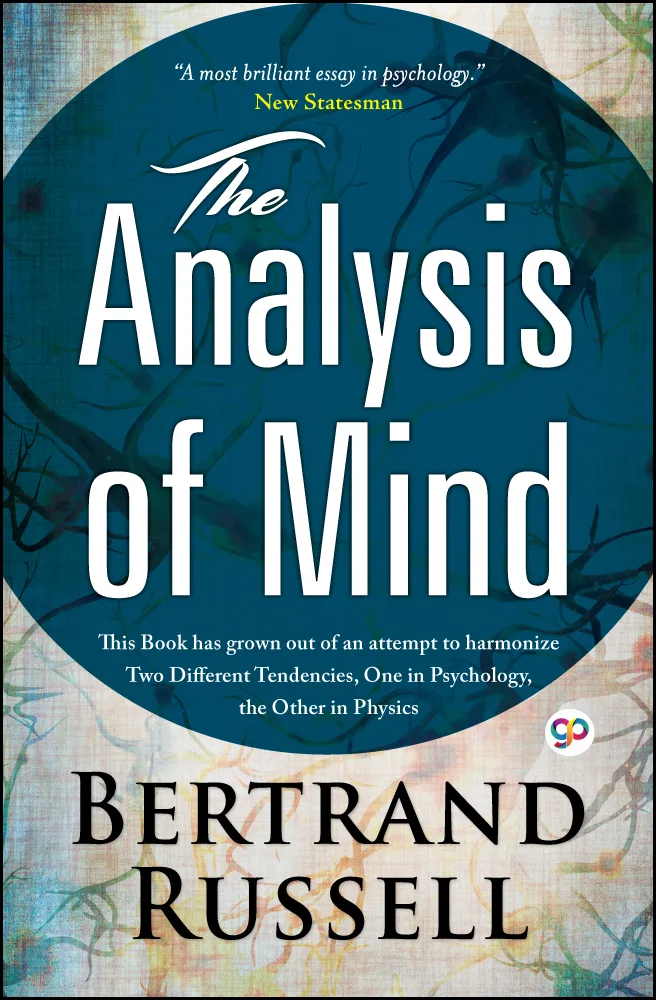
The Analysis of Mind
Paperback
• 272 Pages
• INR 345.00
• English
• 9789354997433
No ratings yet
| Publisher | General Press |
|---|---|
| ISBN13 | 9789354997433 |
| ASIN/SKU | 9354997430 |
| Book Format | Paperback |
| Language | English |
| Pages | 272 |
| List Price | INR 345.00 |
| Subject Code | PSY010000, PHI015000, PHI004000 |
| Dimensions | 8.25 x 5.25 x 1.0 inches |
| Book Code | BD00067840 |
Buy this Book
Amazon Stores
Ebook Stores
Other Stores
Discover The Analysis of Mind by Bertrand Russell. This book is published by General Press in Paperback format, ISBN 9789354997433, ASIN 9354997430, under Non Fiction, Philosophy, Psychology.
Book Description
“A most brilliant essay in psychology.” —New Statesman.
“A delightful experience.” —Joseph Conrad.
Philosopher, mathematician, and social critic, Bertrand Russell was awarded the Nobel Prize for Literature in 1950. In ‘The Analysis of Mind’, one of his most influential and exciting books, Russell presents an intriguing reconciliation between the materialism of psychology with the anti-materialism of physics, drawing upon the writings of psychologists such as William James and John Watson to offer a comprehensive treatment of belief, desire, habit, memory, meaning, and causal law. One of the most important works on the philosophy of mind.
Bertrand Arthur William Russell, 3rd Earl Russell was a British philosopher, logician, mathematician, historian, social reformer, and pacifist. Although he spent the majority of his life in England, he was born in Wales, where he also died. Russell led the British “revolt against Idealism” in the early twentieth century and is one of the founders of analytic philosophy along with his protégé Wittgenstein and his elder Frege.
“A delightful experience.” —Joseph Conrad.
Philosopher, mathematician, and social critic, Bertrand Russell was awarded the Nobel Prize for Literature in 1950. In ‘The Analysis of Mind’, one of his most influential and exciting books, Russell presents an intriguing reconciliation between the materialism of psychology with the anti-materialism of physics, drawing upon the writings of psychologists such as William James and John Watson to offer a comprehensive treatment of belief, desire, habit, memory, meaning, and causal law. One of the most important works on the philosophy of mind.
Bertrand Arthur William Russell, 3rd Earl Russell was a British philosopher, logician, mathematician, historian, social reformer, and pacifist. Although he spent the majority of his life in England, he was born in Wales, where he also died. Russell led the British “revolt against Idealism” in the early twentieth century and is one of the founders of analytic philosophy along with his protégé Wittgenstein and his elder Frege.
Author Biography
Bertrand Russell (1872–1970) was a British philosopher, logician, mathematician, historian, and writer, widely regarded as one of the most influential thinkers of the 20th century. Born into an aristocratic family in Trellech, Wales, he was orphaned young and raised by his grandparents. Russell studied mathematics and philosophy at Trinity College, Cambridge, where he quickly distinguished himself as a brilliant intellect.
In his early career, Russell co-authored Principia Mathematica (1910–1913) with Alfred North Whitehead, a groundbreaking work in symbolic logic and the foundations of mathematics. He made significant contributions to analytic philosophy, especially in logic, epistemology, and the philosophy of language. His essay “On Denoting” (1905) became a cornerstone in the field.
During his middle life, Russell became a public intellectual and social critic. He was an outspoken pacifist during World War I, for which he was imprisoned, and later criticized totalitarianism and nuclear proliferation. His popular works like A History of Western Philosophy (1945) and Why I Am Not a Christian (1927) reached a broad audience.
Russell received the Nobel Prize in Literature in 1950 for his varied and significant writings. He remained active in political causes until his death in 1970 at age 97. His legacy spans both rigorous philosophy and humanist activism.
In his early career, Russell co-authored Principia Mathematica (1910–1913) with Alfred North Whitehead, a groundbreaking work in symbolic logic and the foundations of mathematics. He made significant contributions to analytic philosophy, especially in logic, epistemology, and the philosophy of language. His essay “On Denoting” (1905) became a cornerstone in the field.
During his middle life, Russell became a public intellectual and social critic. He was an outspoken pacifist during World War I, for which he was imprisoned, and later criticized totalitarianism and nuclear proliferation. His popular works like A History of Western Philosophy (1945) and Why I Am Not a Christian (1927) reached a broad audience.
Russell received the Nobel Prize in Literature in 1950 for his varied and significant writings. He remained active in political causes until his death in 1970 at age 97. His legacy spans both rigorous philosophy and humanist activism.
Editorial Reviews
Editorial Reviews will be added soon…
Book Summary
Bertrand Russell’s The Analysis of Mind, first published in 1921, is a major work in the philosophy of mind in which Russell examines the nature of consciousness, perception, memory, belief, imagination, sensation, emotion, and knowledge. Written at a time when psychology and philosophy were increasingly influenced by developments in science, the book attempts to understand the mind without treating it as a mysterious substance completely separate from the physical world. Russell’s central project is to analyze mental phenomena into more basic events and relationships and to reconsider the traditional distinction between mind and matter. Rather than beginning with the assumption that the mind is an independent spiritual substance, he asks what mental experiences actually consist of and how they relate to events in the external world. The result is a demanding but highly influential philosophical investigation into one of the oldest questions in human thought: what is the mind?
At the beginning of The Analysis of Mind, Russell is concerned with the traditional problem of the relationship between mind and matter. For centuries, philosophers had often treated these as two fundamentally different kinds of substance. The physical world was understood in terms of matter, space, motion, and physical causes, while the mental world was associated with thought, consciousness, sensations, and subjective experience. Russell believes that this sharp division creates unnecessary philosophical difficulties. If mind and matter are completely different substances, how can they interact? How can a physical object produce a sensation, and how can a mental decision produce a physical action? Russell attempts to dissolve some of these difficulties by arguing that both mental and physical descriptions may ultimately be constructed from more basic events.
A key idea in the book is that what we call the “mind” should not automatically be regarded as a separate thing. Russell questions the tendency to speak as though there were a permanent mental substance hidden behind experiences. Instead, he examines particular occurrences—sensations, images, beliefs, desires, memories, and other mental events—and asks what relationships among these occurrences create what we ordinarily call a mind. The individual self, in this perspective, is not necessarily a simple, unchanging entity. It may be better understood as a series or structure of experiences connected by certain causal and psychological relations.
Russell’s approach is closely related to his broader philosophical method of analysis. He believes that many philosophical problems arise because ordinary language encourages us to treat concepts as though they referred to simple objects when they may actually represent complex combinations. Just as his earlier logical work attempted to analyze apparently simple statements into more fundamental components, The Analysis of Mind attempts to analyze apparently simple mental concepts into more basic occurrences and relationships. Instead of asking only what “the mind” is, Russell asks what happens when we perceive, remember, believe, imagine, or desire something.
One of the most important subjects Russell examines is sensation. When we see a red object, hear a sound, taste something sweet, or experience pain, we naturally speak as though we are receiving information from the external world. But Russell wants to distinguish between the physical object itself and the immediate experience associated with it. The experience of seeing red, for example, is not identical in a simple sense with the physical object that causes the visual experience. The philosophical problem is therefore to determine how sensations relate to external objects and to the events occurring in our nervous systems.
Russell is particularly interested in what he calls “sensibilia,” a term used for sense-related occurrences that form part of his attempt to explain perception without relying on traditional metaphysical assumptions. His analysis is connected with a broader philosophical position sometimes described as neutral monism. According to this approach, the fundamental constituents of reality need not be classified as either mental or physical in the traditional sense. Instead, what we call mental events and what we call physical events may be different organizations or descriptions of more basic neutral events. This allows Russell to avoid treating mind and matter as two completely independent substances.
The distinction between sensation and perception is especially important. When we perceive an object, we tend to think that the object is simply “given” to consciousness. Russell argues that perception is more complicated. What we directly experience may consist of particular sensory events, while our belief that these events correspond to a stable external object involves interpretation, memory, and knowledge. A table, for example, is not simply identical with one visual sensation. We perceive it from different angles, under different lighting conditions, and through different senses, yet we treat these changing experiences as appearances of one continuing object.
This leads Russell to examine the role of inference and belief. Human beings do not merely experience sensations; they interpret them. We see a familiar shape and immediately recognize it as a chair. We hear footsteps and infer that someone is approaching. We see smoke and believe that something is burning. Much of ordinary perception therefore involves expectations and learned associations. Russell wants to understand these processes without assuming that every act of perception requires a mysterious mental observer who sits behind the experience and interprets it.
Memory provides another major problem. When we remember an event, we seem to have access to something that happened in the past. But the past event itself is no longer occurring. What, then, is a memory? Russell examines the difference between present experience and knowledge of past experience. A memory is not simply a physical recording stored somewhere in the mind like a photograph in a box. It involves present mental events that are causally connected with previous experiences. The present recollection carries information about something that happened earlier, but the remembering itself is a current occurrence.
Russell’s analysis of memory contributes to his larger rejection of the idea that the mind must contain permanent mental objects. A memory image may resemble an earlier sensation, but it is not literally the same event. This distinction becomes important because ordinary language often makes psychological processes sound more static than they really are. We say that we “have” a memory, but Russell encourages us to ask what actually occurs when remembering takes place. The answer involves present experiences, images, beliefs, and causal connections with earlier events.
Imagination is similarly examined. Human beings can experience images of things that are not currently present. We can imagine a person, a landscape, a sound, or an event that is not happening around us. Yet an imagined object does not necessarily have the same status as an external physical object. Russell distinguishes between the occurrence of an image and belief in the existence of what the image represents. Someone can imagine a dragon without believing that a dragon is physically standing nearby. This distinction helps explain how imagination differs from ordinary perception.
Belief is one of the most difficult subjects in the book because it seems to involve a relationship between the mind and something believed. Russell attempts to avoid treating beliefs as mysterious internal objects. Instead, belief is connected with behavior, expectation, perception, memory, and the organization of mental events. A belief that it will rain, for instance, affects how a person interprets clouds, whether they carry an umbrella, and what they expect to happen. Belief is therefore not simply a static item stored in consciousness; it is part of a larger pattern of responses and expectations.
Russell also discusses desire and emotion. Human actions cannot be explained entirely by intellectual calculation because people are driven by desires, impulses, hopes, fears, and aversions. Desire influences attention and behavior by making certain outcomes appear important. If someone is hungry, food becomes psychologically prominent. If someone fears danger, threatening signs become especially noticeable. Russell’s analysis suggests that mental life is not simply a passive recording of reality. It involves active tendencies that influence what we notice, expect, remember, and pursue.
The relationship between belief and desire is particularly important for understanding human action. People do not usually act because they possess isolated beliefs. They act because beliefs and desires interact. A person may believe that a particular action will produce a certain result and desire that result. Together, the belief and desire can explain why the person acts. This kind of analysis moves philosophy of mind toward psychology and behavioral explanation while preserving the complexity of human experience.
Russell also examines the unconscious or non-conscious aspects of mental life. He recognizes that many processes influencing behavior are not immediately present in conscious awareness. A person may act from habits, associations, desires, or memories without explicitly thinking about them. This makes the traditional equation of “mind” with conscious thought inadequate. Mental life is larger and more complicated than the stream of thoughts a person can report at a particular moment.
Language plays an important role in Russell’s analysis because ordinary words such as “mind,” “self,” “thought,” and “object” can encourage philosophical confusion. Russell repeatedly warns against assuming that every noun corresponds to a single entity. Saying “the mind remembers” can make it sound as though there is a separate object called the mind performing an action called remembering. A more careful analysis examines the actual sequence of events involved in remembering. This is characteristic of Russell’s general philosophy: clarify the logical structure beneath ordinary language rather than allowing grammar to dictate metaphysics.
The concept of the self is therefore treated with caution. People ordinarily believe that there is one continuing “I” who experiences everything. Russell does not necessarily deny personal identity in ordinary life, but he questions whether introspection reveals a simple, permanent entity corresponding to the word “self.” What we directly encounter may instead be a succession of sensations, images, thoughts, memories, emotions, and other events connected in systematic ways. The apparent unity of the self may arise from these connections rather than from an independently existing mental substance.
This perspective also changes the way we understand consciousness. Consciousness is not necessarily a separate substance that stands outside the physical universe and observes it. Russell instead investigates consciousness as a characteristic or organization of certain events. His neutral-monist approach allows him to ask whether the same underlying events can enter into different relations and therefore be described in either mental or physical terms. This is one of the book’s most philosophically ambitious ideas because it attempts to overcome the traditional opposition between materialism and dualism.
Russell’s argument is also influenced by contemporary developments in psychology and science. He was writing during a period when behaviorism, psychoanalysis, physiology, and experimental psychology were challenging older philosophical assumptions about consciousness. Although Russell does not simply accept any one psychological school, he recognizes that philosophy of mind must take scientific discoveries seriously. Questions about perception, memory, behavior, and the nervous system cannot be answered satisfactorily by metaphysical speculation alone.
At the same time, Russell does not reduce mental life to simplistic physical mechanisms. His project is more subtle. He wants to show that we can analyze mental phenomena without assuming a separate mental substance. The fact that psychological events have physical correlations does not automatically mean that subjective experience has been explained away. Instead, the philosopher must examine how different kinds of description relate to the same underlying reality.
One of the deepest implications of The Analysis of Mind is that the categories “mental” and “physical” may not represent the ultimate structure of reality. Russell suggests that what appears as mind when organized in one way can appear as matter when organized in another. This is the central appeal of neutral monism: it attempts to provide a common foundation from which both psychological and physical descriptions can be developed. Rather than asking whether the universe is fundamentally mental or fundamentally material, Russell asks whether both categories might emerge from something more basic.
The book is therefore not a conventional introduction to psychology. It is a philosophical investigation into the assumptions behind concepts such as sensation, perception, memory, belief, desire, consciousness, and matter. Russell does not simply tell readers what the mind is; he repeatedly dismantles apparently obvious answers and replaces them with more precise questions. His method can feel difficult because he is attempting to expose hidden assumptions in everyday thinking.
Ultimately, The Analysis of Mind by Bertrand Russell is an important work for readers interested in philosophy of mind, consciousness, psychology, perception, epistemology, and the relationship between mind and matter. Its central message is that the mind should not automatically be treated as a mysterious substance separate from the physical world. By analyzing sensations, images, beliefs, desires, memories, and perceptions as events connected through complex relationships, Russell attempts to construct a more scientifically informed and philosophically coherent account of mental life.
For readers searching for The Analysis of Mind summary, analysis, key ideas, or an explanation of Bertrand Russell’s philosophy of mind, the book is best understood as an attempt to move beyond the traditional mind-body problem. Russell challenges the assumption that reality must be divided into two fundamentally different substances called mind and matter. His neutral-monist approach proposes instead that the basic constituents of experience may be neither mental nor physical in the traditional sense, with the distinction emerging from how those constituents are organized and described. The enduring importance of the book lies in this effort to connect philosophical analysis with psychology and science while preserving the complexity of human experience. Russell invites us to look beneath familiar words and ask what actually happens when we perceive, remember, believe, desire, and think—and in doing so, he turns the seemingly ordinary experience of having a mind into one of the most fascinating philosophical problems of all.
At the beginning of The Analysis of Mind, Russell is concerned with the traditional problem of the relationship between mind and matter. For centuries, philosophers had often treated these as two fundamentally different kinds of substance. The physical world was understood in terms of matter, space, motion, and physical causes, while the mental world was associated with thought, consciousness, sensations, and subjective experience. Russell believes that this sharp division creates unnecessary philosophical difficulties. If mind and matter are completely different substances, how can they interact? How can a physical object produce a sensation, and how can a mental decision produce a physical action? Russell attempts to dissolve some of these difficulties by arguing that both mental and physical descriptions may ultimately be constructed from more basic events.
A key idea in the book is that what we call the “mind” should not automatically be regarded as a separate thing. Russell questions the tendency to speak as though there were a permanent mental substance hidden behind experiences. Instead, he examines particular occurrences—sensations, images, beliefs, desires, memories, and other mental events—and asks what relationships among these occurrences create what we ordinarily call a mind. The individual self, in this perspective, is not necessarily a simple, unchanging entity. It may be better understood as a series or structure of experiences connected by certain causal and psychological relations.
Russell’s approach is closely related to his broader philosophical method of analysis. He believes that many philosophical problems arise because ordinary language encourages us to treat concepts as though they referred to simple objects when they may actually represent complex combinations. Just as his earlier logical work attempted to analyze apparently simple statements into more fundamental components, The Analysis of Mind attempts to analyze apparently simple mental concepts into more basic occurrences and relationships. Instead of asking only what “the mind” is, Russell asks what happens when we perceive, remember, believe, imagine, or desire something.
One of the most important subjects Russell examines is sensation. When we see a red object, hear a sound, taste something sweet, or experience pain, we naturally speak as though we are receiving information from the external world. But Russell wants to distinguish between the physical object itself and the immediate experience associated with it. The experience of seeing red, for example, is not identical in a simple sense with the physical object that causes the visual experience. The philosophical problem is therefore to determine how sensations relate to external objects and to the events occurring in our nervous systems.
Russell is particularly interested in what he calls “sensibilia,” a term used for sense-related occurrences that form part of his attempt to explain perception without relying on traditional metaphysical assumptions. His analysis is connected with a broader philosophical position sometimes described as neutral monism. According to this approach, the fundamental constituents of reality need not be classified as either mental or physical in the traditional sense. Instead, what we call mental events and what we call physical events may be different organizations or descriptions of more basic neutral events. This allows Russell to avoid treating mind and matter as two completely independent substances.
The distinction between sensation and perception is especially important. When we perceive an object, we tend to think that the object is simply “given” to consciousness. Russell argues that perception is more complicated. What we directly experience may consist of particular sensory events, while our belief that these events correspond to a stable external object involves interpretation, memory, and knowledge. A table, for example, is not simply identical with one visual sensation. We perceive it from different angles, under different lighting conditions, and through different senses, yet we treat these changing experiences as appearances of one continuing object.
This leads Russell to examine the role of inference and belief. Human beings do not merely experience sensations; they interpret them. We see a familiar shape and immediately recognize it as a chair. We hear footsteps and infer that someone is approaching. We see smoke and believe that something is burning. Much of ordinary perception therefore involves expectations and learned associations. Russell wants to understand these processes without assuming that every act of perception requires a mysterious mental observer who sits behind the experience and interprets it.
Memory provides another major problem. When we remember an event, we seem to have access to something that happened in the past. But the past event itself is no longer occurring. What, then, is a memory? Russell examines the difference between present experience and knowledge of past experience. A memory is not simply a physical recording stored somewhere in the mind like a photograph in a box. It involves present mental events that are causally connected with previous experiences. The present recollection carries information about something that happened earlier, but the remembering itself is a current occurrence.
Russell’s analysis of memory contributes to his larger rejection of the idea that the mind must contain permanent mental objects. A memory image may resemble an earlier sensation, but it is not literally the same event. This distinction becomes important because ordinary language often makes psychological processes sound more static than they really are. We say that we “have” a memory, but Russell encourages us to ask what actually occurs when remembering takes place. The answer involves present experiences, images, beliefs, and causal connections with earlier events.
Imagination is similarly examined. Human beings can experience images of things that are not currently present. We can imagine a person, a landscape, a sound, or an event that is not happening around us. Yet an imagined object does not necessarily have the same status as an external physical object. Russell distinguishes between the occurrence of an image and belief in the existence of what the image represents. Someone can imagine a dragon without believing that a dragon is physically standing nearby. This distinction helps explain how imagination differs from ordinary perception.
Belief is one of the most difficult subjects in the book because it seems to involve a relationship between the mind and something believed. Russell attempts to avoid treating beliefs as mysterious internal objects. Instead, belief is connected with behavior, expectation, perception, memory, and the organization of mental events. A belief that it will rain, for instance, affects how a person interprets clouds, whether they carry an umbrella, and what they expect to happen. Belief is therefore not simply a static item stored in consciousness; it is part of a larger pattern of responses and expectations.
Russell also discusses desire and emotion. Human actions cannot be explained entirely by intellectual calculation because people are driven by desires, impulses, hopes, fears, and aversions. Desire influences attention and behavior by making certain outcomes appear important. If someone is hungry, food becomes psychologically prominent. If someone fears danger, threatening signs become especially noticeable. Russell’s analysis suggests that mental life is not simply a passive recording of reality. It involves active tendencies that influence what we notice, expect, remember, and pursue.
The relationship between belief and desire is particularly important for understanding human action. People do not usually act because they possess isolated beliefs. They act because beliefs and desires interact. A person may believe that a particular action will produce a certain result and desire that result. Together, the belief and desire can explain why the person acts. This kind of analysis moves philosophy of mind toward psychology and behavioral explanation while preserving the complexity of human experience.
Russell also examines the unconscious or non-conscious aspects of mental life. He recognizes that many processes influencing behavior are not immediately present in conscious awareness. A person may act from habits, associations, desires, or memories without explicitly thinking about them. This makes the traditional equation of “mind” with conscious thought inadequate. Mental life is larger and more complicated than the stream of thoughts a person can report at a particular moment.
Language plays an important role in Russell’s analysis because ordinary words such as “mind,” “self,” “thought,” and “object” can encourage philosophical confusion. Russell repeatedly warns against assuming that every noun corresponds to a single entity. Saying “the mind remembers” can make it sound as though there is a separate object called the mind performing an action called remembering. A more careful analysis examines the actual sequence of events involved in remembering. This is characteristic of Russell’s general philosophy: clarify the logical structure beneath ordinary language rather than allowing grammar to dictate metaphysics.
The concept of the self is therefore treated with caution. People ordinarily believe that there is one continuing “I” who experiences everything. Russell does not necessarily deny personal identity in ordinary life, but he questions whether introspection reveals a simple, permanent entity corresponding to the word “self.” What we directly encounter may instead be a succession of sensations, images, thoughts, memories, emotions, and other events connected in systematic ways. The apparent unity of the self may arise from these connections rather than from an independently existing mental substance.
This perspective also changes the way we understand consciousness. Consciousness is not necessarily a separate substance that stands outside the physical universe and observes it. Russell instead investigates consciousness as a characteristic or organization of certain events. His neutral-monist approach allows him to ask whether the same underlying events can enter into different relations and therefore be described in either mental or physical terms. This is one of the book’s most philosophically ambitious ideas because it attempts to overcome the traditional opposition between materialism and dualism.
Russell’s argument is also influenced by contemporary developments in psychology and science. He was writing during a period when behaviorism, psychoanalysis, physiology, and experimental psychology were challenging older philosophical assumptions about consciousness. Although Russell does not simply accept any one psychological school, he recognizes that philosophy of mind must take scientific discoveries seriously. Questions about perception, memory, behavior, and the nervous system cannot be answered satisfactorily by metaphysical speculation alone.
At the same time, Russell does not reduce mental life to simplistic physical mechanisms. His project is more subtle. He wants to show that we can analyze mental phenomena without assuming a separate mental substance. The fact that psychological events have physical correlations does not automatically mean that subjective experience has been explained away. Instead, the philosopher must examine how different kinds of description relate to the same underlying reality.
One of the deepest implications of The Analysis of Mind is that the categories “mental” and “physical” may not represent the ultimate structure of reality. Russell suggests that what appears as mind when organized in one way can appear as matter when organized in another. This is the central appeal of neutral monism: it attempts to provide a common foundation from which both psychological and physical descriptions can be developed. Rather than asking whether the universe is fundamentally mental or fundamentally material, Russell asks whether both categories might emerge from something more basic.
The book is therefore not a conventional introduction to psychology. It is a philosophical investigation into the assumptions behind concepts such as sensation, perception, memory, belief, desire, consciousness, and matter. Russell does not simply tell readers what the mind is; he repeatedly dismantles apparently obvious answers and replaces them with more precise questions. His method can feel difficult because he is attempting to expose hidden assumptions in everyday thinking.
Ultimately, The Analysis of Mind by Bertrand Russell is an important work for readers interested in philosophy of mind, consciousness, psychology, perception, epistemology, and the relationship between mind and matter. Its central message is that the mind should not automatically be treated as a mysterious substance separate from the physical world. By analyzing sensations, images, beliefs, desires, memories, and perceptions as events connected through complex relationships, Russell attempts to construct a more scientifically informed and philosophically coherent account of mental life.
For readers searching for The Analysis of Mind summary, analysis, key ideas, or an explanation of Bertrand Russell’s philosophy of mind, the book is best understood as an attempt to move beyond the traditional mind-body problem. Russell challenges the assumption that reality must be divided into two fundamentally different substances called mind and matter. His neutral-monist approach proposes instead that the basic constituents of experience may be neither mental nor physical in the traditional sense, with the distinction emerging from how those constituents are organized and described. The enduring importance of the book lies in this effort to connect philosophical analysis with psychology and science while preserving the complexity of human experience. Russell invites us to look beneath familiar words and ask what actually happens when we perceive, remember, believe, desire, and think—and in doing so, he turns the seemingly ordinary experience of having a mind into one of the most fascinating philosophical problems of all.
Sample Chapters
Sample Chapters will be added soon…
Reader Reviews
No reviews yet.
The Analysis of Mind
Download Cover Image
Do you want to download the full cover image for The Analysis of Mind?