
The Mis-Education of the Negro
Hardcover
• 192 Pages
• INR 295.00
• English
• 9789354997501
No ratings yet
| Publisher | General Press |
|---|---|
| ISBN13 | 9789354997501 |
| ASIN/SKU | 9354997503 |
| Book Format | Hardcover |
| Language | English |
| Pages | 192 |
| List Price | INR 295.00 |
| Subject Code | EDU040000, EDU020000, EDU016000 |
| Dimensions | 8.25 x 5.25 x 1.0 inches |
| Book Code | BD00067846 |
Buy this Book
Amazon Stores
Ebook Stores
Other Stores
Discover The Mis-Education of the Negro by Carter G. Woodson. This book is published by General Press in Hardcover format, ISBN 9789354997501, ASIN 9354997503, under History, African American History, Classics.
Book Description
‘The Mis-Education of the Negro’ is one of the most important books on education ever written. Carter G. Woodson shows us the weakness of Euro-centric based curriculums that fail to include African American history and culture. This system miseducated the African American student, failing to prepare them for success and to give them an adequate sense of who they are within the system that they must live. Woodson provides many strong solutions to the problems he identifies. A must-read for anyone working in the education field.
Carter Woodson (1875-1950) was a prominent black leader and intellectual of the first half of the twentieth century who was born in Virginia to formerly enslaved parents. The second African American to receive a Ph.D. at Harvard, he was a seminal figure in increasing the visibility of the black experience in American history.
Carter Woodson (1875-1950) was a prominent black leader and intellectual of the first half of the twentieth century who was born in Virginia to formerly enslaved parents. The second African American to receive a Ph.D. at Harvard, he was a seminal figure in increasing the visibility of the black experience in American history.
Author Biography
Carter Godwin Woodson (December 19, 1875 – April 3, 1950) was an African-American historian, author, journalist and the founder of the Association for the Study of African American Life and History. Woodson was one of the first scholars to study African-American history. A founder of The Journal of Negro History in 1915, Woodson has been cited as the father of black history. In February 1926 he announced the celebration of "Negro History Week", considered the precursor of Black History Month.
Editorial Reviews
Editorial Reviews will be added soon…
Book Summary
The Mis-Education of the Negro by Carter G. Woodson is a landmark work of educational and social criticism that examines how schooling can either liberate the mind or quietly reinforce the conditions that limit a people’s freedom. First published in 1933, the book argues that the education received by many Black Americans had too often been shaped by institutions, values, and assumptions that encouraged dependence rather than independent thought. Woodson, a historian, educator, and founder of the Association for the Study of Negro Life and History, was deeply concerned that education should prepare people not merely to earn a living but to understand their history, develop self-respect, solve problems within their communities, and contribute meaningfully to society. His central question is therefore much larger than the classroom: What happens to a people when their education teaches them to admire someone else's culture while neglecting their own?
Woodson begins by challenging the conventional belief that simply attending school makes a person educated. In his view, there is a crucial difference between schooling and education. A person may acquire diplomas, memorize information, learn professional skills, and become socially respectable while still lacking the ability to think independently. True education, for Woodson, should develop judgment, initiative, creativity, and the capacity to examine inherited assumptions. Mis-education occurs when schooling does the opposite—when students absorb ideas without learning to question them or when the curriculum trains them to function within an existing social order without encouraging them to improve it.
The book's central argument is that the problem is not individual ignorance but a systematic distortion of education. Woodson argues that Black students were frequently taught through curricula that centered European and white American achievements while giving inadequate attention to Black history, Black intellectual contributions, and the experiences of Black communities. This absence had psychological consequences. If young people repeatedly encounter a version of history in which people who look like them appear only as slaves, servants, or passive recipients of civilization, they may internalize the idea that their own group has contributed little to human progress. Conversely, Woodson believes that learning an honest and complete history can strengthen confidence and encourage intellectual independence.
One of the book's most important insights concerns the power of the curriculum. What schools choose to teach—and what they leave out—helps determine how students understand the world. Woodson argues that an educational system can subtly shape students into accepting existing social hierarchies. The problem does not necessarily require teachers to explicitly tell students that they are inferior. It can happen through omission, selective representation, and the repeated assumption that one cultural tradition is the universal standard. In this sense, mis-education is often invisible to the person experiencing it. The student may believe that the ideas being taught are simply neutral facts when they actually reflect particular social and historical perspectives.
Woodson is particularly critical of education that prepares Black students to imitate white society rather than address the needs of their own communities. He does not oppose learning from other cultures, nor does he argue that Black Americans should isolate themselves intellectually. His concern is that education becomes destructive when imitation replaces independent judgment. Students may be encouraged to pursue prestigious careers, adopt fashionable social habits, and seek personal advancement while receiving little preparation for solving problems such as poverty, discrimination, unemployment, unequal access to resources, and inadequate community institutions. Education, Woodson insists, should have a practical relationship with the realities people face.
This criticism leads to his discussion of professional education. Woodson recognizes the value of doctors, lawyers, teachers, ministers, and other professionals, but he questions an educational system that encourages people to view professional status as the ultimate measure of success. A person may become highly credentialed while remaining disconnected from the community that helped make the achievement possible. Woodson wants educated people to understand that knowledge creates responsibilities. The educated individual should use learning to improve social conditions rather than simply escape them personally.
The chapter on the educated Negro is especially significant because Woodson's criticism is not directed only at institutions dominated by white society. He also challenges Black intellectuals and professionals who, in his view, become separated from ordinary people. A person can become so invested in status that they begin looking down upon the very community they should be helping. Woodson sees this as another consequence of mis-education. If education teaches people that success means distancing themselves from their origins, then educational achievement can unintentionally weaken collective progress.
Woodson repeatedly returns to the relationship between education and economic life. He argues that Black communities need educational institutions that prepare students for productive participation in the real economy. Too often, schooling may encourage aspirations disconnected from available opportunities or fail to provide practical training in agriculture, trades, business, industry, and other forms of useful work. Woodson is not advocating a narrow vocational education in which students are trained only for specific jobs. Instead, he wants education to combine intellectual development with practical competence. A well-educated person should be able to understand principles, solve problems, and apply knowledge creatively.
Another important target of Woodson's criticism is the attitude toward manual labor and vocational work. Social prejudice can cause people to regard certain forms of work as inferior, even when those forms of work are economically valuable and essential to community life. Woodson believes education should teach students to respect productive labor and develop skills that allow them to become economically independent. A society cannot become genuinely self-sufficient if educated people are ashamed of necessary forms of work simply because those occupations lack social prestige.
Woodson also examines the role of teachers. Teachers possess enormous influence because they do not merely transmit information; they help shape the attitudes through which students interpret the world. A teacher who has internalized racial stereotypes may reproduce them even without intending to. A teacher who understands the dignity and potential of Black history can instead help students develop confidence and intellectual curiosity. For Woodson, teacher preparation therefore matters enormously. Educators must understand both their subjects and the communities they serve.
The book also contains a powerful critique of the teaching of history. Woodson believes that historical knowledge should not be reduced to memorizing names and dates. History should help people understand how societies develop, why institutions exist, how inequalities are created, and how individuals and communities have responded to adversity. When Black history is treated as an occasional supplement rather than an integral part of American and world history, students receive an incomplete picture of reality. Woodson's approach is therefore not simply about adding a few famous Black figures to existing textbooks. It is about reconsidering the framework through which history itself is taught.
A particularly important consequence of mis-education, according to Woodson, is loss of self-confidence. He argues that people repeatedly exposed to narratives of their group's inferiority may begin to doubt their own intellectual abilities. This can produce a cycle in which individuals underestimate themselves, avoid ambitious forms of creativity, or seek validation from institutions that do not value them equally. Woodson's solution is not empty praise or exaggerated nationalism. Instead, he advocates knowledge. Understanding the achievements, struggles, creativity, and resilience of Black people provides evidence against inherited assumptions of inferiority.
Woodson also explores the psychology of imitation. When a person has been taught that another group's language, appearance, manners, institutions, or intellectual traditions are inherently superior, they may begin measuring themselves against an external standard. The result can be a persistent desire to prove worthiness according to criteria established by someone else. Woodson considers this a particularly damaging form of dependence because it operates internally. Even after external barriers are removed, a person may continue to carry assumptions produced by earlier social conditioning.
The book's critique of religious institutions follows a similar pattern. Woodson acknowledges the importance of religion and the role churches have played in Black communities, but he argues that religious education can also become detached from practical social problems. Faith, in his view, should encourage moral responsibility and constructive action rather than passive acceptance. Ministers and religious leaders therefore have educational responsibilities of their own. The church should help develop people who can think, work, organize, and contribute to the improvement of their communities.
Woodson is equally concerned about social leadership. He does not believe that progress can be achieved simply by waiting for exceptional individuals to emerge. Communities need institutions and educational systems capable of developing many capable people. This is why his criticism extends beyond individual students and teachers. The real issue is the structure of society: who controls educational priorities, whose history is considered important, what kinds of work are valued, and what goals schools encourage students to pursue.
One of Woodson's most enduring ideas is that education should be connected to community needs. Schools should not exist as isolated institutions whose only objective is to produce graduates. They should help communities identify problems and develop solutions. Students should learn how agriculture, business, public health, economics, government, technology, culture, and history affect everyday life. Education becomes meaningful when people can use it to improve the conditions around them.
This practical philosophy does not mean Woodson rejects intellectual learning. Quite the opposite: he wants education to produce independent thinkers. His criticism of purely vocational training is as important as his criticism of purely academic education. A student who learns a trade without learning how to think critically may become skilled but intellectually dependent. A student who studies abstract ideas without learning how to apply them may become knowledgeable but socially ineffective. Woodson seeks a combination of intellectual freedom and practical usefulness.
The title The Mis-Education of the Negro therefore refers to a process much deeper than poor teaching. Woodson is describing the misdirection of the mind. A person can be highly literate and still be mis-educated if their learning prevents them from understanding themselves, their history, and their responsibilities. The problem is especially serious when education produces people who become instruments of the very system that disadvantages their communities. In Woodson's argument, the most dangerous form of mis-education is not the absence of knowledge but knowledge organized in a way that discourages independence.
The book also contains an implicit call for cultural self-determination. Woodson wants Black Americans to become producers of knowledge rather than merely consumers of knowledge produced elsewhere. This means researching Black history, documenting community experiences, developing institutions, creating literature and scholarship, and building educational programs responsive to actual needs. A people who cannot tell their own story risk having their identity defined by others.
At the same time, Woodson's argument has a universal dimension. Although the book is specifically concerned with the educational experiences of Black Americans, its deeper question applies to education generally. Who decides what counts as knowledge? Who writes the curriculum? Whose achievements are remembered? What assumptions are students encouraged to accept without question? These questions remain relevant wherever education intersects with culture, power, class, race, or national identity.
For readers searching for a summary of The Mis-Education of the Negro, Carter G. Woodson's educational philosophy, the meaning of mis-education, Black education and history, the importance of Black history in schools, educational inequality, cultural identity, self-reliance, or Woodson's views on schooling, the book's central message can be stated simply: education should teach people how to think, not merely what to think. It should help individuals understand their history, recognize their capabilities, develop useful skills, question inherited assumptions, and take responsibility for improving their communities.
Ultimately, The Mis-Education of the Negro is a passionate argument for intellectual freedom and purposeful education. Woodson does not believe that degrees alone can transform society. He wants education to produce people who can see problems clearly and possess the confidence and knowledge to address them. His criticism of the educational system is therefore also a call for renewal. Schools, teachers, families, religious institutions, professionals, and communities all have a role in creating an education that develops rather than diminishes human potential.
The book remains powerful because its fundamental question is still alive: Does education make us more capable of thinking for ourselves, or does it simply teach us to fit into an existing system? Woodson's answer is uncompromising. Genuine education should awaken curiosity, self-respect, historical awareness, practical ability, and independent judgment. It should not teach people to despise their origins or measure their worth according to standards imposed from outside. It should equip them to understand the world and, when necessary, to change it. That is the lasting significance of The Mis-Education of the Negro: it is not merely a criticism of a particular educational system in the early twentieth century, but a profound reminder that the freedom of a people depends in part upon the freedom of its mind.
Woodson begins by challenging the conventional belief that simply attending school makes a person educated. In his view, there is a crucial difference between schooling and education. A person may acquire diplomas, memorize information, learn professional skills, and become socially respectable while still lacking the ability to think independently. True education, for Woodson, should develop judgment, initiative, creativity, and the capacity to examine inherited assumptions. Mis-education occurs when schooling does the opposite—when students absorb ideas without learning to question them or when the curriculum trains them to function within an existing social order without encouraging them to improve it.
The book's central argument is that the problem is not individual ignorance but a systematic distortion of education. Woodson argues that Black students were frequently taught through curricula that centered European and white American achievements while giving inadequate attention to Black history, Black intellectual contributions, and the experiences of Black communities. This absence had psychological consequences. If young people repeatedly encounter a version of history in which people who look like them appear only as slaves, servants, or passive recipients of civilization, they may internalize the idea that their own group has contributed little to human progress. Conversely, Woodson believes that learning an honest and complete history can strengthen confidence and encourage intellectual independence.
One of the book's most important insights concerns the power of the curriculum. What schools choose to teach—and what they leave out—helps determine how students understand the world. Woodson argues that an educational system can subtly shape students into accepting existing social hierarchies. The problem does not necessarily require teachers to explicitly tell students that they are inferior. It can happen through omission, selective representation, and the repeated assumption that one cultural tradition is the universal standard. In this sense, mis-education is often invisible to the person experiencing it. The student may believe that the ideas being taught are simply neutral facts when they actually reflect particular social and historical perspectives.
Woodson is particularly critical of education that prepares Black students to imitate white society rather than address the needs of their own communities. He does not oppose learning from other cultures, nor does he argue that Black Americans should isolate themselves intellectually. His concern is that education becomes destructive when imitation replaces independent judgment. Students may be encouraged to pursue prestigious careers, adopt fashionable social habits, and seek personal advancement while receiving little preparation for solving problems such as poverty, discrimination, unemployment, unequal access to resources, and inadequate community institutions. Education, Woodson insists, should have a practical relationship with the realities people face.
This criticism leads to his discussion of professional education. Woodson recognizes the value of doctors, lawyers, teachers, ministers, and other professionals, but he questions an educational system that encourages people to view professional status as the ultimate measure of success. A person may become highly credentialed while remaining disconnected from the community that helped make the achievement possible. Woodson wants educated people to understand that knowledge creates responsibilities. The educated individual should use learning to improve social conditions rather than simply escape them personally.
The chapter on the educated Negro is especially significant because Woodson's criticism is not directed only at institutions dominated by white society. He also challenges Black intellectuals and professionals who, in his view, become separated from ordinary people. A person can become so invested in status that they begin looking down upon the very community they should be helping. Woodson sees this as another consequence of mis-education. If education teaches people that success means distancing themselves from their origins, then educational achievement can unintentionally weaken collective progress.
Woodson repeatedly returns to the relationship between education and economic life. He argues that Black communities need educational institutions that prepare students for productive participation in the real economy. Too often, schooling may encourage aspirations disconnected from available opportunities or fail to provide practical training in agriculture, trades, business, industry, and other forms of useful work. Woodson is not advocating a narrow vocational education in which students are trained only for specific jobs. Instead, he wants education to combine intellectual development with practical competence. A well-educated person should be able to understand principles, solve problems, and apply knowledge creatively.
Another important target of Woodson's criticism is the attitude toward manual labor and vocational work. Social prejudice can cause people to regard certain forms of work as inferior, even when those forms of work are economically valuable and essential to community life. Woodson believes education should teach students to respect productive labor and develop skills that allow them to become economically independent. A society cannot become genuinely self-sufficient if educated people are ashamed of necessary forms of work simply because those occupations lack social prestige.
Woodson also examines the role of teachers. Teachers possess enormous influence because they do not merely transmit information; they help shape the attitudes through which students interpret the world. A teacher who has internalized racial stereotypes may reproduce them even without intending to. A teacher who understands the dignity and potential of Black history can instead help students develop confidence and intellectual curiosity. For Woodson, teacher preparation therefore matters enormously. Educators must understand both their subjects and the communities they serve.
The book also contains a powerful critique of the teaching of history. Woodson believes that historical knowledge should not be reduced to memorizing names and dates. History should help people understand how societies develop, why institutions exist, how inequalities are created, and how individuals and communities have responded to adversity. When Black history is treated as an occasional supplement rather than an integral part of American and world history, students receive an incomplete picture of reality. Woodson's approach is therefore not simply about adding a few famous Black figures to existing textbooks. It is about reconsidering the framework through which history itself is taught.
A particularly important consequence of mis-education, according to Woodson, is loss of self-confidence. He argues that people repeatedly exposed to narratives of their group's inferiority may begin to doubt their own intellectual abilities. This can produce a cycle in which individuals underestimate themselves, avoid ambitious forms of creativity, or seek validation from institutions that do not value them equally. Woodson's solution is not empty praise or exaggerated nationalism. Instead, he advocates knowledge. Understanding the achievements, struggles, creativity, and resilience of Black people provides evidence against inherited assumptions of inferiority.
Woodson also explores the psychology of imitation. When a person has been taught that another group's language, appearance, manners, institutions, or intellectual traditions are inherently superior, they may begin measuring themselves against an external standard. The result can be a persistent desire to prove worthiness according to criteria established by someone else. Woodson considers this a particularly damaging form of dependence because it operates internally. Even after external barriers are removed, a person may continue to carry assumptions produced by earlier social conditioning.
The book's critique of religious institutions follows a similar pattern. Woodson acknowledges the importance of religion and the role churches have played in Black communities, but he argues that religious education can also become detached from practical social problems. Faith, in his view, should encourage moral responsibility and constructive action rather than passive acceptance. Ministers and religious leaders therefore have educational responsibilities of their own. The church should help develop people who can think, work, organize, and contribute to the improvement of their communities.
Woodson is equally concerned about social leadership. He does not believe that progress can be achieved simply by waiting for exceptional individuals to emerge. Communities need institutions and educational systems capable of developing many capable people. This is why his criticism extends beyond individual students and teachers. The real issue is the structure of society: who controls educational priorities, whose history is considered important, what kinds of work are valued, and what goals schools encourage students to pursue.
One of Woodson's most enduring ideas is that education should be connected to community needs. Schools should not exist as isolated institutions whose only objective is to produce graduates. They should help communities identify problems and develop solutions. Students should learn how agriculture, business, public health, economics, government, technology, culture, and history affect everyday life. Education becomes meaningful when people can use it to improve the conditions around them.
This practical philosophy does not mean Woodson rejects intellectual learning. Quite the opposite: he wants education to produce independent thinkers. His criticism of purely vocational training is as important as his criticism of purely academic education. A student who learns a trade without learning how to think critically may become skilled but intellectually dependent. A student who studies abstract ideas without learning how to apply them may become knowledgeable but socially ineffective. Woodson seeks a combination of intellectual freedom and practical usefulness.
The title The Mis-Education of the Negro therefore refers to a process much deeper than poor teaching. Woodson is describing the misdirection of the mind. A person can be highly literate and still be mis-educated if their learning prevents them from understanding themselves, their history, and their responsibilities. The problem is especially serious when education produces people who become instruments of the very system that disadvantages their communities. In Woodson's argument, the most dangerous form of mis-education is not the absence of knowledge but knowledge organized in a way that discourages independence.
The book also contains an implicit call for cultural self-determination. Woodson wants Black Americans to become producers of knowledge rather than merely consumers of knowledge produced elsewhere. This means researching Black history, documenting community experiences, developing institutions, creating literature and scholarship, and building educational programs responsive to actual needs. A people who cannot tell their own story risk having their identity defined by others.
At the same time, Woodson's argument has a universal dimension. Although the book is specifically concerned with the educational experiences of Black Americans, its deeper question applies to education generally. Who decides what counts as knowledge? Who writes the curriculum? Whose achievements are remembered? What assumptions are students encouraged to accept without question? These questions remain relevant wherever education intersects with culture, power, class, race, or national identity.
For readers searching for a summary of The Mis-Education of the Negro, Carter G. Woodson's educational philosophy, the meaning of mis-education, Black education and history, the importance of Black history in schools, educational inequality, cultural identity, self-reliance, or Woodson's views on schooling, the book's central message can be stated simply: education should teach people how to think, not merely what to think. It should help individuals understand their history, recognize their capabilities, develop useful skills, question inherited assumptions, and take responsibility for improving their communities.
Ultimately, The Mis-Education of the Negro is a passionate argument for intellectual freedom and purposeful education. Woodson does not believe that degrees alone can transform society. He wants education to produce people who can see problems clearly and possess the confidence and knowledge to address them. His criticism of the educational system is therefore also a call for renewal. Schools, teachers, families, religious institutions, professionals, and communities all have a role in creating an education that develops rather than diminishes human potential.
The book remains powerful because its fundamental question is still alive: Does education make us more capable of thinking for ourselves, or does it simply teach us to fit into an existing system? Woodson's answer is uncompromising. Genuine education should awaken curiosity, self-respect, historical awareness, practical ability, and independent judgment. It should not teach people to despise their origins or measure their worth according to standards imposed from outside. It should equip them to understand the world and, when necessary, to change it. That is the lasting significance of The Mis-Education of the Negro: it is not merely a criticism of a particular educational system in the early twentieth century, but a profound reminder that the freedom of a people depends in part upon the freedom of its mind.
Sample Chapters
Sample Chapters will be added soon…
Reader Reviews
No reviews yet.
The Mis-Education of the Negro
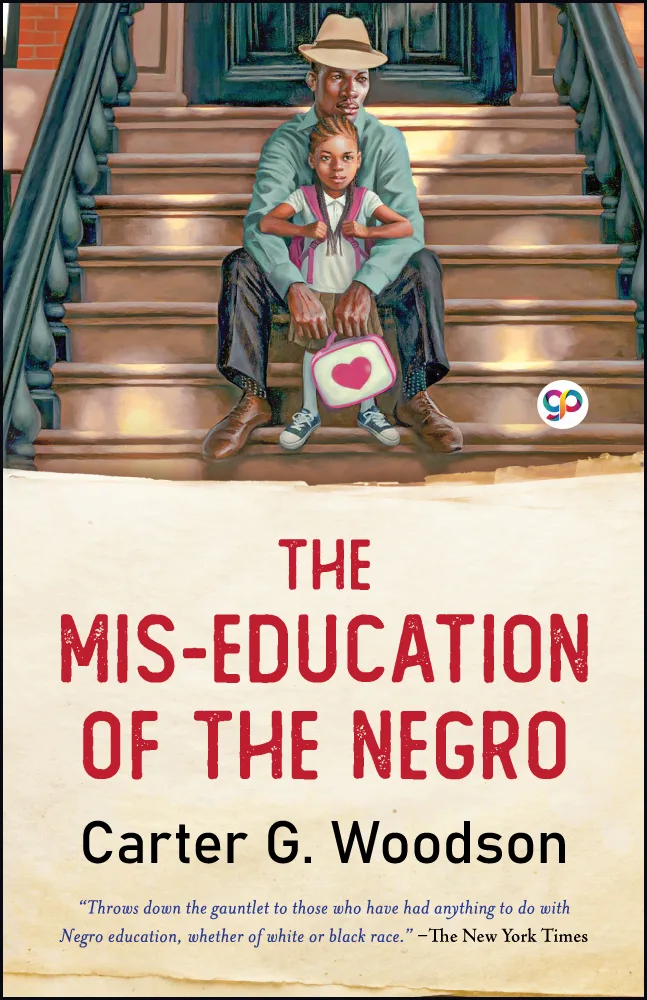
Download Cover Image
Do you want to download the full cover image for The Mis-Education of the Negro?