
The Science of Breathing
Paperback
• 104 Pages
• INR 199.00
• English
• 9789354997594
No ratings yet
| Publisher | General Press |
|---|---|
| ISBN13 | 9789354997594 |
| ASIN/SKU | 9354997597 |
| Book Format | Paperback |
| Language | English |
| Pages | 104 |
| List Price | INR 199.00 |
| Subject Code | HEA059000, HEA032000, SEL019000 |
| Dimensions | 8.25 x 5.25 x 1.0 inches |
| Book Code | BD00067854 |
Buy this Book
Amazon Stores
Ebook Stores
Other Stores
Discover The Science of Breathing by Yogi Ramacharaka. This book is published by General Press in Paperback format, ISBN 9789354997594, ASIN 9354997597, under Health, Fitness and Dieting, Healthy Living, Yoga and Meditaion.
Book Description
First published in 1903, ‘The Science of Breathing’ is the first of many titles on yoga and Hinduism by the mysterious Yogi Ramacharaka. There are no official records of this author and many scholars believe that he did not exist and the name is instead a pseudonym for the true writer, William Walker Atkinson, the famed occultist and pioneer of the American New Thought movement.
This manual on the science of controlling your breathing includes chapters on both the spiritual aspect of yoga and breathing, as well as the practical aspect of how to include these concepts in your yoga practice. Chapters contain lessons on such important practices as nostril vs. mouth-breathing, the Yogi complete breath, Yogi rhythmic breathing, and Yogi spiritual breathing. Both experienced and beginner yoga enthusiasts will discover a treasure of useful advice in this thoughtful guide.
This manual on the science of controlling your breathing includes chapters on both the spiritual aspect of yoga and breathing, as well as the practical aspect of how to include these concepts in your yoga practice. Chapters contain lessons on such important practices as nostril vs. mouth-breathing, the Yogi complete breath, Yogi rhythmic breathing, and Yogi spiritual breathing. Both experienced and beginner yoga enthusiasts will discover a treasure of useful advice in this thoughtful guide.
Author Biography
Yogi Ramacharaka was the pseudonym of William Walker Atkinson (1862–1932), an American attorney, publisher, and occultist who became a major figure in the New Thought and yoga movements of the early 20th century. Born in Baltimore, Maryland, Atkinson initially pursued a successful career in law and business. However, after a personal and financial crisis in the 1890s, he turned to metaphysical studies for healing and transformation.
In his middle life, Atkinson became deeply involved in New Thought philosophy and Eastern spiritual teachings. Under the name Yogi Ramacharaka, he authored a series of books that introduced Western audiences to yoga, Hindu philosophy, and health practices. These included The Science of Breath (1903), Fourteen Lessons in Yogi Philosophy, and Advanced Course in Yogi Philosophy and Oriental Occultism. The Science of Breath became especially influential, offering clear guidance on pranayama (breathing exercises) and their physical, mental, and spiritual benefits.
Though he never traveled to India, Atkinson claimed to have studied under an Indian yogi and used the Ramacharaka identity to lend authenticity to his Eastern teachings. His works were widely read and helped shape early Western perceptions of yoga and meditation.
Atkinson died in 1932, leaving behind a legacy of cross-cultural spiritual writing under multiple pseudonyms.
In his middle life, Atkinson became deeply involved in New Thought philosophy and Eastern spiritual teachings. Under the name Yogi Ramacharaka, he authored a series of books that introduced Western audiences to yoga, Hindu philosophy, and health practices. These included The Science of Breath (1903), Fourteen Lessons in Yogi Philosophy, and Advanced Course in Yogi Philosophy and Oriental Occultism. The Science of Breath became especially influential, offering clear guidance on pranayama (breathing exercises) and their physical, mental, and spiritual benefits.
Though he never traveled to India, Atkinson claimed to have studied under an Indian yogi and used the Ramacharaka identity to lend authenticity to his Eastern teachings. His works were widely read and helped shape early Western perceptions of yoga and meditation.
Atkinson died in 1932, leaving behind a legacy of cross-cultural spiritual writing under multiple pseudonyms.
Editorial Reviews
Editorial Reviews will be added soon…
Book Summary
Yogi Ramacharaka’s The Science of Breath is a classic work on yogic breathing, pranayama, and the relationship between breath, physical vitality, mental control, and spiritual development. Originally published in the early twentieth century, the book was written to introduce Western readers to ideas that Ramacharaka associated with the Hindu-Yogi tradition. The work presents breathing as far more than an automatic bodily function. For Ramacharaka, breath is a bridge between the physical body and the mind, and conscious breathing can become a practical discipline for cultivating energy, calmness, concentration, and inner awareness. The book is deliberately written in accessible language and moves from the physical mechanics of respiration toward psychological, psychic, and spiritual interpretations of breath.
The central idea of The Science of Breath can be expressed in a very simple statement: breathing is closely connected with living, and learning to breathe consciously can change the way we experience our physical and mental life. Ramacharaka begins with the obvious fact that every living human being depends upon breathing, but he then asks readers to look more carefully at something they normally do without thinking. We breathe thousands of times without consciously directing the process, yet the quality and manner of breathing can influence how the body feels and how the mind behaves. His purpose is therefore to make an unconscious activity more conscious. Rather than treating breath as background noise, he asks the reader to regard it as an instrument that can be studied, practiced, and refined.
One of the book’s most important concepts is prana. In Ramacharaka’s presentation, prana is not simply oxygen or air. It is understood as a vital force associated with life itself. The author distinguishes this yogic concept from the purely physiological explanation of respiration. According to his philosophy, atmospheric air contains prana, and ordinary breathing supplies the body with a normal amount of this vital energy. Controlled breathing, however, is presented as a way of consciously increasing, directing, and storing this energy. Modern readers may interpret this idea differently depending on their philosophical or scientific perspective, but it is essential to understanding the book on its own terms. The Science of Breath is not merely an anatomy manual; it is a synthesis of breathing practice and yogic philosophy.
Ramacharaka first examines different methods of breathing. He divides respiration into four broad categories: high breathing, mid breathing, low breathing, and Yogi Complete Breathing. The first three represent incomplete ways of using the respiratory apparatus, while the fourth is presented as the foundation of yogic breathing practice. High breathing, also called clavicular or collarbone breathing, emphasizes the upper part of the chest. Ramacharaka considers it inefficient because it requires considerable muscular effort while making relatively limited use of the lungs. He contrasts this with low breathing, which makes greater use of the diaphragm and lower portion of the lungs. His discussion is essentially an argument for fuller, more coordinated respiration rather than shallow, restricted breathing.
This leads to the heart of the book: the Yogi Complete Breath. Ramacharaka regards this method as the fundamental breathing technique upon which the rest of his system is built. He does not want readers to treat it as an interesting exercise that they try once or twice. Instead, he argues that it should gradually become a natural way of breathing. Mastery requires practice, patience, and repetition. The author explicitly rejects the idea of an effortless shortcut. His point is surprisingly modern in spirit: knowing a technique intellectually is not the same as developing it as a habit.
The Yogi Complete Breath involves coordinating the lower, middle, and upper regions of the respiratory system so that breathing becomes deeper and more comprehensive. Rather than forcing the breath into one small area of the chest, the practitioner learns to use the respiratory muscles in a more integrated manner. The purpose, in Ramacharaka’s framework, is to maximize the usefulness of each breath and establish a calmer, more efficient respiratory rhythm. The practice also becomes the foundation for the more specialized exercises that appear later in the book.
An important lesson here is that effective breathing begins with awareness. Ramacharaka repeatedly encourages the student to observe how breathing actually happens rather than immediately attempting complicated techniques. This makes the book partly a training manual in attention. The reader becomes aware of the diaphragm, chest, abdomen, rhythm, inhalation, exhalation, and pauses. Breathing becomes something the practitioner can feel directly. That attention is important because the author believes the breath provides a pathway toward greater control of the body and mind.
The book then moves beyond ordinary respiration into rhythmic breathing. Rhythm is central to Ramacharaka’s philosophy because he sees the human organism as responsive to regular patterns. By consciously regulating the pace of inhalation, retention, and exhalation, the practitioner can cultivate steadiness and control. The exercises are not presented merely as physical gymnastics. They are intended to train the nervous system, concentration, and will. This is where The Science of Breath begins to shift from a book about breathing mechanics into a broader book about self-mastery.
Ramacharaka places considerable emphasis on the nervous system. In his model, breathing and the nervous system are closely connected, and conscious control of respiration can therefore influence one's mental and emotional condition. The book presents breathing as a tool for calming, energizing, concentrating, and regulating the individual. It also discusses the distinction between breathing through the nose and breathing through the mouth, strongly favoring nasal breathing. The author regards the nose as an important part of the body's respiratory mechanism rather than merely an alternative entrance for air.
The practical exercises become progressively more specialized. Among them are the seven Yogi developing exercises and several minor exercises designed to develop different aspects of respiratory control. The book also introduces rhythmic breathing and exercises associated with vibration. These practices demonstrate that Ramacharaka's approach is systematic: first establish correct breathing, then develop control, then use that control for broader physical, mental, psychic, and spiritual purposes. The table of contents itself reflects this progression, moving from physiology and breathing methods toward rhythmic breathing and eventually psychic and spiritual breathing.
One of the book’s most interesting themes is the relationship between breath and mental states. Ramacharaka believes that the breath can be deliberately used to influence the mind. When a person is frightened, agitated, exhausted, or excited, breathing often changes automatically. Conversely, deliberately changing the breathing pattern can help produce a different internal state. Although Ramacharaka explains this relationship through the language and philosophy of his period, the basic experiential observation is easy to understand: our emotional condition and breathing pattern are intimately connected. His practical suggestion is to make that connection conscious rather than allowing breathing to remain entirely automatic.
This makes the book relevant to readers interested in meditation, mindfulness, stress management, yoga breathing, pranayama, and concentration. Ramacharaka's ultimate goal is not simply to help someone breathe more deeply. He wants the practitioner to develop greater command over the relationship between body and mind. Breath becomes a doorway into self-observation. Once the reader becomes sensitive to breathing, the body becomes easier to observe, the mind becomes easier to notice, and emotional reactions can potentially be approached with greater awareness.
At the same time, the book should be understood within its historical context. Ramacharaka presents traditional yogic ideas alongside explanations framed in the physiological vocabulary available to him. Some of his claims about prana, stored vital energy, psychic phenomena, and the effects of particular breathing practices belong to his spiritual and occult worldview rather than to modern biomedical science. For example, his explanation that controlled breathing can accumulate prana in the brain and nerve centers is part of the book's yogic philosophy, not a modern physiological description. This distinction is important for a contemporary reader: the book can be appreciated as a historical and philosophical work on breath without treating every metaphysical claim as established medical fact.
The later portions of The Science of Breath extend the idea of breathing into psychic and spiritual development. Ramacharaka sees breath as a connection between the ordinary physical self and deeper levels of consciousness. The breath becomes a means of directing attention inward. The ultimate purpose of mastering breathing is therefore not simply greater physical efficiency but a more integrated form of human development. The progression is deliberate: physical control leads toward mental control, mental control toward psychic awareness, and psychic awareness toward spiritual understanding.
This broader philosophy explains why the book continues to attract readers more than a century after its original publication. It belongs to an important period in the history of yoga's introduction to Western audiences. Ramacharaka presented yogic teachings in relatively straightforward English and intentionally minimized difficult Sanskrit terminology so that Western readers could engage with the ideas more easily. Bibliographic records identify The Science of Breath as a work published by the Yogi Publication Society in the early 1900s, and it has subsequently appeared in numerous editions.
Perhaps the most humane aspect of the book is its insistence on practice rather than intellectual curiosity. Ramacharaka repeatedly reminds the reader that breathing techniques cannot be mastered simply by reading about them. The student has to practice patiently until the correct method becomes familiar. The book therefore has an almost apprenticeship-like quality. It does not tell readers that transformation happens because they have discovered a secret. Instead, it tells them to work gradually, observe carefully, and develop control through repetition.
The deepest message of The Science of Breath is consequently broader than pranayama itself. Ramacharaka asks readers to become conscious of something they normally take for granted. Breath is always with us, yet we rarely pay attention to it. By bringing awareness to breathing, he believes we can begin to develop awareness of the body, emotions, thoughts, energy, and eventually the deeper dimensions of consciousness. Whether one accepts his spiritual interpretation literally or approaches the book simply as a historical introduction to yogic breathing, this basic invitation remains compelling: pay attention to the breath, and you may learn something about yourself.
For anyone searching for a summary of The Science of Breath by Yogi Ramacharaka, the key takeaway is that the book presents breathing as a complete system of personal development rather than a simple bodily function. It begins with the mechanics of respiration, distinguishes shallow and incomplete forms of breathing from the fuller Yogi Complete Breath, introduces rhythmic and specialized breathing exercises, and then connects breath with vitality, nervous-system control, concentration, psychic awareness, and spiritual development. Its enduring lesson is one of conscious practice: breathing is always happening, but learning to breathe with awareness can become a discipline for becoming more aware of life itself.
The central idea of The Science of Breath can be expressed in a very simple statement: breathing is closely connected with living, and learning to breathe consciously can change the way we experience our physical and mental life. Ramacharaka begins with the obvious fact that every living human being depends upon breathing, but he then asks readers to look more carefully at something they normally do without thinking. We breathe thousands of times without consciously directing the process, yet the quality and manner of breathing can influence how the body feels and how the mind behaves. His purpose is therefore to make an unconscious activity more conscious. Rather than treating breath as background noise, he asks the reader to regard it as an instrument that can be studied, practiced, and refined.
One of the book’s most important concepts is prana. In Ramacharaka’s presentation, prana is not simply oxygen or air. It is understood as a vital force associated with life itself. The author distinguishes this yogic concept from the purely physiological explanation of respiration. According to his philosophy, atmospheric air contains prana, and ordinary breathing supplies the body with a normal amount of this vital energy. Controlled breathing, however, is presented as a way of consciously increasing, directing, and storing this energy. Modern readers may interpret this idea differently depending on their philosophical or scientific perspective, but it is essential to understanding the book on its own terms. The Science of Breath is not merely an anatomy manual; it is a synthesis of breathing practice and yogic philosophy.
Ramacharaka first examines different methods of breathing. He divides respiration into four broad categories: high breathing, mid breathing, low breathing, and Yogi Complete Breathing. The first three represent incomplete ways of using the respiratory apparatus, while the fourth is presented as the foundation of yogic breathing practice. High breathing, also called clavicular or collarbone breathing, emphasizes the upper part of the chest. Ramacharaka considers it inefficient because it requires considerable muscular effort while making relatively limited use of the lungs. He contrasts this with low breathing, which makes greater use of the diaphragm and lower portion of the lungs. His discussion is essentially an argument for fuller, more coordinated respiration rather than shallow, restricted breathing.
This leads to the heart of the book: the Yogi Complete Breath. Ramacharaka regards this method as the fundamental breathing technique upon which the rest of his system is built. He does not want readers to treat it as an interesting exercise that they try once or twice. Instead, he argues that it should gradually become a natural way of breathing. Mastery requires practice, patience, and repetition. The author explicitly rejects the idea of an effortless shortcut. His point is surprisingly modern in spirit: knowing a technique intellectually is not the same as developing it as a habit.
The Yogi Complete Breath involves coordinating the lower, middle, and upper regions of the respiratory system so that breathing becomes deeper and more comprehensive. Rather than forcing the breath into one small area of the chest, the practitioner learns to use the respiratory muscles in a more integrated manner. The purpose, in Ramacharaka’s framework, is to maximize the usefulness of each breath and establish a calmer, more efficient respiratory rhythm. The practice also becomes the foundation for the more specialized exercises that appear later in the book.
An important lesson here is that effective breathing begins with awareness. Ramacharaka repeatedly encourages the student to observe how breathing actually happens rather than immediately attempting complicated techniques. This makes the book partly a training manual in attention. The reader becomes aware of the diaphragm, chest, abdomen, rhythm, inhalation, exhalation, and pauses. Breathing becomes something the practitioner can feel directly. That attention is important because the author believes the breath provides a pathway toward greater control of the body and mind.
The book then moves beyond ordinary respiration into rhythmic breathing. Rhythm is central to Ramacharaka’s philosophy because he sees the human organism as responsive to regular patterns. By consciously regulating the pace of inhalation, retention, and exhalation, the practitioner can cultivate steadiness and control. The exercises are not presented merely as physical gymnastics. They are intended to train the nervous system, concentration, and will. This is where The Science of Breath begins to shift from a book about breathing mechanics into a broader book about self-mastery.
Ramacharaka places considerable emphasis on the nervous system. In his model, breathing and the nervous system are closely connected, and conscious control of respiration can therefore influence one's mental and emotional condition. The book presents breathing as a tool for calming, energizing, concentrating, and regulating the individual. It also discusses the distinction between breathing through the nose and breathing through the mouth, strongly favoring nasal breathing. The author regards the nose as an important part of the body's respiratory mechanism rather than merely an alternative entrance for air.
The practical exercises become progressively more specialized. Among them are the seven Yogi developing exercises and several minor exercises designed to develop different aspects of respiratory control. The book also introduces rhythmic breathing and exercises associated with vibration. These practices demonstrate that Ramacharaka's approach is systematic: first establish correct breathing, then develop control, then use that control for broader physical, mental, psychic, and spiritual purposes. The table of contents itself reflects this progression, moving from physiology and breathing methods toward rhythmic breathing and eventually psychic and spiritual breathing.
One of the book’s most interesting themes is the relationship between breath and mental states. Ramacharaka believes that the breath can be deliberately used to influence the mind. When a person is frightened, agitated, exhausted, or excited, breathing often changes automatically. Conversely, deliberately changing the breathing pattern can help produce a different internal state. Although Ramacharaka explains this relationship through the language and philosophy of his period, the basic experiential observation is easy to understand: our emotional condition and breathing pattern are intimately connected. His practical suggestion is to make that connection conscious rather than allowing breathing to remain entirely automatic.
This makes the book relevant to readers interested in meditation, mindfulness, stress management, yoga breathing, pranayama, and concentration. Ramacharaka's ultimate goal is not simply to help someone breathe more deeply. He wants the practitioner to develop greater command over the relationship between body and mind. Breath becomes a doorway into self-observation. Once the reader becomes sensitive to breathing, the body becomes easier to observe, the mind becomes easier to notice, and emotional reactions can potentially be approached with greater awareness.
At the same time, the book should be understood within its historical context. Ramacharaka presents traditional yogic ideas alongside explanations framed in the physiological vocabulary available to him. Some of his claims about prana, stored vital energy, psychic phenomena, and the effects of particular breathing practices belong to his spiritual and occult worldview rather than to modern biomedical science. For example, his explanation that controlled breathing can accumulate prana in the brain and nerve centers is part of the book's yogic philosophy, not a modern physiological description. This distinction is important for a contemporary reader: the book can be appreciated as a historical and philosophical work on breath without treating every metaphysical claim as established medical fact.
The later portions of The Science of Breath extend the idea of breathing into psychic and spiritual development. Ramacharaka sees breath as a connection between the ordinary physical self and deeper levels of consciousness. The breath becomes a means of directing attention inward. The ultimate purpose of mastering breathing is therefore not simply greater physical efficiency but a more integrated form of human development. The progression is deliberate: physical control leads toward mental control, mental control toward psychic awareness, and psychic awareness toward spiritual understanding.
This broader philosophy explains why the book continues to attract readers more than a century after its original publication. It belongs to an important period in the history of yoga's introduction to Western audiences. Ramacharaka presented yogic teachings in relatively straightforward English and intentionally minimized difficult Sanskrit terminology so that Western readers could engage with the ideas more easily. Bibliographic records identify The Science of Breath as a work published by the Yogi Publication Society in the early 1900s, and it has subsequently appeared in numerous editions.
Perhaps the most humane aspect of the book is its insistence on practice rather than intellectual curiosity. Ramacharaka repeatedly reminds the reader that breathing techniques cannot be mastered simply by reading about them. The student has to practice patiently until the correct method becomes familiar. The book therefore has an almost apprenticeship-like quality. It does not tell readers that transformation happens because they have discovered a secret. Instead, it tells them to work gradually, observe carefully, and develop control through repetition.
The deepest message of The Science of Breath is consequently broader than pranayama itself. Ramacharaka asks readers to become conscious of something they normally take for granted. Breath is always with us, yet we rarely pay attention to it. By bringing awareness to breathing, he believes we can begin to develop awareness of the body, emotions, thoughts, energy, and eventually the deeper dimensions of consciousness. Whether one accepts his spiritual interpretation literally or approaches the book simply as a historical introduction to yogic breathing, this basic invitation remains compelling: pay attention to the breath, and you may learn something about yourself.
For anyone searching for a summary of The Science of Breath by Yogi Ramacharaka, the key takeaway is that the book presents breathing as a complete system of personal development rather than a simple bodily function. It begins with the mechanics of respiration, distinguishes shallow and incomplete forms of breathing from the fuller Yogi Complete Breath, introduces rhythmic and specialized breathing exercises, and then connects breath with vitality, nervous-system control, concentration, psychic awareness, and spiritual development. Its enduring lesson is one of conscious practice: breathing is always happening, but learning to breathe with awareness can become a discipline for becoming more aware of life itself.
Sample Chapters
Sample Chapters will be added soon…
Reader Reviews
No reviews yet.
The Science of Breathing
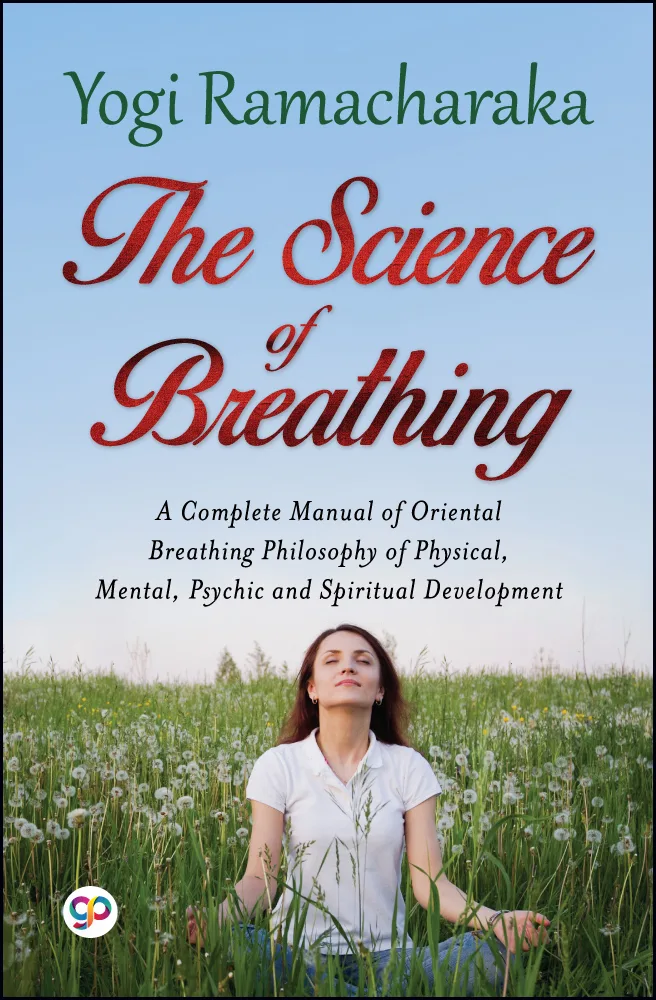
Download Cover Image
Do you want to download the full cover image for The Science of Breathing?