
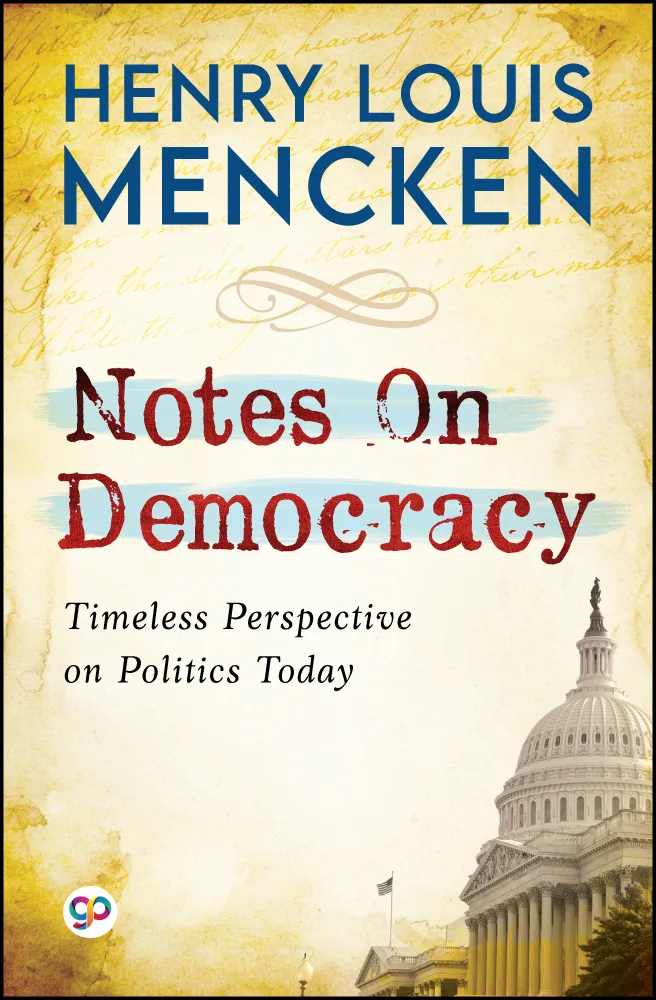
Notes on Democracy
Hardcover
• 176 Pages
• INR 295.00
• English
• 9789354999116
No ratings yet
| Publisher | General Press |
|---|---|
| ISBN13 | 9789354999116 |
| ASIN/SKU | 9354999115 |
| Book Format | Hardcover |
| Language | English |
| Pages | 176 |
| List Price | INR 295.00 |
| Subject Code | POL007000, POL032000, HIS054000 |
| Dimensions | 8.25 x 5.25 x 1.0 inches |
| Book Code | BD00067866 |
Buy this Book
Amazon Stores
Ebook Stores
Other Stores
Discover Notes on Democracy by H.L. Mencken. This book is published by General Press in Hardcover format, ISBN 9789354999116, ASIN 9354999115, under Politics and Social Sciences, Politics and Government, Political Philosophy.
Book Description
Democracy came into the Western World to the tune of sweet, soft music. There was, at the start, no harsh bawling from below there was only a dulcet twittering from above. Democratic man thus began as an ideal being, full of ineffable virtues and romantic wrongs in brief, as Rousseau’s noble savage in smock and jerkin, brought out of the tropical wilds to shame the lords and masters of the civilized lands.
The fact continues to have important consequences to this day. It remains impossible, as it was in the eighteenth century, to separate the democratic idea from the theory that there is a mystical merit, an esoteric and ineradicable rectitude, in the man at the bottom of the scale—that inferiority, by some strange magic, becomes a sort of superiority—nay, the superiority of superiorities.
The fact continues to have important consequences to this day. It remains impossible, as it was in the eighteenth century, to separate the democratic idea from the theory that there is a mystical merit, an esoteric and ineradicable rectitude, in the man at the bottom of the scale—that inferiority, by some strange magic, becomes a sort of superiority—nay, the superiority of superiorities.
Author Biography
Henry Louis "H.L." Mencken became one of the most influential and prolific journalists in America in the 1920s and '30s, writing about all the shams and con artists in the world. He attacked chiropractors and the Ku Klux Klan, politicians and other journalists. Most of all, he attacked Puritan morality. He called Puritanism, "the haunting fear that someone, somewhere, may be happy."
At the height of his career, he edited and wrote for The American Mercury magazine and the Baltimore Sun newspaper, wrote a nationally syndicated newspaper column for the Chicago Tribune, and published two or three books every year. His masterpiece was one of the few books he wrote about something he loved, a book called The American Language (1919), a history and collection of American vernacular speech. It included a translation of the Declaration of Independence into American English that began, "When things get so balled up that the people of a country got to cut loose from some other country, and go it on their own hook, without asking no permission from nobody, excepting maybe God Almighty, then they ought to let everybody know why they done it, so that everybody can see they are not trying to put nothing over on nobody."
When asked what he would like for an epitaph, Mencken wrote, "If, after I depart this vale, you ever remember me and have thought to please my ghost, forgive some sinner and wink your eye at some homely girl."
At the height of his career, he edited and wrote for The American Mercury magazine and the Baltimore Sun newspaper, wrote a nationally syndicated newspaper column for the Chicago Tribune, and published two or three books every year. His masterpiece was one of the few books he wrote about something he loved, a book called The American Language (1919), a history and collection of American vernacular speech. It included a translation of the Declaration of Independence into American English that began, "When things get so balled up that the people of a country got to cut loose from some other country, and go it on their own hook, without asking no permission from nobody, excepting maybe God Almighty, then they ought to let everybody know why they done it, so that everybody can see they are not trying to put nothing over on nobody."
When asked what he would like for an epitaph, Mencken wrote, "If, after I depart this vale, you ever remember me and have thought to please my ghost, forgive some sinner and wink your eye at some homely girl."
Editorial Reviews
Editorial Reviews will be added soon…
Book Summary
Notes on Democracy by H.L. Mencken is a sharp, provocative, and deliberately irreverent critique of democratic government, political culture, mass opinion, and the idealized image of the ordinary voter. First published in 1926 by Alfred A. Knopf, the book is not a conventional political-science treatise. It is a collection of argumentative essays in which Mencken uses satire, irony, exaggeration, skepticism, and deliberately abrasive language to question whether democracy actually produces the wisdom, virtue, liberty, and competent government that its admirers promise. The book is organized into four major sections—“Democratic Man,” “The Democratic State,” “Democracy and Liberty,” and “Coda”—and its 212-page original edition moves from a critique of the democratic citizen to an examination of politicians, elections, lawmaking, morality, corruption, and the future of democracy.
Mencken's central argument is deliberately uncomfortable: democracy often fails because it assumes too much wisdom, rationality, and virtue on the part of ordinary people. He does not approach politics with the traditional belief that the majority is naturally wise simply because it is the majority. Instead, he asks what happens when large numbers of imperfect, uninformed, emotional, prejudiced, and easily influenced people are given political power. His answer is characteristically cynical. Democratic politicians learn to appeal to popular fears and desires rather than to intelligence or long-term judgment. The voter, meanwhile, often rewards the politician who tells him what he wants to hear. Mencken sees this relationship as a cycle in which public ignorance creates political opportunism and political opportunism, in turn, encourages further public ignorance.
The first major section, “Democratic Man,” examines the human being whom democracy supposedly places at the center of political life. Mencken begins by challenging the romantic image of the common person that emerged from eighteenth- and nineteenth-century democratic thought. The democratic tradition, he argues, often treats ordinary people as naturally virtuous and oppressed people as morally superior to those above them. Mencken sees this as an unrealistic idealization. In his view, being poor, ordinary, or politically powerless does not automatically make a person wise or virtuous. Human nature remains complicated regardless of social position.
This attack on the romanticization of the “common man” is one of the foundations of the book. Mencken is not impressed by the assumption that the masses possess a special collective wisdom. He argues that individuals can be intelligent, courageous, creative, and independent, but a crowd often behaves differently from an individual. In a crowd, people may become more emotional, more suggestible, and more willing to follow slogans. The political system that treats the collective judgment of millions as automatically superior to the judgment of a smaller number of informed people therefore contains a built-in weakness.
Mencken's discussion of human psychology is especially important because he believes political behavior cannot be understood simply by studying constitutions and institutions. Voters are driven not only by reason but also by fear, envy, resentment, vanity, tribal loyalty, and the desire to belong. His chapter titles themselves reveal this psychological approach: “The New Psychology,” “The Rôle of the Hormones,” and “Envy as a Philosophy.” Although some of Mencken's early twentieth-century psychological and biological assumptions now appear dated, his larger insight remains recognizable: political decisions are influenced by emotion as much as by rational calculation.
The discussion of envy is particularly revealing. Mencken argues that democratic politics can transform private resentment into public policy. People may resent those who possess greater wealth, status, education, talent, or influence, and politicians can exploit that resentment by promising to punish or restrain unpopular groups. Mencken is suspicious whenever political rhetoric presents envy as a moral virtue. He believes that a society should distinguish between genuine injustice and the simple desire to bring successful people down.
This does not mean that Mencken believes all inequalities are justified or that every criticism of wealth is motivated by envy. His broader concern is with the psychological mechanism through which politicians discover that resentment can be politically useful. If a candidate can persuade voters that another group is responsible for their frustrations, that candidate can convert dissatisfaction into political support. The result is a politics driven less by careful policy and more by emotional identification.
Mencken then examines liberty and democratic man. One of his recurring concerns is that democracy and liberty are not necessarily identical. A majority can use its political power to restrict the freedom of minorities or individuals. This is an important distinction in Mencken's thought. Simply allowing the majority to vote does not guarantee individual freedom. In fact, majority rule can sometimes become another form of coercion if the majority believes that its preferences should control every aspect of social life.
This concern becomes especially important when Mencken discusses moral reform and Puritanism. He is deeply suspicious of movements that attempt to legislate personal behavior according to rigid moral standards. The table of contents places “The Democrat as Moralist” and “Where Puritanism Fails” within the section “Democracy and Liberty,” indicating that Mencken sees moral majoritarianism as a potential threat to freedom. He believes democratic majorities can become intensely moralistic when they are persuaded that imposing their values on others is a form of public virtue.
The first section ends with “The Eternal Mob,” a phrase that captures Mencken's pessimism about mass politics. The mob is not simply a group of stupid individuals. It represents the tendency of large groups to prefer emotional certainty over complicated truth. Crowds want heroes, villains, slogans, and simple answers. Politicians who understand this can become extraordinarily powerful by giving the crowd precisely what it wants.
The second major section, “The Democratic State,” shifts attention from citizens to political institutions. Mencken distinguishes between different forms of democracy and examines the idea of the “popular will.” His fundamental objection is that there may be no single, coherent popular will. Millions of people have different interests, beliefs, prejudices, and desires. Elections compress this enormous diversity into simplistic political choices, and the resulting winner can claim to represent “the people” even though a substantial portion of the population may have opposed him.
This leads to Mencken's discussion of representation. The democratic system claims to represent citizens, but Mencken questions how accurately it actually does so. Electoral systems inevitably simplify public opinion. A candidate can win office without representing the majority of all citizens, and political parties can translate complicated issues into campaign slogans. His chapter on “Disproportional Representation” examines precisely this problem.
Mencken's harshest criticism is reserved for the politician under democracy. He argues that the democratic politician is trapped by the need to win elections. This creates an incentive to tell voters what they want to hear, even when the politician privately knows that those promises are unrealistic. Mencken's famous distinction between the demagogue and the “demaslave” expresses this cynical relationship: one deceives the public, while the other adapts himself to what the public already wants to believe. The point is not merely that politicians lie. Mencken argues that democratic politics can structurally reward the politician most willing to flatter popular opinion.
This creates what might be called the marketplace of political illusion. Candidates compete for votes, and voters reward emotionally attractive promises. A politician who offers painful but necessary policies may lose to one who offers comforting solutions. Consequently, political competition does not always select the most competent leader. It can select the best performer.
Mencken's chapter on “Utopia” continues this criticism by questioning the tendency to imagine politics as a mechanism capable of creating a perfect society. He is deeply skeptical of political promises to eliminate human conflict, corruption, inequality, or unhappiness. Human beings remain flawed regardless of the system in which they live. Changing political institutions cannot completely change human nature.
This skepticism is important because Mencken is not simply arguing that democracy should be replaced by a perfect alternative. He does not offer a detailed constitutional blueprint for an ideal political system. His project is primarily destructive: he wants to expose the weaknesses of democratic idealism. The book is therefore stronger as a critique than as a positive political program.
Mencken does acknowledge occasional exceptions. The chapter titled “The Occasional Exception” suggests that he does not believe every democratic politician is incompetent or dishonest. Extraordinary individuals can rise within democratic systems. But Mencken treats such people as exceptions rather than evidence that the system itself reliably produces excellence. This distinction is important because it prevents the book from becoming a simple claim that all politicians are equally foolish.
His discussion of lawmakers and legislation extends the argument. Mencken doubts that passing laws automatically solves social problems. Legislators are themselves products of the political environment, and they may respond to pressure groups, popular fears, moral crusades, and electoral incentives. The result can be excessive legislation: laws created because voters want politicians to “do something,” even when the legislation is ineffective or counterproductive.
The chapter “The Rewards of Virtue” is characteristically ironic. Mencken asks what happens when political systems reward behavior that appears virtuous rather than behavior that is actually useful. A politician can gain public approval by appearing morally righteous even when the practical consequences of his policies are harmful. This distinction between moral appearance and practical competence runs throughout the book.
The reference to “Lame Ducks” further illustrates Mencken's fascination with the strange incentives built into democratic institutions. He is interested in what politicians do when they are leaving office or have lost political influence. Once the immediate pressure of reelection disappears, political behavior can change. Mencken uses such situations to reveal the extent to which electoral incentives shape political conduct.
The third section, “Democracy and Liberty,” brings Mencken's institutional criticism into direct contact with the question of individual freedom. He examines the democratic desire for peace, morality, reform, and social order. Again, his concern is that majority sentiment can become coercive. A society can be democratic in the sense that its laws are supported by popular majorities while simultaneously becoming restrictive toward individuals who do not conform.
The chapter “The Democrat as Moralist” is especially important because Mencken believes political majorities often become convinced that their own moral preferences should be imposed on everyone else. This tendency can be seen in campaigns against alcohol, sexuality, speech, literature, and other areas of private life. The danger, from Mencken's perspective, is that moral enthusiasm can make coercion appear virtuous.
His treatment of Puritanism is connected with this same concern. Mencken associates Puritanical politics with the desire to regulate human behavior through law and social pressure. He is skeptical of attempts to eliminate vice by legislation because people cannot simply be legislated into virtue. Excessive moral regulation may instead create hypocrisy, underground behavior, selective enforcement, and corruption.
This leads naturally to the chapter on “Corruption Under Democracy.” Mencken argues that corruption is not simply the result of a few bad individuals. Political systems create incentives, and whenever government possesses valuable power, people will attempt to influence those who control it. Campaigns require money, politicians seek support, businesses seek favorable treatment, and interest groups seek legislation that benefits them. Democracy therefore does not automatically eliminate corruption. It can simply create democratic forms of influence-peddling.
The final section, “Coda,” turns toward the future. Mencken asks what will become of democracy and whether its weaknesses are temporary or permanent. His tone remains skeptical. He does not suddenly become an enthusiastic democrat. Instead, he continues to question the belief that political progress necessarily means greater popular participation. His “Last Words” serve as a final expression of his distrust of political romanticism.
Yet the lasting value of Notes on Democracy does not depend on accepting Mencken's conclusions. Indeed, many readers may strongly disagree with his contemptuous characterization of ordinary voters and his pessimism about democratic government. His language is often intentionally insulting, and some of his social assumptions reflect the prejudices of his era. His analysis also sometimes substitutes wit for systematic evidence. As Walter Lippmann observed in a contemporary review, the book's weakness as a work of ideas partly lies in the contrast Mencken creates between the unpleasant political reality he knows and an idealized society he imagines.
Nevertheless, the book remains compelling because Mencken asks questions that democracies cannot afford to ignore. Do voters always make rational decisions? Can majorities threaten individual liberty? Do elections reward competence or merely popularity? Why do politicians make promises they cannot fulfill? How easily can fear, envy, and resentment become political weapons? Can laws solve moral problems? Does majority rule guarantee freedom? These questions explain why a book written in 1926 can still feel relevant to modern readers.
Ultimately, Notes on Democracy by H.L. Mencken is best understood not as a balanced defense or rejection of democracy, but as a provocative warning against treating democracy as a sacred system beyond criticism. Mencken attacks the assumption that the majority is automatically wise, that politicians are naturally public-spirited, and that popular government necessarily produces liberty and competent administration. His argument is intentionally exaggerated, satirical, and often cruel, but beneath the rhetoric lies a serious concern about human nature and political incentives.
For readers searching for a Notes on Democracy summary, H.L. Mencken political philosophy, Notes on Democracy analysis, Mencken's criticism of democracy, democratic man, the popular will, political demagogues, democracy and liberty, political corruption, or the main ideas of Notes on Democracy, the book's central lesson is that democratic institutions should never be confused with democratic perfection. Democracy gives political power to ordinary human beings, but ordinary human beings remain vulnerable to ignorance, emotion, prejudice, vanity, and manipulation. Mencken's challenge is therefore not simply “Is democracy good or bad?” but a more uncomfortable question: What happens when imperfect people are given political power and then encouraged by politicians to believe that their collective judgment is automatically wise? Whether one agrees with his bleak answer or not, Notes on Democracy remains a memorable exercise in political skepticism—and a reminder that the health of a democracy depends not only on elections, but also on informed citizens, institutional restraints, individual liberty, and a willingness to question the comforting myths surrounding political power.
Mencken's central argument is deliberately uncomfortable: democracy often fails because it assumes too much wisdom, rationality, and virtue on the part of ordinary people. He does not approach politics with the traditional belief that the majority is naturally wise simply because it is the majority. Instead, he asks what happens when large numbers of imperfect, uninformed, emotional, prejudiced, and easily influenced people are given political power. His answer is characteristically cynical. Democratic politicians learn to appeal to popular fears and desires rather than to intelligence or long-term judgment. The voter, meanwhile, often rewards the politician who tells him what he wants to hear. Mencken sees this relationship as a cycle in which public ignorance creates political opportunism and political opportunism, in turn, encourages further public ignorance.
The first major section, “Democratic Man,” examines the human being whom democracy supposedly places at the center of political life. Mencken begins by challenging the romantic image of the common person that emerged from eighteenth- and nineteenth-century democratic thought. The democratic tradition, he argues, often treats ordinary people as naturally virtuous and oppressed people as morally superior to those above them. Mencken sees this as an unrealistic idealization. In his view, being poor, ordinary, or politically powerless does not automatically make a person wise or virtuous. Human nature remains complicated regardless of social position.
This attack on the romanticization of the “common man” is one of the foundations of the book. Mencken is not impressed by the assumption that the masses possess a special collective wisdom. He argues that individuals can be intelligent, courageous, creative, and independent, but a crowd often behaves differently from an individual. In a crowd, people may become more emotional, more suggestible, and more willing to follow slogans. The political system that treats the collective judgment of millions as automatically superior to the judgment of a smaller number of informed people therefore contains a built-in weakness.
Mencken's discussion of human psychology is especially important because he believes political behavior cannot be understood simply by studying constitutions and institutions. Voters are driven not only by reason but also by fear, envy, resentment, vanity, tribal loyalty, and the desire to belong. His chapter titles themselves reveal this psychological approach: “The New Psychology,” “The Rôle of the Hormones,” and “Envy as a Philosophy.” Although some of Mencken's early twentieth-century psychological and biological assumptions now appear dated, his larger insight remains recognizable: political decisions are influenced by emotion as much as by rational calculation.
The discussion of envy is particularly revealing. Mencken argues that democratic politics can transform private resentment into public policy. People may resent those who possess greater wealth, status, education, talent, or influence, and politicians can exploit that resentment by promising to punish or restrain unpopular groups. Mencken is suspicious whenever political rhetoric presents envy as a moral virtue. He believes that a society should distinguish between genuine injustice and the simple desire to bring successful people down.
This does not mean that Mencken believes all inequalities are justified or that every criticism of wealth is motivated by envy. His broader concern is with the psychological mechanism through which politicians discover that resentment can be politically useful. If a candidate can persuade voters that another group is responsible for their frustrations, that candidate can convert dissatisfaction into political support. The result is a politics driven less by careful policy and more by emotional identification.
Mencken then examines liberty and democratic man. One of his recurring concerns is that democracy and liberty are not necessarily identical. A majority can use its political power to restrict the freedom of minorities or individuals. This is an important distinction in Mencken's thought. Simply allowing the majority to vote does not guarantee individual freedom. In fact, majority rule can sometimes become another form of coercion if the majority believes that its preferences should control every aspect of social life.
This concern becomes especially important when Mencken discusses moral reform and Puritanism. He is deeply suspicious of movements that attempt to legislate personal behavior according to rigid moral standards. The table of contents places “The Democrat as Moralist” and “Where Puritanism Fails” within the section “Democracy and Liberty,” indicating that Mencken sees moral majoritarianism as a potential threat to freedom. He believes democratic majorities can become intensely moralistic when they are persuaded that imposing their values on others is a form of public virtue.
The first section ends with “The Eternal Mob,” a phrase that captures Mencken's pessimism about mass politics. The mob is not simply a group of stupid individuals. It represents the tendency of large groups to prefer emotional certainty over complicated truth. Crowds want heroes, villains, slogans, and simple answers. Politicians who understand this can become extraordinarily powerful by giving the crowd precisely what it wants.
The second major section, “The Democratic State,” shifts attention from citizens to political institutions. Mencken distinguishes between different forms of democracy and examines the idea of the “popular will.” His fundamental objection is that there may be no single, coherent popular will. Millions of people have different interests, beliefs, prejudices, and desires. Elections compress this enormous diversity into simplistic political choices, and the resulting winner can claim to represent “the people” even though a substantial portion of the population may have opposed him.
This leads to Mencken's discussion of representation. The democratic system claims to represent citizens, but Mencken questions how accurately it actually does so. Electoral systems inevitably simplify public opinion. A candidate can win office without representing the majority of all citizens, and political parties can translate complicated issues into campaign slogans. His chapter on “Disproportional Representation” examines precisely this problem.
Mencken's harshest criticism is reserved for the politician under democracy. He argues that the democratic politician is trapped by the need to win elections. This creates an incentive to tell voters what they want to hear, even when the politician privately knows that those promises are unrealistic. Mencken's famous distinction between the demagogue and the “demaslave” expresses this cynical relationship: one deceives the public, while the other adapts himself to what the public already wants to believe. The point is not merely that politicians lie. Mencken argues that democratic politics can structurally reward the politician most willing to flatter popular opinion.
This creates what might be called the marketplace of political illusion. Candidates compete for votes, and voters reward emotionally attractive promises. A politician who offers painful but necessary policies may lose to one who offers comforting solutions. Consequently, political competition does not always select the most competent leader. It can select the best performer.
Mencken's chapter on “Utopia” continues this criticism by questioning the tendency to imagine politics as a mechanism capable of creating a perfect society. He is deeply skeptical of political promises to eliminate human conflict, corruption, inequality, or unhappiness. Human beings remain flawed regardless of the system in which they live. Changing political institutions cannot completely change human nature.
This skepticism is important because Mencken is not simply arguing that democracy should be replaced by a perfect alternative. He does not offer a detailed constitutional blueprint for an ideal political system. His project is primarily destructive: he wants to expose the weaknesses of democratic idealism. The book is therefore stronger as a critique than as a positive political program.
Mencken does acknowledge occasional exceptions. The chapter titled “The Occasional Exception” suggests that he does not believe every democratic politician is incompetent or dishonest. Extraordinary individuals can rise within democratic systems. But Mencken treats such people as exceptions rather than evidence that the system itself reliably produces excellence. This distinction is important because it prevents the book from becoming a simple claim that all politicians are equally foolish.
His discussion of lawmakers and legislation extends the argument. Mencken doubts that passing laws automatically solves social problems. Legislators are themselves products of the political environment, and they may respond to pressure groups, popular fears, moral crusades, and electoral incentives. The result can be excessive legislation: laws created because voters want politicians to “do something,” even when the legislation is ineffective or counterproductive.
The chapter “The Rewards of Virtue” is characteristically ironic. Mencken asks what happens when political systems reward behavior that appears virtuous rather than behavior that is actually useful. A politician can gain public approval by appearing morally righteous even when the practical consequences of his policies are harmful. This distinction between moral appearance and practical competence runs throughout the book.
The reference to “Lame Ducks” further illustrates Mencken's fascination with the strange incentives built into democratic institutions. He is interested in what politicians do when they are leaving office or have lost political influence. Once the immediate pressure of reelection disappears, political behavior can change. Mencken uses such situations to reveal the extent to which electoral incentives shape political conduct.
The third section, “Democracy and Liberty,” brings Mencken's institutional criticism into direct contact with the question of individual freedom. He examines the democratic desire for peace, morality, reform, and social order. Again, his concern is that majority sentiment can become coercive. A society can be democratic in the sense that its laws are supported by popular majorities while simultaneously becoming restrictive toward individuals who do not conform.
The chapter “The Democrat as Moralist” is especially important because Mencken believes political majorities often become convinced that their own moral preferences should be imposed on everyone else. This tendency can be seen in campaigns against alcohol, sexuality, speech, literature, and other areas of private life. The danger, from Mencken's perspective, is that moral enthusiasm can make coercion appear virtuous.
His treatment of Puritanism is connected with this same concern. Mencken associates Puritanical politics with the desire to regulate human behavior through law and social pressure. He is skeptical of attempts to eliminate vice by legislation because people cannot simply be legislated into virtue. Excessive moral regulation may instead create hypocrisy, underground behavior, selective enforcement, and corruption.
This leads naturally to the chapter on “Corruption Under Democracy.” Mencken argues that corruption is not simply the result of a few bad individuals. Political systems create incentives, and whenever government possesses valuable power, people will attempt to influence those who control it. Campaigns require money, politicians seek support, businesses seek favorable treatment, and interest groups seek legislation that benefits them. Democracy therefore does not automatically eliminate corruption. It can simply create democratic forms of influence-peddling.
The final section, “Coda,” turns toward the future. Mencken asks what will become of democracy and whether its weaknesses are temporary or permanent. His tone remains skeptical. He does not suddenly become an enthusiastic democrat. Instead, he continues to question the belief that political progress necessarily means greater popular participation. His “Last Words” serve as a final expression of his distrust of political romanticism.
Yet the lasting value of Notes on Democracy does not depend on accepting Mencken's conclusions. Indeed, many readers may strongly disagree with his contemptuous characterization of ordinary voters and his pessimism about democratic government. His language is often intentionally insulting, and some of his social assumptions reflect the prejudices of his era. His analysis also sometimes substitutes wit for systematic evidence. As Walter Lippmann observed in a contemporary review, the book's weakness as a work of ideas partly lies in the contrast Mencken creates between the unpleasant political reality he knows and an idealized society he imagines.
Nevertheless, the book remains compelling because Mencken asks questions that democracies cannot afford to ignore. Do voters always make rational decisions? Can majorities threaten individual liberty? Do elections reward competence or merely popularity? Why do politicians make promises they cannot fulfill? How easily can fear, envy, and resentment become political weapons? Can laws solve moral problems? Does majority rule guarantee freedom? These questions explain why a book written in 1926 can still feel relevant to modern readers.
Ultimately, Notes on Democracy by H.L. Mencken is best understood not as a balanced defense or rejection of democracy, but as a provocative warning against treating democracy as a sacred system beyond criticism. Mencken attacks the assumption that the majority is automatically wise, that politicians are naturally public-spirited, and that popular government necessarily produces liberty and competent administration. His argument is intentionally exaggerated, satirical, and often cruel, but beneath the rhetoric lies a serious concern about human nature and political incentives.
For readers searching for a Notes on Democracy summary, H.L. Mencken political philosophy, Notes on Democracy analysis, Mencken's criticism of democracy, democratic man, the popular will, political demagogues, democracy and liberty, political corruption, or the main ideas of Notes on Democracy, the book's central lesson is that democratic institutions should never be confused with democratic perfection. Democracy gives political power to ordinary human beings, but ordinary human beings remain vulnerable to ignorance, emotion, prejudice, vanity, and manipulation. Mencken's challenge is therefore not simply “Is democracy good or bad?” but a more uncomfortable question: What happens when imperfect people are given political power and then encouraged by politicians to believe that their collective judgment is automatically wise? Whether one agrees with his bleak answer or not, Notes on Democracy remains a memorable exercise in political skepticism—and a reminder that the health of a democracy depends not only on elections, but also on informed citizens, institutional restraints, individual liberty, and a willingness to question the comforting myths surrounding political power.
Sample Chapters
Sample Chapters will be added soon…
Reader Reviews
No reviews yet.
Notes on Democracy
Download Cover Image
Do you want to download the full cover image for Notes on Democracy?