
The Three Musketeers
Paperback
• 656 Pages
• INR 825.00
• English
• 9789354999444
No ratings yet
| Publisher | General Press |
|---|---|
| ISBN13 | 9789354999444 |
| ASIN/SKU | 9354999441 |
| Book Format | Paperback |
| Language | English |
| Pages | 656 |
| List Price | INR 825.00 |
| Subject Code | FIC004000, FIC002000, FIC027050 |
| Dimensions | 8.25 x 5.25 x 1.0 inches |
| Book Code | BD00067884 |
Buy this Book
Amazon Stores
Ebook Stores
Other Stores
Discover The Three Musketeers by Alexandre Dumas. This book is published by General Press in Paperback format, ISBN 9789354999444, ASIN 9354999441, under Literature and Fiction, Action and Adventure, Classics.
Book Description
Adventure, friendship, romance, betrayal, and swordplay collide in Alexandre Dumas’s 'The Three Musketeers', a classic historical adventure novel that has captivated readers for generations. Set in seventeenth-century France, the story follows the ambitious young d’Artagnan as he leaves his home in Gascony and travels to Paris with dreams of becoming a musketeer, only to discover that courage and loyalty are tested far beyond the battlefield.
Determined to prove himself, d’Artagnan quickly becomes entangled with three of the king’s most celebrated musketeers: Athos, Porthos, and Aramis. Though very different in personality and temperament, the three men share an unbreakable bond and a deep commitment to the famous principle of “all for one and one for all.” What begins as rivalry soon develops into a powerful friendship, drawing d’Artagnan into a dangerous world of political intrigue, secret missions, forbidden romances, and deadly confrontations.
As tensions rise between the forces loyal to King Louis XIII and the powerful Cardinal Richelieu, d’Artagnan and his companions find themselves caught in schemes that reach far beyond their own personal ambitions. Their adventures take them through royal courts, shadowy encounters, clandestine meetings, and thrilling sword fights, while questions of honor and loyalty repeatedly force them to choose between personal safety and the interests of those they have sworn to protect.
Dumas combines fast-moving action with humor, romance, suspense, and memorable characters, creating a story that feels both grand and deeply personal. Beneath the duels and political conspiracies is a timeless exploration of friendship, courage, ambition, and the willingness to stand beside others when danger closes in.
For readers who love classic adventure, historical fiction, swashbuckling heroes, and unforgettable friendships, 'The Three Musketeers' offers a wonderfully entertaining journey into a world where every promise can carry a price and every encounter may lead to another adventure. Once d’Artagnan joins forces with the three musketeers, there is no telling how far their loyalty—and their courage—will take them.
Determined to prove himself, d’Artagnan quickly becomes entangled with three of the king’s most celebrated musketeers: Athos, Porthos, and Aramis. Though very different in personality and temperament, the three men share an unbreakable bond and a deep commitment to the famous principle of “all for one and one for all.” What begins as rivalry soon develops into a powerful friendship, drawing d’Artagnan into a dangerous world of political intrigue, secret missions, forbidden romances, and deadly confrontations.
As tensions rise between the forces loyal to King Louis XIII and the powerful Cardinal Richelieu, d’Artagnan and his companions find themselves caught in schemes that reach far beyond their own personal ambitions. Their adventures take them through royal courts, shadowy encounters, clandestine meetings, and thrilling sword fights, while questions of honor and loyalty repeatedly force them to choose between personal safety and the interests of those they have sworn to protect.
Dumas combines fast-moving action with humor, romance, suspense, and memorable characters, creating a story that feels both grand and deeply personal. Beneath the duels and political conspiracies is a timeless exploration of friendship, courage, ambition, and the willingness to stand beside others when danger closes in.
For readers who love classic adventure, historical fiction, swashbuckling heroes, and unforgettable friendships, 'The Three Musketeers' offers a wonderfully entertaining journey into a world where every promise can carry a price and every encounter may lead to another adventure. Once d’Artagnan joins forces with the three musketeers, there is no telling how far their loyalty—and their courage—will take them.
Author Biography
Alexandre Dumas (1802–1870) was a celebrated French novelist and playwright, renowned for his swashbuckling historical adventures and prolific literary output. Born in Villers-Cotterêts, France, Dumas was the son of Thomas-Alexandre Dumas, a general in Napoleon’s army of Afro-Caribbean descent. Despite facing racial prejudice, Dumas pursued a literary career in Paris, first achieving success with plays like Henri III and His Court (1829).
In his early and middle years, Dumas turned to historical fiction, collaborating with assistants such as Auguste Maquet. He achieved lasting fame with The Three Musketeers (1844), Twenty Years After (1845), and The Count of Monte Cristo (1844–1846). These novels captivated readers with their action, intricate plots, and vivid characters. His writing blended romance, history, and adventure, making him one of the most widely read French authors of all time.
Dumas was incredibly prolific, writing hundreds of works, including essays, travel books, and a multi-volume memoir. He also founded a theater and engaged in political causes, including support for Italian unification. Though he faced financial difficulties later in life, his popularity remained high.
Alexandre Dumas died in 1870 near Dieppe. His legacy endures worldwide, with his novels continuously adapted for stage, film, and television.
In his early and middle years, Dumas turned to historical fiction, collaborating with assistants such as Auguste Maquet. He achieved lasting fame with The Three Musketeers (1844), Twenty Years After (1845), and The Count of Monte Cristo (1844–1846). These novels captivated readers with their action, intricate plots, and vivid characters. His writing blended romance, history, and adventure, making him one of the most widely read French authors of all time.
Dumas was incredibly prolific, writing hundreds of works, including essays, travel books, and a multi-volume memoir. He also founded a theater and engaged in political causes, including support for Italian unification. Though he faced financial difficulties later in life, his popularity remained high.
Alexandre Dumas died in 1870 near Dieppe. His legacy endures worldwide, with his novels continuously adapted for stage, film, and television.
Editorial Reviews
Editorial Reviews will be added soon…
Book Summary
Alexandre Dumas’s The Three Musketeers is a thrilling historical adventure filled with sword fights, friendship, romance, political intrigue, betrayal, and daring escapes. First published in 1844, the novel follows the young and ambitious d’Artagnan as he leaves his home in Gascony to seek fame and fortune among the king’s musketeers in Paris. Along the way, he becomes closely connected with Athos, Porthos, and Aramis, three experienced musketeers whose famous friendship becomes the emotional center of the story. The novel combines real historical figures and events with Dumas’s lively imagination, creating a fast-moving tale in which loyalty and courage repeatedly collide with ambition and deception.
The story begins with d’Artagnan, a young man from Gascony who dreams of becoming a musketeer. Armed with little more than his courage, a letter of introduction, and his father’s advice, he travels to Paris. He is inexperienced but confident, sometimes reckless, and eager to prove himself. Soon after arriving, he becomes involved in a series of misunderstandings that lead him into confrontations with Athos, Porthos, and Aramis, the three musketeers.
What begins as a series of potential duels unexpectedly develops into one of the most famous friendships in adventure literature. When the four men discover that they share a common enemy, they join forces. Their motto, “All for one, and one for all,” captures the spirit of their relationship. They are very different personalities, but they trust one another completely. Athos is noble, thoughtful, and mysterious; Porthos is proud, strong, and fond of luxury; Aramis is elegant, intelligent, and torn between military life and his religious ambitions. D’Artagnan is younger than the others, but his courage and determination gradually earn their respect.
The political background of the novel adds depth to the adventure. France is ruled by King Louis XIII, while the powerful Cardinal Richelieu exercises enormous political influence. The cardinal is intelligent, ambitious, and determined to strengthen his position at court. Although he is not simply a cartoon villain, his political schemes frequently bring him into conflict with d’Artagnan and the musketeers.
The queen, Anne of Austria, is caught in a dangerous political situation. She has a secret relationship of affection with the Duke of Buckingham, an English nobleman and political enemy of France. To protect her reputation and political position, the queen depends upon the loyalty of a small number of trusted people.
One of the most important objects in the novel is a set of diamond studs belonging to the queen. Richelieu discovers that the queen has given them to Buckingham and creates a plan that could expose her. He encourages the king to demand that Anne wear the diamonds at an upcoming royal ball. If she cannot produce them, her secret may be revealed.
D’Artagnan and his friends become involved in the desperate effort to recover the diamonds from England and return them to the queen in time. The mission becomes a race against political enemies and the clock. The musketeers encounter obstacles at every stage, and their journey demonstrates the extraordinary courage and loyalty that define them.
During these adventures, d’Artagnan becomes involved with Constance Bonacieux, a young woman connected with the queen. He falls in love with her and becomes determined to protect her. Their relationship gives the story an emotional dimension beyond swordplay and political intrigue. D’Artagnan’s feelings for Constance also make him vulnerable, because his enemies quickly discover that she matters deeply to him.
The novel’s most dangerous figure is Milady de Winter. Beautiful, intelligent, manipulative, and ruthless, Milady is one of Dumas’s most memorable villains. She is capable of changing identities, winning people’s trust, and using attraction as a weapon. Behind her elegance lies a calculating personality willing to betray or destroy anyone who stands in her way.
Milady’s connection to Athos is particularly significant. Athos recognizes her as someone from his past, and this revelation creates one of the novel’s darkest personal conflicts. Their history explains part of Athos’s melancholy and gives the reader insight into the hidden tragedy behind his calm exterior.
As the story develops, Milady becomes increasingly dangerous. She works with Richelieu’s political network and attempts to eliminate people who threaten her interests. Her actions eventually place Constance in grave danger. D’Artagnan and his friends become determined to stop her, but Milady repeatedly escapes their attempts to control her.
The novel is filled with reversals of fortune. Characters who appear trustworthy may turn out to be deceptive, while apparent enemies sometimes become temporary allies. Dumas keeps the plot moving through sudden discoveries, secret identities, letters, disguises, imprisonment, escapes, and duels. The excitement comes not only from physical action but also from the uncertainty of knowing whom to trust.
The musketeers themselves are not perfect heroes. They have flaws, ambitions, romantic entanglements, and personal weaknesses. Porthos is vain and enjoys displaying his wealth. Aramis struggles between his worldly desires and his religious aspirations. Athos carries deep emotional pain and sometimes withdraws from the others. D’Artagnan can be impulsive and ambitious. Their imperfections make their friendship more believable and their victories more satisfying.
The political conflict between Richelieu and the musketeers is also more complicated than a simple battle between good and evil. Richelieu is a formidable political strategist who recognizes d’Artagnan’s abilities. At times, he attempts to use the young man’s ambition for his own purposes. D’Artagnan, meanwhile, learns that survival in the political world requires more than bravery with a sword. He must also learn to understand motives, secrets, and power.
The story eventually moves toward a darker confrontation with Milady. Her crimes become increasingly serious, and the consequences of her actions bring several characters together. The musketeers and their allies seek justice outside ordinary political institutions because they believe the authorities cannot adequately deal with the danger she represents.
The final sections of the novel are more tragic than the early adventures. Loss and betrayal remind the characters that courage does not guarantee happiness. D’Artagnan, who began the story dreaming of glory, has matured through painful experiences. He learns that heroism involves responsibility as well as excitement and that friendship can demand sacrifice.
Yet the novel ends with the promise of further adventures. D’Artagnan’s journey is not truly finished. He has gained experience, reputation, and a deeper understanding of loyalty. His friendship with Athos, Porthos, and Aramis has become the foundation of his new life.
At its heart, The Three Musketeers is a celebration of friendship. The famous principle of standing together is more important than any individual victory. Dumas suggests that courage becomes greater when shared with people who are willing to risk themselves for one another. The musketeers may quarrel, joke, compete, and disagree, but when danger arrives, they stand together.
The novel also explores the tension between honor and ambition, love and politics, appearance and reality. Its characters live in a world where personal loyalty can be more reliable than official authority, and where intelligence and deception can be as powerful as physical strength.
Ultimately, The Three Musketeers remains enduring because it combines a grand historical setting with intensely human characters. D’Artagnan’s transformation from an inexperienced young man into a capable and respected musketeer provides the novel with its central coming-of-age journey. Alongside him, Athos, Porthos, and Aramis demonstrate different forms of courage and loyalty. With its unforgettable friendships, brilliant villainy, romance, political intrigue, and constant adventure, Dumas’s novel captures the timeless appeal of choosing loyalty over fear and standing together when everything seems to be against you.
The story begins with d’Artagnan, a young man from Gascony who dreams of becoming a musketeer. Armed with little more than his courage, a letter of introduction, and his father’s advice, he travels to Paris. He is inexperienced but confident, sometimes reckless, and eager to prove himself. Soon after arriving, he becomes involved in a series of misunderstandings that lead him into confrontations with Athos, Porthos, and Aramis, the three musketeers.
What begins as a series of potential duels unexpectedly develops into one of the most famous friendships in adventure literature. When the four men discover that they share a common enemy, they join forces. Their motto, “All for one, and one for all,” captures the spirit of their relationship. They are very different personalities, but they trust one another completely. Athos is noble, thoughtful, and mysterious; Porthos is proud, strong, and fond of luxury; Aramis is elegant, intelligent, and torn between military life and his religious ambitions. D’Artagnan is younger than the others, but his courage and determination gradually earn their respect.
The political background of the novel adds depth to the adventure. France is ruled by King Louis XIII, while the powerful Cardinal Richelieu exercises enormous political influence. The cardinal is intelligent, ambitious, and determined to strengthen his position at court. Although he is not simply a cartoon villain, his political schemes frequently bring him into conflict with d’Artagnan and the musketeers.
The queen, Anne of Austria, is caught in a dangerous political situation. She has a secret relationship of affection with the Duke of Buckingham, an English nobleman and political enemy of France. To protect her reputation and political position, the queen depends upon the loyalty of a small number of trusted people.
One of the most important objects in the novel is a set of diamond studs belonging to the queen. Richelieu discovers that the queen has given them to Buckingham and creates a plan that could expose her. He encourages the king to demand that Anne wear the diamonds at an upcoming royal ball. If she cannot produce them, her secret may be revealed.
D’Artagnan and his friends become involved in the desperate effort to recover the diamonds from England and return them to the queen in time. The mission becomes a race against political enemies and the clock. The musketeers encounter obstacles at every stage, and their journey demonstrates the extraordinary courage and loyalty that define them.
During these adventures, d’Artagnan becomes involved with Constance Bonacieux, a young woman connected with the queen. He falls in love with her and becomes determined to protect her. Their relationship gives the story an emotional dimension beyond swordplay and political intrigue. D’Artagnan’s feelings for Constance also make him vulnerable, because his enemies quickly discover that she matters deeply to him.
The novel’s most dangerous figure is Milady de Winter. Beautiful, intelligent, manipulative, and ruthless, Milady is one of Dumas’s most memorable villains. She is capable of changing identities, winning people’s trust, and using attraction as a weapon. Behind her elegance lies a calculating personality willing to betray or destroy anyone who stands in her way.
Milady’s connection to Athos is particularly significant. Athos recognizes her as someone from his past, and this revelation creates one of the novel’s darkest personal conflicts. Their history explains part of Athos’s melancholy and gives the reader insight into the hidden tragedy behind his calm exterior.
As the story develops, Milady becomes increasingly dangerous. She works with Richelieu’s political network and attempts to eliminate people who threaten her interests. Her actions eventually place Constance in grave danger. D’Artagnan and his friends become determined to stop her, but Milady repeatedly escapes their attempts to control her.
The novel is filled with reversals of fortune. Characters who appear trustworthy may turn out to be deceptive, while apparent enemies sometimes become temporary allies. Dumas keeps the plot moving through sudden discoveries, secret identities, letters, disguises, imprisonment, escapes, and duels. The excitement comes not only from physical action but also from the uncertainty of knowing whom to trust.
The musketeers themselves are not perfect heroes. They have flaws, ambitions, romantic entanglements, and personal weaknesses. Porthos is vain and enjoys displaying his wealth. Aramis struggles between his worldly desires and his religious aspirations. Athos carries deep emotional pain and sometimes withdraws from the others. D’Artagnan can be impulsive and ambitious. Their imperfections make their friendship more believable and their victories more satisfying.
The political conflict between Richelieu and the musketeers is also more complicated than a simple battle between good and evil. Richelieu is a formidable political strategist who recognizes d’Artagnan’s abilities. At times, he attempts to use the young man’s ambition for his own purposes. D’Artagnan, meanwhile, learns that survival in the political world requires more than bravery with a sword. He must also learn to understand motives, secrets, and power.
The story eventually moves toward a darker confrontation with Milady. Her crimes become increasingly serious, and the consequences of her actions bring several characters together. The musketeers and their allies seek justice outside ordinary political institutions because they believe the authorities cannot adequately deal with the danger she represents.
The final sections of the novel are more tragic than the early adventures. Loss and betrayal remind the characters that courage does not guarantee happiness. D’Artagnan, who began the story dreaming of glory, has matured through painful experiences. He learns that heroism involves responsibility as well as excitement and that friendship can demand sacrifice.
Yet the novel ends with the promise of further adventures. D’Artagnan’s journey is not truly finished. He has gained experience, reputation, and a deeper understanding of loyalty. His friendship with Athos, Porthos, and Aramis has become the foundation of his new life.
At its heart, The Three Musketeers is a celebration of friendship. The famous principle of standing together is more important than any individual victory. Dumas suggests that courage becomes greater when shared with people who are willing to risk themselves for one another. The musketeers may quarrel, joke, compete, and disagree, but when danger arrives, they stand together.
The novel also explores the tension between honor and ambition, love and politics, appearance and reality. Its characters live in a world where personal loyalty can be more reliable than official authority, and where intelligence and deception can be as powerful as physical strength.
Ultimately, The Three Musketeers remains enduring because it combines a grand historical setting with intensely human characters. D’Artagnan’s transformation from an inexperienced young man into a capable and respected musketeer provides the novel with its central coming-of-age journey. Alongside him, Athos, Porthos, and Aramis demonstrate different forms of courage and loyalty. With its unforgettable friendships, brilliant villainy, romance, political intrigue, and constant adventure, Dumas’s novel captures the timeless appeal of choosing loyalty over fear and standing together when everything seems to be against you.
Sample Chapters
Sample Chapters will be added soon…
Reader Reviews
No reviews yet.
The Three Musketeers
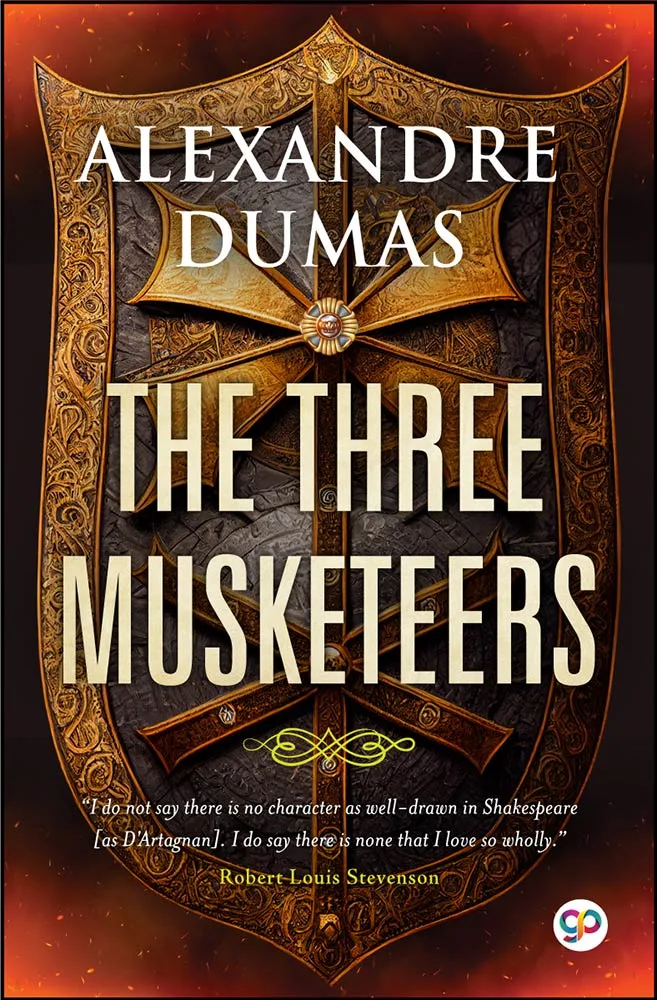
Download Cover Image
Do you want to download the full cover image for The Three Musketeers?