
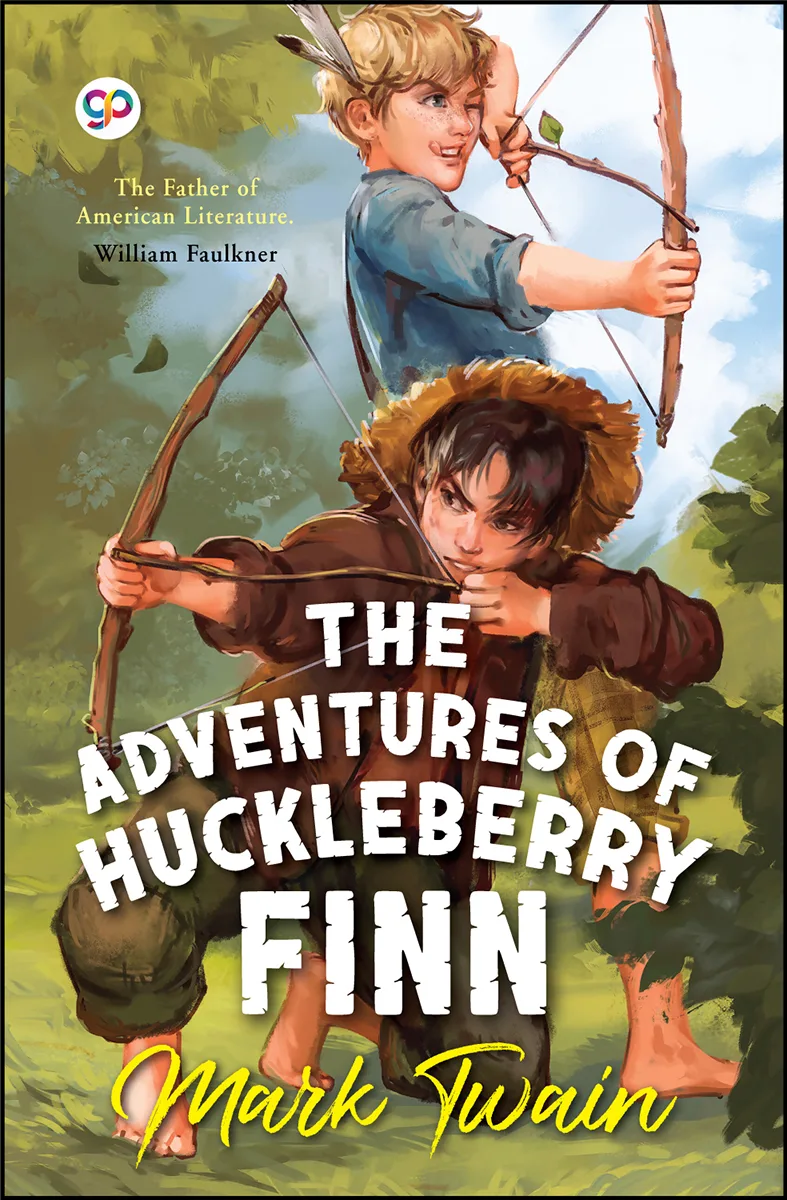
The Adventures of Huckleberry Finn
Paperback
• 352 Pages
• INR 450.00
• English
• 9789354999611
No ratings yet
| Publisher | General Press |
|---|---|
| ISBN13 | 9789354999611 |
| ASIN/SKU | 9354999611 |
| Book Format | Paperback |
| Language | English |
| Pages | 352 |
| List Price | INR 450.00 |
| Subject Code | JUV001000, FIC004000, FIC084020 |
| Dimensions | 8.25 x 5.25 x 1.0 inches |
| Book Code | BD00067900 |
Buy this Book
Amazon Stores
Ebook Stores
Other Stores
Discover The Adventures of Huckleberry Finn by Mark Twain. This book is published by General Press in Paperback format, ISBN 9789354999611, ASIN 9354999611, under Literature and Fiction, Action and Adventure, American Classics.
Book Description
The American novel ‘The Adventures of Huckleberry Finn’ is Mark Twain's masterwork. In this timeless story of childhood exploration, Huckleberry Finn, Tom Sawyer's closest friend, takes center stage. Huck and Jim, a fugitive slave, float a log raft down the massive Mississippi River in order to escape their alcoholic father and the Widow Douglas's enlightening influence. The two escapees become closer as a result of the interesting people and exciting circumstances they come across, such as a pair of aristocratic conmen intent on robbing Arkansas blind and vicious thieves hiding in an abandoned steamboat, until Huck is forced to decide between Jim's freedom and his own salvation.
It is one of the first significant books published in the American vernacular, and is fundamental to the identity of the country. It is still relevant today because of its nuanced handling of weighty subjects like the ills of slavery, the individual versus society, and the competing drives of human nature.
It is one of the first significant books published in the American vernacular, and is fundamental to the identity of the country. It is still relevant today because of its nuanced handling of weighty subjects like the ills of slavery, the individual versus society, and the competing drives of human nature.
Author Biography
Born Samuel Langhorne Clemens in 1835 in Florida, Missouri, Mark Twain was raised in the bustling river town of Hannibal. The mighty Mississippi River deeply shaped his youth and imagination. After his father's death, he left school at twelve to work as a printer's apprentice, igniting his lifelong connection to publishing. He later fulfilled a childhood dream by becoming a Mississippi steamboat pilot, a profession that provided his famous pen name—a river term indicating a safe depth of two fathoms.
The outbreak of the Civil War in 1861 halted commercial river traffic, prompting Twain to travel west to Nevada in search of silver. When mining proved unsuccessful, he pivoted to journalism. Working as a reporter in Virginia City and San Francisco, he honed his distinctive literary voice: a blend of biting satire, irreverent humor, and keen social observation. In 1865, his humorous short story "The Celebrated Jumping Frog of Calaveras County" became a massive success, catapulting him to national fame.
Settling in Hartford, Connecticut, Twain entered his most prolific creative period. Drawing heavily upon his idyllic boyhood memories, he published The Adventures of Tom Sawyer in 1876. He followed this with his undisputed masterpiece, Adventures of Huckleberry Finn, in 1884. Often celebrated as the Great American Novel, the book revolutionized the country's literature through its pioneering use of colloquial speech and its profound, uncompromising indictment of institutionalized slavery and Southern hypocrisy.
Despite achieving unprecedented international acclaim, Twain's final decades were marred by severe financial instability from failed entrepreneurial investments and profound personal grief, including the deaths of his wife and three of his four children. Consequently, his later writings adopted a noticeably darker, more cynical tone that reflected his growing disillusionment with human nature. He passed away in 1910 at the age of seventy-four, leaving behind an enduring legacy as America's premier humorist and a towering architect of modern American literature.
The outbreak of the Civil War in 1861 halted commercial river traffic, prompting Twain to travel west to Nevada in search of silver. When mining proved unsuccessful, he pivoted to journalism. Working as a reporter in Virginia City and San Francisco, he honed his distinctive literary voice: a blend of biting satire, irreverent humor, and keen social observation. In 1865, his humorous short story "The Celebrated Jumping Frog of Calaveras County" became a massive success, catapulting him to national fame.
Settling in Hartford, Connecticut, Twain entered his most prolific creative period. Drawing heavily upon his idyllic boyhood memories, he published The Adventures of Tom Sawyer in 1876. He followed this with his undisputed masterpiece, Adventures of Huckleberry Finn, in 1884. Often celebrated as the Great American Novel, the book revolutionized the country's literature through its pioneering use of colloquial speech and its profound, uncompromising indictment of institutionalized slavery and Southern hypocrisy.
Despite achieving unprecedented international acclaim, Twain's final decades were marred by severe financial instability from failed entrepreneurial investments and profound personal grief, including the deaths of his wife and three of his four children. Consequently, his later writings adopted a noticeably darker, more cynical tone that reflected his growing disillusionment with human nature. He passed away in 1910 at the age of seventy-four, leaving behind an enduring legacy as America's premier humorist and a towering architect of modern American literature.
Editorial Reviews
Editorial Reviews will be added soon…
Book Summary
The Adventures of Huckleberry Finn by Mark Twain is one of the most important and widely discussed novels in American literature. First published in 1884–1885, the novel follows Huckleberry Finn, a poor, independent-minded boy who escapes his abusive father and travels down the Mississippi River with Jim, an enslaved man who is running away in search of freedom. Although the story is filled with adventure, humor, deception, danger, and memorable characters, its deeper subject is the development of Huck’s moral understanding. Through his journey, Huck gradually learns to question the values taught by the society around him, particularly the assumptions surrounding slavery, race, religion, respectability, and “civilization.” Project Gutenberg classifies the novel among adventure stories, Bildungsromans, humorous fiction, stories about boys and friendship, and works concerning race relations, fugitive slaves, and the Mississippi River.
The novel is narrated by Huck himself, and this first-person perspective is one of Mark Twain’s greatest achievements. Huck speaks in the language and dialect of the world in which he has grown up rather than in polished literary English. Twain deliberately uses several regional dialects to make the voices of his characters sound authentic. Because Huck is young, poorly educated, and unfamiliar with formal social conventions, he often describes complicated events in remarkably simple language. This creates much of the novel’s humor, but it also allows Twain to expose the contradictions of society through the eyes of someone who does not always understand why adults believe the things they believe.
At the beginning of the novel, Huck is living with the Widow Douglas and Miss Watson, who are trying to “civilize” him. They want him to wear respectable clothes, attend school, behave properly, and accept religious and social rules. Huck does not enjoy this life. He prefers freedom, nature, adventure, and the company of his friend Tom Sawyer. Huck’s discomfort with civilization becomes an important theme throughout the story. He is not naturally rebellious simply for the sake of rebellion; rather, he feels that many of society’s rules are artificial and restrictive. The novel begins with this tension between individual freedom and social expectations.
Huck’s situation becomes more dangerous when his father, Pap, returns. Pap is an abusive, alcoholic man who resents Huck’s education and financial independence. He kidnaps Huck and takes him to a remote cabin, where he keeps him imprisoned. Huck realizes that staying with Pap could eventually destroy him, so he carefully plans an escape. He stages his own death by making it appear that someone has murdered him and then disappears. This escape is one of the first major moments in Huck’s development because he takes control of his own fate instead of waiting for adults to rescue him.
After escaping, Huck hides on Jackson’s Island in the Mississippi River. There he unexpectedly discovers Jim, Miss Watson’s enslaved man, who has also run away. Jim explains that he fled after learning that Miss Watson planned to sell him farther south, where he feared he would be separated permanently from his family. Huck and Jim are now both fugitives, but their situations are profoundly different. Huck is escaping an abusive father and a society he dislikes; Jim is escaping a system that legally treats him as property. Their meeting establishes the central relationship of the novel.
At first, Huck is troubled by the fact that he is helping a runaway slave. The society in which he has been raised has taught him that helping Jim escape is morally wrong. Huck has been taught that slavery is legal and that a person who helps a slave escape is committing a serious offense. Yet his personal relationship with Jim gradually becomes more important to him than the rules he has inherited. Huck sees Jim as a human being, a companion, and eventually a close friend. The great moral conflict of the novel emerges from this contradiction between social morality and personal conscience.
The Mississippi River becomes the physical and symbolic center of the story. Huck and Jim travel by raft, hoping eventually to reach a place where Jim can be free. The river provides them with moments of peace and beauty, but it is also dangerous and unpredictable. On the raft, away from towns and institutions, they experience a temporary freedom from the social structures that control them on land. Their relationship develops naturally because they have to depend on one another. The river becomes almost a separate world in which the usual rules of society are suspended.
One of the most important aspects of Huck and Jim’s friendship is the gradual change in Huck’s perception of Jim. At first Huck sometimes treats Jim as an object of amusement and deliberately plays tricks on him. Yet Jim repeatedly demonstrates intelligence, loyalty, affection, courage, and emotional depth. Huck eventually recognizes that Jim is not fundamentally different from himself. Jim worries about his family, fears losing the people he loves, remembers his children, and dreams of freedom. Through these experiences, Huck’s inherited assumptions about race begin to collapse.
The journey is interrupted by a series of encounters that expose the dishonesty and cruelty of the wider society. Huck and Jim meet two traveling con men known as the Duke and the King. These men falsely claim noble identities and use deception to exploit ordinary people. They perform fraudulent schemes, manipulate emotions, and take advantage of communities wherever they go. Their behavior becomes another example of the hypocrisy Twain sees in respectable society. People who claim authority and social status are not necessarily moral, while those whom society labels as criminals or outsiders may possess greater humanity.
The Duke and the King eventually involve Huck and Jim in increasingly dangerous schemes. Their performances lead to the famous episode involving the Wilks family, in which the two con men pretend to be the brothers of a recently deceased man in order to steal his inheritance. Huck becomes uncomfortable with their cruelty and decides to help Mary Jane Wilks discover the truth. This episode demonstrates that Huck’s moral instincts are developing. He still does not possess a complete philosophical understanding of justice, but he increasingly recognizes when someone is being exploited.
Another memorable section involves the Grangerford and Shepherdson families, two wealthy families locked in a generations-long feud. Huck is welcomed by the Grangerfords and initially admires their manners, possessions, and apparent respectability. Yet he gradually discovers that they are involved in a violent cycle of revenge with the Shepherdsons. Members of both families attend church while carrying weapons, and the feud continues despite the fact that neither side can remember its original cause clearly. Twain uses this episode to expose the absurdity of social traditions that are accepted simply because they have existed for a long time.
The Grangerford episode becomes tragic when several family members are killed. Huck witnesses the consequences of hatred disguised as honor. This experience reinforces one of the novel’s central lessons: civilized appearance does not guarantee civilized behavior. People may speak politely, attend church, wear fine clothes, and follow social customs while committing terrible acts. Twain repeatedly turns this contradiction into satire, asking readers to consider whether society’s definition of respectability has anything to do with genuine morality.
Huck’s moral struggle becomes especially intense when he and Jim approach Cairo, where Jim hopes to escape into free territory. Huck knows that helping Jim escape violates everything he has been taught about slavery. He becomes convinced that he has done something morally wrong and even decides to write a letter informing Miss Watson where Jim is. However, when he thinks about Jim’s friendship and remembers the experiences they have shared, he cannot send the letter. He tears it up and chooses Jim instead. This is the decisive moral moment of Huck’s journey.
Huck’s decision is significant because he believes he is doing something wrong according to the moral standards of his society. He has been taught that helping Jim escape will send him to hell. Yet Huck chooses to accept that supposed punishment rather than betray his friend. In one of the novel’s most powerful ironies, Huck believes he is making a morally bad choice while the reader recognizes that he is making the morally right one. Twain uses this reversal to challenge the legitimacy of a society that defines slavery as lawful and compassion as sinful.
The journey continues through further deception and violence. Eventually the Duke and King sell Jim to the Phelps family, claiming that he is a runaway slave. Huck is devastated because Jim has become more than a traveling companion; he has become a member of Huck’s chosen family. Huck decides that he must rescue him. His decision demonstrates how far he has traveled morally. At the beginning of the novel, Huck was uncertain whether helping Jim was wrong. By this stage, he no longer seriously questions whether Jim deserves freedom.
The final section introduces Tom Sawyer, who arrives and becomes involved in the rescue plan. Tom knows that Jim is already legally free because Miss Watson has died and her will has freed him, but he does not tell Huck or the others. Instead, Tom turns the rescue into an elaborate adventure filled with unnecessary complications, secret messages, tunnels, ropes, and invented dangers. The contrast between Huck’s practical approach and Tom’s romantic imagination is both comic and revealing. Huck wants to get Jim out safely; Tom wants to create an exciting story.
The ending has therefore been one of the most debated parts of the novel. Jim suffers unnecessary risks because Tom insists on treating the escape as an adventure rather than a straightforward rescue. Nevertheless, Jim demonstrates remarkable patience, generosity, and concern for others. When Tom is wounded during the escape, Jim refuses to leave him behind even though doing so could jeopardize Jim’s own freedom. Jim’s compassion ultimately exposes the moral limitations of the supposedly “civilized” people around him.
Tom finally reveals that Jim has actually been free since Miss Watson’s death. The complicated escape was therefore unnecessary from a practical standpoint. Miss Watson had freed Jim in her will after regretting her earlier decision to sell him. Tom also brings news that Huck’s father has died, meaning Huck is finally free from the threat of Pap. Jim’s freedom and Huck’s freedom thus become connected. Both characters have escaped forms of captivity, although Jim’s experience has been far more dangerous and brutal.
Huck’s development is the heart of The Adventures of Huckleberry Finn. At the beginning, he accepts many of society’s assumptions without examining them. He thinks slavery is wrong only in the sense that he is breaking the law by helping Jim. Gradually, however, personal experience teaches him that the social rules he has been given are not necessarily moral. Jim’s humanity becomes undeniable, and Huck begins to trust his own conscience. His moral education occurs not in school or church but through friendship, suffering, observation, and personal responsibility.
The theme of freedom runs through the entire novel. Huck wants freedom from civilization, Pap, and social expectations, while Jim wants freedom from slavery and the possibility of being separated from his family. The Mississippi River represents a temporary space where both can experience independence. Yet Twain makes it clear that freedom is fragile. The river can carry Huck and Jim toward safety, but the institutions and people on shore continually threaten them. Freedom is therefore not simply a physical destination; it is a moral and psychological condition.
Race and slavery are at the center of the novel’s historical and moral complexity. Twain wrote about a society in which slavery had been deeply embedded in law, economics, religion, and everyday life. The novel exposes the contradiction between claims of Christian civilization and the treatment of Black people as property. Jim is one of the novel’s most sympathetic figures, particularly in his devotion to his family and his concern for Huck. At the same time, modern readers and scholars have rightly debated the novel’s racial language, stereotypes, and comic treatment of Jim. The work can therefore be both a powerful critique of racism and a text whose representation of race requires careful, critical reading.
Another major theme is the meaning of civilization. Twain repeatedly asks whether the people who consider themselves civilized actually behave more morally than those they judge as uncivilized. Huck is considered a troublesome boy because he refuses to conform, while supposedly respectable adults lie, exploit others, participate in violence, and defend slavery. Jim, meanwhile, is legally treated as property but repeatedly acts with kindness and courage. Twain turns conventional definitions upside down. The novel suggests that genuine civilization should be measured by compassion and moral courage rather than manners, wealth, education, or social position.
The novel is also a coming-of-age story, or Bildungsroman, because Huck’s journey changes the way he understands himself and the world. His growth is not smooth or complete. He continues to make mistakes, misunderstand situations, and imitate the behavior of people around him. Yet his experience with Jim permanently changes his moral perspective. He learns that conscience can conflict with social rules and that doing the right thing may require rejecting what everyone else considers respectable.
Ultimately, The Adventures of Huckleberry Finn is much more than an adventure story about a boy traveling down the Mississippi River. It is a powerful exploration of friendship, freedom, conscience, race, hypocrisy, identity, and moral growth. Mark Twain uses Huck’s innocent voice to reveal the contradictions of American society and to show how difficult it can be for an individual to recognize injustice when that injustice has been presented as normal. The river provides the setting for adventure, but the real journey is Huck’s movement from inherited prejudice toward personal moral awareness.
For readers searching for a The Adventures of Huckleberry Finn summary, analysis, themes, characters, or explanation, the central message is found in Huck’s relationship with Jim. Huck begins the novel believing that society knows what is right. By the end, he has learned that society itself can be deeply wrong. His friendship with Jim teaches him to value a human being above a social rule, even when he does not have the language or intellectual framework to explain exactly why. That is what makes Huck’s journey so enduring. Twain presents moral growth not as the memorization of rules but as the difficult process of seeing another person fully, questioning inherited beliefs, and finding the courage to act according to one’s conscience. The novel remains a landmark of American literature because its questions about freedom, prejudice, social conformity, and individual morality continue to challenge readers long after Huck and Jim disappear around the bend of the Mississippi River.
The novel is narrated by Huck himself, and this first-person perspective is one of Mark Twain’s greatest achievements. Huck speaks in the language and dialect of the world in which he has grown up rather than in polished literary English. Twain deliberately uses several regional dialects to make the voices of his characters sound authentic. Because Huck is young, poorly educated, and unfamiliar with formal social conventions, he often describes complicated events in remarkably simple language. This creates much of the novel’s humor, but it also allows Twain to expose the contradictions of society through the eyes of someone who does not always understand why adults believe the things they believe.
At the beginning of the novel, Huck is living with the Widow Douglas and Miss Watson, who are trying to “civilize” him. They want him to wear respectable clothes, attend school, behave properly, and accept religious and social rules. Huck does not enjoy this life. He prefers freedom, nature, adventure, and the company of his friend Tom Sawyer. Huck’s discomfort with civilization becomes an important theme throughout the story. He is not naturally rebellious simply for the sake of rebellion; rather, he feels that many of society’s rules are artificial and restrictive. The novel begins with this tension between individual freedom and social expectations.
Huck’s situation becomes more dangerous when his father, Pap, returns. Pap is an abusive, alcoholic man who resents Huck’s education and financial independence. He kidnaps Huck and takes him to a remote cabin, where he keeps him imprisoned. Huck realizes that staying with Pap could eventually destroy him, so he carefully plans an escape. He stages his own death by making it appear that someone has murdered him and then disappears. This escape is one of the first major moments in Huck’s development because he takes control of his own fate instead of waiting for adults to rescue him.
After escaping, Huck hides on Jackson’s Island in the Mississippi River. There he unexpectedly discovers Jim, Miss Watson’s enslaved man, who has also run away. Jim explains that he fled after learning that Miss Watson planned to sell him farther south, where he feared he would be separated permanently from his family. Huck and Jim are now both fugitives, but their situations are profoundly different. Huck is escaping an abusive father and a society he dislikes; Jim is escaping a system that legally treats him as property. Their meeting establishes the central relationship of the novel.
At first, Huck is troubled by the fact that he is helping a runaway slave. The society in which he has been raised has taught him that helping Jim escape is morally wrong. Huck has been taught that slavery is legal and that a person who helps a slave escape is committing a serious offense. Yet his personal relationship with Jim gradually becomes more important to him than the rules he has inherited. Huck sees Jim as a human being, a companion, and eventually a close friend. The great moral conflict of the novel emerges from this contradiction between social morality and personal conscience.
The Mississippi River becomes the physical and symbolic center of the story. Huck and Jim travel by raft, hoping eventually to reach a place where Jim can be free. The river provides them with moments of peace and beauty, but it is also dangerous and unpredictable. On the raft, away from towns and institutions, they experience a temporary freedom from the social structures that control them on land. Their relationship develops naturally because they have to depend on one another. The river becomes almost a separate world in which the usual rules of society are suspended.
One of the most important aspects of Huck and Jim’s friendship is the gradual change in Huck’s perception of Jim. At first Huck sometimes treats Jim as an object of amusement and deliberately plays tricks on him. Yet Jim repeatedly demonstrates intelligence, loyalty, affection, courage, and emotional depth. Huck eventually recognizes that Jim is not fundamentally different from himself. Jim worries about his family, fears losing the people he loves, remembers his children, and dreams of freedom. Through these experiences, Huck’s inherited assumptions about race begin to collapse.
The journey is interrupted by a series of encounters that expose the dishonesty and cruelty of the wider society. Huck and Jim meet two traveling con men known as the Duke and the King. These men falsely claim noble identities and use deception to exploit ordinary people. They perform fraudulent schemes, manipulate emotions, and take advantage of communities wherever they go. Their behavior becomes another example of the hypocrisy Twain sees in respectable society. People who claim authority and social status are not necessarily moral, while those whom society labels as criminals or outsiders may possess greater humanity.
The Duke and the King eventually involve Huck and Jim in increasingly dangerous schemes. Their performances lead to the famous episode involving the Wilks family, in which the two con men pretend to be the brothers of a recently deceased man in order to steal his inheritance. Huck becomes uncomfortable with their cruelty and decides to help Mary Jane Wilks discover the truth. This episode demonstrates that Huck’s moral instincts are developing. He still does not possess a complete philosophical understanding of justice, but he increasingly recognizes when someone is being exploited.
Another memorable section involves the Grangerford and Shepherdson families, two wealthy families locked in a generations-long feud. Huck is welcomed by the Grangerfords and initially admires their manners, possessions, and apparent respectability. Yet he gradually discovers that they are involved in a violent cycle of revenge with the Shepherdsons. Members of both families attend church while carrying weapons, and the feud continues despite the fact that neither side can remember its original cause clearly. Twain uses this episode to expose the absurdity of social traditions that are accepted simply because they have existed for a long time.
The Grangerford episode becomes tragic when several family members are killed. Huck witnesses the consequences of hatred disguised as honor. This experience reinforces one of the novel’s central lessons: civilized appearance does not guarantee civilized behavior. People may speak politely, attend church, wear fine clothes, and follow social customs while committing terrible acts. Twain repeatedly turns this contradiction into satire, asking readers to consider whether society’s definition of respectability has anything to do with genuine morality.
Huck’s moral struggle becomes especially intense when he and Jim approach Cairo, where Jim hopes to escape into free territory. Huck knows that helping Jim escape violates everything he has been taught about slavery. He becomes convinced that he has done something morally wrong and even decides to write a letter informing Miss Watson where Jim is. However, when he thinks about Jim’s friendship and remembers the experiences they have shared, he cannot send the letter. He tears it up and chooses Jim instead. This is the decisive moral moment of Huck’s journey.
Huck’s decision is significant because he believes he is doing something wrong according to the moral standards of his society. He has been taught that helping Jim escape will send him to hell. Yet Huck chooses to accept that supposed punishment rather than betray his friend. In one of the novel’s most powerful ironies, Huck believes he is making a morally bad choice while the reader recognizes that he is making the morally right one. Twain uses this reversal to challenge the legitimacy of a society that defines slavery as lawful and compassion as sinful.
The journey continues through further deception and violence. Eventually the Duke and King sell Jim to the Phelps family, claiming that he is a runaway slave. Huck is devastated because Jim has become more than a traveling companion; he has become a member of Huck’s chosen family. Huck decides that he must rescue him. His decision demonstrates how far he has traveled morally. At the beginning of the novel, Huck was uncertain whether helping Jim was wrong. By this stage, he no longer seriously questions whether Jim deserves freedom.
The final section introduces Tom Sawyer, who arrives and becomes involved in the rescue plan. Tom knows that Jim is already legally free because Miss Watson has died and her will has freed him, but he does not tell Huck or the others. Instead, Tom turns the rescue into an elaborate adventure filled with unnecessary complications, secret messages, tunnels, ropes, and invented dangers. The contrast between Huck’s practical approach and Tom’s romantic imagination is both comic and revealing. Huck wants to get Jim out safely; Tom wants to create an exciting story.
The ending has therefore been one of the most debated parts of the novel. Jim suffers unnecessary risks because Tom insists on treating the escape as an adventure rather than a straightforward rescue. Nevertheless, Jim demonstrates remarkable patience, generosity, and concern for others. When Tom is wounded during the escape, Jim refuses to leave him behind even though doing so could jeopardize Jim’s own freedom. Jim’s compassion ultimately exposes the moral limitations of the supposedly “civilized” people around him.
Tom finally reveals that Jim has actually been free since Miss Watson’s death. The complicated escape was therefore unnecessary from a practical standpoint. Miss Watson had freed Jim in her will after regretting her earlier decision to sell him. Tom also brings news that Huck’s father has died, meaning Huck is finally free from the threat of Pap. Jim’s freedom and Huck’s freedom thus become connected. Both characters have escaped forms of captivity, although Jim’s experience has been far more dangerous and brutal.
Huck’s development is the heart of The Adventures of Huckleberry Finn. At the beginning, he accepts many of society’s assumptions without examining them. He thinks slavery is wrong only in the sense that he is breaking the law by helping Jim. Gradually, however, personal experience teaches him that the social rules he has been given are not necessarily moral. Jim’s humanity becomes undeniable, and Huck begins to trust his own conscience. His moral education occurs not in school or church but through friendship, suffering, observation, and personal responsibility.
The theme of freedom runs through the entire novel. Huck wants freedom from civilization, Pap, and social expectations, while Jim wants freedom from slavery and the possibility of being separated from his family. The Mississippi River represents a temporary space where both can experience independence. Yet Twain makes it clear that freedom is fragile. The river can carry Huck and Jim toward safety, but the institutions and people on shore continually threaten them. Freedom is therefore not simply a physical destination; it is a moral and psychological condition.
Race and slavery are at the center of the novel’s historical and moral complexity. Twain wrote about a society in which slavery had been deeply embedded in law, economics, religion, and everyday life. The novel exposes the contradiction between claims of Christian civilization and the treatment of Black people as property. Jim is one of the novel’s most sympathetic figures, particularly in his devotion to his family and his concern for Huck. At the same time, modern readers and scholars have rightly debated the novel’s racial language, stereotypes, and comic treatment of Jim. The work can therefore be both a powerful critique of racism and a text whose representation of race requires careful, critical reading.
Another major theme is the meaning of civilization. Twain repeatedly asks whether the people who consider themselves civilized actually behave more morally than those they judge as uncivilized. Huck is considered a troublesome boy because he refuses to conform, while supposedly respectable adults lie, exploit others, participate in violence, and defend slavery. Jim, meanwhile, is legally treated as property but repeatedly acts with kindness and courage. Twain turns conventional definitions upside down. The novel suggests that genuine civilization should be measured by compassion and moral courage rather than manners, wealth, education, or social position.
The novel is also a coming-of-age story, or Bildungsroman, because Huck’s journey changes the way he understands himself and the world. His growth is not smooth or complete. He continues to make mistakes, misunderstand situations, and imitate the behavior of people around him. Yet his experience with Jim permanently changes his moral perspective. He learns that conscience can conflict with social rules and that doing the right thing may require rejecting what everyone else considers respectable.
Ultimately, The Adventures of Huckleberry Finn is much more than an adventure story about a boy traveling down the Mississippi River. It is a powerful exploration of friendship, freedom, conscience, race, hypocrisy, identity, and moral growth. Mark Twain uses Huck’s innocent voice to reveal the contradictions of American society and to show how difficult it can be for an individual to recognize injustice when that injustice has been presented as normal. The river provides the setting for adventure, but the real journey is Huck’s movement from inherited prejudice toward personal moral awareness.
For readers searching for a The Adventures of Huckleberry Finn summary, analysis, themes, characters, or explanation, the central message is found in Huck’s relationship with Jim. Huck begins the novel believing that society knows what is right. By the end, he has learned that society itself can be deeply wrong. His friendship with Jim teaches him to value a human being above a social rule, even when he does not have the language or intellectual framework to explain exactly why. That is what makes Huck’s journey so enduring. Twain presents moral growth not as the memorization of rules but as the difficult process of seeing another person fully, questioning inherited beliefs, and finding the courage to act according to one’s conscience. The novel remains a landmark of American literature because its questions about freedom, prejudice, social conformity, and individual morality continue to challenge readers long after Huck and Jim disappear around the bend of the Mississippi River.
Sample Chapters
Sample Chapters will be added soon…
Reader Reviews
No reviews yet.
The Adventures of Huckleberry Finn
Download Cover Image
Do you want to download the full cover image for The Adventures of Huckleberry Finn?