
Commandant of Auschwitz: The Autobiography of Rudolf Hoess
Hardcover
• 304 Pages
• INR 475.00
• English
• 9789354999703
No ratings yet
| Publisher | General Press |
|---|---|
| ISBN13 | 9789354999703 |
| ASIN/SKU | 9354999700 |
| Book Format | Hardcover |
| Language | English |
| Pages | 304 |
| List Price | INR 475.00 |
| Subject Code | BIO026000, BIO024000, HIS027100 |
| Dimensions | 8.25 x 5.25 x 1.0 inches |
| Book Code | BD00067908 |
Buy this Book
Amazon Stores
Ebook Stores
Other Stores
Discover Commandant of Auschwitz: The Autobiography of Rudolf Hoess by Rudolf Hoess. This book is published by General Press in Hardcover format, ISBN 9789354999703, ASIN 9354999700, under Biographies and Memoirs, Organized Crime True Accounts, Memoirs.
Book Description
Written in a Polish prison cell before his execution, 'Commandant of Auschwitz' is the chilling autobiography of Rudolf Höss, the man who engineered the Holocaust’s deadliest extermination camp. It is a profoundly unsettling book, not because it is filled with manic hatred, but because it is written with the cold, bureaucratic detachment of a middle manager merely doing his job.
Höss traces his life from a strict, devoutly religious childhood to his rapid rise within the SS. The heart of the memoir details his tenure at Auschwitz, where he methodically designed the mechanics of mass murder. In staggering, lucid detail, he describes the logistical challenges of the gas chambers as mere problem-solving exercises. What makes this account so harrowing is Höss’s terrifying ability to compartmentalize his life. He genuinely viewed himself as a dutiful officer, a burdened patriot, and a loving father who would return home to his children just steps away from the crematoria.
This memoir offers a stark, indispensable glimpse into the true nature of the "banality of evil." Höss never expresses profound moral remorse; his regrets are almost entirely administrative. By stripping away the caricature of a raging monster, the autobiography forces the reader to confront a far more terrifying reality: that some of history's greatest atrocities were orchestrated by ordinary humans who completely surrendered their moral compass to blind obedience. Ultimately, it stands as a grim, vital warning about the absolute necessity of preserving our empathy.
Höss traces his life from a strict, devoutly religious childhood to his rapid rise within the SS. The heart of the memoir details his tenure at Auschwitz, where he methodically designed the mechanics of mass murder. In staggering, lucid detail, he describes the logistical challenges of the gas chambers as mere problem-solving exercises. What makes this account so harrowing is Höss’s terrifying ability to compartmentalize his life. He genuinely viewed himself as a dutiful officer, a burdened patriot, and a loving father who would return home to his children just steps away from the crematoria.
This memoir offers a stark, indispensable glimpse into the true nature of the "banality of evil." Höss never expresses profound moral remorse; his regrets are almost entirely administrative. By stripping away the caricature of a raging monster, the autobiography forces the reader to confront a far more terrifying reality: that some of history's greatest atrocities were orchestrated by ordinary humans who completely surrendered their moral compass to blind obedience. Ultimately, it stands as a grim, vital warning about the absolute necessity of preserving our empathy.
Author Biography
Rudolf Franz Ferdinand Höss (also spelled Höß and Hoess; 1900/1901 – 16 April 1947) was an SS-Obersturmbannführer (Lieutenant Colonel), and from 4 May 1940 to November 1943 the first commandant of Auschwitz concentration camp. Höss joined the Nazi Party in 1922 and the SS in 1934. He was hanged in 1947 following his trial.
Editorial Reviews
Editorial Reviews will be added soon…
Book Summary
"Commandant of Auschwitz" by Rudolf Höss is arguably one of the most chilling and disturbing memoirs ever published, precisely because of the mundane, bureaucratic tone in which it is written. Penned in 1946 while Höss was in a Polish prison awaiting trial and eventual execution for his crimes, the autobiography offers an unprecedented look into the mind of one of history's greatest mass murderers. Unlike the rantings of a deranged psychopath, Höss's narrative is orderly, self-pitying, and terrifyingly ordinary. He does not write as a cartoonish villain reveling in bloodshed, but rather as an overwhelmed middle manager tasked with a horrific logistical problem. This deeply unsettling perspective forces the reader to confront the reality that the Holocaust was perpetrated not just by sadistic monsters, but by organized, obedient functionaries who viewed mass murder as a professional duty.
The roots of Höss’s psychological conditioning begin in his childhood, which he describes in meticulous detail. Raised in a fiercely strict and devoutly Catholic household, his father intended for him to become a priest. From his earliest years, Höss was drilled in the virtues of unquestioning obedience, duty, and submission to authority. He was taught that rules were absolute and that questioning a superior was a fundamental sin. This rigid, unforgiving moral framework stripped him of independent ethical judgment. When he later abandoned his religious faith, the psychological architecture of blind obedience remained completely intact. He simply replaced the authority of the Church with the authority of the State, and eventually, the absolute authority of the Nazi Party and the SS.
Höss’s transition into a hardened nationalist was accelerated by the trauma of the First World War. Volunteering at an unusually young age, he saw intense combat in the Middle East and was deeply brutalized by the experience of war. Returning to a defeated, economically shattered, and politically humiliated Germany, he found himself adrift. Like many disillusioned veterans, he joined the Freikorps—paramilitary groups that engaged in brutal, extrajudicial street violence against communists and political enemies. His radicalization culminated in a violent political assassination, for which he was sentenced to a lengthy prison term. It was during this period of imprisonment and subsequent release that he was drawn into the orbit of Adolf Hitler, finding a new sense of belonging and violent purpose in the nascent Nazi movement.
His entry into the SS and the concentration camp system marked the final stage of his desensitization to human suffering. Mentored by Theodor Eicke, the brutal architect of the Dachau concentration camp, Höss was systematically trained to eradicate any lingering feelings of pity or empathy. Eicke hammered into his subordinates that the enemies of the state—whether political dissidents, Jews, or social outcasts—deserved no mercy. Under this tutelage, Höss learned to view cruelty not as a vice, but as a necessary, professional hardness. He moved up the ranks through Dachau and Sachsenhausen, earning a reputation as an efficient, incorruptible, and flawlessly obedient officer who would execute any order without a moment's hesitation.
This reputation for blind efficiency led to his defining assignment: in 1940, Heinrich Himmler ordered Höss to establish a new concentration camp in a malaria-infested region of occupied Poland, near the town of Oświęcim. Auschwitz was born out of dilapidated cavalry barracks, and Höss describes the early days of the camp with the exasperated tone of a project manager dealing with supply chain issues. He complains endlessly about the lack of building materials, the incompetence of his subordinates, and the sprawling diseases that decimated both inmates and guards. The staggering suffering of the prisoners is treated merely as a bureaucratic nuisance. His entire focus was fixed upward, obsessively determined to prove his worth by fulfilling Himmler’s constantly expanding visions for the camp, regardless of the human cost.
The darkest turning point in the memoir occurs in the summer of 1941, when Himmler summons Höss to Berlin for a private, highly classified meeting. It is here that Himmler informs him that Hitler has ordered the "Final Solution to the Jewish Question," and that Auschwitz, due to its strategic railway connections, has been chosen as a primary site for mass extermination. Höss receives this incomprehensibly evil order without a single moral objection. Instead, his narrative immediately pivots to the logistical difficulties of the task. The transition of Auschwitz from a brutal penal and labor camp into an industrialized factory of death is described with terrifying detachment. Millions of lives were suddenly reduced to raw materials in a sprawling machinery of destruction.
Höss devotes significant portions of his writing to detailing the mechanics of mass murder, speaking of it in terms of capacity, flow, and efficiency. He recounts the "discovery" and initial testing of Zyklon B—a hydrogen cyanide pesticide—on Soviet prisoners of war, expressing a chilling sense of relief that a highly efficient killing method had been found to replace the psychological toll that mass shootings took on his SS men. He oversaw the design and construction of the massive crematoria complexes in Birkenau, built to look like bathhouses to deceive the victims until the very last moment. Höss’s primary anxieties were never about the innocent families being gassed, but rather about whether the ovens could burn the bodies fast enough to keep up with the incoming train transports.
Perhaps the most surreal and revolting aspect of the autobiography is Höss’s description of his idyllic family life, which played out merely yards away from the smoking chimneys of the crematoria. He lived in a comfortable villa just outside the camp perimeter with his wife and five children. He writes affectionately of playing with his kids, riding horses, and reading them fairy tales, completely compartmentalizing the fact that he was simultaneously orchestrating the murder of thousands of other children every single day. This cognitive dissonance is breathtaking. He viewed himself as a loving father and a decent man who was simply carrying out a terribly difficult, unsavory job for the good of his nation. He lacked overt, chaotic sadism; his evil was entirely administrative, orderly, and domestic.
In the end, Rudolf Höss goes to his execution without a shred of true moral awakening or profound remorse. While he eventually acknowledges that the extermination of the Jews was a mistake because it failed to serve Germany's strategic interests and ultimately brought ruin upon the nation, he never truly reckons with the sheer humanity of his victims. He remains trapped in his own self-pity, viewing himself as a misunderstood soldier who was betrayed by his superiors and overwhelmed by impossible orders. "Commandant of Auschwitz" remains an essential, if deeply disturbing, historical document. It serves as a permanent, terrifying testament to the "banality of evil," proving that unimaginable atrocities do not require legions of monsters, but merely a system of ordinary men who have surrendered their conscience to unquestioning obedience.
The roots of Höss’s psychological conditioning begin in his childhood, which he describes in meticulous detail. Raised in a fiercely strict and devoutly Catholic household, his father intended for him to become a priest. From his earliest years, Höss was drilled in the virtues of unquestioning obedience, duty, and submission to authority. He was taught that rules were absolute and that questioning a superior was a fundamental sin. This rigid, unforgiving moral framework stripped him of independent ethical judgment. When he later abandoned his religious faith, the psychological architecture of blind obedience remained completely intact. He simply replaced the authority of the Church with the authority of the State, and eventually, the absolute authority of the Nazi Party and the SS.
Höss’s transition into a hardened nationalist was accelerated by the trauma of the First World War. Volunteering at an unusually young age, he saw intense combat in the Middle East and was deeply brutalized by the experience of war. Returning to a defeated, economically shattered, and politically humiliated Germany, he found himself adrift. Like many disillusioned veterans, he joined the Freikorps—paramilitary groups that engaged in brutal, extrajudicial street violence against communists and political enemies. His radicalization culminated in a violent political assassination, for which he was sentenced to a lengthy prison term. It was during this period of imprisonment and subsequent release that he was drawn into the orbit of Adolf Hitler, finding a new sense of belonging and violent purpose in the nascent Nazi movement.
His entry into the SS and the concentration camp system marked the final stage of his desensitization to human suffering. Mentored by Theodor Eicke, the brutal architect of the Dachau concentration camp, Höss was systematically trained to eradicate any lingering feelings of pity or empathy. Eicke hammered into his subordinates that the enemies of the state—whether political dissidents, Jews, or social outcasts—deserved no mercy. Under this tutelage, Höss learned to view cruelty not as a vice, but as a necessary, professional hardness. He moved up the ranks through Dachau and Sachsenhausen, earning a reputation as an efficient, incorruptible, and flawlessly obedient officer who would execute any order without a moment's hesitation.
This reputation for blind efficiency led to his defining assignment: in 1940, Heinrich Himmler ordered Höss to establish a new concentration camp in a malaria-infested region of occupied Poland, near the town of Oświęcim. Auschwitz was born out of dilapidated cavalry barracks, and Höss describes the early days of the camp with the exasperated tone of a project manager dealing with supply chain issues. He complains endlessly about the lack of building materials, the incompetence of his subordinates, and the sprawling diseases that decimated both inmates and guards. The staggering suffering of the prisoners is treated merely as a bureaucratic nuisance. His entire focus was fixed upward, obsessively determined to prove his worth by fulfilling Himmler’s constantly expanding visions for the camp, regardless of the human cost.
The darkest turning point in the memoir occurs in the summer of 1941, when Himmler summons Höss to Berlin for a private, highly classified meeting. It is here that Himmler informs him that Hitler has ordered the "Final Solution to the Jewish Question," and that Auschwitz, due to its strategic railway connections, has been chosen as a primary site for mass extermination. Höss receives this incomprehensibly evil order without a single moral objection. Instead, his narrative immediately pivots to the logistical difficulties of the task. The transition of Auschwitz from a brutal penal and labor camp into an industrialized factory of death is described with terrifying detachment. Millions of lives were suddenly reduced to raw materials in a sprawling machinery of destruction.
Höss devotes significant portions of his writing to detailing the mechanics of mass murder, speaking of it in terms of capacity, flow, and efficiency. He recounts the "discovery" and initial testing of Zyklon B—a hydrogen cyanide pesticide—on Soviet prisoners of war, expressing a chilling sense of relief that a highly efficient killing method had been found to replace the psychological toll that mass shootings took on his SS men. He oversaw the design and construction of the massive crematoria complexes in Birkenau, built to look like bathhouses to deceive the victims until the very last moment. Höss’s primary anxieties were never about the innocent families being gassed, but rather about whether the ovens could burn the bodies fast enough to keep up with the incoming train transports.
Perhaps the most surreal and revolting aspect of the autobiography is Höss’s description of his idyllic family life, which played out merely yards away from the smoking chimneys of the crematoria. He lived in a comfortable villa just outside the camp perimeter with his wife and five children. He writes affectionately of playing with his kids, riding horses, and reading them fairy tales, completely compartmentalizing the fact that he was simultaneously orchestrating the murder of thousands of other children every single day. This cognitive dissonance is breathtaking. He viewed himself as a loving father and a decent man who was simply carrying out a terribly difficult, unsavory job for the good of his nation. He lacked overt, chaotic sadism; his evil was entirely administrative, orderly, and domestic.
In the end, Rudolf Höss goes to his execution without a shred of true moral awakening or profound remorse. While he eventually acknowledges that the extermination of the Jews was a mistake because it failed to serve Germany's strategic interests and ultimately brought ruin upon the nation, he never truly reckons with the sheer humanity of his victims. He remains trapped in his own self-pity, viewing himself as a misunderstood soldier who was betrayed by his superiors and overwhelmed by impossible orders. "Commandant of Auschwitz" remains an essential, if deeply disturbing, historical document. It serves as a permanent, terrifying testament to the "banality of evil," proving that unimaginable atrocities do not require legions of monsters, but merely a system of ordinary men who have surrendered their conscience to unquestioning obedience.
Sample Chapters
AUTOBIOGRAPHY
In the following pages I want to try and tell the story of my innermost being. I shall attempt to reconstruct from memory a true account of all the important events and occurrences in my life and of the psychological heights and depths through which I have passed.
In order to give as complete a picture as possible, it is essential that I first return to the earliest experiences of my childhood.
Until I was six years old, we lived in the remoter outskirts of Baden, in a neighborhood consisting of scattered and isolated farmhouses. The children in the neighborhood were all much older than I and consequently I had no playmates, and was dependent for companionship on grown-up people. I derived little pleasure from this, and tried, whenever possible, to escape their supervision and go off on voyages of solitary exploration. I was fascinated by the immense woods with their tall. Black Forest pines that began near our house. I never ventured to go far into them, however, never beyond a point where I was able, from the mountain slopes, to keep our own valley in sight. Indeed, I was actually forbidden to go into the forest alone, since when I was younger some traveling gypsies had found me playing by myself and had taken me away with them. I was rescued by a neighboring peasant who happened by chance to meet us on the road and who brought me bade home.
A spot that I found particularly attractive was the large reservoir that supplied the town. For hours on end I would listen to the mysterious whisper of the water behind its thick walls, and could never, despite the explanations of my elders, understand what this was. But most of my time I spent in the farmers’ barns and stables, and when people wished to find me it was always there that they looked for me first. The horses particularly delighted me, and I never tired of stroking them and talking to them and giving them tidbits. If I could lay my hands on a brush or a currycomb, I would at once begin grooming them. In spite of the fanners’ anxiety, I would creep between lie horses’ legs while I brushed them, and never to this day has an animal kicked or bitten me. Even a bad-tempered bull that belonged to one of the farmers was always most friendly toward me. Nor was I ever afraid of dogs and none has ever attacked me. I would immediately forsake even my favorite toy, if I saw a chance to steal away to the stables. My mother did everything possible to wean me of this love of animals, which seemed to her so dangerous, but in vain. I developed into a solitary child, and was never happier than when playing or working alone and unobserved. I could not bear being watched by anybody.
Water, too, had an irresistible attraction for me, and I was perpetually washing and bathing. I used to wash all manner of things in the bath or in the stream that flowed through our garden, and many were the toys or clothes that I ruined in this way. This passion for water remains with me to this day.
When I was six years old we settled in the neighborhood of Mannheim. As before, we lived on the outskirts of the town. But to my great disappointment there were no stables and no cattle. My mother often told me how, for weeks on end, I was almost ill with homesickness for my animals and my hills and forest. My parents did everything in their power at that time to distract me from my exaggerated love of animals. They did not succeed: I found books containing pictures of animals and would hide myself away and dream of my cows and horses. On my seventh birthday I was given Hans, a coal-black pony with sparkling eyes and a long mane. I was almost beside myself with joy. I had a comrade at last. For Hans was the most confiding of creatures, and followed me where-ever I went, like a dog. When my parents were away, I would even take him up to my bedroom. Since I was always on good terms with our servants, they accepted this weakness of mine and never gave me away. I had plenty of playmates of my own age where we now lived. We played the games that children play all over the world, and I took part in many a youthful prank. But my greatest joy was to take my Hans into the great Haardt Forest, where we could be entirely alone together, riding for hour after hour without meeting a soul.
School, and the more serious business of life, had now begun. Nothing happened during these first school years that is of importance to my story. I was a keen student, and used to finish my homework as quickly as possible, so that I might have plenty of free time to wander about with Hans.
My parents let me do more or less as I wished.
My father had taken a vow that I should be a priest, and my future profession was therefore already firmly laid down. I was educated entirely with this end in view. My father brought me up on strict military principles. I was also influenced by the deeply religious atmosphere that pervaded our family life, for my father was a devout Catholic. While we lived at Baden I saw little of my father, since he spent much of his time traveling, and his business sometimes kept him away from home for months at a time. All this changed when we moved to Mannheim. My father now found time almost every day to take an interest in me, either checking my schoolwork or discussing my future profession with me. My greatest joy was to hear him talk of his experiences on active service in East Africa, and to listen to his descriptions of battles against rebellious natives, and his accounts of their lives and customs and sinister idolatries. I listened with passionate enthusiasm when he spoke of the blessed and civilizing activities of the missionaries, and I was determined that I myself should one day be a missionary in the gloomy jungles of darkest Africa. They were red-letter days indeed when we were visited by one of the elderly, bearded African Fathers whom my father had known in East Africa. I did not let one word of the conversation escape me, becoming so absorbed that I even forgot my Hans.
My family entertained a great deal, although they rarely visited other people’s houses. Our guests were mostly priests of every sort.
As the years passed, my father’s religious fervor increased, whenever time permitted, he would take me on pilgrimages to all the holy places in our own country, as well as to Einsiedeln in Switzerland and to Lourdes in France. He prayed passionately that the grace of God might be bestowed on me, so that I might one day become a priest blessed by God. I, too, was as deeply religious as was possible for a boy of my age, and I took my religious duties very seriously. I prayed with true, childlike gravity and performed my duties as acolyte with great earnestness. I had been brought up by my parents to be respectful and obedient toward all grown-up people, and especially the elderly, regardless of their social status. I was taught that my highest duty was to help those in need. It was constantly impressed upon me in forceful terms that I must obey promptly the wishes and commands of my parents, teachers, and priests, and indeed of all grown-up people, including servants, and that nothing must distract me from this duty. Whatever they said was always right.
These basic principles on which I was brought up became part of my flesh and blood. I can still dearly remember how my father, who on account of his fervent Catholicism was a determined opponent of the Reich government and its policy, never ceased to remind his friends that, however strong one’s opposition might be, the laws and decrees of the state had to be obeyed unconditionally.
From my earliest youth I was brought up with a strong awareness of duty. In my parents’ house it was insisted that every task be exactly and conscientiously carried out. Each member of the family had his own special duties to perform. My father took particular care to see that I obeyed all his instructions and wishes with the greatest meticulousness. I remember to this day how he hauled me out of bed one night, because I had left the saddlecloth lying in the garden instead of hanging it up in the bam to dry, as he had told me to do. I had simply forgotten all about it. Again and again he impressed on me how great evils almost always spring from small, apparently insignificant misdeeds. At that time I did not fully understand the meaning of this dictum, hut in later years I was to learn, through bitter experience, the truth of his words.
The relationship between my parents was one of loving respect and mutual understanding. Yet I never remember any display of tenderness; but at the same time I never heard them exchange an angry word. While my two sisters, who were four and six years younger than I, were very affectionate and were always hanging about their mother, I had always, from my earliest years, fought shy of any sign of tenderness, much to the regret of my mother, and of all my aunts and other relatives. A handshake and a few brief words of thanks were the most that could be expected of me.
Although both my parents were devoted to me, I was never able to confide in them the many big and little worries that from time to time beset a child’s heart. I had to work all my problems out, as best I could, for myself. My sole confidant was my pony, and I was certain that he understood me. My two sisters were very attached to me, and were perpetually trying to establish a loving and sisterly relationship. But I never wished to have much to do with them. I shared in their games only when I had to, and then I would nag at them until they ran crying to my mother. Many were the practical jokes that I played on them. But despite all this, their devotion to me remained unchanged and they always regretted, and still do to this day, that I was never able to have any warmer feelings for them. They have always been strangers to me.
I had the greatest respect, however, for both my parents, and looked up to them with veneration. But love, the kind of love that other children have for their parents, which I myself later learned to know, I was never able to give them. Why this should have been I have never understood. Even today I can find no explanation.
I was not particularly well-behaved, and certainly not a model child. I was up to all the tricks normal to a boy of my age. I played pranks with the others and took part in the wildest games and brawls, whenever the opportunity came my way. Although there were always times when I had to be on my own, I had enough friends to play with when I wanted to. I stood no nonsense, and always held my own. If I were the victim of an injustice, I would not test until I considered it avenged. In such matters I was implacably and was held in tenor by my classmates. Incidentally, during the whole of my time at the grammar School I shared a bench with a Swedish girl who wanted to be a doctor. We always remained good friends and never quarreled. It was the custom at our school for the same pupils to share a bench during the whole time they were at school together.
When I was thirteen years old, an incident occurred which I most regard as marking the first shattering of the religious beliefs to which I adhered so firmly.
During one of the usual scuffles that took place at the entrance to the gymnasium, I unintentionally threw one of my classmates downstairs. He broke an ankle as a result. During the years, hundreds of schoolboys must have tumbled down those stairs, I among them, and none had ever been seriously hurt. This particular boy was simply unlucky. I was given three days’ confinement It was a Saturday morning. That afternoon I went to confession as I did every week, and I made a dean breast of this accident. I said nothing about it at home, however, as I did not wish to spoil my parents’ Sunday. They would learn about it soon enough next week. My confessor, who was a good friend of my father’s, had been invited to our house that same evening. Next morning I was taxed by my father concerning the accident, and duly punished because I had not told him about it straight away. I was completely overwhelmed, not on account of the punishment, but because of this un-dreamed-of betrayal on the part of the confessor. I had always been taught that the secrets of the sacred confessional were so inviolable that even the most serious offenses there confided to the priest would never be revealed by him. And now this priest, in whom I had placed such implicit trust, to whom I regularly went for confession, and who knew by heart all the ins and outs of my petty sins, had broken the seal of the confessional over a matter as trifling as this! It could only have been he who had told my father of the accident, for neither my father nor my mother nor anyone at home had been into town that day. Our telephone was out of order. None of my classmates lived in the neighborhood. No one, other than this priest had visited us. For a very long time I brooded over all the details of this incident, so monstrous did it appear to me. I was then, and still remain, completely convinced that the priest had broken the seal of confessional secrecy. My faith in the sacred priesthood had been destroyed and doubts began to arise in my mind for the first time. I no longer went to this priest for confession. When he and my father took me to task on that account, I was able to make the excuse that I went to confession in our school church, to the priest who gave us religious instruction. This seemed plausible enough to my father, but I am convinced that my former confessor knew my real reason. He did everything to win me back, but I could no longer bring myself to confess to him. In fact I went further and gave up going to confession altogether, since I no longer regarded the priesthood as worthy of my trust.
I had been taught at school that God meted out severe punishment to those who went to Holy Communion without first making their confession. It might even happen that such sinners would be struck dead at the communion rail.
In my childish ignorance I earnestly beseeched our heavenly Father to make allowances for the feet that I was no longer able to go to confession, and to forgive my sins which I then proceeded to enumerate. Thus did I believe that my sins had been forgiven me, and I went with trembling heart, uncertain as to the rightness of my actions, to Communion in a church where I was unknown. Nothing happened! And I, poor, miserable worm, believed that God had heard my prayer, and had approved of what I had done.
My spirit, which in matters of belief had up to then been so peacefully and surely shepherded, had been severely shaken and the deep, genuine faith of a child had been shattered.
The next year my father died suddenly. I cannot remember that I was much affected by this. I was perhaps too young to appreciate my loss fully. And as a result of his death my life took a very different turn from that which he had wished.
The war broke out. The Mannheim garrison set off for the front. Reserve formations were created. The first trainloads of wounded arrived from the front I was hardly ever at home. There was so much to see, and I did not want to miss anything. I pestered my mother until she gave me permission to enroll as an auxiliary with the Red Cross.
Among all the crowded impressions of that time it is now impossible to recall exactly how I was affected by my first contact with wounded soldiers. I can still remember the gory bandages around heads and arms, and our own field-gray uniforms, and the prewar blue tunics and red trousers of the French, all stained with blood and mud. I still hear their stifled groans as they were loaded into hastily prepared tramcars. I ran hither and thither, handing out refreshments and tobacco. When not at school, I spent my whole time in the hospitals, or the barracks, or at the railway station meeting the troop transports and hospital trains and helping with the distribution of food and comforts. In the hospitals I used to tiptoe past the beds on which the seriously wounded lay moaning, and I saw many who were dying, or even dead. All this made a strange impression upon me, although I cannot now describe my sensations in any greater detail.
The memory of these sad scenes, however, was quickly dispelled by the unconquerable barrack-room humor of the soldiers who had only been slightly wounded or who were not in pain. I never tired of listening to their tales of the front and of their firsthand experiences. The soldier’s blood that ran in my veins responded. For many generations all my forebears on my father’s side had been officers; in 1870 my grandfather had fallen in battle, as a colonel at the head of his regiment. My father too had been a soldier through and through, even though once he had retired from the army his military enthusiasm had been quenched by his religious ardor. I wanted to be a soldier. I was determined at all costs not to miss this war. My mother and my guardian, in fact all my relations, did their best to dissuade me. I must first pass my matriculation, they said, and then we would talk it over. It had been decided in any case that I was to be a priest. I did not argue, but went on trying by every means to get to the front. I often hid in troop trains, but I was always discovered, and in spite of my earnest entreaties was taken back home by the military police on account of my age.
All my thoughts and hopes were directed at that time toward becoming a soldier. My school, my future profession, and my home faded into the background. With quite extraordinary and touching patience and goodness, my mother did her best to make me change my mind. Yet I stubbornly went on seeking every opportunity of achieving my ambition. My mother was powerless in the face of such obstinacy. My relations wanted to send me to a training college for missionaries, although my mother was against this. I was halfhearted in matters of religion, even though I conscientiously followed the regulations of the Church. I lacked my father’s strong, guiding hand.
In 1916 with the help of a cavalry captain whom I had got to know in the hospital, I finally succeeded in joining the regiment in which my father and grandfather had served. After a short period of training I was sent to the front, without my mother’s knowledge.
I was to see her no more, for she died in 1917.
I was sent to Turkey and then to the Iraqi front.
The fact that I had enlisted secretly, combined with the ever-present fear that I be discovered and sent back home, made the long and varied journey that took me through many lands on my way to Turkey a deeply impressive event in the life of a boy not yet sixteen years old. The stay in Constantinople which at that time was still a richly Oriental city, and the journey by train and horse to the far-distant Iraqi front were likewise packed with fresh experiences. Nevertheless these were not of fundamental importance to me and do not remain clearly imprinted on my mind.
In the following pages I want to try and tell the story of my innermost being. I shall attempt to reconstruct from memory a true account of all the important events and occurrences in my life and of the psychological heights and depths through which I have passed.
In order to give as complete a picture as possible, it is essential that I first return to the earliest experiences of my childhood.
Until I was six years old, we lived in the remoter outskirts of Baden, in a neighborhood consisting of scattered and isolated farmhouses. The children in the neighborhood were all much older than I and consequently I had no playmates, and was dependent for companionship on grown-up people. I derived little pleasure from this, and tried, whenever possible, to escape their supervision and go off on voyages of solitary exploration. I was fascinated by the immense woods with their tall. Black Forest pines that began near our house. I never ventured to go far into them, however, never beyond a point where I was able, from the mountain slopes, to keep our own valley in sight. Indeed, I was actually forbidden to go into the forest alone, since when I was younger some traveling gypsies had found me playing by myself and had taken me away with them. I was rescued by a neighboring peasant who happened by chance to meet us on the road and who brought me bade home.
A spot that I found particularly attractive was the large reservoir that supplied the town. For hours on end I would listen to the mysterious whisper of the water behind its thick walls, and could never, despite the explanations of my elders, understand what this was. But most of my time I spent in the farmers’ barns and stables, and when people wished to find me it was always there that they looked for me first. The horses particularly delighted me, and I never tired of stroking them and talking to them and giving them tidbits. If I could lay my hands on a brush or a currycomb, I would at once begin grooming them. In spite of the fanners’ anxiety, I would creep between lie horses’ legs while I brushed them, and never to this day has an animal kicked or bitten me. Even a bad-tempered bull that belonged to one of the farmers was always most friendly toward me. Nor was I ever afraid of dogs and none has ever attacked me. I would immediately forsake even my favorite toy, if I saw a chance to steal away to the stables. My mother did everything possible to wean me of this love of animals, which seemed to her so dangerous, but in vain. I developed into a solitary child, and was never happier than when playing or working alone and unobserved. I could not bear being watched by anybody.
Water, too, had an irresistible attraction for me, and I was perpetually washing and bathing. I used to wash all manner of things in the bath or in the stream that flowed through our garden, and many were the toys or clothes that I ruined in this way. This passion for water remains with me to this day.
When I was six years old we settled in the neighborhood of Mannheim. As before, we lived on the outskirts of the town. But to my great disappointment there were no stables and no cattle. My mother often told me how, for weeks on end, I was almost ill with homesickness for my animals and my hills and forest. My parents did everything in their power at that time to distract me from my exaggerated love of animals. They did not succeed: I found books containing pictures of animals and would hide myself away and dream of my cows and horses. On my seventh birthday I was given Hans, a coal-black pony with sparkling eyes and a long mane. I was almost beside myself with joy. I had a comrade at last. For Hans was the most confiding of creatures, and followed me where-ever I went, like a dog. When my parents were away, I would even take him up to my bedroom. Since I was always on good terms with our servants, they accepted this weakness of mine and never gave me away. I had plenty of playmates of my own age where we now lived. We played the games that children play all over the world, and I took part in many a youthful prank. But my greatest joy was to take my Hans into the great Haardt Forest, where we could be entirely alone together, riding for hour after hour without meeting a soul.
School, and the more serious business of life, had now begun. Nothing happened during these first school years that is of importance to my story. I was a keen student, and used to finish my homework as quickly as possible, so that I might have plenty of free time to wander about with Hans.
My parents let me do more or less as I wished.
My father had taken a vow that I should be a priest, and my future profession was therefore already firmly laid down. I was educated entirely with this end in view. My father brought me up on strict military principles. I was also influenced by the deeply religious atmosphere that pervaded our family life, for my father was a devout Catholic. While we lived at Baden I saw little of my father, since he spent much of his time traveling, and his business sometimes kept him away from home for months at a time. All this changed when we moved to Mannheim. My father now found time almost every day to take an interest in me, either checking my schoolwork or discussing my future profession with me. My greatest joy was to hear him talk of his experiences on active service in East Africa, and to listen to his descriptions of battles against rebellious natives, and his accounts of their lives and customs and sinister idolatries. I listened with passionate enthusiasm when he spoke of the blessed and civilizing activities of the missionaries, and I was determined that I myself should one day be a missionary in the gloomy jungles of darkest Africa. They were red-letter days indeed when we were visited by one of the elderly, bearded African Fathers whom my father had known in East Africa. I did not let one word of the conversation escape me, becoming so absorbed that I even forgot my Hans.
My family entertained a great deal, although they rarely visited other people’s houses. Our guests were mostly priests of every sort.
As the years passed, my father’s religious fervor increased, whenever time permitted, he would take me on pilgrimages to all the holy places in our own country, as well as to Einsiedeln in Switzerland and to Lourdes in France. He prayed passionately that the grace of God might be bestowed on me, so that I might one day become a priest blessed by God. I, too, was as deeply religious as was possible for a boy of my age, and I took my religious duties very seriously. I prayed with true, childlike gravity and performed my duties as acolyte with great earnestness. I had been brought up by my parents to be respectful and obedient toward all grown-up people, and especially the elderly, regardless of their social status. I was taught that my highest duty was to help those in need. It was constantly impressed upon me in forceful terms that I must obey promptly the wishes and commands of my parents, teachers, and priests, and indeed of all grown-up people, including servants, and that nothing must distract me from this duty. Whatever they said was always right.
These basic principles on which I was brought up became part of my flesh and blood. I can still dearly remember how my father, who on account of his fervent Catholicism was a determined opponent of the Reich government and its policy, never ceased to remind his friends that, however strong one’s opposition might be, the laws and decrees of the state had to be obeyed unconditionally.
From my earliest youth I was brought up with a strong awareness of duty. In my parents’ house it was insisted that every task be exactly and conscientiously carried out. Each member of the family had his own special duties to perform. My father took particular care to see that I obeyed all his instructions and wishes with the greatest meticulousness. I remember to this day how he hauled me out of bed one night, because I had left the saddlecloth lying in the garden instead of hanging it up in the bam to dry, as he had told me to do. I had simply forgotten all about it. Again and again he impressed on me how great evils almost always spring from small, apparently insignificant misdeeds. At that time I did not fully understand the meaning of this dictum, hut in later years I was to learn, through bitter experience, the truth of his words.
The relationship between my parents was one of loving respect and mutual understanding. Yet I never remember any display of tenderness; but at the same time I never heard them exchange an angry word. While my two sisters, who were four and six years younger than I, were very affectionate and were always hanging about their mother, I had always, from my earliest years, fought shy of any sign of tenderness, much to the regret of my mother, and of all my aunts and other relatives. A handshake and a few brief words of thanks were the most that could be expected of me.
Although both my parents were devoted to me, I was never able to confide in them the many big and little worries that from time to time beset a child’s heart. I had to work all my problems out, as best I could, for myself. My sole confidant was my pony, and I was certain that he understood me. My two sisters were very attached to me, and were perpetually trying to establish a loving and sisterly relationship. But I never wished to have much to do with them. I shared in their games only when I had to, and then I would nag at them until they ran crying to my mother. Many were the practical jokes that I played on them. But despite all this, their devotion to me remained unchanged and they always regretted, and still do to this day, that I was never able to have any warmer feelings for them. They have always been strangers to me.
I had the greatest respect, however, for both my parents, and looked up to them with veneration. But love, the kind of love that other children have for their parents, which I myself later learned to know, I was never able to give them. Why this should have been I have never understood. Even today I can find no explanation.
I was not particularly well-behaved, and certainly not a model child. I was up to all the tricks normal to a boy of my age. I played pranks with the others and took part in the wildest games and brawls, whenever the opportunity came my way. Although there were always times when I had to be on my own, I had enough friends to play with when I wanted to. I stood no nonsense, and always held my own. If I were the victim of an injustice, I would not test until I considered it avenged. In such matters I was implacably and was held in tenor by my classmates. Incidentally, during the whole of my time at the grammar School I shared a bench with a Swedish girl who wanted to be a doctor. We always remained good friends and never quarreled. It was the custom at our school for the same pupils to share a bench during the whole time they were at school together.
When I was thirteen years old, an incident occurred which I most regard as marking the first shattering of the religious beliefs to which I adhered so firmly.
During one of the usual scuffles that took place at the entrance to the gymnasium, I unintentionally threw one of my classmates downstairs. He broke an ankle as a result. During the years, hundreds of schoolboys must have tumbled down those stairs, I among them, and none had ever been seriously hurt. This particular boy was simply unlucky. I was given three days’ confinement It was a Saturday morning. That afternoon I went to confession as I did every week, and I made a dean breast of this accident. I said nothing about it at home, however, as I did not wish to spoil my parents’ Sunday. They would learn about it soon enough next week. My confessor, who was a good friend of my father’s, had been invited to our house that same evening. Next morning I was taxed by my father concerning the accident, and duly punished because I had not told him about it straight away. I was completely overwhelmed, not on account of the punishment, but because of this un-dreamed-of betrayal on the part of the confessor. I had always been taught that the secrets of the sacred confessional were so inviolable that even the most serious offenses there confided to the priest would never be revealed by him. And now this priest, in whom I had placed such implicit trust, to whom I regularly went for confession, and who knew by heart all the ins and outs of my petty sins, had broken the seal of the confessional over a matter as trifling as this! It could only have been he who had told my father of the accident, for neither my father nor my mother nor anyone at home had been into town that day. Our telephone was out of order. None of my classmates lived in the neighborhood. No one, other than this priest had visited us. For a very long time I brooded over all the details of this incident, so monstrous did it appear to me. I was then, and still remain, completely convinced that the priest had broken the seal of confessional secrecy. My faith in the sacred priesthood had been destroyed and doubts began to arise in my mind for the first time. I no longer went to this priest for confession. When he and my father took me to task on that account, I was able to make the excuse that I went to confession in our school church, to the priest who gave us religious instruction. This seemed plausible enough to my father, but I am convinced that my former confessor knew my real reason. He did everything to win me back, but I could no longer bring myself to confess to him. In fact I went further and gave up going to confession altogether, since I no longer regarded the priesthood as worthy of my trust.
I had been taught at school that God meted out severe punishment to those who went to Holy Communion without first making their confession. It might even happen that such sinners would be struck dead at the communion rail.
In my childish ignorance I earnestly beseeched our heavenly Father to make allowances for the feet that I was no longer able to go to confession, and to forgive my sins which I then proceeded to enumerate. Thus did I believe that my sins had been forgiven me, and I went with trembling heart, uncertain as to the rightness of my actions, to Communion in a church where I was unknown. Nothing happened! And I, poor, miserable worm, believed that God had heard my prayer, and had approved of what I had done.
My spirit, which in matters of belief had up to then been so peacefully and surely shepherded, had been severely shaken and the deep, genuine faith of a child had been shattered.
The next year my father died suddenly. I cannot remember that I was much affected by this. I was perhaps too young to appreciate my loss fully. And as a result of his death my life took a very different turn from that which he had wished.
The war broke out. The Mannheim garrison set off for the front. Reserve formations were created. The first trainloads of wounded arrived from the front I was hardly ever at home. There was so much to see, and I did not want to miss anything. I pestered my mother until she gave me permission to enroll as an auxiliary with the Red Cross.
Among all the crowded impressions of that time it is now impossible to recall exactly how I was affected by my first contact with wounded soldiers. I can still remember the gory bandages around heads and arms, and our own field-gray uniforms, and the prewar blue tunics and red trousers of the French, all stained with blood and mud. I still hear their stifled groans as they were loaded into hastily prepared tramcars. I ran hither and thither, handing out refreshments and tobacco. When not at school, I spent my whole time in the hospitals, or the barracks, or at the railway station meeting the troop transports and hospital trains and helping with the distribution of food and comforts. In the hospitals I used to tiptoe past the beds on which the seriously wounded lay moaning, and I saw many who were dying, or even dead. All this made a strange impression upon me, although I cannot now describe my sensations in any greater detail.
The memory of these sad scenes, however, was quickly dispelled by the unconquerable barrack-room humor of the soldiers who had only been slightly wounded or who were not in pain. I never tired of listening to their tales of the front and of their firsthand experiences. The soldier’s blood that ran in my veins responded. For many generations all my forebears on my father’s side had been officers; in 1870 my grandfather had fallen in battle, as a colonel at the head of his regiment. My father too had been a soldier through and through, even though once he had retired from the army his military enthusiasm had been quenched by his religious ardor. I wanted to be a soldier. I was determined at all costs not to miss this war. My mother and my guardian, in fact all my relations, did their best to dissuade me. I must first pass my matriculation, they said, and then we would talk it over. It had been decided in any case that I was to be a priest. I did not argue, but went on trying by every means to get to the front. I often hid in troop trains, but I was always discovered, and in spite of my earnest entreaties was taken back home by the military police on account of my age.
All my thoughts and hopes were directed at that time toward becoming a soldier. My school, my future profession, and my home faded into the background. With quite extraordinary and touching patience and goodness, my mother did her best to make me change my mind. Yet I stubbornly went on seeking every opportunity of achieving my ambition. My mother was powerless in the face of such obstinacy. My relations wanted to send me to a training college for missionaries, although my mother was against this. I was halfhearted in matters of religion, even though I conscientiously followed the regulations of the Church. I lacked my father’s strong, guiding hand.
In 1916 with the help of a cavalry captain whom I had got to know in the hospital, I finally succeeded in joining the regiment in which my father and grandfather had served. After a short period of training I was sent to the front, without my mother’s knowledge.
I was to see her no more, for she died in 1917.
I was sent to Turkey and then to the Iraqi front.
The fact that I had enlisted secretly, combined with the ever-present fear that I be discovered and sent back home, made the long and varied journey that took me through many lands on my way to Turkey a deeply impressive event in the life of a boy not yet sixteen years old. The stay in Constantinople which at that time was still a richly Oriental city, and the journey by train and horse to the far-distant Iraqi front were likewise packed with fresh experiences. Nevertheless these were not of fundamental importance to me and do not remain clearly imprinted on my mind.
Reader Reviews
No reviews yet.
Commandant of Auschwitz: The Autobiography of Rudolf Hoess
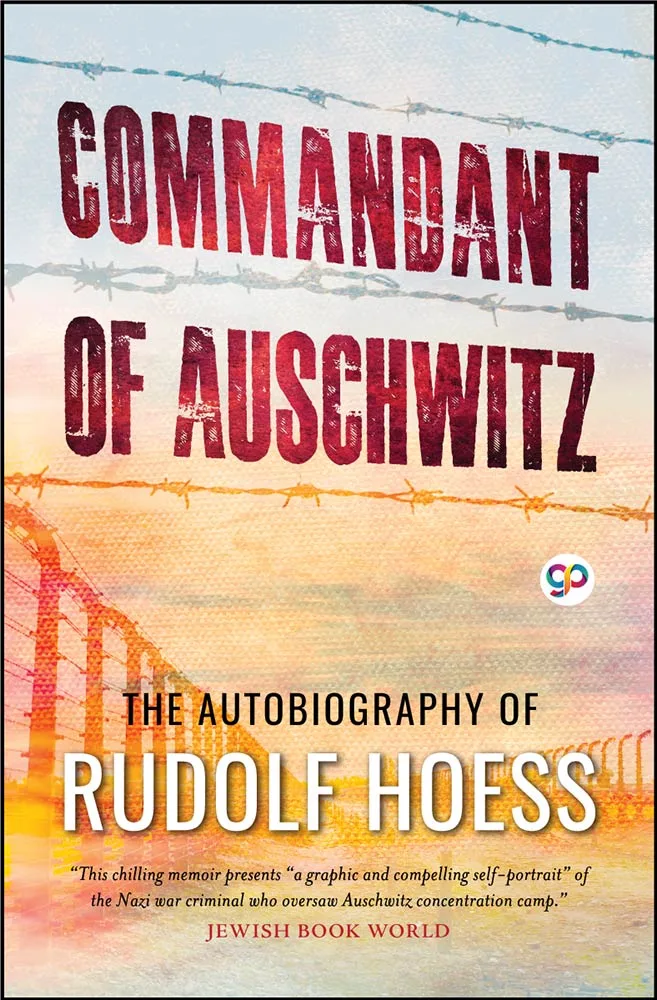
Download Cover Image
Do you want to download the full cover image for Commandant of Auschwitz: The Autobiography of Rudolf Hoess?