
Calculus Made Easy
Hardcover
• 344 Pages
• INR 499.00
• English
• 9789354999802
No ratings yet
| Publisher | General Press |
|---|---|
| ISBN13 | 9789354999802 |
| ASIN/SKU | 9354999808 |
| Book Format | Hardcover |
| Language | English |
| Pages | 344 |
| List Price | INR 499.00 |
| Subject Code | MAT005000, MAT030000, MAT023000 |
| Dimensions | 8.25 x 5.25 x 1.0 inches |
| Book Code | BD00067919 |
Buy this Book
Amazon Stores
Ebook Stores
Other Stores
Discover Calculus Made Easy by Silvanus Thompson. This book is published by General Press in Hardcover format, ISBN 9789354999802, ASIN 9354999808, under Science and Math, Mathematics Study and Teaching, Reference.
Book Description
'Calculus Made Easy' by Silvanus Thompson is a classic mathematics and introductory calculus book that begins with a simple but powerful idea: calculus does not have to be as frightening or complicated as it often seems. Written with a friendly, conversational tone, the book takes readers by the hand and introduces the basic principles of differentiation and integration without drowning them in difficult terminology or unnecessary formalism.
Silvanus Thompson’s central aim is to make calculus understandable to ordinary learners, particularly those who may have struggled with traditional mathematical textbooks. He explains how quantities change, how rates of change can be measured, and how seemingly complex problems can be reduced to a few clear and manageable ideas. Concepts such as derivatives, differentials, limits, integration, maxima and minima, and related rates are introduced gradually, with practical examples that help readers see how the mathematics actually works.
One of the book’s greatest strengths is its emphasis on intuition. Rather than expecting readers to memorize complicated rules before understanding them, Thompson encourages them to develop a feeling for what calculus is doing. His explanations often use everyday situations and familiar patterns to make abstract ideas more concrete. This approach gives the book an unusually approachable quality and explains why it has remained popular with generations of students and independent learners.
'Calculus Made Easy' is especially useful for anyone looking for a gentle introduction to calculus, whether studying mathematics, science, engineering, economics, or simply trying to understand one of the most important branches of mathematics. Thompson’s informal style makes difficult subjects feel less intimidating while still introducing the essential tools needed to progress further.
More than a mathematics textbook, this book is an invitation to stop being afraid of calculus and start seeing the logic behind it. Once Thompson begins revealing how simple ideas connect to the mathematics of change and accumulation, readers may discover that calculus is far more accessible than they ever imagined.
Silvanus Thompson’s central aim is to make calculus understandable to ordinary learners, particularly those who may have struggled with traditional mathematical textbooks. He explains how quantities change, how rates of change can be measured, and how seemingly complex problems can be reduced to a few clear and manageable ideas. Concepts such as derivatives, differentials, limits, integration, maxima and minima, and related rates are introduced gradually, with practical examples that help readers see how the mathematics actually works.
One of the book’s greatest strengths is its emphasis on intuition. Rather than expecting readers to memorize complicated rules before understanding them, Thompson encourages them to develop a feeling for what calculus is doing. His explanations often use everyday situations and familiar patterns to make abstract ideas more concrete. This approach gives the book an unusually approachable quality and explains why it has remained popular with generations of students and independent learners.
'Calculus Made Easy' is especially useful for anyone looking for a gentle introduction to calculus, whether studying mathematics, science, engineering, economics, or simply trying to understand one of the most important branches of mathematics. Thompson’s informal style makes difficult subjects feel less intimidating while still introducing the essential tools needed to progress further.
More than a mathematics textbook, this book is an invitation to stop being afraid of calculus and start seeing the logic behind it. Once Thompson begins revealing how simple ideas connect to the mathematics of change and accumulation, readers may discover that calculus is far more accessible than they ever imagined.
Author Biography
Silvanus Phillips Thompson FRS was a professor of physics at the City and Guilds Technical College in Finsbury, England. He was known for his work as an electrical engineer and as an author.
Thompson is one of the individuals represented on the Engineers Walk in Bristol, England. Thompson was elected a Fellow of the Royal Society in 1891 and was elected a member of the Royal Swedish Academy of Sciences in 1894.
Thompson is one of the individuals represented on the Engineers Walk in Bristol, England. Thompson was elected a Fellow of the Royal Society in 1891 and was elected a member of the Royal Swedish Academy of Sciences in 1894.
Editorial Reviews
Editorial Reviews will be added soon…
Book Summary
Silvanus P. Thompson’s Calculus Made Easy is a classic introduction to calculus written with a simple and practical purpose: to show that calculus is not an impossibly difficult subject reserved for mathematical experts. First published in 1910, the book became famous for its friendly, conversational style and its determination to strip away unnecessary complexity. Rather than beginning with lengthy formal definitions and abstract proofs, Thompson starts with the ideas that make calculus useful—change, rates, slopes, quantities, and accumulation. His approach is direct, intuitive, and often humorous, making the book especially appealing to beginners who feel intimidated by mathematics.
At the heart of the book are the two great ideas of calculus: differentiation and integration. Thompson explains them as different ways of understanding change. Differentiation asks how quickly something is changing at a particular moment, while integration deals with adding up many small quantities to find a total. Although the notation and terminology can initially seem unfamiliar, Thompson repeatedly emphasizes that the underlying ideas are much simpler than the symbols suggest.
The book begins by introducing the idea of quantities that vary. In ordinary arithmetic, we often deal with fixed numbers. Calculus becomes necessary when quantities are constantly changing. A car changes its position, a population changes over time, a temperature rises and falls, and the volume of water in a container changes as it is filled. Thompson wants readers to recognize that calculus is essentially a language for describing such changes.
He then introduces the idea of a variable. A variable is simply a quantity that can take different values. This may seem elementary, but it is essential because calculus studies relationships between changing quantities. Thompson gradually introduces mathematical notation so that readers can express these relationships efficiently rather than becoming overwhelmed by formal terminology.
The first major concept is the derivative. Thompson presents differentiation as a method for finding how rapidly one quantity changes in relation to another. If distance changes with time, differentiation can tell us the speed at a particular instant. If speed changes with time, differentiation gives acceleration. In this way, the derivative becomes something concrete rather than merely a formula to memorize.
A particularly important idea is the notion of an infinitesimal change. Thompson explains that when a variable changes by a very small amount, we can examine the resulting change in another quantity. He uses notation such as dx and dy to represent these tiny changes. The ratio dy/dx then expresses the rate at which one quantity changes compared with another.
Thompson's explanations are especially effective because he connects mathematical symbols with familiar physical situations. Instead of treating dy/dx as an intimidating expression, he encourages readers to see it as a practical statement about change. This approach captures the central intuition behind differential calculus: the derivative measures the instantaneous rate of change.
From there, the book develops the basic rules of differentiation. Thompson explains how to differentiate powers, sums, products, quotients, and more complicated expressions. The famous power rule becomes one of the most useful tools: when a quantity is raised to a power, differentiation produces a new expression according to a simple pattern. Thompson focuses on helping readers understand and use these rules rather than burying them beneath elaborate theoretical arguments.
The chain rule is also introduced as a way of differentiating functions that depend on other functions. Although the formal presentation can appear more complicated, the underlying idea is straightforward: when one quantity changes through another changing quantity, the rates of change can be combined. This becomes an essential technique for handling increasingly complicated expressions.
Thompson also discusses maxima and minima. These are points where a quantity reaches a highest or lowest value. Differentiation provides a powerful way of finding such points because, at a smooth maximum or minimum, the rate of change becomes zero. This connects calculus directly to practical problems involving optimization. Engineers, scientists, economists, and others can use such methods to determine the most efficient, profitable, economical, or physically appropriate solution.
Another major section deals with integration, which Thompson presents as the reverse operation of differentiation. If differentiation breaks a quantity's change down into a rate, integration reconstructs the accumulated quantity. This relationship between differentiation and integration is one of the most beautiful ideas in mathematics.
Thompson explains integration through the idea of adding together countless small quantities. Imagine finding the area beneath a curved line. Ordinary geometry can calculate the areas of familiar shapes such as rectangles and triangles, but a curved boundary is more difficult. Integration solves the problem by imagining the area divided into extremely thin strips and then adding them together. The result is an exact total.
This introduces the reader to the relationship between calculus and area. Integration is not merely a collection of strange symbols; it is a systematic method for accumulation. It can calculate areas, volumes, distances, quantities of material, and many other totals built from continuously changing parts.
Thompson also explains the connection between differentiation and integration through what is now commonly called the Fundamental Theorem of Calculus. The two processes are essentially inverse operations. Differentiation tells us how something changes, while integration allows us to recover the accumulated result of those changes. This unifying idea gives calculus much of its power.
The book goes beyond the simplest rules and introduces applications involving curves, rates, areas, volumes, and physical quantities. Thompson also discusses exponential and logarithmic functions, trigonometric functions, and other important mathematical relationships. His goal throughout is not to turn beginners into specialists immediately, but to give them enough understanding to work confidently with the basic machinery of calculus.
One of the book's greatest strengths is its attitude toward learning. Thompson repeatedly challenges the belief that mathematics must be presented in an unnecessarily complicated way. His famous opening sentiment—that what one fool can do, another can—captures his philosophy. He does not pretend that calculus requires no effort. Instead, he argues that much of the difficulty comes from poor explanations, unfamiliar notation, and the habit of teaching rules before ideas.
The tone is therefore unusually personal for a mathematics textbook. Thompson speaks directly to the reader, anticipates common fears, jokes about mathematical conventions, and tries to make the subject feel approachable. This makes Calculus Made Easy particularly valuable for self-learners. A reader can approach the book without having a strong mathematical background and gradually develop an intuitive sense of what calculus is doing.
At the same time, the book should not be mistaken for a complete modern calculus course. Thompson deliberately simplifies certain ideas and does not provide the rigorous foundations that later mathematics courses require. Concepts such as limits are treated more intuitively than formally. Readers who eventually study university-level mathematics will need to learn the precise definitions and proofs that Thompson largely leaves aside.
But that limitation is also part of the book's enduring appeal. Calculus Made Easy is designed to open the door. It wants readers to understand why calculus works before they become concerned with proving every detail of why it works.
Ultimately, Silvanus P. Thompson's book succeeds because it changes the reader's relationship with calculus. Instead of presenting mathematics as a wall of symbols and rules, it reveals calculus as a natural way of thinking about change and accumulation. Differentiation helps us understand motion, growth, and rates; integration helps us understand totals, areas, and accumulation. Together, they provide a powerful framework for describing the continuously changing world.
More than a century after its publication, Calculus Made Easy remains valuable for precisely this reason. Its central lesson is not simply a collection of formulas. It is the confidence to approach a difficult-looking subject with curiosity rather than fear. Thompson reminds us that behind the complicated notation are remarkably simple ideas—and once those ideas become clear, calculus begins to feel less like an obstacle and more like a useful language for understanding the world.
At the heart of the book are the two great ideas of calculus: differentiation and integration. Thompson explains them as different ways of understanding change. Differentiation asks how quickly something is changing at a particular moment, while integration deals with adding up many small quantities to find a total. Although the notation and terminology can initially seem unfamiliar, Thompson repeatedly emphasizes that the underlying ideas are much simpler than the symbols suggest.
The book begins by introducing the idea of quantities that vary. In ordinary arithmetic, we often deal with fixed numbers. Calculus becomes necessary when quantities are constantly changing. A car changes its position, a population changes over time, a temperature rises and falls, and the volume of water in a container changes as it is filled. Thompson wants readers to recognize that calculus is essentially a language for describing such changes.
He then introduces the idea of a variable. A variable is simply a quantity that can take different values. This may seem elementary, but it is essential because calculus studies relationships between changing quantities. Thompson gradually introduces mathematical notation so that readers can express these relationships efficiently rather than becoming overwhelmed by formal terminology.
The first major concept is the derivative. Thompson presents differentiation as a method for finding how rapidly one quantity changes in relation to another. If distance changes with time, differentiation can tell us the speed at a particular instant. If speed changes with time, differentiation gives acceleration. In this way, the derivative becomes something concrete rather than merely a formula to memorize.
A particularly important idea is the notion of an infinitesimal change. Thompson explains that when a variable changes by a very small amount, we can examine the resulting change in another quantity. He uses notation such as dx and dy to represent these tiny changes. The ratio dy/dx then expresses the rate at which one quantity changes compared with another.
Thompson's explanations are especially effective because he connects mathematical symbols with familiar physical situations. Instead of treating dy/dx as an intimidating expression, he encourages readers to see it as a practical statement about change. This approach captures the central intuition behind differential calculus: the derivative measures the instantaneous rate of change.
From there, the book develops the basic rules of differentiation. Thompson explains how to differentiate powers, sums, products, quotients, and more complicated expressions. The famous power rule becomes one of the most useful tools: when a quantity is raised to a power, differentiation produces a new expression according to a simple pattern. Thompson focuses on helping readers understand and use these rules rather than burying them beneath elaborate theoretical arguments.
The chain rule is also introduced as a way of differentiating functions that depend on other functions. Although the formal presentation can appear more complicated, the underlying idea is straightforward: when one quantity changes through another changing quantity, the rates of change can be combined. This becomes an essential technique for handling increasingly complicated expressions.
Thompson also discusses maxima and minima. These are points where a quantity reaches a highest or lowest value. Differentiation provides a powerful way of finding such points because, at a smooth maximum or minimum, the rate of change becomes zero. This connects calculus directly to practical problems involving optimization. Engineers, scientists, economists, and others can use such methods to determine the most efficient, profitable, economical, or physically appropriate solution.
Another major section deals with integration, which Thompson presents as the reverse operation of differentiation. If differentiation breaks a quantity's change down into a rate, integration reconstructs the accumulated quantity. This relationship between differentiation and integration is one of the most beautiful ideas in mathematics.
Thompson explains integration through the idea of adding together countless small quantities. Imagine finding the area beneath a curved line. Ordinary geometry can calculate the areas of familiar shapes such as rectangles and triangles, but a curved boundary is more difficult. Integration solves the problem by imagining the area divided into extremely thin strips and then adding them together. The result is an exact total.
This introduces the reader to the relationship between calculus and area. Integration is not merely a collection of strange symbols; it is a systematic method for accumulation. It can calculate areas, volumes, distances, quantities of material, and many other totals built from continuously changing parts.
Thompson also explains the connection between differentiation and integration through what is now commonly called the Fundamental Theorem of Calculus. The two processes are essentially inverse operations. Differentiation tells us how something changes, while integration allows us to recover the accumulated result of those changes. This unifying idea gives calculus much of its power.
The book goes beyond the simplest rules and introduces applications involving curves, rates, areas, volumes, and physical quantities. Thompson also discusses exponential and logarithmic functions, trigonometric functions, and other important mathematical relationships. His goal throughout is not to turn beginners into specialists immediately, but to give them enough understanding to work confidently with the basic machinery of calculus.
One of the book's greatest strengths is its attitude toward learning. Thompson repeatedly challenges the belief that mathematics must be presented in an unnecessarily complicated way. His famous opening sentiment—that what one fool can do, another can—captures his philosophy. He does not pretend that calculus requires no effort. Instead, he argues that much of the difficulty comes from poor explanations, unfamiliar notation, and the habit of teaching rules before ideas.
The tone is therefore unusually personal for a mathematics textbook. Thompson speaks directly to the reader, anticipates common fears, jokes about mathematical conventions, and tries to make the subject feel approachable. This makes Calculus Made Easy particularly valuable for self-learners. A reader can approach the book without having a strong mathematical background and gradually develop an intuitive sense of what calculus is doing.
At the same time, the book should not be mistaken for a complete modern calculus course. Thompson deliberately simplifies certain ideas and does not provide the rigorous foundations that later mathematics courses require. Concepts such as limits are treated more intuitively than formally. Readers who eventually study university-level mathematics will need to learn the precise definitions and proofs that Thompson largely leaves aside.
But that limitation is also part of the book's enduring appeal. Calculus Made Easy is designed to open the door. It wants readers to understand why calculus works before they become concerned with proving every detail of why it works.
Ultimately, Silvanus P. Thompson's book succeeds because it changes the reader's relationship with calculus. Instead of presenting mathematics as a wall of symbols and rules, it reveals calculus as a natural way of thinking about change and accumulation. Differentiation helps us understand motion, growth, and rates; integration helps us understand totals, areas, and accumulation. Together, they provide a powerful framework for describing the continuously changing world.
More than a century after its publication, Calculus Made Easy remains valuable for precisely this reason. Its central lesson is not simply a collection of formulas. It is the confidence to approach a difficult-looking subject with curiosity rather than fear. Thompson reminds us that behind the complicated notation are remarkably simple ideas—and once those ideas become clear, calculus begins to feel less like an obstacle and more like a useful language for understanding the world.
Sample Chapters
Sample Chapters will be added soon…
Reader Reviews
No reviews yet.
Calculus Made Easy
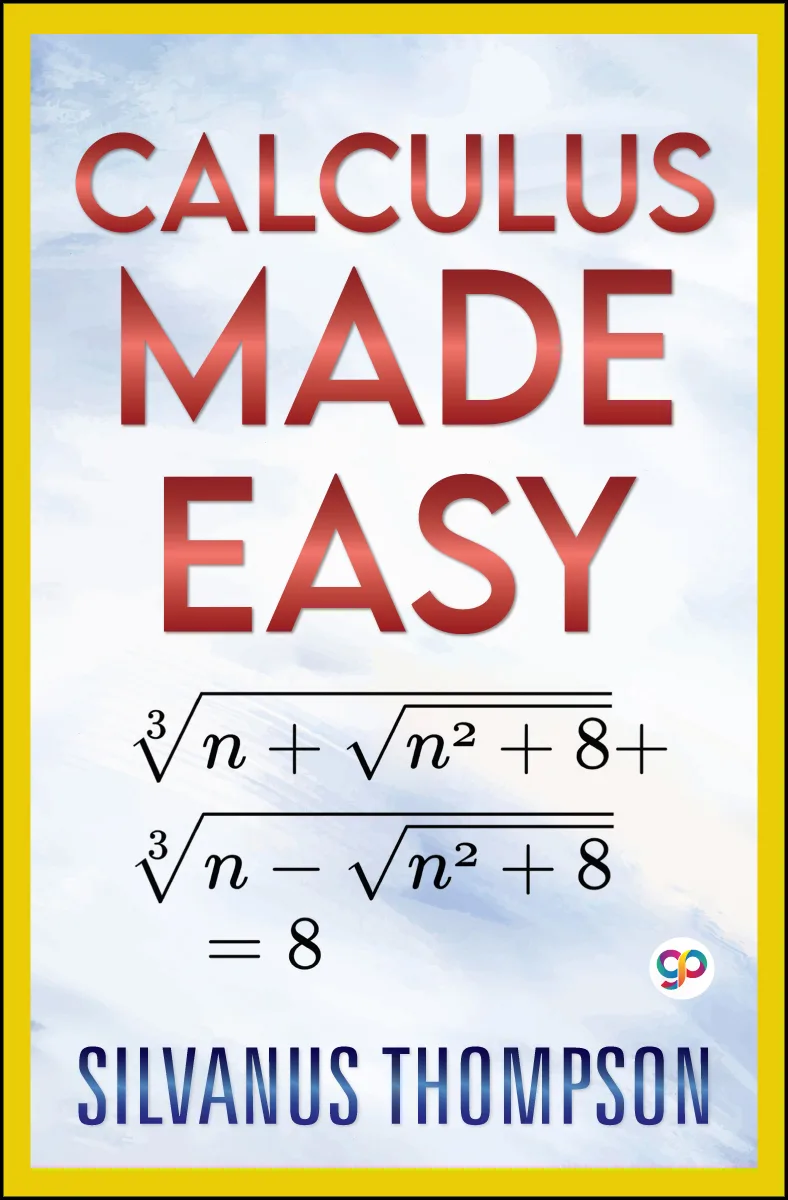
Download Cover Image
Do you want to download the full cover image for Calculus Made Easy?