
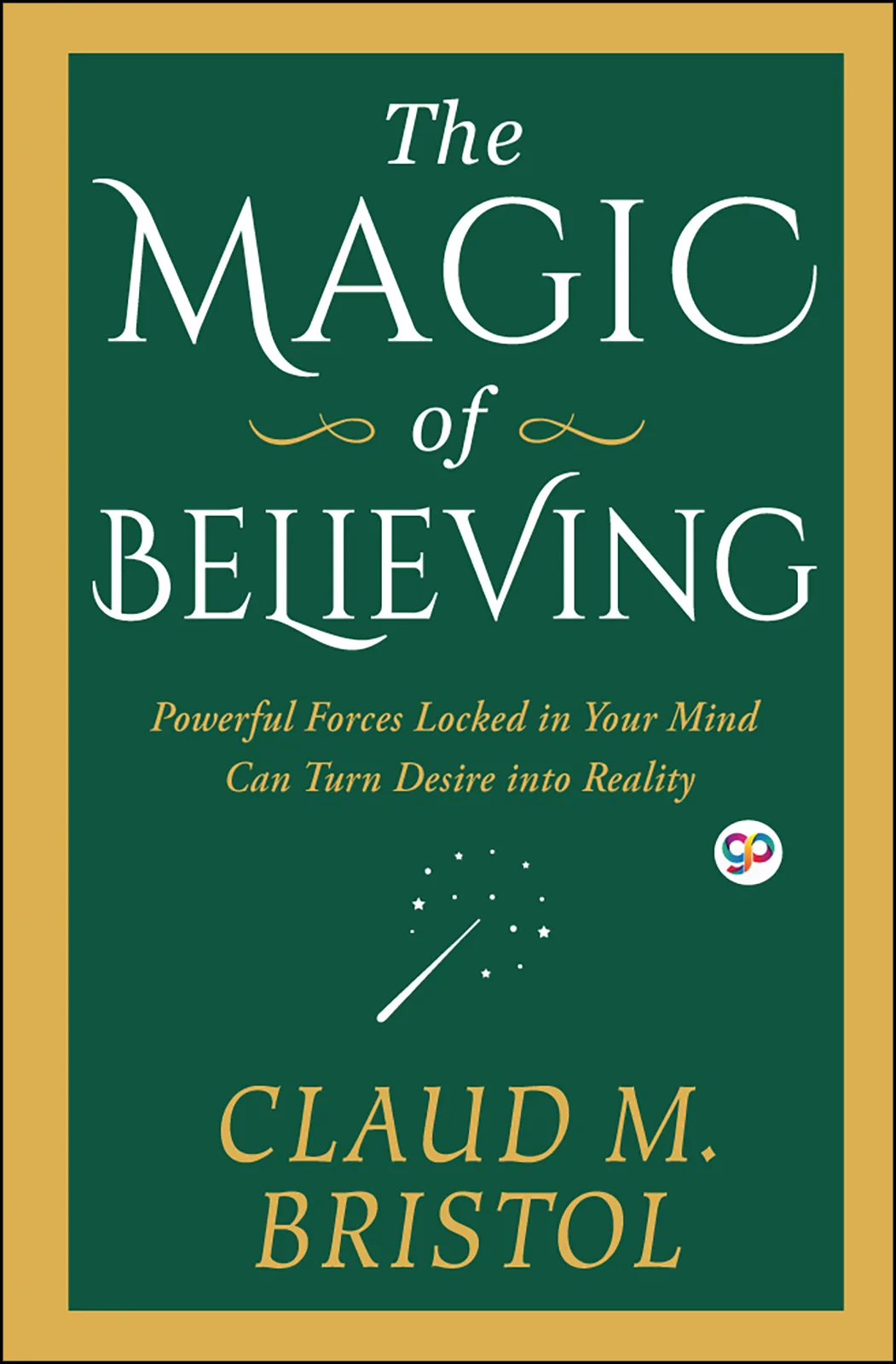
The Magic of Believing
Hardcover
• 236 Pages
• INR 445.00
• English
• 9789388118217
No ratings yet
| Publisher | General Press |
|---|---|
| ISBN13 | 9789388118217 |
| ASIN/SKU | 9388118219 |
| Book Format | Hardcover |
| Language | English |
| Pages | 236 |
| List Price | INR 445.00 |
| Subject Code | SEL021000, SEL032000, SEL027000, REL062000 |
| Publishing Date | 03/08/2018 |
| Dimensions | 8.25 x 5.25 x 1.0 inches |
| Book Code | BD00067929 |
Buy this Book
Amazon Stores
Ebook Stores
Other Stores
Discover The Magic of Believing by Claudie Bristol. This book is published by General Press in Hardcover format, ISBN 9789388118217, ASIN 9388118219, under Self-Help, Motivational, Personal Transformation.
Book Description
What if the greatest force shaping your life is not luck, talent, or circumstance, but the thoughts you quietly hold in your own mind? 'The Magic of Believing' by Claudie Bristol is a classic self-help and personal development book that explores the power of belief, imagination, and focused thought in shaping a person’s experiences and achievements. Bristol presents the idea that the mind is far more influential than most people realize, and that learning to direct its energy can help transform hopes and ambitions into meaningful results.
Rather than treating success as something reserved for the naturally gifted or exceptionally fortunate, Bristol encourages readers to examine the beliefs that guide their everyday decisions. Fear, doubt, negative expectations, and limiting assumptions can become invisible barriers, while confidence, clear intention, and persistent mental focus can open the way toward new possibilities. The book explores practical approaches to strengthening belief and using the imagination deliberately, encouraging readers to picture desired outcomes and develop the inner certainty needed to pursue them.
At the heart of Bristol’s message is the relationship between thought and action. Positive thinking alone is not presented simply as wishful dreaming; instead, the reader is encouraged to cultivate a disciplined mental attitude that influences behavior, persistence, confidence, and relationships. Through accessible explanations and memorable examples, Bristol explores subjects such as visualization, concentration, suggestion, ambition, and the subconscious mind, showing how these ideas can be applied to personal goals and everyday challenges.
Published in an era when interest in the hidden potential of the mind was growing, 'The Magic of Believing' remains an intriguing introduction to the philosophy of self-directed thinking and mental confidence. Its central message is both simple and provocative: before circumstances can change, a person must first learn to believe that change is possible. For readers interested in self-improvement, positive thinking, manifestation, and the psychology of success, Bristol’s ideas offer plenty to consider—and perhaps the most interesting question is what might happen when you begin putting that belief into practice.
Rather than treating success as something reserved for the naturally gifted or exceptionally fortunate, Bristol encourages readers to examine the beliefs that guide their everyday decisions. Fear, doubt, negative expectations, and limiting assumptions can become invisible barriers, while confidence, clear intention, and persistent mental focus can open the way toward new possibilities. The book explores practical approaches to strengthening belief and using the imagination deliberately, encouraging readers to picture desired outcomes and develop the inner certainty needed to pursue them.
At the heart of Bristol’s message is the relationship between thought and action. Positive thinking alone is not presented simply as wishful dreaming; instead, the reader is encouraged to cultivate a disciplined mental attitude that influences behavior, persistence, confidence, and relationships. Through accessible explanations and memorable examples, Bristol explores subjects such as visualization, concentration, suggestion, ambition, and the subconscious mind, showing how these ideas can be applied to personal goals and everyday challenges.
Published in an era when interest in the hidden potential of the mind was growing, 'The Magic of Believing' remains an intriguing introduction to the philosophy of self-directed thinking and mental confidence. Its central message is both simple and provocative: before circumstances can change, a person must first learn to believe that change is possible. For readers interested in self-improvement, positive thinking, manifestation, and the psychology of success, Bristol’s ideas offer plenty to consider—and perhaps the most interesting question is what might happen when you begin putting that belief into practice.
Author Biography
World War I veteran Claude M. Bristol (1891–1951) wrote The Magic of Believing to help former soldiers adjust to civilian life. A pioneer of the New Thought movement and a popular motivational speaker, he addressed a nationwide audience of clubs, business organizations, and salespeople.
Editorial Reviews
Editorial Reviews will be added soon…
Book Summary
The Magic of Believing by Claude M. Bristol is a classic self-help book about the power of thought, belief, imagination, and focused intention. First published in 1948, the book presents the idea that the human mind can strongly influence the direction of a person’s life. Bristol argues that success does not begin with money, education, social position, or luck. It begins in the mind, with a clear picture of what a person wants and a firm belief that it can be achieved. Although some of the book’s claims are presented in a mystical or metaphysical way, its central message is simple: the way we think influences the way we act, and persistent belief can give us the courage and determination needed to turn ideas into reality.
Bristol begins with the importance of belief. He suggests that people often limit themselves because they unconsciously accept negative ideas about their own abilities. If someone repeatedly thinks, “I cannot do this,” that belief can become a psychological barrier. On the other hand, a person who develops a strong conviction that a goal is possible becomes more willing to act, experiment, persist, and overcome difficulties. For Bristol, belief is not merely a pleasant feeling. It is a powerful mental force that can shape attitudes and behavior.
One of the book’s most important ideas is visualization. Bristol encourages readers to create a clear mental picture of the thing they want. Instead of thinking vaguely about success, a person should imagine the desired result as specifically as possible. The mind should become familiar with the picture of achievement. According to Bristol, repeated mental images gradually become stronger and can influence the subconscious mind. Once a goal becomes deeply established in the imagination, the individual is more likely to notice opportunities and take actions that move toward it.
Bristol places great emphasis on the subconscious mind. He believes that much of human behavior is influenced by ideas that operate beneath ordinary conscious awareness. A person may consciously desire success while unconsciously believing that success is impossible or undeserved. Such conflicting beliefs can undermine effort. Bristol therefore encourages readers to replace destructive mental patterns with constructive ones. Repeatedly thinking about desired outcomes, he argues, can help establish new patterns of expectation and confidence.
The author also discusses the relationship between thought and action. His message is not simply that people should sit quietly and imagine becoming successful. Instead, belief should create energy for purposeful action. A strong mental image can provide motivation when circumstances become difficult. When people genuinely believe in a goal, they are more likely to work consistently toward it and less likely to abandon it after an early failure. In this sense, belief becomes a source of persistence.
Another important theme is the influence of words. Bristol argues that spoken language can reinforce mental attitudes. Repeatedly saying negative things about oneself—such as admitting defeat, expecting failure, or constantly complaining—can strengthen negative patterns of thinking. Positive and confident language, by contrast, can help develop a stronger mental attitude. Bristol therefore encourages readers to become careful about what they say and think, because repeated statements can gradually become beliefs.
The book also explores the power of suggestion. Bristol believes that people are influenced by suggestions from others as well as by suggestions they give themselves. Society, family, friends, teachers, and colleagues can all contribute to a person’s understanding of what is possible. If someone is constantly told that a particular goal is unrealistic, that opinion may eventually become part of the person’s own thinking. Bristol encourages readers to become more selective about the ideas they accept and to consciously choose beliefs that support their goals.
A related idea is concentration. Bristol believes that scattered thinking weakens personal effectiveness. People often want many things at once, change their minds frequently, or allow distractions to consume their attention. The author recommends focusing the mind on a definite objective. Concentration makes an idea stronger because attention repeatedly returns to the same purpose. In practical terms, this means knowing what one wants and refusing to let temporary difficulties completely destroy that sense of direction.
Bristol also discusses the role of emotion in achieving goals. He suggests that thoughts become more powerful when they are accompanied by genuine feeling. Simply repeating words without conviction may have little effect. When a person emotionally connects with a desired future, the goal becomes more vivid and personally meaningful. Hope, enthusiasm, confidence, and determination can therefore strengthen the mental picture and encourage sustained effort.
The book repeatedly returns to the importance of persistence. Bristol recognizes that people will encounter rejection, disappointment, uncertainty, and failure. These experiences can easily weaken belief. However, he argues that temporary setbacks should not be confused with permanent defeat. A person who keeps returning mentally to the desired objective can maintain the motivation necessary to continue. In this way, persistence becomes an expression of belief.
One of the more distinctive aspects of Bristol’s philosophy is his belief that thought can attract circumstances and opportunities. He presents this idea in terms of mental and sometimes mysterious forces, suggesting that strongly held thoughts can influence the world around us. Modern readers may interpret this idea more practically: a person who thinks clearly about a goal is more likely to recognize relevant opportunities, build useful relationships, and take purposeful action. Even without accepting Bristol’s more mystical explanations literally, the psychological value of focused attention remains understandable.
Ultimately, The Magic of Believing is a book about taking greater responsibility for one’s mental life. Bristol asks readers to examine the thoughts they repeatedly entertain and the beliefs they have accepted about themselves. His central lesson is that achievement begins with an inner picture before it becomes an outer reality. A person must first imagine a possibility, develop faith in it, and then support that belief through disciplined action.
The enduring appeal of the book comes from its optimistic view of human potential. Bristol does not portray success as something reserved for a fortunate few. He encourages ordinary people to recognize the influence of their own minds and to replace fear and self-doubt with purpose and confidence. While some of his claims about mental forces may be understood as products of the self-help thinking of his era rather than established scientific principles, the book’s practical message remains accessible: our thoughts influence our attitudes, our attitudes influence our actions, and repeated actions can gradually change our lives. In that sense, the “magic” of believing is ultimately the transformation that can occur when a clear purpose, a confident mind, and persistent effort work together.
Bristol begins with the importance of belief. He suggests that people often limit themselves because they unconsciously accept negative ideas about their own abilities. If someone repeatedly thinks, “I cannot do this,” that belief can become a psychological barrier. On the other hand, a person who develops a strong conviction that a goal is possible becomes more willing to act, experiment, persist, and overcome difficulties. For Bristol, belief is not merely a pleasant feeling. It is a powerful mental force that can shape attitudes and behavior.
One of the book’s most important ideas is visualization. Bristol encourages readers to create a clear mental picture of the thing they want. Instead of thinking vaguely about success, a person should imagine the desired result as specifically as possible. The mind should become familiar with the picture of achievement. According to Bristol, repeated mental images gradually become stronger and can influence the subconscious mind. Once a goal becomes deeply established in the imagination, the individual is more likely to notice opportunities and take actions that move toward it.
Bristol places great emphasis on the subconscious mind. He believes that much of human behavior is influenced by ideas that operate beneath ordinary conscious awareness. A person may consciously desire success while unconsciously believing that success is impossible or undeserved. Such conflicting beliefs can undermine effort. Bristol therefore encourages readers to replace destructive mental patterns with constructive ones. Repeatedly thinking about desired outcomes, he argues, can help establish new patterns of expectation and confidence.
The author also discusses the relationship between thought and action. His message is not simply that people should sit quietly and imagine becoming successful. Instead, belief should create energy for purposeful action. A strong mental image can provide motivation when circumstances become difficult. When people genuinely believe in a goal, they are more likely to work consistently toward it and less likely to abandon it after an early failure. In this sense, belief becomes a source of persistence.
Another important theme is the influence of words. Bristol argues that spoken language can reinforce mental attitudes. Repeatedly saying negative things about oneself—such as admitting defeat, expecting failure, or constantly complaining—can strengthen negative patterns of thinking. Positive and confident language, by contrast, can help develop a stronger mental attitude. Bristol therefore encourages readers to become careful about what they say and think, because repeated statements can gradually become beliefs.
The book also explores the power of suggestion. Bristol believes that people are influenced by suggestions from others as well as by suggestions they give themselves. Society, family, friends, teachers, and colleagues can all contribute to a person’s understanding of what is possible. If someone is constantly told that a particular goal is unrealistic, that opinion may eventually become part of the person’s own thinking. Bristol encourages readers to become more selective about the ideas they accept and to consciously choose beliefs that support their goals.
A related idea is concentration. Bristol believes that scattered thinking weakens personal effectiveness. People often want many things at once, change their minds frequently, or allow distractions to consume their attention. The author recommends focusing the mind on a definite objective. Concentration makes an idea stronger because attention repeatedly returns to the same purpose. In practical terms, this means knowing what one wants and refusing to let temporary difficulties completely destroy that sense of direction.
Bristol also discusses the role of emotion in achieving goals. He suggests that thoughts become more powerful when they are accompanied by genuine feeling. Simply repeating words without conviction may have little effect. When a person emotionally connects with a desired future, the goal becomes more vivid and personally meaningful. Hope, enthusiasm, confidence, and determination can therefore strengthen the mental picture and encourage sustained effort.
The book repeatedly returns to the importance of persistence. Bristol recognizes that people will encounter rejection, disappointment, uncertainty, and failure. These experiences can easily weaken belief. However, he argues that temporary setbacks should not be confused with permanent defeat. A person who keeps returning mentally to the desired objective can maintain the motivation necessary to continue. In this way, persistence becomes an expression of belief.
One of the more distinctive aspects of Bristol’s philosophy is his belief that thought can attract circumstances and opportunities. He presents this idea in terms of mental and sometimes mysterious forces, suggesting that strongly held thoughts can influence the world around us. Modern readers may interpret this idea more practically: a person who thinks clearly about a goal is more likely to recognize relevant opportunities, build useful relationships, and take purposeful action. Even without accepting Bristol’s more mystical explanations literally, the psychological value of focused attention remains understandable.
Ultimately, The Magic of Believing is a book about taking greater responsibility for one’s mental life. Bristol asks readers to examine the thoughts they repeatedly entertain and the beliefs they have accepted about themselves. His central lesson is that achievement begins with an inner picture before it becomes an outer reality. A person must first imagine a possibility, develop faith in it, and then support that belief through disciplined action.
The enduring appeal of the book comes from its optimistic view of human potential. Bristol does not portray success as something reserved for a fortunate few. He encourages ordinary people to recognize the influence of their own minds and to replace fear and self-doubt with purpose and confidence. While some of his claims about mental forces may be understood as products of the self-help thinking of his era rather than established scientific principles, the book’s practical message remains accessible: our thoughts influence our attitudes, our attitudes influence our actions, and repeated actions can gradually change our lives. In that sense, the “magic” of believing is ultimately the transformation that can occur when a clear purpose, a confident mind, and persistent effort work together.
Sample Chapters
Chapter 1 : How I Came to Tap the Power of Belief
Is there a something, a force, a factor, a power, a science—call it what you will—which a few people understand and use to overcome their difficulties and achieve outstanding success? I firmly believe that there is, and it is my purpose in this, first complete exposition of the subject, to attempt to explain it so that you may use it if you desire.
About fifteen years ago, the financial editor of a great Los Angeles newspaper after attending lectures I had given to financial men in that city and after having read my brochure, T.N.T. – It Rocks the Earth, wrote:
You have caught from the ether something that has a mystical quality—a something that explains the magic of coincidence, the mystery of what makes men lucky.
I realized that I had run across something that was workable, but I didn’t consider it then, neither do I now, as anything mystical, except in the sense that it is unknown to the majority of people. It is something that has always been known to a fortunate few down the centuries, but, for some unknown reason, is little understood by the average person.
When I started out years ago, to teach this science through the medium of lectures and my brochure, I wasn’t certain that it could be or would be grasped by the ordinary individual; but now that I have seen those who have used it to double and triple their incomes, build their own successful businesses, acquire homes in the country, and create sizable fortunes, I am convinced that any intelligent person who is sincere with himself can reach any heights he desires. I had no intention of writing a second book, although many urged me to do so, until a woman in the book business, who had sold many copies of my first little book, literally ‘read the riot act’ to me, declaring:
‘You have a duty to perform to the ex-service men and women, and all others who seek places for themselves in a post-war world, to give them in easily understood form not only what you contained in your T.N.T. – It Rocks the Earth but the new material that you have given in your lectures. Everyone of ambition wants to get ahead and you have amply demonstrated you have something that will help anyone, and it’s up to you to pass it along.’
It took time to sell myself on the idea, but having served as a soldier in World War 1, mostly in France and Germany, and having been an active official for many years in ex-service men’s organizations as well as a member of a state commission to aid in the rehabilitation of ex-service men and women, I realized that it would be no easy task for many individuals to make outstanding places for themselves in a practical world from which they had long been separated. It is with them in mind, as well as all ambitious men and women, and with a sincere desire to help that I write this more full and detailed exposition of the power of belief.
I am cognizant of the fact that there are powerful forces at work in this country that would dominate us, substituting a kind of regimentation for the competitive system which has made America great among nations. They would attempt to destroy individual thinking and initiative, cherished ever since our Pilgrim Fathers established this country in defiance of Old World tyranny. I believe that we must continue to retain the wealth of spirit of our forefathers, for if we don’t, we shall find ourselves dominated in everything we do by a mighty few and shall become serfs in fact if not in name. Thus, this work is written also to help develop individual thinking and doing.
Since I am aware that this book may fall into the hands of some who may call me a ‘crackpot’ or a ‘screwball’, let me say that I am past the half-century mark and have had many years of hard practical business experience, as well as a good number of years as a newspaper man. I started as a police reporter, and police reporters are trained to get facts and’ accept nothing for granted.’ For a two-year period I was church editor of a large metropolitan newspaper, during which I came in close contact with clergymen and leaders of all sects and denominations, mind-healers, divine healers, spiritualists, Christian scientists, new thought-ers, unity leaders, sun and idol worshippers, and, yes, even a few infidels and pagans.
Gypsy Smith, well known English evangelist, was making an early tour of America at that time, and as I used to sit night after night on his platform, watching people stumble down the aisles, some sobbing, others shouting hysterically, I wondered.
Again, I wondered as I accompanied the police in answering a riot call, when some Holy Rollers in a moment of hysteria knocked over a stove and set fire to their meeting hall. When I attended my first and only meeting of Shakers, I wondered as I did while attending various spiritualistic meetings. I wondered as I heard the testimonials at the Wednesday night meetings of Christian scientists. I wondered when I witnessed a group of people being immersed in the icy waters of a mountain stream and coming up shouting ‘Hallelujah’, even though their teeth were chattering. I wondered at the ceremonial dances of the Indians and their rain-calling programmes. Billy Sunday also caused me to wonder, as in later years did Aimee Semple McPherson.
In France, during the first war, I marvelled at the simple faith of the peasants and the powers of their village padres. The stories of the so-called miracles at Lourdes, as well as of somewhat similar miracles at other shrines, also held great interest. When I saw elderly men and women in a famous old Roman church climb literally on their knees up a long flight of stairs to gaze upon a holy urn—a climb that is no simple task for an athletically trained young person—I wondered again.
Business brought me into contact with the Mormons, and when I heard of the belief in the story of Joseph Smith and the revelations on the plates of gold, I was again given to wonderment. The Dukbobors of western Canada, who would doff their clothes when provoked, likewise made me wonder. While in Hawaii, I heard much about the powers of the kahunas who, it was claimed, could, by praying cause people to die or live. The great powers attributed to these kahunas profoundly impressed me.
In my early days as a newspaper man, I saw a famous medium try to make the ‘spirits’ respond before a crowded courtroom of antagonistic scoffers. The judge had promised the medium he would be freed if he could get the ‘spirits’ to speak in the courtroom. They failed to materialize and I wondered why, because the medium’s followers had testified to remarkable prior séances.
Many years later, I was commissioned to write a series of articles on what is known in police parlance as the ‘fortune telling racket’. I visited everything from gypsy phrenologists to crystal-ball gazers, from astrologers to spiritualistic mediums. I have heard what purported to be the voices of old Indian’ guides’ tell me the past, the present, and the future, and I heard from relatives I never knew existed.
Several times I have been in a hospital room in which people around me died, while others with seemingly worse ailments were up and apparently fully recovered within a short time. I have known of partially paralyzed people who got over their condition in a matter of days. I have known people who claim to have cured their rheumatism or arthritis by wearing a copper band around their wrists—others by mental healing. From relatives and close friends I have heard stories of how warts on hands have suddenly disappeared. I am familiar with the stories of those who permit rattlesnakes to bite them and still live, and with hundreds of other tales of mysterious healings and happenings.
I have, moreover, made myself familiar with the lives of great men and women of history; I have met and interviewed many outstanding men and women in all lines of human endeavour; and I have often wondered just what it was that took them to the top. I have seen coaches take apparently inferior baseball and football teams and infuse them with ‘something’ that caused them to win. In the depression days I saw sales organizations, badly whipped, do an abrupt about-face and bring in more business than ever before.
Apparently I was born with a huge bump of curiosity, for I have always had an insatiable yearning to seek explanations and answers. This yearning has taken me to many strange places, brought to light many peculiar cases, and has caused me to read every book I could get my hands on dealing with religions, cults, and both physical and mental sciences. I have read literally thousands of books on modern psychology, metaphysics, ancient magic, Voodooism, Yogism, Theosophy, Christian Science, Unity, Truth, New Thought, Coueism, and many others dealing with what I call Mind Stuff, as well as the philosophies and teachings of the great masters of the past.
Many were nonsensical, others strange, and many very profound. Gradually, I discovered that there is a golden thread that runs through all the teachings and makes them work for those who sincerely accept and apply them, and that thread can be named in a single word—belief. It is this same element or factor, belief, which causes people to be cured through mental healing, enables others to climb high the ladder of success, and gets phenomenal results for all who accept it. Why belief is a miracle worker is something that cannot be satisfactorily explained; but have no doubt about it, there’s genuine magic in believing. ‘The magic of believing’ became a phrase around which my thoughts steadily revolved.
When T.N.T—It Rocks the Earth was first published, I imagined that it would be easily understood, as I had written it simply; but as the years went by, I found that some readers protested that it was too much in digest form, while others said they couldn’t understand it. I had assumed that most people knew something about the power of thought. I was mistaken and I realized that those who had an understanding of the subject were comparatively few. Later, in my many years of lecturing before clubs, business and sales organizations, I discovered that while most people were vitally interested in the subject, it had to be fully explained. Finally, I undertook to write this book in words that anyone who reads can understand and with the hope that it will help many to reach their goal in life.
The science of thought is as old as man himself. The wise men of all ages have known about it and used it. The only thing the writer has done is to put the subject in modern language and bring to the reader’s attention what a few of the outstanding minds of today are doing to substantiate the great truths that have come down through the centuries.
Fortunately for the world, people generally are coming to the realization that there is ‘something to this mind-stuff after all’, and the writer believes that there are millions of people who would like to get a better understanding of it and prove that it does work.
Therefore, I start with relating a few experiences of my own life, with the hope that by hearing them, you will gain a better understanding of the entire science. Early in 1918, I landed in France as a ‘casual’ soldier, unattached to a regular company. As a result, it was several weeks before my service record, necessary for my pay, caught up with me. During that period, I was without money to buy gum, candy, cigarettes, and the like, as the few dollars I had before sailing had been spent at the transport’s canteen to relieve the monotony of the ship’s menu. Every time I saw a man light a cigarette or chew a stick of gum, the thought came that I was without money to spend on myself. Certainly, I was eating and the army clothed me and provided me with a place on the ground to sleep, but I grew bitter because I had no spending money and no way of getting any. One night en route to the forward area on a crowded troop train when sleep was out of the question, I made up my mind that when I returned to civilian life, ‘I would have a lot of money.’ The whole pattern of my life was altered at that moment.
True, I had been something of a reader in my youth; the Bible had been a ‘must’ in our family. As a boy, I was interested in wireless telegraphy, X-ray, high-frequency apparatus, and similar manifestations of electricity, and I had read every book on these subjects I could find. But while I was familiar with such terms as radiations, frequencies, vibrations, oscillations, magnetic influences, etc., in those days they meant nothing to me outside the strictly electrical field. Perhaps the first inkling of a connection between the mind and electrical or vibratory influences came when, upon my completing law school, an instructor had given me an old book, Thomson Jay Hudson’s Law of Psychic Phenomena. I read it but only superficially. Either I did not understand it or my mind was not ready to receive its profound truths, because, when on that fateful night in the spring of 1918 I told myself that someday I would have a lot of money, I did not realize that I was laying the groundwork for a series of causes which would unleash forces that would bring accomplishment. As a matter of fact, the idea that I could with any thinking and believing develop a fortune never entered my mind.
On my army classification card, I was listed as a newspaper man. I had been attending an army training school to qualify for a commission, but the whole training-school course was discontinued just as we finished the course; thus most of us landed in France as enlisted men. However, I considered myself a qualified newspaper man and felt that there was a better place for me in the A.E.F (American Expeditionary Forces); yet, like many others, I found myself pushing wheelbarrows and lugging heavy shells and other ammunition. Then one night at an ammunition depot near Toul, things began to happen. I was ordered to appear before the commanding officer who asked me whom I knew at First Army Headquarters. I didn’t know a soul there and didn’t even know where it was located, and I told him. Then he showed me orders directing me to report immediately to that headquarters. A car and driver were provided and the next morning found me at First Army Headquarters in charge of a daily progress bulletin. There I was answerable only to a colonel.
During the months that followed, I frequently thought about the commission to which I was entitled. Then the links began to form into a chain. One day, entirely out of a clear sky, came orders transferring me to the Stars and Stripes, the army newspaper; I for long had an ambition to be on its staff but had done nothing about it. The next day as I was preparing to leave for Paris, I was called before the colonel who showed me a telegram signed by the Adjutant General’s office at GHQ (General Head Quarters), asking if I was available for a commission. The colonel asked whether I would rather have a commission than report to the army newspaper. Foreseeing that the war would soon end and I would be happier among other newspaper men, I said I would prefer the transfer to the Stars and Stripes. I never learned who was responsible for the telegram, but obviously something was working on my behalf.
Following the armistice, my desire to get out of the army became insistent. I wanted to begin building that fortune, but the Stars and Stripes did not suspend publication until the summer of 1919, and it was August before I got home. However, the forces I had unconsciously set in motion were already setting the stage for me and that fortune. It was about nine thirty the next morning after my arrival home, that I received a telephone call from the president of a well known club in which I had been active. He told me to call a certain man prominent in the investment banking business, who had read a newspaper item about my return and had expressed a wish to see me before I resumed newspaper work. I called the man and two days later embarked upon a long career as an investment banker, which later led me to the vice-presidency of a well known Pacific Coast firm.
While my salary was small at the start, I realized that I was in a business where there were many opportunities to make money. Just how I was to make it was then not revealed, but I ‘just knew’ that I would have that fortune I had in mind. In less than ten years not only did I have it, and it was sizable, but I was a substantial stockholder in the company and had several outside profitable interests. During those years, I had constantly before me a mental picture of wealth.
Many people in moments of abstraction or while talking on the telephone engage in what is known as ‘doodling’—drawing or sketching odd designs and patterns upon paper. My ‘doodling’ was in the form of dollar signs like these $$$$$—$$$$—$$$—$$ on every paper that came across my desk. The cardboard covers of all the files placed before me daily were scrawled with these markings; so were the covers of telephone directories, scratch-pads, and even the face of important correspondence. I want my readers to have this story, because it suggests the mechanics to be used in applying this magic which will be explained in detail later.
During the past years, I have found that by far the greatest problems bothering most people are financial ones, and in the post-war days with their intense competition, millions are facing the same kind of problems. However, it matters little to what ends this science is used, it will be effective in achieving the object of your desire—and in this connection, let me tell you of another experience.
Shortly after the idea of T.N.T.—It Rocks the Earth came to me and before I reduced it to writing, I decided on a trip to the Orient and sailed on the Empress of Japan, noted for its excellent cuisine. In my travels through Canada and in Europe I had developed a fondness for ‘Trappist’ cheese (made by the Trappist monks of Quebec), and when I couldn’t find it on the ship’s menus, I complained laughingly to the chief steward that I had sailed on his ship only to get some of the famous ‘Trappist’ cheese. He replied that he was sorry but there was none aboard. The more I thought about it, the more I hungered for some of that cheese. One night a ship’s party was held and upon returning to my cabin quarters, after midnight, I found that a big table had been set up in one of the rooms and on it was the largest cheese I had ever seen. It was ‘Trappist’ cheese. Later I asked the chief steward where he found it and he answered, ‘I was certain we had none aboard when you first mentioned it, but you seemed so set on having some I made up my mind to search through all the ship’s stores. We found it in the emergency storeroom in the bottom of the hold.’ Something was working for me on that trip, too, for I had no claim to anything but ordinary service. However, I sat at the executive officer’s table and was frequently his personal guest in his quarters as well as on inspection trips through the ship.
Is there a something, a force, a factor, a power, a science—call it what you will—which a few people understand and use to overcome their difficulties and achieve outstanding success? I firmly believe that there is, and it is my purpose in this, first complete exposition of the subject, to attempt to explain it so that you may use it if you desire.
About fifteen years ago, the financial editor of a great Los Angeles newspaper after attending lectures I had given to financial men in that city and after having read my brochure, T.N.T. – It Rocks the Earth, wrote:
You have caught from the ether something that has a mystical quality—a something that explains the magic of coincidence, the mystery of what makes men lucky.
I realized that I had run across something that was workable, but I didn’t consider it then, neither do I now, as anything mystical, except in the sense that it is unknown to the majority of people. It is something that has always been known to a fortunate few down the centuries, but, for some unknown reason, is little understood by the average person.
When I started out years ago, to teach this science through the medium of lectures and my brochure, I wasn’t certain that it could be or would be grasped by the ordinary individual; but now that I have seen those who have used it to double and triple their incomes, build their own successful businesses, acquire homes in the country, and create sizable fortunes, I am convinced that any intelligent person who is sincere with himself can reach any heights he desires. I had no intention of writing a second book, although many urged me to do so, until a woman in the book business, who had sold many copies of my first little book, literally ‘read the riot act’ to me, declaring:
‘You have a duty to perform to the ex-service men and women, and all others who seek places for themselves in a post-war world, to give them in easily understood form not only what you contained in your T.N.T. – It Rocks the Earth but the new material that you have given in your lectures. Everyone of ambition wants to get ahead and you have amply demonstrated you have something that will help anyone, and it’s up to you to pass it along.’
It took time to sell myself on the idea, but having served as a soldier in World War 1, mostly in France and Germany, and having been an active official for many years in ex-service men’s organizations as well as a member of a state commission to aid in the rehabilitation of ex-service men and women, I realized that it would be no easy task for many individuals to make outstanding places for themselves in a practical world from which they had long been separated. It is with them in mind, as well as all ambitious men and women, and with a sincere desire to help that I write this more full and detailed exposition of the power of belief.
I am cognizant of the fact that there are powerful forces at work in this country that would dominate us, substituting a kind of regimentation for the competitive system which has made America great among nations. They would attempt to destroy individual thinking and initiative, cherished ever since our Pilgrim Fathers established this country in defiance of Old World tyranny. I believe that we must continue to retain the wealth of spirit of our forefathers, for if we don’t, we shall find ourselves dominated in everything we do by a mighty few and shall become serfs in fact if not in name. Thus, this work is written also to help develop individual thinking and doing.
Since I am aware that this book may fall into the hands of some who may call me a ‘crackpot’ or a ‘screwball’, let me say that I am past the half-century mark and have had many years of hard practical business experience, as well as a good number of years as a newspaper man. I started as a police reporter, and police reporters are trained to get facts and’ accept nothing for granted.’ For a two-year period I was church editor of a large metropolitan newspaper, during which I came in close contact with clergymen and leaders of all sects and denominations, mind-healers, divine healers, spiritualists, Christian scientists, new thought-ers, unity leaders, sun and idol worshippers, and, yes, even a few infidels and pagans.
Gypsy Smith, well known English evangelist, was making an early tour of America at that time, and as I used to sit night after night on his platform, watching people stumble down the aisles, some sobbing, others shouting hysterically, I wondered.
Again, I wondered as I accompanied the police in answering a riot call, when some Holy Rollers in a moment of hysteria knocked over a stove and set fire to their meeting hall. When I attended my first and only meeting of Shakers, I wondered as I did while attending various spiritualistic meetings. I wondered as I heard the testimonials at the Wednesday night meetings of Christian scientists. I wondered when I witnessed a group of people being immersed in the icy waters of a mountain stream and coming up shouting ‘Hallelujah’, even though their teeth were chattering. I wondered at the ceremonial dances of the Indians and their rain-calling programmes. Billy Sunday also caused me to wonder, as in later years did Aimee Semple McPherson.
In France, during the first war, I marvelled at the simple faith of the peasants and the powers of their village padres. The stories of the so-called miracles at Lourdes, as well as of somewhat similar miracles at other shrines, also held great interest. When I saw elderly men and women in a famous old Roman church climb literally on their knees up a long flight of stairs to gaze upon a holy urn—a climb that is no simple task for an athletically trained young person—I wondered again.
Business brought me into contact with the Mormons, and when I heard of the belief in the story of Joseph Smith and the revelations on the plates of gold, I was again given to wonderment. The Dukbobors of western Canada, who would doff their clothes when provoked, likewise made me wonder. While in Hawaii, I heard much about the powers of the kahunas who, it was claimed, could, by praying cause people to die or live. The great powers attributed to these kahunas profoundly impressed me.
In my early days as a newspaper man, I saw a famous medium try to make the ‘spirits’ respond before a crowded courtroom of antagonistic scoffers. The judge had promised the medium he would be freed if he could get the ‘spirits’ to speak in the courtroom. They failed to materialize and I wondered why, because the medium’s followers had testified to remarkable prior séances.
Many years later, I was commissioned to write a series of articles on what is known in police parlance as the ‘fortune telling racket’. I visited everything from gypsy phrenologists to crystal-ball gazers, from astrologers to spiritualistic mediums. I have heard what purported to be the voices of old Indian’ guides’ tell me the past, the present, and the future, and I heard from relatives I never knew existed.
Several times I have been in a hospital room in which people around me died, while others with seemingly worse ailments were up and apparently fully recovered within a short time. I have known of partially paralyzed people who got over their condition in a matter of days. I have known people who claim to have cured their rheumatism or arthritis by wearing a copper band around their wrists—others by mental healing. From relatives and close friends I have heard stories of how warts on hands have suddenly disappeared. I am familiar with the stories of those who permit rattlesnakes to bite them and still live, and with hundreds of other tales of mysterious healings and happenings.
I have, moreover, made myself familiar with the lives of great men and women of history; I have met and interviewed many outstanding men and women in all lines of human endeavour; and I have often wondered just what it was that took them to the top. I have seen coaches take apparently inferior baseball and football teams and infuse them with ‘something’ that caused them to win. In the depression days I saw sales organizations, badly whipped, do an abrupt about-face and bring in more business than ever before.
Apparently I was born with a huge bump of curiosity, for I have always had an insatiable yearning to seek explanations and answers. This yearning has taken me to many strange places, brought to light many peculiar cases, and has caused me to read every book I could get my hands on dealing with religions, cults, and both physical and mental sciences. I have read literally thousands of books on modern psychology, metaphysics, ancient magic, Voodooism, Yogism, Theosophy, Christian Science, Unity, Truth, New Thought, Coueism, and many others dealing with what I call Mind Stuff, as well as the philosophies and teachings of the great masters of the past.
Many were nonsensical, others strange, and many very profound. Gradually, I discovered that there is a golden thread that runs through all the teachings and makes them work for those who sincerely accept and apply them, and that thread can be named in a single word—belief. It is this same element or factor, belief, which causes people to be cured through mental healing, enables others to climb high the ladder of success, and gets phenomenal results for all who accept it. Why belief is a miracle worker is something that cannot be satisfactorily explained; but have no doubt about it, there’s genuine magic in believing. ‘The magic of believing’ became a phrase around which my thoughts steadily revolved.
When T.N.T—It Rocks the Earth was first published, I imagined that it would be easily understood, as I had written it simply; but as the years went by, I found that some readers protested that it was too much in digest form, while others said they couldn’t understand it. I had assumed that most people knew something about the power of thought. I was mistaken and I realized that those who had an understanding of the subject were comparatively few. Later, in my many years of lecturing before clubs, business and sales organizations, I discovered that while most people were vitally interested in the subject, it had to be fully explained. Finally, I undertook to write this book in words that anyone who reads can understand and with the hope that it will help many to reach their goal in life.
The science of thought is as old as man himself. The wise men of all ages have known about it and used it. The only thing the writer has done is to put the subject in modern language and bring to the reader’s attention what a few of the outstanding minds of today are doing to substantiate the great truths that have come down through the centuries.
Fortunately for the world, people generally are coming to the realization that there is ‘something to this mind-stuff after all’, and the writer believes that there are millions of people who would like to get a better understanding of it and prove that it does work.
Therefore, I start with relating a few experiences of my own life, with the hope that by hearing them, you will gain a better understanding of the entire science. Early in 1918, I landed in France as a ‘casual’ soldier, unattached to a regular company. As a result, it was several weeks before my service record, necessary for my pay, caught up with me. During that period, I was without money to buy gum, candy, cigarettes, and the like, as the few dollars I had before sailing had been spent at the transport’s canteen to relieve the monotony of the ship’s menu. Every time I saw a man light a cigarette or chew a stick of gum, the thought came that I was without money to spend on myself. Certainly, I was eating and the army clothed me and provided me with a place on the ground to sleep, but I grew bitter because I had no spending money and no way of getting any. One night en route to the forward area on a crowded troop train when sleep was out of the question, I made up my mind that when I returned to civilian life, ‘I would have a lot of money.’ The whole pattern of my life was altered at that moment.
True, I had been something of a reader in my youth; the Bible had been a ‘must’ in our family. As a boy, I was interested in wireless telegraphy, X-ray, high-frequency apparatus, and similar manifestations of electricity, and I had read every book on these subjects I could find. But while I was familiar with such terms as radiations, frequencies, vibrations, oscillations, magnetic influences, etc., in those days they meant nothing to me outside the strictly electrical field. Perhaps the first inkling of a connection between the mind and electrical or vibratory influences came when, upon my completing law school, an instructor had given me an old book, Thomson Jay Hudson’s Law of Psychic Phenomena. I read it but only superficially. Either I did not understand it or my mind was not ready to receive its profound truths, because, when on that fateful night in the spring of 1918 I told myself that someday I would have a lot of money, I did not realize that I was laying the groundwork for a series of causes which would unleash forces that would bring accomplishment. As a matter of fact, the idea that I could with any thinking and believing develop a fortune never entered my mind.
On my army classification card, I was listed as a newspaper man. I had been attending an army training school to qualify for a commission, but the whole training-school course was discontinued just as we finished the course; thus most of us landed in France as enlisted men. However, I considered myself a qualified newspaper man and felt that there was a better place for me in the A.E.F (American Expeditionary Forces); yet, like many others, I found myself pushing wheelbarrows and lugging heavy shells and other ammunition. Then one night at an ammunition depot near Toul, things began to happen. I was ordered to appear before the commanding officer who asked me whom I knew at First Army Headquarters. I didn’t know a soul there and didn’t even know where it was located, and I told him. Then he showed me orders directing me to report immediately to that headquarters. A car and driver were provided and the next morning found me at First Army Headquarters in charge of a daily progress bulletin. There I was answerable only to a colonel.
During the months that followed, I frequently thought about the commission to which I was entitled. Then the links began to form into a chain. One day, entirely out of a clear sky, came orders transferring me to the Stars and Stripes, the army newspaper; I for long had an ambition to be on its staff but had done nothing about it. The next day as I was preparing to leave for Paris, I was called before the colonel who showed me a telegram signed by the Adjutant General’s office at GHQ (General Head Quarters), asking if I was available for a commission. The colonel asked whether I would rather have a commission than report to the army newspaper. Foreseeing that the war would soon end and I would be happier among other newspaper men, I said I would prefer the transfer to the Stars and Stripes. I never learned who was responsible for the telegram, but obviously something was working on my behalf.
Following the armistice, my desire to get out of the army became insistent. I wanted to begin building that fortune, but the Stars and Stripes did not suspend publication until the summer of 1919, and it was August before I got home. However, the forces I had unconsciously set in motion were already setting the stage for me and that fortune. It was about nine thirty the next morning after my arrival home, that I received a telephone call from the president of a well known club in which I had been active. He told me to call a certain man prominent in the investment banking business, who had read a newspaper item about my return and had expressed a wish to see me before I resumed newspaper work. I called the man and two days later embarked upon a long career as an investment banker, which later led me to the vice-presidency of a well known Pacific Coast firm.
While my salary was small at the start, I realized that I was in a business where there were many opportunities to make money. Just how I was to make it was then not revealed, but I ‘just knew’ that I would have that fortune I had in mind. In less than ten years not only did I have it, and it was sizable, but I was a substantial stockholder in the company and had several outside profitable interests. During those years, I had constantly before me a mental picture of wealth.
Many people in moments of abstraction or while talking on the telephone engage in what is known as ‘doodling’—drawing or sketching odd designs and patterns upon paper. My ‘doodling’ was in the form of dollar signs like these $$$$$—$$$$—$$$—$$ on every paper that came across my desk. The cardboard covers of all the files placed before me daily were scrawled with these markings; so were the covers of telephone directories, scratch-pads, and even the face of important correspondence. I want my readers to have this story, because it suggests the mechanics to be used in applying this magic which will be explained in detail later.
During the past years, I have found that by far the greatest problems bothering most people are financial ones, and in the post-war days with their intense competition, millions are facing the same kind of problems. However, it matters little to what ends this science is used, it will be effective in achieving the object of your desire—and in this connection, let me tell you of another experience.
Shortly after the idea of T.N.T.—It Rocks the Earth came to me and before I reduced it to writing, I decided on a trip to the Orient and sailed on the Empress of Japan, noted for its excellent cuisine. In my travels through Canada and in Europe I had developed a fondness for ‘Trappist’ cheese (made by the Trappist monks of Quebec), and when I couldn’t find it on the ship’s menus, I complained laughingly to the chief steward that I had sailed on his ship only to get some of the famous ‘Trappist’ cheese. He replied that he was sorry but there was none aboard. The more I thought about it, the more I hungered for some of that cheese. One night a ship’s party was held and upon returning to my cabin quarters, after midnight, I found that a big table had been set up in one of the rooms and on it was the largest cheese I had ever seen. It was ‘Trappist’ cheese. Later I asked the chief steward where he found it and he answered, ‘I was certain we had none aboard when you first mentioned it, but you seemed so set on having some I made up my mind to search through all the ship’s stores. We found it in the emergency storeroom in the bottom of the hold.’ Something was working for me on that trip, too, for I had no claim to anything but ordinary service. However, I sat at the executive officer’s table and was frequently his personal guest in his quarters as well as on inspection trips through the ship.
Reader Reviews
No reviews yet.
The Magic of Believing
Download Cover Image
Do you want to download the full cover image for The Magic of Believing?