
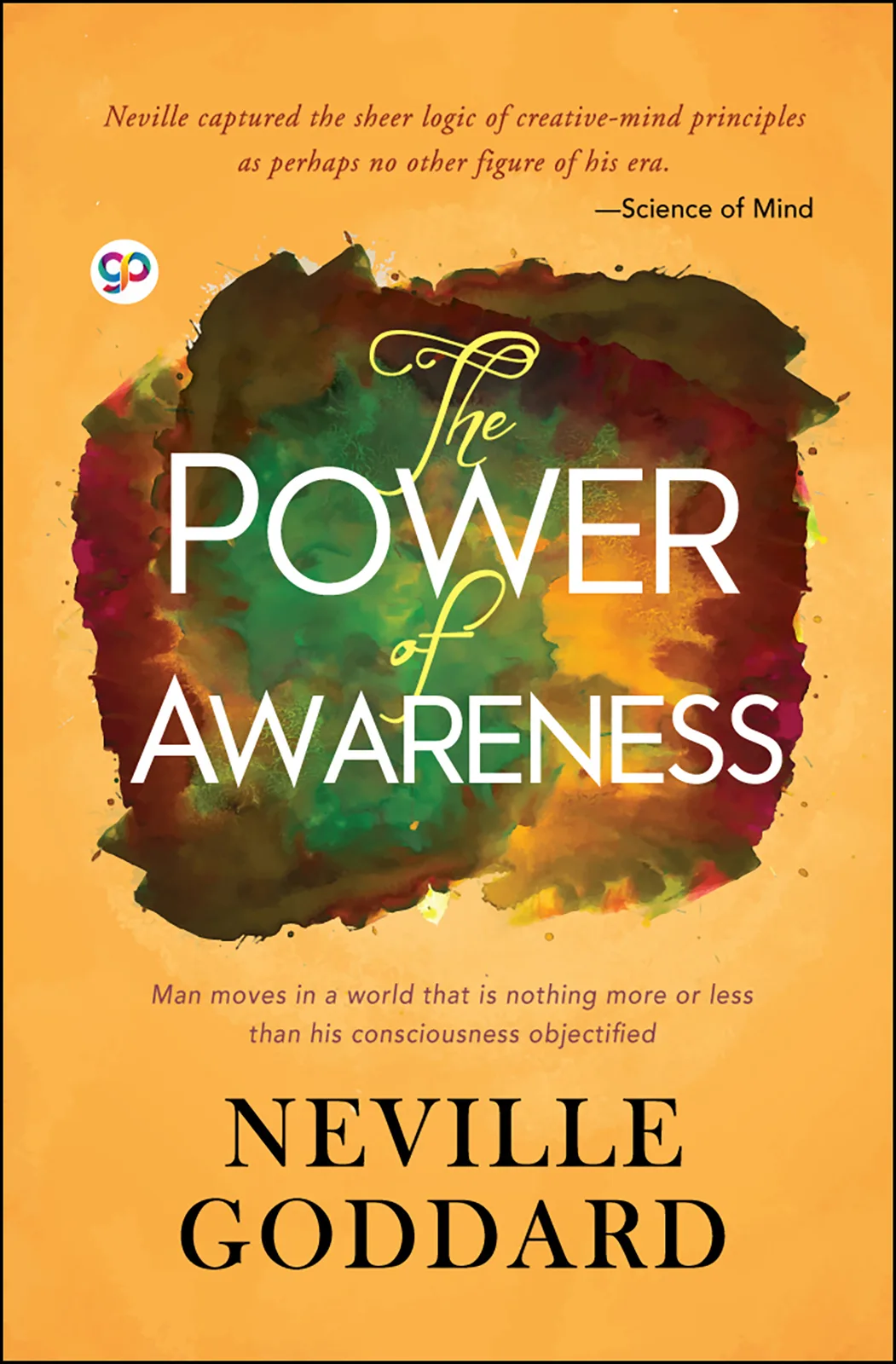
The Power of Awareness
Hardcover
• 120 Pages
• INR 345.00
• English
• 9789388118330
No ratings yet
| Publisher | General Press |
|---|---|
| ISBN13 | 9789388118330 |
| ASIN/SKU | 9388118332 |
| Book Format | Hardcover |
| Language | English |
| Pages | 120 |
| List Price | INR 345.00 |
| Subject Code | OCC027000, SEL038000, OCC039000, SEL031000 |
| Publishing Date | 22/08/2018 |
| Dimensions | 8.25 x 5.25 x 1.0 inches |
| Book Code | BD00067951 |
Buy this Book
Amazon Stores
Ebook Stores
Other Stores
Discover The Power of Awareness by Neville Goddard. This book is published by General Press in Hardcover format, ISBN 9789388118330, ASIN 9388118332, under Self-Help, Spirituality, Nonfiction.
Book Description
Neville Goddard’s "The Power of Awareness" is a profound, gently transformative guide that invites us to recognize the boundless creative power of our own minds. Written with beautiful clarity, the book steps away from traditional religious dogma to propose a radically empowering idea: that human consciousness is the very presence of God within us. Goddard argues that our external world is not a series of random, uncontrollable events, but rather a direct reflection of our internal beliefs, assumptions, and deeply held feelings.
At the heart of the book is the concept of 'assumption'. Goddard teaches that if we wish to change our lives, we must first change our concept of ourselves. With immense empathy for the struggles of the human condition, he explains that we do not need to fight or manipulate our outer circumstances. Instead, we must quietly, steadfastly assume the feeling of our wish already being fulfilled. By anchoring our imagination in the reality of our desired state, our external world naturally reshapes itself to match.
'The Power of Awareness' is far more than a manual for manifesting desires. It is a deeply humane call to spiritual maturity and self-responsibility. It reassures us that we are not helpless victims of fate, but the very architects of our destiny. Through lucid, comforting prose, Goddard leaves us with a timeless reminder: true freedom begins the moment we awaken to the quiet, miraculous power resting within our own awareness.
At the heart of the book is the concept of 'assumption'. Goddard teaches that if we wish to change our lives, we must first change our concept of ourselves. With immense empathy for the struggles of the human condition, he explains that we do not need to fight or manipulate our outer circumstances. Instead, we must quietly, steadfastly assume the feeling of our wish already being fulfilled. By anchoring our imagination in the reality of our desired state, our external world naturally reshapes itself to match.
'The Power of Awareness' is far more than a manual for manifesting desires. It is a deeply humane call to spiritual maturity and self-responsibility. It reassures us that we are not helpless victims of fate, but the very architects of our destiny. Through lucid, comforting prose, Goddard leaves us with a timeless reminder: true freedom begins the moment we awaken to the quiet, miraculous power resting within our own awareness.
Author Biography
Neville Lancelot Goddard (1905–1972) was a prominent and highly influential teacher in the New Thought movement, best known for his philosophy on the creative power of the human imagination. Born in St. Michael, Barbados, Goddard moved to New York City in 1922 to study drama. While working as a dancer and actor, his interests shifted toward mysticism after meeting an eccentric Ethiopian rabbi named Abdullah, who mentored him in Kabbalah, esoteric Christianity, and the psychological interpretation of scripture.
Leaving the theater behind, Neville dedicated his life to teaching what he termed "The Law of Assumption"—the principle that one can manifest their desires by vividly assuming the feeling of the wish fulfilled. Unlike many of his contemporaries, he taught that the Bible was not a historical record but a psychological drama mapping the evolution of human consciousness, asserting that the divine creator is the human imagination itself.
Throughout the mid-20th century, he delivered hundreds of unscripted lectures across the United States and authored foundational metaphysical classics, including Feeling is the Secret and The Power of Awareness. Today, Goddard’s visionary teachings continue to experience a massive resurgence, profoundly shaping modern self-help, spirituality, and manifestation philosophies.
Leaving the theater behind, Neville dedicated his life to teaching what he termed "The Law of Assumption"—the principle that one can manifest their desires by vividly assuming the feeling of the wish fulfilled. Unlike many of his contemporaries, he taught that the Bible was not a historical record but a psychological drama mapping the evolution of human consciousness, asserting that the divine creator is the human imagination itself.
Throughout the mid-20th century, he delivered hundreds of unscripted lectures across the United States and authored foundational metaphysical classics, including Feeling is the Secret and The Power of Awareness. Today, Goddard’s visionary teachings continue to experience a massive resurgence, profoundly shaping modern self-help, spirituality, and manifestation philosophies.
Editorial Reviews
Editorial Reviews will be added soon…
Book Summary
"The Power of Awareness" by Neville Goddard is a profound and deeply mystical exploration of human consciousness and its direct role in shaping our physical reality. At the very heart of Goddard’s philosophy is a startlingly simple yet radical premise: consciousness is the only true reality. He asserts that the physical world we navigate every day is not an independent, external construct, but rather a perfect, unyielding mirror reflecting our inner state of being. To understand this, Goddard introduces the concept of "I AM," which he identifies as the unconditioned awareness of being. This "I AM" is the fundamental truth of our existence, the divine spark within us, and the ultimate creative force in the universe. Before we are anything specific—before we are rich, poor, healthy, or sick—we simply exist as pure awareness. Recognizing this unconditioned consciousness is the crucial first step toward mastering the power that lies dormant within us, as it shifts our identity away from the limitations of the physical body and toward the limitless potential of the mind.
Building upon this foundation, Goddard explains that all meaningful changes in our lives must begin from within. Most people live in a state of constant struggle, attempting to manipulate external circumstances to find happiness, success, or peace. However, Goddard insists that this approach is fundamentally backward. Because the external world is nothing more than a delayed projection of our internal state, trying to change the outside without first changing the inside is as futile as trying to alter our reflection in a mirror by smashing the glass. Our self-concept—the deeply held beliefs, feelings, and assumptions we carry about who we are and what is true—dictates the exact circumstances we encounter. Therefore, the key to transforming our lives is not found in forceful action in the physical world, but in a radical shift in our own consciousness. We must become acutely aware of our inner dialogue and the subtle feelings we harbor, realizing that these invisible forces are the true architects of our destiny.
The practical application of this philosophy is encapsulated in what Goddard famously calls the Law of Assumption. This is perhaps the most impactful and widely recognized concept in the book. The Law of Assumption states that if we assume the feeling of our wish already fulfilled, our external reality will inevitably alter itself to match that internal assumption. It is not about wishing, hoping, or begging for something good to happen in the distant future. Instead, it requires us to step boldly into the psychological state of already being or having that which we desire in the present moment. By assuming this state, we bridge the gap between where we are and where we want to be. The assumption, even if completely denied by our physical senses and logical mind, will harden into fact if we persist in it. This requires a leap of faith—a willingness to trust the unseen reality of our imagination over the visible evidence of our current circumstances.
A mind-bending concept that Goddard introduces to support the Law of Assumption is the idea that creation is already finished. He proposes that every possible scenario, outcome, and state of being already exists simultaneously in the timeless, spaceless realm of eternity. We are not actually creating anything new when we desire a profound change in our lives; rather, we are simply moving our awareness to a reality that already exists. Think of it like walking through an infinite mansion with countless rooms. The room of wealth, the room of perfect health, and the room of loving relationships all exist right now in the unseen realm. Our job is simply to move our consciousness into the desired room and dwell there. Because creation is already complete, there is no need for anxiety, doubt, or strain. We do not have to figure out the exact mechanisms of how our desires will manifest. The means and the ways are automatically orchestrated by the deeper mind once we firmly anchor our consciousness in the end result.
Central to this transformative process is the unparalleled power of human feeling. Goddard is emphatic that intellectually understanding a desire is completely insufficient for its physical manifestation. A thought alone has no power to alter reality unless it is deeply impregnated with feeling. Feeling is the secret ingredient, the vital force that breathes life into a dormant assumption. When Goddard speaks of feeling, he doesn't necessarily mean intense emotional outbursts or forced excitement; rather, he refers to the deep, quiet conviction and psychological sensation of reality. It is the feeling of relief, gratitude, or quiet satisfaction that naturally accompanies the actual fulfillment of a desire. When we imagine our goal, we must engage our imaginary senses—we must touch, see, hear, and feel the reality of it in our minds as vividly as we do in the physical world. This sensory vividness in imagination convinces the subconscious mind that the experience is real, and the subconscious proceeds to objectify it.
To successfully maintain this feeling of the wish fulfilled, we must exercise ruthless control over our attention. Goddard points out that our attention is our most valuable currency. What we continuously pay attention to grows, and what we withdraw our attention from naturally withers and dies. Most of us live entirely reactive lives, allowing the daily news, the opinions of others, and our immediate physical hardships to dictate where our attention goes. To become conscious creators, we must undergo a strict mental diet. We must deliberately choose to focus only on those thoughts, feelings, and internal conversations that perfectly align with our desired state. When doubts, fears, or contradictory physical evidence arise, we must gently but firmly pull our attention away from them and redirect it back to our assumption. This is not about suppressing negativity, but rather about intentionally starving it of the conscious attention it needs to survive.
Ultimately, mastering the power of awareness means learning how to continuously "live in the end." This is the psychological practice of thinking from the goal rather than thinking of the goal. When we think of something, we are implicitly acknowledging that it is separate from us and resides somewhere out of reach in the future. When we think from it, we are declaring that we already possess it right now. We must view the world from the exact perspective of the person we wish to become. If our goal is to be a successful artist, we must stop hoping to be one someday and start walking, talking, and thinking like a successful artist today. This profound shift in identity changes our natural, spontaneous reactions to the world around us. Our everyday reactions are the truest test of our state of consciousness. If we still react to life's challenges from our old state of lack or fear, we have not truly assumed the new state.
Remaining faithful to an unseen reality when the physical senses are screaming the exact opposite is undeniably the greatest challenge in this practice. Goddard acknowledges this inherent human difficulty but offers a clear, uncompromising solution: relentless persistence. The physical world we see today is simply the delayed, hardened manifestation of our past thoughts and assumptions. It is a dead world, a lingering echo of what once was. When we persist in a new assumption, the old world must eventually collapse and rearrange itself to reflect the new inner truth. If we fail to see our desires manifest, it is only because we have broken our assumption and returned to our old, familiar state of consciousness. Faith, in Goddard's view, is not a blind belief in an external deity, but rather absolute, unshakable loyalty to the unseen reality of one's own imagination.
In the end, 'The Power of Awareness' is far more than a practical manual for acquiring wealth, health, or personal success. It is a profound spiritual awakening. It calls upon the reader to wake up from the heavy slumber of victimhood and realize their true, divine nature. By understanding that our own wonderful human imagination is the sole creator of our world, we are stripped of all excuses and forced to take absolute responsibility for our lives. There is no one to blame, no one to fight, and no one to change but ourselves. This realization can initially feel daunting, but it is ultimately the greatest liberation a human being can experience. We are freed from the tyranny of external circumstances, luck, and fate. We discover that we are the sole architects of our destiny, empowered to mold our reality through the simple, majestic, and transformative power of our own awareness.
Building upon this foundation, Goddard explains that all meaningful changes in our lives must begin from within. Most people live in a state of constant struggle, attempting to manipulate external circumstances to find happiness, success, or peace. However, Goddard insists that this approach is fundamentally backward. Because the external world is nothing more than a delayed projection of our internal state, trying to change the outside without first changing the inside is as futile as trying to alter our reflection in a mirror by smashing the glass. Our self-concept—the deeply held beliefs, feelings, and assumptions we carry about who we are and what is true—dictates the exact circumstances we encounter. Therefore, the key to transforming our lives is not found in forceful action in the physical world, but in a radical shift in our own consciousness. We must become acutely aware of our inner dialogue and the subtle feelings we harbor, realizing that these invisible forces are the true architects of our destiny.
The practical application of this philosophy is encapsulated in what Goddard famously calls the Law of Assumption. This is perhaps the most impactful and widely recognized concept in the book. The Law of Assumption states that if we assume the feeling of our wish already fulfilled, our external reality will inevitably alter itself to match that internal assumption. It is not about wishing, hoping, or begging for something good to happen in the distant future. Instead, it requires us to step boldly into the psychological state of already being or having that which we desire in the present moment. By assuming this state, we bridge the gap between where we are and where we want to be. The assumption, even if completely denied by our physical senses and logical mind, will harden into fact if we persist in it. This requires a leap of faith—a willingness to trust the unseen reality of our imagination over the visible evidence of our current circumstances.
A mind-bending concept that Goddard introduces to support the Law of Assumption is the idea that creation is already finished. He proposes that every possible scenario, outcome, and state of being already exists simultaneously in the timeless, spaceless realm of eternity. We are not actually creating anything new when we desire a profound change in our lives; rather, we are simply moving our awareness to a reality that already exists. Think of it like walking through an infinite mansion with countless rooms. The room of wealth, the room of perfect health, and the room of loving relationships all exist right now in the unseen realm. Our job is simply to move our consciousness into the desired room and dwell there. Because creation is already complete, there is no need for anxiety, doubt, or strain. We do not have to figure out the exact mechanisms of how our desires will manifest. The means and the ways are automatically orchestrated by the deeper mind once we firmly anchor our consciousness in the end result.
Central to this transformative process is the unparalleled power of human feeling. Goddard is emphatic that intellectually understanding a desire is completely insufficient for its physical manifestation. A thought alone has no power to alter reality unless it is deeply impregnated with feeling. Feeling is the secret ingredient, the vital force that breathes life into a dormant assumption. When Goddard speaks of feeling, he doesn't necessarily mean intense emotional outbursts or forced excitement; rather, he refers to the deep, quiet conviction and psychological sensation of reality. It is the feeling of relief, gratitude, or quiet satisfaction that naturally accompanies the actual fulfillment of a desire. When we imagine our goal, we must engage our imaginary senses—we must touch, see, hear, and feel the reality of it in our minds as vividly as we do in the physical world. This sensory vividness in imagination convinces the subconscious mind that the experience is real, and the subconscious proceeds to objectify it.
To successfully maintain this feeling of the wish fulfilled, we must exercise ruthless control over our attention. Goddard points out that our attention is our most valuable currency. What we continuously pay attention to grows, and what we withdraw our attention from naturally withers and dies. Most of us live entirely reactive lives, allowing the daily news, the opinions of others, and our immediate physical hardships to dictate where our attention goes. To become conscious creators, we must undergo a strict mental diet. We must deliberately choose to focus only on those thoughts, feelings, and internal conversations that perfectly align with our desired state. When doubts, fears, or contradictory physical evidence arise, we must gently but firmly pull our attention away from them and redirect it back to our assumption. This is not about suppressing negativity, but rather about intentionally starving it of the conscious attention it needs to survive.
Ultimately, mastering the power of awareness means learning how to continuously "live in the end." This is the psychological practice of thinking from the goal rather than thinking of the goal. When we think of something, we are implicitly acknowledging that it is separate from us and resides somewhere out of reach in the future. When we think from it, we are declaring that we already possess it right now. We must view the world from the exact perspective of the person we wish to become. If our goal is to be a successful artist, we must stop hoping to be one someday and start walking, talking, and thinking like a successful artist today. This profound shift in identity changes our natural, spontaneous reactions to the world around us. Our everyday reactions are the truest test of our state of consciousness. If we still react to life's challenges from our old state of lack or fear, we have not truly assumed the new state.
Remaining faithful to an unseen reality when the physical senses are screaming the exact opposite is undeniably the greatest challenge in this practice. Goddard acknowledges this inherent human difficulty but offers a clear, uncompromising solution: relentless persistence. The physical world we see today is simply the delayed, hardened manifestation of our past thoughts and assumptions. It is a dead world, a lingering echo of what once was. When we persist in a new assumption, the old world must eventually collapse and rearrange itself to reflect the new inner truth. If we fail to see our desires manifest, it is only because we have broken our assumption and returned to our old, familiar state of consciousness. Faith, in Goddard's view, is not a blind belief in an external deity, but rather absolute, unshakable loyalty to the unseen reality of one's own imagination.
In the end, 'The Power of Awareness' is far more than a practical manual for acquiring wealth, health, or personal success. It is a profound spiritual awakening. It calls upon the reader to wake up from the heavy slumber of victimhood and realize their true, divine nature. By understanding that our own wonderful human imagination is the sole creator of our world, we are stripped of all excuses and forced to take absolute responsibility for our lives. There is no one to blame, no one to fight, and no one to change but ourselves. This realization can initially feel daunting, but it is ultimately the greatest liberation a human being can experience. We are freed from the tyranny of external circumstances, luck, and fate. We discover that we are the sole architects of our destiny, empowered to mold our reality through the simple, majestic, and transformative power of our own awareness.
Sample Chapters
Chapter 1 : I Am
“All things when they are admitted are made manifest by the light: for everything that is made manifest is light.”
Ephesians 5:13
The “Light” is consciousness. Consciousness is one, manifesting in legions of forms or levels of consciousness. There is no one that is not all that is, for consciousness, though expressed in an infinite series of levels, is not divisional. There is no real separation or gap in consciousness. ‘I AM’ cannot be divided. I may conceive myself to be a rich man, a poor man, a beggar man or a thief, but the center of my being remains the same regardless of the concept I hold of myself. At the center of manifestation there is only one ‘I AM’ manifesting in legions of forms or concepts of itself and “I am that I am”.
‘I AM’ is the selfdefinition of the absolute, the foundation on which everything rests. ‘I AM’ is the first cause-substance. ‘I AM’ is the selfdefinition of God.
“I AM hath sent me unto you.”
“I AM THAT I AM.”
“Be still and know that I AM God.”
‘I AM’ is a feeling of permanent awareness. The very center of consciousness is the feeling of ‘I AM’ I may forget who I am, where I am, what I am but I cannot forget that I AM. The awareness of being remains, regardless of the degree of forgetfulness of who, where and what I am.
‘I AM’ is that which, amid unnumbered forms, is ever the same. This great discovery of cause reveals that, good or bad, man is actually the arbiter of his own fate, and that it is his concept of himself that determines the world in which he lives. In other words, if you are experiencing ill health, knowing the truth about cause, you cannot attribute the illness to anything other than to the particular arrangement of the basic cause-substance, an arrangement which is defined by your concept ‘I am unwell.’ This is why you are told “Let the weak man say, ‘I am strong’.” (Joel 3:10), for by his assumption, the cause-substance – ‘I AM’ – is rearranged and must, therefore, manifest that which its rearrangement affirms. This principle governs every aspect of your life, be it social, financial, intellectual, or spiritual.
‘I AM’ is that reality to which, whatever happens, we must turn for an explanation of the phenomena of life. It is ‘I AM’s’ concept of itself that determines the form and scenery of its existence. Everything depends upon its attitude towards itself; that which it will not affirm as true of itself cannot awaken in its world. That is, your concept of yourself, such as “I am strong,” “I am secure,” “I am loved,” determines the world in which you live. In other words, when you say, “I am a man, I am a father, I am an American,” you are not defining different ‘I AMs;’ you are defining different concepts or arrangements of the one cause-substance – the one ‘I AM’. Even in the phenomena of nature, if the tree were articulate, it would say, “I am a tree, an apple tree, a fruitful tree”.
When you know that consciousness is the one and only reality – conceiving itself to be something good, bad, or indifferent, and becoming that which it conceived itself to be – you are free from the tyranny of second causes, free from the belief that there are causes outside of your own mind that can affect your life.
In the state of consciousness of the individual is found the explanation of the phenomena of life. If man’s concept of himself were different, everything in his world would be different. His concept of himself being what it is, everything in his world must be as it is.
Thus it is abundantly clear that there is only one I AM and you are that I AM. And while I AM is infinite, you, by your concept of yourself, are displaying only a limited aspect of the infinite ‘I AM.’
“Build thee more stately mansions, O my soul,
As the swift seasons roll!
Leave thy low-vaulted past!
Let each new temple, nobler than the last,
Shut thee from heaven with a dome more vast
Till thou at length art free,
Leaving thine outgrown shell by life’s unresting sea!”
Chapter 2 : Consciousness
It is only by a change of consciousness, by actually changing your concept of yourself that you can “build more stately mansions” – the manifestations of higher and higher concepts. (By manifesting is meant experiencing the results of these concepts in your world.) It is of vital importance to understand clearly just what consciousness is.
The reason lies in the fact that consciousness is the one and only reality, it is the first and only cause-substance of the phenomena of life. Nothing has existence for man save through the consciousness he has of it. Therefore, it is to consciousness you must turn, for it is the only foundation on which the phenomena of life can be explained.
If we accept the idea of a first cause, it would follow that the evolution of that cause could never result in anything foreign to itself. That is, if the first cause-substance is light, all its evolutions, fruits and manifestations would remain light. The first cause-substance being consciousness, all its evolutions, fruits, and phenomena must remain consciousness. All that could be observed would be a higher or lower form or variation of the same thing. In other words, if your consciousness is the only reality, it must also be the only substance. Consequently, what appears to you as circumstances, conditions and even material objects are really only the products of your own consciousness. Nature, then, as a thing or a complex of things external to your mind, must be rejected. You and your environment cannot be regarded as existing separately. You and your world are one.
Therefore, you must turn from the objective appearance of things to the subjective center of things, your consciousness, if you truly desire to know the cause of the phenomena of life, and how to use this knowledge to realize your fondest dreams. In the midst of the apparent contradictions, antagonisms, and contrasts of your life, there is only one principle at work, only your consciousness operating. Difference does not consist in variety of substance, but in variety of arrangement of the same cause-substance, your consciousness.
The world moves with motiveless necessity. By this is meant that it has no motive of its own, but is under the necessity of manifesting your concept, the arrangement of your mind, and your mind is always arranged in the image of all you believe and consent to as true. The rich man, poor man, beggar man or thief are not different minds, but different arrangements of the same mind, in the same sense that a piece of steel, when magnetized, differs not in substance from its demagnetized state but in the arrangement and order of its molecules. A single electron revolving in a specified orbit constitutes the unit of magnetism. When a piece of steel or anything else is demagnetized, the revolving electrons have not stopped. Therefore, the magnetism has not gone out of existence. There is only a rearrangement of the particles, so that they produce no outside or perceptible effect. When particles are arranged at random, mixed up in all directions, the substance is said to be demagnetized; but when particles are marshalled in ranks so that a number of them face in one direction, the substance is a magnet. Magnetism is not generated; it is displayed. Health, wealth, beauty, and genius are not created; they are only manifested by the arrangement of your mind – that is, by your concept of yourself. The importance of this in your daily life should be immediately apparent.
The basic nature of the primal cause is consciousness. Therefore, the ultimate substance of all things is consciousness.
Chapter 3 : Power of Assumption
Man’s chief delusion is his conviction that there are causes other than his own state of consciousness. All that befalls a man – all that is done by him – all that comes from him – happens as a result of his state of consciousness. A man’s consciousness is all that he thinks and desires and loves, all that he believes is true and consents to. That is why a change of consciousness is necessary before you can change your outer world. Rain falls as a result of a change in the temperature in the higher regions of the atmosphere, so, in like manner, a change of circumstance happens as a result of a change in your state of consciousness.
“Be ye transformed by the renewing of your mind.”
To be transformed, the whole basis of your thoughts must change. But your thoughts cannot change unless you have new ideas, for you think from your ideas. All transformation begins with an intense, burning desire to be transformed. The first step in the ‘renewing of the mind’ is desire. You must want to be different before you can begin to change yourself. Then you must make your future dream a present fact. You do this by assuming the feeling of your wish fulfilled. By desiring to be other than what you are, you can create an ideal of the person you want to be and assume that you are already that person. If this assumption is persisted in until it becomes your dominant feeling, the attainment of your ideal is inevitable. The ideal you hope to achieve is always ready for an incarnation, but unless you yourself offer it human parentage, it is incapable of birth. Therefore, your attitude should be one in which – having desired to express a higher state – you alone accept the task of incarnating this new and greater value of yourself.
In giving birth to your ideal you must bear in mind that the methods of mental and spiritual knowledge are entirely different. This is a point that is truly understood by probably not more than one person in a million. You know a thing mentally by looking at it from the outside, by comparing it with other things, by analyzing it and defining it; whereas you can know a thing spiritually only by becoming it. You must be the thing itself and not merely talk about it or look at it. You must be like the moth in search of his idol, the flame,
“who spurred with true desire, plunging at once into the sacred fire, folded his wings within, till he became one color and one substance with the flame. He only knew the flame who in it burned, and only he could tell who ne’er to tell returned.”
Just as the moth in his desire to know the flame was willing to destroy himself, so must you in becoming a new person be willing to die to your present self.
You must be conscious of being healthy if you are to know what health is. You must be conscious of being secure if you are to know what security is. Therefore, to incarnate a new and greater value of yourself, you must assume that you already are what you want to be and then live by faith in this assumption – which is not yet incarnate in the body of your life – in confidence that this new value or state of consciousness will become incarnated through your absolute fidelity to the assumption that you are that which you desire to be. This is what wholeness means, what integrity means. They mean submission of the whole self to the feeling of the wish fulfilled in certainty that that new state of consciousness is the renewing of mind which transforms. There is no order in Nature corresponding to this willing submission of the self to the ideal beyond the self. Therefore, it is the height of folly to expect the incarnation of a new and greater concept of self to come about by natural evolutionary process. That which requires a state of consciousness to produce its effect obviously cannot be effected without such a state of consciousness, and in your ability to assume the feeling of a greater life, to assume a new concept of yourself, you possess what the rest of Nature does not possess – Imagination – the instrument by which you create your world.
Your imagination is the instrument, the means, whereby your redemption from slavery, sickness, and poverty is effected. If you refuse to assume the responsibility of the incarnation of a new and higher concept of yourself, then you reject the means, the only means, whereby your redemption – that is, the attainment of your ideal – can be effected.
Imagination is the only redemptive power in the universe. However, your nature is such that it is optional to you whether you remain in your present concept of yourself (a hungry being longing for freedom, health, and security) or choose to become the instrument of your own redemption, imagining yourself as that which you want to be, and thereby satisfying your hunger and redeeming yourself.
“O be strong then, and brave, pure, patient and true;
The work that is yours let no other hand do.
For the strength for all need is faithfully given
From the fountain within you – The Kingdom of Heaven.”
“All things when they are admitted are made manifest by the light: for everything that is made manifest is light.”
Ephesians 5:13
The “Light” is consciousness. Consciousness is one, manifesting in legions of forms or levels of consciousness. There is no one that is not all that is, for consciousness, though expressed in an infinite series of levels, is not divisional. There is no real separation or gap in consciousness. ‘I AM’ cannot be divided. I may conceive myself to be a rich man, a poor man, a beggar man or a thief, but the center of my being remains the same regardless of the concept I hold of myself. At the center of manifestation there is only one ‘I AM’ manifesting in legions of forms or concepts of itself and “I am that I am”.
‘I AM’ is the selfdefinition of the absolute, the foundation on which everything rests. ‘I AM’ is the first cause-substance. ‘I AM’ is the selfdefinition of God.
“I AM hath sent me unto you.”
“I AM THAT I AM.”
“Be still and know that I AM God.”
‘I AM’ is a feeling of permanent awareness. The very center of consciousness is the feeling of ‘I AM’ I may forget who I am, where I am, what I am but I cannot forget that I AM. The awareness of being remains, regardless of the degree of forgetfulness of who, where and what I am.
‘I AM’ is that which, amid unnumbered forms, is ever the same. This great discovery of cause reveals that, good or bad, man is actually the arbiter of his own fate, and that it is his concept of himself that determines the world in which he lives. In other words, if you are experiencing ill health, knowing the truth about cause, you cannot attribute the illness to anything other than to the particular arrangement of the basic cause-substance, an arrangement which is defined by your concept ‘I am unwell.’ This is why you are told “Let the weak man say, ‘I am strong’.” (Joel 3:10), for by his assumption, the cause-substance – ‘I AM’ – is rearranged and must, therefore, manifest that which its rearrangement affirms. This principle governs every aspect of your life, be it social, financial, intellectual, or spiritual.
‘I AM’ is that reality to which, whatever happens, we must turn for an explanation of the phenomena of life. It is ‘I AM’s’ concept of itself that determines the form and scenery of its existence. Everything depends upon its attitude towards itself; that which it will not affirm as true of itself cannot awaken in its world. That is, your concept of yourself, such as “I am strong,” “I am secure,” “I am loved,” determines the world in which you live. In other words, when you say, “I am a man, I am a father, I am an American,” you are not defining different ‘I AMs;’ you are defining different concepts or arrangements of the one cause-substance – the one ‘I AM’. Even in the phenomena of nature, if the tree were articulate, it would say, “I am a tree, an apple tree, a fruitful tree”.
When you know that consciousness is the one and only reality – conceiving itself to be something good, bad, or indifferent, and becoming that which it conceived itself to be – you are free from the tyranny of second causes, free from the belief that there are causes outside of your own mind that can affect your life.
In the state of consciousness of the individual is found the explanation of the phenomena of life. If man’s concept of himself were different, everything in his world would be different. His concept of himself being what it is, everything in his world must be as it is.
Thus it is abundantly clear that there is only one I AM and you are that I AM. And while I AM is infinite, you, by your concept of yourself, are displaying only a limited aspect of the infinite ‘I AM.’
“Build thee more stately mansions, O my soul,
As the swift seasons roll!
Leave thy low-vaulted past!
Let each new temple, nobler than the last,
Shut thee from heaven with a dome more vast
Till thou at length art free,
Leaving thine outgrown shell by life’s unresting sea!”
Chapter 2 : Consciousness
It is only by a change of consciousness, by actually changing your concept of yourself that you can “build more stately mansions” – the manifestations of higher and higher concepts. (By manifesting is meant experiencing the results of these concepts in your world.) It is of vital importance to understand clearly just what consciousness is.
The reason lies in the fact that consciousness is the one and only reality, it is the first and only cause-substance of the phenomena of life. Nothing has existence for man save through the consciousness he has of it. Therefore, it is to consciousness you must turn, for it is the only foundation on which the phenomena of life can be explained.
If we accept the idea of a first cause, it would follow that the evolution of that cause could never result in anything foreign to itself. That is, if the first cause-substance is light, all its evolutions, fruits and manifestations would remain light. The first cause-substance being consciousness, all its evolutions, fruits, and phenomena must remain consciousness. All that could be observed would be a higher or lower form or variation of the same thing. In other words, if your consciousness is the only reality, it must also be the only substance. Consequently, what appears to you as circumstances, conditions and even material objects are really only the products of your own consciousness. Nature, then, as a thing or a complex of things external to your mind, must be rejected. You and your environment cannot be regarded as existing separately. You and your world are one.
Therefore, you must turn from the objective appearance of things to the subjective center of things, your consciousness, if you truly desire to know the cause of the phenomena of life, and how to use this knowledge to realize your fondest dreams. In the midst of the apparent contradictions, antagonisms, and contrasts of your life, there is only one principle at work, only your consciousness operating. Difference does not consist in variety of substance, but in variety of arrangement of the same cause-substance, your consciousness.
The world moves with motiveless necessity. By this is meant that it has no motive of its own, but is under the necessity of manifesting your concept, the arrangement of your mind, and your mind is always arranged in the image of all you believe and consent to as true. The rich man, poor man, beggar man or thief are not different minds, but different arrangements of the same mind, in the same sense that a piece of steel, when magnetized, differs not in substance from its demagnetized state but in the arrangement and order of its molecules. A single electron revolving in a specified orbit constitutes the unit of magnetism. When a piece of steel or anything else is demagnetized, the revolving electrons have not stopped. Therefore, the magnetism has not gone out of existence. There is only a rearrangement of the particles, so that they produce no outside or perceptible effect. When particles are arranged at random, mixed up in all directions, the substance is said to be demagnetized; but when particles are marshalled in ranks so that a number of them face in one direction, the substance is a magnet. Magnetism is not generated; it is displayed. Health, wealth, beauty, and genius are not created; they are only manifested by the arrangement of your mind – that is, by your concept of yourself. The importance of this in your daily life should be immediately apparent.
The basic nature of the primal cause is consciousness. Therefore, the ultimate substance of all things is consciousness.
Chapter 3 : Power of Assumption
Man’s chief delusion is his conviction that there are causes other than his own state of consciousness. All that befalls a man – all that is done by him – all that comes from him – happens as a result of his state of consciousness. A man’s consciousness is all that he thinks and desires and loves, all that he believes is true and consents to. That is why a change of consciousness is necessary before you can change your outer world. Rain falls as a result of a change in the temperature in the higher regions of the atmosphere, so, in like manner, a change of circumstance happens as a result of a change in your state of consciousness.
“Be ye transformed by the renewing of your mind.”
To be transformed, the whole basis of your thoughts must change. But your thoughts cannot change unless you have new ideas, for you think from your ideas. All transformation begins with an intense, burning desire to be transformed. The first step in the ‘renewing of the mind’ is desire. You must want to be different before you can begin to change yourself. Then you must make your future dream a present fact. You do this by assuming the feeling of your wish fulfilled. By desiring to be other than what you are, you can create an ideal of the person you want to be and assume that you are already that person. If this assumption is persisted in until it becomes your dominant feeling, the attainment of your ideal is inevitable. The ideal you hope to achieve is always ready for an incarnation, but unless you yourself offer it human parentage, it is incapable of birth. Therefore, your attitude should be one in which – having desired to express a higher state – you alone accept the task of incarnating this new and greater value of yourself.
In giving birth to your ideal you must bear in mind that the methods of mental and spiritual knowledge are entirely different. This is a point that is truly understood by probably not more than one person in a million. You know a thing mentally by looking at it from the outside, by comparing it with other things, by analyzing it and defining it; whereas you can know a thing spiritually only by becoming it. You must be the thing itself and not merely talk about it or look at it. You must be like the moth in search of his idol, the flame,
“who spurred with true desire, plunging at once into the sacred fire, folded his wings within, till he became one color and one substance with the flame. He only knew the flame who in it burned, and only he could tell who ne’er to tell returned.”
Just as the moth in his desire to know the flame was willing to destroy himself, so must you in becoming a new person be willing to die to your present self.
You must be conscious of being healthy if you are to know what health is. You must be conscious of being secure if you are to know what security is. Therefore, to incarnate a new and greater value of yourself, you must assume that you already are what you want to be and then live by faith in this assumption – which is not yet incarnate in the body of your life – in confidence that this new value or state of consciousness will become incarnated through your absolute fidelity to the assumption that you are that which you desire to be. This is what wholeness means, what integrity means. They mean submission of the whole self to the feeling of the wish fulfilled in certainty that that new state of consciousness is the renewing of mind which transforms. There is no order in Nature corresponding to this willing submission of the self to the ideal beyond the self. Therefore, it is the height of folly to expect the incarnation of a new and greater concept of self to come about by natural evolutionary process. That which requires a state of consciousness to produce its effect obviously cannot be effected without such a state of consciousness, and in your ability to assume the feeling of a greater life, to assume a new concept of yourself, you possess what the rest of Nature does not possess – Imagination – the instrument by which you create your world.
Your imagination is the instrument, the means, whereby your redemption from slavery, sickness, and poverty is effected. If you refuse to assume the responsibility of the incarnation of a new and higher concept of yourself, then you reject the means, the only means, whereby your redemption – that is, the attainment of your ideal – can be effected.
Imagination is the only redemptive power in the universe. However, your nature is such that it is optional to you whether you remain in your present concept of yourself (a hungry being longing for freedom, health, and security) or choose to become the instrument of your own redemption, imagining yourself as that which you want to be, and thereby satisfying your hunger and redeeming yourself.
“O be strong then, and brave, pure, patient and true;
The work that is yours let no other hand do.
For the strength for all need is faithfully given
From the fountain within you – The Kingdom of Heaven.”
Reader Reviews
No reviews yet.
The Power of Awareness
Download Cover Image
Do you want to download the full cover image for The Power of Awareness?