
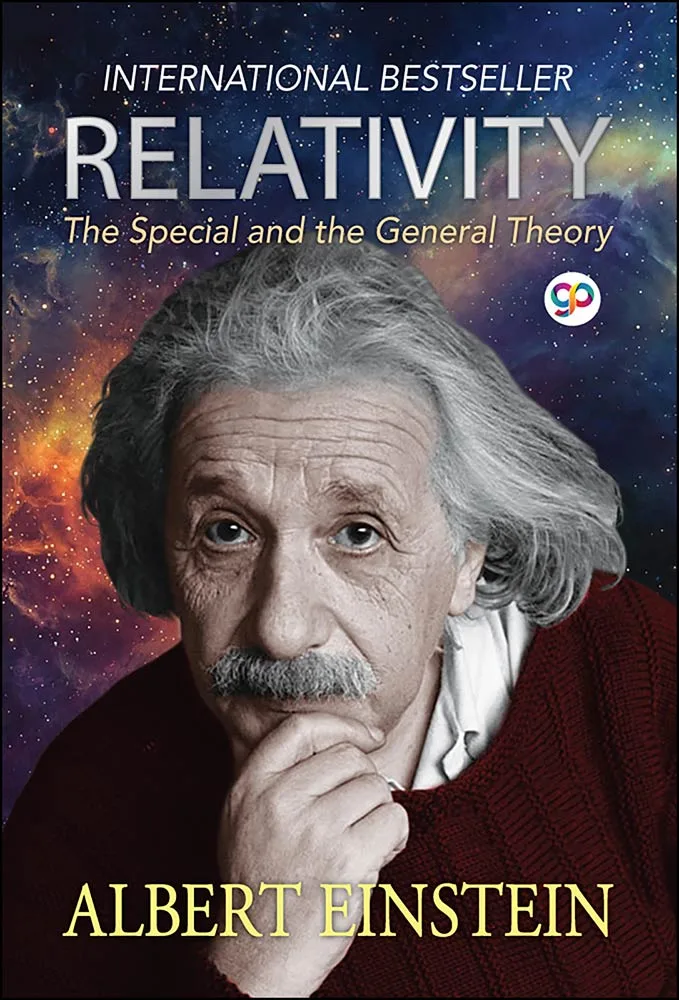
Relativity: The Special and the General Theory
Paperback
• 192 Pages
• INR 395.01
• English
• 9789380914220
No ratings yet
| Publisher | General Press |
|---|---|
| ISBN13 | 9789380914220 |
| ASIN/SKU | 9380914229 |
| Book Format | Paperback |
| Language | English |
| Pages | 192 |
| List Price | INR 395.01 |
| Subject Code | SCI061000, SCI004000, SCI034000 |
| Publishing Date | 01/05/2013 |
| Dimensions | 8.25 x 5.25 x 1.0 inches |
| Book Code | BD00067952 |
Buy this Book
Amazon Stores
Ebook Stores
Other Stores
Discover Relativity: The Special and the General Theory by Albert Einstein. This book is published by General Press in Paperback format, ISBN 9789380914220, ASIN 9380914229, under Science and Math, Classics, Nonfiction.
Book Description
What if time could slow down, space could bend, and the passage of a second could depend on how fast you were moving? In 'Relativity: The Special and the General Theory', Albert Einstein presents a groundbreaking science and physics classic that introduces readers to the revolutionary ideas that transformed our understanding of space, time, motion, gravity, and the universe itself.
Written to make his theories accessible beyond the world of professional physicists, Einstein begins with the foundations of special relativity, exploring how measurements of time and distance change for observers moving relative to one another. Instead of treating time as something universal and fixed, he shows that our measurements of time and space are connected to the observer's motion. From this seemingly simple shift emerges one of the most famous ideas in modern science: the relationship between mass and energy.
The book then moves from special relativity toward the broader and more challenging theory of general relativity. Here, Einstein rethinks gravity itself. Rather than describing gravity simply as a force acting between objects, he explains it through the geometry of space and time. Matter and energy influence the structure of spacetime, while that structure determines how objects move. This new way of looking at gravity offers a striking explanation of phenomena that classical physics could not fully account for.
Einstein does not merely present abstract equations; he carefully builds the concepts that allow readers to understand why his theories matter. Thought experiments, familiar physical situations, and logical explanations help reveal how ordinary assumptions about space, time, motion, and gravity begin to change when examined closely. The result is both an introduction to revolutionary physics and a glimpse into the remarkable way scientific thinking can overturn ideas that once seemed unquestionable.
'Relativity: The Special and the General Theory' remains an influential and surprisingly approachable guide to one of the greatest intellectual revolutions of the twentieth century. For anyone curious about Einstein's theory of relativity and the hidden structure of the universe, this book offers a fascinating journey into ideas that continue to shape how we understand reality.
Written to make his theories accessible beyond the world of professional physicists, Einstein begins with the foundations of special relativity, exploring how measurements of time and distance change for observers moving relative to one another. Instead of treating time as something universal and fixed, he shows that our measurements of time and space are connected to the observer's motion. From this seemingly simple shift emerges one of the most famous ideas in modern science: the relationship between mass and energy.
The book then moves from special relativity toward the broader and more challenging theory of general relativity. Here, Einstein rethinks gravity itself. Rather than describing gravity simply as a force acting between objects, he explains it through the geometry of space and time. Matter and energy influence the structure of spacetime, while that structure determines how objects move. This new way of looking at gravity offers a striking explanation of phenomena that classical physics could not fully account for.
Einstein does not merely present abstract equations; he carefully builds the concepts that allow readers to understand why his theories matter. Thought experiments, familiar physical situations, and logical explanations help reveal how ordinary assumptions about space, time, motion, and gravity begin to change when examined closely. The result is both an introduction to revolutionary physics and a glimpse into the remarkable way scientific thinking can overturn ideas that once seemed unquestionable.
'Relativity: The Special and the General Theory' remains an influential and surprisingly approachable guide to one of the greatest intellectual revolutions of the twentieth century. For anyone curious about Einstein's theory of relativity and the hidden structure of the universe, this book offers a fascinating journey into ideas that continue to shape how we understand reality.
Author Biography
Albert Einstein is often remembered as a symbol of pure, unapproachable genius, but the man behind the messy hair was profoundly human. Born in Ulm, Germany, in 1879, he was not a child prodigy. He spoke late and struggled with the rigid, authoritarian schooling of his time. Yet, a simple gift from his father—a pocket compass—sparked a lifelong fascination with the unseen forces of the universe. He simply wanted to know how the world worked.
Because he did not fit the traditional academic mold, Einstein struggled to find a teaching job after graduating. He eventually settled as a clerk at the Swiss Patent Office. In that quiet room in Bern, surrounded by blueprints of clocks and trains, he let his imagination roam freely. In 1905, during what is now known as his "miracle year," the 26-year-old published four papers that completely rewrote the laws of physics. He revealed that space and time are not fixed, but woven together, forever changing our understanding of reality.
Despite winning the Nobel Prize in 1921 and becoming the most famous scientist on the planet, Einstein remained incredibly grounded. He was a gentle soul who loved playing the violin, sailing, and walking without socks. As dark political clouds gathered over Europe in the 1930s, his Jewish heritage made him a target in Nazi Germany. He was forced to leave his homeland, eventually finding refuge in Princeton, New Jersey.
In the United States, Einstein used his immense platform not just for science, but for humanity. He spoke out passionately for civil rights, pacifism, and global cooperation. He deeply regretted the way his equations ultimately paved the way for nuclear weapons, spending his final years advocating for peace.
When he passed away in 1955, the world lost more than a brilliant physicist. It lost a deeply compassionate thinker who showed us that imagination is more important than knowledge, and that curiosity is the greatest gift of the human spirit.
Because he did not fit the traditional academic mold, Einstein struggled to find a teaching job after graduating. He eventually settled as a clerk at the Swiss Patent Office. In that quiet room in Bern, surrounded by blueprints of clocks and trains, he let his imagination roam freely. In 1905, during what is now known as his "miracle year," the 26-year-old published four papers that completely rewrote the laws of physics. He revealed that space and time are not fixed, but woven together, forever changing our understanding of reality.
Despite winning the Nobel Prize in 1921 and becoming the most famous scientist on the planet, Einstein remained incredibly grounded. He was a gentle soul who loved playing the violin, sailing, and walking without socks. As dark political clouds gathered over Europe in the 1930s, his Jewish heritage made him a target in Nazi Germany. He was forced to leave his homeland, eventually finding refuge in Princeton, New Jersey.
In the United States, Einstein used his immense platform not just for science, but for humanity. He spoke out passionately for civil rights, pacifism, and global cooperation. He deeply regretted the way his equations ultimately paved the way for nuclear weapons, spending his final years advocating for peace.
When he passed away in 1955, the world lost more than a brilliant physicist. It lost a deeply compassionate thinker who showed us that imagination is more important than knowledge, and that curiosity is the greatest gift of the human spirit.
Editorial Reviews
Editorial Reviews will be added soon…
Book Summary
Relativity: The Special and the General Theory by Albert Einstein is a clear and influential introduction to the ideas behind his theories of special and general relativity. Written for readers without advanced mathematical training, the book explains how our ordinary ideas about space, time, motion, gravity, and the physical world must change when examined carefully. Einstein does not present relativity merely as a collection of difficult scientific formulas. He presents it as a new way of thinking about nature, built on simple questions about how observers measure events.
The book begins by examining one of the concepts people usually take for granted: simultaneity. In everyday life, we assume that two events either happen at the same time or they do not. Einstein shows that this seemingly simple idea depends on the observer. If two lightning strikes occur at different points along a railway track, a person standing midway between them may judge them to be simultaneous. But a person moving toward one flash and away from the other may receive the light at different times and reach a different conclusion. There is therefore no universal, absolute definition of “at the same time.”
This leads Einstein to one of the central ideas of special relativity: measurements of space and time depend on the motion of the observer. Classical physics had treated space and time as separate and absolute backgrounds within which events occurred. Einstein argues instead that space and time are interconnected and that their measurements change according to the relative motion of observers.
The theory is based on two fundamental principles. First, the laws of physics have the same form for all observers moving at constant velocity relative to one another. Second, the speed of light in a vacuum is the same for all such observers, regardless of the motion of the source or observer. The second principle is especially surprising because ordinary experience suggests that velocities should simply add together. Light does not behave in this familiar way.
From these principles come several remarkable consequences. One is time dilation: a moving clock is measured to run more slowly relative to an observer for whom the clock is moving. Another is length contraction: an object moving at high speed is measured to be shorter along its direction of motion. These effects are not mechanical distortions caused by some physical pressure. They arise from the structure of space and time itself.
Einstein also explains how the theory changes our understanding of mass and energy. The famous relation E = mc² expresses the equivalence of mass and energy. Because the speed of light squared is an enormous number, even a small amount of mass corresponds to a tremendous amount of energy. This principle later became fundamental to nuclear physics and helped explain the enormous energy released in nuclear reactions.
After discussing special relativity, Einstein turns to gravity. Newton had described gravity as a force acting between masses. His theory was enormously successful, but Einstein recognized that the Newtonian picture was not completely compatible with special relativity. He therefore searched for a deeper description of gravity.
The key to general relativity comes from what Einstein calls the equivalence of gravitational and inertial effects. Imagine an observer inside a closed elevator. If the elevator is accelerating upward in empty space, objects released inside it appear to fall toward the floor. The observer cannot, from inside the elevator alone, easily distinguish this experience from the effect of a gravitational field. This simple thought experiment leads Einstein toward a revolutionary interpretation of gravity.
Instead of treating gravity as an ordinary force acting across empty space, general relativity describes gravity as a consequence of the curvature of spacetime. Matter and energy influence the geometry of spacetime, and objects move according to that geometry. In this picture, planets orbit the Sun not because an invisible force simply pulls them through otherwise fixed space, but because the Sun changes the geometry around it.
This new understanding also changes the meaning of time. Gravity affects clocks. A clock closer to a massive body runs differently from a clock farther away. Time therefore does not pass at exactly the same rate everywhere. Space and time are influenced by gravity, making the universe a dynamic geometric structure rather than a rigid stage.
Einstein then considers how light behaves in a gravitational field. If spacetime is curved, the path of light can also be affected. This leads to the prediction that light passing near a massive object, such as the Sun, should be deflected. Observations during the solar eclipse of 1919 provided famous evidence supporting this prediction and helped make Einstein an international scientific celebrity.
The book also discusses the motion of planets, particularly Mercury. Newtonian calculations could not completely explain a small irregularity in Mercury’s orbit. General relativity successfully accounts for this discrepancy. Einstein presents this as an important example of how the new theory explains phenomena that had resisted classical physics.
As the discussion develops, Einstein emphasizes that scientific theories are not simply collections of facts. They are frameworks for organizing observations. Concepts such as space, time, motion, and gravity are tools through which human beings understand physical reality. When observations reveal limitations in an old framework, science must be willing to rethink even its most familiar assumptions.
One of the most important features of the book is Einstein’s use of thought experiments. Rather than overwhelming the reader with mathematics, he asks us to imagine trains, clocks, elevators, light rays, and observers moving through space. These imagined situations reveal contradictions in ordinary assumptions and make the deeper principles easier to understand.
Ultimately, Relativity: The Special and the General Theory presents a profound change in humanity’s understanding of the universe. Space and time are not absolute, gravity is connected to the geometry of spacetime, and measurements depend upon the observer’s state of motion and position in a gravitational field. Yet Einstein’s purpose is not to make the universe seem impossibly strange. On the contrary, he shows that once we abandon certain intuitive assumptions, nature becomes more coherent.
The enduring lesson of the book is that reality can be very different from everyday experience. Human intuition evolved for ordinary speeds, distances, and gravitational conditions, so the deeper structure of nature may remain hidden until we learn to question what seems obvious. Einstein’s great achievement was not merely discovering new equations but teaching us to look at the universe differently. His theory reminds us that scientific progress often begins with a simple but courageous act: asking whether the things we have always assumed to be true are really true.
The book begins by examining one of the concepts people usually take for granted: simultaneity. In everyday life, we assume that two events either happen at the same time or they do not. Einstein shows that this seemingly simple idea depends on the observer. If two lightning strikes occur at different points along a railway track, a person standing midway between them may judge them to be simultaneous. But a person moving toward one flash and away from the other may receive the light at different times and reach a different conclusion. There is therefore no universal, absolute definition of “at the same time.”
This leads Einstein to one of the central ideas of special relativity: measurements of space and time depend on the motion of the observer. Classical physics had treated space and time as separate and absolute backgrounds within which events occurred. Einstein argues instead that space and time are interconnected and that their measurements change according to the relative motion of observers.
The theory is based on two fundamental principles. First, the laws of physics have the same form for all observers moving at constant velocity relative to one another. Second, the speed of light in a vacuum is the same for all such observers, regardless of the motion of the source or observer. The second principle is especially surprising because ordinary experience suggests that velocities should simply add together. Light does not behave in this familiar way.
From these principles come several remarkable consequences. One is time dilation: a moving clock is measured to run more slowly relative to an observer for whom the clock is moving. Another is length contraction: an object moving at high speed is measured to be shorter along its direction of motion. These effects are not mechanical distortions caused by some physical pressure. They arise from the structure of space and time itself.
Einstein also explains how the theory changes our understanding of mass and energy. The famous relation E = mc² expresses the equivalence of mass and energy. Because the speed of light squared is an enormous number, even a small amount of mass corresponds to a tremendous amount of energy. This principle later became fundamental to nuclear physics and helped explain the enormous energy released in nuclear reactions.
After discussing special relativity, Einstein turns to gravity. Newton had described gravity as a force acting between masses. His theory was enormously successful, but Einstein recognized that the Newtonian picture was not completely compatible with special relativity. He therefore searched for a deeper description of gravity.
The key to general relativity comes from what Einstein calls the equivalence of gravitational and inertial effects. Imagine an observer inside a closed elevator. If the elevator is accelerating upward in empty space, objects released inside it appear to fall toward the floor. The observer cannot, from inside the elevator alone, easily distinguish this experience from the effect of a gravitational field. This simple thought experiment leads Einstein toward a revolutionary interpretation of gravity.
Instead of treating gravity as an ordinary force acting across empty space, general relativity describes gravity as a consequence of the curvature of spacetime. Matter and energy influence the geometry of spacetime, and objects move according to that geometry. In this picture, planets orbit the Sun not because an invisible force simply pulls them through otherwise fixed space, but because the Sun changes the geometry around it.
This new understanding also changes the meaning of time. Gravity affects clocks. A clock closer to a massive body runs differently from a clock farther away. Time therefore does not pass at exactly the same rate everywhere. Space and time are influenced by gravity, making the universe a dynamic geometric structure rather than a rigid stage.
Einstein then considers how light behaves in a gravitational field. If spacetime is curved, the path of light can also be affected. This leads to the prediction that light passing near a massive object, such as the Sun, should be deflected. Observations during the solar eclipse of 1919 provided famous evidence supporting this prediction and helped make Einstein an international scientific celebrity.
The book also discusses the motion of planets, particularly Mercury. Newtonian calculations could not completely explain a small irregularity in Mercury’s orbit. General relativity successfully accounts for this discrepancy. Einstein presents this as an important example of how the new theory explains phenomena that had resisted classical physics.
As the discussion develops, Einstein emphasizes that scientific theories are not simply collections of facts. They are frameworks for organizing observations. Concepts such as space, time, motion, and gravity are tools through which human beings understand physical reality. When observations reveal limitations in an old framework, science must be willing to rethink even its most familiar assumptions.
One of the most important features of the book is Einstein’s use of thought experiments. Rather than overwhelming the reader with mathematics, he asks us to imagine trains, clocks, elevators, light rays, and observers moving through space. These imagined situations reveal contradictions in ordinary assumptions and make the deeper principles easier to understand.
Ultimately, Relativity: The Special and the General Theory presents a profound change in humanity’s understanding of the universe. Space and time are not absolute, gravity is connected to the geometry of spacetime, and measurements depend upon the observer’s state of motion and position in a gravitational field. Yet Einstein’s purpose is not to make the universe seem impossibly strange. On the contrary, he shows that once we abandon certain intuitive assumptions, nature becomes more coherent.
The enduring lesson of the book is that reality can be very different from everyday experience. Human intuition evolved for ordinary speeds, distances, and gravitational conditions, so the deeper structure of nature may remain hidden until we learn to question what seems obvious. Einstein’s great achievement was not merely discovering new equations but teaching us to look at the universe differently. His theory reminds us that scientific progress often begins with a simple but courageous act: asking whether the things we have always assumed to be true are really true.
Sample Chapters
1. Physical Meaning of Geometrical Propositions
In your schooldays most of you who read this book made acquaintance with the noble building of Euclid’s geometry and you remember — perhaps with more respect than love — the magnificent structure, on the lofty staircase of which you were chased about for uncounted hours by conscientious teachers. By reason of your past experience, you would certainly regard everyone with disdain who should pronounce even the most out-of-the-way proposition of this science to be untrue. But perhaps this feeling of proud certainty would leave you immediately if someone were to ask you: “What, then, do you mean by the assertion that these propositions are true?” Let us proceed to give this question a little consideration.
Geometry sets out from certain conceptions such as ‘plane’, ‘point’, and ‘straight line’, with which we are able to associate more or less definite ideas, and from certain simple propositions (axioms) which, in virtue of these ideas, we are inclined to accept as ‘true’. Then, on the basis of a logical process, the justification of which we feel ourselves compelled to admit, all remaining propositions are shown to follow from those axioms, i.e. they are proven. A proposition is then correct (‘true’) when it has been derived in the recognised manner from the axioms. The question of ‘truth’ of the individual geometrical propositions is thus reduced to one of the ‘truth’ of the axioms. Now it has long been known that the last question is not only unanswerable by the methods of geometry, but that it is in itself entirely without meaning. We cannot ask whether it is true that only one straight line goes through two points. We can only say that Euclidean geometry deals with things called ‘straight lines’, to each of which is ascribed the property of being uniquely determined by two points situated on it. The concept ‘true’ does not tally with the assertions of pure geometry, because by the word ‘true’ we are eventually in the habit of designating always the correspondence with a ‘real’ object; geometry, however, is not concerned with the relation of the ideas involved in it to objects of experience, but only with the logical connection of these ideas among themselves.
It is not difficult to understand why, in spite of this, we feel constrained to call the propositions of geometry ‘true’. Geometrical ideas correspond to more or less exact objects in nature, and these last are undoubtedly the exclusive cause of the genesis of those ideas. Geometry ought to refrain from such a course, in order to give to its structure the largest possible logical unity. The practice, for example, of seeing in a ‘distance’ two marked positions on a practically rigid body is something which is lodged deeply in our habit of thought. We are accustomed further to regard three points as being situated on a straight line, if their apparent positions can be made to coincide for observation with one eye, under suitable choice of our place of observation.
If, in pursuance of our habit of thought, we now supplement the propositions of Euclidean geometry by the single proposition that two points on a practically rigid body always correspond to the same distance (line-interval), independently of any changes in position to which we may subject the body, the propositions of Euclidean geometry then resolve themselves into propositions on the possible relative position of practically rigid bodies.[1] Geometry, which has been supplemented in this way, is then to be treated as a branch of physics. We can now legitimately ask as to the ‘truth’ of geometrical propositions interpreted in this way, since we are justified in asking whether these propositions are satisfied for those real things we have associated with the geometrical ideas. In less exact terms we can express this by saying that by the ‘truth’ of a geometrical proposition in this sense we understand its validity for a construction with rule and compasses.
Of course the conviction of the ‘truth’ of geometrical propositions in this sense is founded exclusively on rather incomplete experience. For the present we shall assume the ‘truth’ of the geometrical propositions, then at a later stage (in the general Theory of Relativity) we shall see that this ‘truth’ is limited, and we shall consider the extent of its limitation.
2. The System of Co-ordinates
On the basis of the physical interpretation of distance which has been indicated, we are also in a position to establish the distance between two points on a rigid body by means of measurements. For this purpose we require a ‘distance’ (rod S) which is to be used once and for all, and which we employ as a standard measure. If, now, A and B are two points on a rigid body, we can construct the line joining them according to the rules of geometry. Then, starting from A, we can mark off the distance S time after time until we reach B. The number of these operations required is the numerical measure of the distance AB. This is the basis of all measurement of length.[2]
Every description of the scene of an event or of the position of an object in space is based on the specification of the point on a rigid body (body of reference) with which that event or object coincides. This applies not only to scientific description, but also to everyday life. If I analyse the place specification ‘Times Square, New York,’[3] I arrive at the following result. The earth is the rigid body to which the specification of place refers; ‘Times Square, New York’ is a well-defined point to which a name has been assigned and with which the event coincides in space.[4]
This primitive method of place specification deals only with places on the surface of rigid bodies, and is dependent on the existence of points on this surface which are distinguishable from each other. But we can free ourselves from both of these limitations without altering the nature of our specification of position. If, for instance, a cloud is hovering over Times Square, then we can determine its position relative to the surface of the earth by erecting a pole perpendicularly on the Square, so that it reaches the cloud. The length of the pole measured with the standard measuring rod, combined with the specification of the position of the foot of the pole, supplies us with a complete place specification. On the basis of this illustration, we are able to see the manner in which a refinement of the conception of position has been developed.
a) We imagine the rigid body, to which the place specification is referred, supplemented in such a manner that the object whose position we require is reached by the completed rigid body.
b) In locating the position of the object, we make use of a number (here the length of the pole measured with the measuring rod) instead of designated points of reference.
c) We speak of the height of the cloud even when the pole which reaches the cloud has not been erected. By means of optical observations of the cloud from different positions on the ground, and taking into account the properties of the propagation of light, we determine the length of the pole we should have required in order to reach the cloud.
From this consideration we see that it will be advantageous if, in the description of position, it should be possible by means of numerical measures to make ourselves independent of the existence of marked positions (possessing names) on the rigid body of reference. In the physics of measurement this is attained by the application of the Cartesian system of co-ordinates.
This consists of three plane surfaces perpendicular to each other and rigidly attached to a rigid body. Referred to a system of co-ordinates, the scene of any event will be determined (for the main part) by the specification of the lengths of the three perpendiculars or co-ordinates (x, y, z) which can be dropped from the scene of the event to those three plane surfaces. The lengths of these three perpendiculars can be determined by a series of manipulations with rigid measuring-rods performed according to the rules and methods laid down by Euclidean geometry.
In practice, the rigid surfaces which constitute the system of co-ordinates are generally not available; furthermore, the magnitudes of the co-ordinates are not actually determined by constructions with rigid rods, but by indirect means. If the results of physics and astronomy are to maintain their clearness, the physical meaning of specifications of position must always be sought in accordance with the above considerations.[5]
We thus obtain the following result: every description of events in space involves the use of a rigid body to which such events have to be referred. The resulting relationship takes for granted that the laws of Euclidean geometry hold for ‘distances’, the ‘distance’ being represented physically by means of the convention of two marks on a rigid body.
3. Space and Time in Classical Mechanics
The purpose of mechanics is to describe how bodies change their position in space with ‘time’. I should load my conscience with grave sins against the sacred spirit of lucidity were I to formulate the aims of mechanics in this way, without serious reflection and detailed explanations. Let us proceed to disclose these sins.
It is not clear what is to be understood here by ‘position’ and ‘space’. I stand at the window of a railway carriage which is travelling uniformly and drop a stone on the embankment, without throwing it. Then, disregarding the influence of the air resistance, I see the stone descend in a straight line. A pedestrian who observes the misdeed from the footpath notices that the stone falls to earth in a parabolic curve. I now ask: Do the ‘positions’ traversed by the stone lie ‘in reality’ on a straight line or on a parabola? Moreover, what is meant here by motion ‘in space’? From the considerations of the previous section the answer is self-evident. In the first place we entirely shun the vague word ‘space’, of which, we must honestly acknowledge, we cannot form the slightest conception, and we replace it by ‘motion relative to a practically rigid body of reference’. The positions relative to the body of reference (railway carriage or embankment) have already been defined in detail in the preceding section. If instead of ‘body of reference’ we insert ‘system of co-ordinates’, which is a useful idea for mathematical description, we are in a position to say: the stone traverses a straight line relative to a system of co-ordinates rigidly attached to the carriage, but relative to a system of co-ordinates rigidly attached to the ground (embankment) it describes a parabola. With the aid of this example it is clearly seen that there is no such thing as an independently existing trajectory (lit. ‘path-curve’)[6], but only a trajectory relative to a particular body of reference.
In order to have a complete description of the motion, we must specify how the body alters its position with time, i.e. for every point on the trajectory it must be stated at what time the body is situated there. These data must be supplemented by such a definition of time that, in virtue of this definition, these time-values can be regarded essentially as magnitudes (results of measurements) capable of observation. If we take our stand on the ground of classical mechanics, we can satisfy this requirement for our illustration in the following manner. We imagine two clocks of identical construction; the man at the railway-carriage window is holding one of them, and the man on the footpath the other. Each of the observers determines the position on his own reference-body occupied by the stone at each tick of the clock he is holding in his hand. In this connection we have not taken account of the inaccuracy involved by the finiteness of the velocity of propagation of light. With this and with a second difficulty prevailing here we shall have to deal in detail later.
4. The Galileian System of Co-ordinates
As is well known, the fundamental law of the mechanics of Galilei-Newton, which is known as the law of inertia, can be stated thus: A body removed sufficiently far from other bodies continues in a state of rest or of uniform motion in a straight line. This law not only says something about the motion of the bodies, but it also indicates the reference-bodies or systems of co-ordinates, permissible in mechanics, which can be used in mechanical description. The visible fixed stars are bodies for which the law of inertia certainly holds to a high degree of approximation. Now if we use a system of co-ordinates which is rigidly attached to the earth, then, relative to this system, every fixed star describes a circle of immense radius in the course of an astronomical day, a result which is opposed to the statement of the law of inertia. So that if we adhere to this law, we must refer these motions only to systems of co-ordinates relative to which the fixed stars do not move in a circle. A system of co-ordinates of which the state of motion is such that the law of inertia holds relative to it is called a ‘Galileian system of co-ordinates.’ The laws of the mechanics of Galilei-Newton can be regarded as valid only for a Galileian system of co-ordinates.
5. The Principle of Relativity
(in the Restricted Sense)
In order to attain the greatest possible clearness, let us return to our example of the railway carriage supposed to be travelling uniformly. We call its motion a uniform translation (‘uniform’ because it is of constant velocity and direction; ‘translation’ because although the carriage changes its position relative to the embankment, yet it does not rotate in so doing). Let us imagine a raven flying through the air in such a manner that its motion, as observed from the embankment, is uniform and in a straight line. If we were to observe the flying raven from the moving railway carriage we should find that the motion of the raven would be one of different velocity and direction, but that it would still be uniform and in a straight line. Expressed in an abstract manner we may say: if a mass m is moving uniformly in a straight line with respect to a co-ordinate system K, then it will also be moving uniformly and in a straight line relative to a second co-ordinate system K’, provided that the latter is executing a uniform translatory motion with respect to K. In accordance with the discussion contained in the preceding section, it follows that:
If K is a Galileian co-ordinate system, then every other co-ordinate system K’ is a Galileian one, when, in relation to K, it is in a condition of uniform motion of translation. Relative to K’ the mechanical laws of Galilei-Newton hold good exactly as they do with respect to K.
We advance a step further in our generalisation when we express the tenet thus: if, relative to K, K’ is a uniformly moving co-ordinate system devoid of rotation, then natural phenomena run their course with respect to K’ according to exactly the same general laws as with respect to K. This statement is called the Principle of Relativity (in the restricted sense).
As long as one was convinced that all natural phenomena were capable of representation with the help of classical mechanics, there was no need to doubt the validity of this principle of relativity. But in view of the more recent development of electrodynamics and optics, it became more and more evident that classical mechanics affords an insufficient foundation for the physical description of all natural phenomena. At this juncture the question of the validity of the principle of relativity became ripe for discussion, and it did not appear impossible that the answer to this question might be in the negative.
Nevertheless, there are two general facts which at the outset speak very much in favour of the validity of the principle of relativity. Even though classical mechanics does not supply us with a sufficiently broad basis for the theoretical presentation of all physical phenomena, still we must grant it a considerable measure of ‘truth’, since it supplies us with the actual motions of the heavenly bodies with a delicacy of detail little short of wonderful. The principle of relativity must therefore apply with great accuracy in the domain of mechanics. But that a principle of such broad generality should hold with such exactness in one domain of phenomena, and yet should be invalid for another, is a priori not very probable.
We now proceed to the second argument, to which, moreover, we shall return later. If the principle of relativity (in the restricted sense) does not hold, then the Galileian co-ordinate systems K, K’, K”, etc., which are moving uniformly relative to each other, will not be equivalent for the description of natural phenomena. In this case we should be constrained to believe that natural laws are capable of being formulated in a particularly simple manner, and of course, only on condition that, from amongst all possible Galileian co-ordinate systems, we should have chosen one (K0) of a particular state of motion as our body of reference. We should then be justified (because of its merits for the description of natural phenomena) in calling this system ‘absolutely at rest’, and all other Galileian systems K ‘in motion’. If, for instance, our embankment were the system K0, then our railway carriage would be a system K, relative to which less simple laws would hold than with respect to K0. This diminished simplicity would be due to the fact that the carriage K would be in motion (i.e. ‘really’) with respect to K0. In the general laws of nature which have been formulated with reference to K, the magnitude and direction of the velocity of the carriage would necessarily play a part. We should expect, for instance, that the note emitted by an organ-pipe placed with its axis parallel to the direction of travel would be different from that emitted if the axis of the pipe were placed perpendicular to this direction.
Now in virtue of its motion in an orbit round the sun, our earth is comparable with a railway carriage travelling with a velocity of about 30 kilometres per second. If the principle of relativity were not valid, we should therefore expect that the direction of motion of the earth at any moment would enter into the laws of nature, and also that physical systems in their behaviour would be dependent on the orientation in space with respect to the earth. For owing to the alteration in direction of the velocity of revolution of the earth in the course of a year, the earth cannot be at rest relative to the hypothetical system K0 throughout the whole year. However, the most careful observations have never revealed such anisotropic properties in terrestrial physical space, i.e. a physical non-equivalence of different directions. This is a very powerful argument in favour of the principle of relativity.
[1]. It follows that a natural object is associated also with a straight line. Three points A, B and C on a rigid body thus lie in a straight line when the points A and C being given, B is chosen such that the sum of the distances AB and BC is as short as possible. This incomplete suggestion will suffice for the present purpose.
[2]. Here we have assumed that there is nothing left over, i.e. that the measurement gives a whole number. This difficulty is got over by the use of divided measuring-rods, the introduction of which does not demand any fundamentally new method.
In your schooldays most of you who read this book made acquaintance with the noble building of Euclid’s geometry and you remember — perhaps with more respect than love — the magnificent structure, on the lofty staircase of which you were chased about for uncounted hours by conscientious teachers. By reason of your past experience, you would certainly regard everyone with disdain who should pronounce even the most out-of-the-way proposition of this science to be untrue. But perhaps this feeling of proud certainty would leave you immediately if someone were to ask you: “What, then, do you mean by the assertion that these propositions are true?” Let us proceed to give this question a little consideration.
Geometry sets out from certain conceptions such as ‘plane’, ‘point’, and ‘straight line’, with which we are able to associate more or less definite ideas, and from certain simple propositions (axioms) which, in virtue of these ideas, we are inclined to accept as ‘true’. Then, on the basis of a logical process, the justification of which we feel ourselves compelled to admit, all remaining propositions are shown to follow from those axioms, i.e. they are proven. A proposition is then correct (‘true’) when it has been derived in the recognised manner from the axioms. The question of ‘truth’ of the individual geometrical propositions is thus reduced to one of the ‘truth’ of the axioms. Now it has long been known that the last question is not only unanswerable by the methods of geometry, but that it is in itself entirely without meaning. We cannot ask whether it is true that only one straight line goes through two points. We can only say that Euclidean geometry deals with things called ‘straight lines’, to each of which is ascribed the property of being uniquely determined by two points situated on it. The concept ‘true’ does not tally with the assertions of pure geometry, because by the word ‘true’ we are eventually in the habit of designating always the correspondence with a ‘real’ object; geometry, however, is not concerned with the relation of the ideas involved in it to objects of experience, but only with the logical connection of these ideas among themselves.
It is not difficult to understand why, in spite of this, we feel constrained to call the propositions of geometry ‘true’. Geometrical ideas correspond to more or less exact objects in nature, and these last are undoubtedly the exclusive cause of the genesis of those ideas. Geometry ought to refrain from such a course, in order to give to its structure the largest possible logical unity. The practice, for example, of seeing in a ‘distance’ two marked positions on a practically rigid body is something which is lodged deeply in our habit of thought. We are accustomed further to regard three points as being situated on a straight line, if their apparent positions can be made to coincide for observation with one eye, under suitable choice of our place of observation.
If, in pursuance of our habit of thought, we now supplement the propositions of Euclidean geometry by the single proposition that two points on a practically rigid body always correspond to the same distance (line-interval), independently of any changes in position to which we may subject the body, the propositions of Euclidean geometry then resolve themselves into propositions on the possible relative position of practically rigid bodies.[1] Geometry, which has been supplemented in this way, is then to be treated as a branch of physics. We can now legitimately ask as to the ‘truth’ of geometrical propositions interpreted in this way, since we are justified in asking whether these propositions are satisfied for those real things we have associated with the geometrical ideas. In less exact terms we can express this by saying that by the ‘truth’ of a geometrical proposition in this sense we understand its validity for a construction with rule and compasses.
Of course the conviction of the ‘truth’ of geometrical propositions in this sense is founded exclusively on rather incomplete experience. For the present we shall assume the ‘truth’ of the geometrical propositions, then at a later stage (in the general Theory of Relativity) we shall see that this ‘truth’ is limited, and we shall consider the extent of its limitation.
2. The System of Co-ordinates
On the basis of the physical interpretation of distance which has been indicated, we are also in a position to establish the distance between two points on a rigid body by means of measurements. For this purpose we require a ‘distance’ (rod S) which is to be used once and for all, and which we employ as a standard measure. If, now, A and B are two points on a rigid body, we can construct the line joining them according to the rules of geometry. Then, starting from A, we can mark off the distance S time after time until we reach B. The number of these operations required is the numerical measure of the distance AB. This is the basis of all measurement of length.[2]
Every description of the scene of an event or of the position of an object in space is based on the specification of the point on a rigid body (body of reference) with which that event or object coincides. This applies not only to scientific description, but also to everyday life. If I analyse the place specification ‘Times Square, New York,’[3] I arrive at the following result. The earth is the rigid body to which the specification of place refers; ‘Times Square, New York’ is a well-defined point to which a name has been assigned and with which the event coincides in space.[4]
This primitive method of place specification deals only with places on the surface of rigid bodies, and is dependent on the existence of points on this surface which are distinguishable from each other. But we can free ourselves from both of these limitations without altering the nature of our specification of position. If, for instance, a cloud is hovering over Times Square, then we can determine its position relative to the surface of the earth by erecting a pole perpendicularly on the Square, so that it reaches the cloud. The length of the pole measured with the standard measuring rod, combined with the specification of the position of the foot of the pole, supplies us with a complete place specification. On the basis of this illustration, we are able to see the manner in which a refinement of the conception of position has been developed.
a) We imagine the rigid body, to which the place specification is referred, supplemented in such a manner that the object whose position we require is reached by the completed rigid body.
b) In locating the position of the object, we make use of a number (here the length of the pole measured with the measuring rod) instead of designated points of reference.
c) We speak of the height of the cloud even when the pole which reaches the cloud has not been erected. By means of optical observations of the cloud from different positions on the ground, and taking into account the properties of the propagation of light, we determine the length of the pole we should have required in order to reach the cloud.
From this consideration we see that it will be advantageous if, in the description of position, it should be possible by means of numerical measures to make ourselves independent of the existence of marked positions (possessing names) on the rigid body of reference. In the physics of measurement this is attained by the application of the Cartesian system of co-ordinates.
This consists of three plane surfaces perpendicular to each other and rigidly attached to a rigid body. Referred to a system of co-ordinates, the scene of any event will be determined (for the main part) by the specification of the lengths of the three perpendiculars or co-ordinates (x, y, z) which can be dropped from the scene of the event to those three plane surfaces. The lengths of these three perpendiculars can be determined by a series of manipulations with rigid measuring-rods performed according to the rules and methods laid down by Euclidean geometry.
In practice, the rigid surfaces which constitute the system of co-ordinates are generally not available; furthermore, the magnitudes of the co-ordinates are not actually determined by constructions with rigid rods, but by indirect means. If the results of physics and astronomy are to maintain their clearness, the physical meaning of specifications of position must always be sought in accordance with the above considerations.[5]
We thus obtain the following result: every description of events in space involves the use of a rigid body to which such events have to be referred. The resulting relationship takes for granted that the laws of Euclidean geometry hold for ‘distances’, the ‘distance’ being represented physically by means of the convention of two marks on a rigid body.
3. Space and Time in Classical Mechanics
The purpose of mechanics is to describe how bodies change their position in space with ‘time’. I should load my conscience with grave sins against the sacred spirit of lucidity were I to formulate the aims of mechanics in this way, without serious reflection and detailed explanations. Let us proceed to disclose these sins.
It is not clear what is to be understood here by ‘position’ and ‘space’. I stand at the window of a railway carriage which is travelling uniformly and drop a stone on the embankment, without throwing it. Then, disregarding the influence of the air resistance, I see the stone descend in a straight line. A pedestrian who observes the misdeed from the footpath notices that the stone falls to earth in a parabolic curve. I now ask: Do the ‘positions’ traversed by the stone lie ‘in reality’ on a straight line or on a parabola? Moreover, what is meant here by motion ‘in space’? From the considerations of the previous section the answer is self-evident. In the first place we entirely shun the vague word ‘space’, of which, we must honestly acknowledge, we cannot form the slightest conception, and we replace it by ‘motion relative to a practically rigid body of reference’. The positions relative to the body of reference (railway carriage or embankment) have already been defined in detail in the preceding section. If instead of ‘body of reference’ we insert ‘system of co-ordinates’, which is a useful idea for mathematical description, we are in a position to say: the stone traverses a straight line relative to a system of co-ordinates rigidly attached to the carriage, but relative to a system of co-ordinates rigidly attached to the ground (embankment) it describes a parabola. With the aid of this example it is clearly seen that there is no such thing as an independently existing trajectory (lit. ‘path-curve’)[6], but only a trajectory relative to a particular body of reference.
In order to have a complete description of the motion, we must specify how the body alters its position with time, i.e. for every point on the trajectory it must be stated at what time the body is situated there. These data must be supplemented by such a definition of time that, in virtue of this definition, these time-values can be regarded essentially as magnitudes (results of measurements) capable of observation. If we take our stand on the ground of classical mechanics, we can satisfy this requirement for our illustration in the following manner. We imagine two clocks of identical construction; the man at the railway-carriage window is holding one of them, and the man on the footpath the other. Each of the observers determines the position on his own reference-body occupied by the stone at each tick of the clock he is holding in his hand. In this connection we have not taken account of the inaccuracy involved by the finiteness of the velocity of propagation of light. With this and with a second difficulty prevailing here we shall have to deal in detail later.
4. The Galileian System of Co-ordinates
As is well known, the fundamental law of the mechanics of Galilei-Newton, which is known as the law of inertia, can be stated thus: A body removed sufficiently far from other bodies continues in a state of rest or of uniform motion in a straight line. This law not only says something about the motion of the bodies, but it also indicates the reference-bodies or systems of co-ordinates, permissible in mechanics, which can be used in mechanical description. The visible fixed stars are bodies for which the law of inertia certainly holds to a high degree of approximation. Now if we use a system of co-ordinates which is rigidly attached to the earth, then, relative to this system, every fixed star describes a circle of immense radius in the course of an astronomical day, a result which is opposed to the statement of the law of inertia. So that if we adhere to this law, we must refer these motions only to systems of co-ordinates relative to which the fixed stars do not move in a circle. A system of co-ordinates of which the state of motion is such that the law of inertia holds relative to it is called a ‘Galileian system of co-ordinates.’ The laws of the mechanics of Galilei-Newton can be regarded as valid only for a Galileian system of co-ordinates.
5. The Principle of Relativity
(in the Restricted Sense)
In order to attain the greatest possible clearness, let us return to our example of the railway carriage supposed to be travelling uniformly. We call its motion a uniform translation (‘uniform’ because it is of constant velocity and direction; ‘translation’ because although the carriage changes its position relative to the embankment, yet it does not rotate in so doing). Let us imagine a raven flying through the air in such a manner that its motion, as observed from the embankment, is uniform and in a straight line. If we were to observe the flying raven from the moving railway carriage we should find that the motion of the raven would be one of different velocity and direction, but that it would still be uniform and in a straight line. Expressed in an abstract manner we may say: if a mass m is moving uniformly in a straight line with respect to a co-ordinate system K, then it will also be moving uniformly and in a straight line relative to a second co-ordinate system K’, provided that the latter is executing a uniform translatory motion with respect to K. In accordance with the discussion contained in the preceding section, it follows that:
If K is a Galileian co-ordinate system, then every other co-ordinate system K’ is a Galileian one, when, in relation to K, it is in a condition of uniform motion of translation. Relative to K’ the mechanical laws of Galilei-Newton hold good exactly as they do with respect to K.
We advance a step further in our generalisation when we express the tenet thus: if, relative to K, K’ is a uniformly moving co-ordinate system devoid of rotation, then natural phenomena run their course with respect to K’ according to exactly the same general laws as with respect to K. This statement is called the Principle of Relativity (in the restricted sense).
As long as one was convinced that all natural phenomena were capable of representation with the help of classical mechanics, there was no need to doubt the validity of this principle of relativity. But in view of the more recent development of electrodynamics and optics, it became more and more evident that classical mechanics affords an insufficient foundation for the physical description of all natural phenomena. At this juncture the question of the validity of the principle of relativity became ripe for discussion, and it did not appear impossible that the answer to this question might be in the negative.
Nevertheless, there are two general facts which at the outset speak very much in favour of the validity of the principle of relativity. Even though classical mechanics does not supply us with a sufficiently broad basis for the theoretical presentation of all physical phenomena, still we must grant it a considerable measure of ‘truth’, since it supplies us with the actual motions of the heavenly bodies with a delicacy of detail little short of wonderful. The principle of relativity must therefore apply with great accuracy in the domain of mechanics. But that a principle of such broad generality should hold with such exactness in one domain of phenomena, and yet should be invalid for another, is a priori not very probable.
We now proceed to the second argument, to which, moreover, we shall return later. If the principle of relativity (in the restricted sense) does not hold, then the Galileian co-ordinate systems K, K’, K”, etc., which are moving uniformly relative to each other, will not be equivalent for the description of natural phenomena. In this case we should be constrained to believe that natural laws are capable of being formulated in a particularly simple manner, and of course, only on condition that, from amongst all possible Galileian co-ordinate systems, we should have chosen one (K0) of a particular state of motion as our body of reference. We should then be justified (because of its merits for the description of natural phenomena) in calling this system ‘absolutely at rest’, and all other Galileian systems K ‘in motion’. If, for instance, our embankment were the system K0, then our railway carriage would be a system K, relative to which less simple laws would hold than with respect to K0. This diminished simplicity would be due to the fact that the carriage K would be in motion (i.e. ‘really’) with respect to K0. In the general laws of nature which have been formulated with reference to K, the magnitude and direction of the velocity of the carriage would necessarily play a part. We should expect, for instance, that the note emitted by an organ-pipe placed with its axis parallel to the direction of travel would be different from that emitted if the axis of the pipe were placed perpendicular to this direction.
Now in virtue of its motion in an orbit round the sun, our earth is comparable with a railway carriage travelling with a velocity of about 30 kilometres per second. If the principle of relativity were not valid, we should therefore expect that the direction of motion of the earth at any moment would enter into the laws of nature, and also that physical systems in their behaviour would be dependent on the orientation in space with respect to the earth. For owing to the alteration in direction of the velocity of revolution of the earth in the course of a year, the earth cannot be at rest relative to the hypothetical system K0 throughout the whole year. However, the most careful observations have never revealed such anisotropic properties in terrestrial physical space, i.e. a physical non-equivalence of different directions. This is a very powerful argument in favour of the principle of relativity.
[1]. It follows that a natural object is associated also with a straight line. Three points A, B and C on a rigid body thus lie in a straight line when the points A and C being given, B is chosen such that the sum of the distances AB and BC is as short as possible. This incomplete suggestion will suffice for the present purpose.
[2]. Here we have assumed that there is nothing left over, i.e. that the measurement gives a whole number. This difficulty is got over by the use of divided measuring-rods, the introduction of which does not demand any fundamentally new method.
Reader Reviews
No reviews yet.
Relativity: The Special and the General Theory
Download Cover Image
Do you want to download the full cover image for Relativity: The Special and the General Theory?