
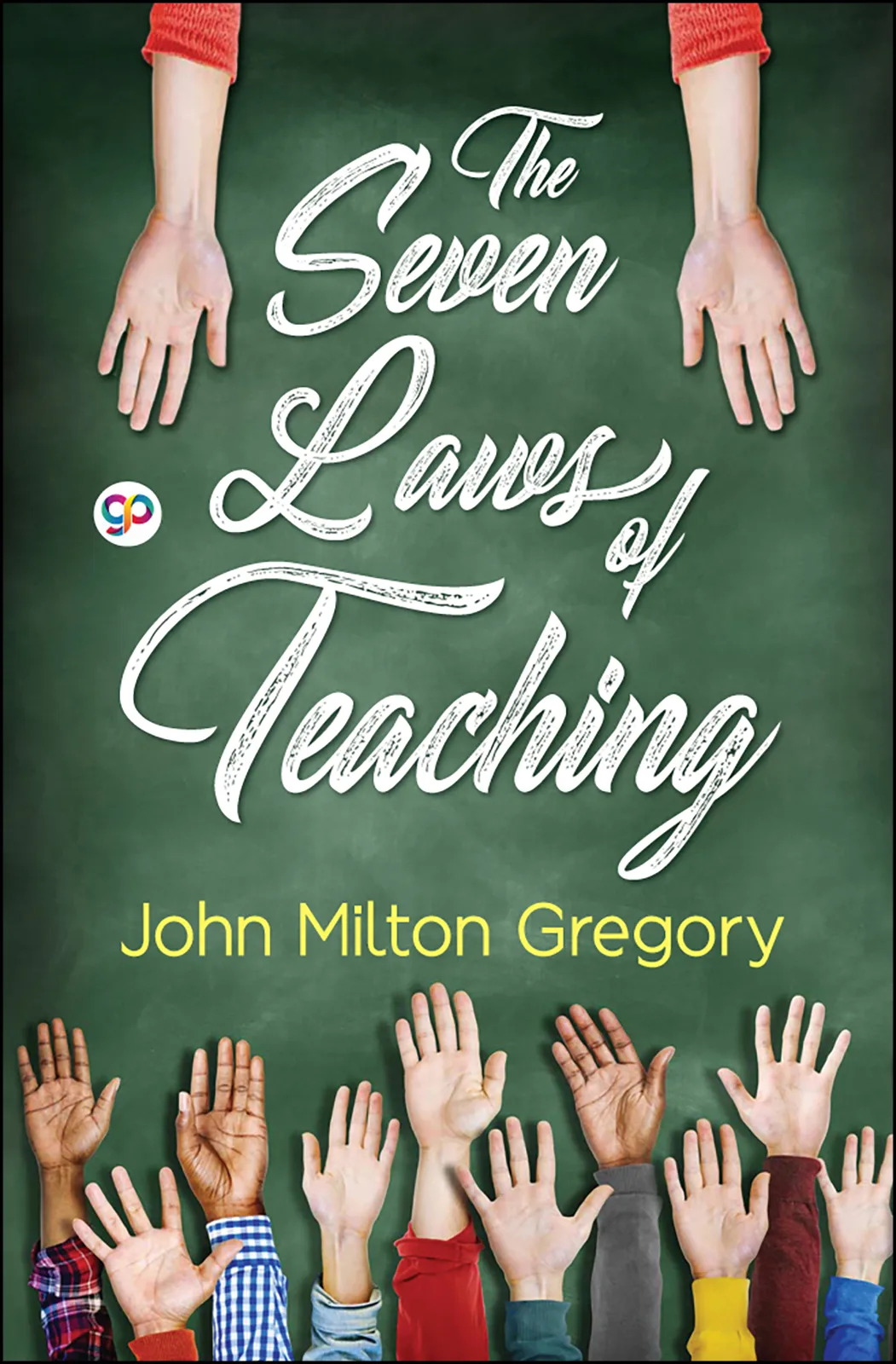
The Seven Laws of Teaching
Hardcover
• 128 Pages
• INR 345.00
• English
• 9789388118460
No ratings yet
| Publisher | General Press |
|---|---|
| ISBN13 | 9789388118460 |
| ASIN/SKU | 9388118464 |
| Book Format | Hardcover |
| Language | English |
| Pages | 128 |
| List Price | INR 345.00 |
| Subject Code | SEL027000, EDU060020, BIB001010, BIB022010 |
| Publishing Date | 07/09/2018 |
| Dimensions | 8.25 x 5.25 x 1.0 inches |
| Book Code | BD00067967 |
Buy this Book
Amazon Stores
Ebook Stores
Other Stores
Discover The Seven Laws of Teaching by John Milton Gregory. This book is published by General Press in Hardcover format, ISBN 9789388118460, ASIN 9388118464, under Education and Teaching, Teaching Methods, Teacher Training and Professional Development.
Book Description
What if the reason so much teaching fails has nothing to do with the teacher's knowledge — and everything to do with a handful of principles that most educators have never been taught themselves? That is the quietly revolutionary premise behind 'The Seven Laws of Teaching' by John Milton Gregory, a timeless work of educational philosophy that has shaped the thinking of teachers, parents, and mentors since it was first published in the late nineteenth century.
Gregory's argument is elegant in its simplicity. Teaching, he believed, is not an art that depends on personality or inspiration alone — it is a science governed by natural laws, and when those laws are understood and applied, genuine learning becomes almost inevitable. When they are ignored or violated, even the most knowledgeable and well-intentioned teacher will find their efforts falling flat. The book is his attempt to identify and articulate those laws with enough clarity that any serious educator could understand and use them.
The seven laws Gregory lays out move through the full arc of the teaching and learning relationship — from the nature of the knowledge being taught and the mind of the learner, to the language that connects them, the method of instruction, and the all-important question of whether genuine understanding has actually been achieved. Each law is paired with its corresponding violation, which gives the book a refreshing practical edge. Gregory doesn't just tell you what to do; he helps you recognize the specific mistakes that undermine learning without most teachers ever noticing.
What makes this book so remarkable is how little it has dated. Written long before modern educational theory, it nonetheless anticipates many of the insights that research has since confirmed — that learning must connect to what the student already knows, that engagement matters more than repetition, and that true teaching is measured not by what is delivered but by what is genuinely understood. For anyone who teaches in any form — in a classroom, a home, a pulpit, or a boardroom — this slim, searching book has a way of making you rethink everything you thought you knew about how people actually learn.
Gregory's argument is elegant in its simplicity. Teaching, he believed, is not an art that depends on personality or inspiration alone — it is a science governed by natural laws, and when those laws are understood and applied, genuine learning becomes almost inevitable. When they are ignored or violated, even the most knowledgeable and well-intentioned teacher will find their efforts falling flat. The book is his attempt to identify and articulate those laws with enough clarity that any serious educator could understand and use them.
The seven laws Gregory lays out move through the full arc of the teaching and learning relationship — from the nature of the knowledge being taught and the mind of the learner, to the language that connects them, the method of instruction, and the all-important question of whether genuine understanding has actually been achieved. Each law is paired with its corresponding violation, which gives the book a refreshing practical edge. Gregory doesn't just tell you what to do; he helps you recognize the specific mistakes that undermine learning without most teachers ever noticing.
What makes this book so remarkable is how little it has dated. Written long before modern educational theory, it nonetheless anticipates many of the insights that research has since confirmed — that learning must connect to what the student already knows, that engagement matters more than repetition, and that true teaching is measured not by what is delivered but by what is genuinely understood. For anyone who teaches in any form — in a classroom, a home, a pulpit, or a boardroom — this slim, searching book has a way of making you rethink everything you thought you knew about how people actually learn.
Author Biography
John Milton Gregory was one of the educational leaders of the generation that has just passed from the stage. He was born at Sand Lake, in Rensselaer County, New York, on July 6th, 1822. His early training was obtained in the district schools and he became himself a district school teacher at the age of seventeen. Three years later, apparently destined for the profession of law, he entered Union College at Schenectady, New York, But after graduating in 1846, he gave up the study of law to enter the ministry of the Baptist Church. His heart, however, was in teaching, and in 1852 he became head of a classical school in Detroit, Michigan. Almost immediately he was recognized as a leader in the educational councils of the state.
In 1868, when the University of Illinois was established under the name, 'Illinois State Industrial University,' Dr. Gregory was asked to undertake the organization of the new institution. His work for thirteen years in laying the foundations of one of the largest and strongest of the state universities gives him a secure place in the history of American education. After leaving the University of Illinois he served for sometime as a member of the United States Civil Service Commission. The great work of his life, however, was the organization of the University, and just before he died in 1898 he asked that his body be laid to rest within the campus of the school for which he had done so much.
In 1868, when the University of Illinois was established under the name, 'Illinois State Industrial University,' Dr. Gregory was asked to undertake the organization of the new institution. His work for thirteen years in laying the foundations of one of the largest and strongest of the state universities gives him a secure place in the history of American education. After leaving the University of Illinois he served for sometime as a member of the United States Civil Service Commission. The great work of his life, however, was the organization of the University, and just before he died in 1898 he asked that his body be laid to rest within the campus of the school for which he had done so much.
Editorial Reviews
Editorial Reviews will be added soon…
Book Summary
John Milton Gregory’s The Seven Laws of Teaching is a practical and thoughtful guide to the art of teaching. First published in the nineteenth century and later revised, the book presents teaching not simply as the act of giving information, but as a process of helping another person understand, think, and grow. Gregory argues that good teaching follows certain natural principles. These principles are not complicated formulas or rigid classroom rules. Instead, they are basic truths about how people learn and how teachers can make learning clearer, more meaningful, and more effective.
The book is organized around seven fundamental laws, each describing an essential relationship between the teacher, the learner, the subject, and the learning process. Gregory’s purpose is to help teachers become more conscious of what they are doing. A teacher may possess extensive knowledge, but knowledge alone does not make someone an effective teacher. The real challenge is to transfer understanding from one mind to another in a way that the learner can grasp and use.
The first law concerns the teacher: “The teacher must know that which he would teach.” Gregory begins with a simple but essential principle. A teacher cannot effectively communicate knowledge that they do not genuinely understand. Merely memorizing facts is not enough. The teacher should possess a clear and organized understanding of the subject and should know its important relationships and practical meaning. A strong teacher should be able to explain an idea in different ways, answer reasonable questions, and distinguish the central points from unnecessary details.
This law also places responsibility on teachers to continue learning. Teaching should not be based entirely on old notes or memorized explanations. A teacher who keeps developing their own understanding becomes better equipped to respond to different learners and different situations. Knowledge gives the teacher confidence, but genuine understanding gives the teacher flexibility.
The second law focuses on the learner: “The learner must attend with interest to the material to be learned.” Gregory recognizes that learning cannot be forced simply by speaking. A teacher may deliver an excellent explanation, but if the learner is distracted, uninterested, or mentally absent, little learning will occur. Attention is therefore an essential condition of education.
For Gregory, interest is closely connected with attention. People naturally pay attention to things that seem meaningful, relevant, or connected to their lives. The teacher’s responsibility is therefore not merely to demand attention but to awaken it. A lesson should give learners a reason to care. Questions, examples, demonstrations, stories, and connections with familiar experiences can help make an abstract subject interesting. This principle remains highly relevant in modern education, where maintaining attention can be one of the greatest challenges.
The third law states that “The language used as a medium of instruction must be common to the teacher and learner.” Gregory emphasizes the importance of communication. Even when the teacher understands a subject perfectly, learning cannot take place if the explanation is expressed in language the learner does not understand.
This does not mean that teachers should avoid new vocabulary altogether. Rather, unfamiliar words and concepts should be introduced carefully and explained in terms that learners already understand. Gregory encourages teachers to begin with the learner’s existing knowledge and gradually lead them toward more advanced ideas. Clear language is therefore not a sign of simplifying the subject too much; it is a means of building a bridge between what the learner already knows and what they are about to learn.
The fourth law concerns the lesson itself: “The lesson to be learned must be explicable in terms of truth already known by the learner.” This is one of Gregory’s most important educational insights. New knowledge becomes easier to understand when it is connected to something familiar.
A learner does not approach a lesson with an empty mind. Every person already possesses experiences, ideas, memories, observations, and beliefs. Effective teaching builds upon this existing mental foundation. For example, a child can understand more complicated mathematical ideas more easily when those ideas are connected with familiar objects, counting, or everyday situations. In the same way, an abstract scientific principle can become clearer when the teacher connects it to something the learner has observed in ordinary life.
The fifth law states that “Teaching is arousing and using the pupil’s mind to grasp the desired thought or to master the desired skill.” Here Gregory moves beyond explanation. He argues that teaching is not complete when the teacher has spoken and the student has listened. The learner must actively think.
This means that effective teaching should encourage students to discover relationships, answer questions, solve problems, compare ideas, and explain concepts in their own words. A teacher who does everything for the learner may produce temporary memorization but not lasting understanding. The learner must participate mentally in the process. Gregory therefore sees the teacher less as someone who pours information into passive minds and more as someone who guides learners toward active intellectual engagement.
The sixth law emphasizes the importance of testing: “The learner must reproduce in his own mind the truth to be learned.” In other words, students should demonstrate that they have actually understood the lesson. Reproduction does not necessarily mean repeating the teacher’s exact words. It means being able to express the idea independently, apply it, explain it, or use it in a new situation.
This principle makes evaluation an important part of teaching. Questions, exercises, discussions, demonstrations, and practical applications help reveal whether learning has truly taken place. They also show the teacher where misunderstanding remains. A student who can repeat a definition may still fail to understand its meaning. True learning becomes visible when the student can use knowledge independently.
The seventh and final law concerns application: “The learner must apply the truth learned.” Knowledge becomes more valuable when it influences thought and action. Gregory does not want education to produce people who merely accumulate information. He wants learners to use what they know.
Application can take many forms. A mathematical principle can be used to solve a problem. A scientific concept can explain an everyday observation. A language skill can improve communication. A moral principle can influence behavior. A practical skill can be demonstrated through action. The purpose of learning is therefore not simply to know something but to make that knowledge useful.
Taken together, Gregory’s seven laws create a complete picture of the teaching process. The teacher must know the subject. The learner must be attentive and interested. Both must share understandable language. New knowledge must connect with existing knowledge. The learner must actively think. Understanding must be demonstrated and reproduced. Finally, knowledge should be applied.
One of the book’s greatest strengths is its simplicity. Gregory does not treat education as an obscure science reserved for experts. He presents teaching as a human relationship governed by understandable principles. His ideas can apply to classrooms, homes, religious education, professional training, mentoring, and everyday situations in which one person helps another learn.
Although the language and educational context of the book belong to an earlier era, many of its central ideas remain remarkably relevant. Modern educational theories may use different terminology, but the emphasis on prior knowledge, engagement, active learning, clear communication, practice, feedback, and application continues to be important.
Ultimately, The Seven Laws of Teaching reminds us that teaching is not primarily about speaking—it is about creating understanding. A good teacher does not simply transfer information but awakens curiosity, connects new ideas with familiar experience, encourages independent thought, checks understanding, and gives learners opportunities to use what they have learned. Gregory’s lasting message is that effective education happens when the learner becomes an active participant in the journey from knowing to understanding and finally to doing.
The book is organized around seven fundamental laws, each describing an essential relationship between the teacher, the learner, the subject, and the learning process. Gregory’s purpose is to help teachers become more conscious of what they are doing. A teacher may possess extensive knowledge, but knowledge alone does not make someone an effective teacher. The real challenge is to transfer understanding from one mind to another in a way that the learner can grasp and use.
The first law concerns the teacher: “The teacher must know that which he would teach.” Gregory begins with a simple but essential principle. A teacher cannot effectively communicate knowledge that they do not genuinely understand. Merely memorizing facts is not enough. The teacher should possess a clear and organized understanding of the subject and should know its important relationships and practical meaning. A strong teacher should be able to explain an idea in different ways, answer reasonable questions, and distinguish the central points from unnecessary details.
This law also places responsibility on teachers to continue learning. Teaching should not be based entirely on old notes or memorized explanations. A teacher who keeps developing their own understanding becomes better equipped to respond to different learners and different situations. Knowledge gives the teacher confidence, but genuine understanding gives the teacher flexibility.
The second law focuses on the learner: “The learner must attend with interest to the material to be learned.” Gregory recognizes that learning cannot be forced simply by speaking. A teacher may deliver an excellent explanation, but if the learner is distracted, uninterested, or mentally absent, little learning will occur. Attention is therefore an essential condition of education.
For Gregory, interest is closely connected with attention. People naturally pay attention to things that seem meaningful, relevant, or connected to their lives. The teacher’s responsibility is therefore not merely to demand attention but to awaken it. A lesson should give learners a reason to care. Questions, examples, demonstrations, stories, and connections with familiar experiences can help make an abstract subject interesting. This principle remains highly relevant in modern education, where maintaining attention can be one of the greatest challenges.
The third law states that “The language used as a medium of instruction must be common to the teacher and learner.” Gregory emphasizes the importance of communication. Even when the teacher understands a subject perfectly, learning cannot take place if the explanation is expressed in language the learner does not understand.
This does not mean that teachers should avoid new vocabulary altogether. Rather, unfamiliar words and concepts should be introduced carefully and explained in terms that learners already understand. Gregory encourages teachers to begin with the learner’s existing knowledge and gradually lead them toward more advanced ideas. Clear language is therefore not a sign of simplifying the subject too much; it is a means of building a bridge between what the learner already knows and what they are about to learn.
The fourth law concerns the lesson itself: “The lesson to be learned must be explicable in terms of truth already known by the learner.” This is one of Gregory’s most important educational insights. New knowledge becomes easier to understand when it is connected to something familiar.
A learner does not approach a lesson with an empty mind. Every person already possesses experiences, ideas, memories, observations, and beliefs. Effective teaching builds upon this existing mental foundation. For example, a child can understand more complicated mathematical ideas more easily when those ideas are connected with familiar objects, counting, or everyday situations. In the same way, an abstract scientific principle can become clearer when the teacher connects it to something the learner has observed in ordinary life.
The fifth law states that “Teaching is arousing and using the pupil’s mind to grasp the desired thought or to master the desired skill.” Here Gregory moves beyond explanation. He argues that teaching is not complete when the teacher has spoken and the student has listened. The learner must actively think.
This means that effective teaching should encourage students to discover relationships, answer questions, solve problems, compare ideas, and explain concepts in their own words. A teacher who does everything for the learner may produce temporary memorization but not lasting understanding. The learner must participate mentally in the process. Gregory therefore sees the teacher less as someone who pours information into passive minds and more as someone who guides learners toward active intellectual engagement.
The sixth law emphasizes the importance of testing: “The learner must reproduce in his own mind the truth to be learned.” In other words, students should demonstrate that they have actually understood the lesson. Reproduction does not necessarily mean repeating the teacher’s exact words. It means being able to express the idea independently, apply it, explain it, or use it in a new situation.
This principle makes evaluation an important part of teaching. Questions, exercises, discussions, demonstrations, and practical applications help reveal whether learning has truly taken place. They also show the teacher where misunderstanding remains. A student who can repeat a definition may still fail to understand its meaning. True learning becomes visible when the student can use knowledge independently.
The seventh and final law concerns application: “The learner must apply the truth learned.” Knowledge becomes more valuable when it influences thought and action. Gregory does not want education to produce people who merely accumulate information. He wants learners to use what they know.
Application can take many forms. A mathematical principle can be used to solve a problem. A scientific concept can explain an everyday observation. A language skill can improve communication. A moral principle can influence behavior. A practical skill can be demonstrated through action. The purpose of learning is therefore not simply to know something but to make that knowledge useful.
Taken together, Gregory’s seven laws create a complete picture of the teaching process. The teacher must know the subject. The learner must be attentive and interested. Both must share understandable language. New knowledge must connect with existing knowledge. The learner must actively think. Understanding must be demonstrated and reproduced. Finally, knowledge should be applied.
One of the book’s greatest strengths is its simplicity. Gregory does not treat education as an obscure science reserved for experts. He presents teaching as a human relationship governed by understandable principles. His ideas can apply to classrooms, homes, religious education, professional training, mentoring, and everyday situations in which one person helps another learn.
Although the language and educational context of the book belong to an earlier era, many of its central ideas remain remarkably relevant. Modern educational theories may use different terminology, but the emphasis on prior knowledge, engagement, active learning, clear communication, practice, feedback, and application continues to be important.
Ultimately, The Seven Laws of Teaching reminds us that teaching is not primarily about speaking—it is about creating understanding. A good teacher does not simply transfer information but awakens curiosity, connects new ideas with familiar experience, encourages independent thought, checks understanding, and gives learners opportunities to use what they have learned. Gregory’s lasting message is that effective education happens when the learner becomes an active participant in the journey from knowing to understanding and finally to doing.
Sample Chapters
Sample Chapters will be added soon…
Reader Reviews
No reviews yet.
The Seven Laws of Teaching
Download Cover Image
Do you want to download the full cover image for The Seven Laws of Teaching?