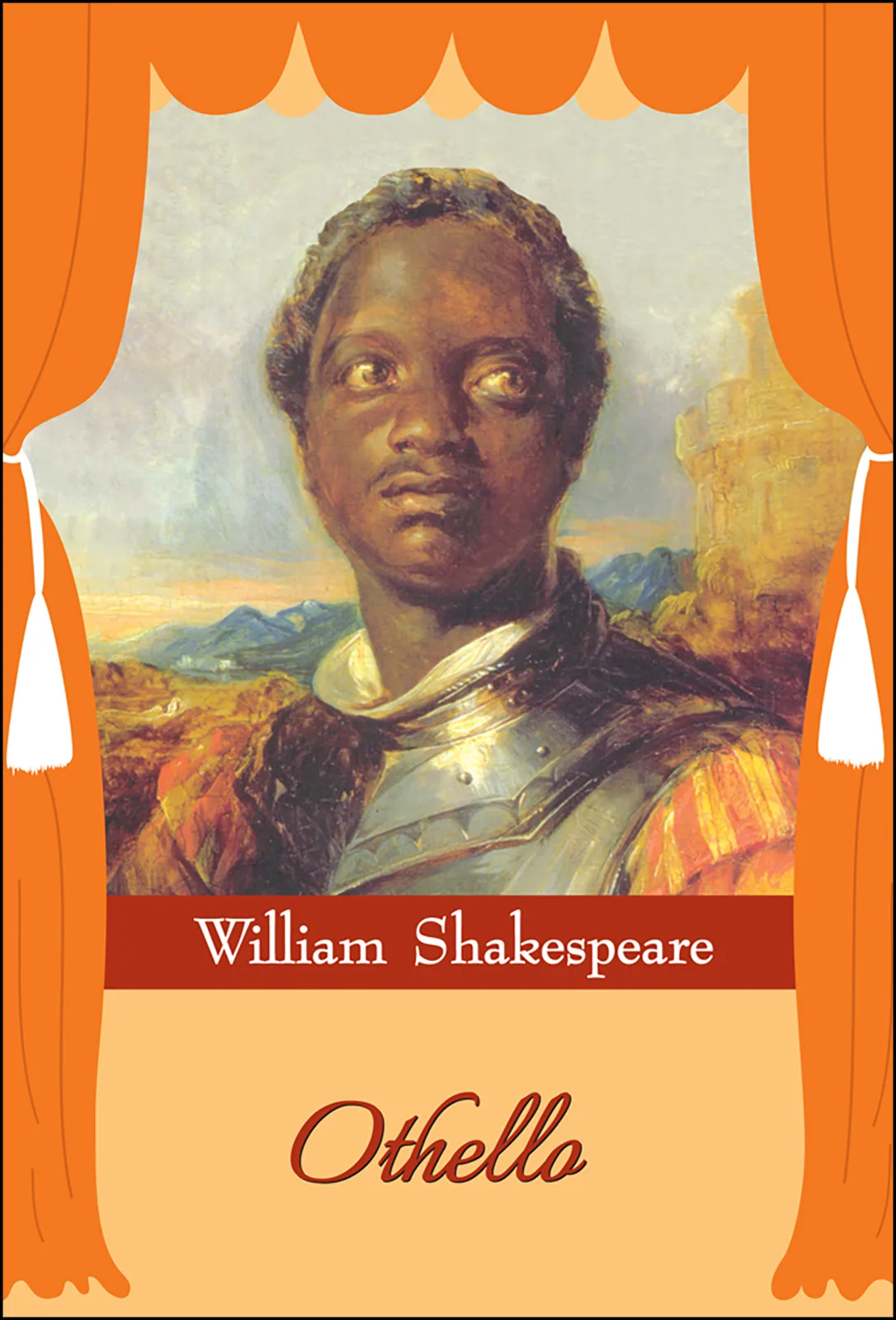
Othello
Paperback
• 132 Pages
• INR 245.00
• English
• 9789380914404
No ratings yet
| Publisher | General Press |
|---|---|
| ISBN13 | 9789380914404 |
| ASIN/SKU | 9380914407 |
| Book Format | Paperback |
| Language | English |
| Pages | 132 |
| List Price | INR 245.00 |
| Subject Code | DRA003000, DRA004000, DRA010000, FIC004000 |
| Publishing Date | 01/01/2013 |
| Dimensions | 8.25 x 5.25 x 1.0 inches |
| Book Code | BD00067968 |
Buy this Book
Amazon Stores
Ebook Stores
Other Stores
Discover Othello by William Shakespeare. This book is published by General Press in Paperback format, ISBN 9789380914404, ASIN 9380914407, under Literature and Fiction, Classics, Drama.
Book Description
Othello has long been recognised as one of the most powerful of Shakespeare's tragedies. This is an intense drama of love, deception, jealousy and destruction, written in 1603.
Dramatic and powerful in its scope, Othello explores the perils of suspicion and jealousy and the ensuing breakdown of relationships and disaster that can arise from such emotions. Othello, a revered soldier, secretly marries Desdemona, the daughter of a Venetian senator, but is led to believe that she has been unfaithful to him by his ensign, Iago, leading to tragic events. Desdemona's love for Othello, the Moor, transcends racial prejudice; but the envious Iago conspires to devastate their lives. In its vivid rendering of racism, sexism, contested identities, and the savagery lurking within civilization, Othello is arguably the most topical and accessible tragedy from Shakespeare's major phase as a dramatist. Productions on stage and screen regularly renew its power to engross, impress and trouble the imagination.
Dramatic and powerful in its scope, Othello explores the perils of suspicion and jealousy and the ensuing breakdown of relationships and disaster that can arise from such emotions. Othello, a revered soldier, secretly marries Desdemona, the daughter of a Venetian senator, but is led to believe that she has been unfaithful to him by his ensign, Iago, leading to tragic events. Desdemona's love for Othello, the Moor, transcends racial prejudice; but the envious Iago conspires to devastate their lives. In its vivid rendering of racism, sexism, contested identities, and the savagery lurking within civilization, Othello is arguably the most topical and accessible tragedy from Shakespeare's major phase as a dramatist. Productions on stage and screen regularly renew its power to engross, impress and trouble the imagination.
Author Biography
William Shakespeare (baptised 26 April 1564) was an English poet and playwright, widely regarded as the greatest writer in the English language and the world's pre-eminent dramatist. He is often called England's national poet and the 'Bard of Avon' (or simply "The Bard"). His surviving works consist of 37 plays, 154 sonnets, two long narrative poems, and several other poems. His plays have been translated into every major living language.
Shakespeare was born and raised in Stratford-upon-Avon. Scholars believe that he died on his fifty-second birthday, coinciding with St George’s Day. At the age of 18 he married Anne Hathaway, who bore him three children: Susanna, twins Hamnet and Judith. Between 1585 and 1592 he began a successful career in London as an actor, writer, and part owner of the playing company the Lord Chamberlain's Men, later known as the King's Men. He appears to have retired to Stratford around 1613, where he died three years later.
Shakespeare produced most of his known work between 1590 and 1613. His early plays were mainly comedies and histories, genres he raised to the peak of sophistication and artistry by the end of the sixteenth century. Next he wrote mainly tragedies until about 1608. He was a respected poet and playwright in his own day, but his reputation did not rise to its present heights until the nineteenth century. The Romantics, in particular, acclaimed Shakespeare's genius, and the Victorians hero-worshipped Shakespeare. In the twentieth century, his work was repeatedly adopted and rediscovered by new movements in scholarship and performance. His plays remain highly popular today and are consistently performed and reinterpreted in diverse cultural and political contexts throughout the world.
Shakespeare was born and raised in Stratford-upon-Avon. Scholars believe that he died on his fifty-second birthday, coinciding with St George’s Day. At the age of 18 he married Anne Hathaway, who bore him three children: Susanna, twins Hamnet and Judith. Between 1585 and 1592 he began a successful career in London as an actor, writer, and part owner of the playing company the Lord Chamberlain's Men, later known as the King's Men. He appears to have retired to Stratford around 1613, where he died three years later.
Shakespeare produced most of his known work between 1590 and 1613. His early plays were mainly comedies and histories, genres he raised to the peak of sophistication and artistry by the end of the sixteenth century. Next he wrote mainly tragedies until about 1608. He was a respected poet and playwright in his own day, but his reputation did not rise to its present heights until the nineteenth century. The Romantics, in particular, acclaimed Shakespeare's genius, and the Victorians hero-worshipped Shakespeare. In the twentieth century, his work was repeatedly adopted and rediscovered by new movements in scholarship and performance. His plays remain highly popular today and are consistently performed and reinterpreted in diverse cultural and political contexts throughout the world.
Editorial Reviews
Editorial Reviews will be added soon…
Book Summary
Othello by William Shakespeare is one of the most powerful tragedies in English literature, exploring jealousy, love, betrayal, racism, manipulation, trust, and the destructive consequences of insecurity. Written around the early seventeenth century and first performed around 1604, the play tells the tragic story of Othello, a respected Moorish general in the Venetian army, and Desdemona, the Venetian woman he secretly marries. Their relationship begins with genuine love and mutual devotion but is gradually destroyed by the calculated lies of Othello’s ensign, Iago. Shakespeare turns what initially appears to be a love story into a deeply disturbing study of how suspicion can overpower reason. The play moves from Venice to Cyprus, and its central conflict develops when Iago convinces Othello that his faithful wife has been unfaithful with Cassio.
At the beginning of Othello, the audience immediately encounters Iago, one of Shakespeare’s most memorable villains. Iago is furious because Othello has promoted Michael Cassio to the position of lieutenant instead of him. Iago believes that he deserves the promotion because of his military experience, while Cassio, in his eyes, is an inexperienced outsider who has received the position through favor. Iago therefore decides to take revenge on Othello. His anger, however, is not limited to professional disappointment. He also claims to suspect that Othello has had an affair with Emilia, Iago’s wife, although Shakespeare never establishes that this suspicion is true. Iago’s motives remain deliberately complicated, and part of his terrifying nature comes from his ability to create destruction without needing a single simple reason for it. He presents himself to others as honest and loyal while secretly manipulating almost everyone around him.
Iago first uses Roderigo as a tool. Roderigo is a wealthy Venetian who has been in love with Desdemona and is devastated to learn that she has married Othello. Iago exploits Roderigo’s desire to possess Desdemona and persuades him to help with his plans. Together, they inform Brabantio, Desdemona’s father, about his daughter’s secret marriage. Iago deliberately uses crude and racist language to provoke Brabantio, encouraging him to imagine that his daughter has been taken from him by a foreign man. Brabantio is horrified that Desdemona has married Othello without his permission and accuses Othello of using magic or deception to win her affection. This opening establishes an important aspect of the tragedy: Othello is respected for his military achievements, yet he remains an outsider in Venetian society because of his race, origin, and cultural background.
The conflict soon reaches the Duke and the Venetian Senate. Othello is required to defend himself against Brabantio’s accusations, but instead of becoming defensive, he calmly tells the story of how Desdemona came to love him. Othello explains that Desdemona became fascinated by the stories of his adventurous and difficult life. She listened to accounts of battles, travel, danger, captivity, and suffering, and through these stories the two developed a deep emotional connection. Desdemona confirms Othello’s account and declares that she married him because she loves him. Her testimony is important because it establishes that their marriage is not based on magic, coercion, or deception. The Senate therefore accepts the marriage, while Othello is ordered to travel to Cyprus because the Turkish threat requires his military leadership. Desdemona chooses to accompany her husband.
The move from Venice to Cyprus marks a major change in the atmosphere of the play. Venice represents a structured political society governed by law and public authority, whereas Cyprus becomes the isolated setting in which Iago can carry out his private campaign of destruction. The Turkish fleet is destroyed by a storm, removing the external military threat almost immediately. With the war effectively over, the attention of the characters turns toward personal relationships, and Iago finds the perfect environment for his plan. The tragedy is therefore no longer about Venice defending itself against an enemy; it becomes a psychological war inside Othello’s marriage.
Iago begins by attacking Cassio. He arranges for Cassio to become drunk and encourages a quarrel that ends in violence. Othello, who values military discipline, removes Cassio from his position as lieutenant. Cassio is devastated because his reputation and career mean everything to him. Iago then advises Cassio to ask Desdemona for help in restoring his position. Cassio follows the advice, unaware that Iago has created the situation specifically for this purpose. Desdemona is compassionate and agrees to speak to Othello on Cassio’s behalf. To an innocent observer, there is nothing improper about this. Desdemona is simply trying to help a disgraced friend. But Iago sees an opportunity to turn her kindness into evidence of supposed infidelity.
This is where Iago’s manipulation becomes particularly dangerous. He does not immediately accuse Desdemona of adultery. Instead, he makes suggestions, pauses, hints, and carefully chosen comments. He understands that a direct accusation might seem unbelievable. His method is more subtle: he allows Othello to reach the conclusion he wants. Iago repeatedly presents himself as reluctant to speak because he claims that he does not want to damage Othello’s feelings. This apparent hesitation makes his lies seem more trustworthy. The tragedy demonstrates how easily a person can be manipulated when information is presented as something supposedly difficult or painful to reveal.
Othello initially refuses to believe that Desdemona could betray him. His love for her is sincere, and he knows that she has chosen him despite their differences in age, race, and background. Yet these very differences gradually become sources of insecurity. Iago understands that Othello may secretly wonder whether Desdemona could truly remain faithful to a man so different from the Venetian society in which she was raised. Iago therefore transforms Othello’s private fears into what appears to be external evidence. His manipulation is especially effective because Othello is accustomed to dealing with straightforward military problems. In battle, an enemy can be identified and confronted. In marriage, however, suspicion has no clear physical form.
The central theme of jealousy in Othello develops gradually rather than suddenly. Iago famously describes jealousy as a “green-eyed monster,” but his warning is deeply ironic because he is the person deliberately creating the monster inside Othello. Othello begins to demand proof of Desdemona’s unfaithfulness. Iago knows that actual proof does not exist, so he manufactures circumstances that can be interpreted as proof. The most important object in this process is Desdemona’s handkerchief, a small personal possession that becomes an enormous symbol within the tragedy.
The handkerchief is originally a gift from Othello to Desdemona and carries emotional significance because of the story Othello tells about its history. Desdemona accidentally loses it, and Emilia finds it. Iago takes it from Emilia and arranges for Cassio to possess it without understanding its importance. When Othello discovers that Cassio has encountered the handkerchief, he interprets this as confirmation that Desdemona and Cassio are lovers. The handkerchief therefore becomes an example of how an ordinary object can acquire false meaning when a person is already controlled by suspicion. Shakespeare shows that jealousy does not require truth; it requires only something that can be interpreted as evidence.
As Othello becomes increasingly jealous, his personality changes dramatically. The confident general who calmly defended his marriage before the Venetian Senate becomes emotionally unstable and obsessed with proving Desdemona’s guilt. He begins to see ordinary conversations as signs of betrayal. His language becomes more violent, and his judgment deteriorates. Iago, meanwhile, continues to appear honest and loyal. This contrast between appearance and reality is one of the play’s most important ideas. Iago repeatedly benefits because people believe him to be trustworthy. His reputation for honesty becomes the very weapon he uses to destroy others.
Desdemona remains innocent throughout the conspiracy. Her kindness toward Cassio is interpreted as sexual interest, even though her intentions are completely different. Shakespeare uses her character to show how innocence can become vulnerable in a world dominated by manipulation. Desdemona does not understand the hidden game being played around her until it is too late. She continues to love Othello even when he becomes cruel toward her. Her tragedy is especially painful because she cannot defend herself against accusations that are based on fabricated evidence rather than anything she has actually done.
Emilia, Iago’s wife and Desdemona’s attendant, also becomes increasingly important. At first, Emilia participates unknowingly in Iago’s scheme by giving him the handkerchief. However, as the tragedy develops, she begins to understand what has happened. Her eventual discovery of Iago’s deception becomes crucial to exposing the truth. Emilia’s character provides an important contrast to Desdemona. While Desdemona represents devoted innocence, Emilia becomes a voice of experience and moral courage. In the final act, she refuses to remain silent when she realizes that Desdemona has been falsely accused.
The final act brings the tragedy to its devastating conclusion. Othello, convinced that Desdemona has betrayed him, enters their bedroom and confronts her. Desdemona insists that she is innocent, but Othello has become so convinced by Iago that he cannot accept her words. He smothers her in their marriage bed. The horror of this moment lies not only in the murder itself but in the fact that Othello believes he is punishing a guilty woman. The man who once loved Desdemona becomes her murderer because he has allowed another man’s lies to replace his own knowledge of his wife.
Immediately afterward, the truth begins to emerge. Emilia learns that Desdemona is dead and eventually discovers Iago’s involvement with the handkerchief. She exposes her husband’s lies and makes clear that Desdemona was innocent. Iago is finally revealed as the architect of the deception. His carefully constructed image of “honesty” collapses. Othello realizes that he has murdered the woman he loved based on false information. His recognition comes too late to save Desdemona, but it forces him to confront his own responsibility. He cannot undo his crime, and he ultimately kills himself. Iago is captured and remains alive to face punishment, but he refuses to explain his motives fully.
The ending makes Othello much more than a simple story about a jealous husband. Shakespeare presents jealousy as a destructive psychological force, but he also examines racism, insecurity, gender inequality, manipulation, and the fragile nature of trust. Othello’s outsider status is particularly important. Iago repeatedly uses racist language, while Othello himself sometimes appears to internalize the prejudices surrounding him. The play does not present racism as merely background decoration; prejudice becomes part of the emotional environment in which Othello’s insecurity develops. Modern readers often pay particular attention to how race, class, and gender interact throughout the tragedy.
Another major theme in Othello by William Shakespeare is the difference between appearance and reality. Iago appears honest but is dishonest. Desdemona appears suspicious to Othello but is innocent. Cassio appears to be involved in an affair but is not. The handkerchief appears to be evidence of betrayal but proves nothing. Othello appears to be a powerful and rational military leader, yet privately he becomes vulnerable to emotional manipulation. Shakespeare repeatedly asks readers to consider how much we actually know about other people and how easily appearances can be transformed into false conclusions.
The tragedy also explores the meaning of love and trust. Othello and Desdemona's marriage begins with extraordinary emotional intensity. Their relationship crosses social and cultural boundaries, and Desdemona willingly chooses Othello despite opposition from her father and the prejudices of society. The marriage could have survived its differences, but it cannot survive the destruction of trust. Once Othello stops believing Desdemona and starts believing Iago, their relationship becomes almost impossible to save. Shakespeare therefore presents trust not as a minor part of love but as one of its foundations.
Ultimately, the summary of Othello is the story of a respected general whose loving marriage is destroyed by a manipulative subordinate who turns insecurity into jealousy and jealousy into violence. Iago does not overpower Othello physically; he defeats him psychologically. Othello's greatest weakness is not his lack of courage but his inability to withstand uncertainty once he becomes convinced that Desdemona has betrayed him. The tragedy is made even more painful because the audience knows the truth while Othello remains trapped inside Iago's deception.
Othello remains one of Shakespeare's most enduring tragedies because its central fears are deeply human. People can still experience jealousy, insecurity, mistrust, manipulation, and the pain of believing something without sufficient evidence. The play also remains important because its treatment of race, marriage, gender, and power invites different interpretations across generations. Shakespeare does not offer an easy moral lesson in which one villain alone is responsible for everything. Iago creates the deception, but Othello ultimately acts on it. Desdemona suffers because other people interpret her behavior through assumptions she cannot control. Emilia becomes courageous when she decides that silence is no longer acceptable. In this way, the tragedy reminds readers that lies become powerful when people accept them without questioning them. Othello's final description of himself as a man who “loved not wisely, but too well” captures the tragic contradiction at the heart of the play: his love is genuine, but love without trust, reason, and self-control can become destructive.
For students searching for an Othello book summary, Othello plot summary, Othello character analysis, themes of Othello, jealousy in Othello, Iago's role in Othello, Desdemona and Othello's relationship, or an explanation of Shakespeare's Othello, the play can ultimately be understood as a tragedy of corrupted trust. Shakespeare takes a marriage founded on love and turns it into a study of how suspicion can distort reality. Othello begins as a powerful man who believes in his wife, his reputation, and his ability to judge the world around him. By the end, he has lost the ability to distinguish truth from manipulation. That transformation is what makes Othello by William Shakespeare so emotionally devastating and so enduring: the tragedy is not simply that innocent people die, but that the truth becomes visible only after it is too late to save them.
At the beginning of Othello, the audience immediately encounters Iago, one of Shakespeare’s most memorable villains. Iago is furious because Othello has promoted Michael Cassio to the position of lieutenant instead of him. Iago believes that he deserves the promotion because of his military experience, while Cassio, in his eyes, is an inexperienced outsider who has received the position through favor. Iago therefore decides to take revenge on Othello. His anger, however, is not limited to professional disappointment. He also claims to suspect that Othello has had an affair with Emilia, Iago’s wife, although Shakespeare never establishes that this suspicion is true. Iago’s motives remain deliberately complicated, and part of his terrifying nature comes from his ability to create destruction without needing a single simple reason for it. He presents himself to others as honest and loyal while secretly manipulating almost everyone around him.
Iago first uses Roderigo as a tool. Roderigo is a wealthy Venetian who has been in love with Desdemona and is devastated to learn that she has married Othello. Iago exploits Roderigo’s desire to possess Desdemona and persuades him to help with his plans. Together, they inform Brabantio, Desdemona’s father, about his daughter’s secret marriage. Iago deliberately uses crude and racist language to provoke Brabantio, encouraging him to imagine that his daughter has been taken from him by a foreign man. Brabantio is horrified that Desdemona has married Othello without his permission and accuses Othello of using magic or deception to win her affection. This opening establishes an important aspect of the tragedy: Othello is respected for his military achievements, yet he remains an outsider in Venetian society because of his race, origin, and cultural background.
The conflict soon reaches the Duke and the Venetian Senate. Othello is required to defend himself against Brabantio’s accusations, but instead of becoming defensive, he calmly tells the story of how Desdemona came to love him. Othello explains that Desdemona became fascinated by the stories of his adventurous and difficult life. She listened to accounts of battles, travel, danger, captivity, and suffering, and through these stories the two developed a deep emotional connection. Desdemona confirms Othello’s account and declares that she married him because she loves him. Her testimony is important because it establishes that their marriage is not based on magic, coercion, or deception. The Senate therefore accepts the marriage, while Othello is ordered to travel to Cyprus because the Turkish threat requires his military leadership. Desdemona chooses to accompany her husband.
The move from Venice to Cyprus marks a major change in the atmosphere of the play. Venice represents a structured political society governed by law and public authority, whereas Cyprus becomes the isolated setting in which Iago can carry out his private campaign of destruction. The Turkish fleet is destroyed by a storm, removing the external military threat almost immediately. With the war effectively over, the attention of the characters turns toward personal relationships, and Iago finds the perfect environment for his plan. The tragedy is therefore no longer about Venice defending itself against an enemy; it becomes a psychological war inside Othello’s marriage.
Iago begins by attacking Cassio. He arranges for Cassio to become drunk and encourages a quarrel that ends in violence. Othello, who values military discipline, removes Cassio from his position as lieutenant. Cassio is devastated because his reputation and career mean everything to him. Iago then advises Cassio to ask Desdemona for help in restoring his position. Cassio follows the advice, unaware that Iago has created the situation specifically for this purpose. Desdemona is compassionate and agrees to speak to Othello on Cassio’s behalf. To an innocent observer, there is nothing improper about this. Desdemona is simply trying to help a disgraced friend. But Iago sees an opportunity to turn her kindness into evidence of supposed infidelity.
This is where Iago’s manipulation becomes particularly dangerous. He does not immediately accuse Desdemona of adultery. Instead, he makes suggestions, pauses, hints, and carefully chosen comments. He understands that a direct accusation might seem unbelievable. His method is more subtle: he allows Othello to reach the conclusion he wants. Iago repeatedly presents himself as reluctant to speak because he claims that he does not want to damage Othello’s feelings. This apparent hesitation makes his lies seem more trustworthy. The tragedy demonstrates how easily a person can be manipulated when information is presented as something supposedly difficult or painful to reveal.
Othello initially refuses to believe that Desdemona could betray him. His love for her is sincere, and he knows that she has chosen him despite their differences in age, race, and background. Yet these very differences gradually become sources of insecurity. Iago understands that Othello may secretly wonder whether Desdemona could truly remain faithful to a man so different from the Venetian society in which she was raised. Iago therefore transforms Othello’s private fears into what appears to be external evidence. His manipulation is especially effective because Othello is accustomed to dealing with straightforward military problems. In battle, an enemy can be identified and confronted. In marriage, however, suspicion has no clear physical form.
The central theme of jealousy in Othello develops gradually rather than suddenly. Iago famously describes jealousy as a “green-eyed monster,” but his warning is deeply ironic because he is the person deliberately creating the monster inside Othello. Othello begins to demand proof of Desdemona’s unfaithfulness. Iago knows that actual proof does not exist, so he manufactures circumstances that can be interpreted as proof. The most important object in this process is Desdemona’s handkerchief, a small personal possession that becomes an enormous symbol within the tragedy.
The handkerchief is originally a gift from Othello to Desdemona and carries emotional significance because of the story Othello tells about its history. Desdemona accidentally loses it, and Emilia finds it. Iago takes it from Emilia and arranges for Cassio to possess it without understanding its importance. When Othello discovers that Cassio has encountered the handkerchief, he interprets this as confirmation that Desdemona and Cassio are lovers. The handkerchief therefore becomes an example of how an ordinary object can acquire false meaning when a person is already controlled by suspicion. Shakespeare shows that jealousy does not require truth; it requires only something that can be interpreted as evidence.
As Othello becomes increasingly jealous, his personality changes dramatically. The confident general who calmly defended his marriage before the Venetian Senate becomes emotionally unstable and obsessed with proving Desdemona’s guilt. He begins to see ordinary conversations as signs of betrayal. His language becomes more violent, and his judgment deteriorates. Iago, meanwhile, continues to appear honest and loyal. This contrast between appearance and reality is one of the play’s most important ideas. Iago repeatedly benefits because people believe him to be trustworthy. His reputation for honesty becomes the very weapon he uses to destroy others.
Desdemona remains innocent throughout the conspiracy. Her kindness toward Cassio is interpreted as sexual interest, even though her intentions are completely different. Shakespeare uses her character to show how innocence can become vulnerable in a world dominated by manipulation. Desdemona does not understand the hidden game being played around her until it is too late. She continues to love Othello even when he becomes cruel toward her. Her tragedy is especially painful because she cannot defend herself against accusations that are based on fabricated evidence rather than anything she has actually done.
Emilia, Iago’s wife and Desdemona’s attendant, also becomes increasingly important. At first, Emilia participates unknowingly in Iago’s scheme by giving him the handkerchief. However, as the tragedy develops, she begins to understand what has happened. Her eventual discovery of Iago’s deception becomes crucial to exposing the truth. Emilia’s character provides an important contrast to Desdemona. While Desdemona represents devoted innocence, Emilia becomes a voice of experience and moral courage. In the final act, she refuses to remain silent when she realizes that Desdemona has been falsely accused.
The final act brings the tragedy to its devastating conclusion. Othello, convinced that Desdemona has betrayed him, enters their bedroom and confronts her. Desdemona insists that she is innocent, but Othello has become so convinced by Iago that he cannot accept her words. He smothers her in their marriage bed. The horror of this moment lies not only in the murder itself but in the fact that Othello believes he is punishing a guilty woman. The man who once loved Desdemona becomes her murderer because he has allowed another man’s lies to replace his own knowledge of his wife.
Immediately afterward, the truth begins to emerge. Emilia learns that Desdemona is dead and eventually discovers Iago’s involvement with the handkerchief. She exposes her husband’s lies and makes clear that Desdemona was innocent. Iago is finally revealed as the architect of the deception. His carefully constructed image of “honesty” collapses. Othello realizes that he has murdered the woman he loved based on false information. His recognition comes too late to save Desdemona, but it forces him to confront his own responsibility. He cannot undo his crime, and he ultimately kills himself. Iago is captured and remains alive to face punishment, but he refuses to explain his motives fully.
The ending makes Othello much more than a simple story about a jealous husband. Shakespeare presents jealousy as a destructive psychological force, but he also examines racism, insecurity, gender inequality, manipulation, and the fragile nature of trust. Othello’s outsider status is particularly important. Iago repeatedly uses racist language, while Othello himself sometimes appears to internalize the prejudices surrounding him. The play does not present racism as merely background decoration; prejudice becomes part of the emotional environment in which Othello’s insecurity develops. Modern readers often pay particular attention to how race, class, and gender interact throughout the tragedy.
Another major theme in Othello by William Shakespeare is the difference between appearance and reality. Iago appears honest but is dishonest. Desdemona appears suspicious to Othello but is innocent. Cassio appears to be involved in an affair but is not. The handkerchief appears to be evidence of betrayal but proves nothing. Othello appears to be a powerful and rational military leader, yet privately he becomes vulnerable to emotional manipulation. Shakespeare repeatedly asks readers to consider how much we actually know about other people and how easily appearances can be transformed into false conclusions.
The tragedy also explores the meaning of love and trust. Othello and Desdemona's marriage begins with extraordinary emotional intensity. Their relationship crosses social and cultural boundaries, and Desdemona willingly chooses Othello despite opposition from her father and the prejudices of society. The marriage could have survived its differences, but it cannot survive the destruction of trust. Once Othello stops believing Desdemona and starts believing Iago, their relationship becomes almost impossible to save. Shakespeare therefore presents trust not as a minor part of love but as one of its foundations.
Ultimately, the summary of Othello is the story of a respected general whose loving marriage is destroyed by a manipulative subordinate who turns insecurity into jealousy and jealousy into violence. Iago does not overpower Othello physically; he defeats him psychologically. Othello's greatest weakness is not his lack of courage but his inability to withstand uncertainty once he becomes convinced that Desdemona has betrayed him. The tragedy is made even more painful because the audience knows the truth while Othello remains trapped inside Iago's deception.
Othello remains one of Shakespeare's most enduring tragedies because its central fears are deeply human. People can still experience jealousy, insecurity, mistrust, manipulation, and the pain of believing something without sufficient evidence. The play also remains important because its treatment of race, marriage, gender, and power invites different interpretations across generations. Shakespeare does not offer an easy moral lesson in which one villain alone is responsible for everything. Iago creates the deception, but Othello ultimately acts on it. Desdemona suffers because other people interpret her behavior through assumptions she cannot control. Emilia becomes courageous when she decides that silence is no longer acceptable. In this way, the tragedy reminds readers that lies become powerful when people accept them without questioning them. Othello's final description of himself as a man who “loved not wisely, but too well” captures the tragic contradiction at the heart of the play: his love is genuine, but love without trust, reason, and self-control can become destructive.
For students searching for an Othello book summary, Othello plot summary, Othello character analysis, themes of Othello, jealousy in Othello, Iago's role in Othello, Desdemona and Othello's relationship, or an explanation of Shakespeare's Othello, the play can ultimately be understood as a tragedy of corrupted trust. Shakespeare takes a marriage founded on love and turns it into a study of how suspicion can distort reality. Othello begins as a powerful man who believes in his wife, his reputation, and his ability to judge the world around him. By the end, he has lost the ability to distinguish truth from manipulation. That transformation is what makes Othello by William Shakespeare so emotionally devastating and so enduring: the tragedy is not simply that innocent people die, but that the truth becomes visible only after it is too late to save them.
Sample Chapters
Characters in the Play
OTHELLO, the Moor, a general serving the Venetian state.
DESDEMONA, Othello’s wife.
BRABANTIO, a Venetian senator and Desdemona’s father.
IAGO, Othello’s ‘ancient’ (ensign).
EMILIA, Iago’s wife.
CASSIO, Othello’s lieutenant.
BIANCA, a courtesan, Cassio’s mistress.
RODERIGO, a Venetian gentleman.
DUKE of Venice.
SENATORS of Venice.
MONTANO, Governor of Cyprus.
GRATIANO, a noble Venetian, Desdemona’s uncle.
LODOVICO, a noble Venetian, Desdemona’s cousin.
SAILOR.
CLOWN.
MESSENGER.
HERALD.
OFFICERS, GENTLEMEN, MUSICIANS and ATTENDANTS.
Act 1
Scene 1. Venice at night. A street.
Enter RODERIGO and IAGO.
RODERIGO : Tush, never tell me; I take it much unkindly
That thou, Iago, who hast had my purse
As if the strings were thine, shouldst know of this.
IAGO : ’Sblood, but you’ll not hear me.
If ever I did dream of such a matter,
Abhor me.
RODERIGO : Thou told’st me thou didst hold him in thy hate.
IAGO : Despise me if I do not. Three great ones of the city,
In personal suit to make me his lieutenant,
Off-capped to him; and, by the faith of man,
I know my price: I am worth no worse a place.
But he, as loving his own pride and purposes,
Evades them with a bombast circumstance
Horribly stuffed with epithets of war;
And, in conclusion,
Nonsuits my mediators: for, ‘Certes,’ says he,
‘I have already chose my officer.’
And what was he?
Forsooth, a great arithmetician,
One Michael Cassio, a Florentine,
A fellow almost damned in a fair wife,
That never set a squadron in the field,
Nor the division of a battle knows
More than a spinster – unless the bookish theoric,
Wherein the toga’d consuls can propose
As masterly as he; mere prattle without practice
Is all his soldiership. But he, sir, had th’election;
And I (of whom his eyes had seen the proof
At Rhodes, at Cyprus, and on other grounds
Christian and heathen) must be be-lee’d and calmed
By debitor-and-creditor. This counter-caster,
He, in good time, must his lieutenant be,
And I, God bless the mark, His Moorship’s ancient.
RODERIGO : By heaven, I rather would have been his hangman.
IAGO : Why, there’s no remedy: ’tis the curse of service;
Preferment goes by letter and affection,
And not by old gradation, where each second
Stood heir to th’first. Now, sir, be judge yourself
Whether I in any just term am affined
To love the Moor.
RODERIGO : I would not follow him then.
IAGO : O, sir, content you.
I follow him to serve my turn upon him.
We cannot all be masters, nor all masters
Cannot be truly followed. You shall mark
Many a duteous and knee-crooking knave
That, doting on his own obsequious bondage,
Wears out his time, much like his master’s ass,
For nought but provender, and, when he’s old, cashiered.
Whip me such honest knaves! Others there are
Who, trimmed in forms and visages of duty,
Keep yet their hearts attending on themselves;
And, throwing but shows of service on their lords,
Do well thrive by ’em; and, when they’ve lined their coats,
Do themselves homage. These fellows have some soul,
And such a one do I profess myself – for sir,
It is as sure as you are Roderigo,
Were I the Moor, I would not be Iago;
In following him, I follow but myself.
Heaven is my judge, not I for love and duty,
But seeming so, for my peculiar end;
For when my outward action doth demónstrate
The native act and figure of my heart
In compliment extern, ’tis not long after
But I will wear my heart upon my sleeve
For daws to peck at. I am not what I am.
RODERIGO : What a full fortune does the thick-lips owe,
If he can carry’t thus!
IAGO : Call up her father,
Rouse him, make after him, poison his delight,
Proclaim him in the streets, incense her kinsmen,
And, though he in a fertile climate dwell,
Plague him with flies; though that his joy be joy,
Yet throw such changes of vexation on’t
As it may lose some colour.
RODERIGO : Here is her father’s house; I’ll call aloud.
IAGO : Do, with like timorous accent and dire yell
As when, by night and negligence, the fire
Is spied in populous cities.
RODERIGO : What, ho, Brabantio! Signior Brabantio, ho!
IAGO : Awake! What, ho, Brabantio! Thieves, thieves, thieves!
Look to your house, your daughter, and your bags!
Thieves, thieves!
Enter BRABANTIO at a window above.
BRABANTIO : What is the reason of this terrible summons?
What is the matter there?
RODERIGO : Signior, is all your family within?
IAGO : Are your doors locked?
BRABANTIO : Why, wherefore ask you this?
IAGO : Zounds, sir, you’re robbed; for shame, put on your gown;
Your heart is burst; you have lost half your soul:
Even now, now, very now, an old black ram
Is tupping your white ewe! Arise, arise;
Awake the snorting citizens with the bell,
Or else the devil will make a grandsire of you.
Arise, I say!
BRABANTIO : What, have you lost your wits?
RODERIGO : Most reverend signior, do you know my voice?
BRABANTIO : Not I; what are you?
RODERIGO : My name is Roderigo.
BRABANTIO : The worser welcome:
I have charged thee not to haunt about my doors;
In honest plainness thou hast heard me say
My daughter is not for thee; and now, in madness,
Being full of supper and distempering draughts,
Upon malicious knavery dost thou come
To start my quiet.
RODERIGO : Sir, sir, sir –
BRABANTIO : But thou must needs be sure,
My spirit and my place have in them power
To make this bitter to thee.
RODERIGO : Patience, good sir.
BRABANTIO : What tell’st thou me of robbing? This is Venice:
My house is not a grange.
RODERIGO : Most grave Brabantio,
In simple and pure soul I come to you.
IAGO : Zounds, sir, you are one of those that will not serve God if the devil bid you. Because we come to do you service and you think we are ruffians, you’ll have your daughter covered with a Barbary horse; you’ll have your nephews neigh to you; you’ll have coursers for cousins, and jennets for germans.
BRABANTIO : What profane wretch art thou?
IAGO : I am one, sir, that comes to tell you, your daughter and the Moor are now making the beast with two backs.
BRABANTIO : Thou art a villain.
IAGO : You are a senator.
BRABANTIO : This thou shalt answer. I know thee, Roderigo.
RODERIGO : Sir, I will answer anything. But I beseech you,
If’t be your pleasure and most wise consent
(As partly I find it is) that your fair daughter,
At this odd-even and dull watch o’th’night,
Transported with no worse nor better guard
But with a knave of common hire, a gondolier,
To the gross clasps of a lascivious Moor –
If this be known to you, and your allowance,
We then have done you bold and saucy wrongs.
But if you know not this, my manners tell me
We have your wrong rebuke. Do not believe
That, from the sense of all civility,
I thus would play and trifle with your reverence.
Your daughter (if you have not given her leave),
I say again, hath made a gross revolt,
Tying her duty, beauty, wit and fortunes
In an extravagant and wheeling stranger
Of here and everywhere. Straight satisfy yourself:
If she be in her chamber or your house,
Let loose on me the justice of the state
For thus deluding you.
BRABANTIO : Strike on the tinder, ho!
Give me a taper; call up all my people!
This accident is not unlike my dream;
Belief of it oppresses me already.
Light, I say, light!
[Exit above.
OTHELLO, the Moor, a general serving the Venetian state.
DESDEMONA, Othello’s wife.
BRABANTIO, a Venetian senator and Desdemona’s father.
IAGO, Othello’s ‘ancient’ (ensign).
EMILIA, Iago’s wife.
CASSIO, Othello’s lieutenant.
BIANCA, a courtesan, Cassio’s mistress.
RODERIGO, a Venetian gentleman.
DUKE of Venice.
SENATORS of Venice.
MONTANO, Governor of Cyprus.
GRATIANO, a noble Venetian, Desdemona’s uncle.
LODOVICO, a noble Venetian, Desdemona’s cousin.
SAILOR.
CLOWN.
MESSENGER.
HERALD.
OFFICERS, GENTLEMEN, MUSICIANS and ATTENDANTS.
Act 1
Scene 1. Venice at night. A street.
Enter RODERIGO and IAGO.
RODERIGO : Tush, never tell me; I take it much unkindly
That thou, Iago, who hast had my purse
As if the strings were thine, shouldst know of this.
IAGO : ’Sblood, but you’ll not hear me.
If ever I did dream of such a matter,
Abhor me.
RODERIGO : Thou told’st me thou didst hold him in thy hate.
IAGO : Despise me if I do not. Three great ones of the city,
In personal suit to make me his lieutenant,
Off-capped to him; and, by the faith of man,
I know my price: I am worth no worse a place.
But he, as loving his own pride and purposes,
Evades them with a bombast circumstance
Horribly stuffed with epithets of war;
And, in conclusion,
Nonsuits my mediators: for, ‘Certes,’ says he,
‘I have already chose my officer.’
And what was he?
Forsooth, a great arithmetician,
One Michael Cassio, a Florentine,
A fellow almost damned in a fair wife,
That never set a squadron in the field,
Nor the division of a battle knows
More than a spinster – unless the bookish theoric,
Wherein the toga’d consuls can propose
As masterly as he; mere prattle without practice
Is all his soldiership. But he, sir, had th’election;
And I (of whom his eyes had seen the proof
At Rhodes, at Cyprus, and on other grounds
Christian and heathen) must be be-lee’d and calmed
By debitor-and-creditor. This counter-caster,
He, in good time, must his lieutenant be,
And I, God bless the mark, His Moorship’s ancient.
RODERIGO : By heaven, I rather would have been his hangman.
IAGO : Why, there’s no remedy: ’tis the curse of service;
Preferment goes by letter and affection,
And not by old gradation, where each second
Stood heir to th’first. Now, sir, be judge yourself
Whether I in any just term am affined
To love the Moor.
RODERIGO : I would not follow him then.
IAGO : O, sir, content you.
I follow him to serve my turn upon him.
We cannot all be masters, nor all masters
Cannot be truly followed. You shall mark
Many a duteous and knee-crooking knave
That, doting on his own obsequious bondage,
Wears out his time, much like his master’s ass,
For nought but provender, and, when he’s old, cashiered.
Whip me such honest knaves! Others there are
Who, trimmed in forms and visages of duty,
Keep yet their hearts attending on themselves;
And, throwing but shows of service on their lords,
Do well thrive by ’em; and, when they’ve lined their coats,
Do themselves homage. These fellows have some soul,
And such a one do I profess myself – for sir,
It is as sure as you are Roderigo,
Were I the Moor, I would not be Iago;
In following him, I follow but myself.
Heaven is my judge, not I for love and duty,
But seeming so, for my peculiar end;
For when my outward action doth demónstrate
The native act and figure of my heart
In compliment extern, ’tis not long after
But I will wear my heart upon my sleeve
For daws to peck at. I am not what I am.
RODERIGO : What a full fortune does the thick-lips owe,
If he can carry’t thus!
IAGO : Call up her father,
Rouse him, make after him, poison his delight,
Proclaim him in the streets, incense her kinsmen,
And, though he in a fertile climate dwell,
Plague him with flies; though that his joy be joy,
Yet throw such changes of vexation on’t
As it may lose some colour.
RODERIGO : Here is her father’s house; I’ll call aloud.
IAGO : Do, with like timorous accent and dire yell
As when, by night and negligence, the fire
Is spied in populous cities.
RODERIGO : What, ho, Brabantio! Signior Brabantio, ho!
IAGO : Awake! What, ho, Brabantio! Thieves, thieves, thieves!
Look to your house, your daughter, and your bags!
Thieves, thieves!
Enter BRABANTIO at a window above.
BRABANTIO : What is the reason of this terrible summons?
What is the matter there?
RODERIGO : Signior, is all your family within?
IAGO : Are your doors locked?
BRABANTIO : Why, wherefore ask you this?
IAGO : Zounds, sir, you’re robbed; for shame, put on your gown;
Your heart is burst; you have lost half your soul:
Even now, now, very now, an old black ram
Is tupping your white ewe! Arise, arise;
Awake the snorting citizens with the bell,
Or else the devil will make a grandsire of you.
Arise, I say!
BRABANTIO : What, have you lost your wits?
RODERIGO : Most reverend signior, do you know my voice?
BRABANTIO : Not I; what are you?
RODERIGO : My name is Roderigo.
BRABANTIO : The worser welcome:
I have charged thee not to haunt about my doors;
In honest plainness thou hast heard me say
My daughter is not for thee; and now, in madness,
Being full of supper and distempering draughts,
Upon malicious knavery dost thou come
To start my quiet.
RODERIGO : Sir, sir, sir –
BRABANTIO : But thou must needs be sure,
My spirit and my place have in them power
To make this bitter to thee.
RODERIGO : Patience, good sir.
BRABANTIO : What tell’st thou me of robbing? This is Venice:
My house is not a grange.
RODERIGO : Most grave Brabantio,
In simple and pure soul I come to you.
IAGO : Zounds, sir, you are one of those that will not serve God if the devil bid you. Because we come to do you service and you think we are ruffians, you’ll have your daughter covered with a Barbary horse; you’ll have your nephews neigh to you; you’ll have coursers for cousins, and jennets for germans.
BRABANTIO : What profane wretch art thou?
IAGO : I am one, sir, that comes to tell you, your daughter and the Moor are now making the beast with two backs.
BRABANTIO : Thou art a villain.
IAGO : You are a senator.
BRABANTIO : This thou shalt answer. I know thee, Roderigo.
RODERIGO : Sir, I will answer anything. But I beseech you,
If’t be your pleasure and most wise consent
(As partly I find it is) that your fair daughter,
At this odd-even and dull watch o’th’night,
Transported with no worse nor better guard
But with a knave of common hire, a gondolier,
To the gross clasps of a lascivious Moor –
If this be known to you, and your allowance,
We then have done you bold and saucy wrongs.
But if you know not this, my manners tell me
We have your wrong rebuke. Do not believe
That, from the sense of all civility,
I thus would play and trifle with your reverence.
Your daughter (if you have not given her leave),
I say again, hath made a gross revolt,
Tying her duty, beauty, wit and fortunes
In an extravagant and wheeling stranger
Of here and everywhere. Straight satisfy yourself:
If she be in her chamber or your house,
Let loose on me the justice of the state
For thus deluding you.
BRABANTIO : Strike on the tinder, ho!
Give me a taper; call up all my people!
This accident is not unlike my dream;
Belief of it oppresses me already.
Light, I say, light!
[Exit above.
Reader Reviews
No reviews yet.
Othello