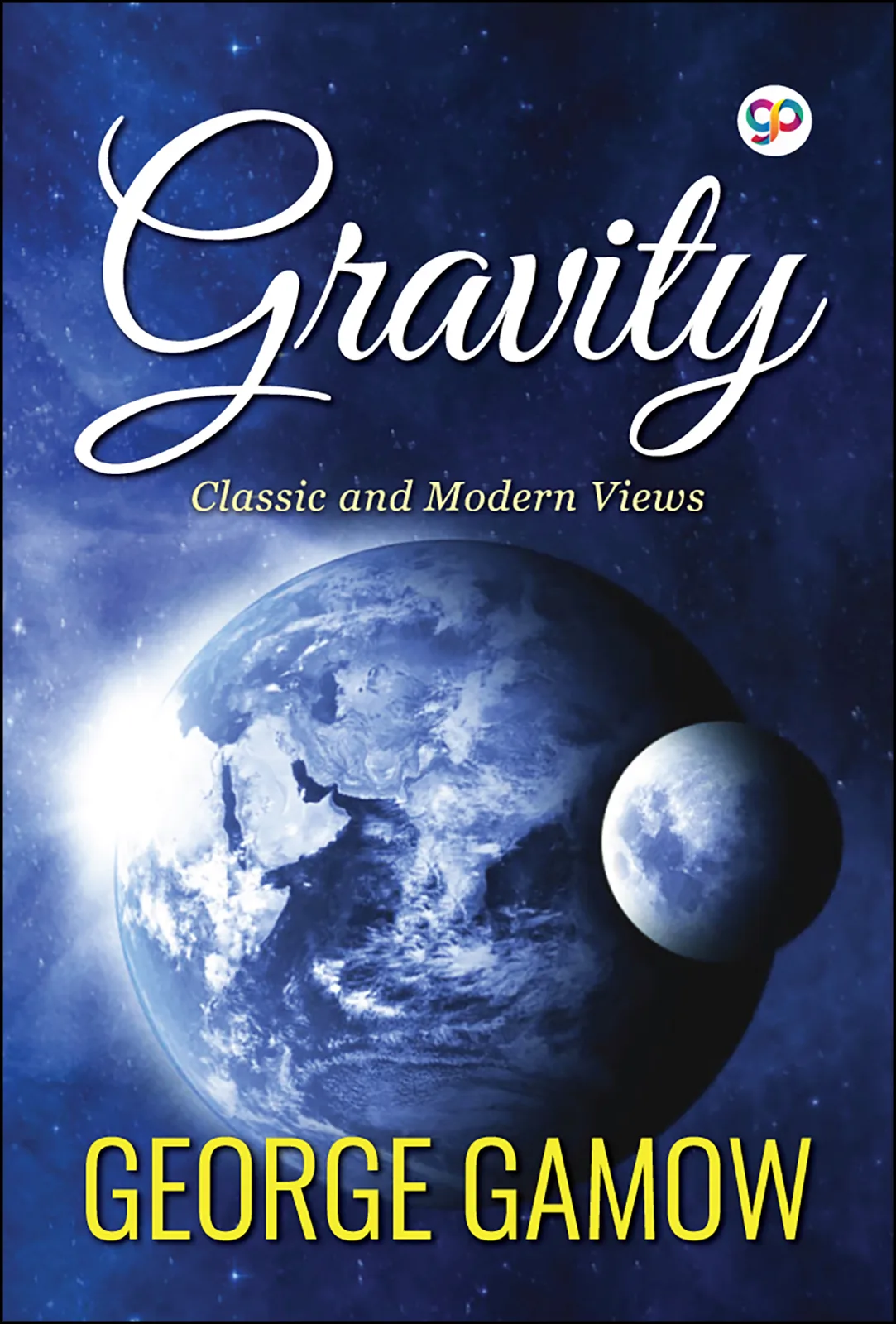
Gravity
Paperback
• 160 Pages
• INR 295.00
• English
• 9789388118484
No ratings yet
| Publisher | General Press |
|---|---|
| ISBN13 | 9789388118484 |
| ASIN/SKU | 9388118480 |
| Book Format | Paperback |
| Language | English |
| Pages | 160 |
| List Price | INR 295.00 |
| Subject Code | FIC028030, TEC037000, FIC036000, HIS037070 |
| Publishing Date | 01/01/2018 |
| Dimensions | 8.25 x 5.25 x 1.0 inches |
| Book Code | BD00067971 |
Buy this Book
Amazon Stores
Ebook Stores
Other Stores
Discover Gravity by George Gamow. This book is published by General Press in Paperback format, ISBN 9789388118484, ASIN 9388118480, under Science and Math, Nonfiction, Reference.
Book Description
'Gravity' by George Gamow is a classic science book that explores the fascinating world of physics, astronomy, and the mysterious force that holds the universe together. Written in an engaging popular-science style, this accessible work turns the seemingly ordinary experience of falling objects, moving planets, and standing on Earth into a doorway to some of the biggest questions about the universe.
What makes gravity so remarkable is that we encounter it every moment without usually thinking about it. We walk, jump, throw objects, watch the Moon move across the sky, and observe planets following their paths, all under its influence. Gamow takes this familiar force and shows how deeply connected it is to humanity’s attempts to understand nature. Rather than treating physics as a collection of intimidating formulas, he presents its ideas through clear explanations, imaginative examples, and a sense of curiosity that makes complicated concepts approachable.
The book traces the development of our understanding of gravity and the scientists whose discoveries transformed the way people viewed the heavens and the Earth. Classical ideas about motion and attraction lead naturally into broader questions about planetary movement, the structure of the cosmos, and the relationship between matter, space, and motion. Gamow’s talent lies in showing how one scientific question can open the door to another, allowing readers to see physics as an evolving human adventure rather than a finished set of facts.
As the discussion expands, Gravity becomes more than an explanation of why things fall. It offers a glimpse into the remarkable laws that govern celestial bodies and the immense forces operating throughout the universe. Gamow also brings his characteristic wit and storytelling ability to the subject, making the journey feel lively and surprisingly entertaining.
For readers interested in science, astronomy, physics, or the history of scientific thought, 'Gravity' offers an inviting introduction to one of nature’s most fundamental forces. Its greatest appeal is the way it transforms something we take for granted into a source of wonder—and once you begin looking at gravity through Gamow’s eyes, you may never see the world around you in quite the same way.
What makes gravity so remarkable is that we encounter it every moment without usually thinking about it. We walk, jump, throw objects, watch the Moon move across the sky, and observe planets following their paths, all under its influence. Gamow takes this familiar force and shows how deeply connected it is to humanity’s attempts to understand nature. Rather than treating physics as a collection of intimidating formulas, he presents its ideas through clear explanations, imaginative examples, and a sense of curiosity that makes complicated concepts approachable.
The book traces the development of our understanding of gravity and the scientists whose discoveries transformed the way people viewed the heavens and the Earth. Classical ideas about motion and attraction lead naturally into broader questions about planetary movement, the structure of the cosmos, and the relationship between matter, space, and motion. Gamow’s talent lies in showing how one scientific question can open the door to another, allowing readers to see physics as an evolving human adventure rather than a finished set of facts.
As the discussion expands, Gravity becomes more than an explanation of why things fall. It offers a glimpse into the remarkable laws that govern celestial bodies and the immense forces operating throughout the universe. Gamow also brings his characteristic wit and storytelling ability to the subject, making the journey feel lively and surprisingly entertaining.
For readers interested in science, astronomy, physics, or the history of scientific thought, 'Gravity' offers an inviting introduction to one of nature’s most fundamental forces. Its greatest appeal is the way it transforms something we take for granted into a source of wonder—and once you begin looking at gravity through Gamow’s eyes, you may never see the world around you in quite the same way.
Author Biography
George Gamow (1904—1968), was a Russian-born American nuclear physicist and cosmologist who was one of the foremost advocates of the big-bang theory, according to which the universe was formed in a colossal explosion that took place billions of years ago.
Gamow attended Leningrad (now St. Petersburg) University, where he studied briefly with A.A. Friedmann, a mathematician and cosmologist who suggested that the universe should be expanding. At that time Gamow did not pursue Friedmann’s suggestion, preferring instead to delve into quantum theory. After graduating in 1928, he traveled to Göttingen, where he developed his quantum theory of radioactivity, the first successful explanation of the behaviour of radioactive elements.
In 1934, after emigrating from the Soviet Union, Gamow was appointed professor of physics at George Washington University in Washington, D.C. There he collaborated with Edward Teller in developing a theory of beta decay (1936), a nuclear decay process in which an electron is emitted.
In 1954 Gamow’s scientific interests grew to encompass biochemistry. He proposed the concept of a genetic code and maintained that the code was determined by the order of recurring triplets of nucleotides, the basic components of DNA. His proposal was vindicated during the rapid development
of genetic theory that followed.
Gamow held the position of professor of physics at the University of Colorado, Boulder, from 1956 until his death. He is perhaps best known for his popular writings, designed to introduce to the non-specialist such difficult subjects as relativity and cosmology. His first such work, Mr. Tompkins in Wonderland (1939), gave rise to the multivolume Mr. Tompkins series (1939–67). Among his other writings are One, Two, Three...Infinity (1947), The Creation of the Universe (1952), A Planet Called Earth (1963), and A Star Called the Sun (1964).
Gamow attended Leningrad (now St. Petersburg) University, where he studied briefly with A.A. Friedmann, a mathematician and cosmologist who suggested that the universe should be expanding. At that time Gamow did not pursue Friedmann’s suggestion, preferring instead to delve into quantum theory. After graduating in 1928, he traveled to Göttingen, where he developed his quantum theory of radioactivity, the first successful explanation of the behaviour of radioactive elements.
In 1934, after emigrating from the Soviet Union, Gamow was appointed professor of physics at George Washington University in Washington, D.C. There he collaborated with Edward Teller in developing a theory of beta decay (1936), a nuclear decay process in which an electron is emitted.
In 1954 Gamow’s scientific interests grew to encompass biochemistry. He proposed the concept of a genetic code and maintained that the code was determined by the order of recurring triplets of nucleotides, the basic components of DNA. His proposal was vindicated during the rapid development
of genetic theory that followed.
Gamow held the position of professor of physics at the University of Colorado, Boulder, from 1956 until his death. He is perhaps best known for his popular writings, designed to introduce to the non-specialist such difficult subjects as relativity and cosmology. His first such work, Mr. Tompkins in Wonderland (1939), gave rise to the multivolume Mr. Tompkins series (1939–67). Among his other writings are One, Two, Three...Infinity (1947), The Creation of the Universe (1952), A Planet Called Earth (1963), and A Star Called the Sun (1964).
Editorial Reviews
Editorial Reviews will be added soon…
Book Summary
George Gamow’s Gravity is an engaging introduction to one of the most familiar yet most mysterious forces in nature. Gravity is something we experience every moment: it keeps our feet on the ground, makes rain fall, holds the Moon around Earth, and keeps planets moving around the Sun. Yet Gamow’s central purpose is to show that gravity is far more remarkable than this everyday familiarity suggests. Through a mixture of simple explanations, thought experiments, historical anecdotes, and imaginative examples, he guides the reader from ordinary observations to some of the deepest ideas in modern physics.
Gamow does not treat gravity as merely a formula to be memorized. Instead, he presents it as a problem that challenged human beings for centuries. Why do objects fall toward Earth? Why does the Moon not simply fly away into space? Why do planets follow regular paths around the Sun? And why should the same force that causes an apple to fall also govern the movements of the stars and planets? These questions provide the foundation for the story.
The book begins with the familiar experience of falling objects. Human beings knew for thousands of years that unsupported objects move downward, but knowing that something happens is very different from understanding why it happens. Ancient thinkers, especially Aristotle, tried to explain falling through ideas about the natural tendencies of different kinds of matter. Heavy objects, in Aristotle’s view, naturally moved toward the center of the universe, while lighter substances behaved differently. This explanation seemed reasonable for centuries because it matched ordinary experience reasonably well.
Gamow then brings the reader into the scientific revolution, particularly the work of Galileo Galilei. Galileo challenged traditional assumptions about falling bodies and demonstrated the importance of careful observation and experiment. One of the major lessons associated with his work is that objects fall with the same acceleration when air resistance is negligible, regardless of their mass. This overturned the old belief that heavier objects must fall faster simply because they are heavier.
Galileo’s investigations also helped establish a new way of thinking about motion. Instead of explaining movement through philosophical assumptions, scientists could describe it mathematically and test those descriptions against nature. This change prepared the way for Isaac Newton.
Newton represents the great turning point in Gamow’s story of gravity. Newton recognized that the force causing an apple to fall toward Earth could be related to the force that keeps the Moon in orbit. This was an extraordinary conceptual leap. The heavens and the Earth, traditionally regarded as belonging to different realms, could be governed by the same physical laws.
Newton’s law of universal gravitation states that every mass attracts every other mass. The strength of this attraction depends on the masses involved and decreases with the square of the distance between them. Gamow explains the meaning of this law in accessible language, showing that gravity is not simply an Earthly phenomenon. The same principle applies to planets, moons, stars, and other astronomical bodies.
One of the most beautiful ideas in the book is the connection between falling and orbiting. The Moon is, in a sense, continually falling toward Earth. It does not crash into Earth because it also has sideways motion. As it falls, the curved shape of its path carries it around the planet. The same basic idea explains why artificial satellites can remain in orbit. An orbiting spacecraft is constantly being pulled toward Earth, but its forward velocity causes it to keep missing the planet.
Gamow uses such examples to make an important point: motion in space is not fundamentally different from motion on Earth. Gravity gives celestial movements their order and predictability. Newton’s achievement was therefore much more than discovering a force. He showed that a single mathematical framework could explain phenomena occurring on vastly different scales.
The book also explores the consequences of Newtonian gravity for the solar system. The planets move around the Sun in approximately elliptical orbits, following patterns that had already been described by Johannes Kepler. Newton provided the deeper physical explanation for Kepler’s laws. The Sun’s enormous mass creates the gravitational attraction that governs planetary motion, while the planets’ own motions prevent them from simply falling straight into the Sun.
Gamow’s discussion of these ideas emphasizes how scientific discoveries build upon one another. Kepler’s observations, Galileo’s experiments, and Newton’s theoretical work were not isolated achievements. Each helped make the next step possible. Science, in this sense, appears as a continuing human conversation with nature.
Another important theme is the universality of gravitational attraction. Gravity does not require physical contact. Earth attracts the Moon across empty space, and the Sun attracts Earth across an enormous distance. This idea was initially difficult to accept. How could one object influence another without touching it? Newton himself recognized the mystery involved, even though his mathematical law described the effects with extraordinary accuracy.
Gamow also shows how gravity determines the structure of larger astronomical systems. Stars attract one another, galaxies are held together by gravitational forces, and enormous collections of matter influence the motion of bodies around them. Gravity therefore operates from the smallest familiar falling object to the largest structures known in the universe.
As the book moves toward modern physics, the simple Newtonian picture begins to encounter deeper questions. Newton’s theory is enormously successful, but it assumes a particular understanding of space and time. Albert Einstein’s theory of relativity transformed that understanding. Instead of treating gravity simply as a force acting across space, Einstein described gravity through the geometry of space and time.
The transition from Newton to Einstein is one of the most fascinating intellectual developments associated with the subject. In Einstein’s picture, massive bodies distort spacetime, and objects move through this curved geometry. Earth does not merely experience a mysterious pulling force from the Sun; rather, the Sun profoundly affects the geometry through which Earth moves. This provides a new way of understanding orbital motion.
Gamow’s treatment of modern physics reflects his larger talent as a science communicator. Difficult concepts are approached through familiar experiences and imaginative reasoning rather than overwhelming mathematical detail. The reader is encouraged to visualize situations and ask what would happen if ordinary conditions were changed. This method makes abstract scientific ideas feel tangible.
Gravity also reveals its importance in the lives of stars. A star exists in a delicate balance between gravitational forces pulling matter inward and physical processes pushing outward. When that balance changes, dramatic events can occur. Stars can collapse, explode, or transform into extraordinarily dense objects. Gravity can therefore be both a stabilizing influence and an agent of cosmic catastrophe.
The subject becomes even more striking when considering extreme gravitational objects such as black holes. If matter becomes sufficiently compressed, gravity can become so strong that not even light can escape from the resulting region. The idea that gravity can influence light itself shows how far the concept has evolved from the simple observation of a stone falling from a height.
Throughout the book, Gamow maintains a sense of wonder. Gravity is presented not as a dry chapter in a physics textbook but as a thread connecting everyday life with the architecture of the cosmos. The same basic phenomenon that makes us stumble when we jump also governs the motions of planets and stars.
Perhaps the deepest lesson of Gravity is that familiar things can conceal extraordinary truths. We often stop wondering about gravity because it is so constant. Gamow reverses this familiarity. He asks the reader to look again at falling objects, planetary motion, and the night sky and recognize the remarkable unity behind them.
Ultimately, Gravity is both a scientific introduction and a celebration of human curiosity. It tells the story of how people gradually moved from observing falling objects to understanding universal laws and eventually to questioning the nature of space and time itself. Galileo, Kepler, Newton, and Einstein appear not simply as names in scientific history but as thinkers who changed the questions humanity could ask.
Gamow’s greatest achievement is making this intellectual journey accessible without stripping it of its mystery. The book leaves the reader with a richer understanding of gravity and, more importantly, with a renewed sense of wonder about the universe. Gravity is not merely the force that keeps us on Earth. It is one of the great organizing principles of nature, binding together falling bodies, moons, planets, stars, and galaxies. To understand gravity is therefore to begin understanding the immense and beautiful structure of the universe in which we live.
Gamow does not treat gravity as merely a formula to be memorized. Instead, he presents it as a problem that challenged human beings for centuries. Why do objects fall toward Earth? Why does the Moon not simply fly away into space? Why do planets follow regular paths around the Sun? And why should the same force that causes an apple to fall also govern the movements of the stars and planets? These questions provide the foundation for the story.
The book begins with the familiar experience of falling objects. Human beings knew for thousands of years that unsupported objects move downward, but knowing that something happens is very different from understanding why it happens. Ancient thinkers, especially Aristotle, tried to explain falling through ideas about the natural tendencies of different kinds of matter. Heavy objects, in Aristotle’s view, naturally moved toward the center of the universe, while lighter substances behaved differently. This explanation seemed reasonable for centuries because it matched ordinary experience reasonably well.
Gamow then brings the reader into the scientific revolution, particularly the work of Galileo Galilei. Galileo challenged traditional assumptions about falling bodies and demonstrated the importance of careful observation and experiment. One of the major lessons associated with his work is that objects fall with the same acceleration when air resistance is negligible, regardless of their mass. This overturned the old belief that heavier objects must fall faster simply because they are heavier.
Galileo’s investigations also helped establish a new way of thinking about motion. Instead of explaining movement through philosophical assumptions, scientists could describe it mathematically and test those descriptions against nature. This change prepared the way for Isaac Newton.
Newton represents the great turning point in Gamow’s story of gravity. Newton recognized that the force causing an apple to fall toward Earth could be related to the force that keeps the Moon in orbit. This was an extraordinary conceptual leap. The heavens and the Earth, traditionally regarded as belonging to different realms, could be governed by the same physical laws.
Newton’s law of universal gravitation states that every mass attracts every other mass. The strength of this attraction depends on the masses involved and decreases with the square of the distance between them. Gamow explains the meaning of this law in accessible language, showing that gravity is not simply an Earthly phenomenon. The same principle applies to planets, moons, stars, and other astronomical bodies.
One of the most beautiful ideas in the book is the connection between falling and orbiting. The Moon is, in a sense, continually falling toward Earth. It does not crash into Earth because it also has sideways motion. As it falls, the curved shape of its path carries it around the planet. The same basic idea explains why artificial satellites can remain in orbit. An orbiting spacecraft is constantly being pulled toward Earth, but its forward velocity causes it to keep missing the planet.
Gamow uses such examples to make an important point: motion in space is not fundamentally different from motion on Earth. Gravity gives celestial movements their order and predictability. Newton’s achievement was therefore much more than discovering a force. He showed that a single mathematical framework could explain phenomena occurring on vastly different scales.
The book also explores the consequences of Newtonian gravity for the solar system. The planets move around the Sun in approximately elliptical orbits, following patterns that had already been described by Johannes Kepler. Newton provided the deeper physical explanation for Kepler’s laws. The Sun’s enormous mass creates the gravitational attraction that governs planetary motion, while the planets’ own motions prevent them from simply falling straight into the Sun.
Gamow’s discussion of these ideas emphasizes how scientific discoveries build upon one another. Kepler’s observations, Galileo’s experiments, and Newton’s theoretical work were not isolated achievements. Each helped make the next step possible. Science, in this sense, appears as a continuing human conversation with nature.
Another important theme is the universality of gravitational attraction. Gravity does not require physical contact. Earth attracts the Moon across empty space, and the Sun attracts Earth across an enormous distance. This idea was initially difficult to accept. How could one object influence another without touching it? Newton himself recognized the mystery involved, even though his mathematical law described the effects with extraordinary accuracy.
Gamow also shows how gravity determines the structure of larger astronomical systems. Stars attract one another, galaxies are held together by gravitational forces, and enormous collections of matter influence the motion of bodies around them. Gravity therefore operates from the smallest familiar falling object to the largest structures known in the universe.
As the book moves toward modern physics, the simple Newtonian picture begins to encounter deeper questions. Newton’s theory is enormously successful, but it assumes a particular understanding of space and time. Albert Einstein’s theory of relativity transformed that understanding. Instead of treating gravity simply as a force acting across space, Einstein described gravity through the geometry of space and time.
The transition from Newton to Einstein is one of the most fascinating intellectual developments associated with the subject. In Einstein’s picture, massive bodies distort spacetime, and objects move through this curved geometry. Earth does not merely experience a mysterious pulling force from the Sun; rather, the Sun profoundly affects the geometry through which Earth moves. This provides a new way of understanding orbital motion.
Gamow’s treatment of modern physics reflects his larger talent as a science communicator. Difficult concepts are approached through familiar experiences and imaginative reasoning rather than overwhelming mathematical detail. The reader is encouraged to visualize situations and ask what would happen if ordinary conditions were changed. This method makes abstract scientific ideas feel tangible.
Gravity also reveals its importance in the lives of stars. A star exists in a delicate balance between gravitational forces pulling matter inward and physical processes pushing outward. When that balance changes, dramatic events can occur. Stars can collapse, explode, or transform into extraordinarily dense objects. Gravity can therefore be both a stabilizing influence and an agent of cosmic catastrophe.
The subject becomes even more striking when considering extreme gravitational objects such as black holes. If matter becomes sufficiently compressed, gravity can become so strong that not even light can escape from the resulting region. The idea that gravity can influence light itself shows how far the concept has evolved from the simple observation of a stone falling from a height.
Throughout the book, Gamow maintains a sense of wonder. Gravity is presented not as a dry chapter in a physics textbook but as a thread connecting everyday life with the architecture of the cosmos. The same basic phenomenon that makes us stumble when we jump also governs the motions of planets and stars.
Perhaps the deepest lesson of Gravity is that familiar things can conceal extraordinary truths. We often stop wondering about gravity because it is so constant. Gamow reverses this familiarity. He asks the reader to look again at falling objects, planetary motion, and the night sky and recognize the remarkable unity behind them.
Ultimately, Gravity is both a scientific introduction and a celebration of human curiosity. It tells the story of how people gradually moved from observing falling objects to understanding universal laws and eventually to questioning the nature of space and time itself. Galileo, Kepler, Newton, and Einstein appear not simply as names in scientific history but as thinkers who changed the questions humanity could ask.
Gamow’s greatest achievement is making this intellectual journey accessible without stripping it of its mystery. The book leaves the reader with a richer understanding of gravity and, more importantly, with a renewed sense of wonder about the universe. Gravity is not merely the force that keeps us on Earth. It is one of the great organizing principles of nature, binding together falling bodies, moons, planets, stars, and galaxies. To understand gravity is therefore to begin understanding the immense and beautiful structure of the universe in which we live.
Sample Chapters
Sample Chapters will be added soon…
Reader Reviews
No reviews yet.
Gravity