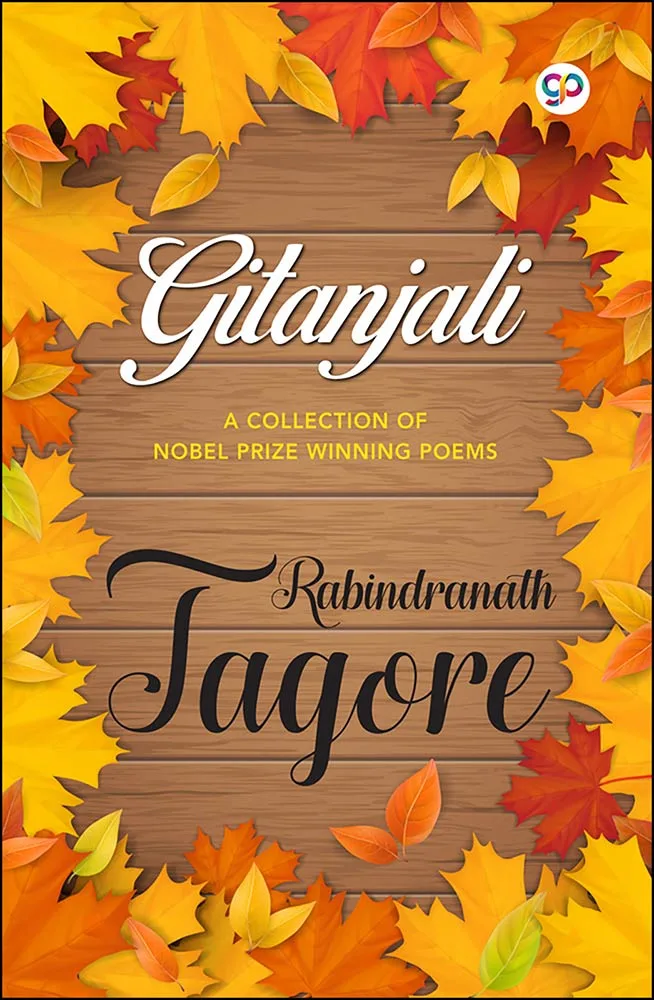
Gitanjali
Paperback
• 142 Pages
• INR 245.00
• English
• 9789380914886
No ratings yet
| Publisher | General Press |
|---|---|
| ISBN13 | 9789380914886 |
| ASIN/SKU | 9380914881 |
| Book Format | Paperback |
| Language | English |
| Pages | 142 |
| List Price | INR 245.00 |
| Subject Code | FIC004000, POE000000, POE023000 |
| Dimensions | 8.25 x 5.25 x 1.0 inches |
| Book Code | BD00067993 |
Buy this Book
Amazon Stores
Ebook Stores
Other Stores
Discover Gitanjali by Rabindranath Tagore. This book is published by General Press in Paperback format, ISBN 9789380914886, ASIN 9380914881, under Literature and Fiction, Indian Writing, Poetry.
Book Description
'Gitanjali' by Rabindranath Tagore is a celebrated work of devotional poetry and spiritual literature that explores the deepest questions of faith, love, life, death, and humanity’s relationship with the divine. What makes this classic so moving is its quiet simplicity: rather than presenting grand religious arguments, Tagore finds the sacred in ordinary moments, human emotions, nature, work, suffering, and the longing of the individual soul.
The poems in Gitanjali, meaning “Song Offerings,” unfold like an intimate conversation between the poet and a presence greater than himself. Tagore writes of a human heart that seeks closeness with God while recognizing its own weaknesses, doubts, pride, and limitations. The speaker repeatedly turns away from worldly possessions and ego, searching instead for humility, freedom, inner peace, and a life devoted to something beyond the self. Along the way, love becomes more than a personal emotion; it becomes a spiritual force capable of connecting human beings with one another and with the world around them.
Nature plays an especially important role in the collection. Rivers, flowers, sunlight, seasons, dust, birds, and changing landscapes become reflections of spiritual truth. Tagore’s vision is not one of escaping the world but of discovering the divine within it. He also celebrates ordinary people and everyday labor, suggesting that holiness can be found not only in temples or moments of prayer but in honest work and compassionate human connection.
At its heart, 'Gitanjali' is a meditation on surrender, devotion, mortality, and the search for meaning. Its language is lyrical yet remarkably accessible, allowing readers to approach profound ideas through images and emotions rather than complicated philosophy. More than a collection of poems, it feels like a journey inward—a gentle invitation to look beyond the noise of everyday life and listen to the voice of the soul. Even after more than a century, Gitanjali continues to raise timeless questions about what it means to love, believe, live, and finally let go, making it a classic worth discovering for yourself.
The poems in Gitanjali, meaning “Song Offerings,” unfold like an intimate conversation between the poet and a presence greater than himself. Tagore writes of a human heart that seeks closeness with God while recognizing its own weaknesses, doubts, pride, and limitations. The speaker repeatedly turns away from worldly possessions and ego, searching instead for humility, freedom, inner peace, and a life devoted to something beyond the self. Along the way, love becomes more than a personal emotion; it becomes a spiritual force capable of connecting human beings with one another and with the world around them.
Nature plays an especially important role in the collection. Rivers, flowers, sunlight, seasons, dust, birds, and changing landscapes become reflections of spiritual truth. Tagore’s vision is not one of escaping the world but of discovering the divine within it. He also celebrates ordinary people and everyday labor, suggesting that holiness can be found not only in temples or moments of prayer but in honest work and compassionate human connection.
At its heart, 'Gitanjali' is a meditation on surrender, devotion, mortality, and the search for meaning. Its language is lyrical yet remarkably accessible, allowing readers to approach profound ideas through images and emotions rather than complicated philosophy. More than a collection of poems, it feels like a journey inward—a gentle invitation to look beyond the noise of everyday life and listen to the voice of the soul. Even after more than a century, Gitanjali continues to raise timeless questions about what it means to love, believe, live, and finally let go, making it a classic worth discovering for yourself.
Author Biography
Rabindranath Tagore (1861-1941) was the youngest son of Debendranath Tagore, a leader of the Brahmo Samaj. He was educated at home and although at seventeen he was sent to England for formal schooling, he did not finish his studies there. In his mature years, in addition to his many-sided literary activities, he managed the family estates, a project which brought him into close touch with common humanity and increased his interest in social reforms. He also started an experimental school at Shantiniketan where he tried his Upanishadic ideals of education. From time to time he participated in the Indian nationalist movement, though in his own non-sentimental and visionary way; and Gandhi, the political father of modern India, was his devoted friend. Tagore was knighted by the ruling British Government in 1915, but within a few years he resigned the honour as a protest against British policies in India.
Tagore had early success as a writer in his native Bengal. With his translations of some of his poems he became rapidly known in the West. In fact, his fame attained a luminous height, taking him across continents on lecture tours and tours of friendship. For the world he became the voice of India's spiritual heritage; and for India, especially for Bengal, he became a great living institution.
Although, Tagore wrote successfully in all literary genres, he was first of all a poet. Among his fifty and odd volumes of poetry are Manasi (1890) {The Ideal One}, Sonar Tari (1894) {The Golden Boat}, Gitanjali (1910) {Song Offerings}, Gitimalya (1914) {Wreath of Songs}, and Balaka (1916) {The Flight of Cranes}. The English renderings of his poetry, which include The Gardener (1913), Fruit-Gathering (1916), and The Fugitive (1921), do not generally correspond to particular volumes in the original Bengali; and in spite of its title, Gitanjali: Song Offerings (1912), the most acclaimed of them, contains poems from other works besides its namesake. Tagore’s major plays are Raja (1910) {The King of the Dark Chamber}, Dakghar (1912) {The Post Office}, Achalayatan (1912) {The Immovable}, Muktadhara (1922) {The Waterfall}, and Raktakaravi (1926) {Red Oleanders}. He is the author of several volumes of short stories and a number of novels, among them Gora (1910), Ghare-Baire (1916) {The Home and the World}, and Yogayog (1929) {Crosscurrents}. Besides these, he wrote musical dramas, dance dramas, essays of all types, travel diaries, and two autobiographies, one in his middle years and the other shortly before his death in 1941. Tagore also left numerous drawings and paintings, and songs for which he wrote the music himself.
Tagore had early success as a writer in his native Bengal. With his translations of some of his poems he became rapidly known in the West. In fact, his fame attained a luminous height, taking him across continents on lecture tours and tours of friendship. For the world he became the voice of India's spiritual heritage; and for India, especially for Bengal, he became a great living institution.
Although, Tagore wrote successfully in all literary genres, he was first of all a poet. Among his fifty and odd volumes of poetry are Manasi (1890) {The Ideal One}, Sonar Tari (1894) {The Golden Boat}, Gitanjali (1910) {Song Offerings}, Gitimalya (1914) {Wreath of Songs}, and Balaka (1916) {The Flight of Cranes}. The English renderings of his poetry, which include The Gardener (1913), Fruit-Gathering (1916), and The Fugitive (1921), do not generally correspond to particular volumes in the original Bengali; and in spite of its title, Gitanjali: Song Offerings (1912), the most acclaimed of them, contains poems from other works besides its namesake. Tagore’s major plays are Raja (1910) {The King of the Dark Chamber}, Dakghar (1912) {The Post Office}, Achalayatan (1912) {The Immovable}, Muktadhara (1922) {The Waterfall}, and Raktakaravi (1926) {Red Oleanders}. He is the author of several volumes of short stories and a number of novels, among them Gora (1910), Ghare-Baire (1916) {The Home and the World}, and Yogayog (1929) {Crosscurrents}. Besides these, he wrote musical dramas, dance dramas, essays of all types, travel diaries, and two autobiographies, one in his middle years and the other shortly before his death in 1941. Tagore also left numerous drawings and paintings, and songs for which he wrote the music himself.
Editorial Reviews
Editorial Reviews will be added soon…
Book Summary
Rabindranath Tagore’s Gitanjali, often translated as “Song Offerings,” is not a conventional book with a continuous story, plot, or group of characters. It is a collection of deeply personal poems in which Tagore explores God, nature, love, death, work, human dignity, loneliness, and the search for spiritual freedom. Written in a simple yet profound language, the poems describe an inner journey from self-centeredness toward surrender, from fear toward freedom, and from separation toward a sense of unity with the world.
The English Gitanjali, published in 1912, brought Tagore international recognition and contributed to his receiving the Nobel Prize in Literature in 1913. Although the poems are deeply rooted in Indian spiritual traditions, their emotional concerns are universal. Tagore speaks about the human longing to find meaning in ordinary existence and to experience a living relationship with the divine.
The Search for God
At the heart of Gitanjali is Tagore’s relationship with God. Yet the God he describes is not distant, abstract, or confined to a temple. The divine is present in nature, in human relationships, in work, in suffering, and in everyday life.
The speaker repeatedly addresses God directly, sometimes as a beloved, sometimes as a master, sometimes as a companion, and sometimes as an unseen presence. There is an intimate quality to these conversations. The poet does not pretend to possess perfect faith. Instead, he admits his weaknesses, doubts, distractions, pride, and fears.
This makes the spirituality of Gitanjali deeply human. Tagore’s relationship with God is not presented as something already completed. It is a continuous search. The poet longs to become worthy of divine presence, but he also recognizes that his own ego constantly stands in the way.
The Problem of the Ego
One of the collection’s most important themes is the struggle against ego and selfishness. Tagore repeatedly suggests that human beings suffer because they become too attached to possessions, pride, status, personal desires, and the illusion of separateness.
The individual wants to possess life rather than receive it. He wants recognition rather than service. He wants to control rather than surrender.
Tagore therefore longs to empty himself of unnecessary pride so that something greater can enter. His spiritual ideal is not the destruction of individuality but its transformation. The human self becomes meaningful when it recognizes its connection with something larger than itself.
This surrender is not passive weakness. It is a form of liberation. When the individual stops making the ego the center of existence, life becomes wider, more generous, and more joyful.
Nature as a Spiritual Presence
Nature occupies an essential place in Gitanjali. Rivers, flowers, rain, sunlight, clouds, seasons, fields, birds, and the changing sky are not merely decorative images. They are ways through which the poet experiences the sacred.
The natural world constantly reminds the speaker that life is larger than individual concerns. A flower blooms without demanding recognition. A river moves without possessing anything. The seasons change without resistance. Through such images, Tagore presents nature as a teacher of humility, renewal, and freedom.
The beauty of nature also connects the physical and spiritual worlds. A morning breeze or a simple landscape can become an occasion for discovering divine presence. Tagore suggests that spiritual experience does not always require withdrawal from the world; sometimes it requires learning to see the world more deeply.
God in Ordinary Human Life
A particularly striking feature of Gitanjali is Tagore’s rejection of spirituality that isolates itself from ordinary people. He does not believe that one can truly find God by escaping human life and hiding away in religious ritual.
Instead, the divine can be encountered among ordinary workers—the farmer, laborer, traveler, and person engaged in daily effort. This gives the collection an important ethical dimension.
Tagore’s message is that love of God must express itself through love and service toward humanity. Spirituality that ignores human suffering becomes empty. The sacred is present not only in prayer but also in honest work, compassion, and participation in the life of the world.
This idea makes Gitanjali more than a collection of devotional poems. It becomes a meditation on how a person should live.
Freedom from Fear
Another major theme is freedom. Tagore is deeply concerned with the many forms of imprisonment that affect human beings: fear, ignorance, narrow-mindedness, superstition, social divisions, and excessive attachment to tradition.
One of the collection’s most famous visions is of a country where the mind is “without fear” and knowledge is freely available. In this vision, freedom is not simply political independence. It is intellectual and spiritual freedom.
A truly free person is capable of thinking clearly, seeking truth, and moving beyond artificial divisions. Tagore connects personal liberation with the liberation of society. A nation cannot become genuinely free if its people remain imprisoned by fear and prejudice.
Love, Separation, and Longing
The poems also use the language of love and longing. The speaker often waits for the divine beloved, sometimes feeling close to God and sometimes painfully separated.
This longing gives the poems their emotional intensity. The absence of God is not simply emptiness; it creates a desire that continually draws the speaker forward.
Human love and divine love sometimes overlap in Tagore’s imagery. Love becomes a way of understanding the relationship between the individual and the infinite. The heart longs for union because it senses that its present state of separation is incomplete.
Death and Immortality
Death is another recurring presence in Gitanjali. Tagore does not treat death merely as something terrifying. Instead, he gradually learns to see it as part of the larger rhythm of existence.
Death reminds human beings that they do not own life. Everything they possess is temporary. Yet this recognition need not produce despair. When one learns to surrender attachment, death becomes less frightening.
The poet hopes to meet death with dignity and openness, having lived fully and offered himself completely. Immortality, in this sense, is not necessarily endless physical existence. It is participation in something larger than the individual self.
The Journey Toward Spiritual Fulfillment
Taken as a whole, Gitanjali describes an inner movement. The poet begins with a sense of separation, weakness, and longing. He struggles against pride and attachment, searches for God in nature and humanity, confronts fear and death, and gradually moves toward surrender and acceptance.
The journey never becomes a simple declaration that all problems have disappeared. Tagore retains humility about the human condition. Spiritual awareness comes through repeated moments of recognition rather than through one dramatic revelation.
Ultimately, Gitanjali teaches that the sacred is already present within ordinary life. God is not something that must necessarily be discovered by escaping the world. God can be found in love, work, nature, beauty, suffering, humility, and service.
The deepest message of the collection is therefore one of surrender and connection. Human beings become truly free not when they possess everything, but when they release their possessiveness. They become spiritually rich not by accumulating more, but by giving themselves more completely. And they come closer to the divine when they stop seeing themselves as isolated individuals and recognize the unity that connects all life.
In Gitanjali, Tagore transforms personal prayer into universal poetry. His poems speak quietly, but their central invitation is powerful: live without fear, love without possession, work without selfishness, accept death without despair, and remain open to the divine presence flowing through the world.
The English Gitanjali, published in 1912, brought Tagore international recognition and contributed to his receiving the Nobel Prize in Literature in 1913. Although the poems are deeply rooted in Indian spiritual traditions, their emotional concerns are universal. Tagore speaks about the human longing to find meaning in ordinary existence and to experience a living relationship with the divine.
The Search for God
At the heart of Gitanjali is Tagore’s relationship with God. Yet the God he describes is not distant, abstract, or confined to a temple. The divine is present in nature, in human relationships, in work, in suffering, and in everyday life.
The speaker repeatedly addresses God directly, sometimes as a beloved, sometimes as a master, sometimes as a companion, and sometimes as an unseen presence. There is an intimate quality to these conversations. The poet does not pretend to possess perfect faith. Instead, he admits his weaknesses, doubts, distractions, pride, and fears.
This makes the spirituality of Gitanjali deeply human. Tagore’s relationship with God is not presented as something already completed. It is a continuous search. The poet longs to become worthy of divine presence, but he also recognizes that his own ego constantly stands in the way.
The Problem of the Ego
One of the collection’s most important themes is the struggle against ego and selfishness. Tagore repeatedly suggests that human beings suffer because they become too attached to possessions, pride, status, personal desires, and the illusion of separateness.
The individual wants to possess life rather than receive it. He wants recognition rather than service. He wants to control rather than surrender.
Tagore therefore longs to empty himself of unnecessary pride so that something greater can enter. His spiritual ideal is not the destruction of individuality but its transformation. The human self becomes meaningful when it recognizes its connection with something larger than itself.
This surrender is not passive weakness. It is a form of liberation. When the individual stops making the ego the center of existence, life becomes wider, more generous, and more joyful.
Nature as a Spiritual Presence
Nature occupies an essential place in Gitanjali. Rivers, flowers, rain, sunlight, clouds, seasons, fields, birds, and the changing sky are not merely decorative images. They are ways through which the poet experiences the sacred.
The natural world constantly reminds the speaker that life is larger than individual concerns. A flower blooms without demanding recognition. A river moves without possessing anything. The seasons change without resistance. Through such images, Tagore presents nature as a teacher of humility, renewal, and freedom.
The beauty of nature also connects the physical and spiritual worlds. A morning breeze or a simple landscape can become an occasion for discovering divine presence. Tagore suggests that spiritual experience does not always require withdrawal from the world; sometimes it requires learning to see the world more deeply.
God in Ordinary Human Life
A particularly striking feature of Gitanjali is Tagore’s rejection of spirituality that isolates itself from ordinary people. He does not believe that one can truly find God by escaping human life and hiding away in religious ritual.
Instead, the divine can be encountered among ordinary workers—the farmer, laborer, traveler, and person engaged in daily effort. This gives the collection an important ethical dimension.
Tagore’s message is that love of God must express itself through love and service toward humanity. Spirituality that ignores human suffering becomes empty. The sacred is present not only in prayer but also in honest work, compassion, and participation in the life of the world.
This idea makes Gitanjali more than a collection of devotional poems. It becomes a meditation on how a person should live.
Freedom from Fear
Another major theme is freedom. Tagore is deeply concerned with the many forms of imprisonment that affect human beings: fear, ignorance, narrow-mindedness, superstition, social divisions, and excessive attachment to tradition.
One of the collection’s most famous visions is of a country where the mind is “without fear” and knowledge is freely available. In this vision, freedom is not simply political independence. It is intellectual and spiritual freedom.
A truly free person is capable of thinking clearly, seeking truth, and moving beyond artificial divisions. Tagore connects personal liberation with the liberation of society. A nation cannot become genuinely free if its people remain imprisoned by fear and prejudice.
Love, Separation, and Longing
The poems also use the language of love and longing. The speaker often waits for the divine beloved, sometimes feeling close to God and sometimes painfully separated.
This longing gives the poems their emotional intensity. The absence of God is not simply emptiness; it creates a desire that continually draws the speaker forward.
Human love and divine love sometimes overlap in Tagore’s imagery. Love becomes a way of understanding the relationship between the individual and the infinite. The heart longs for union because it senses that its present state of separation is incomplete.
Death and Immortality
Death is another recurring presence in Gitanjali. Tagore does not treat death merely as something terrifying. Instead, he gradually learns to see it as part of the larger rhythm of existence.
Death reminds human beings that they do not own life. Everything they possess is temporary. Yet this recognition need not produce despair. When one learns to surrender attachment, death becomes less frightening.
The poet hopes to meet death with dignity and openness, having lived fully and offered himself completely. Immortality, in this sense, is not necessarily endless physical existence. It is participation in something larger than the individual self.
The Journey Toward Spiritual Fulfillment
Taken as a whole, Gitanjali describes an inner movement. The poet begins with a sense of separation, weakness, and longing. He struggles against pride and attachment, searches for God in nature and humanity, confronts fear and death, and gradually moves toward surrender and acceptance.
The journey never becomes a simple declaration that all problems have disappeared. Tagore retains humility about the human condition. Spiritual awareness comes through repeated moments of recognition rather than through one dramatic revelation.
Ultimately, Gitanjali teaches that the sacred is already present within ordinary life. God is not something that must necessarily be discovered by escaping the world. God can be found in love, work, nature, beauty, suffering, humility, and service.
The deepest message of the collection is therefore one of surrender and connection. Human beings become truly free not when they possess everything, but when they release their possessiveness. They become spiritually rich not by accumulating more, but by giving themselves more completely. And they come closer to the divine when they stop seeing themselves as isolated individuals and recognize the unity that connects all life.
In Gitanjali, Tagore transforms personal prayer into universal poetry. His poems speak quietly, but their central invitation is powerful: live without fear, love without possession, work without selfishness, accept death without despair, and remain open to the divine presence flowing through the world.
Sample Chapters
Chapter 1
Thou hast made me endless, such is thy pleasure. This frail vessel thou emptiest again and again, and fillest it ever with fresh life.
This little flute of a reed thou hast carried over hills and dales, and hast breathed through it melodies eternally new.
At the immortal touch of thy hands my little heart loses its limits in joy and gives birth to utterance ineffable.
Thy infinite gifts come to me only on these very small hands of mine. Ages pass, and still thou pourest, and still there is room to fill.
Chapter 2
When thou commandest me to sing, it seems that my heart would break with pride; and I look to thy face, and tears come to my eyes.
All that is harsh and dissonant in my life melts into one sweet harmony – and my adoration spreads wings like a glad bird on its flight across the sea.
I know thou takest pleasure in my singing. I know that only as a singer I come before thy presence.
I touch by the edge of the far-spreading wing of my song thy feet which I could never aspire to reach.
Drunk with the joy of singing I forget myself and call thee friend who art my lord.
Chapter 3
I know not how thou singest, my master! I ever listen in silent amazement.
The light of thy music illumines the world. The life breath of thy music runs from sky to sky. The holy stream of thy music breaks through all stony obstacles and rushes on.
My heart longs to join in thy song, but vainly struggles for a voice. I would speak, but speech breaks not into song, and I cry out baffled. Ah, thou hast made my heart captive in the endless meshes of thy music, my master!
Chapter 4
Life of my life, I shall ever try to keep my body pure, knowing that thy living touch is upon all my limbs.
I shall ever try to keep all untruths out from my thoughts, knowing that thou art that truth which has kindled the light of reason in my mind.
I shall ever try to drive all evils away from my heart and keep my love in flower, knowing that thou hast thy seat in the inmost shrine of my heart.
And it shall be my endeavour to reveal thee in my actions, knowing it is thy power gives me strength to act.
Chapter 5
I ask for a moment’s indulgence to sit by thy side. The works that I have in hand I will finish afterwards.
Away from the sight of thy face my heart knows no rest nor respite, and my work becomes an endless toil in a shoreless sea of toil.
To-day the summer has come at my window with its sighs and murmurs; and the bees are plying their minstrely at the court of the flowering grove.
Now it is time to sit quiet, face to face with thee, and to sing dedication of life in this silent and overflowing leisure.
Chapter 6
Pluck this little flower and take it. Delay not! I fear lest it droop and drop into the dust.
It may not find a place in thy garland, but honour it with a touch of pain from thy hand and pluck it. I fear lest the day end before I am aware, and the time of offering go by.
Though its colour be not deep and its smell be faint, use this flower in thy service and pluck it while there is time.
Chapter 7
My song has put off her adornments. She has no pride of dress and decoration. Ornaments would mar our union; they would come between thee and me; their jingling would drown thy whispers.
My poet’s vanity dies in shame before thy sight. O master poet, I have sat down at thy feet. Only let me make my life simple and straight, like a flute of reed for thee to fill with music.
Chapter 8
The child, who is decked with prince’s robes and who has jewelled chains round his neck loses all pleasure in his play; his dress hampers him at every step.
In fear that it may be frayed, or stained with dust he keeps himself from the world, and is afraid even to move.
Mother, it is no gain, thy bondage of finery, if it keep one shut off from the healthful dust of the earth, if it rob one of the right of entrance to the great fair of common human life.
Chapter 9
O fool, to try to carry thyself upon thy own shoulders! O beggar, to come to beg at thy own door!
Leave all thy burdens on his hands who can bear all, and never look behind in regret.
Thy desire at once puts out the light from the lamp it touches with its breath. It is unholy – take not thy gifts through its unclean hands. Accept only what is offered by sacred love.
Chapter 10
Here is thy footstool and there rest thy feet where live the poorest, and lowliest, and lost.
When I try to bow to thee, my obeisance cannot reach down to the depth where thy feet rest among the poorest, and lowliest, and lost.
Pride can never approach to where thou walkest in the clothes of the humble among the poorest, and lowliest, and lost.
My heart can never find its way to where thou keepest company with the companionless among the poorest, the lowliest, and the lost.
Chapter 11
Leave this chanting and singing and telling of beads! Whom dost thou worship in this lonely dark corner of a temple with doors all shut? Open thine eyes and see thy God is not before thee!
He is there where the tiller is tilling the hard ground and where the pathmaker is breaking stones. He is with them in sun and in shower, and his garment is covered with dust. Put off thy holy mantle and even like him come down on the dusty soil!
Deliverance? Where is this deliverance to be found? Our master himself has joyfully taken upon him the bonds of creation; he is bound with us all for ever.
Come out of thy meditations and leave aside thy flowers and incense! What harm is there is thy clothes become tattered and stained? Meet him and stand by him in toil and in sweat of thy brow.
Chapter 12
The time that my journey takes is long and the way of it long.
I came out on the chariot of the first gleam of light, and pursued my voyage through the wildernesses of worlds leaving my track on many a star and planet.
It is the most distant course that comes nearest to thyself, and that training is the most intricate which leads to the utter simplicity of a tune.
The traveller has to knock at every alien door to come to his own, and one has to wander through all the outer worlds to reach the innermost shrine at the end.
My eyes strayed far and wide before I shut them and said, “Here art thou!”
The question and the cry, “Oh, where?” melt into tears of a thousand streams and deluge the world with the flood of the assurance, “I am!”
Chapter 13
The song that I came to sing remains unsung to this day.
I have spent my days in stringing and in unstringing my instrument.
The time has not come true, the words have not been rightly set; only there is the agony of wishing in my heart.
The blossom has not opened; only the wind is sighing by.
I have not seen his face, nor have I listened to his voice; only I have heard his gentle footsteps from the road before my house.
The livelong day has passed in spreading his seat on the floor; but the lamp has not been lit and I cannot ask him into my house.
I live in the hope of meeting with him; but this meeting is not yet.
Chapter 14
My desires are many and my cry is pitiful, but ever didst thou save me by hard refusals; and this strong mercy has been wrought into my life through and through.
Day by day thou art making me worthy of the simple, great gifts that thou gavest to me unasked – this sky and the light, this body and the life and the mind – saving me from perils of overmuch desire.
There are times when I languidly linger and times when I awaken and hurry in search of my goal; but cruelly thou hidest thyself from before me.
Day by day thou art making me worthy of thy full acceptance by refusing me ever and anon, saving me from perils of weak, uncertain desire.
Chapter 15
I am here to sing thee songs. In this hall of thine I have a corner seat.
In thy world I have no work to do; my useless life can only break out in tunes without a purpose.
When the hour strikes for thy silent worship at the dark temple of midnight, command me, my master, to stand before thee to sing.
When in the morning air the golden harp is tuned honour me, commanding my presence.
Chapter 16
I have had my invitation to this world’s festival, and thus my life has been blessed. My eyes have seen and my ears have heard.
It was my part at this feast to play upon my instrument, and I have done all I could.
Now, I ask, has the time come at last when I may go in and see thy face and offer thee my silent salutation?
Chapter 17
I am only waiting for love to give myself up at last into his hands. That is why it is so late and why I have been guilty of such omissions.
They come with their laws and their codes to bind me fast; but I evade them ever, for I am only waiting for love to give myself up at last into his hands.
People blame me and call me heedless; I doubt not they are right in their blame.
The market day is over and work is all done for the busy. Those who came to call me in vain have gone back in anger. I am only waiting for love to give myself up at last into his hands.
Chapter 18
Clouds heap upon clouds and it darkens. Ah, love, why dost thou let me wait outside at the door all alone?
In the busy moments of the noontide work I am with the crowd, but on this dark lonely day it is only for thee that I hope.
If thou showest me not thy face, if thou leavest me wholly aside, I know not how I am to pass these long, rainy hours.
I keep gazing on the far-away gloom of the sky, and my heart wanders wailing with the restless wind.
Chapter 19
If thou speakest not I will fill my heart with thy silence and endure it. I will keep still and wait like the night with starry vigil and its head bent low with patience.
The morning will surely come, the darkness will vanish, and thy voice pour down in golden streams breaking through the sky.
Then thy words will take wing in songs from every one of my birds’ nests, and thy melodies will break forth in flowers in all my forest groves.
Chapter 20
On the day when the lotus bloomed, alas, my mind was straying, and I knew it not. My basket was empty and the flower remained unheeded.
Only now and again a sadness fell upon me, and I started up from my dream and felt a sweet trace of a strange fragrance in the south wind.
That vague sweetness made my heart ache with longing and it seemed to me that it was the eager breath of the summer seeking for its completion.
I knew not then that it was so near, that it was mine, and that this perfect sweetness had blossomed in the depth of my own heart.
Thou hast made me endless, such is thy pleasure. This frail vessel thou emptiest again and again, and fillest it ever with fresh life.
This little flute of a reed thou hast carried over hills and dales, and hast breathed through it melodies eternally new.
At the immortal touch of thy hands my little heart loses its limits in joy and gives birth to utterance ineffable.
Thy infinite gifts come to me only on these very small hands of mine. Ages pass, and still thou pourest, and still there is room to fill.
Chapter 2
When thou commandest me to sing, it seems that my heart would break with pride; and I look to thy face, and tears come to my eyes.
All that is harsh and dissonant in my life melts into one sweet harmony – and my adoration spreads wings like a glad bird on its flight across the sea.
I know thou takest pleasure in my singing. I know that only as a singer I come before thy presence.
I touch by the edge of the far-spreading wing of my song thy feet which I could never aspire to reach.
Drunk with the joy of singing I forget myself and call thee friend who art my lord.
Chapter 3
I know not how thou singest, my master! I ever listen in silent amazement.
The light of thy music illumines the world. The life breath of thy music runs from sky to sky. The holy stream of thy music breaks through all stony obstacles and rushes on.
My heart longs to join in thy song, but vainly struggles for a voice. I would speak, but speech breaks not into song, and I cry out baffled. Ah, thou hast made my heart captive in the endless meshes of thy music, my master!
Chapter 4
Life of my life, I shall ever try to keep my body pure, knowing that thy living touch is upon all my limbs.
I shall ever try to keep all untruths out from my thoughts, knowing that thou art that truth which has kindled the light of reason in my mind.
I shall ever try to drive all evils away from my heart and keep my love in flower, knowing that thou hast thy seat in the inmost shrine of my heart.
And it shall be my endeavour to reveal thee in my actions, knowing it is thy power gives me strength to act.
Chapter 5
I ask for a moment’s indulgence to sit by thy side. The works that I have in hand I will finish afterwards.
Away from the sight of thy face my heart knows no rest nor respite, and my work becomes an endless toil in a shoreless sea of toil.
To-day the summer has come at my window with its sighs and murmurs; and the bees are plying their minstrely at the court of the flowering grove.
Now it is time to sit quiet, face to face with thee, and to sing dedication of life in this silent and overflowing leisure.
Chapter 6
Pluck this little flower and take it. Delay not! I fear lest it droop and drop into the dust.
It may not find a place in thy garland, but honour it with a touch of pain from thy hand and pluck it. I fear lest the day end before I am aware, and the time of offering go by.
Though its colour be not deep and its smell be faint, use this flower in thy service and pluck it while there is time.
Chapter 7
My song has put off her adornments. She has no pride of dress and decoration. Ornaments would mar our union; they would come between thee and me; their jingling would drown thy whispers.
My poet’s vanity dies in shame before thy sight. O master poet, I have sat down at thy feet. Only let me make my life simple and straight, like a flute of reed for thee to fill with music.
Chapter 8
The child, who is decked with prince’s robes and who has jewelled chains round his neck loses all pleasure in his play; his dress hampers him at every step.
In fear that it may be frayed, or stained with dust he keeps himself from the world, and is afraid even to move.
Mother, it is no gain, thy bondage of finery, if it keep one shut off from the healthful dust of the earth, if it rob one of the right of entrance to the great fair of common human life.
Chapter 9
O fool, to try to carry thyself upon thy own shoulders! O beggar, to come to beg at thy own door!
Leave all thy burdens on his hands who can bear all, and never look behind in regret.
Thy desire at once puts out the light from the lamp it touches with its breath. It is unholy – take not thy gifts through its unclean hands. Accept only what is offered by sacred love.
Chapter 10
Here is thy footstool and there rest thy feet where live the poorest, and lowliest, and lost.
When I try to bow to thee, my obeisance cannot reach down to the depth where thy feet rest among the poorest, and lowliest, and lost.
Pride can never approach to where thou walkest in the clothes of the humble among the poorest, and lowliest, and lost.
My heart can never find its way to where thou keepest company with the companionless among the poorest, the lowliest, and the lost.
Chapter 11
Leave this chanting and singing and telling of beads! Whom dost thou worship in this lonely dark corner of a temple with doors all shut? Open thine eyes and see thy God is not before thee!
He is there where the tiller is tilling the hard ground and where the pathmaker is breaking stones. He is with them in sun and in shower, and his garment is covered with dust. Put off thy holy mantle and even like him come down on the dusty soil!
Deliverance? Where is this deliverance to be found? Our master himself has joyfully taken upon him the bonds of creation; he is bound with us all for ever.
Come out of thy meditations and leave aside thy flowers and incense! What harm is there is thy clothes become tattered and stained? Meet him and stand by him in toil and in sweat of thy brow.
Chapter 12
The time that my journey takes is long and the way of it long.
I came out on the chariot of the first gleam of light, and pursued my voyage through the wildernesses of worlds leaving my track on many a star and planet.
It is the most distant course that comes nearest to thyself, and that training is the most intricate which leads to the utter simplicity of a tune.
The traveller has to knock at every alien door to come to his own, and one has to wander through all the outer worlds to reach the innermost shrine at the end.
My eyes strayed far and wide before I shut them and said, “Here art thou!”
The question and the cry, “Oh, where?” melt into tears of a thousand streams and deluge the world with the flood of the assurance, “I am!”
Chapter 13
The song that I came to sing remains unsung to this day.
I have spent my days in stringing and in unstringing my instrument.
The time has not come true, the words have not been rightly set; only there is the agony of wishing in my heart.
The blossom has not opened; only the wind is sighing by.
I have not seen his face, nor have I listened to his voice; only I have heard his gentle footsteps from the road before my house.
The livelong day has passed in spreading his seat on the floor; but the lamp has not been lit and I cannot ask him into my house.
I live in the hope of meeting with him; but this meeting is not yet.
Chapter 14
My desires are many and my cry is pitiful, but ever didst thou save me by hard refusals; and this strong mercy has been wrought into my life through and through.
Day by day thou art making me worthy of the simple, great gifts that thou gavest to me unasked – this sky and the light, this body and the life and the mind – saving me from perils of overmuch desire.
There are times when I languidly linger and times when I awaken and hurry in search of my goal; but cruelly thou hidest thyself from before me.
Day by day thou art making me worthy of thy full acceptance by refusing me ever and anon, saving me from perils of weak, uncertain desire.
Chapter 15
I am here to sing thee songs. In this hall of thine I have a corner seat.
In thy world I have no work to do; my useless life can only break out in tunes without a purpose.
When the hour strikes for thy silent worship at the dark temple of midnight, command me, my master, to stand before thee to sing.
When in the morning air the golden harp is tuned honour me, commanding my presence.
Chapter 16
I have had my invitation to this world’s festival, and thus my life has been blessed. My eyes have seen and my ears have heard.
It was my part at this feast to play upon my instrument, and I have done all I could.
Now, I ask, has the time come at last when I may go in and see thy face and offer thee my silent salutation?
Chapter 17
I am only waiting for love to give myself up at last into his hands. That is why it is so late and why I have been guilty of such omissions.
They come with their laws and their codes to bind me fast; but I evade them ever, for I am only waiting for love to give myself up at last into his hands.
People blame me and call me heedless; I doubt not they are right in their blame.
The market day is over and work is all done for the busy. Those who came to call me in vain have gone back in anger. I am only waiting for love to give myself up at last into his hands.
Chapter 18
Clouds heap upon clouds and it darkens. Ah, love, why dost thou let me wait outside at the door all alone?
In the busy moments of the noontide work I am with the crowd, but on this dark lonely day it is only for thee that I hope.
If thou showest me not thy face, if thou leavest me wholly aside, I know not how I am to pass these long, rainy hours.
I keep gazing on the far-away gloom of the sky, and my heart wanders wailing with the restless wind.
Chapter 19
If thou speakest not I will fill my heart with thy silence and endure it. I will keep still and wait like the night with starry vigil and its head bent low with patience.
The morning will surely come, the darkness will vanish, and thy voice pour down in golden streams breaking through the sky.
Then thy words will take wing in songs from every one of my birds’ nests, and thy melodies will break forth in flowers in all my forest groves.
Chapter 20
On the day when the lotus bloomed, alas, my mind was straying, and I knew it not. My basket was empty and the flower remained unheeded.
Only now and again a sadness fell upon me, and I started up from my dream and felt a sweet trace of a strange fragrance in the south wind.
That vague sweetness made my heart ache with longing and it seemed to me that it was the eager breath of the summer seeking for its completion.
I knew not then that it was so near, that it was mine, and that this perfect sweetness had blossomed in the depth of my own heart.
Reader Reviews
No reviews yet.
Gitanjali