
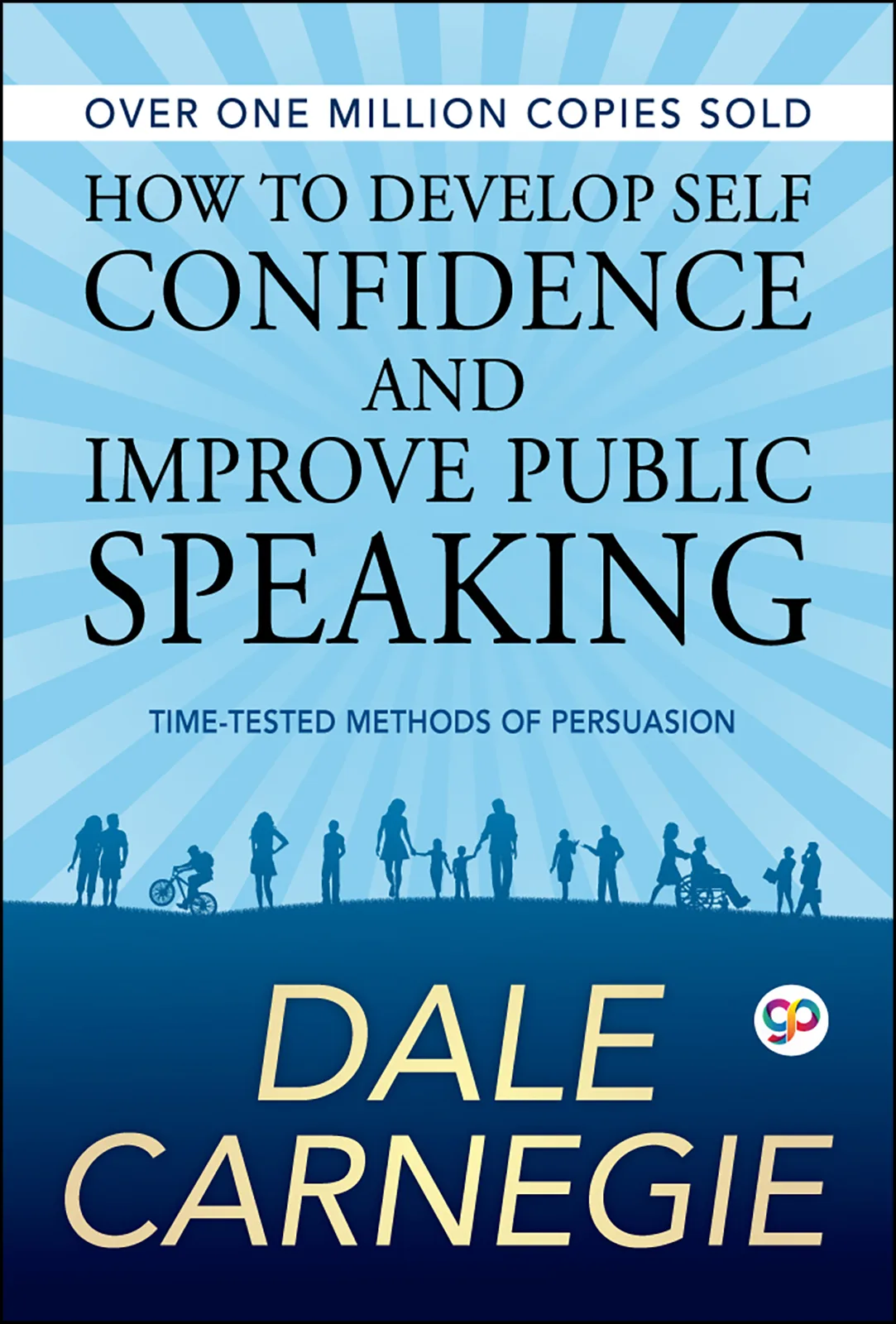
How to Develop Self Confidence and Improve Public Speaking
Paperback
• 204 Pages
• INR 275.00
• English
• 9789387669000
No ratings yet
| Publisher | General Press |
|---|---|
| ISBN13 | 9789387669000 |
| ASIN/SKU | 9387669009 |
| Book Format | Paperback |
| Language | English |
| Pages | 204 |
| List Price | INR 275.00 |
| Subject Code | SEL027000, LAN009000, LAN032000 |
| Publishing Date | 09/04/2018 |
| Dimensions | 8.25 x 5.25 x 1.0 inches |
| Book Code | BD00067998 |
Buy this Book
Amazon Stores
Ebook Stores
Other Stores
Discover How to Develop Self Confidence and Improve Public Speaking by Dale Carnegie. This book is published by General Press in Paperback format, ISBN 9789387669000, ASIN 9387669009, under Self-Help, Business Communication, Personal Growth.
Book Description
What if the biggest obstacle between you and confident communication is not a lack of ability, but simply fear? 'How to Develop Self Confidence and Improve Public Speaking' by Dale Carnegie is a practical self-help and personal development book that explores how ordinary people can overcome nervousness, build self-confidence, and become more effective public speakers. Drawing on Carnegie’s experience teaching communication skills, the book approaches public speaking not as a rare talent reserved for naturally charismatic people, but as a learnable skill that improves through preparation, practice, and genuine engagement with others.
At the heart of the book is the idea that confidence grows through action. Carnegie examines the anxieties that make people hesitate before speaking, whether it is the fear of making mistakes, being judged, forgetting what to say, or simply standing in front of an audience. Instead of suggesting that these fears can disappear overnight, he offers practical ways to face them gradually and turn nervous energy into useful confidence. His approach encourages readers to speak about subjects they understand, prepare thoughtfully, practice repeatedly, and focus more on communicating their ideas than on worrying about how they appear.
The book also explores what makes a speech memorable and convincing. Carnegie emphasizes sincerity, enthusiasm, clear organization, personal experience, and a strong connection with the audience. Readers learn that effective public speaking is not merely about impressive vocabulary or polished delivery. A speaker becomes compelling when the audience can sense genuine interest, confidence, and purpose behind the words. This makes the lessons useful not only for formal speeches but also for meetings, interviews, presentations, conversations, and everyday situations where the ability to express oneself clearly matters.
What makes Carnegie’s advice especially accessible is its encouraging tone. Rather than treating nervousness as a personal weakness, he presents confidence as something that can be developed step by step. The book ultimately offers a reassuring message: becoming a better speaker begins with having the courage to speak, learn from experience, and keep going. For anyone searching for practical guidance on how to develop self-confidence and improve public speaking, Carnegie’s timeless lessons offer both motivation and useful techniques—and may leave you wondering how much more confidently you could express yourself with a little practice.
At the heart of the book is the idea that confidence grows through action. Carnegie examines the anxieties that make people hesitate before speaking, whether it is the fear of making mistakes, being judged, forgetting what to say, or simply standing in front of an audience. Instead of suggesting that these fears can disappear overnight, he offers practical ways to face them gradually and turn nervous energy into useful confidence. His approach encourages readers to speak about subjects they understand, prepare thoughtfully, practice repeatedly, and focus more on communicating their ideas than on worrying about how they appear.
The book also explores what makes a speech memorable and convincing. Carnegie emphasizes sincerity, enthusiasm, clear organization, personal experience, and a strong connection with the audience. Readers learn that effective public speaking is not merely about impressive vocabulary or polished delivery. A speaker becomes compelling when the audience can sense genuine interest, confidence, and purpose behind the words. This makes the lessons useful not only for formal speeches but also for meetings, interviews, presentations, conversations, and everyday situations where the ability to express oneself clearly matters.
What makes Carnegie’s advice especially accessible is its encouraging tone. Rather than treating nervousness as a personal weakness, he presents confidence as something that can be developed step by step. The book ultimately offers a reassuring message: becoming a better speaker begins with having the courage to speak, learn from experience, and keep going. For anyone searching for practical guidance on how to develop self-confidence and improve public speaking, Carnegie’s timeless lessons offer both motivation and useful techniques—and may leave you wondering how much more confidently you could express yourself with a little practice.
Author Biography
Dale Carnegie (1888–1955) was a pioneering American writer, lecturer, and developer of world-renowned courses in self-improvement, salesmanship, corporate training, public speaking, and interpersonal skills. Born into poverty on a farm in Maryville, Missouri, Carnegie sought a way out of his early struggles through education. He attended State Teachers College in Warrensburg, where he discovered a profound natural talent for debate and public speaking. After graduating, he worked various rigorous sales jobs—including selling bacon, soap, and lard for Armour and Company—before moving to New York City to briefly pursue a career in acting.
In 1912, recognizing a widespread need among professionals for improved communication skills, Carnegie convinced a local YMCA manager to let him teach a public speaking class in exchange for a percentage of the proceeds. The class was a massive, immediate success, ultimately leading to the establishment of the Dale Carnegie Institute. His core teaching philosophy centered on the idea that success in business and life depends far more on one's ability to communicate effectively, build self-confidence, and interact positively with others than on purely technical knowledge.
Carnegie’s monumental breakthrough occurred in 1936 with the publication of How to Win Friends and Influence People. Originally intended merely as a supplemental textbook for his courses, the book became an unprecedented overnight sensation. It offered practical, highly accessible advice on handling people, winning them over to your way of thinking, and leading without arousing resentment. It has since sold tens of millions of copies worldwide, fundamentally shaping the modern self-help genre.
Carnegie later authored several other influential works, including How to Stop Worrying and Start Living (1948). His pragmatic wisdom, rooted in genuine appreciation and empathy for others, continues to transform lives, cementing his enduring legacy as a titan of personal development.
In 1912, recognizing a widespread need among professionals for improved communication skills, Carnegie convinced a local YMCA manager to let him teach a public speaking class in exchange for a percentage of the proceeds. The class was a massive, immediate success, ultimately leading to the establishment of the Dale Carnegie Institute. His core teaching philosophy centered on the idea that success in business and life depends far more on one's ability to communicate effectively, build self-confidence, and interact positively with others than on purely technical knowledge.
Carnegie’s monumental breakthrough occurred in 1936 with the publication of How to Win Friends and Influence People. Originally intended merely as a supplemental textbook for his courses, the book became an unprecedented overnight sensation. It offered practical, highly accessible advice on handling people, winning them over to your way of thinking, and leading without arousing resentment. It has since sold tens of millions of copies worldwide, fundamentally shaping the modern self-help genre.
Carnegie later authored several other influential works, including How to Stop Worrying and Start Living (1948). His pragmatic wisdom, rooted in genuine appreciation and empathy for others, continues to transform lives, cementing his enduring legacy as a titan of personal development.
Editorial Reviews
Editorial Reviews will be added soon…
Book Summary
Dale Carnegie’s How to Develop Self-Confidence and Improve Public Speaking is a practical and encouraging guide to one of the most common human fears: standing before other people and expressing oneself with confidence. Carnegie does not present public speaking as a mysterious talent possessed only by naturally gifted people. Instead, he argues that confidence can be developed through preparation, practice, experience, and a willingness to overcome fear gradually.
The book’s central message is simple but powerful: people become confident speakers by speaking. Confidence does not usually come first and action later. In most cases, action creates confidence. A person who waits until all fear has disappeared may wait forever. The way forward is to begin, make mistakes, learn from them, and continue.
Carnegie starts by recognizing that nervousness is natural. Even experienced speakers can feel tension before addressing an audience. The problem is not the existence of fear but the way we respond to it. A beginner often imagines that everyone is watching for mistakes, judging every word, and noticing every sign of nervousness. Carnegie tries to break this illusion. Audiences are generally more sympathetic than anxious speakers imagine, and most listeners are interested in the subject rather than in finding faults with the speaker.
One of Carnegie’s most important pieces of advice is to practice speaking as much as possible. Reading about public speaking can provide useful principles, but it cannot replace actual experience. The first speeches may feel uncomfortable, but each attempt reduces the mystery surrounding the situation. With repeated exposure, the speaker gradually discovers that standing before an audience is not as frightening as the imagination suggested.
Preparation is another major foundation of confidence. Carnegie strongly discourages the idea of trying to memorize an entire speech word for word. Memorization can make a speaker rigid and can create panic if a single sentence is forgotten. Instead, he recommends becoming thoroughly familiar with the subject and organizing the main ideas clearly. When speakers understand what they want to say, they can express themselves naturally.
A well-prepared speaker does not necessarily need to know every sentence in advance. What matters is knowing the central message, the major points, supporting examples, and the order in which the ideas should be presented. This gives the speaker freedom to use natural language rather than sounding as though a text is being recited.
Carnegie also emphasizes choosing subjects about which one has genuine knowledge or experience. A speaker who talks about something personally meaningful is more likely to sound convincing. Experience gives speech warmth and authenticity. A person who has personally faced a difficulty, learned a lesson, observed something interesting, or developed expertise in a particular field has material that can be communicated with confidence.
This leads to another important principle: sincerity. Carnegie believes that audiences respond strongly to genuine feeling. A speaker does not need to imitate famous orators or adopt an artificial style. Trying to sound impressive can actually make a person less effective. The best speakers are often those who speak naturally, as themselves, while communicating an idea they genuinely care about.
Carnegie gives considerable attention to beginning a speech effectively. The opening moments are important because they establish the audience’s attention and the speaker’s confidence. A strong beginning might involve an interesting personal experience, a surprising fact, a question, a vivid example, or a clear statement of the subject. The goal is to create immediate interest rather than beginning with unnecessary formalities.
Stories are especially important in Carnegie’s approach. People naturally respond to stories because stories transform abstract ideas into human experiences. Instead of simply telling an audience that courage is important, for example, a speaker can describe a moment when someone had to act despite fear. Such examples make ideas memorable.
Carnegie also emphasizes concrete details. General statements can sound vague and distant, while specific experiences create pictures in the listener’s mind. A speaker who gives details about a person, place, event, or personal experience can make an audience feel present in the situation.
Another important lesson concerns the use of language. Carnegie encourages speakers to prefer simple, direct words over complicated vocabulary. Public speaking is not an opportunity to display how many difficult words one knows. Its purpose is communication. A speaker who uses familiar language can reach more people and usually sounds more confident and sincere.
Voice and delivery are equally important. A good speech is not simply a collection of correct sentences. The speaker’s voice conveys enthusiasm, conviction, warmth, and emotion. Carnegie encourages variation in pace, pitch, volume, and emphasis. A completely flat voice can make even an excellent subject seem dull.
At the same time, effective delivery should not become theatrical performance. The speaker should communicate naturally, allowing genuine feeling to influence the voice. If the speaker is excited about an idea, the audience should be able to hear that excitement.
Carnegie also discusses physical presence. Posture, facial expression, gestures, and eye contact can reinforce the spoken message. A speaker who stands naturally and looks at members of the audience appears more confident and engaged. Nervous movements, excessive pacing, or constantly looking at notes can distract listeners.
However, Carnegie does not encourage speakers to become obsessed with their gestures. Excessive self-consciousness can make nervousness worse. The focus should remain on the message and the audience. When speakers become genuinely interested in helping listeners understand an idea, they naturally become less preoccupied with themselves.
This shift from self-consciousness to audience-centered communication is one of the book’s most valuable lessons. Fear often comes from thinking, “How am I doing?” Carnegie encourages the speaker to think instead, “How can I help these people?” Once the purpose becomes communication rather than self-display, much of the pressure disappears.
Carnegie also addresses the problem of mistakes. A speaker may forget a word, lose a train of thought, mispronounce something, or experience a moment of silence. Such incidents can feel enormous to the speaker, but the audience often barely notices them. The best response is usually to continue calmly rather than drawing attention to the mistake.
The book repeatedly returns to courage. Carnegie does not define courage as the complete absence of fear. Courage means acting despite fear. Every successful speech becomes evidence that the speaker is capable of doing something that once seemed frightening. This creates a positive cycle: experience produces confidence, confidence encourages further experience, and further experience produces greater confidence.
Carnegie also believes that public speaking can improve a person’s broader personality. Learning to express ideas clearly can strengthen thinking itself. Preparing a speech forces a person to decide what really matters, organize information, and communicate it logically. Confidence in speaking can therefore spill over into professional life, social relationships, leadership, and everyday conversation.
The book’s practical philosophy is ultimately about growth rather than perfection. A beginner should not compare a first speech with the performance of an experienced professional speaker. Every speaker begins somewhere. Improvement comes from identifying weaknesses, practicing deliberately, learning from each experience, and continuing to speak.
The title’s two goals—self-confidence and public speaking—are therefore inseparable. Better speaking builds confidence, and greater confidence improves speaking. But the confidence Carnegie describes is not arrogance. It is the quiet assurance that comes from preparation, experience, and trust in one’s ability to communicate.
In the end, Carnegie’s message is remarkably humane. Fear of public speaking is not evidence of weakness. It is a normal human response to being observed and judged. The solution is not to wait for fear to disappear but to face it repeatedly in manageable steps.
How to Develop Self-Confidence and Improve Public Speaking remains valuable because it treats confidence as something that can be learned rather than something a person either possesses or lacks. Carnegie encourages readers to prepare carefully, speak about subjects they know, use simple language, tell meaningful stories, communicate with genuine feeling, and practice relentlessly. Most importantly, he asks them to stop demanding perfection from themselves.
The real secret of confident speaking, according to Carnegie, is experience. The more often we stand up and speak, the less frightening the experience becomes. Eventually, what once seemed terrifying becomes familiar. Confidence is not a gift that arrives before we begin; it is a quality we build by beginning, continuing, and discovering through experience that we are capable of more than we imagined.
The book’s central message is simple but powerful: people become confident speakers by speaking. Confidence does not usually come first and action later. In most cases, action creates confidence. A person who waits until all fear has disappeared may wait forever. The way forward is to begin, make mistakes, learn from them, and continue.
Carnegie starts by recognizing that nervousness is natural. Even experienced speakers can feel tension before addressing an audience. The problem is not the existence of fear but the way we respond to it. A beginner often imagines that everyone is watching for mistakes, judging every word, and noticing every sign of nervousness. Carnegie tries to break this illusion. Audiences are generally more sympathetic than anxious speakers imagine, and most listeners are interested in the subject rather than in finding faults with the speaker.
One of Carnegie’s most important pieces of advice is to practice speaking as much as possible. Reading about public speaking can provide useful principles, but it cannot replace actual experience. The first speeches may feel uncomfortable, but each attempt reduces the mystery surrounding the situation. With repeated exposure, the speaker gradually discovers that standing before an audience is not as frightening as the imagination suggested.
Preparation is another major foundation of confidence. Carnegie strongly discourages the idea of trying to memorize an entire speech word for word. Memorization can make a speaker rigid and can create panic if a single sentence is forgotten. Instead, he recommends becoming thoroughly familiar with the subject and organizing the main ideas clearly. When speakers understand what they want to say, they can express themselves naturally.
A well-prepared speaker does not necessarily need to know every sentence in advance. What matters is knowing the central message, the major points, supporting examples, and the order in which the ideas should be presented. This gives the speaker freedom to use natural language rather than sounding as though a text is being recited.
Carnegie also emphasizes choosing subjects about which one has genuine knowledge or experience. A speaker who talks about something personally meaningful is more likely to sound convincing. Experience gives speech warmth and authenticity. A person who has personally faced a difficulty, learned a lesson, observed something interesting, or developed expertise in a particular field has material that can be communicated with confidence.
This leads to another important principle: sincerity. Carnegie believes that audiences respond strongly to genuine feeling. A speaker does not need to imitate famous orators or adopt an artificial style. Trying to sound impressive can actually make a person less effective. The best speakers are often those who speak naturally, as themselves, while communicating an idea they genuinely care about.
Carnegie gives considerable attention to beginning a speech effectively. The opening moments are important because they establish the audience’s attention and the speaker’s confidence. A strong beginning might involve an interesting personal experience, a surprising fact, a question, a vivid example, or a clear statement of the subject. The goal is to create immediate interest rather than beginning with unnecessary formalities.
Stories are especially important in Carnegie’s approach. People naturally respond to stories because stories transform abstract ideas into human experiences. Instead of simply telling an audience that courage is important, for example, a speaker can describe a moment when someone had to act despite fear. Such examples make ideas memorable.
Carnegie also emphasizes concrete details. General statements can sound vague and distant, while specific experiences create pictures in the listener’s mind. A speaker who gives details about a person, place, event, or personal experience can make an audience feel present in the situation.
Another important lesson concerns the use of language. Carnegie encourages speakers to prefer simple, direct words over complicated vocabulary. Public speaking is not an opportunity to display how many difficult words one knows. Its purpose is communication. A speaker who uses familiar language can reach more people and usually sounds more confident and sincere.
Voice and delivery are equally important. A good speech is not simply a collection of correct sentences. The speaker’s voice conveys enthusiasm, conviction, warmth, and emotion. Carnegie encourages variation in pace, pitch, volume, and emphasis. A completely flat voice can make even an excellent subject seem dull.
At the same time, effective delivery should not become theatrical performance. The speaker should communicate naturally, allowing genuine feeling to influence the voice. If the speaker is excited about an idea, the audience should be able to hear that excitement.
Carnegie also discusses physical presence. Posture, facial expression, gestures, and eye contact can reinforce the spoken message. A speaker who stands naturally and looks at members of the audience appears more confident and engaged. Nervous movements, excessive pacing, or constantly looking at notes can distract listeners.
However, Carnegie does not encourage speakers to become obsessed with their gestures. Excessive self-consciousness can make nervousness worse. The focus should remain on the message and the audience. When speakers become genuinely interested in helping listeners understand an idea, they naturally become less preoccupied with themselves.
This shift from self-consciousness to audience-centered communication is one of the book’s most valuable lessons. Fear often comes from thinking, “How am I doing?” Carnegie encourages the speaker to think instead, “How can I help these people?” Once the purpose becomes communication rather than self-display, much of the pressure disappears.
Carnegie also addresses the problem of mistakes. A speaker may forget a word, lose a train of thought, mispronounce something, or experience a moment of silence. Such incidents can feel enormous to the speaker, but the audience often barely notices them. The best response is usually to continue calmly rather than drawing attention to the mistake.
The book repeatedly returns to courage. Carnegie does not define courage as the complete absence of fear. Courage means acting despite fear. Every successful speech becomes evidence that the speaker is capable of doing something that once seemed frightening. This creates a positive cycle: experience produces confidence, confidence encourages further experience, and further experience produces greater confidence.
Carnegie also believes that public speaking can improve a person’s broader personality. Learning to express ideas clearly can strengthen thinking itself. Preparing a speech forces a person to decide what really matters, organize information, and communicate it logically. Confidence in speaking can therefore spill over into professional life, social relationships, leadership, and everyday conversation.
The book’s practical philosophy is ultimately about growth rather than perfection. A beginner should not compare a first speech with the performance of an experienced professional speaker. Every speaker begins somewhere. Improvement comes from identifying weaknesses, practicing deliberately, learning from each experience, and continuing to speak.
The title’s two goals—self-confidence and public speaking—are therefore inseparable. Better speaking builds confidence, and greater confidence improves speaking. But the confidence Carnegie describes is not arrogance. It is the quiet assurance that comes from preparation, experience, and trust in one’s ability to communicate.
In the end, Carnegie’s message is remarkably humane. Fear of public speaking is not evidence of weakness. It is a normal human response to being observed and judged. The solution is not to wait for fear to disappear but to face it repeatedly in manageable steps.
How to Develop Self-Confidence and Improve Public Speaking remains valuable because it treats confidence as something that can be learned rather than something a person either possesses or lacks. Carnegie encourages readers to prepare carefully, speak about subjects they know, use simple language, tell meaningful stories, communicate with genuine feeling, and practice relentlessly. Most importantly, he asks them to stop demanding perfection from themselves.
The real secret of confident speaking, according to Carnegie, is experience. The more often we stand up and speak, the less frightening the experience becomes. Eventually, what once seemed terrifying becomes familiar. Confidence is not a gift that arrives before we begin; it is a quality we build by beginning, continuing, and discovering through experience that we are capable of more than we imagined.
Sample Chapters
Chapter 1 : Increase Courage and Self-Confidence
“Courage is one step ahead of fear.”
Coleman Young
More than eighteen thousand businesspersons, since 1912, have been members of the various public speaking courses conducted by me. Most of them have, at my request, written stating why they had enrolled for this training and what they hoped to obtain from it. Naturally, the phraseology varied; but the central desire in these letters, the basic want in the vast majority, remained surprisingly the same: “When I am called upon to stand up and speak,” man after man wrote, “I become so self-conscious, so frightened, that I can’t think clearly, can’t concentrate, can’t remember what I had intended to say. I want to gain self-confidence, poise, and the ability to think on my feet. I want to get my thoughts together in logical order and I want to be able to say my say clearly and convincingly before a business group or audience.” Thousands of their confessions sounded about like that. Years ago, a gentleman here called D.W. Ghent joined my public speaking course in Philadelphia. Shortly after the opening session, he invited me to lunch with him in the Manufacturers’ Club. He was a man of middle age and had always led an active life; was head of his own manufacturing establishment, a leader in church work and civic activities. While we were having lunch that day, he leaned across the table and said: “I have been asked many times to talk before various gatherings but I have never been able to do so. I get so fussed, my mind becomes an utter blank: so I have side-stepped it all my life. But I am chairman now of a board of college trustees. I must preside at their meetings. Do you think it will be possible for me to learn to speak at this late date in my life?”
“Do I think, Mr. Ghent?” I replied. “It is not a question of my thinking. I know you can, and I know you will if you will only practice and follow the directions and instructions.”
After he had completed his training, we lost touch with each other for a while. In 1921, we met and lunched together again at the Manufacturers’ Club. We sat in the same corner and occupied the same table that we had had on the first occasion. Reminding him of our former conversation, I asked him if I had been too sanguine then. He took a little red-backed notebook out of his pocket and showed me a list of talks and dates for which he was booked. “And the ability to make these,” he confessed, “the pleasure I get in doing it, the additional service I can render to the community—these are among the most gratifying things in my life.”
The International Conference for the Limitation of Armaments had been held in Washington shortly before that. When it was known that Lloyd George was planning to attend it, the Baptists of Philadelphia cabled, inviting him to speak at a great mass meeting to be held in their city. Lloyd George cabled back that if he came to Washington he would accept their invitation. And Mr. Ghent informed me that he himself had been chosen, from among all the Baptists of that city, to introduce England’s premier to the audience.
And this was the man who had sat at that same table less than three years before and solemnly asked me if I thought he would ever be able to talk in public!
Was the rapidity with which he forged ahead in his speaking ability unusual? Not at all. There have been hundreds of similar cases. For example—to quote one more specific instance—years ago, a Brooklyn physician, whom we will call Dr. Curtis, spent the winter in Florida near the training grounds of the Giants. Being an enthusiastic baseball fan, he often went to see them practise. In time, he became quite friendly with the team, and was invited to attend a banquet given in their honour.
After the coffee and nuts were served, several prominent guests were called upon to “say a few words”. Suddenly with the abruptness and unexpectedness of an explosion, he heard the toast-master remark: “We have a physician with us tonight, and I am going to ask Dr. Curtis to talk on a baseball player’s health.”
Was he prepared? Of course. He had had the best preparation in the world; he had been studying hygiene and practising medicine for almost a third of a century. He could have sat in his chair and talked about this subject all night to the man seated on his right or left. But to get up and say the same things to even a small audience—that was another matter. That was a paralyzing matter. His heart doubled its pace and skipped beats at the very contemplation of it. He had never made a public speech in his life, and every thought he had had now took wings.
What was he to do? The audience was applauding. Everyone was looking at him. He shook his head. But that served only to heighten the applause, to increase the demand. The cries of “Dr. Curtis! Speech! Speech!” grew louder and more insistent.
He was in positive misery. He knew that if he got up he would fail, that he would be unable to utter half a dozen sentences. So he arose and, without saying a word, turned his back on his friends and walked silently out of the room, a deeply embarrassed and humiliated man.
Small wonder that one of the first things he did after getting back to Brooklyn was to come to the Central Y.M.C.A. and enrol in the course in Public Speaking. He didn’t propose to be put to the blush and be stricken dumb a second time.
He was the kind of student that delights an instructor: he was in dead earnest. He wanted to be able to talk, and there was no half-heartedness about his desires. He prepared his talks thoroughly, he practised them with a will, and he never missed a single session of the course.
He did precisely what such a student always does: he progressed at a rate that surprised him, that surpassed his fondest hopes. After the first few sessions his nervousness subsided, and his confidence mounted higher and higher. In two months he had become the star speaker of the group. He was soon accepting invitations to speak elsewhere; he now loved the feel and exhilaration of it, the distinction and the additional friends it brought him.
The gaining of self-confidence and courage and the ability to think calmly and clearly while talking to a group is not one-tenth as difficult as most men imagine. It is not a gift bestowed by providence on only a few rarely endowed individuals. It is like the ability to play golf. Any man can develop his own latent capacity if he has sufficient desire to do so.
Is there the faintest shadow of a reason why you should not be able to think as well in a perpendicular position before an audience as you can when sitting down? Surely, you know there is not. In fact, you ought to think better when facing a group of men. Their presence ought to stir you and lift you. A great many speakers will tell you that the presence of an audience is a stimulus, an inspiration, that drives their brains to function more clearly, more keenly. At such times, thoughts, facts, ideas, that they did not know they possessed, drift smoking by, as Henry Ward Beecher said; and they have but to reach out and lay their hands hot upon them. They ought to be your experience. It probably will be if you practise and persevere.
Of this much, however, you may be absolutely sure: training and practise will wear away your audience-fright and give you self-confidence and an abiding courage.
Do not imagine that your case is unusually difficult. Even those who afterwards became the most eloquent representatives of their generation were, at the outset of their careers, afflicted by this blinding fear and self-consciousness.
Mark Twain, the first time he stood up to lecture, felt as if his mouth were filled with cotton and his pulse were speeding for some prize cup.
The late Jean Jaurès, the most powerful political speaker that France produced during his generation, sat, for a year, tongue-tied in the Chamber of Deputies before he could summon of the courage to make his initial speech.
John Bright, the illustrious Englishman who, during the civil war, defended in England the cause of union and emancipation, made his maiden speech before a group of countryfolk gathered in a school building. He was so frightened on the way to the place, so fearful that he would fail, that he implored his companion to start applause to bolster him up whenever he showed signs of giving way to his nervousness.
Charles Stewart Parnell, the great Irish leader, at the outset of his speaking career, was so nervous, according to the testimony of his brother, that he frequently clenched his fists until his nails sank into his flesh and his palms bled.
Disraeli admitted that he would rather have led a cavalry charge than have faced the House of Commons for the first time. His opening speech there was a ghastly failure. So was Sheridan’s.
In fact, so many of the famous speakers of England have made poor showings at first that there is now a feeling in Parliament that it is rather an inauspicious omen for a young man’s initial talk to be a decided success. So take heart.
After watching the careers and aiding somewhat in the development of so many speakers, the author is always glad when a student has, at the outset, a certain amount of flutter and nervous agitation.
There is a certain responsibility in making a talk, even if it is to only two dozen men in a business conference—a certain strain, a certain shock, a certain excitement. The speaker ought to be keyed up like a thoroughbred straining of the bit. The immortal Cicero said, two thousand years ago, that all public speaking of real merit was characterized by nervousness.
Speakers often experience this same feeling even when they are talking over the radio. “Microphone fright”, it is called. When Charlie Chaplin went “on the air”, he had his speech all written out. Surely he was used to audiences. He toured America back in 1912 with a vaudeville sketch entitled “A Night in a Music Hall”. Before that he was on the legitimate stage in England. Yet, when he went into the padded room and faced the microphone, he had a feeling in the stomach not unlike the sensation one gets when he crosses the Atlantic during a stormy February.
James Kirkwood, a famous motion picture actor and director, had a similar experience. He used to be a star on the speaking stage; but when he came out of the sending room after addressing the invisible audience, he was mopping perspiration from his brow. “An opening night on Broadway,” he confessed, “is nothing in comparison to that.”
Some men, no matter how often they speak, always experience this self-consciousness just before they commence; but in a few seconds after they have got on their feet, it disappears.
Even Lincoln felt shy for the few opening moments. In a few moments he gained composure and warmth and earnestness, and his real speech began.
Your experience may be similar to his.
In order to get the most out of this training, and to get it with rapidity and dispatch, four things are essential:
First : Start with a Strong and Persistent Desire
This is of far more importance than you probably realize. If your instructor could look into your mind and heart now and ascertain the depth of your desires, he could foretell, almost with certainty, the swiftness of the progress you will make. If your desire is pale and flabby, your achievements will also take on that hue and consistency. But, if you go after this subject with persistence, and with the energy of a bulldog after a cat, nothing underneath the Milky Way will defeat you.
Therefore, arouse your enthusiasm for this study. Enumerate its benefits. Think of what additional self-confidence and the ability to talk more convincingly in business will mean to you. Think of what it may mean to you socially; of the friends it will bring, of the increase of your personal influence, of the leadership it will give you. And it will give you leadership more rapidly than almost any other activity you can think of or imagine.
It is an attainment that almost every person of education longs for. After Andrew Carnegie’s death there was found, among his papers, a plan for his life drawn up when he was thirty-three years of age. He then felt that in two more years he could so arrange his business as to have an annual income of fifty thousand dollars; so he proposed to retire at thirty-five, go to Oxford and get a thorough education, and “pay special attention to speaking in public.”
Think of the glow of satisfaction and pleasure that will accrue from the exercise of this new power. The author has travelled round over no small part of this terrestrial ball; and has had many and varied experiences; but for downright, and lasting inward satisfaction, he knows of few things that will compare to standing before an audience and making men think your thoughts after you. It will give you a sense of strength, a feeling of power. It will appeal to your pride of personal accomplishment. It will set you off from and raise you above your fellowmen. There is magic in it and a never-to-be-forgotten thrill. “Two minutes before I begin,” a speaker confessed, “I would rather be whipped than start; but two minutes before I finish, I would rather be shot than stop.”
In every course, some men grow faint-hearted and fall by the wayside; so you should keep thinking of what this course will mean to you until your desire is white hot. You should start this programme with an enthusiasm that will carry you through every session, triumphant to the end. Tell your friends that you have joined this course. Set aside one certain night of the week for the reading of these lessons and the preparation of your talks. In short, make it as easy as possible to go ahead. Make it as difficult as possible to retreat.
When Julius Ceasar sailed over the channel from Gaul and landed with his legions on what is now England, what did he do to insure the success of his arms? A very clever thing: he halted his soldiers on the chalk cliffs of Dover, and, looking down over the waves two hundred feet below, they saw red tongues of fire consume every ship in which they had crossed. In the enemy’s country, with the last link with the Continent gone, the last means of retreating burned, there was but one thing left for them to do: to advance, to conquer. That is precisely what they did.
Such was the spirit of the immortal Caesar. Why not make it yours, too, in this war to exterminate your foolish fear of audiences.
Second : Act Confidently
To develop courage when you are facing an audience, act as if you already have it. Of course, unless you are prepared, all the acting in the world will avail but little. But granted that you know what you are going to talk about, step out briskly and take a deep breath. In fact, breathe deeply for thirty seconds before you ever face your audience. The increased supply of oxygen will buoy you up and give you courage. The great tenor, Jean de Reszke, used to say that when you had your breath so you “could sit on it”, nervousness vanished.
When a youth of the Peuhl tribe in Central Africa attains manhood and wishes to take unto himself a wife, he is compelled to undergo the ceremony of flagellation. The women of the tribe foregather, singing and clapping their hands to the rhythm of tom-toms. The candidate strides forth stripped naked to the waist. Suddenly a man armed with a cruel whip sets upon the lad, beating his bare skin, lashing him, flogging him like a fiend. Welts appear; often the skin is cut, blood flows; scars are made that last a lifetime. During this scourging, a venerable judge of the tribe crouches at the feet of the victim to see if he moves or exhibits the slightest evidence of pain. To pass the test successfully the tortured aspirant must not only endure the ordeal, but, as he endures it, he must sing a paean of praise.
In every age, in every clime, men have always admired courage; so, no matter how your heart may be pounding inside, stride forth bravely, stop, stand still like the scourged youth of Central Africa, and like him, act as if you loved it.
Draw yourself up to your full height and look your audience straight in the eyes, and begin to talk as confidently as if every one of them owed you money. Imagine that they do. Imagine that they have assembled there to bet you for an extension of credit. The psychological effect on you will be beneficial.
Do not nervously button and unbutton your coat, and fumble with your hands. If you must make nervous movements, place your hands behind your back and twist your fingers there where no one can see the performance—or wiggle your toes.
As a general rule, it is bed for a speaker to hide behind furniture, but it may give you a little courage the first few times to stand behind a table or chair and to grip them tightly—or hold a coin firmly in the palm of your hand.
How did Theodore Roosevelt develop his characteristic courage and self-reliance? Was he endowed by nature with a venturesome and daring spirit? Not at all. “Having been a rather sickly and awkward boy,” he confesses in his Autobiography. “I was, as a young man, at first both nervous and distrustful of my own prowess. I had to train myself painfully and laboriously not merely as regards my body but as regards my soul and spirit.”
Fortunately, he has told us how he achieved the transformation: “When a boy,” he writes, “I read a passage in one of Marryat’s books which always impressed me. In this passage the captain of some small British man-of-war is explaining to the hero how to acquire the quality of fearlessness. He says that at the outset almost every man is frightened when he goes into action, but that the course to follow is for the man to keep such a grip on himself that he can act just if he were not frightened. After this is kept up long enough, it changes from pretence to reality, and the man does in very fact become fearless by sheer dint of practising fearlessness when he does not feel it. (I am using my own language, not Marryat’s.)
“This was the theory upon which I went. There were all kinds of things of which I was afraid at first, ranging from grizzly bears to ‘mean’ horses and gun-fighters; but by acting as if I was not afraid I gradually ceased to be afraid. Most men can have the same experience if they choose.”
So take the offensive against your fears. Go out to meet them, battle them, conquer them by sheer boldness at every opportunity.
Have a massage, and then think of yourself as a courier boy instructed to deliver it. We pay slight attention to the boy. It is the courier that we want. The message—that is the thing. Keep your mind on it. Keep your heart in it. Know it like the back of your hand. Believe it feelingly. Then talk as if you were determined to say it. Do that, and the chances are ten to one that you will soon be master of the occasion and master of yourself.
Third : Know Thoroughly What You are Going to Talk About
Unless a man has thought out and planned his talk and knows what he is going to say, he can’t feel very comfortable when he faces his auditors. He is like the blind leading the blind. Under such circumstances, your speaker ought to be self-conscious, ought to feel repentant, ought to be ashamed of his negligence.
“I was elected to the Legislature in the autumn of 1881,” Theodore Roosevelt wrote in his Autobiography, “and found myself the youngest man in that body. Like all young men and inexperienced members, I had considerable difficulty in teaching myself to speak. I profited much by the advice of a hard-headed old countryman—who was unconsciously paraphrasing the Duke of Wellington, who was himself doubtless paraphrasing somebody else. The advice ran: ‘Don’t speak until you are sure you have something to say, and know just what it is; then say it, and sit down.’”
“Courage is one step ahead of fear.”
Coleman Young
More than eighteen thousand businesspersons, since 1912, have been members of the various public speaking courses conducted by me. Most of them have, at my request, written stating why they had enrolled for this training and what they hoped to obtain from it. Naturally, the phraseology varied; but the central desire in these letters, the basic want in the vast majority, remained surprisingly the same: “When I am called upon to stand up and speak,” man after man wrote, “I become so self-conscious, so frightened, that I can’t think clearly, can’t concentrate, can’t remember what I had intended to say. I want to gain self-confidence, poise, and the ability to think on my feet. I want to get my thoughts together in logical order and I want to be able to say my say clearly and convincingly before a business group or audience.” Thousands of their confessions sounded about like that. Years ago, a gentleman here called D.W. Ghent joined my public speaking course in Philadelphia. Shortly after the opening session, he invited me to lunch with him in the Manufacturers’ Club. He was a man of middle age and had always led an active life; was head of his own manufacturing establishment, a leader in church work and civic activities. While we were having lunch that day, he leaned across the table and said: “I have been asked many times to talk before various gatherings but I have never been able to do so. I get so fussed, my mind becomes an utter blank: so I have side-stepped it all my life. But I am chairman now of a board of college trustees. I must preside at their meetings. Do you think it will be possible for me to learn to speak at this late date in my life?”
“Do I think, Mr. Ghent?” I replied. “It is not a question of my thinking. I know you can, and I know you will if you will only practice and follow the directions and instructions.”
After he had completed his training, we lost touch with each other for a while. In 1921, we met and lunched together again at the Manufacturers’ Club. We sat in the same corner and occupied the same table that we had had on the first occasion. Reminding him of our former conversation, I asked him if I had been too sanguine then. He took a little red-backed notebook out of his pocket and showed me a list of talks and dates for which he was booked. “And the ability to make these,” he confessed, “the pleasure I get in doing it, the additional service I can render to the community—these are among the most gratifying things in my life.”
The International Conference for the Limitation of Armaments had been held in Washington shortly before that. When it was known that Lloyd George was planning to attend it, the Baptists of Philadelphia cabled, inviting him to speak at a great mass meeting to be held in their city. Lloyd George cabled back that if he came to Washington he would accept their invitation. And Mr. Ghent informed me that he himself had been chosen, from among all the Baptists of that city, to introduce England’s premier to the audience.
And this was the man who had sat at that same table less than three years before and solemnly asked me if I thought he would ever be able to talk in public!
Was the rapidity with which he forged ahead in his speaking ability unusual? Not at all. There have been hundreds of similar cases. For example—to quote one more specific instance—years ago, a Brooklyn physician, whom we will call Dr. Curtis, spent the winter in Florida near the training grounds of the Giants. Being an enthusiastic baseball fan, he often went to see them practise. In time, he became quite friendly with the team, and was invited to attend a banquet given in their honour.
After the coffee and nuts were served, several prominent guests were called upon to “say a few words”. Suddenly with the abruptness and unexpectedness of an explosion, he heard the toast-master remark: “We have a physician with us tonight, and I am going to ask Dr. Curtis to talk on a baseball player’s health.”
Was he prepared? Of course. He had had the best preparation in the world; he had been studying hygiene and practising medicine for almost a third of a century. He could have sat in his chair and talked about this subject all night to the man seated on his right or left. But to get up and say the same things to even a small audience—that was another matter. That was a paralyzing matter. His heart doubled its pace and skipped beats at the very contemplation of it. He had never made a public speech in his life, and every thought he had had now took wings.
What was he to do? The audience was applauding. Everyone was looking at him. He shook his head. But that served only to heighten the applause, to increase the demand. The cries of “Dr. Curtis! Speech! Speech!” grew louder and more insistent.
He was in positive misery. He knew that if he got up he would fail, that he would be unable to utter half a dozen sentences. So he arose and, without saying a word, turned his back on his friends and walked silently out of the room, a deeply embarrassed and humiliated man.
Small wonder that one of the first things he did after getting back to Brooklyn was to come to the Central Y.M.C.A. and enrol in the course in Public Speaking. He didn’t propose to be put to the blush and be stricken dumb a second time.
He was the kind of student that delights an instructor: he was in dead earnest. He wanted to be able to talk, and there was no half-heartedness about his desires. He prepared his talks thoroughly, he practised them with a will, and he never missed a single session of the course.
He did precisely what such a student always does: he progressed at a rate that surprised him, that surpassed his fondest hopes. After the first few sessions his nervousness subsided, and his confidence mounted higher and higher. In two months he had become the star speaker of the group. He was soon accepting invitations to speak elsewhere; he now loved the feel and exhilaration of it, the distinction and the additional friends it brought him.
The gaining of self-confidence and courage and the ability to think calmly and clearly while talking to a group is not one-tenth as difficult as most men imagine. It is not a gift bestowed by providence on only a few rarely endowed individuals. It is like the ability to play golf. Any man can develop his own latent capacity if he has sufficient desire to do so.
Is there the faintest shadow of a reason why you should not be able to think as well in a perpendicular position before an audience as you can when sitting down? Surely, you know there is not. In fact, you ought to think better when facing a group of men. Their presence ought to stir you and lift you. A great many speakers will tell you that the presence of an audience is a stimulus, an inspiration, that drives their brains to function more clearly, more keenly. At such times, thoughts, facts, ideas, that they did not know they possessed, drift smoking by, as Henry Ward Beecher said; and they have but to reach out and lay their hands hot upon them. They ought to be your experience. It probably will be if you practise and persevere.
Of this much, however, you may be absolutely sure: training and practise will wear away your audience-fright and give you self-confidence and an abiding courage.
Do not imagine that your case is unusually difficult. Even those who afterwards became the most eloquent representatives of their generation were, at the outset of their careers, afflicted by this blinding fear and self-consciousness.
Mark Twain, the first time he stood up to lecture, felt as if his mouth were filled with cotton and his pulse were speeding for some prize cup.
The late Jean Jaurès, the most powerful political speaker that France produced during his generation, sat, for a year, tongue-tied in the Chamber of Deputies before he could summon of the courage to make his initial speech.
John Bright, the illustrious Englishman who, during the civil war, defended in England the cause of union and emancipation, made his maiden speech before a group of countryfolk gathered in a school building. He was so frightened on the way to the place, so fearful that he would fail, that he implored his companion to start applause to bolster him up whenever he showed signs of giving way to his nervousness.
Charles Stewart Parnell, the great Irish leader, at the outset of his speaking career, was so nervous, according to the testimony of his brother, that he frequently clenched his fists until his nails sank into his flesh and his palms bled.
Disraeli admitted that he would rather have led a cavalry charge than have faced the House of Commons for the first time. His opening speech there was a ghastly failure. So was Sheridan’s.
In fact, so many of the famous speakers of England have made poor showings at first that there is now a feeling in Parliament that it is rather an inauspicious omen for a young man’s initial talk to be a decided success. So take heart.
After watching the careers and aiding somewhat in the development of so many speakers, the author is always glad when a student has, at the outset, a certain amount of flutter and nervous agitation.
There is a certain responsibility in making a talk, even if it is to only two dozen men in a business conference—a certain strain, a certain shock, a certain excitement. The speaker ought to be keyed up like a thoroughbred straining of the bit. The immortal Cicero said, two thousand years ago, that all public speaking of real merit was characterized by nervousness.
Speakers often experience this same feeling even when they are talking over the radio. “Microphone fright”, it is called. When Charlie Chaplin went “on the air”, he had his speech all written out. Surely he was used to audiences. He toured America back in 1912 with a vaudeville sketch entitled “A Night in a Music Hall”. Before that he was on the legitimate stage in England. Yet, when he went into the padded room and faced the microphone, he had a feeling in the stomach not unlike the sensation one gets when he crosses the Atlantic during a stormy February.
James Kirkwood, a famous motion picture actor and director, had a similar experience. He used to be a star on the speaking stage; but when he came out of the sending room after addressing the invisible audience, he was mopping perspiration from his brow. “An opening night on Broadway,” he confessed, “is nothing in comparison to that.”
Some men, no matter how often they speak, always experience this self-consciousness just before they commence; but in a few seconds after they have got on their feet, it disappears.
Even Lincoln felt shy for the few opening moments. In a few moments he gained composure and warmth and earnestness, and his real speech began.
Your experience may be similar to his.
In order to get the most out of this training, and to get it with rapidity and dispatch, four things are essential:
First : Start with a Strong and Persistent Desire
This is of far more importance than you probably realize. If your instructor could look into your mind and heart now and ascertain the depth of your desires, he could foretell, almost with certainty, the swiftness of the progress you will make. If your desire is pale and flabby, your achievements will also take on that hue and consistency. But, if you go after this subject with persistence, and with the energy of a bulldog after a cat, nothing underneath the Milky Way will defeat you.
Therefore, arouse your enthusiasm for this study. Enumerate its benefits. Think of what additional self-confidence and the ability to talk more convincingly in business will mean to you. Think of what it may mean to you socially; of the friends it will bring, of the increase of your personal influence, of the leadership it will give you. And it will give you leadership more rapidly than almost any other activity you can think of or imagine.
It is an attainment that almost every person of education longs for. After Andrew Carnegie’s death there was found, among his papers, a plan for his life drawn up when he was thirty-three years of age. He then felt that in two more years he could so arrange his business as to have an annual income of fifty thousand dollars; so he proposed to retire at thirty-five, go to Oxford and get a thorough education, and “pay special attention to speaking in public.”
Think of the glow of satisfaction and pleasure that will accrue from the exercise of this new power. The author has travelled round over no small part of this terrestrial ball; and has had many and varied experiences; but for downright, and lasting inward satisfaction, he knows of few things that will compare to standing before an audience and making men think your thoughts after you. It will give you a sense of strength, a feeling of power. It will appeal to your pride of personal accomplishment. It will set you off from and raise you above your fellowmen. There is magic in it and a never-to-be-forgotten thrill. “Two minutes before I begin,” a speaker confessed, “I would rather be whipped than start; but two minutes before I finish, I would rather be shot than stop.”
In every course, some men grow faint-hearted and fall by the wayside; so you should keep thinking of what this course will mean to you until your desire is white hot. You should start this programme with an enthusiasm that will carry you through every session, triumphant to the end. Tell your friends that you have joined this course. Set aside one certain night of the week for the reading of these lessons and the preparation of your talks. In short, make it as easy as possible to go ahead. Make it as difficult as possible to retreat.
When Julius Ceasar sailed over the channel from Gaul and landed with his legions on what is now England, what did he do to insure the success of his arms? A very clever thing: he halted his soldiers on the chalk cliffs of Dover, and, looking down over the waves two hundred feet below, they saw red tongues of fire consume every ship in which they had crossed. In the enemy’s country, with the last link with the Continent gone, the last means of retreating burned, there was but one thing left for them to do: to advance, to conquer. That is precisely what they did.
Such was the spirit of the immortal Caesar. Why not make it yours, too, in this war to exterminate your foolish fear of audiences.
Second : Act Confidently
To develop courage when you are facing an audience, act as if you already have it. Of course, unless you are prepared, all the acting in the world will avail but little. But granted that you know what you are going to talk about, step out briskly and take a deep breath. In fact, breathe deeply for thirty seconds before you ever face your audience. The increased supply of oxygen will buoy you up and give you courage. The great tenor, Jean de Reszke, used to say that when you had your breath so you “could sit on it”, nervousness vanished.
When a youth of the Peuhl tribe in Central Africa attains manhood and wishes to take unto himself a wife, he is compelled to undergo the ceremony of flagellation. The women of the tribe foregather, singing and clapping their hands to the rhythm of tom-toms. The candidate strides forth stripped naked to the waist. Suddenly a man armed with a cruel whip sets upon the lad, beating his bare skin, lashing him, flogging him like a fiend. Welts appear; often the skin is cut, blood flows; scars are made that last a lifetime. During this scourging, a venerable judge of the tribe crouches at the feet of the victim to see if he moves or exhibits the slightest evidence of pain. To pass the test successfully the tortured aspirant must not only endure the ordeal, but, as he endures it, he must sing a paean of praise.
In every age, in every clime, men have always admired courage; so, no matter how your heart may be pounding inside, stride forth bravely, stop, stand still like the scourged youth of Central Africa, and like him, act as if you loved it.
Draw yourself up to your full height and look your audience straight in the eyes, and begin to talk as confidently as if every one of them owed you money. Imagine that they do. Imagine that they have assembled there to bet you for an extension of credit. The psychological effect on you will be beneficial.
Do not nervously button and unbutton your coat, and fumble with your hands. If you must make nervous movements, place your hands behind your back and twist your fingers there where no one can see the performance—or wiggle your toes.
As a general rule, it is bed for a speaker to hide behind furniture, but it may give you a little courage the first few times to stand behind a table or chair and to grip them tightly—or hold a coin firmly in the palm of your hand.
How did Theodore Roosevelt develop his characteristic courage and self-reliance? Was he endowed by nature with a venturesome and daring spirit? Not at all. “Having been a rather sickly and awkward boy,” he confesses in his Autobiography. “I was, as a young man, at first both nervous and distrustful of my own prowess. I had to train myself painfully and laboriously not merely as regards my body but as regards my soul and spirit.”
Fortunately, he has told us how he achieved the transformation: “When a boy,” he writes, “I read a passage in one of Marryat’s books which always impressed me. In this passage the captain of some small British man-of-war is explaining to the hero how to acquire the quality of fearlessness. He says that at the outset almost every man is frightened when he goes into action, but that the course to follow is for the man to keep such a grip on himself that he can act just if he were not frightened. After this is kept up long enough, it changes from pretence to reality, and the man does in very fact become fearless by sheer dint of practising fearlessness when he does not feel it. (I am using my own language, not Marryat’s.)
“This was the theory upon which I went. There were all kinds of things of which I was afraid at first, ranging from grizzly bears to ‘mean’ horses and gun-fighters; but by acting as if I was not afraid I gradually ceased to be afraid. Most men can have the same experience if they choose.”
So take the offensive against your fears. Go out to meet them, battle them, conquer them by sheer boldness at every opportunity.
Have a massage, and then think of yourself as a courier boy instructed to deliver it. We pay slight attention to the boy. It is the courier that we want. The message—that is the thing. Keep your mind on it. Keep your heart in it. Know it like the back of your hand. Believe it feelingly. Then talk as if you were determined to say it. Do that, and the chances are ten to one that you will soon be master of the occasion and master of yourself.
Third : Know Thoroughly What You are Going to Talk About
Unless a man has thought out and planned his talk and knows what he is going to say, he can’t feel very comfortable when he faces his auditors. He is like the blind leading the blind. Under such circumstances, your speaker ought to be self-conscious, ought to feel repentant, ought to be ashamed of his negligence.
“I was elected to the Legislature in the autumn of 1881,” Theodore Roosevelt wrote in his Autobiography, “and found myself the youngest man in that body. Like all young men and inexperienced members, I had considerable difficulty in teaching myself to speak. I profited much by the advice of a hard-headed old countryman—who was unconsciously paraphrasing the Duke of Wellington, who was himself doubtless paraphrasing somebody else. The advice ran: ‘Don’t speak until you are sure you have something to say, and know just what it is; then say it, and sit down.’”
Reader Reviews
No reviews yet.
How to Develop Self Confidence and Improve Public Speaking
Download Cover Image
Do you want to download the full cover image for How to Develop Self Confidence and Improve Public Speaking?